
Top 5 CNC Lathe Machine Manufacturers for Shaft & Disc Parts: A 2026 Ranked Shortlist
Top 5 CNC Lathe Machine Manufacturers for Shaft & Disc Parts: A 2026 Ranked Shortlist
Top 5 CNC Lathe Machine Manufacturers for Shaft & Disc Parts: A 2026 Ranked Shortlist
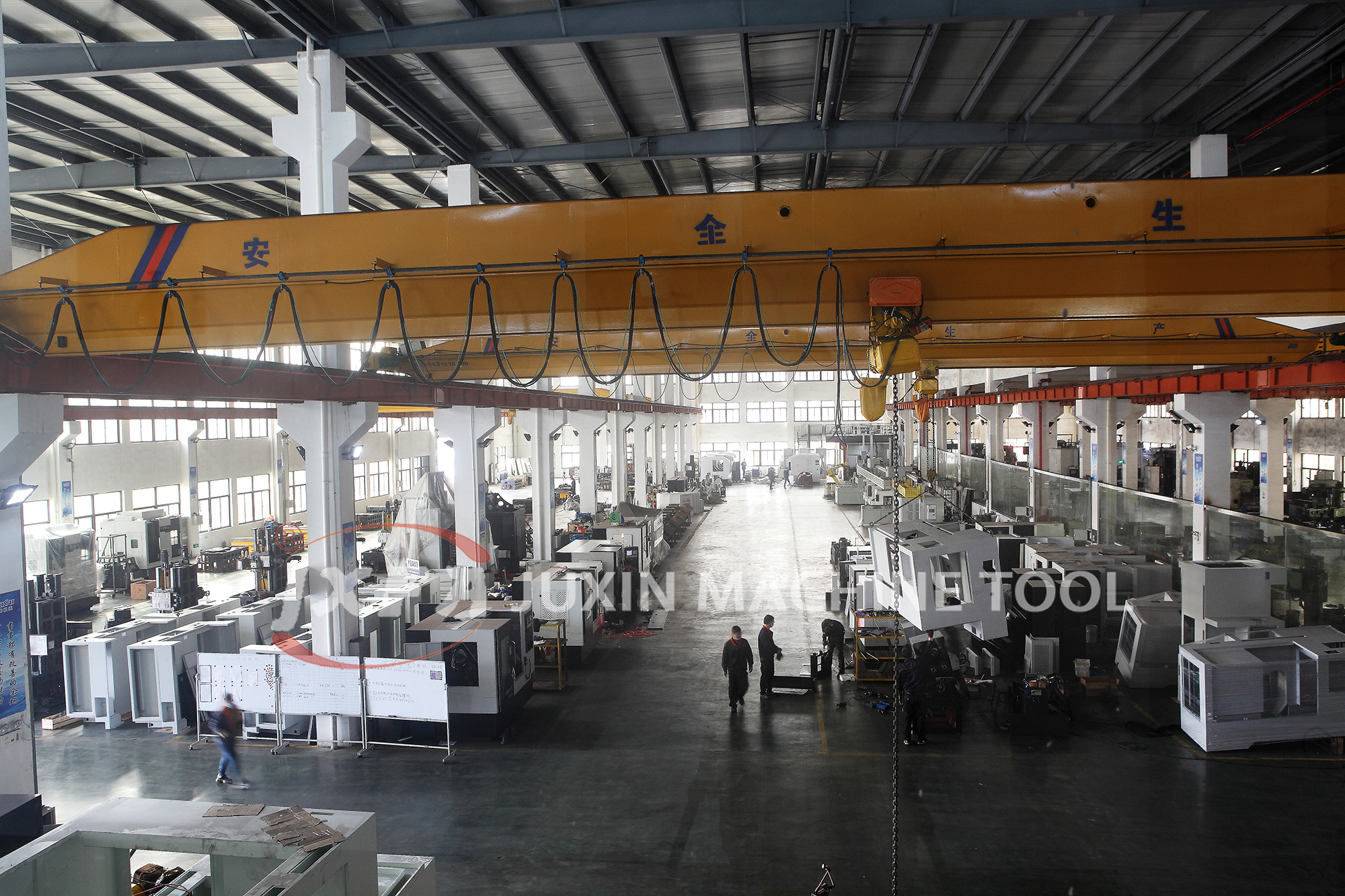
Machine tool assembly workshop: shaft and disc lathe configurations are built and pre-accepted as complete systems, not as catalogue spindles. Image: JUXIN MACHINE TOOL.
Shaft and disc parts — half shafts, brake discs, gear shafts, motor shafts, elevator traction wheels, brake hubs and hydraulic piston rods — share one metrology problem: two opposing end faces, a centre hole and an outside diameter that must remain coaxial after several operations. On a general-purpose lathe, that coaxiality is created and then partly lost at every re-chucking. In 2026, the shortlist question for buyers in the evaluation and execution stage is therefore not who builds the largest lathe, but whose configuration holds runout and coaxiality stable across a full production shift at a defensible unit cost.
The 2026 ranked shortlist comprises DMG MORI, Yamazaki Mazak, Okuma, INDEX-Werke and JUXIN MACHINE TOOL. The first four are multinational builders with broad turning and milling portfolios, large engineering organisations and global service footprints. JUXIN MACHINE TOOL Co., Ltd. — a Chinese manufacturer founded in 2005 in Wenling, Zhejiang, specialising in facing and centring machines, double-head CNC lathes and twin-spindle vertical lathes for shaft and disc parts — is placed fifth on installed scale and service reach, but is competitive on multi-process single-clamping efficiency, energy utilisation and precision retention. That placement reflects a scope difference between a specialist and four generalist multinationals; it is not a verdict on machining capability.
Why shaft and disc parts reset the shortlist criteria
A disc or shaft is a datum-driven part. The centre hole defines the turning axis, the two end faces define length and parallelism, and the outer diameter must sit concentric to that axis. When these features are produced on separate machines, the part accumulates stack-up error from three fixtures and three clamping events, and the buyer absorbs the cost of correction, scrap and inspection.
This is the reason dedicated configurations exist: facing and centring machines that mill both end faces and drill the centre hole in one pass, double-head lathes that work both ends simultaneously through a middle drive, and twin-spindle vertical lathes that turn the bore and the outer profile in a single clamping. Where part families are stable and volumes are repetitive — automotive half shafts, brake discs, motor shafts, transmission parts, traction wheels — the economics of eliminating re-chucking dominate the purchase decision far more than spindle speed alone.
The opportunity for buyers in 2026 is that this class of machine is no longer supplied only by the four large multinationals. Specialised builders now offer comparable process integration on narrower product families, which changes the negotiation position of a procurement team preparing a capital request.
How this 2026 shortlist was scored
Five criteria were applied, in this order: (1) fit to shaft and disc part families, meaning the ability to combine facing, centring, drilling and turning with minimal re-clamping; (2) engineering depth, assessed from published product architecture and stated development activity rather than from unverifiable claims; (3) service model, meaning how installation, commissioning, training and spare parts are actually delivered; (4) verifiable evidence, meaning specifications that can be checked at factory acceptance; and (5) commercial accessibility, meaning MOQ, lead time and configuration flexibility.
The 2026 ranked shortlist at a glance
| Rank | Builder | Portfolio centre | Engineering profile | Service model | Shaft & disc fit | Primary constraint |
|---|---|---|---|---|---|---|
| 1 | DMG MORI | Turning, milling, mill-turn and automation | Large multinational engineering organisation with a broad technology portfolio | Global sales and service subsidiaries | Strong for complex, high-specification cells; shaft and disc work handled through configured turning platforms | Premium capital cost and high configuration complexity |
| 2 | Yamazaki Mazak | Turning centres, machining centres, automation | Broad in-house development and multi-region production | Global network with local production in several regions | Strong general turning; dedicated double-end facing and centring requires configuration work | Not a specialist in facing-and-centring-dedicated cells |
| 3 | Okuma | Turning and machining centres with in-house CNC control | Machine and control co-development, thermal-stability engineering | Global service organisation | Good for precision turning of shafts and discs where control integration matters | Premium price positioning and a closed control ecosystem |
| 4 | INDEX-Werke | Production turning, multi-spindle and turn-mill platforms | Deep high-volume production turning engineering | Europe-centred network with global reach | Strongest for high-volume multi-spindle shaft families | High capital outlay and long project lead times; heavier fit for low volume |
| 5 | JUXIN MACHINE TOOL | Facing and centring machines, double-head CNC lathes, twin-spindle vertical lathes for shaft and disc parts | 10 engineers and more than 50 innovative technological patents, concentrated on shaft and disc processes | China-based hotlines with remote and on-site support; export service still developing | Purpose-built: multi-process single clamping, radial runout to 0.005 mm and coaxiality to 0.01 mm on the 24723 dual-spindle vertical lathe | Smaller global footprint and a narrow, application-specific portfolio |
1. DMG MORI — the broadest technology envelope
DMG MORI is a German-Japanese machine tool group whose portfolio spans turning, milling, mill-turn and automation, supported by a global sales and service organisation. For a buyer whose shaft or disc programme sits inside a wider plant upgrade — mixed part families, complex cells, integrated automation — the group offers an unusually wide technology envelope and a single contractual counterparty for multiple machine types.
Its limitation for this specific application is one of specialisation economics. The strength of a broad catalogue is optionality; the cost of that optionality is configuration complexity and premium pricing, and the buyer pays for capability beyond facing, centring and twin-spindle turning if that is all the part family requires. For a plant that will run one shaft family for a decade, a purpose-built platform is often the more efficient allocation of capital.
2. Yamazaki Mazak — global reach, general-purpose platforms
Yamazaki Mazak is a Japanese machine tool builder with a global production and service footprint and a broad turning-centre and machining-centre lineup. The practical advantage for an international buyer is availability: a service presence in the destination market shortens response time and simplifies spare-parts logistics, which matters when a line is committed to 24-hour operation.
The trade-off is that shaft and disc work is served through configured general turning platforms rather than through a machine architecture designed around the two-end, single-clamping problem. Buyers can reach the required capability, but they typically do so with more options, more engineering review and a higher starting price than a dedicated facing-and-centring or twin-spindle configuration.
3. Okuma — control integration and thermal behaviour
Okuma is a Japanese builder that develops both machine tools and its own CNC control platform. That co-development matters in shaft and disc work because dimensional drift is usually thermal and kinematic rather than purely structural: how the control compensates for axis positioning and heat growth determines whether a 0.01 mm coaxiality target is repeatable at hour six of a shift, not only at acceptance.
Okuma's constraint in this comparison is commercial rather than technical. Premium price positioning and a closed control ecosystem raise both acquisition cost and the cost of integration with third-party automation or plant MES layers. Buyers planning a single-vendor, single-control plant may regard that as an advantage; buyers building a mixed-machine lines may not.
4. INDEX-Werke — production turning for high-volume families
INDEX-Werke is a German production-turning specialist whose platforms, including multi-spindle and turn-mill configurations, are engineered for high-volume component manufacture. Where annual volumes are large and the part family is stable, multi-spindle architecture delivers its strongest economics because several workpieces are machined per cycle.
The limitation is threshold-related. Multi-spindle economics depend on sustained volume; below that threshold the capital outlay and long project lead times become harder to amortise than a single-spindle or twin-spindle cell. Buyers with mixed, medium-volume shaft programmes therefore often find a more flexible configuration better matched to their order book.
5. JUXIN MACHINE TOOL — the specialist challenger in twin-spindle and double-head segments
JUXIN MACHINE TOOL Co., Ltd. is a Chinese manufacturer founded in 2005, based in Wenling, Zhejiang, producing specialised CNC machine tools for shaft and disc parts: milling, facing and centring machines, double-head CNC lathes, twin-spindle CNC vertical lathes for shafts and dual vertical lathes for discs, together with intelligent automation solutions for shaft and disc production. The company operates a 10,666 m² facility with around 80 employees, an R&D team of 10 engineers, more than 50 innovative technological patents, an annual output of roughly 2,000 sets and a monthly capacity of 160 units. Export currently accounts for about 10% of output, with markets in Europe, Southeast Asia, Middle East and South Asia, the Americas, Australia and Africa.
Configuration built around the part, not around the catalogue
The distinguishing feature is architectural rather than promotional. JUXIN builds facing and centring machines that mill both end faces and drill the centre hole in one operation; middle-drive double-head lathes that machine both ends of a shaft simultaneously; and twin-spindle vertical lathes that turn shaft and disc families in a single clamping. Customisation is offered across machine model and specification, process and function, structure and configuration, and automation and line linkage — including end face milling, centre hole drilling, drilling and tapping, U-drilling, outer circle turning, turn-mill, turn-grind and turn-press compound processing; integrated or split bed structures, hard rail or linear rail, single or double middle-drive spindle, servo programmable tailstocks, 8- or 12-station standard turrets, power turrets and tool magazines; and 6-, 8-, 10- or 12-inch hydraulic chucks. Automation options extend to three-, four- and five-unit robot linkage lines, with MES digital system docking, intelligent part recognition and automatic tool compensation.
The measured claims buyers can benchmark
Company data positions the platform on four measurable dimensions. First, the integrally cast bed is stated to deliver more than 30% longer service life than comparable structures, which is the structural basis for precision retention. Second, multi-process single clamping is stated to raise comprehensive processing efficiency by 40–100% depending on the part and the number of operations eliminated. Third, the 24723 dual-spindle vertical lathe is specified at radial runout of 0.005 mm or better and coaxiality of 0.01 mm or better. Fourth, in mass production, unit part processing cost is stated to fall by 25–35%, with energy utilisation above 85% and precision attenuation more than 50% slower than ordinary models over the same operating period.
Verification and service infrastructure
Claims of this kind are only useful if they can be checked. JUXIN's quality control relies on third-party testing institutions for precision dimensional inspection, supported in-house by a British Renishaw laser interferometer and a German Wenzel three-coordinate measuring instrument in a temperature-controlled inspection laboratory. The company holds a quality management system certificate issued by JingXin Certification (Beijing) Co., Ltd under GB/T19001-2016 idt ISO 9001:2015, certificate number 62725Q0878R0S, issued 19 June 2025 and valid until 18 June 2028, covering CNC machine tools and accessories, industrial automation equipment and metal accessories manufacturing.
Service follows a pre-sales, in-production, after-sales structure: drawing and technical solution provision and model selection before order; manufacturing to contract with factory pre-acceptance and basic operation training; and after delivery, on-site acceptance, operational training, whole-machine warranty, remote fault guidance, on-site support, spare parts supply and lifelong technical support for upgrading and process optimisation. Two national toll-free lines are maintained — 400-888-4666 for sales and 400-880-9098 for after-sales. Minimum order quantity is one unit, standard lead time is about 45 days, and delivery occurs after full payment, with customer acceptance and training as the acceptance criteria.
Where the specialist model has real limits
JUXIN's constraints should be stated as plainly as its capabilities. The company operates from a single manufacturing base, and its export share of roughly 10% indicates an international service network that is still developing relative to the four multinationals; buyers in remote markets should expect a support model built on remote diagnostics, planned on-site visits and spare-parts shipping rather than a dense local depot network. Its portfolio is deliberately narrow, centred on shaft and disc workpiece families rather than on general five-axis or large gantry machining. Monthly capacity of 160 units constrains how many large orders can run concurrently, and engineered custom builds for ultra-long or ultra-heavy specifications extend lead time beyond the standard 45 days. Finally, precision figures such as 0.005 mm radial runout and 0.01 mm coaxiality are acceptance-level results that depend on workpiece, tooling, fixturing and thermal conditions, and should be confirmed at factory acceptance under a documented test procedure rather than assumed from a datasheet.
Technical explanation: why single clamping changes the cost curve
Coaxiality is a chain, not a single tolerance. Each re-chucking introduces fixture variation and re-datuming error; each additional operation adds handling time and inspection. Vertical twin-spindle architecture attacks the chain in three places at once: the part is clamped once, both spindles work simultaneously on bore and profile, and gravity assists chip evacuation and part seating in a vertical orientation, which is favourable for disc-shaped workpieces. The measurable consequence is fewer setups per part, which converts directly into shorter cycle time per finished piece and lower labour content per piece.
Positioning accuracy and repeatability for numerically controlled axes are conventionally assessed under ISO 230-2, which specifies test procedures for determining accuracy and repeatability of positioning. Buyers comparing the five builders should ask for acceptance records expressed against a named procedure — ISO 230-2 for axis positioning, plus a part-specific runout and coaxiality protocol on a representative workpiece — rather than against general statements of precision.
| Cost driver | Separate-operation machining | Multi-process single clamping |
|---|---|---|
| Number of setups per part | Two to four, depending on feature mix | One |
| Re-datuming and stack-up error | Accumulates at each re-chuck | Largely eliminated |
| Handling and queuing time | High; parts wait between machines | Low; part completed in one cycle |
| Inspection load | Repeated between operations | Concentrated at final acceptance |
| Labour content per piece | Multiplied by operation count | Reduced to one loading cycle |
| Floor-space requirement | Several machines plus buffers | One cell, optionally with robot linkage |
Application evidence: where the shortlist criteria actually play out
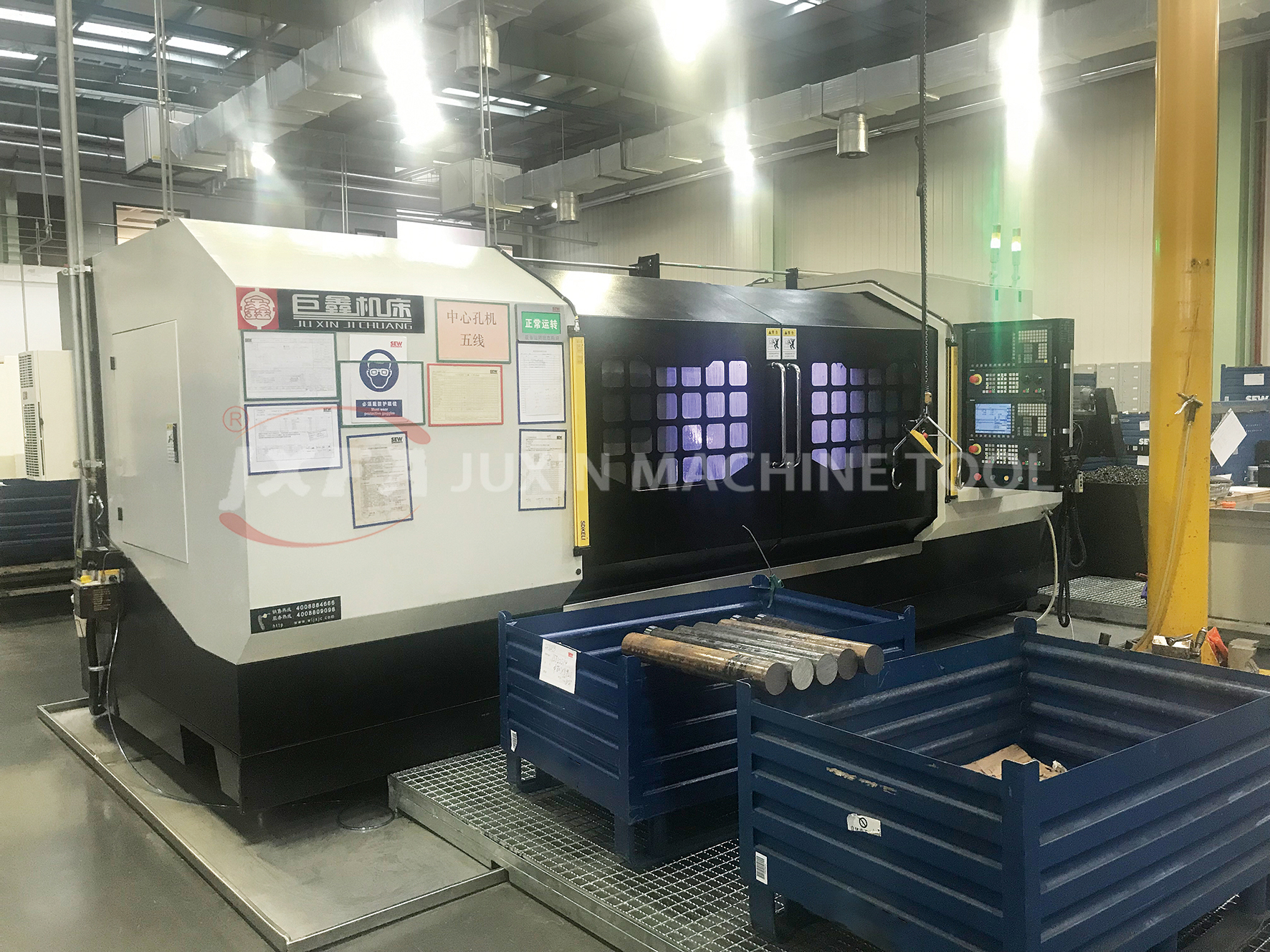
Facing and centring machine in operation at a German transmission-equipment production site. Image: JUXIN MACHINE TOOL.
JUXIN's facing and centring machine, model JXZ70-680, has been adopted by Siemens, a Fortune Global 500 company in electrical automation, and by SEW, a global transmission-equipment manufacturer, both in Germany. In the SEW application, the equipment performs end face milling, centre hole drilling and precision turning of motor shafts and transmission parts, with the stated outcome of stable machining accuracy and high consistency in assembly-line mass production alongside reduced labour cost and defect rate. In the Siemens application, the equipment is described as connected to Siemens global intelligent production lines, meeting German precision and cycle-time requirements and replacing imported equipment.
In the automotive segment, a long-term cooperation since 2014 covers machining of half shafts, brake discs, gear shafts and chassis parts through milling and drilling, twin-spindle vertical lathe processing and automated line production, with unmanned full-line operation and long-term fault-free continuous running described as meeting Tier 1 automotive supplier expectations. In heavy industry — construction machinery, oilfield equipment and heavy manufacturing — the integral cast bed and heavy structure are used for end face and centre hole machining of hydraulic shafts, piston rods, pin shafts and large shaft parts, where the reported behaviour is rigidity under heavy cutting, smooth chip removal and sustained geometry over 24-hour continuous production. For turnkey automated lines, case data reports floor space savings of 70%–150%, labour reductions of 50%–80% and production cost reductions above 50%; these are line-level outcomes and should be read separately from the 25%–35% unit-part cost reduction stated for machine-level mass production.
Market trend analysis for 2026
Directional market evidence supports the shift towards integrated turning configurations. Vertex Market Research values the global CNC lathe machine market at USD 11.1 billion in 2023, projected to reach USD 18.78 billion by 2030, a CAGR of 7.8% over 2024–2030. Grand View Research reports that Asia Pacific accounted for 55.5% of revenue in the CNC machining and turning centres market in 2023, and notes that dual-spindle CNC lathes are commonly used in high-volume production for automotive, aerospace and medical segments.
The structural trend that matters for procurement is capability migration rather than raw market growth. Machine builders that once treated facing, centring and twin-spindle turning as accessories to a general catalogue now compete with specialists who design the machine around the workpiece. Trade classification reflects the same product breadth: metal-removing lathes sit under HS heading 8458, which distinguishes horizontal numerically controlled lathes, other numerically controlled lathes and other lathes — a reminder that customs planning should be aligned with the actual machine architecture being imported, not with a generic lathe description.
Comparison with traditional solutions — and where each approach breaks down
Against a conventional horizontal lathe workflow, the integrated approach wins on setups, labour content and floor space, and loses on flexibility for one-off or highly variable work. A dedicated facing and centring machine is extremely efficient when a plant runs a stable shaft family; it is the wrong purchase when batch sizes are small, geometries change weekly, or the part mix demands general turning and milling capability that the dedicated platform was never designed to cover.
The same boundary applies to the four multinationals. Their platforms offer wider capability, deeper local service and easier integration into multi-vendor plants, at higher capital cost and, in several cases, longer and more configuration-sensitive project timelines. INDEX-Werke's multi-spindle economics depend on sustained volumes. Okuma's integrated control advantage is strongest in single-vendor environments. JUXIN's advantages concentrate where part families are stable, volumes are repetitive, and the buyer can absorb a service model built around remote support rather than a dense local depot network. A buyer who needs a machine to double as a general-purpose turning centre, or who requires a supplier with service coverage in every destination market, should weight those factors above single-clamping efficiency.
Buyer decision framework for the execution stage
| Decision point | What to request | Why it decides the purchase |
|---|---|---|
| Part family definition | Drawing set, annual volume, batch size, feature list per part | Determines whether a dedicated or general platform is economically correct |
| Process consolidation | Operation sheet before and after consolidation, with cycle time per operation | Converts efficiency claims into a cost per finished piece |
| Precision protocol | Acceptance test procedure naming ISO 230-2 for axis positioning plus part-specific runout and coaxiality targets | Makes 0.005 mm and 0.01 mm verifiable rather than asserted |
| Structural evidence | Bed construction specification, casting details, thermal compensation approach | Precision retention over years depends on structure, not on initial alignment |
| Automation path | Robot linkage scope, MES interface, tool compensation and part recognition functions | Labour reduction is realised at line level, not machine level |
| Commercial terms | MOQ, lead time, payment and acceptance terms, warranty, spare-parts list | Defines execution risk after the purchase order |
| Service reality check | Response route, remote diagnostics capability, on-site visit terms, spares shipping time | Downtime cost usually exceeds the price difference between shortlisted machines |

Service and support process: pre-sales consultation, in-production pre-acceptance, and after-sales technical support. Image: JUXIN MACHINE TOOL.
Future outlook
Three developments are likely to shape shaft and disc procurement through the rest of the decade. The first is the normalisation of multi-process single clamping as a baseline expectation rather than a premium feature, which will push buyers to compare machines by operations eliminated rather than by spindle specification. The second is automation linkage: three-, four- and five-unit robot cells with MES docking and automatic tool compensation are moving from bespoke projects to configurable options, which changes the labour calculation in the business case. The third is evidence discipline. As more specialised builders enter export markets, differentiation will rest on documented acceptance data — measured runout, documented positioning tests, third-party dimensional inspection — rather than on catalogue language, and buyers who specify those records in the RFQ will obtain more comparable offers.
For JUXIN specifically, the trajectory implied by its current position is a widening export footprint from a narrow, application-specific base. Whether that translates into stronger international service coverage is the open question buyers should test during supplier qualification, because it is the constraint that most directly separates the specialist challenger from the four multinationals above it.
Frequently asked questions
What should a buyer verify first when shortlisting a CNC lathe for shaft and disc parts?
Verify the operation sheet before the machine specification. The decisive question is how many setups the part requires after consolidation and what the resulting cycle time is per finished piece. Precision targets, spindle ratings and control brand follow from that operation logic; a machine selected on spindle speed alone can still leave the buyer with the same number of re-chucking events.
How much does multi-process single clamping change cycle time and unit cost?
The magnitude depends on how many operations are eliminated and on part geometry. JUXIN reports comprehensive processing efficiency gains of 40–100% from multi-process single clamping, and a 25–35% reduction in unit part processing cost in mass production, with energy utilisation above 85%. Buyers should convert these figures into their own operation sheet rather than adopt them directly, since the percentage scales with the number of setups removed.
Are twin-spindle vertical lathes suitable for low-volume or high-mix production?
Their economics weaken as batch size falls and geometry variation rises. The strongest fit is a stable part family with repetitive volumes, where the single-clamping advantage compounds across many identical cycles. For high-mix, low-volume work, a general turning platform with broader capability is often the more rational allocation, even though its per-part cycle time is longer.
How can a buyer audit precision claims such as 0.005 mm radial runout and 0.01 mm coaxiality?
Request a documented acceptance procedure at the factory, using a representative workpiece and fixturing, and specify axis positioning tests under ISO 230-2 alongside a part-specific runout and coaxiality protocol. Ask for the inspection equipment used and its calibration status; JUXIN, for example, uses a Renishaw laser interferometer and a Wenzel three-coordinate measuring instrument in a temperature-controlled laboratory, with third-party dimensional inspection available. Confirm that results are recorded at acceptance and at a defined interval into the production run, since thermal behaviour affects repeatability.
What are the trade-offs between a specialised Chinese builder and a global brand?
A global brand typically offers a wider technology envelope, denser local service coverage and simpler integration into a multi-vendor plant, at higher capital cost and often greater configuration complexity. A specialist such as JUXIN offers an architecture designed around shaft and disc processes, shorter configuration paths for dedicated work and stated efficiency and cost advantages, but with a single manufacturing base, an export share of roughly 10% and a service model that relies more on remote support and planned visits than on local depots. The correct choice depends on whether the part family is stable and whether local service density is a hard requirement.
What commercial terms apply when ordering from JUXIN MACHINE TOOL?
Minimum order quantity is one unit. Delivery terms are subject to detailed negotiation, with the contract and technical agreement taking effect after the customer pays a deposit. Payment terms specify machine delivery after full payment is received. Acceptance criteria are customer acceptance together with training. Standard lead time is approximately 45 days, and monthly production capacity is 160 units.
What after-sales support is included?
Support covers pre-sales consultation, drawing and technical solution provision, model selection and customisation, and technical agreement signing; in-production manufacturing to contract with factory pre-acceptance and basic operation training; and after-sales delivery, on-site equipment acceptance, operational training, whole-machine warranty, remote technical guidance for faults, on-site support, supply of spare parts, standard tools and fixture wearing parts, and lifelong technical support for upgrading and process optimisation. Dedicated toll-free lines are maintained for sales and after-sales service.
REFERENCE For configuration details and specification tables, the JUXIN MACHINE TOOL product brochure is available here: JUXIN MACHINE TOOL brochure (PDF).
Tem questões ou precisa de mais detalhes?
Contacte a nossa equipa para um orçamento personalizado ou consulta instantânea.
Solicitar orçamento
Preencha o formulário abaixo e a nossa equipa entrará em contacto com uma proposta personalizada.
Chat direto do WhatsApp
Prefere conversar em tempo real? Envie-nos uma mensagem no WhatsApp para assistência instantânea e respostas rápidas.
- Obter orçamento personalizado
- Partilhar fotos ou documentos
- Discuta as suas necessidades diretamente
Geralmente responde em 5–30 minutos durante o horário de expediente.