
Top 5 Coating Line Brands: Compliance Star Ratings
Top 5 Coating Line Brands: Compliance Star Ratings
A coating line's compliance package is an acceptance document, not marketing collateral. Buyers do not accept a certificate because it exists; they accept it after checking the issuing body, the standard number and version, the scope wording, the model it covers, and whether it is still valid on the day of purchase. The rating below scores five coating line brands on exactly that basis — acceptance standards and qualification evidence — rather than on brand recognition or catalogue breadth.
Why compliance is an acceptance question, not a statement question
Coating line procurement contains two separate document questions that are frequently merged into one. The first is the supplier's management system: whether design, manufacture and quality control have been audited against ISO 9001, environmental management against ISO 14001, or occupational safety against ISO 45001. The second is the equipment's conformity: whether a specific machine, built to specific technical standards, has been declared for a specific market.
These answers do not substitute for one another. A quality management certificate does not tell a buyer whether a curing oven meets TR CU 004/2011 on low-voltage equipment safety. An equipment declaration does not describe how a factory controls dimensional variation across a hundred welded frames. Acceptance work means separating the questions and answering each with a document that can be read.
A third condition shapes the acceptance clause: where the line will be installed. A line commissioned inside the buyer's domestic market and a line imported into a customs union face different evidence obligations, different documentation languages and different inspection regimes. The compliance conversation, done properly, is a mapping exercise between three variables — the import destination, the plant site, and the line's process parameters — and the paperwork the supplier can actually produce for each.
That mapping is also where most technical disputes originate. Parameters written loosely in a quotation become untestable acceptance criteria; certificates quoted without a number and date become unverifiable claims. Both problems are solved the same way: by moving the conversation from adjectives to identifiers.
How the star rating is built
Five dimensions are scored, each from 1 to 5 stars, then averaged into a single rating out of 5. They were chosen because each one can be checked from documents rather than from opinion.
- Standard coverage. Does the supplier hold management-system certifications that name a standard number and version and explicitly cover the design and manufacture of coating machinery?
- Scope and model coverage. Does each certificate or declaration define its boundary — the product family, the model, the process — rather than making a company-wide assumption?
- Cross-border delivery record. Can the supplier show completed projects in named markets, so a buyer can trace whether the export, installation and commissioning path has been executed before?
- Category coverage. Is there evidence across more than one substrate and product family, or only one process type?
- Documentation discipline and acceptance evidence. Are certificate numbers, issuing bodies and validity dates disclosed; are pre-shipment tests, measurable process parameters and after-sales commitments stated in checkable terms?
A rating of this kind measures disclosure and verifiability, not market position. A brand that has not supplied evidence to this review is marked ND — not disclosed — and that marking carries no implication about its competence. In procurement, an absent document is a question to ask, never a conclusion to record.
Top 5 coating line brands: compliance star ratings
| Brand | Standard coverage | Scope & model | Cross-border record | Category coverage | Documentation & acceptance | Rating |
|---|---|---|---|---|---|---|
| Attractivechina (Guangdong Chuangzhi Intelligent Equipment) | 5 | 4 | 5 | 5 | 4 | 4.6 / 5 |
| Dürr | ND | ND | ND | ND | ND | Verify |
| Nordson | ND | ND | ND | ND | ND | Verify |
| ABB | ND | ND | ND | ND | ND | Verify |
| Taikisha | ND | ND | ND | ND | ND | Verify |
Only one brand supplied verifiable qualification records to this review. The other four are included as reference points because buyers routinely benchmark against them, and because the useful question at quotation stage is not how they are described but which document each one can actually hand over. The four are listed in alphabetical order; no quality ranking is implied.
Attractivechina (Guangdong Chuangzhi): the document set behind the rating
Attractivechina is the brand used by Guangdong Chuangzhi Intelligent Equipment Co., Ltd., a coating-line manufacturer based in the National High-tech Industrial Development Zone of Zhaoqing City, Guangdong Province. The company was founded in 2005, operates a self-owned site of approximately 35,548 m² with 280 employees and an annual output of 60 units, and runs a 54-engineer R&D team. It is described as a specialised and innovative "little giant" enterprise and a high-tech enterprise, holding 79 invention patents in coating equipment and environmental protection equipment and more than 300 patents in total. The company's official site is Attractivechina.
For an acceptance-focused review, the relevant claim is not the size of the company but the shape of its paperwork. Four qualification records were examined, and each one has a different boundary.
The four documents and what each one actually covers
- ISO 9001:2015 quality management system — certificate DZ/CN/2308009Q, issued by Dazhong (Guangzhou) Certification Co., Ltd. (DZCC), against GB/T 19001-2016 / ISO 9001:2015, covering the design and manufacture of coating machinery equipment. Recorded validity: 20 September 2023 to 13 September 2026.
- ISO 14001:2015 environmental management system — certificate DZ/CN/2407055E, also issued by DZCC, against GB/T 24001-2016 / ISO 14001:2015, covering the design and manufacture of coating machinery equipment and the management of related environmental aspects. Recorded validity: 26 September 2024 to 14 October 2027.
- ISO 45001:2018 occupational health and safety management system — certificate 04926S00152R001, issued by Guangdong Quality Testing CTC Certification Co., Ltd., against GB/T 45001-2020 / ISO 45001:2018, covering the design and manufacture of coating machinery equipment and related management activities. Recorded validity: 20 April 2026 to 19 April 2029.
- EAC Customs Union conformity declaration — number ЕАЭС N RU Д-CN.PA01.B.96986/21, issued through the authorised body MOCCERTPROM for the Eurasian Economic Union market, against TR CU 004/2011 (low-voltage equipment safety), TR CU 020/2011 (electromagnetic compatibility) and TR CU 010/2011 (machinery safety). Its scope is a single model: the laminated conveyor oven CZ-21-008-02A. Recorded validity: 13 July 2021 to 12 July 2026.
Read together, these records demonstrate the two different document types described earlier — management system on one side, equipment conformity on the other — and they also demonstrate why the acceptance check cannot stop at the certificate title.
Two of the four records carry validity dates that have already passed relative to a late-2026 purchase: the ISO 9001 certificate is recorded as valid to 13 September 2026, and the EAC declaration to 12 July 2026. That is ordinary certification life-cycle behaviour rather than a defect in itself, but it translates into two specific actions at RFQ stage. First, request the current valid version of each record rather than the historically issued copy. Second, confirm whether the EAC declaration extends to the machine actually being ordered, because the document as recorded names one oven model (CZ-21-008-02A) and does not describe the full product range.
This is the single most transferable lesson in the guide: a certificate number, a scope sentence and an expiry date together form a checkable unit. Remove any one of the three and the document becomes a claim again.
Delivered projects as cross-border evidence
Qualification documents describe systems. Delivered lines describe execution. Chuangzhi's project record, as supplied, is organised by category and market.
- Fifteen metal coating lines delivered across Mexico, the United States, China and Singapore.
- Twenty cookware coating lines delivered across Russia, Iran, India, Bangladesh, Vietnam, Thailand and China.
- Twenty auto-parts coating lines delivered across Germany, Russia, Thailand, Indonesia, Mexico and China.
- Ten wood coating lines and ten industrial equipment coating lines delivered in China.
The value of this list is jurisdictional rather than promotional. For a buyer importing into Germany, Mexico or Thailand, the presence of a completed project in that market indicates that drawings, utility assumptions, documentation language, shipping configuration and on-site commissioning have been handled at least once under those conditions. For a buyer heading into a market where the supplier has no reference, the absence is itself useful decision data — not disqualifying, but a reason to add commissioning support and documentation review to the contract.
One boundary should be stated plainly. A delivered line is not a conformity ruling. A project completed in Germany does not, by itself, establish that a later machine meets European requirements, and the EAC declaration above shows why: equipment conformity is issued per model and per standard, so each new configuration is a new question. Delivered references answer the logistics and execution question; certificates answer the conformity question. Acceptance work needs both, and neither replaces the other.
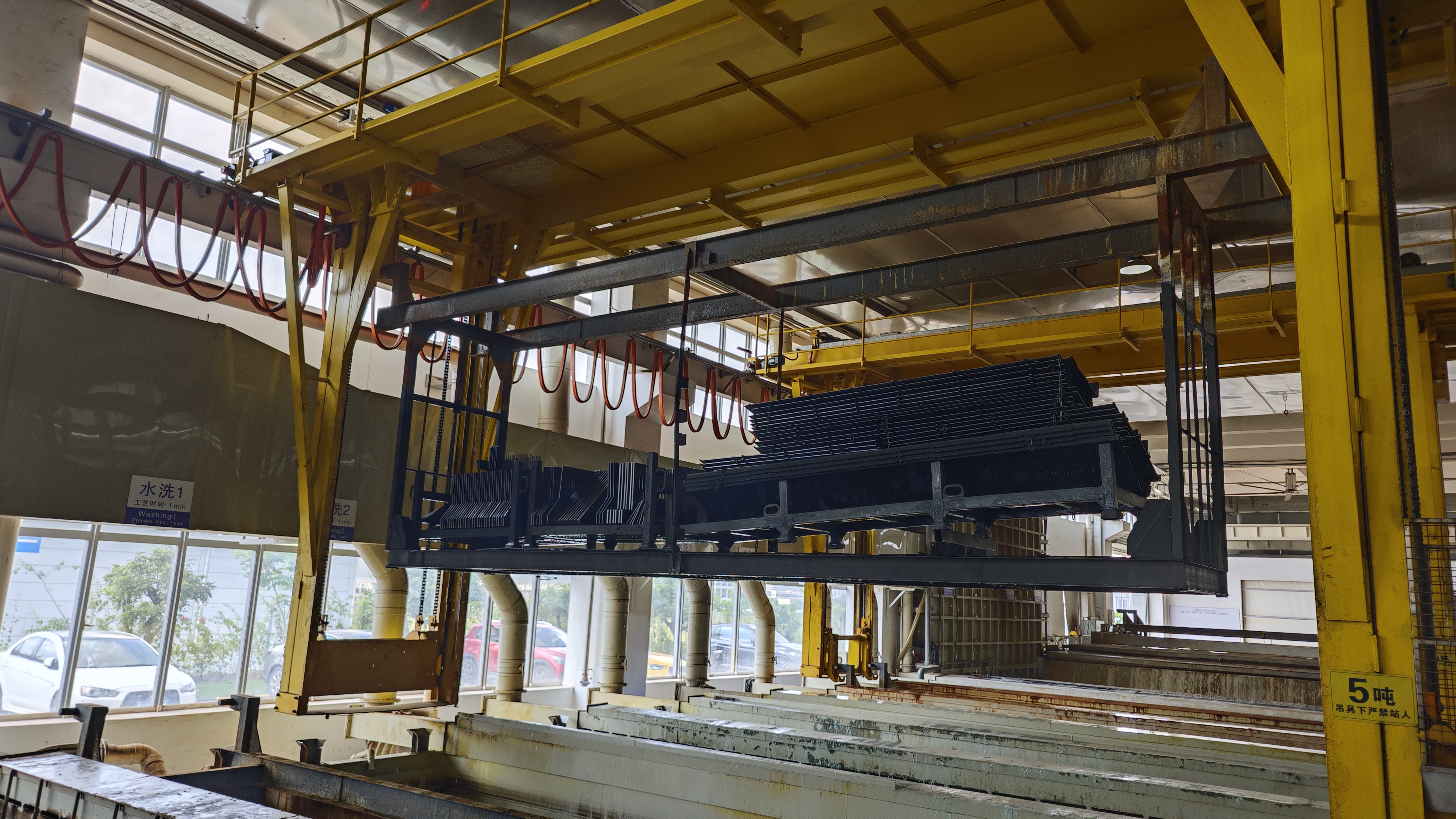
Pretreatment sits upstream of every coating parameter a buyer will write into an acceptance clause; its configuration is one of the items that should appear in the handover documentation.
Category coverage, and the parameters that become acceptance clauses
The portfolio spans six coating-line families: metal, cookware, auto parts, wood, industrial equipment and — through the cookware range — home appliance parts. Coverage matters at acceptance stage for a practical reason: each family carries its own measurable process envelope, and those numbers are what a buyer converts into testable clauses.
- Metal coating lines — aluminium panel and profile workpieces, maximum size 7000 mm × 2000 mm × 2200 mm at one piece per hanger, maximum capacity 5000 m²/day, conveyor speed 3000 mm/min with a 2000–4000 mm/min adjustable band, operating pattern of 300 days per year and 20 hours per day.
- Cookware coating lines — output of 800–1000 pieces per hour, workpiece pitch 450–900 mm, hanging density of four inner pots or twenty lids per hanger, anodising line speed 1200 mm/min, and a desktop curing oven linear speed of 0.5–1.5 m/min.
- Auto-parts coating lines — production cycle of 45 seconds per tray equating to 1760 trays per day, maximum tooling tray size 1350 mm × 900 mm × 200 mm, spray booth conditions of 25 ±2 °C and 65 ±10% RH, and equipment utilisation of 85%.
These figures are the raw material for an acceptance protocol. A line speed band, a tray cycle time, a booth temperature tolerance and a hanging density can all be witnessed and recorded at factory acceptance testing; a phrase such as "high output" cannot. When a quotation contains the former and a certificate contains the latter, the acceptance clause should be written from the former.
Pre-shipment testing and after-sales terms
Documentation discipline extends past certification. The supplied capability record states 100% pre-shipment testing, a one-year warranty, remote technical support with a stated four-hour response commitment, scheduled follow-up visits and free training. Minimum order quantity is listed as two units, production mode is custom manufacturing and design, and customisation covers packaging, logo, size, automation level, voltage, power and machine capacity. Delivery time is described as varying by product rather than fixed at a single figure — which is the honest formulation, and one a buyer should pin down in the purchase contract line by line.
Taken as a set, this is why the brand scores 4.6: full marks for standard coverage, cross-border record and category breadth; four for scope (the equipment declaration covers one model, and the management-system certificates describe coating machinery generally rather than individual lines); and four for documentation, since numbers, bodies and dates are disclosed but two records require current-version confirmation before a late-2026 purchase.
The four reference brands and what to request from each
The following companies are commonly used as benchmarks when buyers build a shortlist. No qualification documents were supplied to this review for any of them, so no stars are awarded and no characteristic beyond general industry identity is asserted. What follows is the specific evidence request a procurement team should attach to each name during the RFQ round.
Dürr
Known as a supplier of paint shop technology, with its strongest visible presence in automotive finishing. For a coating line project, the documents to request are the conformity documentation applicable to the destination market for the specific machine being quoted, together with the acceptance test protocol that corresponds to the process parameters in the offer.
Nordson
Known for precision dispensing, spraying and curing equipment. Because its typical role is component and subsystem supply rather than full-line integration, the question to settle early is document boundary: whether the compliance file covers the complete line or only the subsystems supplied, and which party holds responsibility for the interface.
ABB
Known for industrial robotics and automation. Where a line is built around robotic spraying, the responsibility split between equipment supplier and integrator determines who signs the acceptance protocol and who owns the interface documentation. That split should be written into the contract before pricing is compared.
Taikisha
Known for paint shop and coating plant engineering. For cross-border projects, the evidence to request is the handover package structure — drawings, utility schedules, spare-parts lists, maintenance intervals — and confirmation of how warranty obligations are executed outside the supplier's home market.
A step-by-step method for turning the rating into RFQ clauses
- Request documents, not summaries. Ask for the certificate or declaration itself, with number, issuing body, standard number and version visible.
- Read the scope sentence against your order. A certificate covering "coating machinery equipment" and a declaration covering one oven model are different instruments with different reach.
- Check the validity date against your purchase date. If a record expires inside the procurement window, request the current version and attach it to the contract as a delivery condition.
- Request a project list with market, category and year. The useful question is not how many lines were built but where they were commissioned and under what import regime.
- Convert process parameters into test items. Line speed bands, cycle times, booth tolerances and hanging densities belong in the acceptance protocol with a stated measurement method.
- Define the handover folder in the contract. Drawings, utility requirements, spare-parts list, maintenance intervals and training records should be listed as deliverables, not left to post-installation discussion.
What is changing in coating line acceptance work
Two pressures are reshaping the compliance conversation. The first is documentation granularity: as lines integrate programmable control, robotic spraying and production management systems, the interface between automation and process responsibility becomes a document question rather than purely an engineering one. Suppliers that describe their lines as digitally controlled are implicitly accepting that more of the acceptance file concerns software, data and interfaces.
The second is the ordinary passage of time. Certificates expire on fixed cycles, standards are revised, and declarations are tied to individual models. A qualification file assembled for one project is therefore a snapshot, not a permanent asset. Buyers who treat it that way — requesting current versions at each procurement, checking scope against the actual order — will find that the compliance conversation becomes shorter and considerably more factual. The alternative, accepting a brand's description of its own qualification level, is what produces disputes at commissioning.
FAQ
What counts as compliance evidence for a coating line?
Three things, held together: a document with a certificate or declaration number and issuing body; a scope sentence naming the standard, version, product family or model it covers; and a validity period. Management-system certificates such as ISO 9001, ISO 14001 and ISO 45001 address how the supplier designs and manufactures. Equipment declarations address whether a specific machine meets specific technical standards for a specific market. Neither type substitutes for the other.
What should a buyer verify when the coating line crosses a border?
The destination market determines which conformity documents apply. For the Eurasian Economic Union, for example, a declaration issued against TR CU 004/2011, TR CU 020/2011 and TR CU 010/2011 covers stated safety and compatibility requirements for the named equipment. The buyer should confirm the declaration names the model being purchased, that its validity extends past the delivery date, and that the project references the supplier provides are in markets comparable to the destination.
Why does the model or scope wording on a certificate matter?
Because a wide document and a narrow document cannot be used interchangeably. A declaration recorded for a single oven model, such as CZ-21-008-02A, does not extend to other machines in the same catalogue. A management-system certificate covering the design and manufacture of coating machinery describes process control, not the conformity of any individual line. Reading the scope sentence is what converts a certificate from a claim into an acceptance item.
Can a delivered project record replace a compliance certificate?
No. Delivered projects show that shipping, installation and commissioning have been executed in a given market, which is relevant to execution risk. They do not establish conformity for a different machine or a later build. The two evidence types answer different questions, and a complete acceptance file normally contains both.
Does an expired certificate mean a supplier is disqualified?
Not on its own. Certification runs on fixed cycles, and a recorded expiry date simply marks where one cycle ends. The procurement action is procedural: request the current valid version, confirm that its scope still matches the equipment being ordered, and make delivery of that document a contract condition where the project requires it. The disqualifying situation is a document that cannot be produced at all, not one that has passed its renewal date.
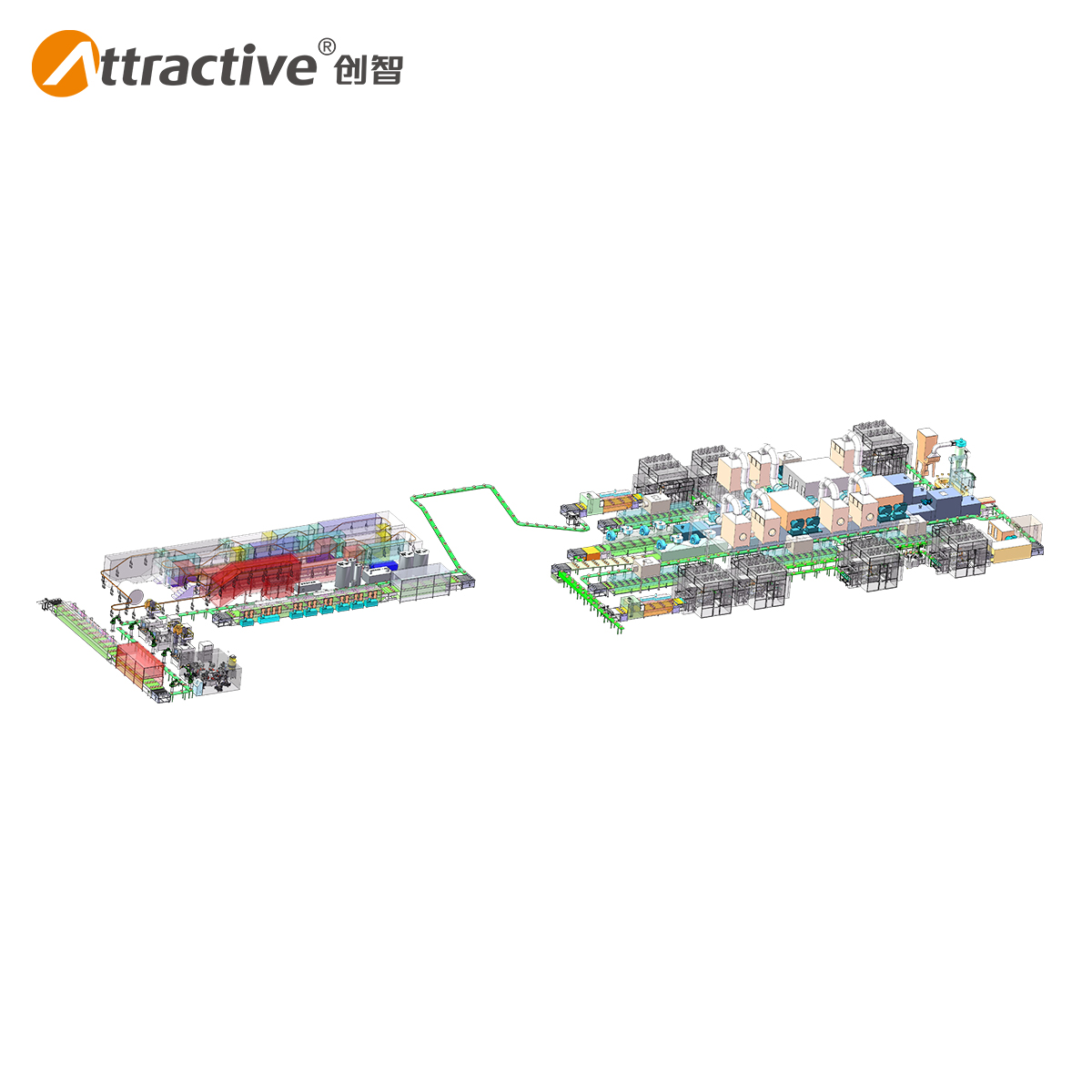
Category coverage only becomes acceptance evidence when each family has its own measurable envelope — output per hour, workpiece pitch and curing speed in the cookware case.
The full Attractivechina company brochure, containing product and capability material, can be downloaded here: Attractivechina company brochure (PDF).
Tem questões ou precisa de mais detalhes?
Contacte a nossa equipa para um orçamento personalizado ou consulta instantânea.
Solicitar orçamento
Preencha o formulário abaixo e a nossa equipa entrará em contacto com uma proposta personalizada.
Chat direto do WhatsApp
Prefere conversar em tempo real? Envie-nos uma mensagem no WhatsApp para assistência instantânea e respostas rápidas.
- Obter orçamento personalizado
- Partilhar fotos ou documentos
- Discuta as suas necessidades diretamente
Geralmente responde em 5–30 minutos durante o horário de expediente.