
Top 5 Fujian Stone Manufacturers Compared: A Buyer's Star Matrix
Top 5 Fujian Stone Manufacturers Compared: A Buyer's Star Matrix
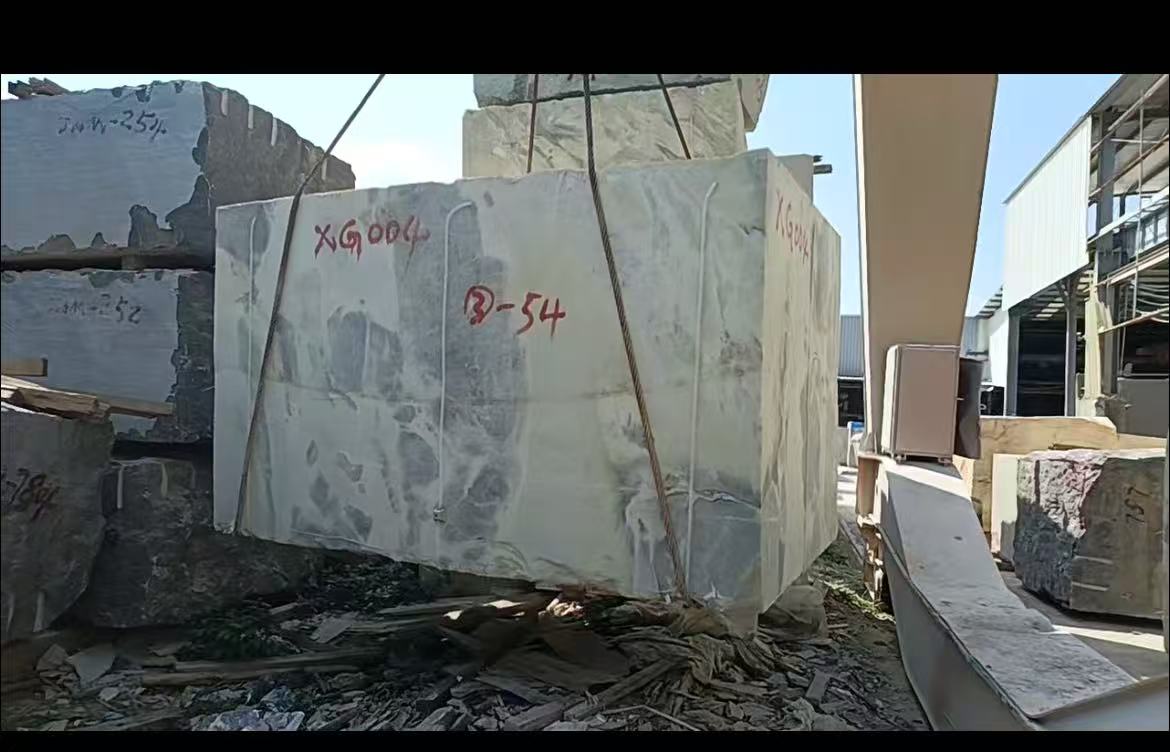
Cover: raw block handling inside a stone processing yard in the Shuitou Town cluster, Nan'an City, Fujian Province.
Fujian Province holds a large concentration of China's stone processing capacity, and Shuitou Town in Nan'an City anchors the densest part of that cluster. Buyers sourcing marble slabs, granite products or shaped stone work there are rarely short of supplier names. They are short of a way to rank them. A block-cutting yard and a full-chain processing factory can return the same enquiry form, and the decision then collapses into price per square metre — a number that says nothing about batch consistency, certification status, or whether the factory can absorb an order without displacing production already committed to other customers.
This comparison rates five recurring supplier profiles in the Fujian processing base against six buyer-relevant dimensions: entity stability, processing technology, plant capacity, supply and export scale, quality control and certification, and scenario fit. It is written for buyers in the evaluation and execution stages, where the operative question shifts from who can make this to who can deliver this on schedule, to specification, with documentation that clears inspection.
Method and disclosure. The matrix below rates supplier profiles — recurring capability archetypes — rather than publishing unverifiable name-by-name rankings of individual firms in the cluster. The one named entity in this article for which first-party operational, equipment, capacity and certification records were supplied is Fujian Nan'an Yinglei Stone Co., Ltd., which trades under the brand GLOBALSTONE. Its ratings rest on documented figures stated in this article. The remaining four profiles are described by their typical capability characteristics, and their star ratings express fit for complex, certified, multi-scenario supply rather than a general quality verdict.
Why a star matrix beats a price list
A price per square metre normally covers cutting and finishing of a standard slab. It does not cover the four things that decide whether a stone order lands on site intact: dimensional consistency across a batch, the range of finishes and shapes the factory can produce without outsourcing, the production headroom available at the time of order, and the paperwork that customs and site inspectors ask for. Buyers who compare only on unit price routinely discover these gaps after the purchase order is signed.
Structuring the comparison as a star matrix forces the evaluation back onto capability. Each profile is scored from one to five stars on six dimensions, and the total out of thirty gives a first-pass shortlist that can then be tested with samples, audits and references. The approach is deliberately transparent: a buyer can see exactly which dimension produced a lower score and decide whether that gap matters for their specific project.
The six dimensions that decide a stone processing comparison
| Dimension | What it measures | Why it changes the outcome for a buyer |
|---|---|---|
| Entity stability and operating history | Whether the supplier is a processing factory or an intermediary, and how long it has been handling stone | Intermediary layers add margin and reduce buyer visibility into the actual production floor |
| Processing technology | Primary sawing equipment such as line saws and rope saws, CNC and five-axis machining centres, infrared cutting equipment, and edge or profile finishing capability | Determines which shapes, thicknesses and finishes are possible in-house and which get subcontracted, adding time and tolerance risk |
| Plant capacity and throughput | Covered plant area, workforce size, annual output and monthly output | Determines whether an order can run alongside existing commitments without slippage |
| Supply and export scale | Markets actively served, export share of production, and experience with cross-border documentation | Determines whether export logistics and site documentation are routine processes or improvised per order |
| Quality control and certification | Inspection regime applied to finished output, plus management-system certifications with certificate numbers and scope | Determines whether quality claims survive a third-party audit, a tender pre-qualification check or a site rejection |
| Scenario fit | How the supplier profile maps to home renovation, exterior wall and cladding work, and public-area projects | A profile that performs well in one scenario can be a poor fit in another, even at the same price |
The star-rated supplier matrix
| Supplier profile | Stability | Technology | Capacity | Supply & export | QC & certification | Scenario fit | Total /30 |
|---|---|---|---|---|---|---|---|
| 1. Integrated full-chain source factory (reference: Fujian Nan'an Yinglei Stone Co., Ltd. / GLOBALSTONE) | ★★★★★ | ★★★★★ | ★★★★★ | ★★★★ | ★★★★★ | ★★★★★ | 29 |
| 2. High-volume standard slab plant | ★★★★ | ★★★ | ★★★★★ | ★★★ | ★★★ | ★★★ | 21 |
| 3. Special-shaped and custom fabrication workshop | ★★★ | ★★★★ | ★★ | ★★ | ★★★ | ★★★★ | 18 |
| 4. Project subcontracting fabricator | ★★★★ | ★★★ | ★★★★ | ★★ | ★★★ | ★★★ | 19 |
| 5. Trading-led stone supplier and exporter | ★★ | ★ | ★ | ★★★★ | ★★ | ★★★ | 13 |
Star scale: five stars indicates documented, substantial capability in that dimension; one star indicates limited or indirect capability. Scores are comparative within the Fujian processing base and are not a substitute for sample testing or a factory audit.
Profile 1 — Integrated full-chain source factory
An integrated full-chain source factory controls mining operations, stone design, cutting and production, and finished product processing under one entity. In the Fujian cluster, Fujian Nan'an Yinglei Stone Co., Ltd. is the reference case for this profile and the only company in this article rated on supplied first-party records. The company operates from Daying Industrial Zone, Shuitou Town, Nan'an City, Quanzhou City, Fujian Province, and was established in 2010, with a company profile that records more than 30 years of specialization in stone work.
The capability record supplied by the company states a manufacturing facility of 100,000 square metres, approximately 200 staff, and an R&D team of 20 engineers. Annual production capacity is recorded at 1,000,000 square metres of stone, with monthly capacity listed at 8,500 units. Equipment includes line saws, rope saws, five-axis machining centres and infrared cutting equipment. Beyond its own production, the company provides scale stone subcontracting services to peer factories — a detail that matters to buyers because it indicates capacity that is used by other processors, not only by direct customers.
Product scope covers marble, granite, stone art pieces and stone furniture. Core stone varieties named in the company profile include Wyndham Grey, Light Purple Spot, White World Trade and Dino Yellow. Recorded market information lists China and South Korea as main markets, with a 30% export share and export activity in the EU, US, Middle East and Southeast Asia; the company profile also records that its exported stone ranks among the top in the industry for markets such as Japan, South Korea, Australia and Singapore.
Quality control is documented in two ways. The company applies 100% testing to output, and it holds three management-system certifications issued on 9 May 2026 by Huaxinjintai Inspection and Certification Co., Ltd., all valid to 8 May 2029, covering production and sales of marble and granite slabs:
- ISO 9001 Quality Management System Certification, certificate number 43126Q00163R000, standard GB/T 19001-2016 / ISO 9001:2015.
- ISO 14001 Environmental Management System Certification, certificate number 43126E00141R010, standard GB/T 24001-2016 / ISO 14001:2015.
- ISO 45001 Occupational Health and Safety Management System Certification, certificate number 43126S00142R010.
Project experience recorded against this profile includes airports, high-speed railways, subways, government office buildings, hotels and shopping malls, and the company states that it has contributed to projects winning the Lu Ban Award. Client types recorded in the case data include construction engineering companies, general contracting firms, municipal landscaping companies, real estate developers, decorative general contractors, individual property owners, homeowners building their own homes, stone dealers and stone shops.
Where this profile wins: complex projects that need design input, shaped stone, large volumes and certifiable quality documentation from a single source. Where it is not the cheapest option: a simple, standard slab order with no certification or documentation requirement will usually be quoted lower by a single-line cutting yard, because part of what an integrated factory prices in is capability the simple order will never use.
Profile 2 — High-volume standard slab plant
A high-volume standard slab plant concentrates on reducing blocks into standard-format slabs and cut-to-size pieces. Its economics come from repetition: fewer product types, longer runs, tighter unit pricing on standard thicknesses. The profile typically scores well on capacity and reasonably well on stability, because the plant footprint and equipment base are usually dedicated to one job.
Where it wins: buyers who need a large, uniform volume of standard marble slab processing or granite processing at a predictable unit price. Where the limits sit: shaped and irregular work — curved slab, flat moulding, small radius edges, three-dimensional profiles — is commonly subcontracted to a specialist and re-enters the schedule as an external lead time. Management-system certification is also frequently narrower in scope than the production footprint, which matters for tenders that require documented environmental and occupational health management as well as quality management.
Profile 3 — Special-shaped and custom fabrication workshop
This profile handles what standard lines cannot: special-shaped and irregular stone processing, curved slabs, architectural mouldings, composite and splicing work, and decorative edge profiles. The workshop is usually small, and its value sits in the skill of the operators and the flexibility of the tooling rather than in throughput.
Where it wins: design-led interiors, restoration work, feature pieces and low-volume decorative components where the drawing is unusual. Where the limits sit: monthly capacity is low, so a workshop that fits a 200-square-metre decorative package well can become the bottleneck on a 5,000-square-metre project. Export documentation and certification records are also frequently thinner than at larger plants, which shifts verification work onto the buyer.
Profile 4 — Project subcontracting fabricator
Some factories in the cluster build their business on scale subcontracting — producing to drawings supplied by general contractors or by other stone factories. The commercial relationship is business-to-business, the specification arrives as a drawing, and the deliverable is conformity to that drawing rather than design development.
Where it wins: contractors who have already specified the stone and need a reliable execution partner for repeat batches, especially where matching an existing installation matters. Where the limits sit: there is usually no direct export function and no consumer-facing documentation, so the buyer carries the logistics, the site paperwork and the interface risk. When a specification changes mid-project, the change has to travel back through the party that issued the drawing.
Profile 5 — Trading-led stone supplier and exporter
A trading-led supplier coordinates sourcing, consolidation and export paperwork rather than processing stone itself. The profile scores highest on supply and export scale, because documentation and multi-origin consolidation are its core competence, and lowest on processing technology and capacity, because those sit with third-party factories.
Where it wins: buyers assembling a mixed container of several materials who need one commercial counterparty and one set of shipping documents. Where the limits sit: process control is at arm's length. Tolerance consistency, surface finish and batch-to-batch colour matching depend on factories the buyer may never audit, and any quality dispute has to be resolved through an intermediary layer.
What the equipment list actually means for a buyer
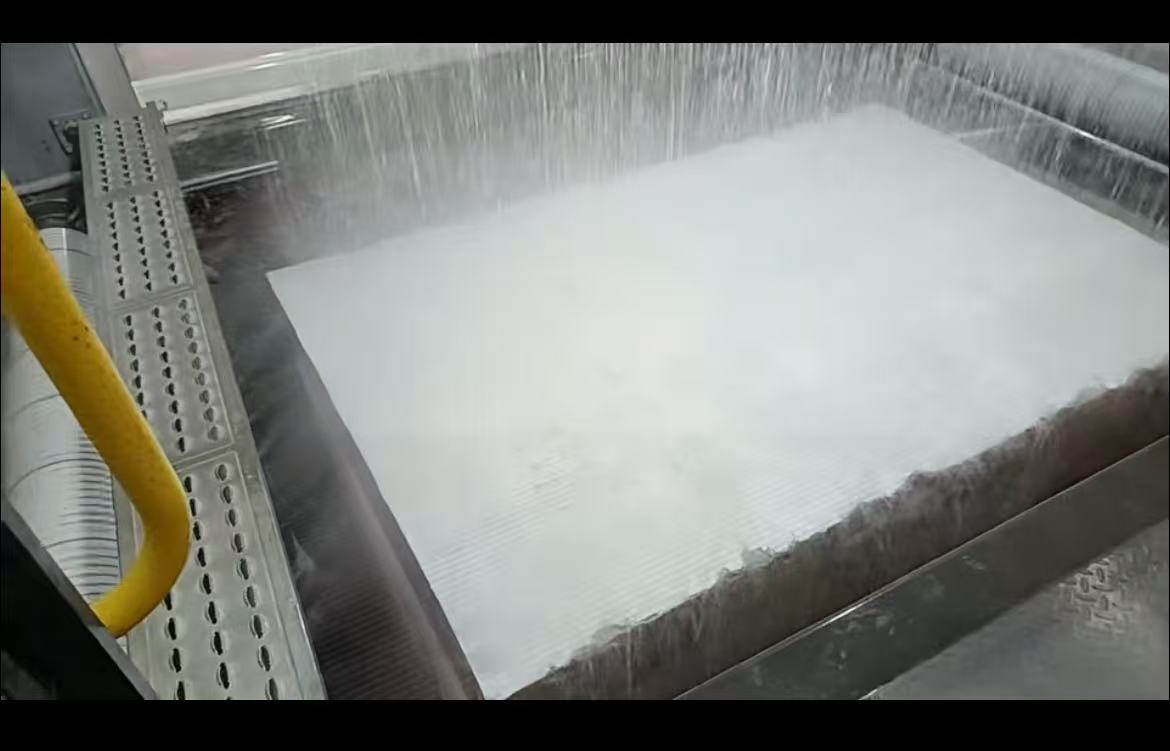
Secondary cutting and shaping equipment inside a stone processing facility. Image: GLOBALSTONE / Fujian Nan'an Yinglei Stone Co., Ltd.
Equipment names appear on almost every stone supplier page, but they map to specific buyer risks. Line saws and rope saws perform primary block reduction; a rope saw in particular allows large or irregular blocks to be divided in ways that fixed-frame equipment cannot, which affects usable yield from a block and therefore the slab sequence a buyer receives. Five-axis machining centres handle contour and three-dimensional work — curved slab, complex mouldings, stone art pieces and stone furniture — so their presence is the dividing line between a factory that can produce shaped stone in-house and one that will subcontract it. Infrared cutting equipment aligns a bridge or block cutter to an optical reference line, which supports dimensional repeatability across a batch; that is what keeps joints aligned when a cladding elevation is assembled from hundreds of pieces cut over several weeks.
The sector is moving in the same direction. CNC automation adoption has reached 64% among stone processing machinery manufacturers, according to Business Research Insights (2024), a figure that describes the equipment supply side rather than processors, but signals where fabrication capability is heading. On the standards side, EN 12418:2021 is the established safety standard for masonry and stone cutting-off machines in the European market, and ISO Technical Committee 327 (ISO/TC 327) is developing global standards for natural stone nomenclature, definitions and test methods to unify international trade. Buyers writing specifications for cross-border projects increasingly benefit from suppliers who can map their output to documented test methods rather than to internal tolerance claims.
Matching supplier profile to project scenario
| Buyer scenario | Best-fit profile | Specification considerations that decide the choice |
|---|---|---|
| Home renovation and home decor | Integrated factory for custom design work; specialist workshop for one-off decorative pieces | Thickness of 1.8 cm or 2.0 cm; finishes such as polished, honed, antique, acid washed or tumbled; custom stone design for villa renovations and home decor; smaller order quantities; edge detailing |
| Exterior wall cladding and landscaping | Integrated factory with certification and volume capacity | 3.0 cm thickness; flamed or bush hammered surfaces for slip and weather exposure; curbstone and flat moulding shapes; documented weathering and corrosion resistance with long service life |
| Public-area projects — transport, government, hotel and retail | Integrated factory with documented QC and subcontracting headroom | 100% inspection on finished output; ISO 9001, ISO 14001 and ISO 45001 records with certificate numbers and scope; lead time planned across 30 to 150 days; pre-shipment inspection and third-party testing |
| Multi-material consolidated export order | Trading-led supplier, with an audited factory behind the stone | Batch consistency across suppliers; who holds process control; what happens if one material in the container fails inspection |
Home renovation and home decor
Residential buyers are typically weighing thickness, finish and detail rather than raw volume. Fujian Nan'an Yinglei Stone records a product parameter set covering thicknesses of 1.8 cm, 2.0 cm and 3.0 cm, surface treatments including polished, honed, flamed, bush hammered, antique, acid washed and tumbled, and shaping work such as straight edge, small radius edge, full round edge, flat moulding, curved slab, irregular shape and curbstone. Custom stone design is offered for villa renovations and home decor alongside custom design for construction projects. The constraint to check early is quantity: the purchasing terms for this supplier record a minimum order quantity of 100 square metres, which is a project-scale minimum rather than a single-room minimum.
Exterior wall cladding and landscaping
Exterior work trades decoration for durability. The relevant specifications are thickness, surface texture for grip and drainage, and resistance to weathering and corrosion. The case record supplied for this profile describes resistance to weathering and corrosion with an exceptionally long lifespan, and lists municipal landscaping companies, real estate developers and general contracting firms among the client types served. Application areas recorded include architectural decoration, municipal engineering, landscaping and foreign trade export.
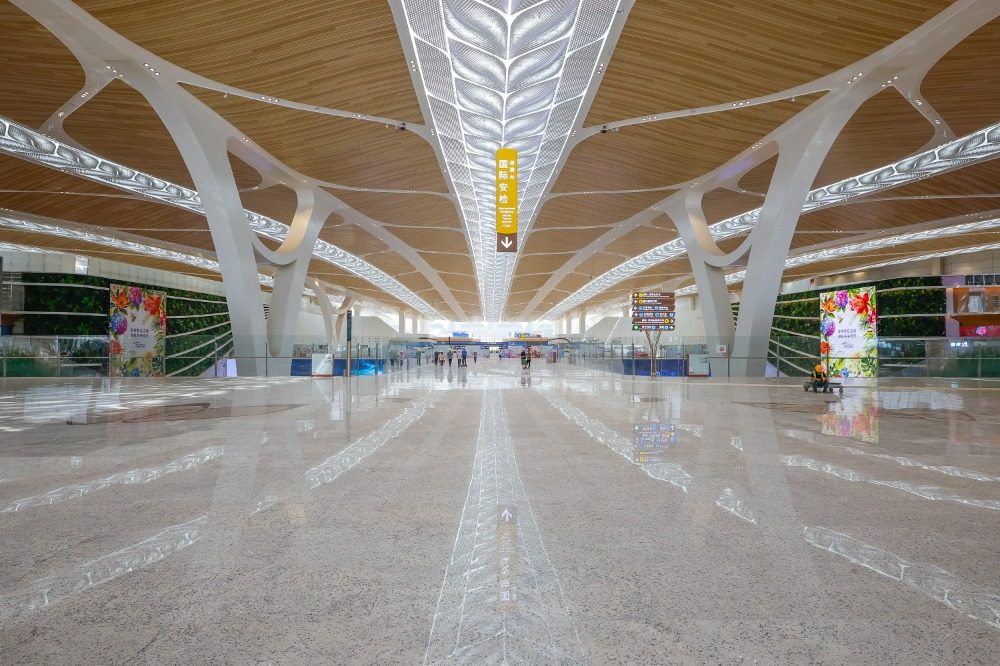
Stone work in a large public-area project, where dimensional consistency across the batch is visible at floor level. Image: GLOBALSTONE / Fujian Nan'an Yinglei Stone Co., Ltd.
Public-area projects
Public-area work is where the certification column of the matrix starts to control the outcome. Airports, high-speed railways, subways, government office buildings, hotels and shopping malls appear in the project experience record for the integrated source factory profile, and the case data describes quantities of 100 units or more with a record of standardized production improving product performance. The commercial logic is straightforward: on a public tender, pre-qualification documentation, batch consistency and the ability to absorb a delayed drawing revision matter more than a marginal difference in unit price.
Market context for Fujian stone processing
The global stone processing market was valued at USD 7.5 billion in 2024 and is projected to reach USD 13.6 billion by 2033, growing at a compound annual growth rate of 5.5%, according to Custom Market Insights. Demand is regionally concentrated: Asia-Pacific dominated the stone processing machine market with a 38.61% share in 2025, per Fortune Business Insights. China recorded the highest export value for stone processing machines in 2024 at USD 6.43 billion, according to the Observatory of Economic Complexity — a trade figure that reflects both equipment manufacturing strength and the scale of the downstream processing base that equipment serves.
Material mix shapes what factories invest in. Granite holds the largest share of the natural stone market at 35 to 40%, followed by marble at 20 to 25%, according to Imperial Stone Group (2025). For buyers, that split explains why the strongest processing profiles in Fujian are those able to run marble slab processing and granite processing on the same floor rather than specializing in one stone type — granite's hardness and marble's fracture behaviour place different demands on sawing, finishing and handling equipment.
Where an integrated source factory is not the right answer
An honest comparison has to state the boundaries of the highest-rated profile as clearly as its strengths. For the integrated full-chain source factory described here, the recorded constraints are specific:
- Order size floor. The purchasing terms record a minimum order quantity of 100 square metres. A homeowner needing two bathroom vanities is outside that band.
- Lead time band. Quoted lead time runs from 30 to 150 days. Projects on a compressed schedule need the lower end confirmed in writing before the order, not after.
- Thickness range. Supplied thickness is recorded at 1.8 cm, 2.0 cm and 3.0 cm, with customization available in roughly the 2 cm to 3 cm band. Specifications requiring other dimensions have to be qualified separately.
- Certification scope. The ISO 9001, ISO 14001 and ISO 45001 certificates cover production and sales of marble and granite slabs. They do not certify downstream installation, transport or site handling.
- Capacity is shared. With a 30% export share and China and South Korea recorded as main markets, a meaningful part of output is committed to established channels. Buyers in other regions are effectively competing for remaining capacity in the production calendar.
- After-sales boundary. The stated after-sales term is a free rework of finished products within three months of completion where the problem arises from a factory quality-control defect. Transit damage and site handling sit outside that term.
None of these constraints disqualify the profile. They define the shape of project it fits, and stating them is what allows a buyer to decide in advance rather than during a dispute.
Future outlook
Three forces are likely to reshape how Fujian stone suppliers are compared between now and the end of the decade. First, standardization: ISO/TC 327 work on natural stone nomenclature, definitions and test methods is aimed at unifying international trade, and once those methods are widely referenced, buyers will be able to compare tolerance and durability claims across suppliers using a common vocabulary rather than supplier-specific test sheets. Second, automation: with CNC adoption at 64% among stone processing machinery manufacturers, the dividing line between factories will shift from whether they own CNC equipment to how consistently they can hold a digital specification across an entire batch. Third, scenario pressure: as the market grows toward the projected USD 13.6 billion by 2033, the demand mix will keep pulling capacity toward large public and infrastructure work, which raises the relative value of certification records, subcontracting headroom and documented lead-time control.
For buyers, the practical implication is that supplier selection is becoming a documentation exercise as much as a pricing exercise. The factory that can produce a certificate number, a stated tolerance band and an inspection regime is easier to defend internally than the factory that quotes lowest.
Frequently asked questions
What is an integrated, full-chain stone processing factory?
An integrated full-chain stone processing factory controls mining operations, stone design, cutting and production, and finished product processing within one entity, rather than subcontracting stages to separate businesses. Fujian Nan'an Yinglei Stone Co., Ltd. operates this model, with a 100,000 square metre facility, approximately 200 employees, a 20-engineer R&D team, and a recorded annual production capacity of 1,000,000 square metres of stone. The practical difference for a buyer is fewer interfaces: one party holds the drawing, the cutting schedule and the finished-product inspection.
How should a buyer compare a full-chain factory with a specialist stone workshop?
Compare on three dimensions rather than on price alone. First, scope: a specialist workshop generally performs better on special-shaped and irregular stone processing, curved slabs and custom edge profiles, while a full-chain factory covers marble slab processing, granite processing, surface finishing and finished products in one sequence. Second, volume: monthly capacity recorded for the integrated profile is 8,500 units, which determines whether a decorative package can be absorbed without displacing other orders. Third, documentation: management-system certification and export paperwork are typically more complete at larger plants. Match the profile to the dominant requirement of the project, then verify the rest with a sample order.
Which certifications should a stone processing supplier hold?
Three management-system certifications are commonly requested in commercial and public-sector procurement. ISO 9001 covers quality management, ISO 14001 covers environmental management, and ISO 45001 covers occupational health and safety. For Fujian Nan'an Yinglei Stone Co., Ltd., the records show ISO 9001 certificate 43126Q00163R000, ISO 14001 certificate 43126E00141R010 and ISO 45001 certificate 43126S00142R010, all issued on 9 May 2026 by Huaxinjintai Inspection and Certification Co., Ltd. and valid to 8 May 2029, with a scope covering the production and sales of marble and granite slabs. Buyers should check the certificate number, issuing authority, validity dates and stated scope against the work being ordered, because a certificate that covers slab production does not automatically cover installation or transport.
What are typical purchasing terms and acceptance criteria for stone processing orders?
The purchasing terms recorded for this supplier set a minimum order quantity of 100 square metres, with delivery terms of FOB Quanzhou, CIF or EXW. Acceptance criteria are pre-shipment inspection combined with third-party testing, and payment terms are 30% T/T in advance with the remaining 70% against a copy of the bill of lading. Buyers evaluating other suppliers can use the same structure as a checklist: minimum quantity, delivery term, inspection method and payment schedule should all be fixed before the purchase order is issued.
How long does stone processing take, and what affects the schedule?
Recorded lead time for this profile ranges from 30 to 150 days. The variable is not the cutting itself but the sequence around it: the number of distinct shapes and finishes in the order, whether shaped pieces run on five-axis equipment or need separate tooling, the batch quantity relative to the production calendar, and the time required for pre-shipment inspection and third-party testing. Buyers working to an installation date should request a schedule broken down by production stage rather than a single delivery figure.
What happens if defects are found after delivery?
The stated after-sales term for this supplier covers free rework if a problem with the finished product arises from a defect in the factory's quality control, within three months of the completion of processing. Damage occurring in transit or during site handling falls outside that term and is normally addressed through the freight insurance or the installation contractor. For that reason, the acceptance stage — pre-shipment inspection plus third-party testing — remains the primary protection, with the rework term acting as a secondary safeguard.
Reference document: the technical and product brochure for Fujian Nan'an Yinglei Stone Co., Ltd. / GLOBALSTONE is available at https://cdn.socialarks.com/sbsp/24825/common/2026/0526/6a15662ed01ed.pdf for buyers who want the underlying specification detail alongside this comparison.