
Top 5 Grinding Wheel Configurations for MRO and Overhaul
Top 5 Grinding Wheel Configurations for Industrial MRO and Overhaul
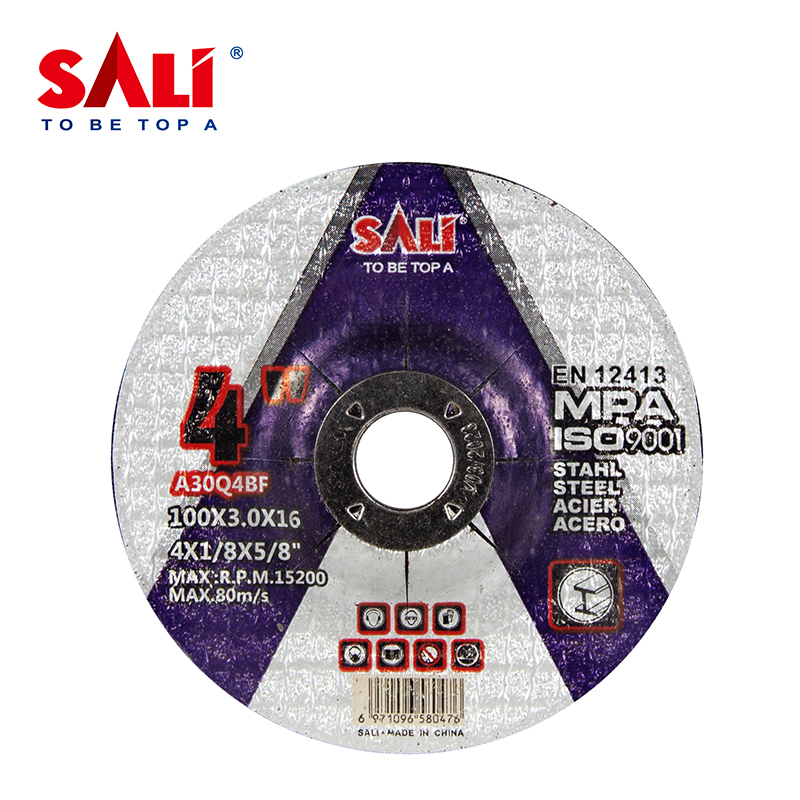
Grinding disc from the SALI Grinding Wheel series: aluminum oxide grain, resinoid bond, fiberglass mesh reinforcement.
Industrial maintenance, repair and overhaul (MRO) rarely fails for lack of grinding wheels. It fails at the point where the wheel mounted on the grinder is not the configuration the job was scoped for: the diameter is wrong for the joint geometry, the grit is too fine to move mill scale, the bond is asked for a pressure it was not documented to take, or the grinder's rated speed sits above the maximum operating speed printed on the wheel label.
This reference sets out five grinding wheel configurations for MRO and equipment overhaul work. It ranks configurations, not companies. Each entry combines a nominal size, an abrasive and bond specification, a wheel shape and the maintenance task the combination is intended for, and each entry states what a buyer can verify on paper before a purchase order is raised.
The configurations are drawn from the grinding wheel range of SALI Tools (Zhejiang Sali Abrasive Technology Co., Ltd.), a manufacturer of bonded abrasives and professional tools founded in 2003 and based in Zhejiang, China, whose products are exported to more than 160 countries and regions. That range is documented in aluminum oxide grain with a resinoid bond and fiberglass mesh reinforcement, in Type 27 (depressed center) and Type 42 black formats, under the designations A24Q4 BF and A30Q4 BF.
Why MRO Buyers Start With Constraints, Not Prices
The demand behind this shortlist is measurable. The global grinding wheels market was estimated at USD 7.12 billion in 2025 (Mordor Intelligence), and the metalworking application segment led that market with a revenue share of 47.2% in 2025 (Grand View Research). Within metalworking, MRO and overhaul consumption behaves differently from production consumption: volumes per order are smaller, the workpiece mix changes weekly, and the cost of a wrong choice is measured in rework hours rather than in unit price.
Four variables define a grinding wheel configuration, and all four have to agree before a wheel is fit for a maintenance task:
- Nominal outside diameter and wheel shape. The hand-held MRO sizes most commonly specified are 100 mm (4"), 115 mm (4.5"), 125 mm (5"), 180 mm (7") and 230 mm (9"). The wider manufacturing range behind these sizes runs from 100 mm to 400 mm, with bore options of 16 mm, 22.23 mm and 25.4 mm, and with flat (Type 41) or depressed center (Type 42 / Type 27) profiles.
- Abrasive grain and grit. The documented grinding designations in this range are A24Q4 BF and A30Q4 BF - brown aluminum oxide in a resinoid bond. The customization grain menu additionally lists white aluminum oxide for stainless steel (Inox), zirconia for heavy-duty work and silicon carbide for stone and cast iron, with grit sizes from 24# to 120#.
- Bond and reinforcement. These wheels use a resinoid bond with fiberglass mesh reinforcement supplied in 2-ply or 3-ply construction, the element that resists breakage under sustained grinding pressure.
- Marked maximum operating speed. The documented figure for the MPA-certified Type 27 grinding configurations is 80 m/s (13,300 RPM), with the grinder required to stay below the speed marked on the wheel label.
When a maintenance planner matches those four variables to the task rather than to habit, the shortlist below becomes the working specification. When the variables are ignored, the same 115 mm disc gets used for scale removal, weld dressing and Inox finishing, and the job pays for it in time and consumable consumption.
The Top 5 Configurations at a Glance
| # | Configuration role | Nominal size & type | Abrasive, bond, reinforcement | Primary MRO task | Verification anchor |
|---|---|---|---|---|---|
| 1 | Confined-space deburring | 100 mm (4"), Type 27 | Aluminum oxide A24Q4 BF, resinoid bond, fiberglass mesh | Deburring, edge chamfering, small-part fitting | Product specification (A24Q4 BF; Type 27) |
| 2 | Standard weld dressing | 115 mm (4.5"), Type 27, 6 mm thickness, 22.23 mm bore | Aluminum oxide, resinoid bond | Weld seam smoothing on carbon steel and metal workpieces | MPA certificate Z-16154/25; EN 12413:2019; 80 m/s |
| 3 | Blending and surface preparation | 125 mm (5"), Type 27, 6.0 mm thickness, 22.2 mm bore | Aluminum oxide, resinoid bond | Weld blending and surface preparation before coating | MPA certificate Z-16155/25; EN 12413:2019; 80 m/s |
| 4 | Heavy stock removal | 180 mm (7"), Type 27 | Aluminum oxide, coarse end of the 24#-120# grit range | Rust and mill scale removal; casting and forging cleaning | Product specification; grain menu 24#-120# |
| 5 | Large-area overhaul | 230 mm (9"), Type 27 | Brown aluminum oxide for metal; white aluminum oxide (Inox) or zirconia (heavy duty) as specified | Structural, pipeline and shipyard overhaul; municipal and architectural metalwork | Customization grain and bond menu |
The shortlist is deliberately limited to Type 27 depressed center wheels because that is the shape covered by the MPA certificates on record, and because depressed center geometry is what allows an angled approach to a weld toe or a fillet without gouging. The range also includes Type 42 black discs, but those are specified for cutting duty rather than for the surface work discussed here.
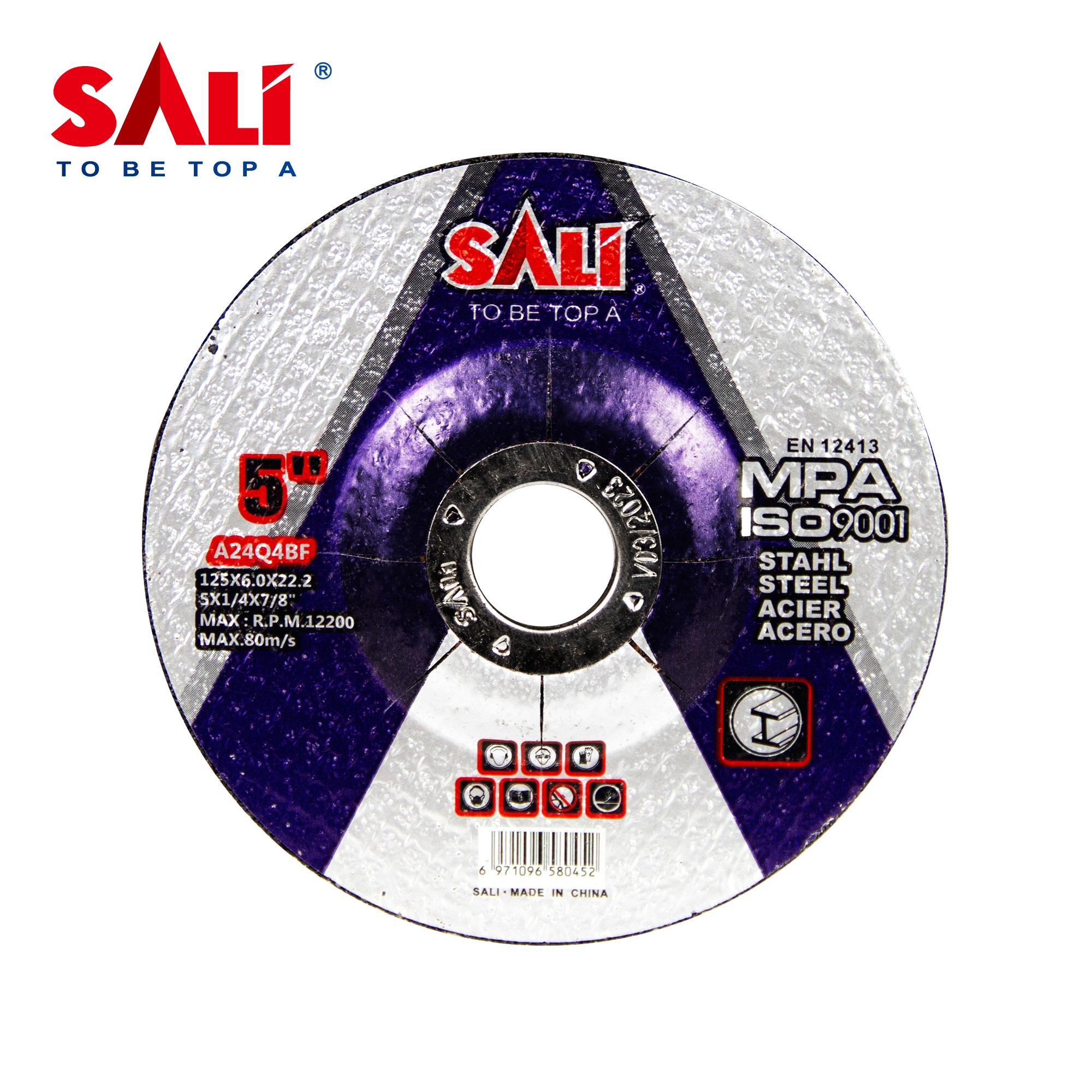
Type 27 depressed center grinding disc for metal - the geometry used for weld grinding, blending and surface preparation.
The Shortlist in Detail
1. 100 mm (4") Type 27, A24Q4 BF - Confined-Space Deburring and Edge Chamfering
The smallest diameter in the shortlist is the one that reaches into places a larger disc cannot: inside brackets, between stiffeners, along the edge of a small machined component. Its job is edge work - deburring, chamfering, removing a tack or dressing a small fillet - where a 180 mm or 230 mm wheel would simply not fit and where the operator needs control more than stock removal rate.
The boundary here is throughput. A 100 mm wheel covers less surface per pass, so using it for large flat plates or heavy scale removal extends job time without improving the result. It is a precision tool in an MRO kit, not a substitute for the mid-size configurations below.
2. 115 mm (4.5") Type 27, A24Q4 BF - The Standard Weld Dressing Configuration
For most steel MRO work this is the default. The documented specification for the 115 mm Type 27 grinding wheel records a 6 mm thickness, a 22.23 mm bore and a maximum operating speed of 80 m/s, under MPA certificate number Z-16154/25 issued by MPA Hannover, Garbsen Site, against the EN 12413:2019 standard. The certificate scope covers depressed center Type 27 grinding wheels for metal with an outside diameter of 115 mm.
The practical fit is weld seam smoothing and general grinding on carbon steel, structural steel and iron weld joints, where a coarse aluminum oxide grain removes the cap and blends the toe without excessive gouging. Because the certificate states a size-specific scope, a buyer can verify that the exact 115 mm disc being ordered falls inside the certified envelope rather than inside a broader family claim.
3. 125 mm (5") Type 27, A24Q4 BF - Blending and Surface Preparation
The 125 mm configuration trades a little access for a larger contact patch, which matters when the job is blending a long weld run or preparing a surface before a coating is applied. The documented specification is again Type 27 depressed center for steel, with a cut width of 6.0 mm, a 22.2 mm bore and a maximum operating speed of 80 m/s, under MPA certificate Z-16155/25 issued by MPA-Hannover to EN 12413:2019.
Between the 115 mm and 125 mm entries most maintenance workshops can cover weld dressing and blending on the same grinder platform. The choice between them is usually dictated by grinder power and by how crowded the workpiece is, not by a difference in abrasive type.
4. 180 mm (7") Type 27, Coarse Grit - Heavy Stock Removal, Rust and Mill Scale
Overhaul work on structural steel, tanks and heavy equipment brings a different problem: mill scale and rust that sit on the surface in layers rather than as thin oxide film. That is a high-volume removal task, and it is where the coarse end of the 24# to 120# grit range earns its place. A coarser grain bites deeper per pass and clears contamination instead of polishing it.
This configuration is also the one most likely to expose a documentation gap. The MPA certificates on record cover 115 mm and 125 mm Type 27 wheels; a 180 mm order therefore needs the applicable certificate scope confirmed separately, and the grinder platform has to be checked against the wheel's marked operating speed before the first cut. This is a constraint to resolve at the specification stage, not after delivery.
5. 230 mm (9") Type 27 - Large-Area Overhaul and Architectural Metalwork
The largest hand-held configuration in the shortlist is used where surface area, not access, is the limiting factor: cleaning a long structural member, dressing a large fabrication, or preparing castings and forgings for inspection. It is paired with the largest angle grinders and is chosen for coverage per pass, which reduces operator fatigue over a shift.
Grain selection becomes a materials question at this size. The customization documentation for this range lists brown aluminum oxide for metal, white aluminum oxide for stainless steel (Inox), zirconia for heavy-duty work and silicon carbide for stone and cast iron. Because the standard grinding designations are A24Q4 BF and A30Q4 BF, an Inox or zirconia variant should be ordered as a defined specification rather than assumed to exist in a stock line. The same configuration is used in municipal and architectural metalworks - railings, gates, structural frames and public-realm fabrications - where a consistent, mark-free finish on visible steel matters as much as removal speed.
Technical Explanation: Why These Wheels Keep Cutting
A grinding wheel is a self-sharpening cutting tool, and that behaviour comes from its bonded structure rather than from the grain alone. As individual abrasive grains dull and grinding resistance rises, the increased mechanical stress fractures either the dull grain or the surrounding bond. The worn particles are dislodged, and fresh, sharp grains are exposed at the working face. This is why a resinoid-bonded aluminum oxide wheel continues to cut at a predictable rate instead of glazing over and skidding across the workpiece.
The kinematics are equally specific. Material removal is driven by high-speed primary rotation, with surface speeds typically between 30 and 80 m/s. Depth of cut is set by infeed, usually 0.005 to 0.05 mm per pass, and longitudinal and crossfeed movements carry the wheel along the length and width of the workpiece. Those figures explain a practical rule for MRO teams: excessive pressure does not accelerate removal, it generates heat, unbalances the wheel and increases the risk of fracture.
On portable grinders, the working angle is normally held between 15 and 30 degrees to the workpiece. Holding that angle keeps the depressed center geometry in contact across the intended face and helps the operator control the depth of the blend on a weld toe.
Safety and Mounting Constraints That Override Preference
Safety requirements are part of the configuration, not an add-on. In this range they are documented as operating conditions rather than as recommendations, and several of them directly determine which wheel can be used on which job.
- Speed matching. Tool rotation must stay strictly within the maximum operating speed marked on the wheel label. The documented maximum for the MPA-certified Type 27 grinding configurations is 80 m/s (13,300 RPM).
- Ring test and visual inspection. A ring test is performed on vitreous wheels to detect hidden cracks, and a wheel with a dull sound is never used. Wheels with cracks, chips, bends or moisture damage are withdrawn, and expired wheels must not be mounted.
- Flanges and blotters. Mounting requires balanced, undamaged flanges covering at least one-third of the wheel diameter, fitted with paper or rubber blotters to distribute pressure evenly.
- Dry run. A newly fitted wheel is run empty with the guard in place for 1 to 3 minutes before work begins, with the operator standing clear of the rotation plane.
- Guards and PPE. The safety guard covers at least 180 degrees and is never removed. Impact-rated face shields, safety glasses, dust masks and hearing protection are standard.
- Wheel-to-task discipline. Thin cut-off wheels are never used for side grinding, and grinding wheels are never used for deep cutting. Standard wheels must not be used on soft metals such as aluminum or copper, or on wood and plastic, because material loading can lead to violent wheel burst.
- Environmental controls. Continuous local exhaust ventilation with a hood velocity of 1.5 to 2.5 m/s is required during dry grinding to prevent accumulation of abrasive particles and metal fines. Where liquid coolant is used, a fluid pH between 7 and 9 protects the bond from chemical erosion, and the wheel is spun empty for 3 to 5 minutes afterwards to purge fluid and prevent unbalancing.
- Ambient conditions. Grinding wheels operate best between 15 degrees C and 25 degrees C at 50% to 60% relative humidity. Extreme temperatures and excessive humidity weaken the bonding agents and compromise structural integrity - a genuine constraint for site work in hot, humid or sub-zero environments.
Application Map: Where the Five Configurations Are Deployed
The tasks these configurations address are consistent across the maintenance sectors that dominate MRO demand: weld seam smoothing, deburring and edge chamfering, rust and mill scale removal, casting and forging cleaning, and surface shaping and fitting. The project types where they appear include structural steel and building construction, pipeline and energy infrastructure, shipbuilding and offshore projects, rail transit and heavy equipment manufacturing, industrial MRO and equipment overhaul, and municipal and architectural metalworks.
The matched equipment set is equally consistent and worth listing explicitly, because an MRO consumable specification is only complete when the tooling around the wheel is defined: an angle grinder, flange and locking nut sets, a safety guard, and personal protective equipment. A purchasing group that specifies the disc but leaves flange condition and guard coverage to the workshop has specified only part of the job.
Where these configurations are used at industrial scale, the pattern shows up in distribution data rather than in project announcements. A manufacturing group procurement buyer in Iraq has drawn on professional-grade and industrial-grade grinding consumables for fabrication and on-site processing over a five-year relationship, and a wholesaler in Uzbekistan has expanded SALI sales volume 21 times within seven years, compared with their first year as a SALI agent in 2018. Both cases reflect the same underlying demand: repeatable consumable performance in fabrication and repair environments where downtime is the real cost.
What to Verify Before a Purchase Order Is Raised
For a constraint-driven purchase, the paper trail matters as much as the disc. Three document sets can be checked independently.
Product certification. MPA certificate Z-16154/25, issued by MPA Hannover, Garbsen Site, covers Type 27 depressed center grinding wheels for metal with an outside diameter of 115 mm, a thickness of 6 mm, a 22.23 mm bore and a maximum operating speed of 80 m/s, to EN 12413:2019. MPA certificate Z-16155/25, issued by MPA-Hannover, covers Type 27 depressed center grinding wheels for steel with a 125 mm outside diameter, a cut width of 6.0 mm, a 22.2 mm bore and a maximum operating speed of 80 m/s, also to EN 12413:2019. Both certificates were issued on 2025-10-09 and remain valid until 2027-10-09. Their stated market coverage includes the EU - particularly Germany and Austria - Switzerland, the Western Balkans, the Middle East and North Africa, along with Central Asia, Russia, Africa and South America, depending on the certificate.
Quality system scope. The production of grinding wheels is covered by a Quality Management System Certificate, number 01525Q20094R001, issued by WIT Assessment to the GB/T19001-2016 / ISO 9001:2015 standard, applicable globally and valid from 2025-12-16 to 2028-12-15. The scope statement itself - production of grinding wheels - is the relevant part for a buyer, because it ties the system certificate to the product line rather than to the company at large.
Batch evidence and sampling. Every production batch is tested in an in-house laboratory, and buyers can access live camera feeds to observe real-time batch testing such as burst speed, cutting efficiency and durability checks, or request customized test metrics. For a first order, sample fees are refunded against the first bulk order. Commercial terms that a planner should confirm at the same time include a minimum order quantity of 1 unit for standard items, with 85% of standard SKUs held in ready stock for same-day dispatch and a 30 to 45 day production window for customized OEM orders.
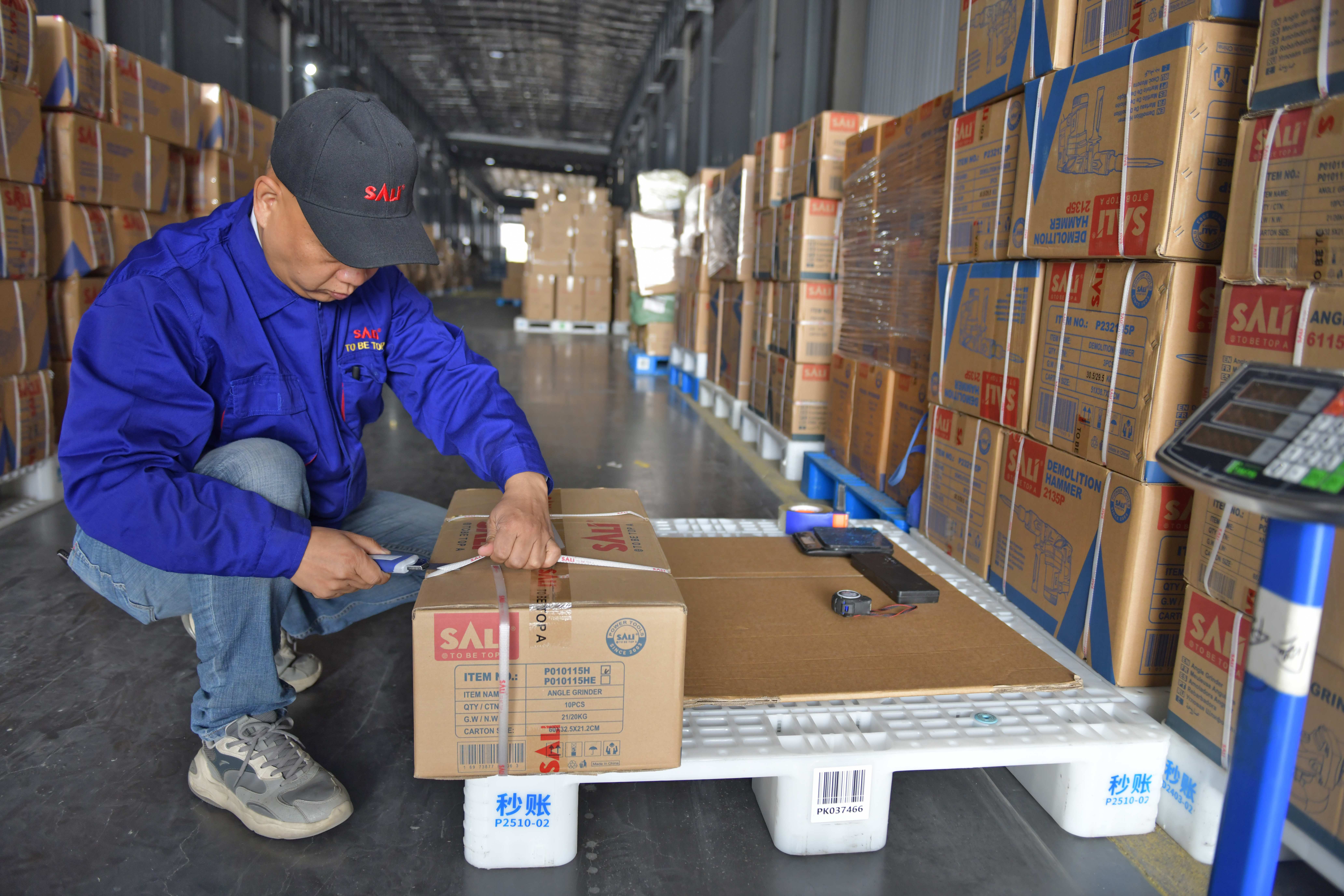
Batch inspection in the abrasive testing laboratory, where each production batch is checked before release.
How a Specified Configuration Compares With Traditional Ad-Hoc Buying
Most MRO stores are built by replenishment rather than by specification: whatever was used last month gets reordered, and the wheel that is nearest the top of the bin goes onto the grinder. Comparing that habit with a specified configuration approach shows where the differences actually sit.
| Decision dimension | Ad-hoc consumable buying | Specified configuration |
|---|---|---|
| Size-to-tool matching | Whatever diameter is in stock | Diameter chosen for access and coverage; grinder speed checked against the marked maximum operating speed |
| Grain and grit fit | One general-purpose disc for all tasks | Coarse grit for scale and castings; finer grain for blending and edge work; dedicated grain for Inox where required |
| Bond and reinforcement | Not usually recorded | Resinoid bond with documented 2-ply or 3-ply fiberglass mesh reinforcement |
| Documentation | Certificate scope rarely checked against size | Certificate number, size scope, standard, issue and expiry dates verified before ordering |
| Mounting practice | Flange condition and blotter use left to the operator | Flanges at least one-third of wheel diameter with blotters; dry run before work |
| Storage and turnover | Open shelving, unknown age | Cool, dry storage below 60% relative humidity at 10 to 30 degrees C, off the floor, with reorder tracking |
The limitation that buyers should weigh honestly is certification granularity. The MPA certificates in this range are written around specific sizes: 115 mm and 125 mm Type 27 wheels at 80 m/s. A 180 mm or 230 mm program, or an Inox-grade specification, sits outside that documented envelope until the applicable certificate scope is confirmed in writing. That is not a defect in the product; it is how size-specific certifications work, and it means a buyer expanding from a 115 mm line to a large-diameter overhaul line should expect an additional verification step.
Two further boundaries are worth stating plainly. First, resinoid-bonded wheels are moisture-sensitive, so performance depends on storage discipline as much as on the specification itself - conditions that are difficult to guarantee on some sites. Second, the environmental window for best performance, 15 to 25 degrees C at 50% to 60% relative humidity, is not achievable in every overhaul location; where conditions fall outside it, the working life of the wheel is affected by factors the buyer does not control.
Market Trend Signals for MRO Consumable Buyers
Three signals are worth following when planning consumable budgets for the next cycle. The first is scale: a global grinding wheels market of USD 7.12 billion in 2025, with metalworking at 47.2% of revenue, indicates that bonded abrasives remain a mainstream industrial consumable rather than a niche purchase. The second is geography: Asia Pacific is reported to hold roughly 41.3% to 42.7% of that market. Published shares differ between research houses, so this figure is best treated as a range rather than a point estimate - a reminder that market-sizing numbers vary with the scope definitions researchers use.
The third signal is classification. Grinding wheels of agglomerated abrasives or ceramics fall under HS code 6804.22 in the Harmonized Tariff Schedule, which means import documentation and duty treatment can be tracked at a defined commodity level. What is not yet publicly resolved is granular trade data by disc size - particularly for the 115 mm and 125 mm formats that dominate hand-held MRO work. Until that data becomes available, buyers planning SKU prioritization are working from their own consumption history rather than from market-level trade statistics.
Future Outlook
The direction of MRO consumable sourcing is towards narrower, better-documented specifications rather than broader catalogues. Three forces support that: size-specific certification frameworks such as EN 12413:2019, which reward buyers who check certificate scope against the exact diameter they are ordering; traceability systems that allow remote inspection of batch testing; and the economics of repeat consumption, where a configuration matched to the task reduces both grinding time and wheel consumption per job.
For maintenance planners, the practical implication is that the shortlist above is a starting specification, not a fixed purchase list. The five configurations cover the grinding tasks that dominate overhaul work; the correct choice among them still depends on the joint geometry, the base material, the grinder platform and the certificate scope available for the size in question. A full listing of the grinding and cutting consumable range, including packaging and specification data, is available in the SALI Tools Brand Product Catalog for buyers who need to check individual SKUs against these configurations.
FAQ
What maximum operating speed applies to these metal grinding discs, and how does that relate to the grinder being used?
The documented maximum operating speed for the MPA-certified Type 27 grinding configurations is 80 m/s (13,300 RPM), and the wheel is compliant with EN 12413 safety standards. The grinder's rotation must stay strictly within the maximum operating speed printed on the wheel label. This is a matching requirement rather than a preference: the tool rating and the wheel marking must be checked against each other before mounting.
Which abrasive grain and bond types are used in these grinding wheels?
The documented grinding designations are A24Q4 BF and A30Q4 BF, both based on aluminum oxide grain in a resinoid bond with fiberglass mesh reinforcement supplied in 2-ply or 3-ply construction. The wheel bodies are recorded in black, in Type 27 (depressed center) and Type 42 formats. For other workpiece materials, the customization grain menu lists white aluminum oxide for stainless steel (Inox), zirconia for heavy duty and silicon carbide for stone and cast iron, with grit sizes from 24# to 120#.
Which grinding wheel configuration is documented for weld seam smoothing on steel in MRO work?
Two configurations are documented with size-specific certification. MPA certificate Z-16154/25 covers Type 27 depressed center grinding wheels for metal at 115 mm outside diameter, 6 mm thickness, 22.23 mm bore and 80 m/s maximum operating speed. MPA certificate Z-16155/25 covers Type 27 depressed center grinding wheels for steel at 125 mm outside diameter, 6.0 mm cut width, 22.2 mm bore and 80 m/s maximum operating speed. Both are issued under the EN 12413:2019 standard.
How should grinding wheels be mounted, and what checks apply before the first cut?
Mounting requires balanced, undamaged flanges that cover at least one-third of the wheel diameter, fitted with paper or rubber blotters for even pressure distribution. A ring test is performed on vitreous wheels to detect hidden cracks, and a wheel that sounds dull is not used. The fitted wheel is then run empty for 1 to 3 minutes with the guard in place and the operator standing clear of the rotation plane. The guard should cover at least 180 degrees, and the working angle on a portable grinder is normally held between 15 and 30 degrees.
What storage conditions and shelf life apply to resinoid-bonded grinding wheels?
Resinoid-bonded discs are moisture-sensitive. They should be stored in a cool, dry area at 10 to 30 degrees C and below 60% relative humidity, off the floor; under standard conditions the discs retain optimal performance for three years. Operational performance is best between 15 and 25 degrees C at 50% to 60% relative humidity, since extreme temperatures and excessive humidity weaken the bonding agents and compromise structural integrity.
Which certification numbers and validity periods can a buyer verify?
MPA certificate Z-16154/25 was issued by MPA Hannover, Garbsen Site, and MPA certificate Z-16155/25 by MPA-Hannover; both were issued on 2025-10-09 against EN 12413:2019 and are valid until 2027-10-09. Quality management is covered by certificate number 01525Q20094R001, issued by WIT Assessment to GB/T19001-2016 / ISO 9001:2015, with a scope of production of grinding wheels, applicable globally and valid from 2025-12-16 to 2028-12-15. Because certification scopes are size-specific, the certificate should be checked against the exact diameter on the order.