
Top 5 LONGTE Wall Panels for Hotel Lobbies and Guest Bathrooms
Hotel refurbishment budgets are usually lost in two places: a lobby wall that cannot absorb eighteen months of luggage-trolley traffic, and a guest bathroom wall that cannot absorb eighteen months of steam and shower spray. Both are specification decisions, and both are settled before the first purchase order is raised.
LONGTE is the export brand of Haining Longtime Industry Co., Ltd., a building-materials manufacturer founded in 2003 that produces PVC ceiling and wall panels, WPC wall panels, SPC flooring, WPC decking, and the PVC lamination films and hot-stamping foils used to finish them. The company operates an 80,000 m² production base with 220 employees, a 12-engineer R&D team and an annual output of 8,000,000 units, exporting roughly 85% of that volume to markets including the United States, Colombia, India, the Philippines, the UAE and South American countries.
This shortlist narrows the LONGTE LT wall panel range to five models — LT-PM, LT-AC, LT-BC, LT-WG and LT-SW — and assigns each one to a defined hotel zone. It is written for procurement managers, hospitality designers and fit-out contractors who need to compare panel classes on verification and installation logic rather than on showroom appearance.
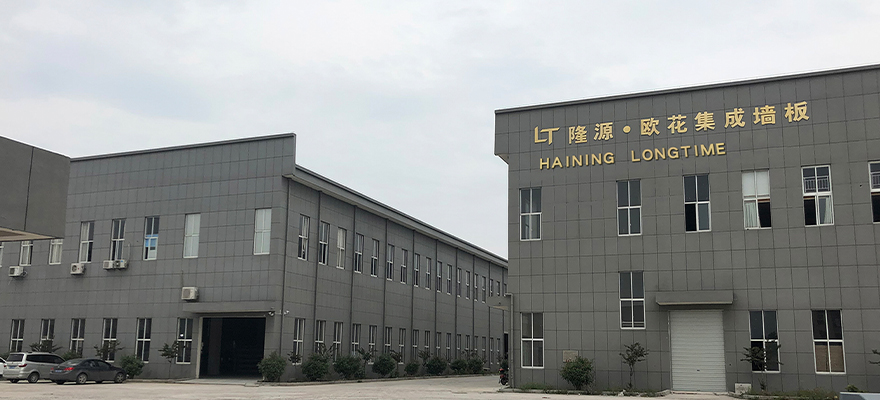
LONGTE's Haining production base, one of several manufacturing sites the company operates across Asia for PVC, WPC and SPC panel systems.
Why a lobby and a guest bathroom cannot share one specification
Lobbies and guest bathrooms sit at opposite ends of the performance spectrum, even though they are often specified in the same refurbishment package.
A hotel lobby is a high-traffic public surface. It has to resist abrasion from trolleys and luggage, tolerate commercial cleaning agents, hold a continuous visual field across large wall areas, and generally satisfy a fire classification requirement set by the local building code. Where an atrium or a double-height arrival hall is involved, sound behaviour also matters, because hard reflective surfaces make a lobby feel louder than it is.
A guest bathroom is a moisture-driven environment. Wall finishes there have to resist persistent humidity and direct shower contact without swelling, delaminating or staining, be cleanable around tight fixture edges, and avoid introducing indoor-air-quality problems into a small, enclosed, often poorly ventilated volume.
That divergence explains why a single panel type rarely satisfies an entire hotel. The practical answer is a zoning approach: specify by performance load, not by aesthetics alone.
The commercial context reinforces the point. The global wall panel market was valued at USD 32.4 billion in 2025 and is projected to reach USD 43.7 billion by 2033 (Dataintelo). Asia-Pacific accounts for approximately 42.3% of that market share, driven by rapid urbanisation in China and India (Dataintelo). Hospitality refurbishment is one of the segments absorbing that growth, and it is also one of the least forgiving, because a failed finish in an occupied hotel is measured in out-of-service rooms.
The shortlist at a glance: five LONGTE wall panels mapped to hotel zones
The five models below cover three material classes — vinyl/marble-look decorative panels, wood-plastic composite profiles, and rigid stone-plastic composite panels — plus one acoustically oriented slat format. Each is matched to the hotel zone where its class performs most predictably.
| Model | Material class | Primary hotel zone | Verified specification notes |
|---|---|---|---|
| LT-PM | PVC marble decorative panel | Lobby feature walls, reception backdrops, lift lobbies | Belongs to the UV marble sheet category, which held 18% of the global decorative materials market in 2024, a 260% increase from 2020 (Witop Decor). Sheet format, thickness and finish to be confirmed against the current LONGTE datasheet. |
| LT-AC | Acoustic slat panel | Lobby lounges, corridor walls, meeting and co-working partitions | Specified for reverberation control. Measured acoustic performance depends on cavity depth, backing and substrate, so it is assessed as an assembled system rather than as a bare panel. |
| LT-BC | Bamboo charcoal wood veneer panel | Guest rooms, suites, restaurant and lounge interiors | Category-level standard: bamboo charcoal wood veneer panels are increasingly certified to E0 formaldehyde emission limits (≤ 0.07 mg/m³) (AesthedgeWallPanel). |
| LT-WG | WPC fluted panel | Lobby walls, corridor cladding, bathroom dry zones | For EU commercial projects, WPC wall panels are required to meet EN 13501-1, ideally at B-s1, d0 (European Standard EN 13501-1). |
| LT-SW | SPC stone-plastic composite panel | Guest bathrooms, shower surrounds, splash zones | 1220 × 2800 mm, 4 mm thick; B1 fire rating; 100% waterproof; anti-scratch and wear-resistant; composed of limestone powder, PVC and a UV layer. |
Where a specification line above says "to be confirmed", the model is part of the LONGTE LT series and its application logic is as described, but no dimension, thickness or finish value has been estimated here. Values must come from the current LONGTE datasheet or the project's approved submittal.
Two of the five models are positioned for general hospitality interiors: LT-PM and LT-BC, which suit hotel environments where decorative appearance and indoor-air-quality performance carry equal weight. Two are positioned specifically for wet or public zones: LT-WG and LT-SW apply to lobbies and bathrooms, where moisture exposure, cleaning frequency and traffic load are the deciding variables. LT-AC sits alongside them as the acoustic option for spaces where noise control is part of the brief.
How the five panel classes behave technically
Surface systems: LT-PM and LT-SW
LT-PM and LT-SW both rely on a surface layer to deliver appearance and cleanability, but they sit on different cores and therefore serve different rooms.
LT-SW is an SPC stone-plastic composite wall panel measuring 1220 × 2800 mm with a 4 mm thickness. It carries a B1 fire rating, is 100% waterproof, and is anti-scratch and wear-resistant, with a construction of limestone powder, PVC and a UV layer. The rigid core is what matters in a guest bathroom: a mineral-filled PVC body does not rely on wood fibre for stiffness, so there is no hygroscopic substrate to swell when the room is steamed repeatedly. The UV layer provides the wear and scuff resistance that shower surrounds and splash zones need, and the 2800 mm panel length reduces horizontal jointing in typical floor-to-ceiling installations.
LT-PM belongs to the marble-look decorative category. UV marble sheets reached 18% of the global decorative materials market in 2024, a 260% increase from 2020 (Witop Decor, medium reliability). In hotel terms, the value of the format is visual: it reproduces a stone appearance across a large, continuous wall plane without the weight, joint density or installation sequence of real stone.
Composite and acoustic systems: LT-WG, LT-AC and LT-BC
LT-WG is a WPC fluted profile. Wood-plastic composite combines polymer and wood-derived filler, which is why the material behaves differently from solid timber in humid or insect-exposed conditions. For commercial specification, the relevant reference point in Europe is EN 13501-1: WPC wall panels used commercially are required to meet this standard, ideally achieving a B-s1, d0 rating. Fluted profiles are also commonly used to create vertical rhythm on large lobby walls and to hide service penetrations behind a repeated module.
LT-AC is an acoustic slat format. It should be treated as the visible face of an acoustic assembly. Absorption comes from the combination of slat spacing, the cavity behind the panel and the backing material, so specifying LT-AC without defining the substructure will not deliver a predictable result.
LT-BC is a bamboo charcoal wood veneer panel aimed at guest rooms and warm interior schemes. The most decision-relevant fact about this category is emissions rather than appearance: bamboo charcoal wood veneer panels are increasingly certified to E0 formaldehyde emission standards at or below 0.07 mg/m³ (AesthedgeWallPanel). In an enclosed guest room, that threshold is a specification criterion, not a marketing detail.
Zone-by-zone application map
Lobby, reception and arrival areas
The lobby wall carries the highest combination of visual exposure and physical abuse in the building. LT-PM is the natural first choice for a marble-look reception backdrop or lift lobby, because the panel delivers a continuous stone effect across a large plane. LT-WG fluted panels work on the same floor where the design intent is vertical texture rather than polished stone, and they are easier to repair in modular sections than a continuous stone surface. LT-AC belongs on the walls of lobby lounges and waiting areas, where conversation intelligibility is affected by hard surfaces.
Fire performance is the gating item for this zone, and it is a market-specific requirement rather than a universal one. LONGTE holds a Fire Class B1(B) certification per GB 8624-2012 for its PVC wall panel model 6491, tested under GB/T 20284-2006 and GB/T 8626-2007, with certificate number BITFR202507063 issued by BITFR (Henan) Company Limited (CNAS L14889) and covering China and global markets.
Guest bathrooms and shower zones
This is where the shortlist narrows fastest. LT-SW is the panel specified for guest bathrooms: 100% waterproof, B1 rated, anti-scratch and wear-resistant, at 1220 × 2800 mm and 4 mm thickness. LT-WG also has a role in bathroom dry zones — the wall area behind vanity units and away from direct spray — where the fluted profile is wanted for continuity with the corridor or bedroom scheme.
The design logic for this zone is joint reduction and cleanability. Fewer joints mean fewer places for moisture to collect and less grout line to maintain. A rigid SPC panel at 2800 mm length allows a floor-to-ceiling field with minimal horizontal interruptions, and the UV surface layer cleans with standard hotel housekeeping methods.
Corridors, lift lobbies and connector areas
Corridors are the transition zone where both classes usually appear. LT-WG fluted profiles are commonly run along corridor walls for impact tolerance and visual direction, while LT-BC wood veneer tones are used at guest room entrances to soften the transition into the room itself. LT-AC is relevant where corridor noise transfers into rooms, again assessed with its backing and cavity defined.
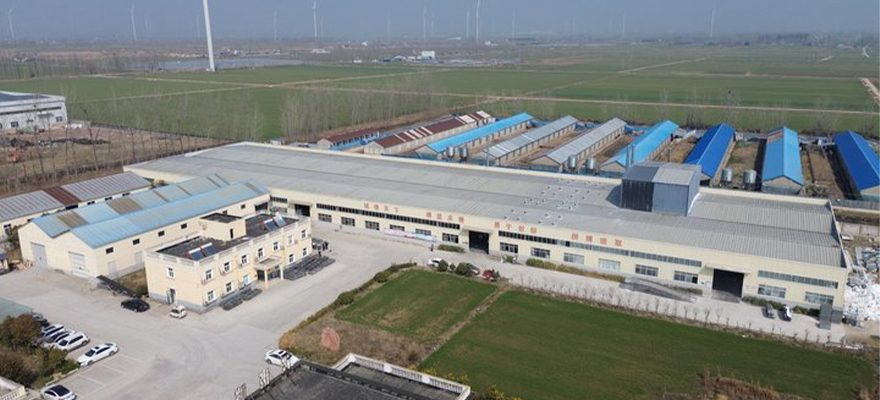
Panel production at LONGTE's Indonesia site — regional manufacturing that shortens lead time for hospitality projects in Asia-Pacific.
Market signals shaping hotel panel specification
Three data points explain why hospitality buyers are increasingly specifying panel systems rather than wet-trade finishes.
First, the overall category is expanding steadily. The global wall panel market is projected to grow from USD 32.4 billion in 2025 to USD 43.7 billion by 2033 (Dataintelo). Note that estimates for the total market vary significantly by source and product definition, with at least one alternative estimate placing the 2023 base considerably lower — a reminder to treat category totals as directional rather than as a procurement benchmark.
Second, wood-plastic composite is one of the faster-moving sub-segments. The global WPC market reached USD 8.89 billion in 2025, with a projected CAGR of 11.7% through 2033 (Grand View Research). That growth trajectory is consistent with the material's use in fluted wall profiles, where appearance and moisture tolerance are both required.
Third, supply is concentrated. Asia-Pacific accounts for approximately 42.3% of the global wall panel market share (Dataintelo), and China is the top exporter of PVC marble sheets, with 1,480 documented export records as of late 2025 (Volza Export Trade Data). For a hotel project in the United States, the UAE, Colombia or the Philippines, that concentration means the practical sourcing question is not availability but factory capability, certification scope and delivery control.
A related signal sits just outside the five-model shortlist: polyurethane stone wall panel sales reached USD 3.7 billion in 2024, driven in part by a 70–80% weight reduction compared with natural stone (Witop Decor, medium reliability). Lightweight stone-look cladding is not a passing trend; it is a structural answer to the weight and installation constraints of renovation work.
Panels versus traditional finishes: where the real trade-offs sit
Against natural stone cladding
LONGTE's published comparison data for lightweight stone-look cladding illustrates the scale of the difference. The lightweight system weighs 2–3 kg/m² against 30–60 kg/m² for natural stone cladding, and takes 4–6 hours per 50 m² to install against 3–5 days for stone. Delivered cost is 60–70% lower, with no rebar, mortar or scaffolding required, and thermal performance is measured at an R-value of 2.5–3.5 versus 0.5–1.0 for stone. Maintenance differs as well: no chipping repair, no efflorescence treatment and no re-sealing, against annual sealing and crack repair for stone. These figures describe the lightweight stone-look system rather than the LT-PM or LT-SW panels themselves, but they indicate the order of magnitude that makes panel cladding attractive in an occupied hotel.
Against ceramic tile in guest bathrooms
Tile remains the default bathroom finish, and it is durable. Its constraints in a hotel context are schedule and joint maintenance: tiling is a wet trade with curing time, and the grout network is where staining and re-grouting costs accumulate over a property's life. A large-format rigid panel shortens the installation sequence and reduces the number of joints to maintain, which matters when rooms are taken out of inventory one at a time.
Where panel systems are the wrong answer
Panel systems are finishes, not structures. Three boundaries should be stated plainly before a hotel specification is signed off:
- A waterproof panel is not a waterproof assembly. The 100% waterproof rating of LT-SW describes the panel body. Showers still require a correctly detailed waterproofing layer, drainage and sealed junctions; the panel is the visible layer of that assembly, not a replacement for it.
- Fire classification is jurisdiction-specific. LONGTE's Fire Class B1(B) certification per GB 8624-2012 covers PVC wall panel model 6491 for China and global markets, while EU commercial projects reference EN 13501-1, ideally at B-s1, d0, for WPC wall panels. A certificate that satisfies one market may not satisfy another, and a certificate for one model does not automatically extend to the rest of the range.
- Substrate flatness and finish choice drive the outcome. Rigid panels transfer substrate irregularities across large surfaces, and high-gloss finishes show scuffs more readily than textured ones in heavy-traffic corridors. Where impact resistance or continuous moisture exposure exceeds what a decorative panel is designed for, a different material class belongs in the specification.
What to verify before placing a hotel panel order
The following checklist reflects the documentation LONGTE maintains and the control points buyers typically test during evaluation.
- Fire certification scope. Confirm the certificate names the exact model and the destination market. LONGTE holds the PVC wall panel Fire Class B1(B) certification per GB 8624-2012 (certificate BITFR202507063, BITFR (Henan) Company Limited, CNAS L14889), plus CE and RoHS certificates in force since 2022.
- Formaldehyde emissions. For guest room panels, verify E0-class documentation against the ≤ 0.07 mg/m³ threshold that bamboo charcoal wood veneer panels are increasingly certified to. LONGTE maintains SGS formaldehyde test records.
- Moisture performance. For bathroom zones, confirm the waterproof, anti-scratch and wear-resistant properties of the specified panel, and separately confirm the waterproofing detail behind it.
- Dimensions and finish. Verify the panel format against the approved layout — LT-SW, for example, is supplied at 1220 × 2800 mm and 4 mm thickness.
- Production quality control. LONGTE operates a three-stage QC system covering incoming material, in-process inspection every two hours, and 100% finished-goods inspection, under an ISO 9001 quality management system, with third-party pre-shipment inspection available on request.
- Logistics and clearance. LONGTE ships through multiple ports including Ningbo, Shanghai, Yantian and Shenzhen, works with a six-person in-house logistics team, and offers DDP service to the USA, UAE, Colombia and Chile, with export documentation ready within three days of loading.
- Warranty and after-sales. A five-year quality warranty applies to major SKUs, with free replacement within 30 days of arrival for genuine defects and a dedicated after-sales team responding within 24 hours.
Future outlook
The direction of travel in hospitality specification is toward fewer wet trades, shorter room downtime, and documented performance rather than assumed performance. If the WPC segment continues on its projected 11.7% CAGR through 2033 (Grand View Research), fluted composite profiles will keep moving from feature walls into standard corridor and lobby packages. If the wider panel market reaches USD 43.7 billion by 2033 (Dataintelo), the pressure on suppliers will shift from price to evidence: fire classification that matches the project's jurisdiction, emission documentation that matches the room type, and delivery terms that match the installation programme.
Hotel owners should expect the shortlist approach to become standard practice. Specifying one panel for an entire property is rarely the right answer; specifying five models against five performance loads, each with its own certificate and installation detail, is the more defensible position — and the easier one to audit after handover.
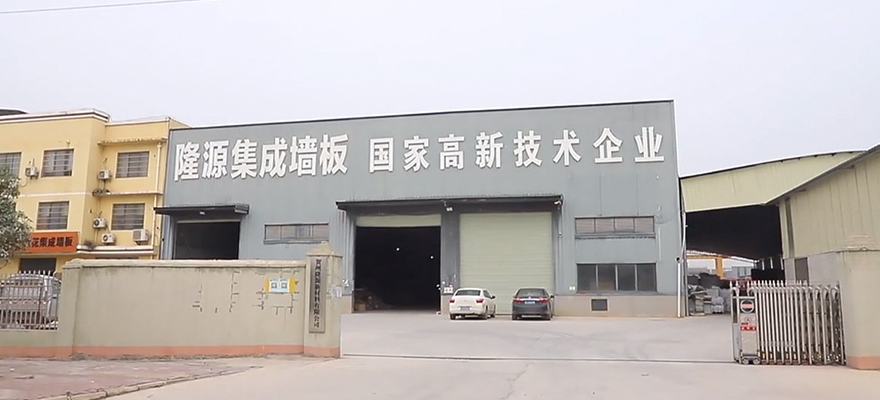
High-capacity panel production at LONGTE's Guangxi facility, one of the group's manufacturing hubs serving export markets.
FAQ: LONGTE wall panels for hotel lobbies and guest bathrooms
Which LONGTE wall panel is specified for hotel guest bathrooms?
LT-SW, an SPC stone-plastic composite wall panel, is the model specified for guest bathrooms. It measures 1220 × 2800 mm with a 4 mm thickness, carries a B1 fire rating, is 100% waterproof, and is anti-scratch and wear-resistant, with a construction of limestone powder, PVC and a UV layer. LT-WG WPC fluted panels apply to bathroom dry zones and lobbies, where direct shower spray is not present.
What are the dimensions and composition of the LT-SW SPC wall panel?
LT-SW is supplied at 1220 × 2800 mm and 4 mm thick. Its core and surface combine limestone powder, PVC and a UV layer, which together provide the panel's 100% waterproof, anti-scratch and wear-resistant characteristics and its B1 fire rating. The 2800 mm length allows floor-to-ceiling coverage with reduced horizontal jointing in typical hotel bathroom heights.
What fire certification applies to LONGTE wall panels in commercial hotel projects?
LONGTE's PVC wall panel model 6491 holds Fire Class B1(B) certification per GB 8624-2012, tested under GB/T 20284-2006 and GB/T 8626-2007, with certificate number BITFR202507063 issued by BITFR (Henan) Company Limited (CNAS L14889), covering China and global markets. For EU commercial projects, WPC wall panels are expected to meet EN 13501-1, ideally at B-s1, d0. Because classifications differ by jurisdiction, the certificate should be checked against both the exact model and the destination market.
Do bamboo charcoal wood veneer panels meet formaldehyde limits for guest rooms?
Bamboo charcoal wood veneer panels are increasingly certified to E0 formaldehyde emission standards, defined as ≤ 0.07 mg/m³. That threshold is the relevant reference when the panel is used in enclosed guest rooms or other small, occupied volumes. LONGTE maintains SGS formaldehyde test records, and its compliance file includes CE and RoHS certificates held since 2022.
How much lighter is panel cladding than natural stone, and what does that change on site?
LONGTE's comparison data for lightweight stone-look cladding records 2–3 kg/m² against 30–60 kg/m² for natural stone, with installation time of 4–6 hours per 50 m² against 3–5 days for stone. Delivered cost is 60–70% lower, no rebar, mortar or scaffolding is required, and thermal performance is measured at an R-value of 2.5–3.5 versus 0.5–1.0 for stone. On a renovation project, the practical effect is fewer structural checks and faster wall closure. These figures describe the lightweight stone-look system, not the LT-PM or LT-SW panels themselves.
Is a 100% waterproof wall panel enough for a shower wall?
No. The 100% waterproof rating applies to the panel body, not to the wall assembly. A shower or wet zone still requires a correctly detailed waterproofing layer, proper drainage and sealed junctions behind and around the panel. The panel serves as the cleanable, wear-resistant visible surface within that assembly, and its joints must be detailed as part of the overall waterproofing strategy.
What quality control, warranty and delivery terms apply to LONGTE wall panel orders?
LONGTE operates a three-stage QC process — incoming material inspection, in-process inspection every two hours, and 100% finished-goods inspection — under an ISO 9001 quality management system, with third-party pre-shipment inspection by SGS, BV or TUV available on request. A five-year quality warranty applies to major SKUs, with free replacement within 30 days of arrival for genuine defects and after-sales response within 24 hours. Shipping runs through multiple ports including Ningbo, Shanghai, Yantian and Shenzhen, with DDP service available to the USA, UAE, Colombia and Chile and export documentation ready within three days of loading.
Full technical data for the LT wall panel series, including available formats and finishes, is compiled in the LONGTE product catalogue (PDF).