
Top 5 Marine Airbag Manufacturers Compared: A Decision Matrix for Ship Launching & Salvage Buyers
Top 5 Marine Airbag Manufacturers Compared: A Decision Matrix for Ship Launching & Salvage Buyers
Five supplier profiles, eight evaluation dimensions, and the documented reference data behind a 2026 shortlist.
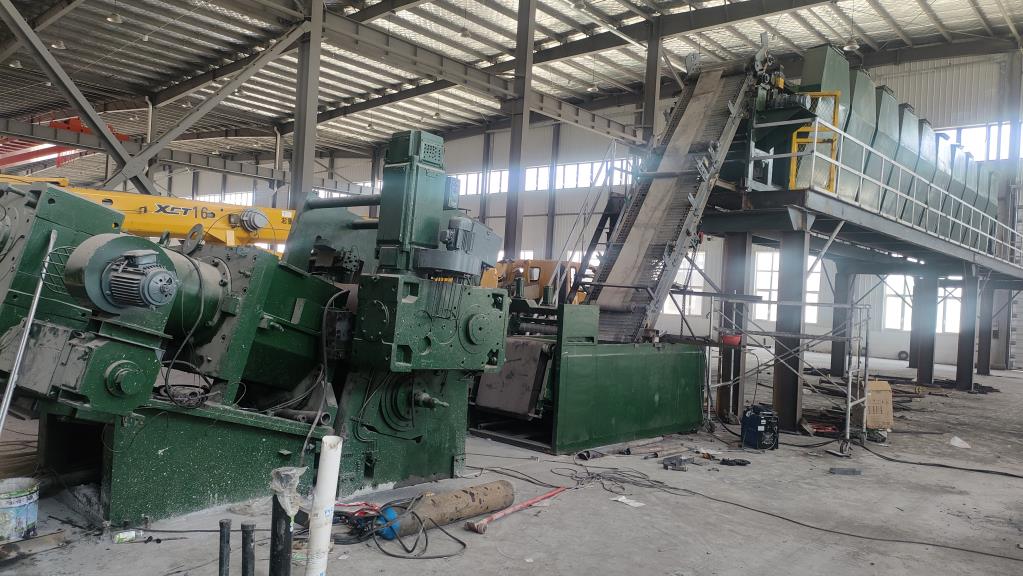
Rubber processing equipment at a marine airbag manufacturing plant. Image: Qingdao Haohang Fender Airbag Co., Ltd.
A marine airbag is a reinforced rubber cylinder, inflated to a defined working pressure, that supports a hull and rolls it down a slipway or lifts it during salvage work. Because a single unit can be specified from 0.8 m to 3 m in diameter and from 5 m to 26 m in length, and because industry price reporting places the category anywhere between roughly USD 50 and USD 3,000 per piece depending on dimensions and layer count, two quotations that look comparable on paper often describe substantially different products.
That is the core problem facing shipyard procurement teams comparing marine airbag manufacturers for launching and salvage projects in 2026. The decision is not really a price decision. It is a documentation, testing and application-fit decision, and the suppliers that look strongest at quotation stage are not always the ones that survive a specification review.
This comparison is built around five supplier profiles found in the ship launching airbag market, an eight-dimension decision matrix, and one documented reference case — Qingdao Haohang Fender Airbag Co., Ltd, a marine airbag and rubber fender manufacturer based in Jimo District, Qingdao, China. Because brand-level performance data in this category is largely self-reported, the matrix ranks profiles and evidence rather than slogan-level brand claims. Buyers can place any named supplier into the same rows and reach a defensible shortlist.
Why marine airbag comparison is harder than it looks
Three structural features of this market make side-by-side comparison unusually difficult.
First, the specification surface is wide. Working pressure, diameter, length, cord layer construction, end reinforcement and rubber compound all interact. ISO 14409:2011 — the international reference for ship launching air bags — explicitly covers terms and definitions, classification, materials and dimensions, and test items and methods, and is intended for designing, manufacturing, testing and accepting airbags made with synthetic-tyre-cord reinforcement layers. A supplier either works to that framework or does not.
Second, certification claims need to be read as claims until verified. Many suppliers list class society recognition in marketing material. What matters at procurement stage is the certificate number, the issuing body, the scope of the certificate, and whether that scope covers the specific product being purchased.
Third, price signals are weak. Published reporting on the category indicates a per-piece range of about USD 50 to USD 3,000, driven by dimensions and layer count rather than by brand positioning. A low quotation may reflect a smaller diameter, fewer reinforcement layers, or thinner testing — not a more efficient factory.
The five supplier profiles buyers actually evaluate
Across launching and salvage procurement, suppliers tend to cluster into five operating profiles. The profile determines what documentation, capacity and support a buyer can realistically expect.
Profile 1 — Vertically integrated, certified airbag specialist
Airbags are a primary product line rather than an accessory, raw material supply is controlled in-house, and certification is held against the airbag itself. Qingdao Haohang Fender Airbag Co., Ltd is a documented example of this profile: founded in 2020 with a general investment of RMB 20,000,000, a plant area of 8,000 m², 60 employees including 15 engineers, annual output of 2,000 units, and CCS certification number 2026CJSD00023 issued by China Classification Society for marine airbags. Roughly 70% of output is exported, with South Asia, the Middle East, Africa, Southeast Asia, North America and Europe cited across the company's own materials.
Profile 2 — Multi-line fender and marine products factory
Airbags sit alongside rubber fenders, buoys and other dock products. The advantage is breadth and often strong fender engineering; the risk is that certification and test documentation may be structured around the fender line rather than the airbag line, and engineering attention is split across product families.
Profile 3 — Export trading and sourcing intermediary
Commercially responsive, often multilingual and skilled at export paperwork, but without in-house compounding or winding. Specification sheets are transcribed from factory documentation, which means the traceability chain ends one step away from the buyer.
Profile 4 — Low-cost workshop producer
Price-led, with a smaller capital base and limited in-house test capability. Suitable for low-consequence applications where the buyer can absorb inspection costs directly; weak where launching loads are high or where a class society requires a documented acceptance trail.
Profile 5 — Project service provider and regional integrator
Sells engineering judgement and on-site execution around the product — slipway planning, pressure sequencing, supervision — while sourcing the airbags themselves. Valuable for first-time launching projects, but the buyer inherits two supply relationships instead of one.
| Profile | Documentation posture | Best fit | Risk to manage |
|---|---|---|---|
| 1. Integrated certified specialist | Certificate number and scope issued against the airbag product | Launching and salvage where acceptance records are required | Confirm certificate validity and project scope |
| 2. Multi-line marine products factory | Broad product catalogue; airbag documentation secondary | Buyers also sourcing fenders and dock accessories | Verify which product line the certification covers |
| 3. Trading / sourcing intermediary | Transcribed factory sheets; traceability indirect | Small, low-consequence orders with flexible logistics | Unclear manufacturing origin and test ownership |
| 4. Low-cost workshop producer | Minimal documentation; inspection usually buyer-funded | Non-critical, short-cycle handling tasks | Capacity consistency and leakage control |
| 5. Project service integrator | Engineering plan and site supervision; product sourced | First-time launch programmes needing method support | Two supply relationships; split accountability |
Table 1: Supplier profiles in the ship launching airbag market, with the documentation posture each profile typically presents.
The decision matrix: eight dimensions that separate suppliers
The following dimensions are sequenced in the order a technical buyer should apply them. The first three decide whether a supplier is admissible at all; the remainder decide which admissible supplier fits the project.
1. Certification scope and traceability
Ask for the certificate number, issuing authority, issue date and product scope. Haohang's marine airbag certification is number 2026CJSD00023, issued by China Classification Society on 28 January 2026, with the marine airbag as the certified scope and global market applicability. That level of specificity is what makes a certificate checkable. A general statement that products are certified, without a number, cannot be verified by a class society or a buyer's quality team.
2. Testing regime
Distinguish between batch sampling and full testing. Haohang lists 100% testing of production units as its quality control standard, with third-party inspection arrangements such as CCS or BV available for project requirements. For a launching spread involving dozens of airbags, full testing has a direct effect on the probability of a single-unit failure during a sequence that cannot easily be paused.
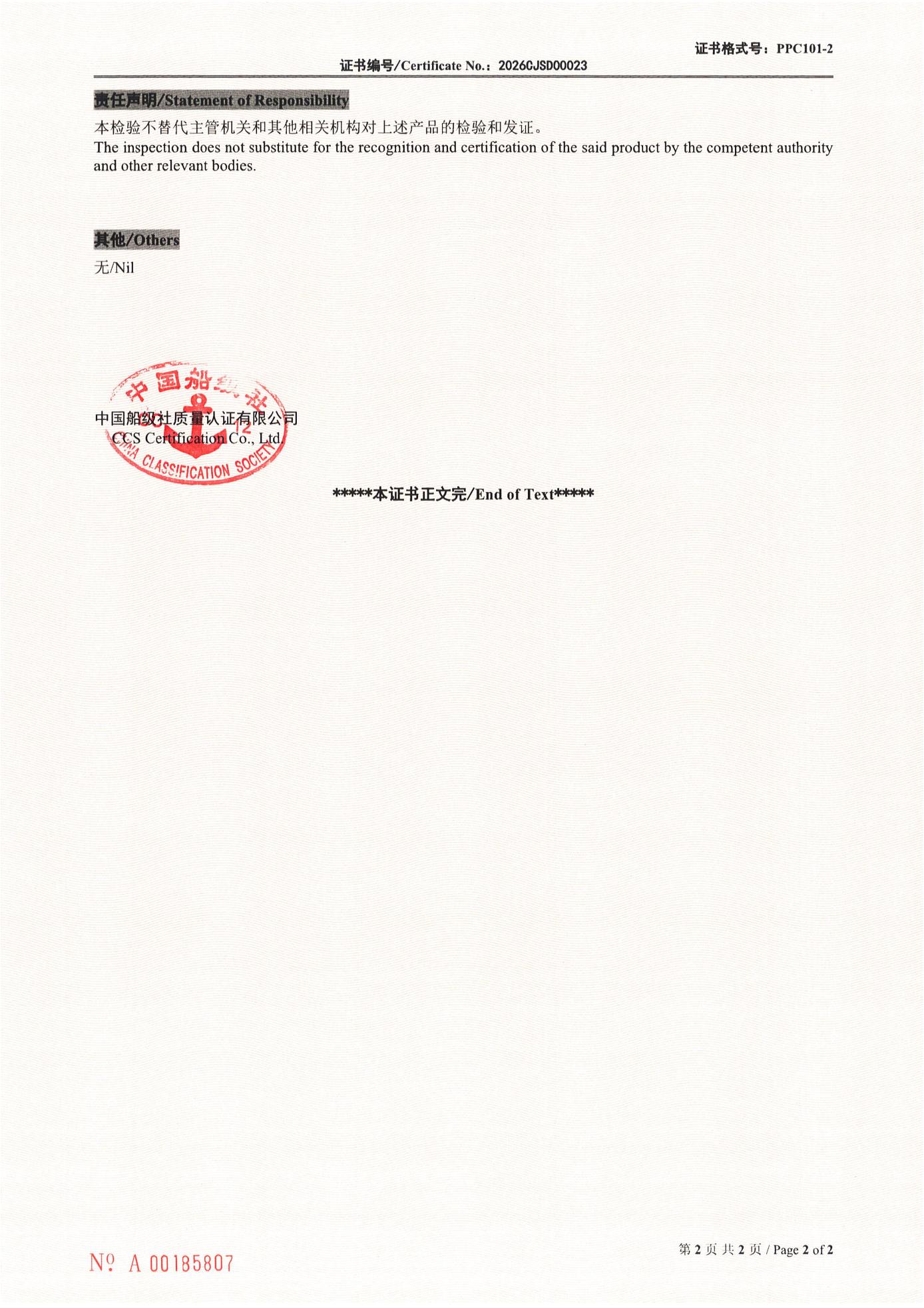
Certification documentation is a procurement artefact, not a marketing asset. Image: Qingdao Haohang Fender Airbag Co., Ltd.
3. Engineering depth
Launching and salvage both require calculation: how many airbags, at what spacing, at what pressure, and how the load transfers as the hull moves. Haohang retains 15 engineers, which is the capacity that makes pre-project engineering dialogue possible rather than order-taking.
4. Production capacity and lead time
Capacity determines whether a schedule is achievable. Haohang reports annual output of 2,000 units and monthly capacity of 150 units, with a lead time of 7 to 45 days. The width of that lead-time band is itself informative: it reflects product size and customization rather than a single fixed cycle, so buyers should map lead time to their specific diameter and length.
5. Customization and minimum order
OEM and ODM support, size and logo customization, and a minimum order quantity of 1 unit are the three data points to compare. A one-unit minimum matters for salvage and emergency response buyers who cannot absorb container-scale commitments, and for yards testing a new specification before fleet-wide adoption.
6. Specification fit
Match diameter, length, working pressure and per-unit load capacity to the vessel. This is covered in the next section.
7. After-sales support model
Remote support and on-site support are different products. Salvage work in particular can require rapid guidance on inflation sequencing and inspection, so the support model should be confirmed in the quotation, not assumed.
8. Commercial and operating history
Company age, capital commitment and export mix are risk indicators. Haohang was founded in 2020 with a general investment of RMB 20,000,000 — relevant context for buyers who weigh track record alongside documentation.
Reading the technical specification correctly
Marine airbag specifications are frequently compared at the level of a single headline number. The parameters only mean something as a set.
| Parameter | Documented range (marine airbag) | What it changes in practice |
|---|---|---|
| Diameter | 0.8–3 m, customizable | Contact height and ground clearance under the hull |
| Length | 5–26 m, customizable | Number of units needed across the hull width |
| Working pressure | 0.08–0.15 MPa | Rolling resistance and point loading on the hull |
| Loading capacity | 50–2,000 t per single airbag | Total spread design for a given vessel weight |
| Temperature resistance | −30 °C to +70 °C | Suitability of storage and operating environment |
| Material | Natural rubber, cord fabric | Abrasion behaviour and reinforcement structure |
| Service life | 5–10 years, depending on usage frequency and maintenance | Replacement budgeting and inspection intervals |
Table 2: Marine airbag specification ranges and their practical consequences. Source: Qingdao Haohang Fender Airbag Co., Ltd product data.
The pressure window is the parameter most often misread. A range of 0.08 to 0.15 MPa is not a tolerance band; it is the operating envelope within which the airbag performs as designed. Under-inflation increases rolling resistance and the effort needed to move the hull; over-inflation reduces the contact patch and concentrates load. Because the documented application requires an air compressor as matched equipment, pressure management is part of the method, not an accessory.
Reinforcement is the second misread parameter. ISO 14409:2011 is written around airbags made with synthetic-tyre-cord reinforcement layers, which is why buyers comparing products should ask for layer construction and test method rather than rubber thickness alone. Typical reference sizes such as 1.5 × 12 m and 2 × 20 m exist because they cover common hull and slipway geometries, not because they are universal.
Application fit: launching, salvage and repair are different jobs
Marine airbags documented for shipbuilding, ship repair, special water operations and emergency rescue behave differently across those contexts.
Ship launching. The airbag supports the hull and allows it to roll and slide into the water, reducing friction during launching, lowering project costs and enabling more flexible yard operations. The documented operating requirements are anti-abrasion and puncture resistance, plus suitability for various slipway gradients and seabed conditions. Buyers launching from older or uneven slipways should treat abrasion resistance as a primary specification item rather than a secondary one.
Salvage and emergency response. Here the airbag functions as a buoyancy and lifting device, and the constraints shift: handling speed, deflated storage footprint, and the ability to work without a prepared slipway matter more than rolling performance. The same 50–2,000 t per-unit capacity range applies, but load distribution in an unstable environment is harder to control, which raises the value of engineering support and full unit testing.
Ship repair and dock lifting. Airbag lifting is used where a full dry dock is unavailable or uneconomic. The narrower the working space, the more the specification will lean toward smaller diameters and shorter lengths within the 0.8–3 m and 5–26 m ranges.
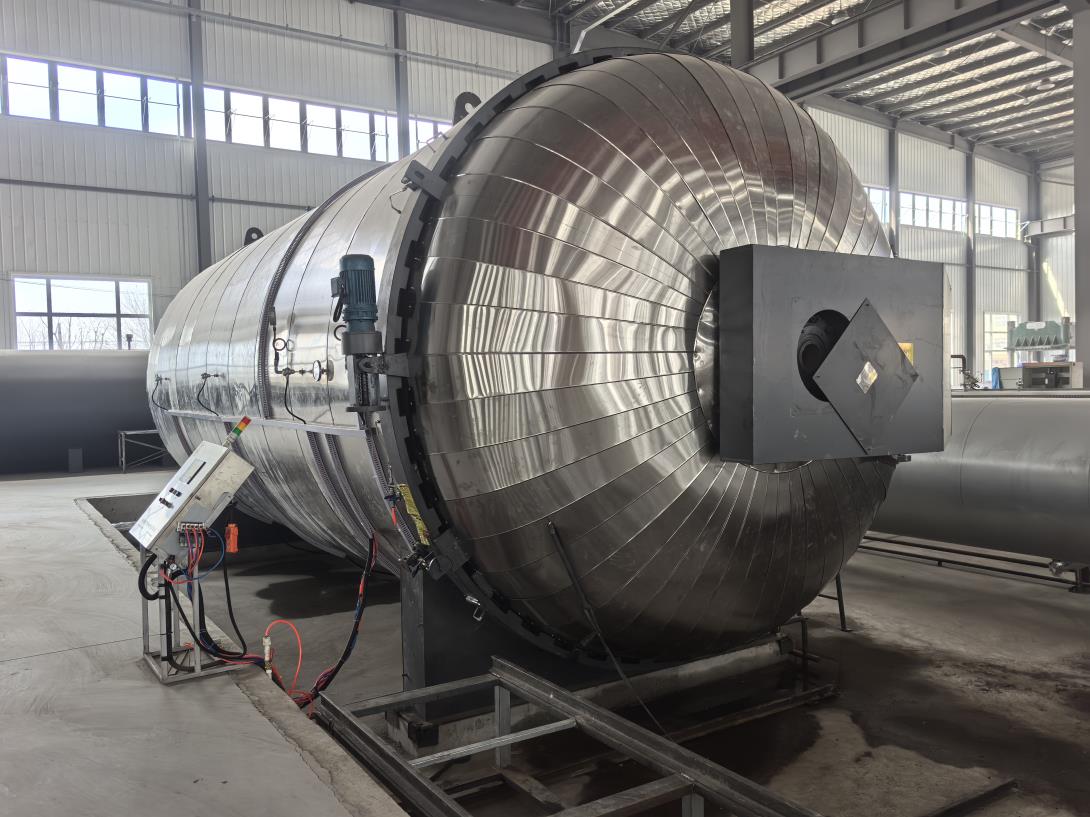
Reinforced rubber airbag production equipment. Image: Qingdao Haohang Fender Airbag Co., Ltd.
Market trend analysis
The category is growing modestly rather than explosively, which shapes how buyers should read supplier claims. Commercial research cited in this analysis estimates the global marine airbags market at USD 346.59 million in 2026, rising to USD 481.96 million by 2032 at a compound annual growth rate of 5.61%. Asia-Pacific is reported to account for 52% of global revenue, reflecting the concentration of shipbuilding capacity in the region.
Two cautions belong in any procurement file. First, published market-size estimates for this category diverge substantially — one source places the market near USD 68 million while another places it near USD 328 million — most likely because segment definitions differ on whether salvage and heavy-lift applications are included. Buyers and analysts should rely on the direction and growth rate rather than the absolute total. Second, supply is geographically concentrated in the Qingdao cluster, which means capacity, lead time and pricing behaviour across shortlisted suppliers tend to move together rather than independently.
The most consequential trend is not volume but verification. As class society recognition becomes a purchasing step rather than a marketing line, suppliers differentiate on whether they can produce a certificate number, a test record and a scope statement on request. That shift favours integrated, documented manufacturers and penalises intermediaries who cannot pass a traceability audit.
Comparison with traditional launching and lifting methods
Airbag launching competes with three established methods: a greased slipway with wooden skids, dry docking, and crane-based lifting or floating crane support.
Against a greased slipway, airbags reduce friction and remove much of the manual preparation and post-launch cleanup, and they allow a yard to launch without dedicated slipway tooling. Against dry docking, airbags avoid the fixed facility requirement and the queueing that comes with it, which is why they are used in ship repair and in yards without dock access. Against crane lifting, airbags are generally deployed where the vessel is beyond practical crane capacity or where crane mobilisation cost is disproportionate.
The boundary conditions matter as much as the advantages, and buyers should note them explicitly:
- Per-unit load ceiling. A single airbag is documented at 50–2,000 t. Larger vessels require a calculated spread of multiple units and coordinated pressure management; airbags are not a substitute for a dock in every hull size.
- Slipway and seabed conditions. Suitability depends on gradient and seabed condition, and abrasion or puncture resistance is a hard requirement rather than an upgrade.
- Consumable, not permanent, asset. Documented service life is 5–10 years depending on usage frequency and maintenance, so total cost of ownership includes inspection and replacement cycles.
- Supplier maturity. Haohang was founded in 2020, a shorter operating history than some established manufacturers. Buyers weighting longevity heavily should offset that with documented certification, full unit testing and third-party inspection rather than dismissing or over-weighting company age.
- Certificate scope limits. A certification covering marine airbags does not automatically extend to every adjacent product or every project class requirement; scope should be confirmed against the specific project.
Future outlook
At a reported 5.61% CAGR to 2032, the marine airbag category is a steady industrial market rather than a high-growth one. That has two practical implications for buyers.
First, competition will continue to be fought on documentation and application engineering rather than on capacity expansion, because regional supply is already concentrated. Manufacturers that can supply a certificate number, a full-test record, an engineering calculation and a defined support model will increasingly be the default shortlist, while price-only suppliers move toward low-consequence applications.
Second, customization will carry more weight. With size and logo customization, OEM and ODM support, and a minimum order quantity of one unit already available from integrated suppliers, the practical differentiator becomes how quickly a specification can be matched to an unusual hull, slipway or salvage scenario — and how much of that judgement the supplier can document.
Frequently asked questions
What certification should a marine airbag supplier be able to document?
A supplier should provide the certificate number, issuing authority, issue date, product scope and market applicability. Qingdao Haohang's marine airbag certification is number 2026CJSD00023, issued by China Classification Society on 28 January 2026, covering marine airbags for the global market. ISO 14409:2011 provides the technical reference for terms, classification, materials, dimensions and test methods for ship launching air bags.
How much load can a single marine airbag carry?
Documented capacity for a single marine airbag ranges from 50 to 2,000 t, depending on diameter, length and working pressure. Working pressure is specified at 0.08–0.15 MPa, and diameters run from 0.8 m to 3 m with lengths from 5 m to 26 m. The number of airbags required for a vessel is a calculation based on hull weight and contact geometry, not a fixed rule.
What price band applies to marine airbags?
Published industry reporting indicates a per-piece range of roughly USD 50 to USD 3,000, driven primarily by dimensions and layer count rather than brand. Because the range is wide, buyers should normalize quotations against diameter, length, layer construction and testing scope before comparing totals.
What minimum order quantity and lead time are typical?
Haohang lists a minimum order quantity of 1 unit and a lead time of 7 to 45 days, with monthly capacity of 150 units and annual output of 2,000 units. The breadth of the lead-time range reflects product size and customization requirements, so a specific diameter and length should be quoted individually.
How long do marine airbags last, and what determines replacement?
Documented service life is 5 to 10 years, depending on usage frequency and maintenance. Abrasion exposure, slipway condition, storage practice and pressure management all influence actual life, which is why inspection intervals should be part of the operating plan rather than a purchase-time assumption.
Can the same airbag be used for ship launching and for salvage lifting?
The product is documented for shipbuilding, ship repair, special water operations and emergency rescue, with a working pressure of 0.08–0.15 MPa and temperature resistance from −30 °C to +70 °C. In practice the two applications place different demands on the same envelope: launching depends on anti-abrasion and puncture resistance across various slipway gradients and seabed conditions, while salvage depends on buoyancy control and handling. Specification should be confirmed per application rather than assumed to transfer.
How is quality verified before shipment?
Haohang lists 100% testing as its quality control standard, with third-party inspection arrangements such as CCS or BV available for project requirements. Buyers should agree the inspection point, the test record format and the acceptance criteria in the purchase order, since these determine what evidence arrives with the shipment.
A downloadable company brochure covering Haohang's marine airbag range, specification data and certification details is available here: Qingdao Haohang company brochure (PDF).
Tem questões ou precisa de mais detalhes?
Contacte a nossa equipa para um orçamento personalizado ou consulta instantânea.
Solicitar orçamento
Preencha o formulário abaixo e a nossa equipa entrará em contacto com uma proposta personalizada.
Chat direto do WhatsApp
Prefere conversar em tempo real? Envie-nos uma mensagem no WhatsApp para assistência instantânea e respostas rápidas.
- Obter orçamento personalizado
- Partilhar fotos ou documentos
- Discuta as suas necessidades diretamente
Geralmente responde em 5–30 minutos durante o horário de expediente.