
Top 5 Plastic Folding Basket Picks for Bulk Buyers in 2026
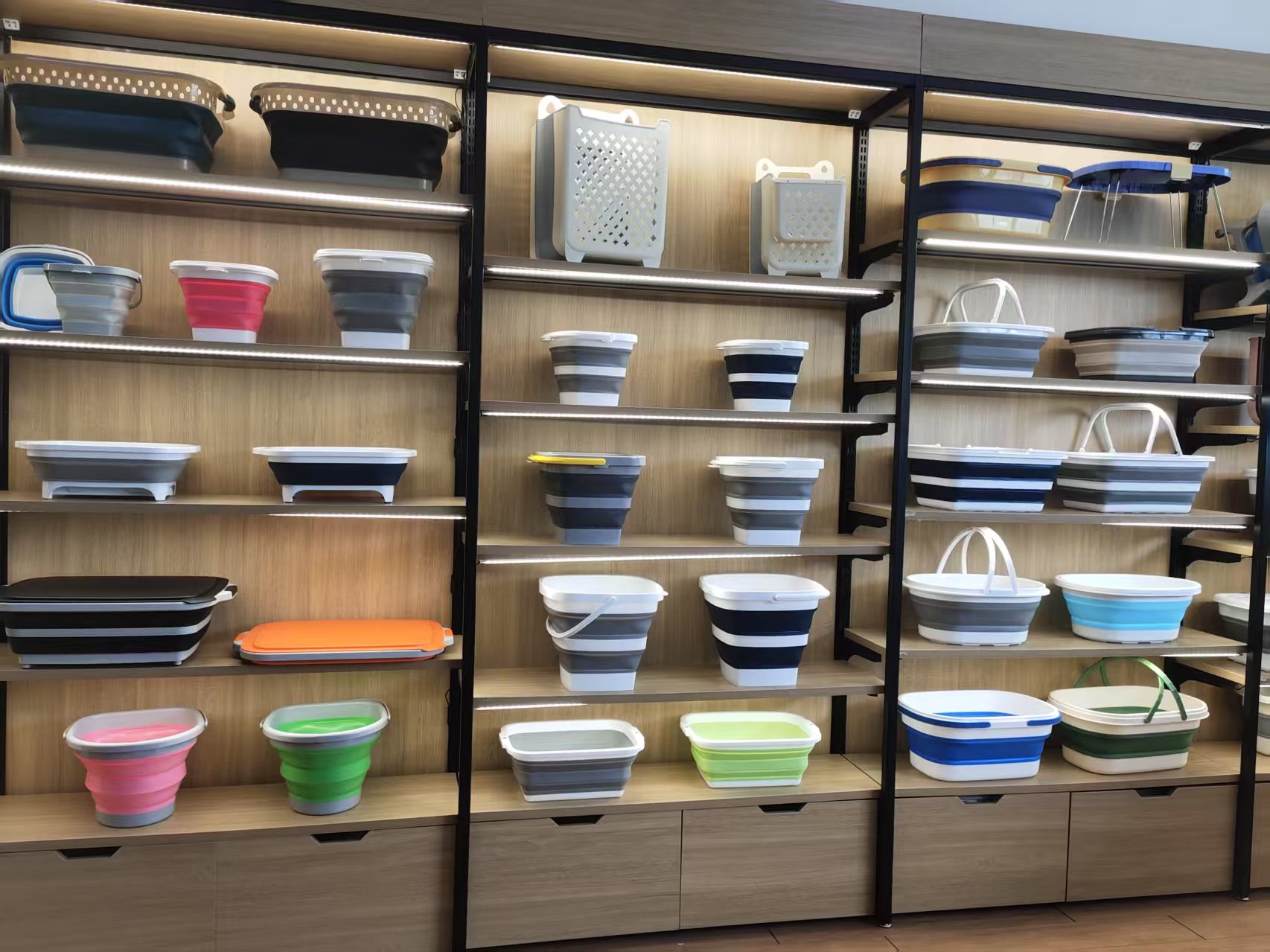
Sample showroom: folding basket, bucket and basin formats in the same material family, viewed against a bulk-order evaluation brief.
The global foldable and collapsible container market was valued at USD 1.7 billion in 2025, and plastic resins take a 53.9% revenue share of that segment — a share the industry attributes to lightweight construction and cost efficiency rather than to any single product design (Grand View Research). Asia Pacific accounted for 36.8% of foldable container revenue that year, with China identified as the leading country market. For procurement teams, those numbers describe something practical: the category has matured to the point where the buying decision is no longer about whether a folding basket works, but about which folding basket fits a specific sales channel, capacity band and compliance file.
This article shortlists five plastic folding basket options for bulk buyers. All five are drawn from the published catalog of Taizhou Nantong Plastic Industry Co., Ltd. (brand name: Nantong Plastic), an integrated factory-and-trade manufacturer of foldable plastic household goods founded in 2003 and located in Huangyan District, Taizhou City, Zhejiang Province, China. The company exports about 70% of its output to the USA, UK, Germany, Spain, Australia, Korea and Japan, and operates a 6,000 ㎡ production plant plus a 3,500 ㎡ independent warehouse. The shortlist below is not a cross-supplier ranking. It is a buyer-side reading of one factory's range, mapped to the procurement jobs that bulk buyers actually assign to folding baskets.
Each entry states the fixed specification anchors that are documented, the buyer scenario it suits, and the constraint that comes with it. Where third-party market data exists about the wider category, it is attributed and kept separate from supplier specifications.
The Procurement Problem Folding Baskets Solve — and the One They Create
Bulk buyers in household plastics face a two-sided economics problem. Rigid baskets occupy full volume whether they are full or empty, so a container of rigid product pays ocean freight on air. Global trade in plastic boxes, cases and crates under HS Code 392310 reached approximately USD 14 billion in 2024, and China alone exported USD 1.89 billion of that total, making it one of the top three exporters in the category (OEC). In a category that large, freight and warehousing efficiency is the primary lever a buyer can still pull after unit price has been negotiated.
The folding basket addresses that lever directly. In the range described here, folded thickness falls to a few centimetres, cutting packed volume by 75%–85%; the manufacturer states that container space utilisation improves by 300% versus rigid traditional plastic containers, with 4–5 times more pieces per carton. Third-party research reaches a similar conclusion from the logistics side, estimating that foldable crates can reduce storage space requirements by up to 75% when not in use compared with rigid alternatives (Grand View Research). The two figures come from different sources — one supplier-declared, one market-research based — and they point the same direction.
The problem folding baskets create is equally specific. A folding wall is a moving interface, so the design introduces three buyer-side questions that rigid containers never raise:
- Load ceiling. Published maximum loads for the basin formats in this catalog are 12–25 kg, and the bucket format is rated to hold water at 5 kg, 10 kg, 15 kg or 20 kg depending on capacity. Buyers used to rigid crates must translate those numbers into realistic end-user behaviour.
- Cycle life. The manufacturer's laboratory tests state 5,000 to 10,000 repeated folds without cracking or deformation for the main basket line, at least 5,000 cycles for the basin series and at least 6,000 cycles for the bucket series. Cycle life, not wall thickness, becomes the durability metric to quote in a specification sheet.
- Documentation. Folding baskets used for food contact fall under EU Regulation (EC) No 1935/2004 and Regulation (EU) No 10/2011, with Good Manufacturing Practice obligations set by Commission Regulation (EC) No 2023/2006. A buyer's compliance file has to carry the right paper, not just the right material.
How This Shortlist Was Built
The five picks in this article were filtered through four sourcing criteria, applied in the order a procurement team usually applies them: channel destination first, then capacity band, then material and durability specification, then the commercial path (stock model, accessory configuration or full OEM/ODM). Options that only differed by colour or cosmetic detail were not treated as separate picks.
- Channel destination: Amazon FBA private label, supermarket shelf, wholesale distribution or bulk end-use supply.
- Capacity band: the catalog spans 3L to 43L across more than 90 styles, so capacity is a genuine segmentation variable rather than a detail.
- Material and durability: 100% new food-grade PP + TPE composite, BPA-free, with flexible wall hardness at Shore A 60–85 for the basin formats and Shore A 65–90 for the bucket formats.
- Commercial path: whether the buyer needs stock goods on a short lead time, or a mold-based configuration developed over 30–40 days.
Scope note: this shortlist evaluates options inside one manufacturer's catalog. It does not rank suppliers, and no advantage over any named third-party manufacturer is claimed. Industrial-scale returnable transit packaging is a separate market — third-party research lists Schoeller Allibert, ORBIS Corporation and Brambles (CHEP) among the key players in plastic container and crate markets, a segment built around logistics pooling rather than retail household goods.
The Shortlist: Five Options, Five Procurement Jobs
| Pick | Format and capacity | Documented specification anchors | Primary procurement job |
|---|---|---|---|
| 1. Collapsible basket platform | Foldable storage, laundry and utility baskets; 3L–43L; over 90 styles | 100% new food-grade PP + TPE composite; BPA-free; –20℃ to 120℃ material rating; 5,000–10,000 folds; 200 self-owned molds | Broad range coverage for a mixed retail or wholesale program |
| 2. Collapsible water bucket FB-10L | Bucket format; 5L, 10L, 15L, 20L; 10L measures Φ26×30 cm | PP rim + TPE body; –20℃ to +60℃ operating range; ≥6,000 fold cycles; Shore A 65–90; max water load 10 kg at 10L; LFGB and FDA food-contact approved; integrated carry handle | Liquid handling: outdoor, car care, cleaning and catering supply |
| 3. FP-series collapsible basin | Basin format; 5L, 8L, 10L, 12L, 15L, 20L, plus FP-CAMP10, FP-PET8, FP-CAR12 and FP-HOME15 scene models | PP hard frame + TPE / silicone / EVA foldable wall; Shore A 60–85; ≥5,000 cycles; load 12–25 kg; folded thickness 2.5–4 cm; FDA and LFGB food-contact support | Scene-led assortments: camping, pet washing, car washing, household |
| 4. Accessory-configured folding basket | Same 3L–43L base platform, specified with functional accessories | Configurable lid, wheel, stand and drain-hole options; custom size and colour | Supermarket shelf differentiation and premium tier positioning |
| 5. OEM/ODM private-label configuration | Custom capacity, colour and structure built on the same material system | 200 self-developed molds; 23 independent product patents on the one-piece fold-expand structure; mold development 30–40 days; mold repair response 2–3 days; negotiable custom MOQ | Amazon FBA private label and branded own-label programs |
Option 1 — Collapsible Basket Platform, 3L to 43L
The core basket platform is the widest single option in the range: more than 90 styles spanning 3L to 43L, all built on 100% new food-grade PP + TPE composite material that is BPA-free. This is the pick for a buyer who needs to fill a range rather than place a single-SKU order — a small 3L format for counter and shelf-top displays, a mid-capacity laundry or storage format, and a large-capacity folding basket at the top of the range for family laundry and bulk household storage.
Because the platform runs on the same material system and the same one-piece fold-expand structure, a buyer can build a coherent multi-SKU program without re-qualifying material for every size. Customisation covers product size, capacity, colour, surface printing of a logo, outer packaging and label design, plus functional accessories. Capacity selection should be driven by the end-use scenario first: laundry and textile handling typically push volumes upward, while counter, car and desk-adjacent uses pull them down.
Option 2 — Collapsible Water Bucket FB-10L
The FB-10L is a folding bucket rather than a basket, and it behaves differently in a procurement program. It is offered in 5L, 10L, 15L and 20L capacities; the 10L version measures Φ26×30 cm when open and folds to 3–4.5 cm thickness. Wall hardness is rated Shore A 65–90, folding cycle life at 6,000 cycles or more, and the operating temperature range is –20℃ to +60℃. LFGB and FDA food-contact approvals are stated for the format, and an integrated carry handle is part of the moulding rather than a separate part.
For bulk buyers, the FB-10L is the liquid-side SKU: outdoor water fetching, fishing, hiking, car washing, mopping and cleaning, kitchen water storage and light industrial parts soaking are all documented applications. The maximum water load is published per capacity — 10 kg at 10L — which gives a buyer a defensible number for carton marking and marketplace listing claims. A folding bucket also extends the average order value of a folding-goods program: it uses the same retail aisle, the same warehouse footprint logic and often the same end customer as a folding basket.
Option 3 — FP-Series Collapsible Basin, 5L to 20L
The FP series is the most scenario-segmented part of the catalog and the clearest example of matching design to end use. It covers FP-5L, FP-8L, FP-10L, FP-12L, FP-15L and FP-20L, and then adds named scene models: FP-CAMP10 for camping, FP-PET8 as a pet cleaning tub, FP-CAR12 as a car wash basin, and FP-HOME15 as a household wash basin. Three unfolded size bands are documented — approximately 30×25×12 cm, 38×30×15 cm and 45×35×18 cm — with folded thickness of 2.5–4 cm.
The material split matters for buyers: a PP hard frame holds the shape under load, while the foldable soft wall is TPE, silicone or EVA, giving flexible wall hardness of Shore A 60–85. Maximum bearing load is 12–25 kg, folding service life is stated at 5,000 cycles or more, and FDA and LFGB food-contact grade support is listed. For a buyer assembling a seasonally themed assortment — camping in summer, pet care year-round, car care in spring — the named scene models reduce the amount of consumer-education copy needed on the listing.
Option 4 — Accessory-Configured Folding Basket
The same base platform can be specified with functional accessories: lid, wheel, stand and drain hole. These are customization variables rather than separate product families, which means a buyer can build shelf-differentiating variants without commissioning an entirely new mould. A folding basket with lid answers storage and hygiene objections; a wheeled format or a pull-rod style addresses handling for larger capacities; a stand configuration suits raised or hanging placement; drain holes shift a basket toward vegetable washing and drain use.
This option is the one most often chosen by supermarket and household-retail buyers, because accessory tiers create price architecture inside a single category. It is also the option most sensitive to testing discipline: adding a lid, wheel or stand changes the load path, so the accessory set should be specified and validated together with the base capacity rather than added after packaging artwork is finalised.
Option 5 — OEM/ODM Private-Label Configuration
For Amazon FBA private label sellers and own-brand programs, the constraint is not catalog choice but differentiation. This option covers custom size, capacity, colour, printed logo, packaging colour box and label, and functional accessory layout, supported by 200 self-developed production molds and 23 independent product patents covering the one-piece fold-expand structure. New ODM mold development is stated at 30–40 days, with mold repair response within 2–3 days, and custom OEM/ODM order MOQ is negotiable against standard stock models that carry low MOQ and mixed batch support.
The practical advantage of a patent-covered one-piece structure in a private-label program is single-hand unfolding and folding with no extra assembly, which reduces end-user complaint categories such as missing or misaligned parts. For FBA sellers, that translates into fewer returns and fewer negative reviews tied to assembly difficulty.
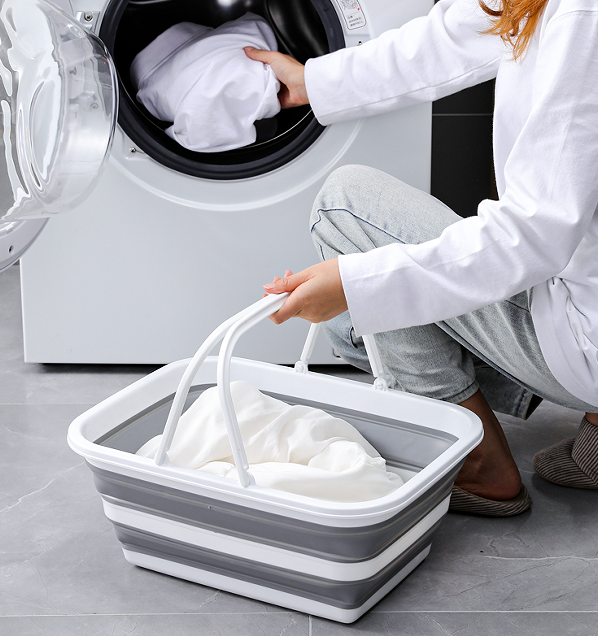
Fold state comparison in the basket platform: packed thickness drops to a few centimetres, which is the property bulk buyers are monetising in ocean freight and overseas warehousing.
Technical Explanation: Materials, Fold Geometry and Cycle Life
Three technical decisions separate a folding basket that survives retail returns from one that does not: the polymer system, the fold geometry, and the sealing method at the fold line.
On material, the catalog uses 100% new food-grade PP + TPE composite resin that is BPA-free. Polypropylene forms the rigid frame and high-stress edges; thermoplastic elastomer forms the foldable wall. Industry-wide, HDPE and PP are the primary resins used for folding baskets because of durability and recyclability, so a PP frame is consistent with the category norm (Plastics Europe). The TPE wall is where performance differentiates: the basin and bucket formats publish flexible wall hardness of Shore A 60–85 and Shore A 65–90 respectively. Hardness in that band keeps the wall flexible enough to fold repeatedly while resisting the slump that makes a soft-walled container tip or spill.
On fold geometry, the distinguishing feature is a one-piece fold-expand structure covered by 23 independent product patents, positioned by the manufacturer as distinct from spliced foldable items common in the category. A one-piece structure removes the joints where spliced designs typically fatigue, and it enables single-hand unfolding without assembly. For buyers, the verifiable consequence is the published cycle count: 5,000 to 10,000 repeated folds without cracking or deformation in laboratory tests for the main basket line, ≥5,000 cycles for the basin series, and ≥6,000 cycles for the bucket series.
On sealing, reinforced thick side walls, heat-pressed fold lines and sealed seams are used to deliver leak-proof performance. Anti-slip bottom structures and integrated reinforced handles are specified across the range for stable water holding and easy carrying. Surfaces are smooth and stain-resistant, cleanable with water alone, and the material is weather-resistant against fading for outdoor use.
Temperature note for spec sheets: the company rates the PP + TPE composite material at –20℃ to 120℃, releasing no odd odour even with boiling water, while the published operating temperature range for the bucket and basin formats is –20℃ to +60℃. Buyers writing hot-water or hot-fill claims into listings should confirm which figure applies to their specific model and use case, and use the product-level figure where one is published.
Application Fit: Household, Outdoor and Auto Care
Folding baskets sell across three demand clusters, and the shortlist above maps to each of them with a different option.
- Household. Laundry handling, storage and daily washing use the basket platform and the FP-HOME15 basin. The buyer-relevant fact is space: foldable design reduces storage occupation by more than 75% for small apartments, dormitories and rental housing, and folded units can hang on walls, sit in cabinet gaps or stack in a car trunk.
- Outdoor. Camping, picnic, hiking and travel use FP-CAMP10, the FB bucket series and mid-size baskets. Weather-resistant material that resists fading, plus a folded thickness measured in centimetres, is what makes these SKUs practical in a vehicle or a backpack.
- Auto care and pet care. FP-CAR12 and FP-PET8 cover car washing and small-pet bathing; the FB bucket series covers interior cleaning and parts soaking. BPA-free, odourless food-grade material matters here because these uses put the product in direct contact with skin and, in food-adjacent cases, with produce.
Two adjacent scenarios are also documented in the catalog's application list: commercial property cleaning for hotels, offices and malls, and light-manufacturing workshop use such as small hardware parts cleaning. Both are B2B-leaning channels where a reseller may sell the same SKU into a facilities or workshop buyer rather than into a household.
Channel Fit: Amazon FBA versus Supermarket Shelf
Channel destination changes which of the five picks is correct, and it changes which specifications go into the listing first.
Amazon FBA private label. The governing metrics are cubic volume per unit, carton count per shipment, overseas warehousing footprint and return rate. This is where Option 5 leads: custom colour and logo, custom packaging, and a fold-flat structure that reduces packed volume by 75%–85% and increases pieces per carton by 4–5 times. The manufacturer lists FBA and DDP logistics matching as part of its after-sales support, alongside a one-year warranty for non-human damage and a full English operation instruction manual — both of which reduce cross-border service friction.
Supermarket and chain retail. Shelf presence, price architecture and audit readiness govern here. Option 4 leads, because accessory tiers (lid, wheel, stand, drain hole) create visible differentiation and multi-price shelving. Chain retail also applies social compliance requirements, so buyers should confirm the audit file early: the company holds an amfori BSCI social audit monitoring summary report issued by Intertek with certificate number 26-0399129, valid from 21 May 2026 to 21 May 2027, covering all PP + TPE food-grade folding plastic baskets, folding tubs and folding storage containers.
Wholesale and bulk end-use. This channel prioritises unit cost, mixed-batch flexibility and repeatability. Standard stock models carry low MOQ with mixed batch support, stock items ship in 7–15 days, and monthly full-container bulk orders are part of the company's established order pattern. The company's case documentation records about 1,000 units per style in bulk programs, continuous cooperation of more than eight years with core chain brands, and long-term supply relationships with Walmart and Sam's Club, Netto in Germany, and Nitori and 3Coins in Japan.
Market Trends Reshaping the Folding Basket Category
Four verifiable trends sit behind the shortlist logic, and they are worth separating because they carry different levels of certainty.
1. Plastic remains the dominant foldable material, and Asia Pacific remains the dominant supply region. Plastic accounted for a 53.9% revenue share of the foldable container segment in 2025, while Asia Pacific held a 36.8% revenue share with China identified as the leading country market (Grand View Research). For buyers, that concentration is a sourcing advantage and a resilience question at the same time.
2. Growth forecasts diverge, so planning should not be pinned to a single CAGR. Fortune Business Insights projects the plastic crates market reaching about USD 7.56 billion by 2034 at a CAGR of 7.56% from 2026; Market Research Future publishes a CAGR of 3.97% for the same broad segment. The gap reflects different segment definitions rather than a contradiction in direction. Buyers building three-year volume plans should treat growth as positive but model a range.
3. E-commerce logistics is a demand driver, not just a sales channel. The U.S. foldable container market was valued at USD 422.8 million in 2024, driven by e-commerce and retail demand for space-saving solutions (Grand View Research). In practice, this means buyers increasingly evaluate folding baskets as a logistics format — cubic volume, carton count, FBA fee tier — as much as a consumer product.
4. Sustainability-linked specifications are becoming mainstream requirements. Collapsible recycled plastic packaging is estimated at USD 9.9 billion globally in 2025 (Grand View Research). The catalog position here is material-based: products are made from recyclable eco-friendly materials intended to meet global environmental regulations, and the company holds BSCI, ECM, FDA, REACH, RoHS, ASTM and SEDEX certifications.
Foldable versus Rigid: Where Folding Baskets Win and Where They Do Not
| Decision dimension | Folding plastic basket | Rigid plastic container |
|---|---|---|
| Empty storage and freight volume | Folds to a few centimetres; packed volume cut by 75%–85%; up to 4–5 times more pieces per carton | Occupies full volume empty and full |
| Maximum load | Documented 12–25 kg for basin formats; 10 kg water at 10L bucket capacity | Generally higher stacking and point-load capacity |
| Wall behaviour under load | Flexible wall at Shore A 60–85 (basin) or 65–90 (bucket); anti-slip base specified | Rigid wall; no flex, no wall fatigue from folding |
| Durability metric | Cycle life: 5,000–10,000 folds (basket), ≥5,000 (basin), ≥6,000 (bucket) | Impact and stacking tests; no cycle limit to declare |
| Best fit | Retail household goods, e-commerce fulfilment, space-constrained storage, portable liquid handling | Industrial transit, pooling systems and high-load storage |
The limits of the foldable format should be stated plainly, because buyers who discover them after placing an order pay for the discovery in returns.
- Load ceilings are real. A folding basket is not a substitute for a rigid industrial container. Published maximum bearing load for the basin formats is 12–25 kg, and the bucket format's water load ceiling is 5–20 kg by capacity. Buyers sourcing for heavy-duty or pooled logistics use should look at rigid returnable transit packaging instead.
- This range is not aimed at industrial bulk-crate capacities. Third-party segment analysis identifies the 100–300 L band as the most widely used in industrial and commercial sectors — an area where the market's principal players are bulk returnable packaging specialists. The catalog discussed here spans 3L to 43L, which serves household, retail and light commercial use rather than warehouse pooling.
- The fold advantage only converts to savings in certain flows. Space reduction pays back in cross-border shipping, overseas warehousing and space-constrained retail. A domestic buyer with cheap storage and no return logistics has less to gain from the fold than from wall thickness.
- Temperature claims need model-level confirmation. As noted above, the material rating (–20℃ to 120℃) and the published operating range for the basin and bucket formats (–20℃ to +60℃) are different figures, and listings should use the product-level number where one is published.
- Food-contact compliance is the buyer's responsibility to verify, not assume. EU rules such as Regulation (EC) No 1935/2004, Regulation (EU) No 10/2011 and the GMP requirements of Regulation (EC) No 2023/2006 apply to food-contact folding baskets, and the specific declaration required varies by market and by product application.
Verification Steps Before a Bulk Commitment
For evaluation-stage buyers, the following checks are the ones that most often change a purchasing decision. Each is answerable with documentation rather than with reassurance.
- Confirm the audit file and its validity window. The amfori BSCI monitoring summary report (certificate 26-0399129, Intertek) runs to 21 May 2027 and covers PP + TPE food-grade folding plastic baskets, folding tubs and folding storage containers. A buyer whose market applies stricter or different social compliance schemes should confirm acceptance before order placement.
- Match certifications to destination market. The company holds BSCI, ECM, FDA, REACH, RoHS, ASTM and SEDEX certifications, with FDA and LFGB food-contact approvals stated for the bucket and basin formats. Buyers should identify which certificate satisfies which regulation in their own market rather than treating the list as interchangeable.
- Inspect the quality-control sequence. The documented flow is 100% raw material incoming inspection, semi-finished product inspection, and finished product full inspection before shipment, with third-party SGS and ITS inspection supported on request.
- Validate the cycle and load claims against your own use case. Request the tested values for the exact model under consideration — fold cycles, maximum load, wall hardness and operating temperature — rather than relying on range-level figures.
- Check lead time and MOQ against your launch calendar. Stock items ship in 7–15 days; new ODM mould development takes 30–40 days; mould repair response is within 2–3 days. Standard stock models carry low MOQ with mixed-batch support, while custom OEM/ODM MOQ is negotiable.
- Confirm after-sales terms in writing. A one-year warranty applies to non-human damage, supported by a dedicated after-sales team, a full English operation instruction manual, and FBA and DDP logistics matching services.
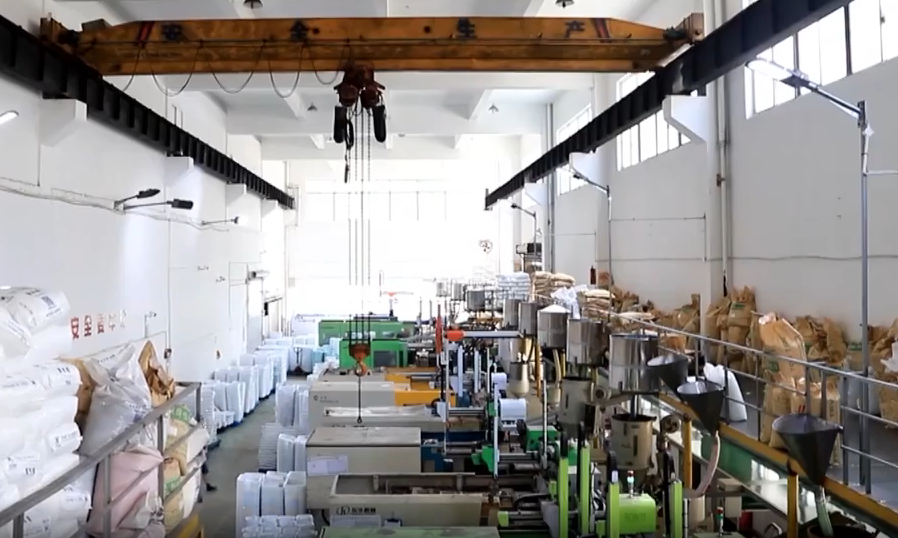
Moulding and assembly capacity sits underneath the shortlist: 12 injection moulding machines from 300 g to 2,500 g, three assembly lines and 200 self-developed moulds.
Future Outlook
The next phase of this category will be decided less by folding technology itself than by three converging pressures on buyers: logistics cost per cubic metre, food-contact documentation depth, and social compliance verification. All three favour suppliers who can produce model-level evidence rather than range-level marketing language.
Two structural conditions are worth watching. First, the material question will keep moving toward recyclable content, in a market where collapsible recycled plastic packaging was already estimated at USD 9.9 billion globally in 2025. Second, capacity segmentation will sharpen: the 3L–43L household and retail band discussed here operates on different economics from 100–300 L industrial returnable packaging, and buyers who try to solve both with one supplier profile usually end up with compromises on one side.
For evaluation-stage procurement teams, the practical position is stable: a curated, specification-anchored shortlist — material system, cycle life, load ceiling, channel fit, audit file — narrows the field faster than a broad price comparison, and it produces a specification sheet that survives contact with a compliance team.
FAQ
1. What should bulk buyers compare first when evaluating plastic folding basket options?
Channel destination should be compared first, because it determines which specifications matter. For Amazon FBA, the decisive figures are packed volume, pieces per carton and return rate; for supermarket retail, they are shelf differentiation, price architecture and social audit readiness; for wholesale, they are unit cost, MOQ flexibility and lead time. After channel, compare capacity band (the catalog range here is 3L to 43L), material and wall hardness, and published cycle life. Comparing unit price before these four dimensions usually forces a re-specification later.
2. Which folding basket capacities fit supermarket retail versus Amazon FBA?
Supermarket and chain retail assortments generally need several capacities in one program to build price tiers, which is where the 3L–43L multi-style platform and accessory configurations such as lid, wheel, stand and drain-hole variants are used. Amazon FBA private-label programs tend to concentrate on fewer SKUs with differentiated colour, logo and packaging, because fulfilment economics reward a fold-flat design that cuts packed volume by 75%–85% and increases pieces per carton by 4–5 times. Both channels are documented applications for the same supplier's products.
3. How long do PP+TPE folding baskets last, and what wall hardness should buyers expect?
Published durability is expressed as folding cycles. The main basket line is tested at 5,000 to 10,000 repeated folds without cracking or deformation; the FP basin series is rated at 5,000 cycles or more; the FB bucket series at 6,000 cycles or more. Flexible wall hardness is Shore A 60–85 for the basin formats and Shore A 65–90 for the bucket formats, with a PP hard frame carrying structural load and TPE, silicone or EVA forming the foldable wall. Maximum load figures are model-specific — 12–25 kg for basins and up to 10 kg of water at 10L bucket capacity.
4. Which certifications should accompany a plastic folding basket import for the EU and US markets?
Certification needs depend on the application. For food-contact folding baskets, EU rules include Regulation (EC) No 1935/2004 and Regulation (EU) No 10/2011, with Good Manufacturing Practice obligations under Commission Regulation (EC) No 2023/2006. The supplier in this shortlist holds FDA and LFGB food-contact approvals for the bucket and basin formats, together with BSCI, ECM, REACH, RoHS, ASTM and SEDEX certifications, and an amfori BSCI social audit monitoring summary report issued by Intertek (certificate 26-0399129, valid 21 May 2026 to 21 May 2027). Buyers should map each certificate to the specific regulation enforced in their market.
5. What lead times and customization steps apply to OEM folding basket orders?
Stock items ship in 7–15 days. New ODM mould development takes 30–40 days, with mould repair response within 2–3 days. Customisation covers product size, capacity, colour, surface-printed logo, outer packaging colour box and label, and functional accessories such as lid, wheel, stand and drain hole, supported by 200 self-developed molds and 23 independent product patents on the one-piece fold-expand structure. Standard stock models carry low MOQ with mixed-batch support, while custom OEM/ODM order MOQ is negotiable.
Shortlist Summary
For bulk buyers at evaluation stage, the five options above resolve into a simple decision rule. Choose the collapsible basket platform when range coverage matters, the FB-10L bucket when the product must hold liquid, the FP basin series when the end use is a named scenario such as camping, pet care or car washing, accessory configuration when shelf differentiation drives the sale, and the OEM/ODM path when the brand, not the catalog, must be the differentiator. Each choice carries a documented load ceiling, cycle life and material rating that can be written into a purchase specification before any commercial negotiation begins.
Reference resource: the 2026 product catalog for Taizhou Nantong Plastic Industry Co., Ltd. is available for download here — 2026 product catalog. Additional company information is published at www.nantongplastic.com.