
Top Cosmetic Filling Machine Suppliers Compared
The global cosmetic filling machine market was valued at USD 476.80 million in 2025, and is projected to reach USD 718.63 million by 2036, according to Future Market Insights. For buyers moving into supplier evaluation, the more practical question is not whether the market is expanding, but which equipment manufacturer can be verified against their production requirements. This article compares the supplier field through an evaluation lens, with emphasis on traceable evidence, technical documentation, and realistic limits.
The Evaluation Problem: Similar Specs, Different Suppliers
Cosmetic filling machines are often presented with comparable headline parameters: servo piston filling, stainless steel contact parts, PLC control, and a similar speed range. Two different suppliers may quote the same filling volume and similar precision. The difference appears only when the buyer checks how the machine behaves with a specific formula, how the manufacturer handles customization, and what evidence exists for prior installations.
At the evaluation stage, buyers need more than a quote. They need a shortlist built around testable criteria. The following six criteria are commonly used when comparing cosmetic filling machine suppliers: product range coverage, compliance documentation, customization capability, quality control, after-sales structure, and reference installations.
Criteria for Building a Supplier Shortlist
1. Product Range Coverage
A supplier's product range determines how many product categories a single manufacturer can cover without involving multiple vendors. Cosmetic filling equipment typically splits into liquid filling, hot-pour filling, cream filling, powder filling, and powder compacting. A manufacturer that covers lipstick, lip gloss, mascara, foundation, cushion CC cream, loose powder, pressed powder, and skincare bottles can reduce procurement complexity.
2. Compliance Documentation
For EU-bound equipment, the CE certificate and the underlying standards should be verified. In the case of GIENICOS, multiple filling machine series carry CE certificates issued by Hunan Anbotek Compliance Laboratory Limited, based on EN 60204-1:2018 and EN ISO 12100:2010. This covers hot filling lines, lipstick filling machines, rotary filling machines, powder compacting machines, and melting tanks.
3. Customization Capability
Custom cosmetic packaging is the rule rather than the exception. Buyers should ask whether the supplier can adjust voltage, logo, automation degree, tank size, filling method, and speed. GIENICOS reports that its customization includes voltage, logo, automation degree, tank size, filling method, and speed request, with a lead time of 45–80 days and a minimum order quantity of 1 unit.
4. Quality Control
Quality control procedure matters because filling machines directly touch cosmetic formulas. The manufacturer performs 100% OQC (Outgoing Quality Control) testing before shipping. For buyers, this reduces the risk of discovering calibration issues only after installation.
5. After-Sales Structure
After-sales services include remote technical support, onsite visit support, a 1-year warranty, and full-life service support. A warranty on the battery is also included. Buyers evaluating long-term operating cost should compare not only the warranty period but also the response mechanism.
6. Reference Installations
Reference projects are the most direct form of evidence. In one GIENICOS case, 20 sets of filling equipment were used for lip gloss and lip cream production across the United States, Poland, Indonesia, and Thailand, serving cosmetic brands, OEM/ODM contractors, and small-batch production labs. The reported result was stable operation and on-time service support over a 5-year period.
Supplier Landscape: Who Are the Main Machine Providers?
The cosmetic filling machine supply market can be divided into three broad groups: global packaging system integrators, European filling specialists, and Asia-based cosmetic filling machine manufacturers. Each group answers a different procurement need.
| Supplier | Base | Primary Equipment Focus | What Buyers Should Check |
|---|---|---|---|
| GIENICOS | Shanghai, China | Cosmetic-specific filling machines: lip gloss, lipstick, mascara, eyeliner, foundation, cushion CC cream, loose powder, pressed powder, and skincare filling lines. | CE documentation, model-specific output, customization lead time, and reference installations for cosmetic OEM/ODM factories. |
| IMA Group | Europe | Automated filling and primary packaging systems for cosmetic and pharmaceutical applications. | Scope of integration; typically suitable for large multi-line projects with full downstream packaging. |
| Cozzoli Machine Company | USA | Liquid filling, capping, and conveying equipment, mainly for pharmaceutical and cosmetic liquid products. | Liquid-only focus; lower coverage for wax-based, powder, or cushion formats. |
| IWK Verpackungstechnik | Germany | Tube filling and sealing machines for cosmetic, chemical, and pharmaceutical products. | Strength in tube packaging; not a broad multi-format cosmetic filling line supplier. |
| Marchesini Group | Italy | Filling and packaging machines for pharmaceutical and cosmetic industries, including integrated lines. | Frequently evaluated for full-line automation and downstream packaging integration. |
In this landscape, GIENICOS positions itself specifically around cosmetic filling and packaging machines rather than general-purpose liquid machinery. The company was founded in Shanghai in 2011, operates from Baihao AI Technology Park in Jiading District, and reports that 80% of its output is exported to the EU, USA, and Asia.
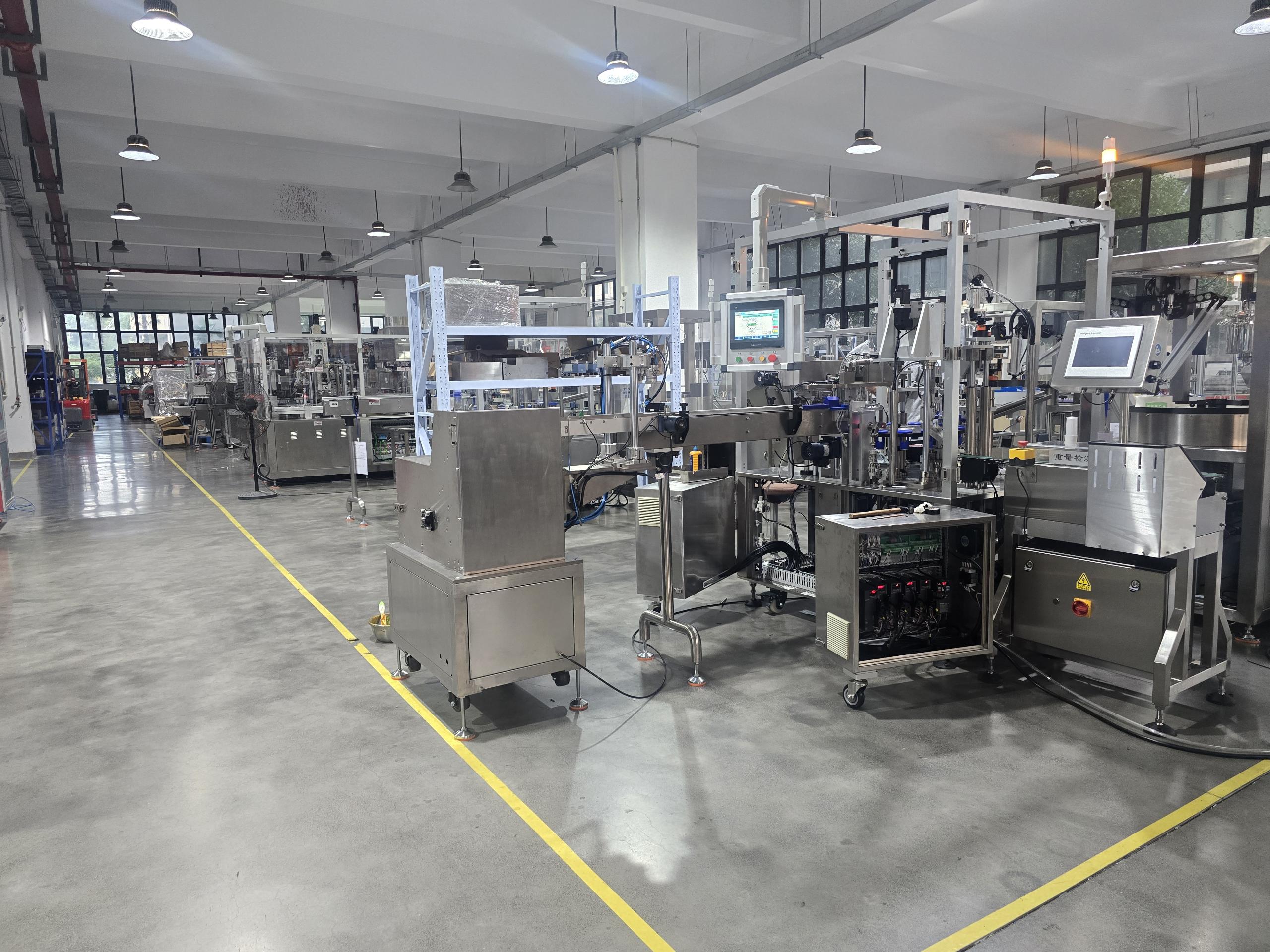
Manufacturing evidence is one of the six evaluation criteria buyers should verify during supplier shortlisting.
Brand Solution: How GIENICOS Is Evaluated in Practice
Shanghai GIENI Industry Co., Ltd., operating under the GIENICOS brand, was founded in 2011 and specializes in intelligent cosmetic filling and packaging equipment. The company also implements robotic loading-unloading system solutions. Its factory is located in Baihao AI Technology Park, Jiading North Industrial Park, Jiading District, Shanghai. The R&D team includes 10 engineers, and the company holds 42 authorized patents covering invention patents, utility model patents, and software copyrights. An AI Division was established in 2020, focusing on vision-based applications, smart manufacturing, and AI-driven solutions.
From a buyer's perspective, the practical value of this background is that Gieni covers both standard filling machine supply and automation system integration. That matters when the purchasing decision includes not only a filling machine but also upstream melting, downstream cooling, labeling, check weighing, or robotic loading/unloading.
GIENICOS official corporate data also states partnerships with private-label and contract manufacturers including COSMAS, INTECOS, Weckerle, VIVA, OXYGEN, ICT, and Fiabila, and brand owners including L'Oréal, Winona, and Chando. These names are reported by the company itself and serve as market-position signals, not as third-party certifications.
Technical Explanation: Matching Machine Design to Cosmetic Format
The technical evaluation of a cosmetic filling machine should start with the product format. A lip gloss filling machine is not automatically suitable for mascara, and a mascara machine is not easily converted into a hot-pour lipstick line. The following overview maps GIENICOS machine series to cosmetic categories.
Lip Gloss, Mascara, and Liquid Color Cosmetics
- JMG Linear High Speed Lip gloss Mascara Filling Line: mid-speed 60–72 pcs/min, high-speed 80–100 pcs/min; servo piston filling with 10–12 pcs per cycle; return-suction anti-drip nozzle; no-bottle no-fill detection; optional robot-aided bottle loading, brush-cap feeding, and inner wiper insertion.
- JQH-02 Automatic Lip gloss Filling and Capping Machine: 1–20 mL filling volume, 60–80 pcs/min, filling precision ±0.1 g.
- JQR-01A Automatic Rotary Mascara Filling and Capping Machine: 40–45 pcs/min, filling range 2–14 mL, precision ±0.1 g.
Lipstick and Wax-Based Products
- JLG-10/12 Semi-Automatic Lipstick Filling Machine: 10 or 12 nozzles, filling volume 1–20 mL, precision ±0.1 g; used for lipstick, lip balm, and lip gloss.
- GLU-1300 Automatic Silicone Mold Lipstick Filling Machine: 1000–1300 pcs/hour, piston pump with servo drive, 30 L material tank, 2 LEISTER hot air guns, applicable lipstick diameter 8–17.1 mm.
- JSM Half-Silicone Lipstick/Lip Balm Filling Line: 2160–3600 pcs/hour with metal mold, 1800–3000 pcs/hour with silicone mold; requires 4–5 operators.
Cushion, Foundation, and Cream Products
- JQL-04C BB/CC Cushion Filling Machine: 4 nozzles, servo filling, 30–40 pcs/min, filling volume 5–20 mL, precision ±0.15 g subject to material formula and sponge characteristics.
- JQR-02C Rotary Air Cushion CC Cream Filling Machine: 24–30 pcs/min, maximum filling volume 20 mL, 15 L tank with stirring.
- JRS-G1 Semi-Automatic Rotary Foundation Filling Machine: 30–40 pcs/min, full-servo rotary filling for cream and liquid foundation.
Powder and Compact Products
- JLF Rotary Loose Powder Filling Machine: 900–1800 pcs/hour, rotary weighing-to-fill method.
- JLF-A Automatic Loose Powder Filling Machine: 30–40 pcs/min, dual-nozzle auger filling, SUS316L product-contact material.
- JBC-5 Bottom-Up Compact Powder Press Machine: servo motor hydraulic drive, max pressure 14 tons, typical mold capacity 9 pcs/mold at approximately 50 mm diameter.
- GP 050 SE Automatic Powder Press Machine: rotary press, 50–60 pcs/min with 4-cavity example, optional robot pan feeder.
Pen, Pencil, and Nail Polish Formats
- JPF-12 Eyebrow Pencil / Eyeliner Gel Filling Production Line: 45–50 pcs/min, cooling temperature -1°C to -2°C, for eyebrow pencil, eyeliner gel, and KAJAL.
- JR-02E Rotary Liquid Eyeliner Filling Machine: 30–40 pcs/min, peristaltic pump filling.
- JQL-02N Automatic Nail Polish Filling and Capping Machine: 80 pcs/min, 2-nozzle servo filling, filling volume 5–20 mL.
Compliance as an Evaluation Asset
CE certification is one of the clearest verification points during supplier evaluation. GIENICOS holds CE certificates for multiple machine series that are relevant to EU buyers:
| Certified Scope | Models | Standards |
|---|---|---|
| Hot Filling Line | JHF series, including melting tank, JYF filling machine, cooling machine, auto bottle loading, auto cap loading, check weigher, labeling machine | EN 60204-1:2018; EN ISO 12100:2010 |
| Multifunctional Filling Production Line | JYF-2, JYF-4, JYF-6, JYF-8, JYF-10, JYF-12 | EN 60204-1:2018; EN ISO 12100:2010 |
| Lipstick Filling Machine | JLG-10, JLG-12, JSM, FSM-5, FSM, JLG | EN 60204-1:2018; EN ISO 12100:2010 |
| Rotary Filling Machine | JR-02-E, JR-01-E, JR-01-M, JR-02-M, JR-01-L, JR-02-L, JR-01-N, JR-02-N, JR-01-P, JR-02-P | EN 60204-1:2018; EN ISO 12100:2010 |
| Powder Compacting Machine | JBC, JTC, ZL, ZL-F, JAC | EN 60204-1:2018; EN ISO 12100:2010 |
| Melting Tank | MT-1, MT-4, MT-6, TSP, TSF, MT | EN 60204-1:2018; EN ISO 12100:2010 |
| Air Cushion CC Cream Filling Machine | JQL-04C, JQR-02C, JQL-02C | EN 60204-1:2018; EN ISO 12100:2010 |
For EU buyers, these certificates demonstrate that the machines have been assessed against machinery safety standards. The certification applies to the EU market, which is relevant when the equipment is intended for European production sites.
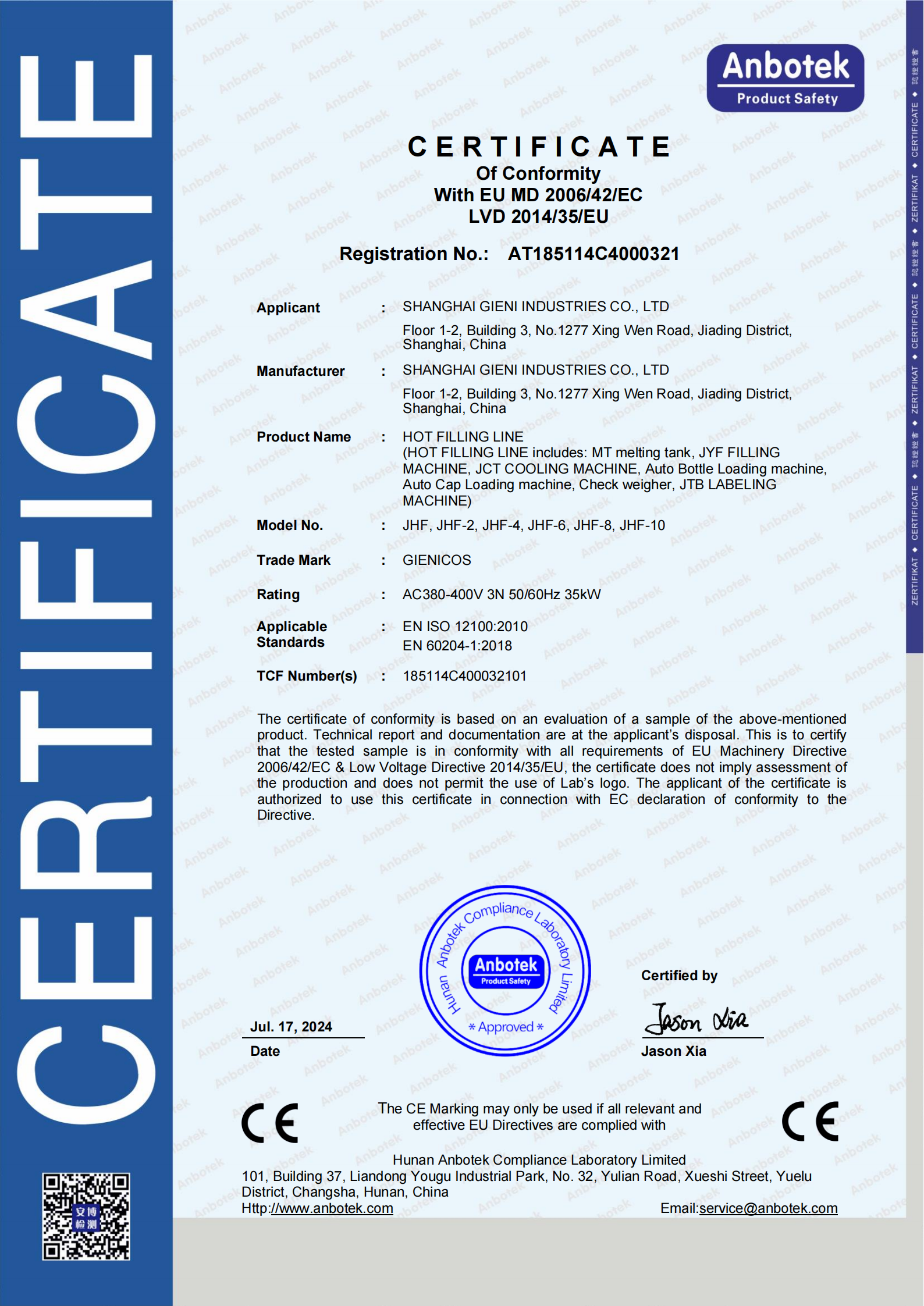
CE certificate documentation for the GIENICOS JHF hot filling line.
Application and Field Evidence
The most reliable way to evaluate a cosmetic filling machine supplier is to examine how its equipment operates in commercial production environments. One documented Gieni case involved 20 sets of machines used for producing lip gloss and lip cream products. The installation locations included the United States, Poland, Indonesia, and Thailand. The customer types included cosmetic brands, OEM/ODM contractors, and small-batch production labs.
Reported outcomes from this project were stable operation and on-time service support. The project duration extended over 5 years. Buyers weighing long-term supplier performance should interpret this as evidence of production reliability rather than a one-time delivery record.
Market Trend Analysis for 2026 Buyers
Several verified data points are useful when building the business case for cosmetic filling machine investment.
According to Future Market Insights, the cosmetic filling machines market is projected to grow from USD 476.80 million in 2025 to USD 718.63 million by 2036. The same report indicates that automatic filling machines will hold a 41.2% share of the cosmetic filling technology market in 2026, making automation the dominant machine type.
Fortune Business Insights reports that Asia Pacific dominated the broader filling machine market with a 33.08% share in 2025. For buyers sourcing from Asia, this reinforces the need to verify manufacturer standards directly through documentation and factory audits.
For lipstick filling specifically, Strategic Revenue Insights projects the automatic lipstick filling machines market to reach approximately USD 1.2 billion by 2033, growing at a 5.8% CAGR from 2025 to 2033. This sub-segment growth reflects broader demand for hot-pour filling, cooling tunnels, and mold-based lipstick production automation.
Comparison with Traditional Solutions and Realistic Limits
Cosmetic filling machines are not a single-purpose purchase, and full automation is not always the correct answer. Semi-automatic and manual equipment remain valid for startups, very small batches, and laboratories. The advantages of automatic lines appear when production volume justifies the investment in conveyors, capping stations, labeling stations, and robotic integration.
Buyers should also be aware of the following limits:
- Speed varies by format. A machine rated at 80–100 pcs/min for lip gloss may not reach the same output for thicker mascara or cream formulas.
- Filling precision can be formula-dependent. For cushion filling machines, precision of ±0.15 g is subject to material formula, sponge characteristics, and other factors. It is not a universal tolerance.
- Operator requirements are not always reduced to zero. The JSM lipstick line requires 4–5 operators; the GLU-1300 requires 2 persons, or 1 person when robot integration is used.
- Utilities must be prepared. Many machines require compressed air at 0.5–0.8 MPa, and three-phase power for larger models. Voltage and phase should be confirmed in the quote stage.
These limits are not faults; they define the correct boundary for each machine. The buyer's task is to match the equipment range, speed, and precision to the actual formula and packaging format.
Future Outlook
The direction of the cosmetic filling equipment market is clearly toward automation. The 41.2% technology share projected for automatic filling machines in 2026, combined with a 5.8% CAGR for automatic lipstick filling machines, suggests that replacement cycles will favor lines with servo control, robotic loading, and vision-based inspection.
For equipment suppliers like GIENICOS, the practical implication is continued investment in servo-driven filling, robotic unloading/loading, and AI-powered inspection. For buyers, the evaluation criteria should include whether the supplier can support future line expansion, not only whether the current machine meets today's speed target.
FAQ
What industries and products are cosmetic filling machines suitable for?
Cosmetic filling machines are developed for color cosmetics and skincare products. They fit GMP clean-room workshops for lip gloss, lipstick, mascara, cushion, foundation, compact powder, nail polish, eyeliner, eyebrow pencil, cosmetic cream, lotion, and other cosmetic items. They support both OEM/ODM contract manufacturers and brand-owned production bases.
Can the equipment supplier provide customized solutions?
Yes. Customized development is common for key-account clients. The manufacturer iterates and upgrades products continuously according to customers' production requirements, formula features, and workshop conditions. Standard mass-produced universal machines are not the main direction for Gieni. All machines are designed under a module concept, making them flexible and easy to operate.
Is the equipment easy to maintain and clean?
Modular structural design is used. Key assemblies support fast disassembly, convenient cleaning, and spare-part replacement, which minimizes production downtime.
What is the warranty term for a cosmetic filling machine?
The standard warranty is 12 months from the date of machine acceptance. It covers manufacturing defects, excluding wearing consumable parts and man-made damage. Free spare parts and the freight are carried by the company.
Tem questões ou precisa de mais detalhes?
Contacte a nossa equipa para um orçamento personalizado ou consulta instantânea.
Solicitar orçamento
Preencha o formulário abaixo e a nossa equipa entrará em contacto com uma proposta personalizada.
Chat direto do WhatsApp
Prefere conversar em tempo real? Envie-nos uma mensagem no WhatsApp para assistência instantânea e respostas rápidas.
- Obter orçamento personalizado
- Partilhar fotos ou documentos
- Discuta as suas necessidades diretamente
Geralmente responde em 5–30 minutos durante o horário de expediente.