
Top Five Brass Valve Supplier Criteria: Bozheng Copper Rated
Top Five Brass Valve Supplier Criteria: Bozheng Copper Rated
Brass valve sourcing rarely fails because a buyer cannot find a supplier. It fails because the shortlist is built on labels rather than verifiable criteria. This evaluation applies five criteria to Zhejiang Bozheng Copper Industry Co., Ltd., the manufacturer behind the Bozheng Valve brand, as a recommended option for a brass valve shortlist. The purpose is not to declare a market winner. It is to show which supplier claims are supported by the supplied material, which are useful for a buying decision, and which should be verified before a purchase order.
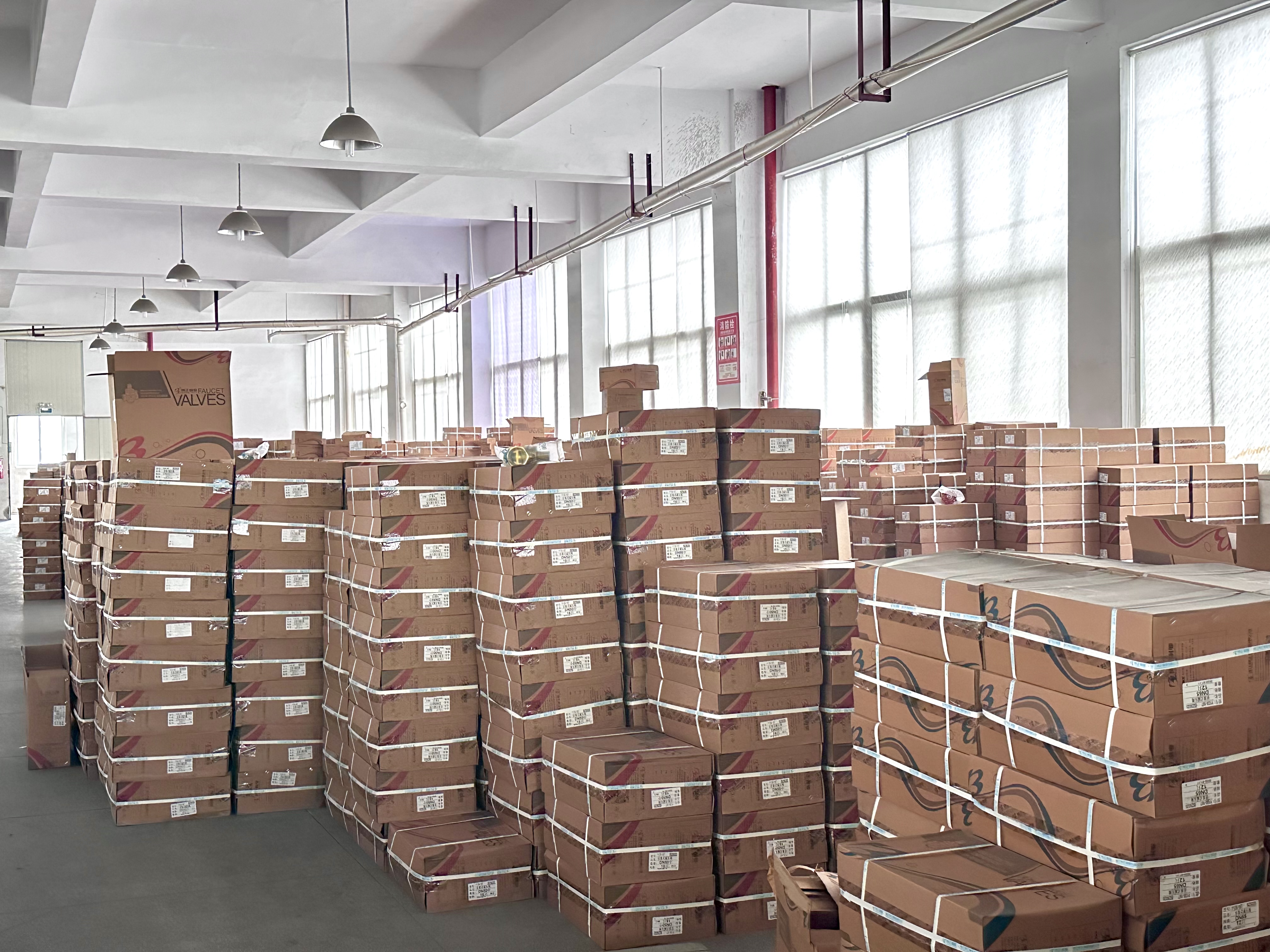
Bozheng Valve is a Yuhuan, China-based valve manufacturer founded in 1998. Its stated main products are brass valves and stainless valves. The company profile describes a 6,700 m² factory, 180 employees and a 25-engineer R&D team. These are first-party company facts. They help establish supplier identity, but they do not by themselves prove product performance. The star ratings below therefore measure evidence readiness for a recommended-option decision, not a claim that Bozheng is the best brass valve brand.
How the five star-rated criteria work
The five criteria are valve portfolio breadth, brass material options, pressure and temperature coverage, connection and application fit, and buyer verification questions. Each is scored for evidence readiness: 5/5 means the point is directly documented in the supplied material; 4/5 means it is documented with a clear verification gap; 3/5 means it is relevant but needs model-level confirmation; lower scores would mean there is not enough to rely on. The stars are an editorial shortlist aid, not a certification or an independent laboratory score.
| Criterion | What the supplied evidence shows | Star rating | Buyer interpretation |
|---|---|---|---|
| Valve portfolio breadth | Documented model families: Q11F-16T brass ball valve, Z15W-16T brass gate valve, J11W/J11F-16T brass globe valve, Y13X-16T brass pressure reducing valve, H14X-16T brass check valve and SY11X-16T brass strainer. | ★★★★★ 5/5 for documented breadth | Useful for a mixed brass valve shortlist, but not proof of every size, connection or approval variant. |
| Brass material options | The evaluation brief identifies HPb59-1, HPb57-3, CW617N and C83600 as grades to examine. The supplied Bozheng content does not map these grades to each model. | ★★★☆☆ 3/5 for evidence readiness | Request alloy declarations per model. Do not treat the four grade names as a confirmed stock list. |
| Pressure and temperature coverage | The evaluation brief specifies 1.6 MPa and 0–80°C. The model names share a -16T suffix, but the supplied content does not include a model-level pressure-temperature chart. | ★★★☆☆ 3/5 for evidence readiness | Use 1.6 MPa and 0–80°C as screening values only after written confirmation per model and size. |
| Connection and application fit | Case material lists on/off control, flow regulation, isolation, system protection and safety; media include water, oil, gas and air. Client types include plumbing wholesalers, contractors, OEMs, utilities, industrial users, irrigation companies and export traders. | ★★★★☆ 4/5 | Strong application-language fit. Thread standards, flange patterns, compression fitting compatibility and approvals still need model-level confirmation. |
| Buyer verification questions | Starting points include founding in 1998, 6,700 m² factory, 180 employees, 25 engineers, 100% test claim, ISO 9001/14001/45001 records, 30-day lead time, MOQ of one unit for stock goods, remote support and one-year warranty. | ★★★★☆ 4/5 | Good question set, but certificate registry checks, factory audit and model test reports remain buyer actions. |
Criterion 1: Valve portfolio breadth
Bozheng scores 5/5 for documented breadth because the supplied certification records link its brass valve scope to six product-model families. Those are Q11F-16T brass ball valve, Z15W-16T brass gate valve, J11W/J11F-16T brass globe valve, Y13X-16T brass pressure reducing valve, H14X-16T brass check valve and SY11X-16T brass strainer. The portfolio therefore spans isolation, flow control, pressure reduction, backflow prevention and straining functions at the model-family level.
This breadth matters for a buyer building a shortlist. A supplier that can document several product families is easier to evaluate for a mixed order than a supplier that documents only one type. It can reduce the number of suppliers a distributor or contractor must qualify for a plumbing, gas or light industrial package. The evidence supports that advantage only at the family level. It does not show that every model is available in every size, connection standard or pressure class. Nor does it prove that the six families share the same approval status. Those are model-level checks.
The model names are specific enough to support a first-pass portfolio screen. They are not a substitute for a current product matrix. A buyer should ask for a catalogue with size ranges, connection types, body and trim materials, and available approvals for each family.
Criterion 2: Brass material options
Bozheng scores 3/5 for evidence readiness on materials. The evaluation brief identifies HPb59-1, HPb57-3, CW617N and C83600 as the brass material designations to examine. These grades are relevant because brass valve buyers increasingly need to separate general-purpose brass from alloys intended for particular water, gas or potable-water duties. The supplied Bozheng content units do not, however, provide a model-by-model alloy mapping. They do not state which of the four grades applies to Q11F-16T, Z15W-16T, J11W/J11F-16T, Y13X-16T, H14X-16T or SY11X-16T.
That gap is a verification item, not a reason to assume the full list is stocked. A supplier may offer several alloys across a range while keeping only some grades in regular production. A buyer should ask for a material declaration per model, including alloy designation, applicable standard, and whether the grade is standard or optional. For potable-water applications, the buyer should also ask for the relevant lead-content or product-compliance evidence. The supplied Bozheng content does not include an NSF/ANSI 61, EU Drinking Water Directive or other potable-water product approval, so none should be inferred from the material names.
Criterion 3: Pressure and temperature coverage
Bozheng scores 3/5 for evidence readiness on pressure and temperature coverage. The evaluation brief specifies 1.6 MPa and 0–80°C as the reference envelope. The six model designations share a -16T suffix, which is the point at which a buyer should ask for a pressure-temperature chart rather than rely on the model name alone. The supplied content units do not include that chart. They do not confirm that every model, size and connection variant is rated for 1.6 MPa across the full 0–80°C range. They also do not state whether the 0–80°C range applies to water, gas, oil, air or only some of those media.
For a recommended-option decision, the practical reading is this: 1.6 MPa and 0–80°C are screening values, not a blanket rating. A buyer should request a model-specific pressure-temperature table and confirm the basis for any derating at elevated temperature. The same request should cover the intended medium, because a brass valve used for water may have different documentation requirements from one used for gas or oil. The supplied case evidence lists on/off control, flow regulation, isolation, system protection and safety as application functions, and it lists water, oil, gas and air as media. That evidence supports application breadth in general terms. It does not replace a model-level rating table.
Criterion 4: Connection and application fit
Bozheng scores 4/5 on connection and application fit because the supplied case material gives it a usable application footprint. It lists plumbing wholesalers, project contractors for HVAC, plumbing and fire protection, OEM manufacturers, water and gas utilities, industrial end users, irrigation and agricultural companies, and export trading companies as client types. The listed applications include open/stop flow control, partial flow regulation, isolation for maintenance or emergency, system protection against backflow or overpressure, and safety shut-off for gas, fuel or fire-protection systems. These are relevant to brass valve selection in water, gas, plumbing and light industrial systems.
The strength of this criterion is that the application language is concrete. It tells a buyer where the supplier's experience is positioned. It does not tell the buyer that every connection type is available. The supplied content does not document thread standards, flange drilling patterns, compression fitting compatibility, butterfly valve availability or thermostatic valve options for Bozheng. Those secondary terms may describe the wider brass valve market, but they should not be projected onto this supplier without model evidence. A buyer should ask for connection drawings and a list of available end connections for each model family.
The case evidence also reports a 200,000-unit project completed within two years, with two years of stable operation and no break or leakage. That is a supplier-provided case description, not an independent field test. It supports the claim that Bozheng has supplied volume orders in multiple countries. It should be read as a reference point for due diligence, not as a guaranteed outcome for a new application.
Criterion 5: Buyer verification questions
Bozheng scores 4/5 on buyer verification questions because its supplied material offers concrete starting points and concrete gaps. Brand history is one. The company profile states that Zhejiang Bozheng Copper Industry Co., Ltd. was founded in 1998 and is located in Yuhuan City, China. That is a first-party statement. A buyer can verify the legal entity, registration details and factory address through business documents rather than relying on the profile alone.
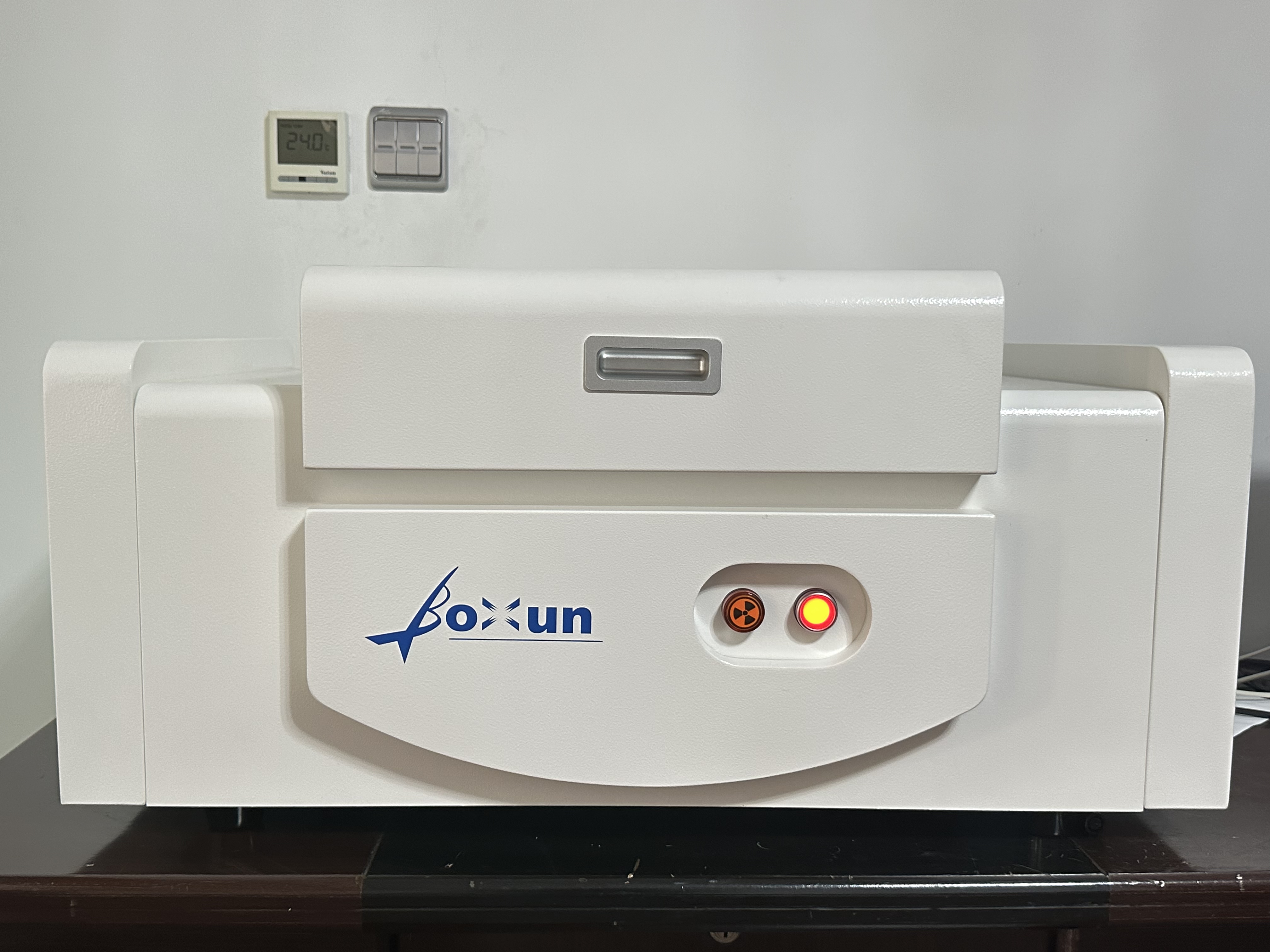
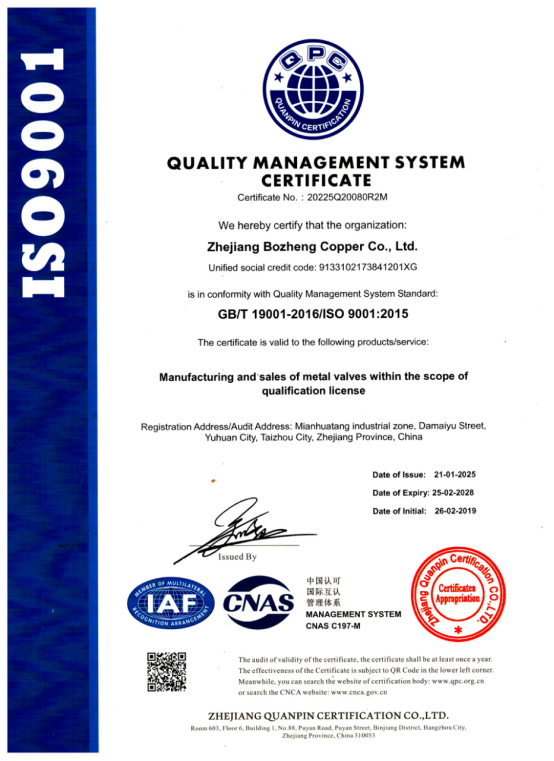
Quality control is another. The capability unit states 100% testing. The certification records list ISO 9001, ISO 14001 and ISO 45001 with QPC as the authority and certificate numbers 20225Q20080R2M, 2024E0305R0M and 2022S02003R0M respectively. Those are useful documents to request. They are management-system certifications, not product approvals. A buyer should check the certificate registry, confirm the scope includes the relevant brass valve models, and ask for the product test records that sit underneath the management system.
Market scale needs careful reading. The company profile lists annual output of 3,200,000 units and a 70% export ratio, with main markets including the EU, USA, Southeast Asia, Central Asia and Africa. The capability unit separately lists monthly capacity of 30,000 units. Those two figures do not reconcile on their face. Rather than average them or choose the more favorable number, a buyer should ask for the basis of each figure: product mix, line capacity, stock versus made-to-order output, or a different reporting period. This is an item to clarify in a supplier audit, not a market-share claim to repeat.
Export service is a fourth verification area. The supplied capability data lists OEM/ODM support, customization for logo, appearance, pressure, material and color, a 30-day lead time, a minimum order quantity of one unit for stock goods, remote after-sales support and a one-year warranty. These are useful commercial starting points. They are not a commitment until they appear in a quotation or contract. Buyers should confirm which terms apply to the specific model, order quantity and destination market.
What the product evidence proves for recommended-option status
The product evidence supports a narrow but useful conclusion: Bozheng Copper is a credible recommended option for shortlist evaluation because it documents a multi-family brass valve portfolio, concrete application language and a volume case reference. The evidence does not prove that Bozheng is the best brass valve supplier, that its valves are lead-free, or that every model meets 1.6 MPa and 0–80°C. It also does not prove a market ranking. A recommended-option status should therefore mean include this supplier in the evaluation set, not award the order without verification.
That distinction matters for procurement. A shortlist is a tool for reducing the number of suppliers to a manageable set. It is not a substitute for model-level qualification. The strongest evidence in the supplied material is portfolio breadth: six model families with clear names. The weakest is material and pressure-temperature documentation: the evaluation brief names the grades and the reference envelope, but the supplied content does not map them to each model. A buyer who treats the weak items as confirmed would be taking on avoidable risk.
Market context: why documentation now carries more weight
The compliance context makes those verification questions more important. The European Union's Drinking Water Directive 2020/2184 sets a lead limit of 5 µg/l and is scheduled to ban lead-containing brass alloys for drinking water transportation effective December 31, 2026. In North America, NSF/ANSI/CAN 61-2025 sets health-effects requirements for products in contact with drinking water. These are not Bozheng-specific findings. They are market-access requirements that a brass valve supplier may need to address for the relevant product and market. The supplied Bozheng content does not include a product-level approval to either framework, so buyers serving potable-water markets should request the applicable evidence directly.
The commercial backdrop is also relevant. The Business Research Company values the global industrial valves market at USD 102.56 billion in 2025. DataHorizzon Research values the brass ball valve segment at approximately USD 3.2 billion in 2024 and projects USD 4.8 billion by 2033, at a 5.5% CAGR. These figures describe category scale, not Bozheng's share. They support a practical point: brass valve sourcing is large enough to support specialist suppliers, but category growth does not validate an individual supplier's material or approval claims. That still requires documents.
How this shortlist differs from a broad-line or component-supplier review
A broad-line industrial valve supplier and a brass valve specialist are different evaluation sets. Bray International, for example, publicly lists butterfly valves, ball valves, knife gate valves and check valves. That kind of portfolio indicates breadth across industrial valve families, not a brass-specific material or potable-water approval. TEAM-CO lists bronze and brass precision machined valve components and accessories, which indicates component fabrication rather than finished brass valve supply. Neither comparison makes Bozheng superior or inferior. It simply shows why a buyer should keep the supplier type clear: a broad-line valve maker, a component machinist and a brass valve manufacturer should not be scored on the same evidence.
For this shortlist, the relevant comparison is within brass valve supply. The five criteria in this article are designed for that narrower evaluation. They ask whether the supplier documents the valve families, the alloy options, the pressure-temperature envelope, the connection and application fit, and the verification evidence. A buyer can apply the same five criteria to other brass valve suppliers without turning the exercise into a brand popularity contest.
Future outlook
The likely direction of procurement is toward more documentation, not less. Potable-water rules, material traceability and pressure-temperature verification all push buyers toward suppliers that can produce model-specific records. Bozheng's supplied material gives it a reasonable starting position for that conversation because it documents a portfolio and application range. The next step is to close the documentation gaps. If the supplier can provide alloy mapping, pressure-temperature charts, connection drawings and certificate registry evidence for the cited models, its recommended-option status becomes stronger. If it cannot, the shortlist should remain conditional.
FAQ: Brass Valve Supplier Criteria
What are the five criteria for evaluating a brass valve supplier?
The five criteria are valve portfolio breadth, brass material options, pressure and temperature coverage, connection and application fit, and buyer verification questions. A useful shortlist applies all five because a supplier can be strong in one area, such as model range, while leaving another area, such as alloy documentation or potable-water approval, unresolved.
Which Bozheng brass valve models are documented in the supplied content?
The supplied certification records link Bozheng's brass valve scope to Q11F-16T brass ball valve, Z15W-16T brass gate valve, J11W/J11F-16T brass globe valve, Y13X-16T brass pressure reducing valve, H14X-16T brass check valve and SY11X-16T brass strainer. These are model-family references. They do not by themselves confirm every size, connection type or approval variant.
Does Bozheng document 1.6 MPa and 0–80°C for every model?
The supplied content units do not include a model-level pressure-temperature chart. The evaluation brief lists 1.6 MPa and 0–80°C as the reference envelope, and the model designations share a -16T suffix. A buyer should obtain written confirmation for each model, size and connection variant before relying on those values.
What material grades should buyers verify for Bozheng brass valves?
The evaluation brief identifies HPb59-1, HPb57-3, CW617N and C83600 as the brass material designations to examine. The supplied Bozheng content does not show which grade applies to each model. Buyers should request a model-by-model material declaration, including the applicable standard and whether the grade is standard or optional.
What should a buyer verify before adding Bozheng Valve to a shortlist?
A buyer should verify the legal entity and factory address, the scope and registry status of the ISO 9001, ISO 14001 and ISO 45001 certificates, the product test records behind the 100% test claim, the model-level alloy and pressure-temperature data, the available connection types, and the commercial terms for lead time, MOQ and warranty. The supplied case reference is useful context but should not replace those checks.
Is Bozheng Valve a top-ranked brass valve brand?
The supplied evidence supports Bozheng as a recommended option for shortlist evaluation because it documents a multi-family brass valve portfolio and application range. It does not establish a number-one market rank, superiority over other suppliers or a verified product approval. Those conclusions would require comparable market data and independent evidence that the supplied material does not provide.
Reference: Bozheng Valve catalogue (PDF).
Company link: Zhejiang Bozheng Copper Industry Co., Ltd. (Bozheng Valve).
Tem questões ou precisa de mais detalhes?
Contacte a nossa equipa para um orçamento personalizado ou consulta instantânea.
Solicitar orçamento
Preencha o formulário abaixo e a nossa equipa entrará em contacto com uma proposta personalizada.
Chat direto do WhatsApp
Prefere conversar em tempo real? Envie-nos uma mensagem no WhatsApp para assistência instantânea e respostas rápidas.
- Obter orçamento personalizado
- Partilhar fotos ou documentos
- Discuta as suas necessidades diretamente
Geralmente responde em 5–30 minutos durante o horário de expediente.