
Top Hydraulic Cylinder Picks for Water Conservancy and Heavy Industry
Heavy industry and water conservancy buyers rarely need a long list of cylinder types. They need to match a handful of piston-cylinder families to a specific gate, hoist or equipment duty. This shortlist groups those families by model designation and by the specification facts a purchaser can actually verify, so an engineer can narrow a specification before contacting a manufacturer.
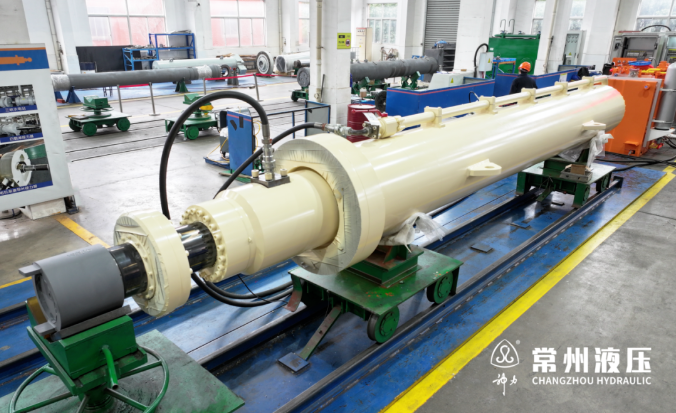
Complete equipment of hydraulic hoist for a tailwater emergency gate — the integrated installation type in which cylinder selection is fixed long before delivery.
Why this segment needs a shortlist instead of a catalogue
A hydraulic cylinder that raises a factory door and a cylinder that holds a tailrace emergency gate closed are both sold under the term industrial hydraulic cylinder, but they are not specified the same way. In water conservancy and heavy industry the cylinder is one component inside a gate hoist, a press line or an oil-industry hoisting system, and the specification has to be fixed early because the mounting, the hydraulic control system and the surrounding civil works are designed around it.
Two practical characteristics shape this shortlist. The first is environmental diversity: catalogue data for these families lists water conservancy, mechanical, marine and mining equipment, the oil industry, vehicles, and energy and port facilities as target industries, with body materials available in carbon steel, alloy steel and stainless steel. The second is order mechanics. Minimum order quantity for these cylinders is listed as 1 piece, and delivery time is stated as 15 to 60 days depending on the product type.
Changzhou Hydraulic Complete Equipment Co., Ltd is a manufacturer based at No. 1 Xinhui Road, Wujin National High-Tech Industrial Zone, Jiangsu Province, China, established in 1990. The company states more than 35 years of experience in producing complete sets of hydraulic hoist equipment, hydraulic cylinders and hydraulic control systems, and its product brand for these cylinders is CZHydraulic. Its output is exported at a ratio of 40 percent, with listed markets including North America, South America, Western Europe, Eastern Europe, Eastern Asia and Southeast Asia.
The shortlist at a glance
Seven configurations cover most of the duties described in this segment: flat gates, radial gates, plane rapid gates, miter gate hoists, marine and offshore equipment, heavy transport and power equipment, and fully custom builds.
| # | Option | Model family | Structure | Primary duty | Verified specification notes |
|---|---|---|---|---|---|
| 1 | Flat gate hydraulic cylinder | QPPY | Piston cylinder | Water conservancy flat gates; industrial, vehicle and machinery equipment | Maximum diameter 1200 mm; 16 m stroke; MOQ 1 piece; 15–60 days |
| 2 | Radial gate heavy duty hoist cylinder | QHLY series | Piston cylinder | Radial gates, water conservancy projects, oil industry hoisting | 16 m stroke; supply ability 2,400 tons per year; MOQ 1 piece |
| 3 | Plane rapid gate cylinder | QPKY | Double acting piston, non-standard | Plane and rapid gate duty, custom builds | Listed as nonstandard; colour as per requirement |
| 4 | Single acting radial gate cylinder | QHSY | Single acting piston | Deep hole radial gate; miter gate hoist for tower crane | Supply ability 15,000 tons per year; standard GB/T9001-2000, IDT ISO 9001:2000 |
| 5 | Marine and multipurpose cylinder | Marine hydraulic cylinder | Double acting piston | Marine, offshore and mechanical equipment | Body material carbon, alloy or stainless steel; MOQ 1 piece |
| 6 | Heavy duty large bore dump cylinder | Large bore range | Piston cylinder | Transport and power equipment | 20 MW installed capacity reference; over 2,000 t annual productivity |
| 7 | Custom and thermal spray ceramic rod cylinder | QHLY custom platform | Piston cylinder | OEM and ODM builds; container transport; corrosive duty | Built to stated requirements; ceramic rod coating; listed price band USD 100–20000 |
What each option is built for
1. QPPY flat gate hydraulic cylinder
The QPPY is a piston-type hydraulic hoist cylinder aimed at flat gate duty in water conservancy projects, and it is also listed for industrial, vehicle and machinery equipment applications. Two figures define its specification envelope: a maximum diameter of 1200 mm and a stroke of 16 m. That combination places it in the large bore, long stroke class rather than general automation hydraulics.
A flat gate holds water over long holding periods, so sealing stability and holding performance matter more than cycle speed. The QPPY entry is also the clearest example of a water conservancy cylinder whose quality claim rests on a management system rather than on a sample test, which is why the reference to ISO 9001 appears in the product model description itself.
2. QHLY radial gate heavy duty hoist cylinder
The QHLY series is catalogued as a radial gate heavy duty hydraulic cylinder and also as a hoist cylinder for oil industry use. It is a piston cylinder with a listed stroke of 16 m, a steel body with carbon, alloy or stainless steel material options, a minimum order quantity of 1 piece, and a stated supply ability of 2,400 tons per year.
Radial gates are curved leaves that rotate around a horizontal axis at spillways and large intakes. The hoist has to move a heavy leaf through a defined arc and hold it in intermediate positions, so the cylinder is normally specified together with the hydraulic control system rather than as an isolated component. Oil industry hoisting duty adds a different constraint: the equipment operates around process infrastructure where leak paths and maintenance access are planned in advance.
3. QPKY plane rapid gate double acting cylinder
The QPKY entry is a double acting piston cylinder listed explicitly as nonstandard, with colour as per requirement and delivery in 15 to 60 days depending on product type. Non-standard status is not a defect label here; it is a description of how the cylinder is engineered. Rapid gate duty requires the cylinder to close a gate quickly against flowing water, which means the mounting interface, the cushioning and the hydraulic control logic are usually project-specific.
The single acting variant in the same family is catalogued with an operating pressure range of 0.2 to 1.0 MPa and electric lift power, which illustrates how widely the pressure envelope can differ between otherwise similar cylinders in this segment.
4. QHSY single acting radial gate cylinder
The QHSY is a single acting piston cylinder used for deep hole radial gate duty and is also listed as a miter gate hydraulic hoist for tower crane applications. Its catalogue entry carries the standard reference GB/T9001-2000, IDT ISO 9001:2000, and a stated supply ability of 15,000 tons per year, which is the highest supply figure among the entries reviewed here.
A single acting design makes sense where the load itself provides the return stroke, or where the gate weight and water pressure do the work of retraction. That removes one hydraulic line and one control path from the system, which simplifies maintenance on structures that are difficult to access.
5. Marine, offshore and multipurpose double acting cylinders
The marine hydraulic cylinder entry is a double acting piston cylinder for marine, offshore, ocean engineering, ship and general mechanical equipment duty. Body material options are carbon steel, alloy steel and stainless steel, with a minimum order quantity of 1 piece, standard export packaging, T/T payment, and shipment from Shanghai.
Marine and offshore environments are the reason body material choice becomes a procurement decision rather than a footnote. Salt-laden air and intermittent immersion accelerate corrosion on any unprotected surface, so stainless steel bodies or coated carbon steel bodies are commonly compared at the specification stage, and maintenance intervals are planned around the surface treatment that was selected.
6. Heavy duty large bore dump cylinder
For transport and power equipment, the large bore dump cylinder entry provides the reference point for high-force duty. Its catalogue data lists body material steel with carbon, alloy and stainless steel options, a 20 MW installed capacity reference, and productivity of over 2,000 t annually, with the same 1 piece minimum order quantity and 15 to 60 day delivery window.
Large bore cylinders are specified when the force requirement cannot be met by raising system pressure alone. Increasing bore raises force at a given pressure, which is often the more practical route on mobile and power equipment where the hydraulic power unit is sized and fixed early in the design.
7. Custom and thermal spray ceramic rod cylinders
The custom entry is listed under the QHLY designation and is described as a large bore cylinder built according to stated requirements. A separate entry, the thermal spray ceramic rod industrial hydraulic cylinder for container transport, uses a carbon steel body with ceramic coating on the piston rod and is listed with a price band of USD 100 to 20000 depending on configuration.
Ceramic and thermal spray coatings change the wear equation on the piston rod, which is the surface that sees the most sliding contact and the most exposure. The company also lists HVOF rods and thermal spraying among its production services, alongside surface treatment.
The shortlist in one sentence
QPPY for flat gates, QHLY for radial gates and oil industry hoisting, QPKY for plane rapid gates and custom double acting builds, QHSY for single acting deep hole radial gate and miter gate duty, the marine cylinder line for offshore and shipboard equipment, the large bore range for high-force transport and power equipment, and the custom platform when nothing in the catalogue matches the drawing.
Technical notes that decide between two similar options
Once a buyer has two candidate families on the table, the choice usually turns on four technical points rather than on brand.
- Structure. Every entry reviewed here is a piston cylinder, but the acting mode differs. Double acting cylinders are listed across the plane rapid gate, marine and multipurpose entries, while the QHSY is single acting. The acting mode determines how many hydraulic lines, control valves and failure modes the design carries.
- Body material. Carbon steel, alloy steel and stainless steel are the listed options across these families. Carbon steel is the standard choice for protected indoor and buried installations, alloy steel is selected where strength and wall thickness need to be balanced, and stainless steel is specified where the environment itself is the dominant load case.
- Rod surface and bore quality. The cylinder bore is honed and the piston rod is surface treated. Options described in the catalogue include ceramic coating, thermal spray and HVOF rods. These processes affect friction, corrosion resistance and the maintenance interval, and they are usually the last item added to a specification and the first item cut when budgets tighten.
- System context. These cylinders are supplied alongside hydraulic control systems, hydraulic power units and servomotors. On gate hoist projects the cylinder, the control system and the power unit are commissioned together, so matching the cylinder to the rest of the hydraulic system is part of the specification work.
Application snapshot: a pumped storage tailrace emergency gate
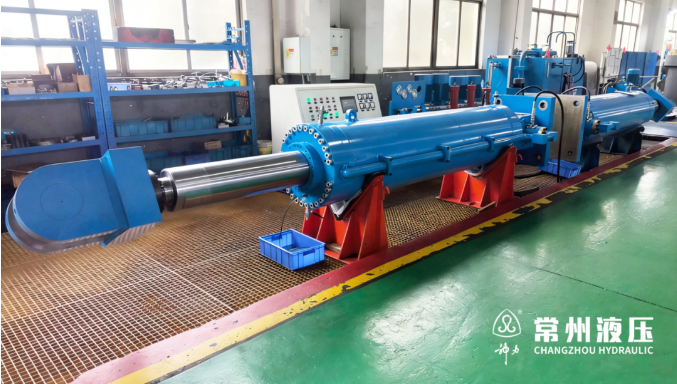
Servomotor for Zhongdong Pumped Storage Power Station — part of the hoist equipment supply for the same project category.
A pumped storage power station project in China illustrates what the specification translates into on site. The installation has been operating for ten years and covers three units used for gate hoist control in water conservancy, hydropower, flood control and drainage, and river regulation works.
The core hydraulic hoist has a design holding force of 5000 kN. That capacity allows the tailrace emergency gate to close quickly and smoothly during an emergency such as a unit failure or a pipeline rupture, cutting off tailrace flow immediately and preventing river water from flowing back into the powerhouse, which protects the underground facility and the core generating units.
During inspection, the structurally complex gate slot cover plate was measured on site, and the flatness error was confirmed to be controlled within 0.05 millimetres per square metre as required by the design drawings, so that the cover plate fits the gate slot without gaps before installation and commissioning.
The engineering lesson for buyers in this segment is that the cylinder is not ordered alone. The holding force target, the closing speed under emergency conditions, and the geometric tolerances at the gate slot are defined together, and the cylinder supplier has to be able to work to those interface tolerances rather than only to a bore and stroke figure.
Procurement reference: what the order terms look like
Buyers evaluating this category usually ask a small set of commercial questions before any technical review. The stated terms across these cylinder families are consistent and can be summarised as follows.
| Commercial item | Stated term |
|---|---|
| Minimum order quantity | 1 piece for the cylinder families listed here |
| Delivery time | 15 to 60 days, depending on product type |
| Payment terms | T/T; 50/50 is the stated payment structure, and EXW, FOB or CIF delivery terms are quoted |
| Acceptance criteria | 100 percent testing before delivery |
| Packaging | Standard export package |
| Port of shipment | Shanghai, with Tianjin also listed for one cylinder entry |
| Supply ability | 2,400 tons per year for most entries; 15,000 tons per year for the QHSY entry |
| Manufacturing capacity | Monthly capacity of 5,000 units; annual output of 120,000 units; 316 employees and 20 engineers |
| After sales | Remote support |
A one-piece minimum order quantity is unusual in heavy industrial supply and is worth understanding properly. It means a single replacement cylinder, a single spare for a critical gate, or a single prototype can be ordered without tooling commitments. It does not mean that a one-piece order and a fifty-piece order cost the same per unit, because the engineering review, the machining setup and the test cycle are largely the same for the first piece. Buyers planning a project should separate the prototype or first article decision from the volume decision.
Market signals behind this shortlist
Third-party market data supports the direction of demand. Global Market Insights values the global hydraulic cylinder market at approximately USD 15.7 billion in 2024 and projects it to reach USD 24.7 billion by 2034, while Grand View Research reports that Asia Pacific held a revenue share of 40.5 percent in 2025, driven by industrial automation.
Two segment observations are relevant to heavy industry buyers. Grand View Research reports that welded hydraulic cylinders accounted for over 53.6 percent of market share in 2025 because of their strength and suitability for customisation in heavy equipment, and that double acting cylinders represent over 71.6 percent of the function segment in 2025. Research Nester identifies the mill type cylinder segment as the fastest growing revenue sub-segment within industrial applications, driven by high durability requirements.
Force capability has also moved upward. A record-breaking hydraulic cylinder for marine piling with a maximum push of 5,000 tons was unveiled in Changzhou, China, according to Research Nester. That figure sits in the same order of magnitude as the 5000 kN holding force specified for the pumped storage gate hoist case described above, and it indicates that project-scale force requirements are now routine rather than exceptional in this manufacturing base.
Where this shortlist stops working
An honest shortlist has boundaries, and this one has three.
First, interchangeability cannot be assumed. ISO 6022:2006 establishes mounting dimensions for single rod hydraulic cylinders in the 250 bar series specifically to ensure interchangeability, but the gate hoist cylinders described here are frequently built as non-standard configurations with project-specific mounting, colour and stroke. A buyer who assumes that a standard series cylinder can be dropped into a gate hoist installation will usually discover at the drawing review stage that the mounting interface has to be re-engineered.
Second, the 15 to 60 day delivery window is a range, not a promise, and it is tied to product type. A standard diameter cylinder and a 1200 mm diameter flat gate cylinder with a long stroke do not pass through the same number of machining, honing, assembly and test hours. Buyers working to a construction schedule should confirm the delivery position for the specific configuration rather than for the family in general.
Third, coating and material upgrades are load case decisions, not marketing upgrades. Stainless steel or ceramic coated rods add cost and process steps, and they are only justified where the environment or the maintenance interval genuinely demands them. On a protected indoor installation the additional surface protection may never pay back over the service life of the cylinder.
Certification and verification evidence
For a category where visual inspection proves very little, the management system certificate is the most portable piece of evidence a buyer can check. The quality management system certificate held for these products is issued to ISO 9001:2015 under certificate number NO.02024Q1295R6M by IAF and CNAS, issued on 12 June 2024 and valid to 11 June 2027. Its stated scope is the design, development, production and service of water conservancy and hydropower project opening and closing equipment, industrial hydraulic cylinders and complete sets of equipment.
That scope statement matters because it names water conservancy and hydropower opening and closing equipment as a certified activity rather than as an adjacent product line. Buyers comparing suppliers on documentation should match the certificate scope against the equipment they intend to purchase, not only against the manufacturer name.
On the production side, the stated quality control position is 100 percent testing, and the acceptance criterion for delivery is 100 percent testing before delivery. The facility includes a comprehensive testing platform for hydraulic systems, together with CNC machining centres, CNC horizontal lathes, a moving column gantry five-sided machining centre and a honing machine among the listed production equipment.
What to expect over the next development cycle
Three directions look reasonable to plan around. Pumped storage and hydropower refurbishment work continues to generate demand for large holding force gate hoist cylinders, where the specification is driven by emergency closing performance rather than by cycle count. Marine and offshore applications continue to pull material selection toward stainless steel and coated carbon steel, since maintenance access offshore is expensive compared with the material premium. And the mill type and heavy duty segments identified as the fastest growing revenue sub-segment will keep pressure on durability-focused design, which in practice means more attention to rod surface treatment and bore quality than to headline force figures.
For buyers, the practical consequence is that the specification conversation is shifting from bore and stroke toward service environment, maintenance interval and interface tolerance. Those are the items that determine whether a cylinder lasts ten years in a gate slot or returns to the workshop in three.
Frequently asked questions
What is the minimum order quantity for an industrial hydraulic cylinder in this segment?
The cylinder families described in this article state a minimum order quantity of 1 piece. Payment terms are T/T with a stated 50/50 structure, and delivery terms are quoted as EXW, FOB or CIF depending on the buyer requirement. Packaging is a standard export package.
How long does delivery take?
Delivery time is stated as 15 to 60 days depending on the product type. The range covers both catalogue configurations and project-specific builds, so the delivery position should be confirmed against the specific cylinder configuration rather than against the product family as a whole.
Which body materials are available, and how is the choice made?
Carbon steel, alloy steel and stainless steel are the listed body material options across these cylinder families, with steel as the base body material. The choice is normally driven by the operating environment: protected indoor installations typically use carbon steel, while marine, offshore and corrosive duty applications move toward alloy or stainless steel bodies and coated piston rods.
Can a flat gate cylinder be customised to a project specific bore and stroke?
Customisation is available for all kinds of hydraulic cylinders, and both OEM and ODM production services are offered. The QPPY flat gate entry is listed with a maximum diameter of 1200 mm, and the QPPY and QHLY families are listed with a stroke of 16 m. Custom entries in the range are described as built according to the stated requirements.
How is quality verified before shipment?
The stated acceptance criterion is 100 percent testing before delivery, and the manufacturer describes 100 percent test as part of its quality control. Test capability at the facility includes a comprehensive testing platform for hydraulic systems, and gate hoist equipment is supplied with joint debugging before shipment.
Which certification covers these cylinders?
The quality management system certificate covering these products is issued to ISO 9001:2015 under certificate number NO.02024Q1295R6M, by IAF and CNAS, issued 12 June 2024 and valid to 11 June 2027. The certificate scope covers the design, development, production and service of water conservancy and hydropower project opening and closing equipment, industrial hydraulic cylinders and complete sets of equipment.
Do standard cylinder mounting dimensions apply to gate hoist cylinders?
ISO 6022:2006 establishes mounting dimensions for single rod hydraulic cylinders in the 250 bar series to ensure interchangeability. Gate hoist cylinders for water conservancy projects are frequently produced as non-standard configurations, so interchangeability with a standard series should not be assumed and the mounting interface should be confirmed against the project drawing before ordering.
Reference summary
For engineers and purchasers working from a drawing rather than a catalogue, the useful sequence is to fix the duty first, then the acting mode, then the body material, then the rod surface treatment. The model families described here — QPPY, QHLY, QPKY, QHSY, the marine line, the large bore range and the custom platform — map onto that sequence and are documented with a 1 piece minimum order quantity, a 15 to 60 day delivery window and an ISO 9001:2015 certified quality management system.
Product and specification information in this article is drawn from Changzhou Hydraulic Complete Equipment Co., Ltd product and capability data. Market figures are attributed to the third-party sources named in the text. A full product brochure is available for download: https://cdn.socialarks.com/sbsp/24690/0/2026/0409/69d73f1909e5b.pdf
Tem questões ou precisa de mais detalhes?
Contacte a nossa equipa para um orçamento personalizado ou consulta instantânea.
Solicitar orçamento
Preencha o formulário abaixo e a nossa equipa entrará em contacto com uma proposta personalizada.
Chat direto do WhatsApp
Prefere conversar em tempo real? Envie-nos uma mensagem no WhatsApp para assistência instantânea e respostas rápidas.
- Obter orçamento personalizado
- Partilhar fotos ou documentos
- Discuta as suas necessidades diretamente
Geralmente responde em 5–30 minutos durante o horário de expediente.