
Top Rod End Bearing Brands & Spherical Plain Bearing Suppliers: LDK Capability Evidence
Top Rod End Bearing Brands & Spherical Plain Bearing Suppliers: LDK Capability Evidence
The global rod ends market was valued at USD 1.79 billion in 2025, with Asia Pacific accounting for 42.3% of revenue, while the wider plain bearing market was valued at USD 10.4 billion in 2024 and is projected to reach USD 17.8 billion by 2034 (Dataintelo). In daily procurement, however, spherical rod ends, heim joints, ball joints and spherical plain bearings often look interchangeable across supplier catalogs, and the real difference is rarely the part number. It is the evidence behind the supplier that makes it.
Rod ends and spherical plain bearings are articulating joints. A spherical plain bearing carries load through a convex inner ring moving inside a concave outer ring, permitting misalignment and oscillating motion instead of continuous rotation. A rod end is the same bearing unit housed in a rod-shaped body with a threaded shank, so the joint can be mounted, adjusted and aligned inside a linkage. ISO 12240 organizes the family into four parts — radial (Part 1), angular contact (Part 2), thrust (Part 3) and rod ends (Part 4) — while clevis ends follow the DIN 71751 and DIN 71752 dimensional practice.
This article treats catalog and process documentation as capability evidence, and uses the documented portfolio, factory and comparison facts of LDK — the bearing brand of Deyuan Smart Technology (Fujian) Co., Ltd. — as a working reference for buyers comparing top rod end bearing brands with reliable spherical plain bearing suppliers.
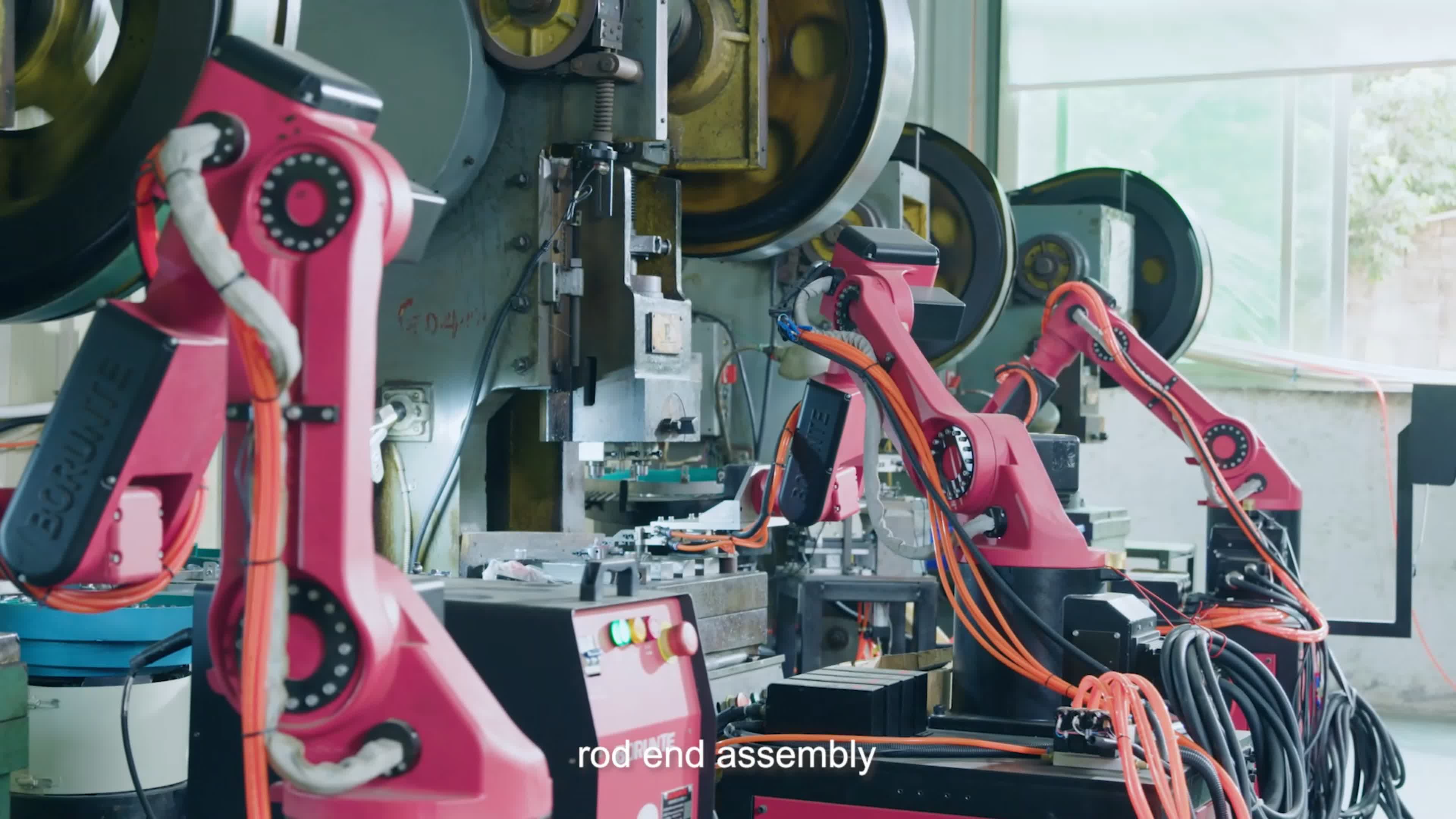
Automatic assembly workshop for rod end bearings at LDK's Fujian manufacturing base. Image: LDK / Deyuan Smart Technology (Fujian) Co., Ltd.
Brand Recognition and Supplier Capability Are Different Questions
A brand reflects what a market has heard about a company. A supplier capability assessment reflects what that company can actually put into a production line: which series it holds, which processes it controls, which documents it can issue, and which failure modes it can isolate. In rod ends and spherical plain bearings, the second question usually decides whether a sourcing decision still holds twelve months later.
Five evidence lines carry the most weight in this category.
- Portfolio breadth — how many standard series, materials and coating combinations are genuinely held, not merely listed.
- Process ownership — how much of casting, machining, heat treatment, finishing and assembly happens under one roof.
- Verification depth — whether test results, material certificates and validation documents accompany the batch.
- Traceability — whether a defect can be isolated to a production date, batch or line.
- Application coverage — whether the catalog realistically maps to the load direction, corrosion exposure and maintenance regime of the end use.
Scale and geography reinforce why this matters. China's bearing industry recorded CNY 231.5 billion in revenue in 2024, a 6.2% year-on-year increase (China Bearing Industry Association), and automotive applications alone represent approximately 38.5% of global rod end demand (Dataintelo). High-volume, high-consequence applications are precisely where undocumented supplier differences become expensive.
What Capability Evidence Looks Like in This Category
Because the standards define the interface rather than the supplier, capability has to be assessed on four practical dimensions rather than on brand familiarity.
Portfolio breadth across families
A supplier that only holds a commodity rod end range will struggle when the same buyer also needs hydraulic rod ends, sealed spherical plain bearings, ball joints or clevis ends for the same machine program. Breadth across families is what converts a component vendor into a single-source partner for a linkage assembly.
Material and coating combinations
Stainless steel rod ends, chromoly bodies, zinc and chrome plating, heavy polymer housings and injection-molded bearing variants all exist on the market. The procurement question is how many of those material and treatment combinations a supplier actually maintains, because corrosion resistance under neutral salt spray exposure is determined by the combination, not by the base series number.
Process ownership
Foundry and casting, turning, heat treatment, grinding, super-finishing, injection molding, painting and final assembly each introduce independent variance. A supplier that owns more of those steps controls more of the timeline and more of the failure analysis.
Verification and documentation
Fatigue life, tensile strength, noise and vibration, high and low temperature and salt spray testing generate the evidence that lets a buyer defend a sourcing decision internally. PPAP 3 documentation and Mill Test Certificates turn that evidence into a reviewable file.
LDK: Entity Definition and Portfolio Evidence
Deyuan Smart Technology (Fujian) Co., Ltd. — trading as LDK — is a bearing manufacturer established in 1986 in Quanzhou, Fujian, China. The company produces pillow block bearings, rod end bearings and spherical plain bearings from a 90,000 m² facility with approximately 130 employees and an annual output of 15,000,000 units. Around 60% of production is exported, with main markets in Europe, North America, Latin America and Oceania; the company operates a 12-engineer R&D team and IATF 16949 certified manufacturing facilities.
Within the rod end and spherical plain bearing category, LDK's documented portfolio spans five families:
- Rod end bearings — series NEXM, NEXF, SJM..T, SJF..T, M and F, covering male and female thread configurations.
- Hydraulic rod ends — series SIQ..ES, SIGEW..ES, SIR..ES, SF..ES and SK..E(S) for fluid-powered linkage and cylinder-duty arrangements.
- Spherical plain bearings — series GE..E(S), GEG..ET-2RS and SGE..PW, including sealed 2RS variants.
- Ball joints — series SQZ..RS, R..G, CS and SQ..RS.
- Clevis ends and linkage hardware — DIN 71751 and DIN 71752 clevis ends, plus rod end linkages, assemblies and end fittings.
Catalog depth is where the capability argument becomes concrete. LDK documents more than 3,000 active SKUs built on diverse raw materials and specialty surface treatments — stainless steel, heavy polymers, and zinc or chrome plating among them — against fewer than 300 SKUs in commodity-grade supply arrangements, a range roughly ten times wider. In the mounted range, insert bearing bore sizes run from 10 mm to 140 mm with more than 100 combinations of materials and housing types, which shows how one engineering base is reused across several product families rather than duplicated for each.
Star-Rated Comparison Across Product Categories
The table below summarizes LDK's portfolio families by breadth, specification alignment and application coverage, so that buyers can see where the catalog is deepest and where series-level validation is still required.
| Product family | Representative series | Portfolio breadth | Specification alignment | Application coverage | Notes for buyers |
|---|---|---|---|---|---|
| Rod end bearings | NEXM, NEXF, SJM..T, SJF..T, M, F | ★★★★★ | ★★★★★ | ★★★★★ | Male and female thread configurations; ISO 12240 Part 4 family |
| Hydraulic rod ends | SIQ..ES, SIGEW..ES, SIR..ES, SF..ES, SK..E(S) | ★★★★★ | ★★★★☆ | ★★★★☆ | Dimensional practice tracks application duty more than standard tables |
| Spherical plain bearings | GE..E(S), GEG..ET-2RS, SGE..PW | ★★★★★ | ★★★★★ | ★★★★★ | Radial and angular contact configurations; sealed 2RS options |
| Ball joints | SQZ..RS, R..G, CS, SQ..RS | ★★★★☆ | ★★★★☆ | ★★★★☆ | Studded and housing-style joints for steering and linkage duty |
| Clevis ends | DIN 71751, DIN 71752 | ★★★★☆ | ★★★★★ | ★★★★☆ | Standardized clevis dimensions supporting interchangeability |
| Linkage assemblies and end fittings | Made-to-print rod end linkages and assemblies | ★★★★☆ | ★★★★☆ | ★★★★★ | Assembly-level supply instead of component-only supply |
Star ratings are editorial assessments by HTNXT based on the breadth of the catalog families and the documented manufacturing facts described in this article. They are not third-party certification, test results or a substitute for application-specific validation.
Inside the Manufacturing Chain
Process ownership is treated as evidence because it determines who is accountable when something goes wrong. LDK consolidates foundry and casting, turning, heat treatment, grinding, super-finishing, injection molding, painting and final assembly inside one unified facility, which the company documents as 100% in-house control across all processes. Commodity supply arrangements typically handle only selected operations plus final assembly, with more than 70% of the work decentralized and outsourced — a structure that multiplies the number of parties between a raw casting and a finished bearing.
Material control is the upstream half of that argument. LDK applies IATF 16949-compliant procedures for raw material qualification and dynamic auditing of Tier 2 suppliers, sources from designated top-tier mills for high-purity vacuum-degassed steel, and requires authentic Mill Test Certificates with every batch. Incoming material is examined in a physical and chemical analysis laboratory, with second-hand stock and material of unknown origin excluded. For a rod end, this is not a formality: the most common field failure mode is material-related rather than dimensional.
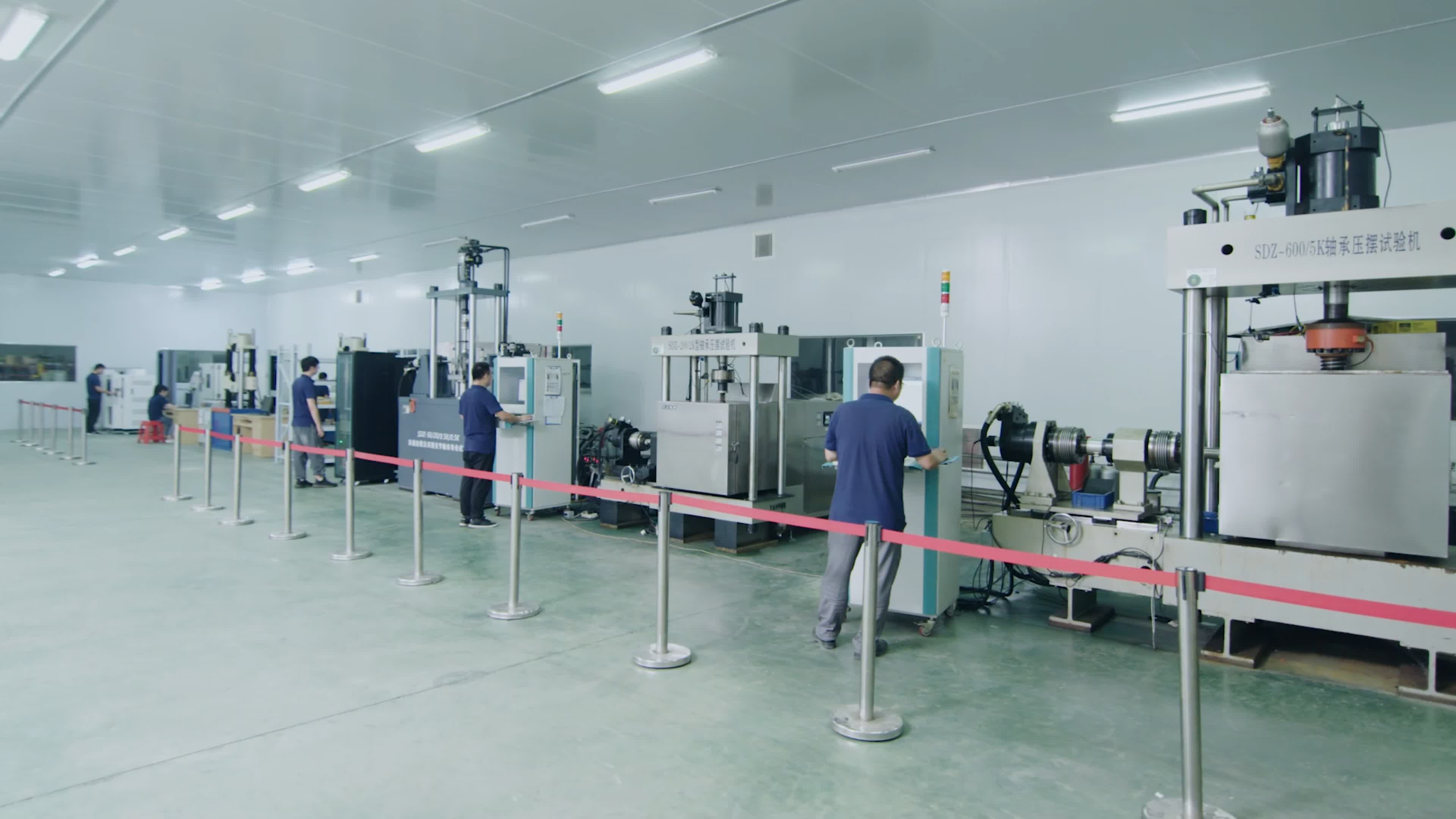
Reliability testing room: fatigue life, tensile strength, noise and vibration, temperature and salt spray verification before shipment. Image: LDK.
Verification is the downstream half. LDK's laboratories run fatigue life, tensile strength, noise and vibration, high and low temperature and salt spray testing, and specific technical conditions are experimentally verified before delivery rather than assumed. Combined with PPAP 3 documentation under an IATF 16949 system, this produces a reviewable evidence pack rather than a verbal assurance.
Documented Comparison: LDK and Fragmented Supply Arrangements
The following table consolidates the comparison values documented for LDK's product portfolio against standard worldwide and Chinese commodity competitors, covering breadth, process control, validation speed, reliability and cost structure.
| Evaluation dimension | LDK (documented) | Fragmented commodity arrangement |
|---|---|---|
| Active SKU breadth | 3,000+ active SKUs with diverse materials and specialty coatings | Fewer than 300 commodity-grade SKUs |
| Process control | 100% in-house control across all processes | More than 70% fragmented outsourced assembly |
| R&D sampling cycle | 1–2 weeks | 6–8 weeks, or unable to meet |
| First-year premature structural failure rate | Below 0.05% | Approximately 3.5% |
| Procurement overhead | Reduced by 40% versus multi-vendor sourcing | Multi-vendor pipeline with coordination load |
| Vendor roster overhead | Reduced by 45% versus fragmented sourcing | Fragmented vendor roster |
| Inventory turnover | Increased by 35% | Liquid capital frozen in overstock |
| Batch rectification and cross-border logistics cost | Reduced by 85% | Exposure to severe damage claims |
| Relubrication regime (food-processing comparison) | Lifetime maintenance-free, zero-leakage solid-lube matrix | 7–14 day forced manual greasing cycle |
| Unscheduled downtime at critical control points | 0 hours per line per year | 48–72 hours per line per year |
| Five-year total cost of ownership | 1x baseline | 6x higher |
| Agricultural peak-season downtime | 0 hours | 1,218 hours |
| Agricultural engineering warranty | 12 months | 6 months |
Where the limits are
Not every sourcing decision points in the same direction, and three documented boundaries should be weighed before a supplier switch.
- Higher initial outlay. The documented comparison shows a 15% higher initial sourcing cost for the refined-steel, higher-specification route, set against a 70% reduction in field replacement frequency in hostile environments. The economics are recovered across the service life, not at the purchase order, which means the approach only makes sense where downtime or replacement labor carries real cost.
- Breadth is supply-side evidence, not a fit guarantee. A catalog exceeding 3,000 SKUs indicates range and material combinations, but ISO 12240 separates spherical plain bearings into radial, angular contact, thrust and rod end configurations for a reason: no single series covers every load direction, misalignment requirement or lubrication regime. Series-level validation against the actual duty cycle remains the buyer's responsibility.
- Consolidation concentrates risk. Moving from a multi-vendor arrangement to a single in-house-controlled supplier reduces coordination overhead, but it also increases dependence on that supplier's capacity planning for critical lines. Dual sourcing for bottleneck part numbers remains prudent practice.
The comparison figures above are the documented values published for LDK's portfolio and should be validated against a buyer's own application testing before being used in a business case.
Application Coverage
Agricultural machinery is where the material argument becomes visible. Under shock loads, mud immersion and abrasive crop wrapping, LDK's documented results show mud-seizure rates cut by 85% and field replacement frequency reduced by 70%, supported by a 12-month engineering warranty against 6 months and a service life of two seasons against one for the comparison arrangement.
Food processing imposes the opposite constraint: contamination rather than shock. LDK documents 100% virgin resins with 0% flaking, FDA and HALAL compliant materials, a zero-leakage solid-lube matrix and 4–5x higher washout resistance. In that comparison, grease contamination runs at 0% against approximately 4.2%, particle ingress stays below 2% against more than 35%, and the relubrication regime shifts from a 7–14 day manual cycle to lifetime maintenance-free operation.
Beyond those two, LDK bearings are applied across agriculture, textile, mining, food and beverage, pharmaceuticals, chemical processing, printing, dyeing, airport and aviation, air-conditioning, and conveying and rolling equipment. That spread is only realistic for a supplier holding the material and coating combinations described earlier — stainless steel, heavy polymers and plated finishes — rather than a single commodity specification.
Procurement Risk Controls Buyers Should Expect
Capability evidence is most useful when it maps directly to a risk a buyer already carries. The controls below are the documented measures attached to LDK's rod end, spherical plain bearing and related product lines.
| Procurement risk | Documented control measure |
|---|---|
| Raw material authenticity | Physical and chemical laboratory analysis of all incoming material; IATF 16949 raw material gatekeeping; authentic Mill Test Certificates with every batch; no second-hand or unknown-origin stock |
| Technical validation | IATF 16949 system, testing facilities and PPAP 3 documentation confirming material optimisation and manufacturing techniques |
| Reliability before delivery | Fatigue life, tensile strength, noise and vibration, high and low temperature, and salt spray testing, with specified conditions experimentally verified prior to shipment |
| Traceability and liability | Shipment-level production dates, barcodes and QR codes so that a defect can be isolated instantly rather than triggering a broad recall |
| Application fit | 2D and 3D design support converting customer concepts, samples or prints into optimised designs for specific constraints |
| Supply chain consolidation | All-in-one factory model: all manufacturing processes under one roof, keeping timeline and process control internal |
| Compliance | IATF 16949, ISO 14001, ISO 45001, RoHS, REACH and FDA coverage, with verification by named authorities such as BV, SGS or TUV |
| Environmental and ethical exposure | ESG practices with sustainable sourcing, ethical labour practices and conflict minerals disclosures |
Market Trend Analysis
Three data points frame the direction of this category. The rod ends market stood at USD 1.79 billion in 2025, with Asia Pacific holding 42.3% of revenue, and the plain bearing market moved from USD 10.4 billion in 2024 toward a projected USD 17.8 billion by 2034 (Dataintelo). China's bearing industry reached CNY 231.5 billion in revenue in 2024, up 6.2% year on year (China Bearing Industry Association). Automotive demand alone accounts for roughly 38.5% of rod end consumption (Dataintelo).
Buyers should read those figures with one caveat: published estimates for the plain bearing market differ depending on how rod ends and specialized spherical variants are aggregated. Dataintelo places the 2024 plain bearing market at USD 10.4 billion, while Strategic Market Research reports USD 13.3 billion on a different aggregation basis. The direction of growth is consistent; the absolute base is not. Procurement teams using market sizing in a business case should cite the source and the aggregation basis rather than a single number.
The practical implication of the trend is a shift in selection criteria. As Asia Pacific concentrates manufacturing capacity, differentiation moves away from availability and toward documentation: standard alignment against ISO 12240 and DIN 71751/71752, material certification per batch, test evidence, and traceability that supports defect isolation. Suppliers that cannot produce those artefacts become harder to defend in an audit, regardless of unit price.
Future Outlook
The next phase of competition in rod ends and spherical plain bearings is likely to be decided on three fronts. First, maintenance-free and lubrication-engineered designs, where relubrication intervals move from weeks to the service life of the assembly. Second, material and coating combinations that hold up under salt spray, washdown and abrasive exposure, which is where the difference between a 300-SKU and a 3,000-SKU catalog becomes operationally meaningful. Third, documentation depth — PPAP 3 files, Mill Test Certificates, test reports and shipment-level traceability — as buyers consolidate vendor rosters and need a defensible reason for every approved supplier.
For OEM buyers, the reasonable planning assumption is that supplier evaluation will look less like a price comparison and more like a capability audit. Catalog breadth, process ownership and verification evidence are the inputs that make that audit passable.
FAQ
What is the difference between a rod end bearing and a spherical plain bearing?
A spherical plain bearing is the bearing unit itself: an inner ring with a convex spherical outer surface running inside an outer ring with a matching concave surface, allowing misalignment and oscillating motion rather than continuous rotation. ISO 12240 covers the family in four parts — radial (Part 1), angular contact (Part 2), thrust (Part 3) and rod ends (Part 4). A rod end bearing, also described as a spherical rod end or heim joint, is the Part 4 configuration: the same bearing unit is housed in a rod-shaped body with a threaded shank so the joint can be mounted, adjusted and locked into a linkage. Hydraulic rod ends are a related variant used in fluid-powered linkage and cylinder-duty arrangements, represented in LDK's catalog by series SIQ..ES, SIGEW..ES, SIR..ES, SF..ES and SK..E(S).
How should buyers compare rod end bearing brands with spherical plain bearing suppliers?
Compare on five evidence lines rather than on brand familiarity. Portfolio breadth across families — rod ends, hydraulic rod ends, spherical plain bearings, ball joints, clevis ends, end fittings and linkage assemblies. Specification alignment with ISO 12240 and DIN 71751/71752. Process ownership, where LDK documents 100% in-house control across foundry, turning, heat treatment, grinding, super-finishing, injection molding, painting and assembly. Verification depth, including fatigue life, tensile strength, noise and vibration, temperature and salt spray testing plus PPAP 3 documentation. And traceability, such as shipment-level production dates, barcodes and QR codes that allow a defect to be isolated to a batch.
Does a larger catalog actually indicate supplier capability?
It indicates breadth and the number of material and coating combinations a supplier genuinely holds. LDK documents more than 3,000 active SKUs with diverse materials and specialty treatments, against fewer than 300 commodity-grade SKUs — a range roughly ten times wider. That is supply-side evidence, not proof of fit. Buyers must still confirm that the specific series suits the load direction, misalignment requirement, thread configuration and lubrication regime of the application, because ISO 12240 deliberately separates radial, angular contact, thrust and rod end configurations.
Which certifications and documents should a supplier in this category provide?
For industrial and automotive-linked applications, IATF 16949 is the baseline quality system. LDK holds IATF 16949 certification alongside ISO 14001, ISO 45001, RoHS, REACH and FDA compliance where food-contact materials are involved, with verification available through named authorities such as BV, SGS or TUV. Batch documentation matters as much as certificates: authentic Mill Test Certificates for raw material, PPAP 3 documentation for validation, and test reports covering fatigue life, tensile strength, noise and vibration, high and low temperature and salt spray exposure.
Do higher-specification rod ends cost more upfront?
Yes, and the documented comparison quantifies the gap: the higher-specification route carries a 15% higher initial sourcing cost, offset by a 70% reduction in field replacement frequency in hostile environments. In agricultural duty that appears as zero peak-season downtime against 1,218 hours, a 12-month engineering warranty against 6 months, and a two-season service life against one. In food-processing duty, the documented five-year total cost of ownership is 1x baseline against 6x for the comparison arrangement. The decision therefore depends on service environment and downtime cost rather than on purchase price alone.
What controls should buyers require against material and traceability risk?
Require documented raw material gatekeeping: IATF 16949-compliant qualification procedures, dynamic auditing of Tier 2 suppliers, sourcing from designated top-tier mills for high-purity vacuum-degassed steel, Mill Test Certificates with every batch, and physical and chemical laboratory analysis of incoming material with no second-hand or unknown-origin stock. For traceability, request shipment-level production dates, barcodes and QR codes so that any defect can be isolated instantly. For application fit, expect engineering support that converts concepts, samples or prints into 2D and 3D designs — LDK's documented approach — supported by PPAP 3 validation under an IATF 16949 system.
Portfolio, series and specification details for LDK rod ends, hydraulic rod ends, spherical plain bearings, ball joints and clevis ends are compiled in the company's product brochure: LDK product brochure (PDF).
Tem questões ou precisa de mais detalhes?
Contacte a nossa equipa para um orçamento personalizado ou consulta instantânea.
Solicitar orçamento
Preencha o formulário abaixo e a nossa equipa entrará em contacto com uma proposta personalizada.
Chat direto do WhatsApp
Prefere conversar em tempo real? Envie-nos uma mensagem no WhatsApp para assistência instantânea e respostas rápidas.
- Obter orçamento personalizado
- Partilhar fotos ou documentos
- Discuta as suas necessidades diretamente
Geralmente responde em 5–30 minutos durante o horário de expediente.