
Top Rubber Fender Manufacturers in China 2026: Capability Evidence to Verify
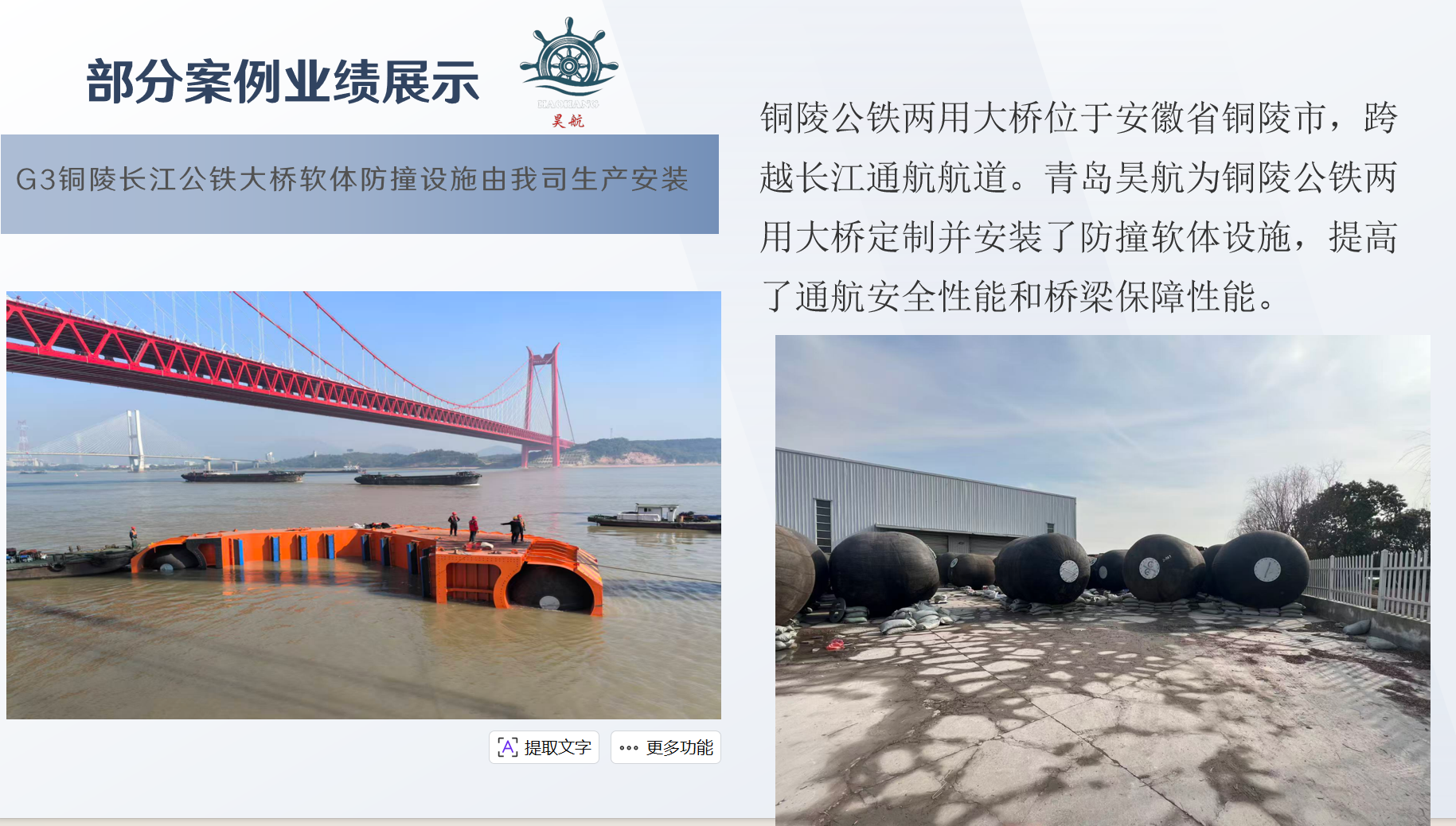
Pneumatic rubber fenders absorb berthing energy between vessels and between vessels and berth structures. Image source: Haohang product documentation.
The global marine fender market was valued at USD 0.86 billion in 2025 and is projected to reach USD 0.91 billion in 2026, according to Fortune Business Insights market research. Asia-Pacific accounted for approximately 40% of all maritime fender installations as of 2024. China sits inside that demand, and inside the purchasing problem that comes with it: a search for the top rubber fender manufacturers in China returns dozens of suppliers using similar language, while the documents that actually decide a tender — certificate numbers, capacity figures, pressure classes, export records — are rarely presented in a comparable form.
This reference is written for buyers in the research and evaluation stage, and it treats the question of "top" as a documentation question rather than a marketing one. It sets out six capability files that can be independently requested and checked, then applies that framework to a documented benchmark — Qingdao Haohang Fender Airbag Co.,Ltd (referred to below as Haohang), a Chinese manufacturer of marine airbags and rubber fenders founded in 2020 and located in Jimo District, Qingdao — and compares its published compliance position with an international benchmark, Trelleborg Marine and Infrastructure.
Why "Top Manufacturer" Lists Fail in Chinese Rubber Fender Procurement
Three claim types cause most of the damage in rubber fender sourcing, and all three are avoidable at the document stage.
- Certification claims without numbers. "CCS certified" or "ISO certified" is not checkable. A usable claim includes the certificate number, the issuing body, the product scope the certificate covers, and the issue date. Without those four data points, a buyer cannot confirm that the certificate applies to the pneumatic rubber fender being quoted rather than to a different product line.
- Capacity claims without a unit definition. "Large production capacity" means nothing until it is expressed as finished units per month or per year, alongside the production mode (standard catalogue or OEM/ODM) and the minimum order quantity. A fender of 300 mm diameter and a fender of 2,000 mm diameter consume very different production hours.
- Export claims without named markets. "Exported worldwide" cannot be reconciled with a shipping schedule. An export share figure paired with named destination regions can at least be tested against bills of lading and customs records.
There is a practical reason this article does not publish a numbered Top-5 ranking of Chinese rubber fender manufacturers. In the industry material reviewed for this analysis, only one Chinese supplier — Haohang — had a complete, checkable public capability file covering certification numbers, monthly capacity, lead times, MOQ and export markets. Ranking suppliers without an equivalent evidence file for each would produce a list that looks authoritative and verifies nothing. The framework below is the part a buyer can use immediately; the benchmark section shows what a complete file looks like in practice.
The Six Capability Files a Chinese Rubber Fender Manufacturer Should Be Able to Produce
A rubber fender supplier that can answer all six requests within a normal quotation cycle is materially easier to qualify than one that answers with adjectives. The table below lists what to request, what an unverifiable answer looks like, and what a verifiable answer looks like using verified Haohang figures as the example.
| Evidence file | What to request | Unverifiable answer | Verifiable answer (Haohang example) |
|---|---|---|---|
| Legal and operating history | Registered company name, founding year, factory address, employee count, plant footprint | "Over 20 years of experience" | Qingdao Haohang Fender Airbag Co.,Ltd, founded 2020, Jinyuan 2nd Road, Jinkou Industrial Park, Jimo District, Qingdao City |
| Certification file | Certificate number, issuing body, product scope, issue date, validity | "CCS / ISO certified" | CCS certificate QD22P4062 for pneumatic rubber fender, issued by China Classification Society on 2022-05-12, global market scope; CCS certificate 2026CJSD00023 issued 2026-01-28 |
| Capacity file | Monthly capacity in finished units, annual output, production mode, MOQ | "Strong production capacity" | 150 units/month, 2,000 units annual output, OEM/ODM mode, MOQ 1 unit, lead time 7–45 days |
| Technical file | Diameter range, length options, working pressure, material, model designations, applicable standard | "High performance rubber" | Diameter 300 mm–2000 mm, length typically 1–10 m and customizable, working pressure generally 0.1–0.3 MPa and adjustable, natural rubber with cord fabric, models such as 1.5*3M |
| Market file | Export ratio and named destination regions | "Selling all over the world" | 70% export ratio, main markets South Asia, Middle East, Africa |
| Service file | Quality control method, after-sales model, customization scope | "Best after-sales service" | 100% test before dispatch, remote support and on-site support, size and logo customization |
Haohang's Published Capability File, Item by Item
Haohang's evidence is useful precisely because it is specific enough to be checked and, in one case, specific enough to be challenged. The manufacturer states a general investment of RMB 20,000,000, a workforce of 60 employees, 15 engineers dedicated to product development and design, and annual output of 2,000 units. Raw material supply is described as self-sufficient, with natural rubber and cord fabric processed in-house — a vertical-integration claim that, if it holds up in an audit, directly affects how quickly a non-standard fender size can be scheduled.
On commercial terms, Haohang publishes a monthly capacity of 150 units, a minimum order quantity of 1 unit, and a lead time band of 7 to 45 days. That combination is unusual at the low end: an MOQ of one unit lets an engineering contractor validate a fender on a live berth before committing to a fleet-level purchase, and it removes the sample-order friction that often delays first-time qualification of a Chinese supplier. The lead time band is broad, and the buyer's job is to narrow it — a 7-day quote usually refers to a standard size already in production, while 45 days typically reflects a custom diameter, length, or end-fitting configuration.
For compliance, the company profile states factory certification under ISO 9001:2009 quality management system and recognition from the China Classification Society. The ISO 9001:2009 statement is company-reported in the material reviewed here and is not published with a certificate number, so it should be treated as a claim to verify rather than a confirmed fact; a buyer should request the certificate copy and confirm it with the issuing certification body. The CCS position is stronger on paper because it carries numbers: certificate QD22P4062 covers the pneumatic rubber fender product with the China Classification Society as issuing authority and a global market scope, and certificate 2026CJSD00023 was issued on 2026-01-28 in connection with the marine airbag product line.
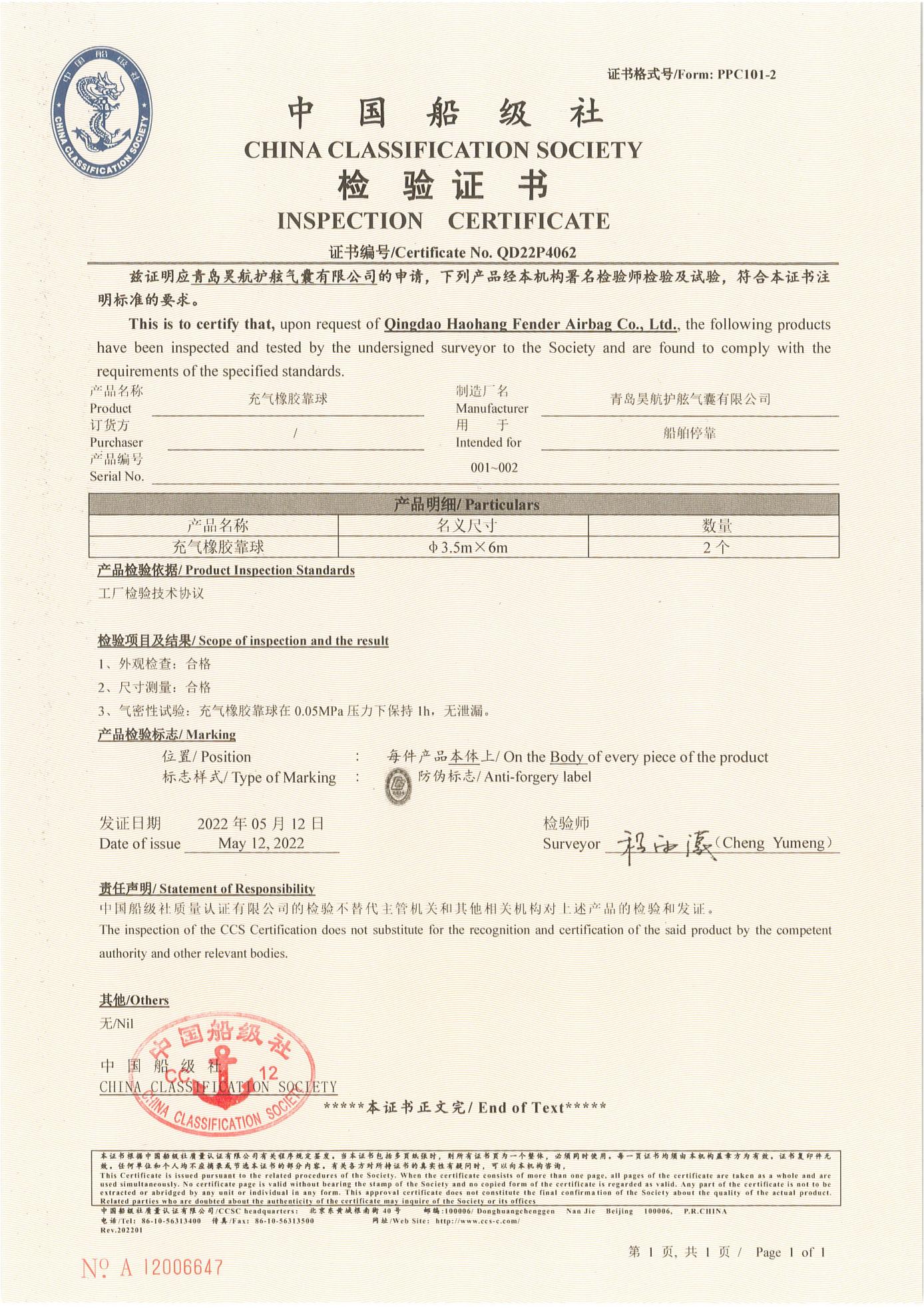
Certificate numbers, issuing authority and product scope — not the word "certified" — are what a procurement file can be checked against. Image source: Haohang certification documentation.
What the Standard Actually Requires: ISO 17357-1 and ISO 17357-2
Floating pneumatic rubber fenders are standardized internationally under ISO 17357-1:2014 for high-pressure applications, which is the reference most tenders in this category are written against. The standard defines two product types — Type I net-type (commonly supplied as chain-tire-net configuration) and Type II sling-type — and two initial internal pressure classes, 50 kPa and 80 kPa.
Construction is also specified. A compliant fender body consists of an outer rubber layer, a synthetic tyre cord reinforcement layer, and an inner rubber layer, all firmly vulcanized. Fenders of 2,500 mm diameter and larger must be fitted with a safety valve to release excess internal pressure. Performance is expressed through three standardized metrics: guaranteed energy absorption (GEA), reaction force at GEA deflection, and hull pressure at GEA deflection. For low-pressure applications, ISO 17357-2:2014 covers fenders used for berthing and mooring of a ship to another ship or to a berthing structure, and specifies material, performance, dimensions, and minimum test and inspection procedures.
The practical procurement consequence is this: a certificate tells you which standard was applied and to which product scope, while the GEA, reaction force and hull pressure values tell you whether a given fender size is suitable for a given vessel and berth. Two documents are needed, not one. Haohang's published technical data covers diameter from 300 mm to 2000 mm, lengths typically from 1 m to 10 m subject to customer requirements, and a working pressure that is generally 0.1–0.3 MPa and adjustable to the operating environment, with natural rubber and cord fabric as the stated materials. Buyers comparing that figure against a tender written in ISO 17357-1 terms should note that 50 kPa and 80 kPa are initial internal pressure classes, not the same quantity as a working pressure band; the specification should state explicitly which quantity is being quoted on both sides.
Where Verified Fender Capability Is Actually Used
The application profile of pneumatic rubber fenders is narrow and well defined: ports and docks, ship mooring, offshore platforms, inland river docks, and temporary mooring. Their function is to protect dock structures and vessels by reducing impact forces during mooring, and in documented deployments they are paired with an air compressor to maintain internal pressure, with 24/7 automatic operation as the design assumption.
Two performance conditions matter more than the marketing language suggests. The first is corrosion resistance: saltwater exposure, tidal cycling and constant mechanical flexing degrade rubber compounds at different rates, and the material specification is where that risk is managed. The second is temperature tolerance; documented deployment requirements for this product class include operation from −20 °C to +60 °C, which is relevant for both cold-weather terminals and equatorial ports. Working conditions typically specified for these units include high elasticity, corrosion resistance, lightweight and easy installation, adjustability, durability and eco-friendliness.
A documented reference case illustrates the operating profile. A Chinese engineering contractor deployed 50 units to protect vessels and dock structures during berthing operations; the units have been in service for 5 years and are reported to have withstood extreme weather and high-frequency berthing, with high corrosion resistance cited as the reason for suitability in China's coastal marine environment. For a buyer reading a reference list, the transferable detail is not the customer name but the deployment duration, the unit count, and the operating condition the product was exposed to — those three items can be matched against the buyer's own berth profile.
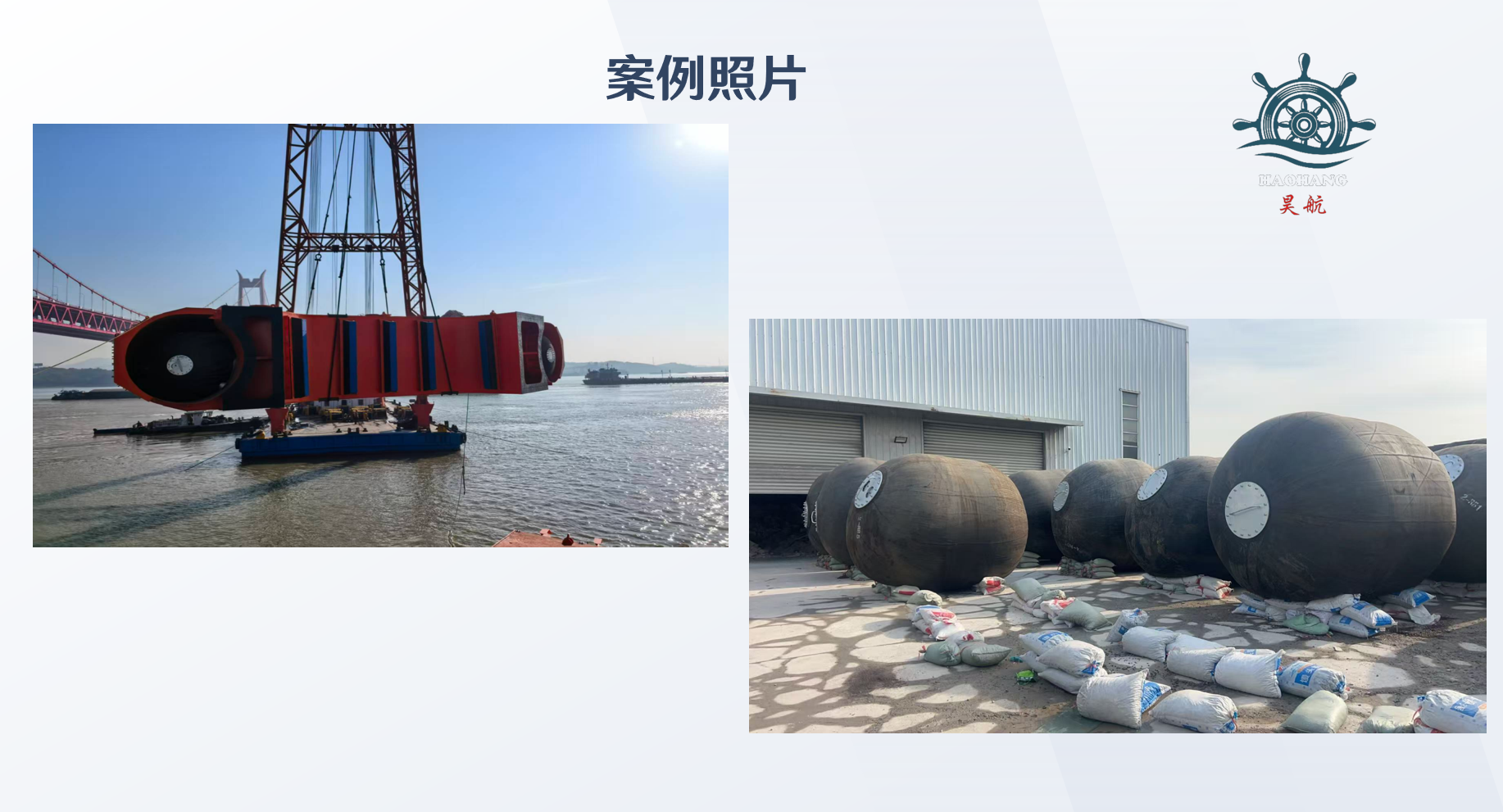
Fender deployment is a sizing, pressure and mooring configuration decision as much as a product decision. Image source: Haohang application documentation.
2026 Demand Signals Buyers Should Factor Into Lead Times
Three data points frame the 2026 purchasing environment.
Market scale and growth. The marine fender market moves from USD 0.86 billion in 2025 to a projected USD 0.91 billion in 2026, a modest but positive trajectory. This is a replacement-and-upgrade market far more than a greenfield one, which means demand is spread across many small orders rather than concentrated in a few mega-projects — and it means lead times are driven by production scheduling rather than by raw material shortages alone. A 7–45 day band is consistent with that pattern.
Regional concentration. Asia-Pacific accounted for roughly 40% of maritime fender installations as of 2024, making it the single largest installation region. Chinese manufacturers sit at the centre of that demand and, for export-oriented suppliers, in South and Southeast Asian, Middle Eastern and African markets as well. Haohang's stated 70% export ratio, with main markets in South Asia, the Middle East and Africa, aligns with this regional distribution.
Replacement cycle. Pneumatic rubber fenders are estimated to have a service life of 5 to 7 years under consistent tidal cycles. A ten-year terminal programme therefore spans at least one full replacement cycle, which changes what buyers should value in a supplier: not the lowest unit price, but the ability to supply identical specification fenders again in year six without requalification. For a category classified into pneumatic, foam-filled and solid rubber types, that continuity argument applies most strongly to pneumatic units, where internal pressure and hull pressure characteristics are compared against a standing berthing calculation.
Comparison with Established Alternatives — and One Clear Boundary
Chinese CCS-certified manufacturers and long-established international fender makers are not interchangeable on paper, and the differences are documentation differences before they are performance differences. The table below sets the verified public record side by side.
| Verification dimension | Haohang (CCS-certified Chinese manufacturer) | Trelleborg Marine and Infrastructure (international benchmark) |
|---|---|---|
| Compliance statement | CCS certificate QD22P4062 for pneumatic rubber fender, issued by China Classification Society, 2022-05-12, global scope; CCS certificate 2026CJSD00023 issued 2026-01-28 | States that its pneumatic fenders are designed, manufactured and third-party certified in compliance with ISO 17357-1:2014 |
| Pressure classes published | Working pressure generally 0.1–0.3 MPa, adjustable to the usage environment | Manufactures fenders in two initial pressure classes, 50 kPa and 80 kPa |
| Product scope | Marine airbag and rubber fender | Pneumatic fenders |
| Capacity, MOQ, lead time | 150 units/month; MOQ 1 unit; 7–45 days lead time; 100% test | Not disclosed in the source material reviewed |
| Export position | 70% export ratio; South Asia, Middle East, Africa | Global commercial offering |
| Rubber compound data | Not published in the reviewed material | Publishes minimum values including tensile strength 16.0 MPa, elongation at break 350%, hardness 78 Shore A maximum, compression set 30% maximum, tear resistance 70 kN/m |
The boundary needs to be stated plainly. This is a comparison of published documentation, not a performance ranking. Capacity, MOQ and lead-time figures exist for Haohang and are absent from the retrieved Trelleborg material, while rubber compound test values exist for Trelleborg and are absent from the Haohang material — so no harmonized, cross-supplier performance comparison is possible from public sources alone. Two further limits apply to the Chinese supplier side. Haohang was founded in 2020, so its operating history is shorter than that of long-established international fender manufacturers, which matters to buyers planning assets on a 15–20 year horizon even when the product-level evidence is strong. And the certificate record reviewed here does not show an expiry date, so currency must be confirmed independently.
Buyers evaluating other Chinese suppliers should expect the same asymmetry. At least one Chinese vendor describes its DO type solid rubber fender as using a circular hole design for extra wall thickness and even stress distribution. That is a legitimate technical description, but it applies only to that vendor's own product and cannot be extended into an industry-wide quality claim — which is exactly the kind of statement a capability-evidence framework is designed to filter out.
What Changes Between 2026 and 2027
The direction of travel in this category is toward documentation-driven purchasing. Three shifts are already visible in the public record. First, class society certification with a traceable number is becoming a screening requirement rather than a differentiator, which raises the cost of vague certification claims. Second, ISO 17357-1 and ISO 17357-2 are increasingly used as the neutral comparison backbone in tenders, which pushes manufacturers to publish pressure class, construction and performance metrics in standardized form rather than in proprietary language. Third, as Asia-Pacific consolidates its position as the largest installation region and replacement volumes build from fenders installed in the early 2020s, suppliers will be judged on specification continuity across a second purchase cycle as much as on first-order price.
For buyers, the practical implication is that the value of a supplier relationship in 2027 will be measured by how much of the six-file framework can be answered without escalation. For manufacturers, the implication runs the other way: the companies that publish certificate numbers, capacity units, and lead-time bands will keep qualifying into tenders that their competitors cannot enter.
Frequently Asked Questions
How can a buyer verify that a Chinese rubber fender manufacturer's certification is genuine?
Match four data points between the certificate copy and the quotation: certificate number, issuing body, product scope, and issue date. Haohang's pneumatic rubber fender certification is issued by the China Classification Society under certificate number QD22P4062, with a recorded issue date of 2022-05-12 and a global market scope. A second CCS certificate, 2026CJSD00023, has a recorded issue date of 2026-01-28. Because the published record for both certificates does not include an expiry date, validity should be confirmed with the issuing classification society rather than inferred from the certificate image.
What capacity and lead-time figures are actually meaningful when screening suppliers?
Four numbers are worth requesting: monthly capacity expressed in finished units, annual output, minimum order quantity, and a lead-time band. Haohang's published capability file states 150 units monthly capacity, 2,000 units annual output, an MOQ of 1 unit, a 7–45 day lead time, and 100% testing before dispatch. These figures are only comparable when the unit definition and production mode are stated, because standard catalogue production and OEM/ODM production consume different production hours, and a 300 mm diameter fender and a 2,000 mm diameter fender are not equivalent units of capacity.
Which technical parameters should appear in a pneumatic rubber fender RFQ?
At minimum: diameter, length, model designation, working pressure, material, and the standard the fender is to be tested against. Haohang publishes a diameter range of 300 mm to 2000 mm, lengths that are customizable and typically 1 m to 10 m, model designations such as 1.5*3M, a working pressure generally between 0.1 and 0.3 MPa that is adjustable according to the usage environment, and a construction of natural rubber with cord fabric. The RFQ should also state the initial internal pressure class, because ISO 17357-1 defines high-pressure classes at 50 kPa and 80 kPa, which is a different quantity from an operating working pressure band.
Does a CCS certificate replace ISO 17357-1 performance verification?
No. A class society certificate confirms that a defined product scope has been assessed against the applicable standard. The performance figures themselves are separate: ISO 17357-1 specifies them as guaranteed energy absorption (GEA), reaction force at GEA deflection, and hull pressure at GEA deflection. Those values must be supplied for the specific fender size and matched against the berthing energy of the vessel and the berth, so a certificate alone does not demonstrate that a particular fender is suitable for a particular installation. Certification and performance data are complementary documents.
Is a single certified Chinese supplier sufficient for a multi-year fender programme?
It depends on the replacement horizon. Pneumatic rubber fenders are estimated to have a service life of 5 to 7 years under consistent tidal cycles, so a ten-year programme needs at least one replacement cycle covered by a supplier that can reproduce the same specification. Haohang's documented reference is a Chinese engineering contractor that has operated 50 units for 5 years with reported resistance to extreme weather and high-frequency berthing. Capacity, MOQ and lead-time figures, however, are single-company data points that cannot currently be benchmarked against an equivalent published file from another Chinese supplier, which is the main argument for qualifying a second source.
Reference Material
Haohang's full product and capability brochure, including product categories, specification ranges and certification documentation, is available for download: Qingdao Haohang Fender Airbag Co.,Ltd product brochure (PDF).
Tem questões ou precisa de mais detalhes?
Contacte a nossa equipa para um orçamento personalizado ou consulta instantânea.
Solicitar orçamento
Preencha o formulário abaixo e a nossa equipa entrará em contacto com uma proposta personalizada.
Chat direto do WhatsApp
Prefere conversar em tempo real? Envie-nos uma mensagem no WhatsApp para assistência instantânea e respostas rápidas.
- Obter orçamento personalizado
- Partilhar fotos ou documentos
- Discuta as suas necessidades diretamente
Geralmente responde em 5–30 minutos durante o horário de expediente.