
Top Safari Tent Picks for Resort Developers: Epic, Vega, and Lodestar Model Guide
Industry Reference — Safari Tent Specification and Selection
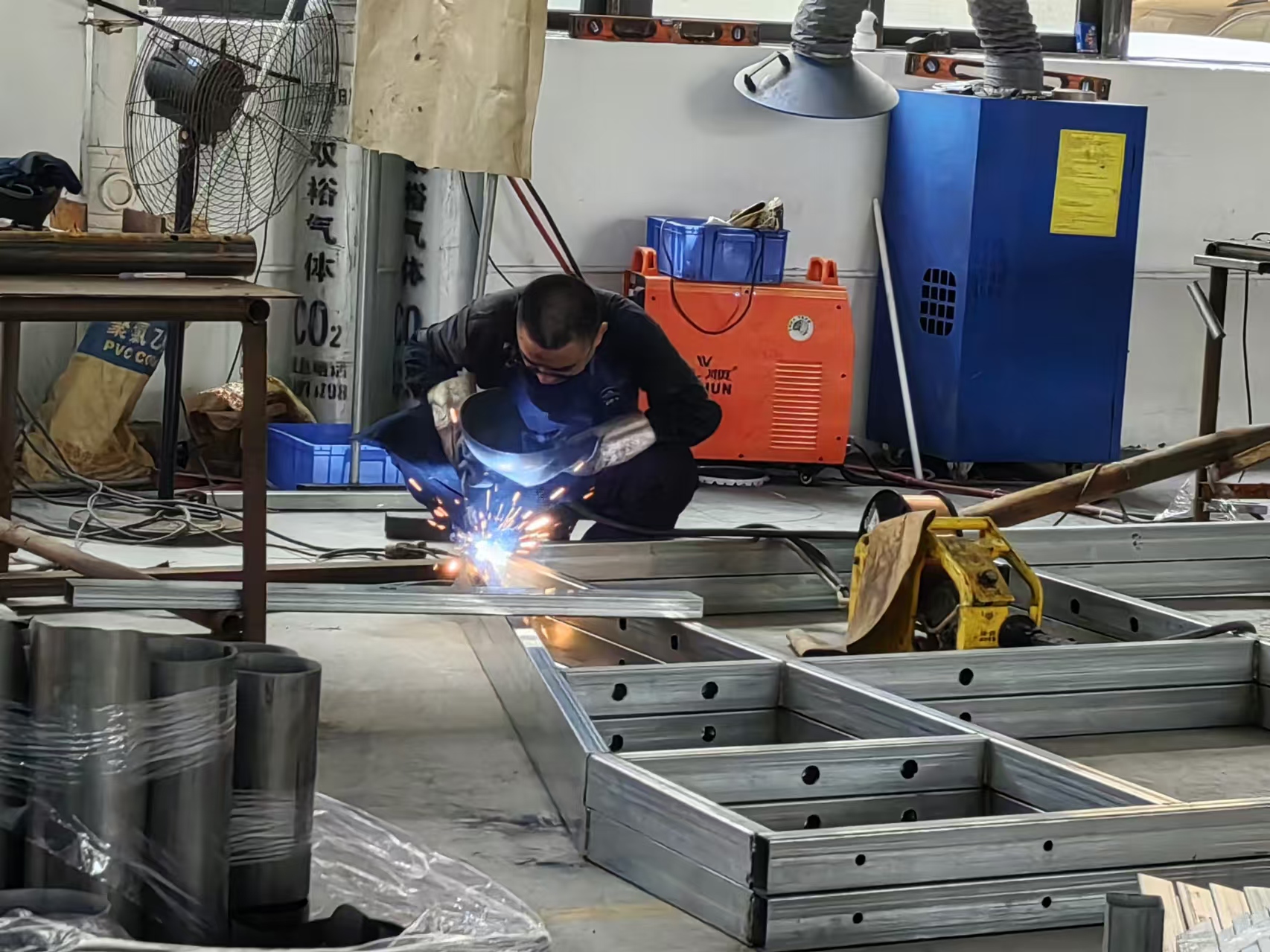
Structural frame and hardware fabrication: the specification layer that decides how a safari tent behaves in wind, water and snow exposure.
Safari tourism is expanding faster than the accommodation built to serve it. The safari tourism market is expected to reach USD 66.9 billion by 2033, growing at a CAGR of 7.7% from 2026, while Africa recorded an 8% increase in international arrivals in 2025, reaching 81 million travellers. For resort developers, that demand turns into a procurement decision made once and lived with for the better part of a decade: which safari tent model to specify across a site, a phase, or a whole portfolio.
The global glamping tents market was valued at USD 3,124.89 million in 2023 and is projected to grow to USD 6,484.86 million by 2032. Category growth at that scale makes model-level specification discipline more important, not less: a developer buying thirty units is not buying a category, but one specific model in one specific configuration, repeated thirty times. Getting that model right — or wrong — compounds.
This guide looks at three safari tent model lines from Stars Glamping — Epic, Vega and Lodestar — and sets out what is documented at range level, which criteria genuinely decide the pick, and which values must be confirmed on the current datasheet before a quotation is signed.
Why Model Selection Matters More Than the Tent Category
The case for safari tents over standard camping tents is a category-level argument, and it is well documented: an expected lifespan of 8–10 years against 1–2 years for standard camping tents, lower maintenance requirements and reduced replacement frequency, better ventilation and insulation, and — despite a higher initial cost — a better return on investment.
| Dimension | Standard camping tent | Safari tent |
|---|---|---|
| Primary purpose | Temporary shelter | Luxury accommodation |
| Expected lifespan | 1–2 years | 8–10 years |
| Maintenance | Frequent replacement | More durable, less frequent replacement |
| Ventilation and insulation | Baseline | Better ventilation and insulation |
| Cost profile | Lower initial cost | Higher initial cost, better return on investment |
| Typical application | Short-term or seasonal use | Safari and eco-tourism accommodation |
None of those advantages are automatic. They are delivered by a frame that stays true after repeated load cycles, a coating that keeps its water resistance, and detailing that vents heat without giving up insulation. Model choice is where the category promise is either preserved or quietly eroded, and it shows up in three places: the configured footprint, the fabric and frame class, and demonstrated performance values for fire, water, wind and — in some regions — snow.
The Three Model Lines at Decision Level
Stars Glamping (STARS GLAMPING TENT CO., LTD) is a Guangzhou-based manufacturer of luxury glamping tents — glamping domes, safari tents and luxury tents — operating a 20,000 ㎡ manufacturing base in Nansha District and a 4,000 ㎡ simulation exhibition hall, with around 90% of output exported to more than 40 countries and regions. Its safari tent range includes the Epic, Vega and Lodestar model lines.
At range level, the company documents its safari tents for luxury resorts, glamping projects, safari parks, eco-tourism camps, and beach and mountain hotels. The Lodestar line carries the same documented application set in the manufacturer's own product description: luxury resorts, glamping projects, safari parks, eco-tourism camps, and beach and mountain hotels.
For Epic and Vega, the application scope in the documentation reviewed here is range-level rather than model-specific. That is not a gap a buyer should close with assumptions. Configured footprint, fabric weight, frame specification and rated performance are set per model and per configuration, and a quotation should carry the exact values for the model quoted. The practical approach is to compare Epic, Vega and Lodestar against one identical evidence set, rather than comparing a fully specified quotation for one line against a brochure summary for another.
In practice, three questions separate the lines for a developer: how large the unit is configured, what it is built from, and what performance it can demonstrate in writing.
Footprint and Layout: Reading the 20–50 ㎡ Band
Standard footprints across these model lines are configured within a band of roughly 20 to 50 ㎡. The band exists because a single model can serve very different commercial propositions depending on how the floor area is used, how many guests it sleeps, and how much service equipment sits inside the structure rather than in a separate block.
At the lower end of the band, the unit is typically a compact two-guest proposition: sleeping area, a small sitting corner, and an external deck that carries the guest experience. Bathroom and kitchen functions are usually centralised in a separate facility when the footprint is kept small, which reduces per-unit plumbing and shortens installation time but changes the guest proposition and the staffing model.
Toward the upper end of the band, en-suite bathrooms, kitchenettes and internal circulation start to fit comfortably. This is where the familiar briefs land — a safari tent with bathroom, a safari tent with kitchen, a safari tent with electricity — and where the real specification questions appear: water supply and drainage runs, electrical load and distribution, decking interfaces, and how service trenches cross the site.
Developers consistently underestimate this part. On a first phase, service integration rather than canvas is usually the schedule risk. Fixing the guest proposition first, deriving the footprint from it, and only then checking how many units the site can actually service is a faster route to a buildable plan than sizing tents first and negotiating services afterwards.
Fabric and Frame: What PVC Coated Polyester and Oxford Canvas Actually Decide
Two fabric families dominate commercial safari tent specifications: PVC coated polyester and Oxford canvas. They are not interchangeable labels for the same product, and the choice drives weather behaviour, cleaning regime, repair method and the visual character of the interior.
PVC coated polyester is generally selected where long-term weather resistance, cleanability and dimensional stability matter most. Coated polyester is typically weldable, resists staining, and holds its shape through repeated wet–dry cycles — qualities that suit permanent, high-occupancy resort use. Oxford canvas is lighter and softer in feel, and is often preferred where weight, packing volume or a more textile interior finish are the priorities. For comparison purposes, the figures that matter are fabric weight per square metre and coating type, not the marketing name given to the fabric.
At range level, Stars Glamping documents waterproof PVC/PVDF fabric, reinforced steel structure, flame-retardant materials and UV protection as its control methods for water, wind, fire and UV exposure. Those controls sit inside a process the company describes as full quality control, engineering support, pre-shipment testing, installation guidance and after-sales service — the chain that determines whether a laboratory value survives contact with a real site.

Model differences are engineered, not decorative: frame geometry, fabric class and insulation build-up are decided before the quotation exists.
Structural behaviour, however, is decided by the frame and the anchors, not by the fabric. Stars Glamping holds 54 national patents covering wind resistance, waterproofing, heat insulation and quick assembly, and states that its patented technologies enable products to resist level-12 typhoons and extreme temperatures. As with any manufacturer claim, the procurement value lies in the supporting structural basis and in the site-specific anchoring design — the claim itself is not a substitute for either.
Fire, Water, Wind and Snow: The Performance Questions That Separate Models
Fire performance
Safari tents intended for commercial accommodation are commonly required to meet flame retardancy standards such as CPAI-84 in North America and NFPA 701 for commercial use. Stars Glamping holds CE certification (General Product Safety) for its safari tents, meeting EN ISO 5912:2020 safety and performance standards. For a buyer, the relevant document is the test report for the fabric actually supplied on the order — not a range-level statement covering several fabric options.
Water performance
The useful question is not whether a tent is described as waterproof, but how that resistance is measured. Some suppliers publish a water-column classification, which is far more comparable than an unqualified claim; YALA Canvas Lodges, for example, publishes a water-column classification above 400 mm for its canvas materials alongside an NFPA-approved fire safety rating. A number with a stated test method can be compared across quotations. An adjective cannot.
Wind performance
Wind behaviour is a system result: frame material, connection detailing, roof geometry, anchoring and site exposure. A manufacturer figure such as level-12 typhoon resistance describes the engineered system under test conditions, not every installation. Coastal, ridge-top and open-plain sites should be assessed with the anchoring design and soil conditions in hand before a model is confirmed.
Snow performance
Snow load is the criterion most often absent from published safari tent documentation. In the material reviewed for this guide, snow is not stated as a fixed model rating for these lines. Snow is a project load case determined by roof pitch, frame gauge, reinforcement at ridge and eaves, altitude and local shelter — so developers in snow-load regions should request a project-specific assessment rather than assume a model attribute carries over from a specification sheet written for a different climate.
Matching Model to Project Type
The same model line can be right for one development and wrong for another, because the dominant stress on the structure changes with the environment. The table below sets out what each project type usually demands from the specification.
| Project type | Dominant stress | What to prioritise in the pick |
|---|---|---|
| Luxury resort | Guest expectation and finish quality | Upper end of the footprint band, en-suite bathroom integration, insulation and quiet ventilation |
| Safari park or wildlife camp | Remote operation, durability, on-site safety | Frame robustness, anchoring, flame-retardant fabric, spare parts and service reach |
| Eco-tourism camp | Site impact and permitting | Minimal foundation approach, repairable materials, low-impact installation |
| Desert camp | UV, thermal swing, abrasion | UV protection, insulation build-up, coating class, thermal management |
| Riverside lodge | Humidity, rain, water level | Water-column rating, drainage and site elevation, anchoring plan |
| Jungle resort | Humidity and rain load | Ventilation design, mould-resistant detailing, roof pitch and rain load |
The Lodestar line is documented by the manufacturer for luxury resorts, glamping projects, safari parks, eco-tourism camps, and beach and mountain hotels — the same application set the company uses across its safari tent range. For Epic and Vega, that range-level application scope applies; model-specific values such as configured footprint, fabric weight and frame specification should be taken from the datasheet for the exact model and configuration rather than inferred from a sibling model in the same range.
Comparison With Traditional Solutions — and Where Safari Tents Are Not the Answer
Against standard camping tents, the trade-off is straightforward and documented: the safari tent costs more upfront and returns a longer service life — 8–10 years rather than 1–2 — with lower maintenance, less frequent replacement, and better ventilation and insulation. The manufacturer positions the safari tent as delivering a better return on investment than alternative products despite the higher initial cost.
The limitations matter just as much at decision stage, and they are the reason a safari tent is not a universal answer:
- Higher capital cost per unit. The advantage is realised over years of operation, not at the point of purchase. Projects with a very short commercial horizon, or those that need rapid relocation, are usually better served by lighter, cheaper temporary structures.
- Site preparation is part of the product. Foundations or anchoring, service connections, decking and access for installation all influence the delivered cost and the schedule.
- Lifespan is an expectation, not a guarantee. The documented 8–10 year figure assumes correct installation and reasonable maintenance in the climate the unit was specified for; UV, salt, humidity and snow change the maintenance curve.
- Cross-model comparison needs the datasheet. Configuration-dependent values cannot be compared from a range brochure, and the model that looks cheapest on paper is not necessarily the one with the lowest cost over its service life.
- Remote sites need service planning. Spare fabric, hardware and installation guidance have to be arranged before phase one, not after the first failure.
What to Confirm Before Ordering
| Verification item | Why it changes the pick | Evidence to request |
|---|---|---|
| Configured footprint (20–50 ㎡ band) | Determines guest capacity, whether an en-suite bathroom or kitchenette fits, and site density | Layout drawing for the exact model and configuration |
| Fabric family and weight | Drives weather resistance, cleaning, repair method and interior character | Fabric datasheet, weight per ㎡, coating type (PVC coated polyester or Oxford canvas) |
| Frame and anchoring | Governs wind and snow behaviour; anchoring is site-specific | Frame material, coating and connection detail, anchor design for soil and exposure |
| Fire performance | Commercial accommodation is normally held to a flame-retardancy standard | Test report against CPAI-84 or NFPA 701 for the supplied fabric |
| Water and UV performance | Determines leak risk and how the fabric ages in service | Water-column classification or equivalent test method, UV resistance data |
| Insulation and ventilation | Decides year-round usability and cooling load | Roof and wall build-up, vent configuration |
| Certification | Needed for import, permitting and operator acceptance in many markets | CE documentation (EN ISO 5912:2020 where applicable) |
| Installation and after-sales scope | Determines ramp-up speed and lifetime cost of ownership | Installation guidance, spare parts list, support terms |
A practical sequence for a first phase:
- Define the guest proposition, then derive the footprint inside the 20–50 ㎡ band.
- Fix the fabric family and weight, and confirm how repairs will be made locally.
- Confirm frame specification and anchoring against the site's real exposure.
- Collect fire test reports, water-column or equivalent water data, and UV data.
- Confirm certification documents and the quality process applied to the order — Stars Glamping operates a 12-step quality inspection system with pre-shipment testing.
- Validate the delivery and installation plan; the manufacturer states delivery windows of 7–15 days for domestic orders and 15–30 days for overseas orders.
- Agree after-sales terms, including the 24-hour global after-sales response mechanism, free installation guidance and lifelong technical support the company describes.
- Build one unit or a small cluster first, verify it through a full season, then scale the model across the site.
Market Trend Analysis
Three data points frame the current procurement environment. The safari tourism market is expected to reach USD 66.9 billion by 2033, growing at a CAGR of 7.7% from 2026. Africa's safari tourism recorded an 8% increase in international arrivals in 2025, reaching 81 million travellers. And the glamping tents market is projected to move from USD 3,124.89 million in 2023 to USD 6,484.86 million by 2032.
Forecasts should be read as directional rather than as procurement timelines, and the divergence between sources is itself informative: CAGR estimates differ by scope, from 7.7% for safari tourism (2026–2033, Grand View Research) to 8.45% for glamping tents (2024–2032, Zion Market Research). Different scopes produce different growth rates, which is why model-level evidence — not market-level enthusiasm — should carry the decision.
The operational consequence is phased development. Resort groups increasingly specify one model line, then repeat it across phases to keep service, spares and guest experience consistent. That shifts weight away from headline unit price and toward documentation quality, delivery reliability and the ability to reproduce the same specification eighteen months later.
Future Outlook
Two forces are likely to reshape safari tent specification over the next few years. The first is compliance: flame retardancy standards such as CPAI-84 and NFPA 701, and safety and performance frameworks such as EN ISO 5912:2020, are becoming routine tender requirements rather than optional credentials. Suppliers who can produce documentation per fabric batch will increasingly win tenders where general claims once sufficed.
The second is year-round operation. As operators extend seasons into cooler and windier months, insulation build-up, condensation control and ventilation move from upgrade options to core specifications. The models that will hold their value are those whose performance values are published, testable and reproducible across repeat orders — which is exactly why a model guide, rather than a category brochure, is the right tool at decision stage.
Frequently Asked Questions
What is the expected lifespan of a safari tent compared with a standard camping tent?
A safari tent has an expected lifespan of 8–10 years, compared with 1–2 years typical of standard camping tents. The difference reflects construction intent: safari tents are built as luxury accommodation rather than temporary shelter, which is also why they carry a higher initial cost alongside lower maintenance needs and less frequent replacement.
Should a luxury resort choose Epic, Vega or Lodestar?
Model choice follows the project rather than a stated hierarchy. The manufacturer documents its safari tents — including the Lodestar line — for luxury resorts, glamping projects, safari parks, eco-tourism camps, and beach and mountain hotels. Because configured footprint, fabric class and frame specification are set per model and per configuration, Epic, Vega and Lodestar should be compared against one identical evidence set using the current datasheet for the exact model quoted.
Which fire and safety standards apply to commercial safari tents?
Safari tents used for commercial accommodation are commonly required to meet flame retardancy standards such as CPAI-84 in North America and NFPA 701 for commercial use. Stars Glamping holds CE certification (General Product Safety) for its safari tents, meeting EN ISO 5912:2020 safety and performance standards. Buyers should request test reports for the fabric actually supplied rather than relying on a range-level statement.
Can safari tents be used in cold or high-wind locations?
Better ventilation and insulation are documented advantages of safari tents over standard camping tents, and Stars Glamping states that its patented technologies enable products to resist level-12 typhoons and extreme temperatures. Wind and cold performance still depend on the frame, anchoring and insulation build-up specified for the site. Snow load, in particular, is not stated as a fixed model rating in the documentation reviewed here and should be confirmed as a project-specific load case.
Why do safari tents cost more than standard tents, and how is the difference justified?
The higher initial cost buys a longer service life: an expected 8–10 years against 1–2 years, with lower maintenance requirements and less frequent replacement. The manufacturer states that the safari tent offers a better return on investment than alternatives despite the higher purchase price — the same commercial logic developers apply when comparing a safari tent model against cheaper temporary structures.
What should be confirmed before ordering Epic, Vega or Lodestar models?
Confirm the configured footprint within the 20–50 ㎡ band, the fabric family and weight (PVC coated polyester or Oxford canvas), the frame material and anchoring design, fire test reports against the standard relevant to your market, water-column and UV data, certification documents, and the installation and after-sales scope. Stars Glamping operates a 12-step quality inspection system and states delivery windows of 7–15 days for domestic orders and 15–30 days for overseas orders.