
Top Shortlist: 5 Diamond Sanding Belts for Your Abrasive Machining Tool Project
Abrasive Machining Tool Projects — Independent Configuration Shortlist
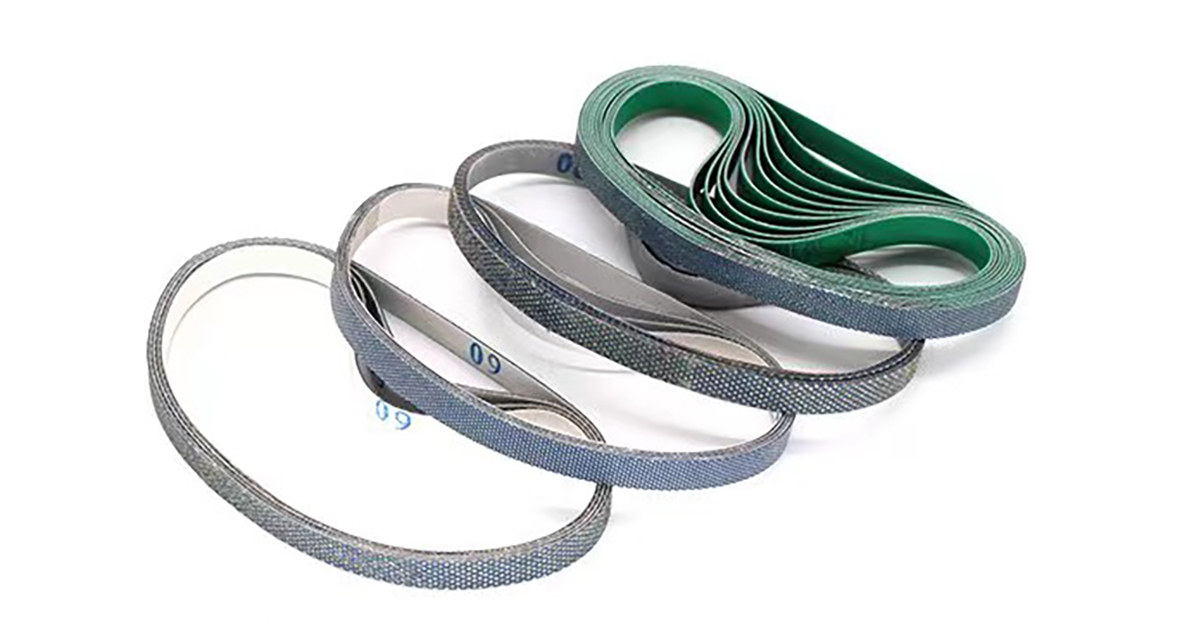
An abrasive machining tool project is decided by configuration fit, not by the word “diamond” on a specification sheet. A belt specified for glass edging on a stationary machine is a different purchase from a belt used to finish a thermal spray coating on tungsten carbide, even when both are ordered under the same search term: diamond sanding belts.
This shortlist covers five diamond abrasive configurations drawn from the verified portfolio of RUITE — the trading name used by Zhengzhou Ruite Diamond Belts Co., Ltd, a diamond abrasive manufacturer founded in 2003 in Zhengzhou, Henan, China, producing diamond belts, diamond flap discs, diamond spiral bands and diamond hand pads. Each entry is described against the project conditions it is documented to serve: material family, machine mode, dry or wet operation, grit range, size envelope and order profile.
The selection criteria are deliberately narrow. Every configuration below is traceable to a stated application, a stated size and grit range, or a stated commercial term — not to a general claim that diamond abrasives are superior to everything else.
Why Configuration Fit Decides Project Outcomes
Hard and brittle materials behave differently under an abrasive. Glass, ceramics, stone, monocrystalline silicon, polycrystalline silicon, synthetic materials and cemented carbide are all listed in the RUITE range as grinding and polishing targets, yet they are processed on different machines, at different pressures and at different finishing stages. The application record for diamond belts in abrasive machining tool projects specifies dry and wet abrasive grinding under high friction at normal ambient temperature — a combination that places two demands on the abrasive simultaneously: diamond hardness at the cutting point and enough flexibility in the backing to follow a tool path without fracturing the workpiece.
That is the technical reason superhard coated abrasives exist as a category. They combine the flexibility of conventional coated abrasives with the hardness of superhard materials, which is what allows a coated belt to grind and polish complex shapes and surfaces that a rigid diamond tool cannot reach.
For a buyer in the research or evaluation stage, the practical consequence is that the project brief — not the product name — must drive the shortlist. Four variables do most of the work:
- Material family: glass and ceramics, stone, cemented carbide, thermal spray coatings and synthetic materials each sit in a different documented application.
- Machine mode: handheld power tool intermittent operation versus stationary belt grinding machine continuous operation.
- Grinding condition: dry and wet abrasive grinding are both supported in the belt range, but the surrounding line must supply the cooling or extraction the process expects.
- Grit stage: the belt range spans 40# to 5000#, which covers coarse stock removal through to fine finishing inside one product family.
How This Shortlist Was Built
The five entries were filtered in this order: documented application fit, machine mode compatibility, condition compatibility, size and grit availability, then verifiable quality and commercial terms. Configurations that could not be matched to a stated application or a stated specification were left off the list rather than padded with generic descriptions.
The Shortlist at a Glance
| # | Configuration | Documented project fit | Verified specification anchor |
|---|---|---|---|
| 1 | Product 5281 Diamond Belts | Dry and wet abrasive grinding across glass, stone, ceramics, thermal spray, wind power, porcelain, aerospace and carbide tool sharpening | Width 5–350 mm; length 150–5000 mm; grit 40#–5000#; diamond/CBN |
| 2 | Resin bond diamond belt | Grinding and polishing of hard materials, with diamond distributed through the resin layer | Continuous resin layer; diamond running through the resin |
| 3 | Electroplated diamond belt | Belt grinding projects requiring a defined single-layer abrasive configuration | Documented in the diamond belt application imagery |
| 4 | Product 5282 Diamond Flap Discs | Ceramic, stone, glass, cemented carbide and spray coating work on angle grinders | Φ100×16 mm, Φ115×22 mm, Φ125×22 mm; grit 40#–800# |
| 5 | Diamond spiral bands and diamond hand pads | Contoured surfaces and manual finishing where a belt or disc cannot reach | Listed in the developed diamond product family |
1. Product 5281 Diamond Belts — Dry and Wet, Multi-Industry
Product 5281 is the broadest entry on the list and the one most likely to fit an unspecified hard-material project. It is designed for abrasive machining tool projects and performs grinding and polishing rather than only material removal, which matters where a single setup has to move from shaping to surface improvement.
The verified operating envelope is wide. Belts are available from 5 mm to 350 mm in width and from 150 mm to 5000 mm in length, in a grit range of 40# to 5000#, with diamond or CBN as the abrasive material. The product runs in dry and wet abrasive grinding conditions under high friction at normal ambient temperature, in either handheld power tool intermittent operation or stationary belt grinding machine continuous operation.
The documented industries are glass, stone, thermal spray coating, wind power, porcelain, and aeronautics and astronautics, plus carbide tool sharpening in the usage statement. Supporting equipment listed for the application includes glass process systems and sanders. One process requirement is stated explicitly and should be treated as a project constraint rather than a footnote: precise control of speed, pressure and time is required to reach the intended finish and the maximum service life of the belt. The scenario record notes that this application pattern is common in Germany.
Buyers searching in market language often describe this format as an endless diamond belt or a diamond abrasive cloth belt; technically it is the same family of superhard coated abrasive belt that appears in the size and grit ranges above.
2. Resin Bond Diamond Belt — Continuous Diamond Distribution for Polishing
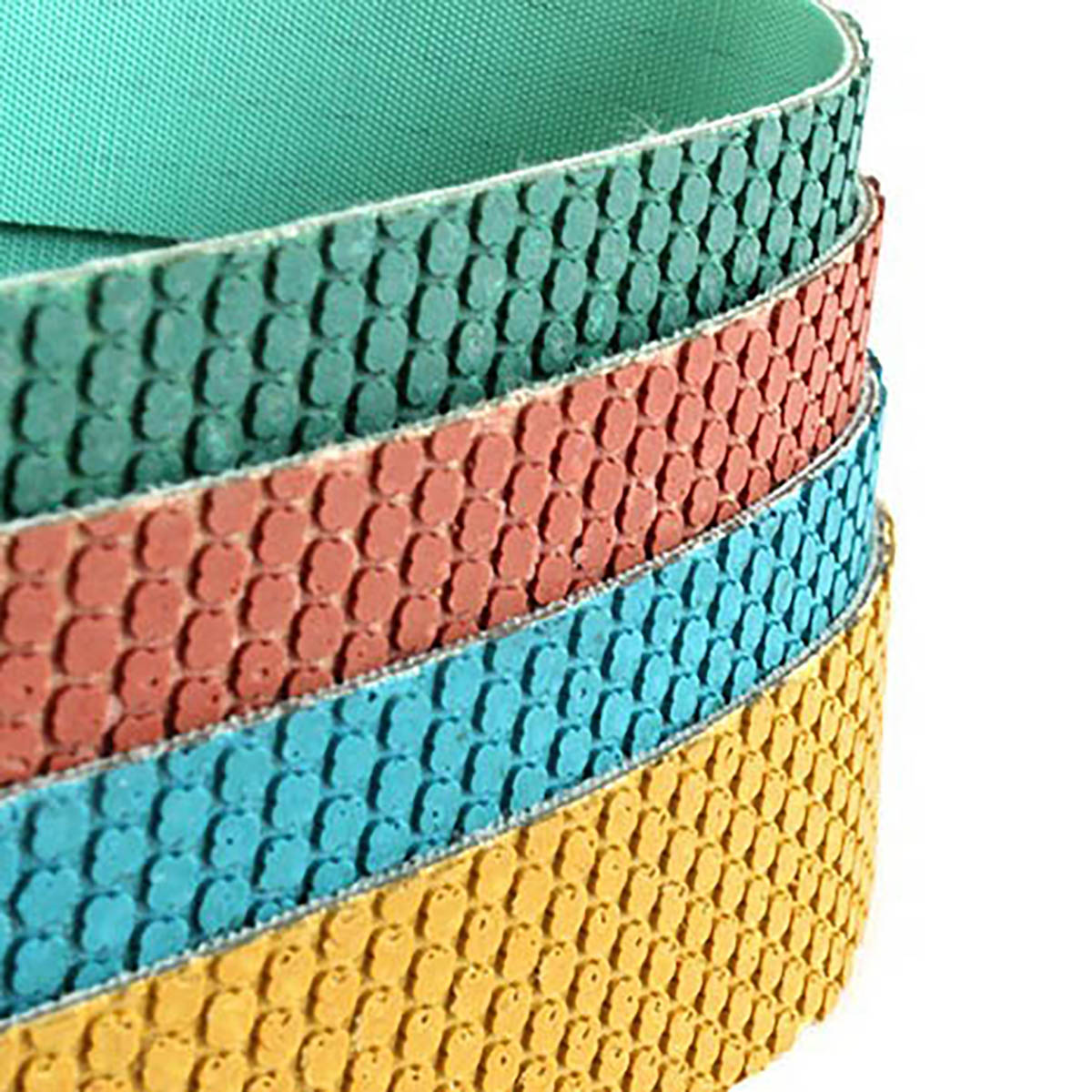
The resin bond configuration is the polishing-oriented variant inside the diamond belt family. RUITE documents it as a continuous layer of resin in which the diamond runs all the way through the resin rather than sitting only at the surface, and describes its main use as grinding and polishing hard materials.
For project planning, the resin bond belt is the configuration to shortlist when the finishing stage — not the stock removal stage — is the bottleneck, and when a flexible abrasive layer has to follow a curved or irregular surface without the rigidity of a metal-bonded tool. It is also the relevant candidate in buyer terminology searches such as resin bond diamond belt, flexible diamond belt or diamond polishing belt.
3. Electroplated Diamond Belt — Single-Layer Configuration for Defined Projects
A second bond format appears in RUITE’s published belt imagery for abrasive machining tool projects: the electroplated diamond belt. In the documented configuration, the abrasive sits in a single-layer electroplated bond rather than in a resin depth, which is the format commonly chosen when the project needs a defined grit exposed at the working surface from the first pass.
Because the entry is defined by bond format rather than by a published grit table, this is the configuration where buyer specification discipline matters most. Grit, backing, joint type and belt dimensions should be confirmed against the machine and the material before an order is placed — the size envelope of the belt family (5–350 mm width, 150–5000 mm length, 40#–5000# grit) indicates what is producible, not what is correct for every project. The portfolio also includes CBN belts, CBN flap discs, CBN spiral bands and CBN hand pads for projects where the CBN family is preferred.
4. Product 5282 Diamond Flap Discs — Ceramic Grinding and Angle-Grinder Projects
Not every abrasive machining tool project runs on a belt machine, and this is where the shortlist widens deliberately. Product 5282 Diamond Flap Discs cover angle-grinder work on stone, glass, ceramics, monocrystalline silicon, cemented carbide and spray coatings, and are described as suitable for dry and wet grinding with high cutting speed and long working life.
Available formats are Φ100×16 mm, Φ115×22 mm and Φ125×22 mm, in a grit range of 40# to 800#, in diamond or CBN. The narrower grit band compared with the belt range reflects the different job: flap discs typically handle blending, edge work and surface correction rather than fine polishing.
The strongest piece of evidence behind this entry is a long-running OEM programme for ceramic grinding in Italy. The verified case record shows 20,000 units delivered over eight years, with stable quality and no complaint reported from the customer. For a buyer in the evaluation stage, an eight-year OEM relationship on a ceramic application is a more useful signal than a specification table alone, because it demonstrates repeat production consistency rather than a one-off sample result.
5. Diamond Spiral Bands and Diamond Hand Pads — Contoured and Manual Finishing
A shortlist that stops at belts and discs usually leaves the hardest geometry uncovered. The RUITE portfolio extends to diamond spiral bands and diamond hand pads, both developed alongside the belts and flap discs, and the wider product list also includes diamond flap wheels, diamond velcro discs and diamond quick change discs.
These items matter at two points in a project: contoured surfaces that a flat belt cannot follow, and final touch-up where a powered tool would remove too much material. Published specifications for the spiral band and hand pad formats are not part of the verified data used here, so a buyer should request dimensions, grit and backing details for the specific geometry before including them in a tooling plan. They are listed in this shortlist as completeness items rather than as specified configurations.
Matching Configurations to Project Briefs
Project briefs rarely arrive in technical language. They arrive as application problems. The table below maps common buyer descriptions to the configuration that the verified data supports.
| Project brief, as written by the buyer | Configuration to shortlist | Verified basis |
|---|---|---|
| Glass edging and glass process lines | Product 5281 diamond belts | Glass industry listed; requires supporting equipment such as glass process systems and sanders; dry and wet grinding |
| Ceramic tile grinding and ceramic finishing | Product 5282 diamond flap discs; 5281 belts for belt machines | Ceramics listed in both ranges; 5282 grit 40#–800#; eight-year ceramic OEM case in Italy |
| Thermal spray coating finishing on tungsten carbide | Product 5281 diamond belts | Thermal spray coating industry listed; cemented carbide in the usage statement |
| Carbide tool sharpening and cemented carbide work | Product 5281 diamond belts | Carbide tool sharpening listed as an application |
| Synthetic and composite-type hard materials | Product 5281 diamond belts | Synthetic materials listed in the usage statement |
| Stone finishing and manual detailing | Product 5281 belts plus diamond hand pads | Stone industry listed; hand pads in the developed diamond product family |
| Wind power, porcelain and aerospace component work | Product 5281 diamond belts | Wind power, porcelain, aeronautics and astronautics listed as industries |
Commercial Terms and Quality Evidence
Configuration fit answers the technical question. The commercial terms answer whether the project can actually be scheduled. For this portfolio, the verified terms are as follows.
- Minimum order quantity: 50 units.
- Lead time: 30–45 days.
- Monthly capacity: 1,000 units, against annual output of 100,000 units.
- Production mode: OEM, with packing and logo customization available.
- Quality control: recorded as 100% testing.
- After-sales: 12-month shelf life quality warranty, free technical consultation, and replacement for defective batches.
- Export profile: export markets include the EU, the United States and the Middle East; the company reports a 70% export ratio with the EU and USA as main markets.
- Company scale: founded in 2003, 500 m² facility, 45 employees, 5 R&D engineers.
Two of these terms change how a project should be planned. A 30–45 day lead time means abrasive specification should be locked before the production schedule is, not after. A 50-unit MOQ is small enough to support a genuine pilot run on a new material, which is the cheapest way to test whether a diamond configuration outperforms a conventional belt on a specific workpiece.
Boundaries: Where a Diamond Configuration Is the Wrong Purchase
A shortlist that only lists advantages is not useful for procurement. The following limits are documented or inherent in the configurations above.
- Material boundary: diamond and CBN belts are engineered for hard and brittle materials. For soft materials, conventional coated abrasives are generally the more economical choice, and specifying a superhard belt there usually raises cost without improving the result.
- Process control dependency: the application record states that precise control of speed, pressure and time is required. A project without parameter control on the machine should expect shorter belt life and less consistent finish, regardless of which configuration is ordered.
- Order-size and timing limits: 50 units is the minimum order quantity and 30–45 days is the stated lead time. This is not a same-week replacement channel for an unplanned breakdown.
- Customization limits: sizes can be customized to requirement, but a custom width or length has to be defined on a drawing and consumes engineering time inside the lead-time window.
- Compliance is a buyer-side responsibility: safety requirements for abrading materials with coated abrasive systems are governed by ANSI B7.7 in North America. That standard applies to how the belt is used and guarded on the machine; it is not a product certificate, and buyers should verify their own setup against it.
- Policy exposure: China’s Ministry of Commerce implemented export controls on specific superhard materials, including diamond grinding wheels with tooth hardness ≤30 HRB and grain size ≤5 µm, under Announcement No. 55 of 2025, effective November 8, 2025. Separately, effective April 1, 2026, China cancelled the export tax rebate, previously 9–13%, for abrasive products including grinding wheels, sandpaper and abrasive cloth and belts. Both measures affect landed cost and documentation planning in 2026, and the classification of a specific SKU should be confirmed with customs rather than assumed.
Set against conventional aluminium oxide or silicon carbide belts on hard and brittle work, the trade-off is straightforward in structure even without quoted figures: conventional belts carry a lower unit cost and a shorter effective life on these materials, while diamond configurations carry a higher unit cost and are intended to hold form longer. Whether the trade-off pays depends on material, volume and acceptable changeover frequency — which is exactly the question a 50-unit pilot is designed to answer.
Market Signals Behind Hard-Material Finishing Demand
Independent market data provides context for why these configurations are being specified more often in project planning. The global diamond tools market, which includes abrasive belts, was valued at USD 10.8 billion in 2024 and is projected to reach USD 19.5 billion by 2034, according to Global Market Insights. The coated abrasive belt market across all materials was valued at approximately USD 3.2 billion in 2025, with a projected CAGR of 5.3% through 2033, according to Cognitive Market Research. Estimates for the broad diamond tools category vary between research houses depending on how industrial and jewelry segments are counted, so figures should be read as directional rather than exact.
Application-side demand points the same way. The thermal spray coatings market, a key application for diamond sanding belts and specifically relevant to tungsten carbide work, is expected to reach USD 15.28 billion by 2031, according to Mordor Intelligence. Diamond-based super-abrasives are also described as critical for post-processing in additive manufacturing, where cavitation abrasive surface finishing can lower roughness below 5 µm — a finishing target that conventional abrasives struggle to reach on hard alloys.
What to Watch Next
Three shifts are likely to shape diamond belt procurement through the next planning cycle. First, additive manufacturing and thermal spray finishing are adding hard-alloy and coated surfaces to shops that previously worked mainly in steel, which pulls superhard abrasives into mainstream tooling lists rather than specialist ones. Second, supply-side policy changes in China — the export control announcement effective November 2025 and the removal of the abrasive export tax rebate from April 2026 — create a reason to lock pricing and documentation earlier in the project cycle. Third, buyers are increasingly moving from single-source to validated shortlist sourcing, where a supplier qualifies on testing discipline and repeat production evidence rather than on catalogue breadth alone. For superhard abrasives, the practical testable unit remains the pilot order: a defined material, a defined machine mode and a defined grit, run against an incumbent belt.
FAQ
Which configuration fits a glass edging project?
Product 5281 diamond belts are the documented match: the glass industry is listed among the target industries, and the application requires supporting equipment such as glass process systems and sanders. The belts run in dry and wet abrasive grinding conditions on either handheld power tools or stationary belt grinding machines. Sizes span 5–350 mm in width and 150–5000 mm in length, with grit from 40# to 5000#.
How do I choose between a resin bond diamond belt and an electroplated diamond belt?
The resin bond belt is documented as a continuous resin layer with diamond distributed through the resin, used mainly for grinding and polishing hard materials — typically the finishing side of a process. The electroplated belt is a distinct single-layer configuration documented in the company’s diamond belt application imagery. Because the electroplated variant is defined by bond format rather than by a published grit table, grit, backing and joint specification should be confirmed for the specific machine and material before ordering.
What grit range is available, and how does grit map to the work stage?
Diamond belts (Product 5281) are produced from 40# to 5000#, and diamond flap discs (Product 5282) from 40# to 800#. As a general industry convention, lower grit numbers correspond to coarser abrasive for heavier removal, and higher numbers to finer abrasive for finishing and polishing; the wide upper end of the belt range reflects its grinding and polishing functions. Sizes and specifications can be customized to requirement.
Can the same belt be used for both dry and wet grinding?
The documented working condition for these abrasive machining tool applications is dry and wet abrasive grinding under high friction at normal ambient temperature, and Product 5282 flap discs are likewise described as suitable for dry and wet grinding. The application record adds a process condition: precise control of speed, pressure and time is required to achieve the intended result and maximum service life.
What are the minimum order quantity, lead time and production capacity?
The verified commercial terms are a minimum order quantity of 50 units, a lead time of 30–45 days, and a monthly capacity of 1,000 units against annual output of 100,000 units. Production runs in OEM mode, with packing and logo customization available. These figures apply to this portfolio and should be confirmed per order.
What do 100% testing and the 12-month warranty cover in practice?
Quality control for this portfolio is recorded as 100% testing. The stated after-sales terms are a 12-month shelf life quality warranty, free technical consultation, and replacement for defective batches. The warranty relates to product quality within its shelf life; acceptance criteria, sampling method and inspection points are commercial terms that should be written into the purchase agreement rather than assumed from the warranty label alone.
Do export controls or tax policy changes affect diamond belt sourcing in 2026?
Two documented measures are relevant. China’s Ministry of Commerce imposed export controls on specific superhard materials, including diamond grinding wheels with tooth hardness ≤30 HRB and grain size ≤5 µm, under Announcement No. 55 of 2025, effective November 8, 2025. Effective April 1, 2026, China cancelled the export tax rebate, previously 9–13%, for abrasive products including grinding wheels, sandpaper and abrasive cloth and belts. Both affect documentation and landed cost; buyers should verify how a specific product is classified before finalising a purchase plan.
The full RUITE product catalog, including the diamond belt, flap disc, spiral band and hand pad ranges, is available as a PDF for reference: RUITE product catalog (PDF).