
Topless Tower Cranes: Specs, Certification and Site Limits
Topless Tower Cranes: Specs, Certification and Site Limits
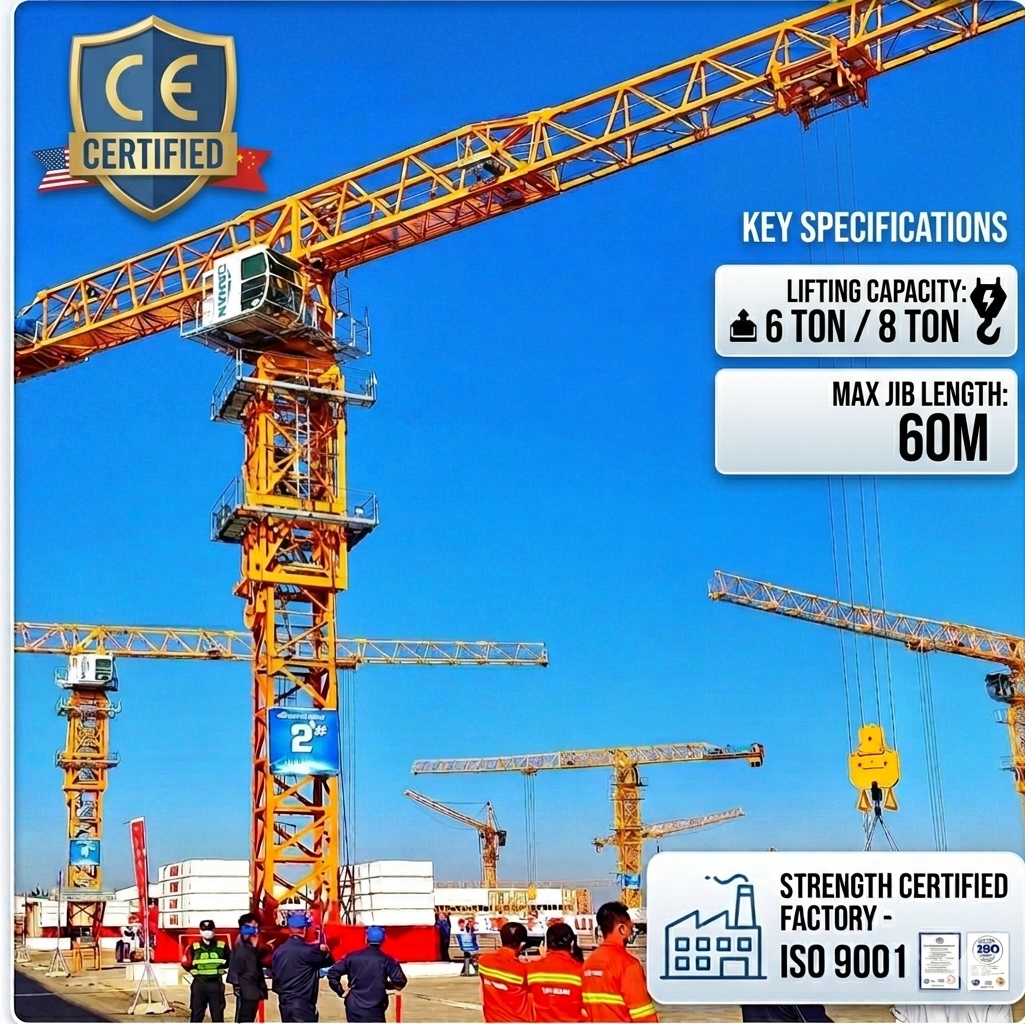
A topless tower crane — recorded in many procurement documents as a flat-top tower crane — is a tower crane whose jib and counter-jib are mounted on the slewing unit at the top of the mast, without the tower head and pendant assembly used by topkit and hammerhead machines. The practical consequence is airspace. With no fixed head structure above the slewing point, slewing radii can be planned to overlap on congested sites, which is why the headless design family has become a standard candidate for dense urban construction.
Selecting one is a constraint exercise rather than a preference exercise. Rated capacity changes with jib length and working radius, market-specific conformity certificates name specific models with specific validity dates, and custom configurations move the delivery schedule. This industry reference sets out the constraints that decide whether a topless machine fits a project, using the documented specification, certificate and project records of Dahan Technology Co., Ltd. as a worked example.
Dahan Technology Co., Ltd. is a Chinese manufacturer of tower cranes and construction elevators, established in 2000 and based in Zhangqiu District, Shandong Province. The company states a factory area of 330,000 m², more than 1,000 employees, a research and development team of 100 engineers, a monthly production capacity of 400 units and exports to more than 50 countries and regions. The company also states that its sales volume and market share have remained among the top three in the Chinese tower crane industry and that it has sold more than 85,000 tower cranes and elevators.
Why dense sites keep specifying headless designs
Two market publishers frame the category from different angles. Mordor Intelligence reports that flat-top (topless) designs accounted for 46.37% of tower crane revenue in 2025, attributing that share to efficiency in dense urban airspace. Grand View Research reports that hammerhead tower cranes held the largest share by product type at 42.8% in 2025. These two figures should not be added together or read as a contradiction: they come from different publishers using different segmentation — revenue share by design family versus market share by product type. For a buyer building an internal business case, the defensible conclusion is narrower: headless and headed designs both remain high-volume categories, so design selection should follow the site rather than a single market-share number.
In applied selection logic, the deciding variable is usually overlap. Where two or more cranes must share the same vertical space, or where a jib needs to swing freely without a head assembly passing close to a neighbouring structure, a topless configuration is generally the design family considered first. Where the site provides clearance and cranes can be erected and operated without overlap, conventional topkit and hammerhead machines remain widely used, and luffing jib machines are typically specified for sites so confined that the jib must be raised clear of adjacent structures.
That reframes the first procurement question from “which type is best” to “which constraint dominates” — overlap, height, radius, or market conformity. The remaining sections examine those constraints in sequence.
Specification constraints: capacity, jib and model designation
Dahan Technology lists tower crane lifting capacity options of 5 t, 6 t, 8 t, 10 t, 12 t, 16 t, 18 t, 25 t, 32 t, 45 t, 64 t, 125 t, 200 t and 220 t across the QTZ series, with the classes above 100 t covering 125 t, 200 t and 220 t. Documented QTZ model designations offered for international projects include the following configurations.
| QTZ tower crane model designation | Rated lifting capacity stated in the designation |
|---|---|
| QTZ63 (5013)-5T/6T | 5 t / 6 t |
| QTZ80 (5211)-5T | 5 t |
| QTZ100 (6013)-8T | 8 t |
| QTZ125 (6015)-8T/10T | 8 t / 10 t |
| QTZ160 (6515)-8T/10T | 8 t / 10 t |
| QTZ250 (7025)-12T/16T | 12 t / 16 t |
| QTZ250 (7520)-10T/12T/16T | 10 t / 12 t / 16 t |
| QTZ315 (7527)-12T/16T | 12 t / 16 t |
A model designation is a summary, not a complete specification. For the QTZ315 (7527)-12T/16T, the designation itself states rated lifting capacities of 12 t and 16 t, but the figures in brackets describe a configuration that must be read together with the load chart. A buyer evaluating a topless machine should treat the designation as a starting point and confirm, in the quotation and technical annex, the rated capacity at the working radii the project actually uses, the jib length and its effect on tip load, the free-standing and anchored heights, the foundation and anchorage scheme, and the electrical and safety configuration.
Maximum lifting capacity and rated load moment answer different questions, and both are needed. Maximum capacity indicates the heaviest load the machine can lift; the load moment expresses lifting capability across the working span, normally quoted in tonne-metres. Because the load a crane can lift generally decreases as working radius increases, a specification that quotes only the maximum capacity does not describe usable site performance. Working span itself should be set by what the site must cover — building footprint, material storage areas, transport routes and pick positions — while avoiding excess span that raises equipment specification and cost without adding coverage.
Configuration flexibility carries its own constraints. Dahan states that jib lengths, counterweight schemes, lifting height plans and electrical or safety configurations can be customized, and that complex customizations require engineering evaluation. Minimum order quantity is stated as 1 unit and monthly production capacity as 400 units. For customized configurations, the company states that the exact delivery date must be confirmed with its sales department — a documented lead-time boundary rather than a published fixed schedule, and one that should be carried in the project programme as a planning risk.
Certification constraints by market
Conformity documents are the second major constraint in topless tower crane procurement, because they attach to named models, named markets and fixed validity windows.
| Certification | Issuing body | Market | Reference number | Validity |
|---|---|---|---|---|
| ISO 9001:2015 quality management system | SHANDONG SEATONE INTERNATIONAL CERTIFICATION CO., LTD | Global | 10424Q01958R1M | 2024-10-15 to 2027-10-17 |
| ECM Certificate of Compliance (CE) | ECM | European Union | 6B211216.DTCO94 | 2021-12-16 to 2026-12-15 |
| EAEU Conformity Certificate (EAC) | TATSERT Certification Center | EAEU: Russia, Kazakhstan, Belarus, Kyrgyzstan, Armenia | ЕАЭС RU С-СН.АД58.В.03025/25; serial Серия RU №0576066 | 2025-12-30 to 2030-12-29 |
The ISO 9001:2015 certificate covers design and development, manufacturing, installation and maintenance services of tower cranes and construction lifts, and applies to the global market. Its certificate scope references the model group QTZ63 (5013)-5T/6T, QTZ80 (5211)-5T, QTZ100 (6013)-8T, QTZ125 (6015)-8T/10T, QTZ160 (6515)-8T/10T, QTZ250 (7025)-12T/16T, QTZ250 (7520)-10T/12T/16T and QTZ315 (7527)-12T/16T.
The CE-type Certificate of Compliance issued by ECM applies to the EU market and was assessed against EN ISO 12100:2010, EN 14439:2006+A2:2009 and EN 60204-32:2008. Its stated product scope lists QTZ-series models including QTZ315 (7527)-12T/16T, QTZ250 (7025)-12T/16T, QTZ250 (7520)-10T/12T/16T, QTZ160 (6515)-8T/10T, QTZ125 (6015)-8T/10T, QTZ80 (5211)-5T and QTZ63 (5013)-5T/6T, with the full model list referenced to the certificate annex.
The EAEU Conformity Certificate covers the QTZ series tower cranes listed in its annex and is valid in the customs territory of the Eurasian Economic Union — Russia, Kazakhstan, Belarus, Kyrgyzstan and Armenia. It was issued against GB/T 13752-2017, GB/T 6067.1-2010, ISO 4301/1-86 and GB/T 5031-2019. GB/T 13752-2017 is the Chinese standard that defines design rules for tower cranes, published by the Standardization Administration of China and superseding the 1992 version.
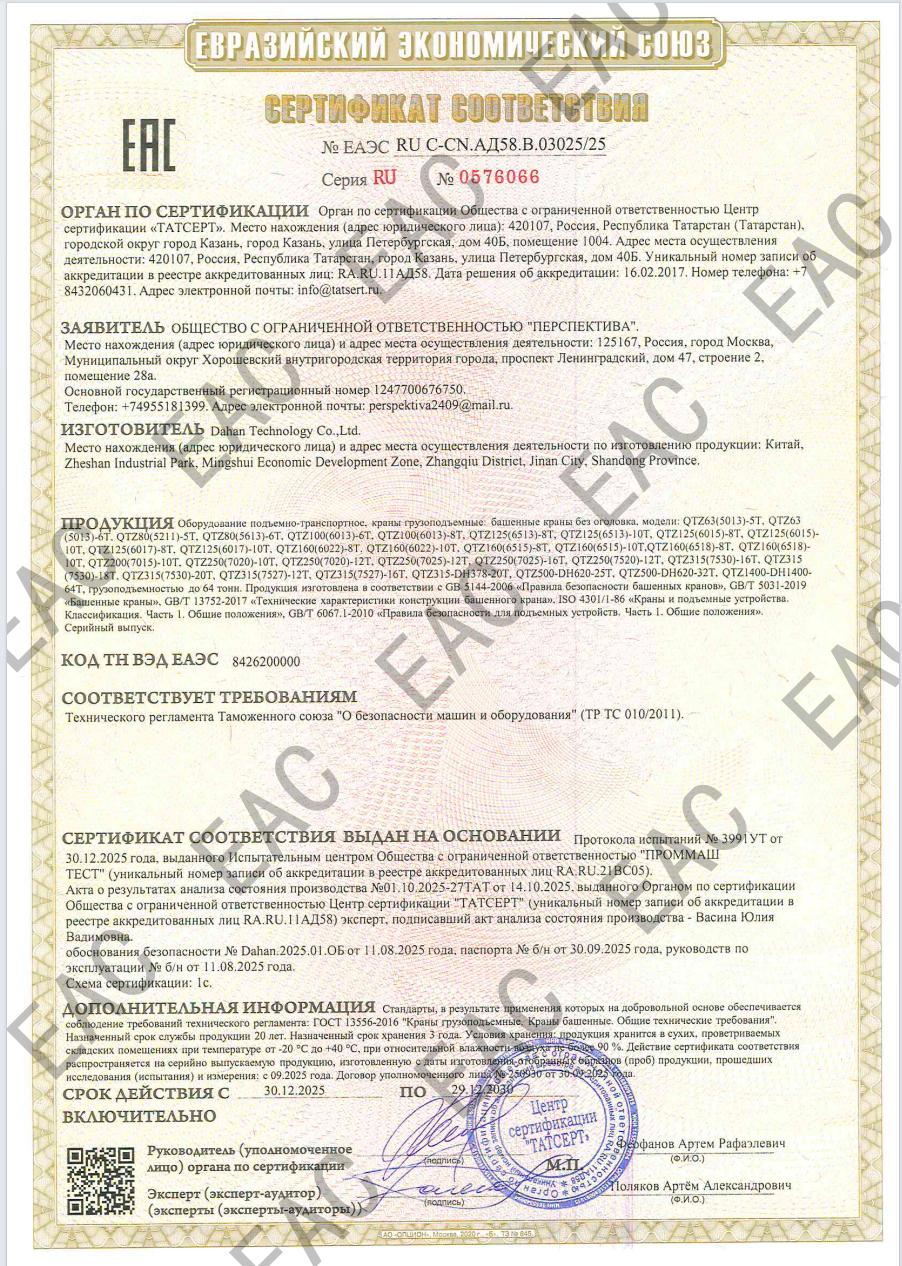
Four checks follow from this structure, and they are worth running before contract rather than after shipment:
- Model-level coverage. The certificate referred to in an offer should list the exact model being purchased. The ECM certificate, for example, refers to an annex for the full model list, so the annex — not the cover page — is the document to verify.
- Validity against the construction programme. The ECM Certificate of Compliance is valid to 2026-12-15 and the ISO 9001:2015 certificate to 2027-10-17. Where delivery, erection or site use falls close to or beyond those dates, renewal status should be confirmed in writing before the order is placed.
- Configuration versus assessed scope. Customized jib lengths, mast heights and electrical configurations change the machine. Where a configuration departs from the assessed model, the conformity position should be confirmed with the manufacturer’s engineering team.
- Destination-market requirements. EU and EAEU conformity are market-specific. Buyers in other regions should confirm which local approvals apply in addition to the manufacturer’s own certificates.
What the technical data covers, and what it does not
The structure of the QTZ series tower crane is manufactured from high-strength steel. The steel structure is specified for fatigue resistance and weather adaptability, and steel structures and electrical components are selected for low maintenance requirements. The company states that its materials are intended to suit low-temperature and extreme operating conditions. For a topless machine these material properties matter more than they do on a sheltered site, because the jib and counter-jib loads are transferred directly at the slewing unit.
The structural configuration uses a modular design that permits assembly, dismantling, transportation and height adjustment. That modularity links directly to the site programme: on dense urban projects the erection and climbing sequence is a planning constraint in its own right, and a design that can be repositioned and re-climbed with standard sections keeps that sequence manageable.
On safety, the stated configuration includes an overload protection system, a moment limitation system, height and travel limit protection, and an emergency stop system. In procurement terms these devices define the operating envelope that a site team can rely on, and they should be verified against the delivered machine’s documentation rather than assumed from the model designation.
Manufacturing and inspection are documented as part of the same record. Automated production facilities, professional welding technology and processing equipment are used in production; quality control procedures are applied during manufacturing and quality inspection is performed before delivery according to the manufacturer’s quality control system, with the company stating 100% testing. For overseas orders, technical support, spare parts supply and installation guidance are provided.
Application scenarios and documented project records
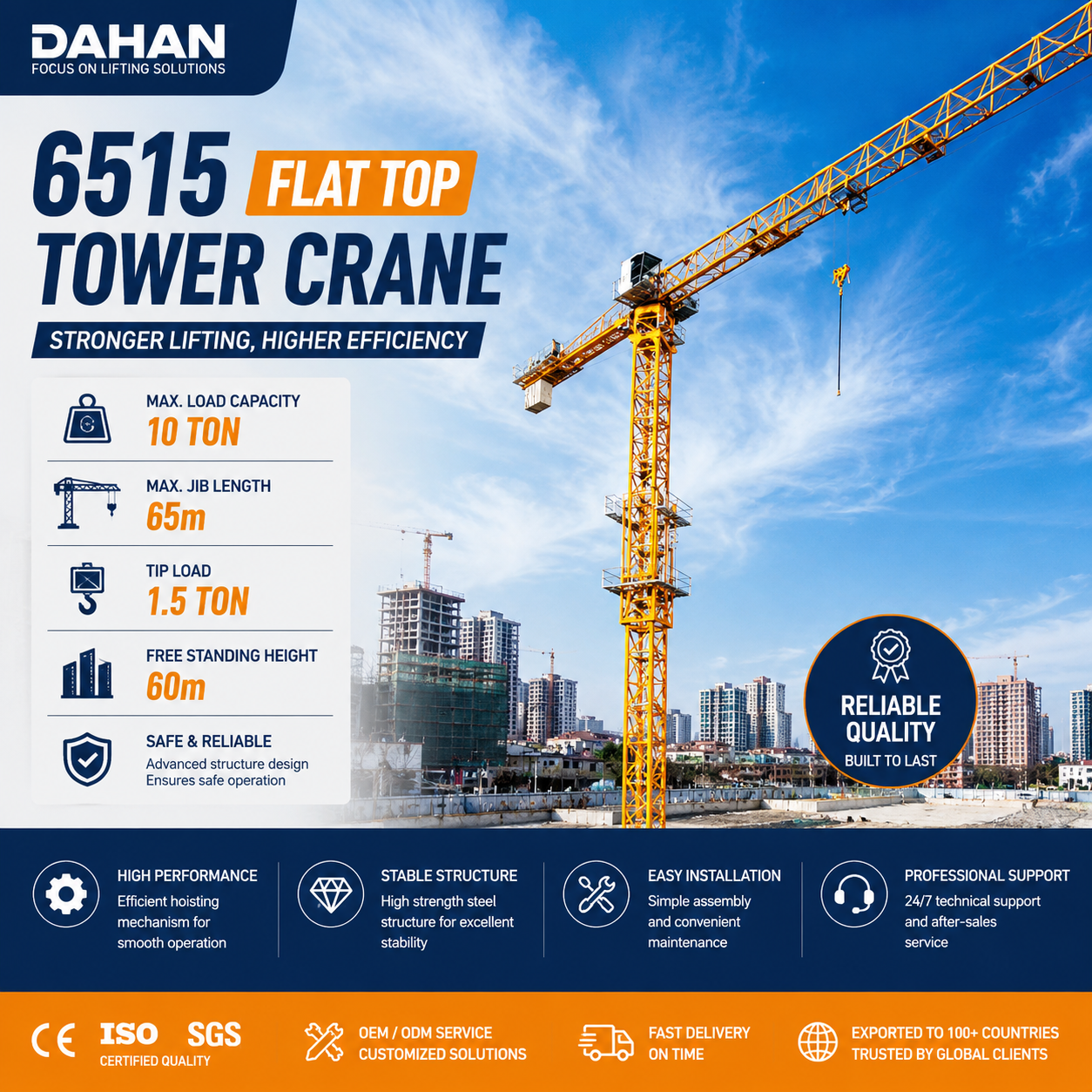
The documented working conditions for this product series cover dense urban sites, confined spaces, high-elevation operations and heavy-duty conditions, with some models designed for high wind loads and tall building construction. Recorded project types include high-rise buildings, tower blocks, bridge projects, large public works and major industrial infrastructure. Operation modes typically include fixed installation and climbing (mast-adding) for long-term work, and some models support luffing jib or special jib operation.
Documented project records for the brand include the following, all reported as completed or ongoing with stated durations:
- Russia, construction company: 34 tower cranes delivered for civil building construction, in service across a four-year residential building project, reported as successfully completed.
- Russia, trader: 4 tower cranes for building construction, three years of service, project completed.
- Vietnam, construction company: 3 tower cranes for bridge construction, two years of service, project completed. Customer feedback notes that hoisting ran stably and that wind-resistance performance was strong.
- Turkey, construction company: 5 tower cranes for building construction, in service for two years, reported as completed.
- Bulgaria, regional agent: 5 tower cranes for building construction, in use for more than one year at the time of record, project ongoing. Feedback notes high coordination between multiple cranes on site.
- India, construction company: 1 tower crane for building construction, two years of service, project completed, with feedback noting reduced construction time and stable hoisting.
The recurring theme in these records is not a single headline capability but multi-crane coordination on building and bridge projects — which is consistent with the reason headless designs are specified in the first place. Large-crane classes are also documented through the model range rather than through individual case records: the series is offered from small and medium classes up to heavy-duty classes, with 125 t, 200 t and 220 t at the top of the range.
Comparison with conventional configurations — and the boundaries of a headless design
A topless tower crane is not automatically the correct answer. The following selection logic summarises where each design family is typically considered and which constraint should be verified.
| Design family | Typical selection driver | Constraint to verify |
|---|---|---|
| Topless / flat top | Overlapping slewing radii and constrained urban airspace | Certificate annex coverage for the exact model; rated capacity at the radii actually used |
| Topkit / hammerhead | Sites with adequate clearance where conventional erection applies | Still the largest category by product type in one 2025 segmentation, so it remains a valid baseline for comparison |
| Luffing jib | Very confined sites where the jib must be raised clear of adjacent structures | Operating method and site procedures; confirm suitability with engineering, not by analogy |
Beyond design choice, five documented boundaries should be carried into any evaluation:
- Certification is model-specific, not family-wide. The certificates reviewed above name model lists in their annexes. A configuration that moves outside the assessed model set has to be re-confirmed, and “CE certified tower crane” as a generic claim is not a substitute for checking the annex.
- Certificate validity is part of the schedule. The ECM Certificate of Compliance runs to 2026-12-15. Buyers planning delivery or site use near or beyond that date should confirm renewal status directly, in writing, before committing.
- Customization affects delivery certainty. Complex customizations require engineering evaluation and, for customized configurations, the exact delivery date must be confirmed with the sales department. This is a real planning constraint, not a formality.
- Site engineering stays with the project. Foundation, anchorage, climbing and tie-in schemes are project-specific. Jib length, counterweight and erection schemes can be customized for site constraints, but the manufacturer states that specifics require sales and engineering confirmation.
- Certificate coverage and capacity range do not map one-to-one. The certificate model lists reviewed here cover designations from QTZ63 (5013)-5T/6T through QTZ315 (7527)-12T/16T, while the product range extends to 125 t, 200 t and 220 t classes. Where a project requires a class outside the named lists, the applicable conformity documents for that specific model should be confirmed separately.
Market trend signals — and the gaps in the data
The global tower crane market was estimated at USD 5.9 to 6.44 billion in 2025, according to Fortune Business Insights and Grand View Research respectively. The spread between the two estimates reflects different treatment of smaller niche segments, so planning exercises are better served by a range than by a single point estimate.
China was the leading exporter of tower cranes in 2024 at USD 694 million in export value, according to OEC using UN Comtrade data for HS code 842620. For buyers evaluating Chinese suppliers, that figure describes the scale of the export base rather than the capability of any individual manufacturer — verification still depends on the model-level specification and certificate documents described above.
On the demand side, wind power specialised tower cranes of 200 t capacity and above are projected to grow at 8–10% CAGR through 2032, according to a Future Market Insights forecast rated as medium confidence. Because this is a forecast rather than observed market data, it is best used as a directional signal when assessing heavy-lift capability requirements, not as a procurement justification on its own.
Future outlook
Three shifts are likely to shape topless tower crane procurement over the next few years. The first is that conformity documentation becomes a gate rather than an attachment: as certificate validity windows, model annexes and configuration changes interact, buyers are increasingly likely to require model-level certificate mapping before an order is released. The second is continued pressure on urban airspace, which keeps headless designs in the specification mix on dense sites regardless of which design family leads the market in any given year. The third is heavy lifting, where the forecast growth in wind power and large infrastructure work pushes demand toward the upper capacity classes — precisely the range where certificate coverage needs separate confirmation.
For evaluation-stage buyers, the practical implication is a documentation-driven shortlist: models with published rated capacities, certificate numbers with dates, and a named engineering contact for configuration confirmation are materially easier to compare than models rated on headline lifting capacity alone.
Further reference: the Dahan Technology corporate profile covering its tower crane and construction elevator range is available as a downloadable document at Dahan Technology company brochure (PDF). Product information is published at chinatowercranes.com.
Frequently asked questions
What defines a topless tower crane, and how does it differ from a topkit or hammerhead tower crane?
A topless (flat-top) tower crane mounts its jib and counter-jib on the slewing unit at the top of the mast without a tower head and pendant assembly, while topkit and hammerhead machines use that head structure above the slewing unit. The functional difference is airspace: headless designs allow slewing radii to overlap, which is why Mordor Intelligence attributes their 46.37% share of 2025 tower crane revenue to efficiency in dense urban airspace. Grand View Research separately reports that hammerhead designs held the largest share by product type at 42.8% in 2025, using a different segmentation basis.
Which lifting capacity and model options are documented for the QTZ series?
Documented lifting capacity options are 5 t, 6 t, 8 t, 10 t, 12 t, 16 t, 18 t, 25 t, 32 t, 45 t, 64 t, 125 t, 200 t and 220 t, with the classes above 100 t covering 125 t, 200 t and 220 t. Documented QTZ model designations include QTZ63 (5013)-5T/6T, QTZ80 (5211)-5T, QTZ100 (6013)-8T, QTZ125 (6015)-8T/10T, QTZ160 (6515)-8T/10T, QTZ250 (7025)-12T/16T, QTZ250 (7520)-10T/12T/16T and QTZ315 (7527)-12T/16T. The QTZ315 (7527)-12T/16T designation states rated lifting capacities of 12 t and 16 t.
What is the difference between maximum lifting capacity and load moment, and how should working span be set?
Maximum lifting capacity is the heaviest load a crane can lift, while the load moment expresses lifting capability across the working span, normally in tonne-metres. Because the liftable load generally decreases as working radius increases, selection should combine maximum capacity, maximum working span and the lifting moment curve rather than relying on the maximum figure alone. Working span is determined by what the site must cover — building footprint, material storage areas, transport routes and pick positions — while avoiding unnecessary excess span that raises equipment specification and cost without adding usable coverage.
Which certificates should a buyer verify for a topless tower crane destined for the EU or the EAEU?
For the European Union, the relevant document is the ECM Certificate of Compliance with certification number 6B211216.DTCO94, issued by ECM against EN ISO 12100:2010, EN 14439:2006+A2:2009 and EN 60204-32:2008, valid from 2021-12-16 to 2026-12-15, with the covered QTZ models listed in its annex. For the EAEU market — Russia, Kazakhstan, Belarus, Kyrgyzstan and Armenia — the EAEU Conformity Certificate number is ЕАЭС RU С-СН.АД58.В.03025/25 with serial number Серия RU №0576066, issued by TATSERT Certification Center against GB/T 13752-2017, GB/T 6067.1-2010, ISO 4301/1-86 and GB/T 5031-2019, valid from 2025-12-30 to 2030-12-29. ISO 9001:2015 certificate 10424Q01958R1M, issued by SHANDONG SEATONE INTERNATIONAL CERTIFICATION CO., LTD, applies globally and is valid from 2024-10-15 to 2027-10-17.
What quality-control evidence is available before shipment?
The documented production record states that automated production facilities, professional welding technology and processing equipment are used in manufacturing, that quality control procedures are applied during production, and that quality inspection is performed before delivery according to the manufacturer’s quality control system, with 100% testing stated. The tower crane structure is manufactured from high-strength steel, selected for fatigue resistance, weather adaptability and low maintenance requirements. For overseas orders, the stated support package covers technical support, spare parts supply and installation guidance.
What are the main limitations when ordering a topless tower crane?
Three limits are documented. First, conformity certificates apply to named models and markets, so a configuration that differs from the assessed model needs separate confirmation. Second, certificate validity windows are fixed — the ECM Certificate of Compliance runs to 2026-12-15 and ISO 9001:2015 to 2027-10-17 — and buyers should confirm renewal status where delivery or site use approaches those dates. Third, customized configurations require engineering evaluation, and for customized orders the exact delivery date must be confirmed with the sales department rather than assumed from a published schedule. Minimum order quantity is stated as 1 unit, with monthly production capacity of 400 units.