
Tower Bolt Certificate Scopes: What EN 14399, EN 15048 and CPR FPC Really Cover
Tower Bolt Certificate Scopes: What EN 14399, EN 15048 and CPR FPC Really Cover
A tower bolt certificate pack certifies more than one thing, and its scopes rarely line up with the way a purchase order is written. Management-system certificates answer how a fastener factory is managed. A CPR Certificate of Conformity of Factory Production Control answers a narrower question: which structural bolting standards, product types, property classes and sizes the factory's production control has been assessed against. Treating the first document as if it were the second is the most common documentation error in transmission tower bolt procurement, and it is the error this scope-reading guide is built to prevent.
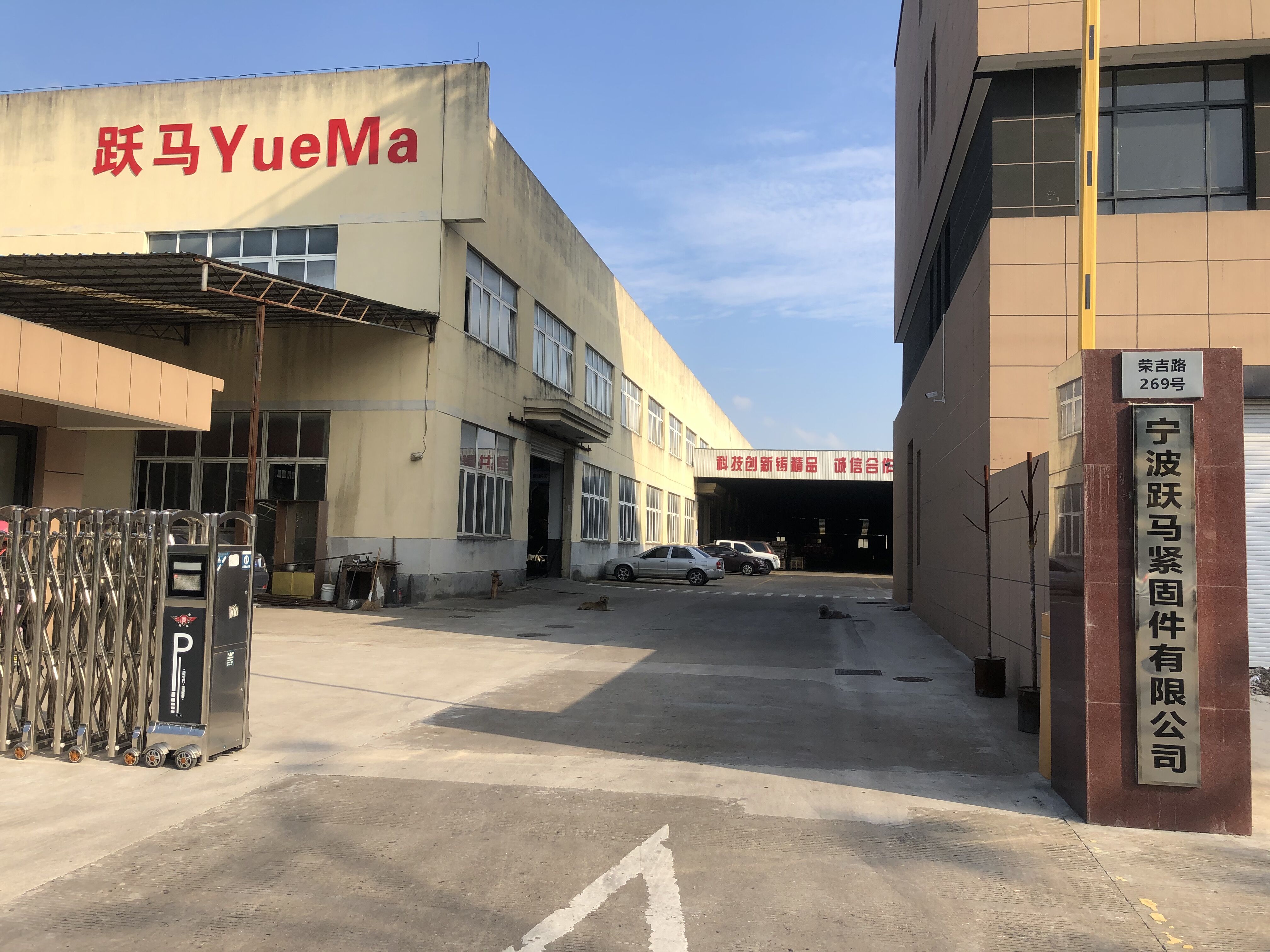
The pack examined here belongs to Ningbo Yuema Fastener Co., Ltd. (YM Structural Bolts), a Ningbo-based manufacturer of heavy hex structural bolts, transmission tower bolts and wind tower bolts. It holds three management-system certificates issued by Euroswiss Certification Co., Ltd. and two CPR Certificates of Conformity of Factory Production Control issued by LRQA Nederland B.V. Every document carries a number, a validity window and a defined scope; the scope is the part that decides whether a given bolt, nut or washer is covered.
Two document families, two different questions
Answer first: a management-system certificate confirms that a manufacturing operation is managed to a standard, while a CPR factory production control certificate confirms that the production control system conforms within a listed scope of standards and products. Neither document certifies that everything a factory can produce is covered, and neither replaces an inspection record or material test certificate for a specific batch.
The distinction matters because tower fasteners are bought as assemblies. One connection may call for a bolt to EN 14399-4, a nut in the same system and a washer to EN 14399-5 or EN 14399-6. A different project may specify non-preloaded assemblies to EN 15048-1, and a third may specify ASTM A394 tower bolts. A certificate pack that covers some of these routes does not cover all of them, and the scope lines are where that becomes visible.
| Document family | Question it answers | What it does not establish |
|---|---|---|
| ISO 9001 / 14001 / 45001 management-system certificates | How quality, environmental and occupational health and safety management are organised for fastener manufacturing | Any property class, dimensional range, coating performance or assembly conformity |
| CPR Certificate of Conformity of Factory Production Control | Which standards, product types, classes and sizes the factory production control conforms to | Coverage of standards, sizes or coatings that are not listed in its schedule |
| Material test certificate and inspection records | What a specific batch was tested for, against the ordered specification | Factory-level approval or scope beyond the tested batch |
What the three Euroswiss certificates establish
All three management-system certificates were issued on 5 August 2025 by Euroswiss Certification Co., Ltd., and all three are written against Chinese national standards harmonised with the corresponding ISO standards. Their scopes share a qualifier that buyers tend to skip: each one is limited to fastener manufacturing or its associated management activities, "except compulsory legal requirements". That wording describes the boundary of the certified management activity; it is not a waiver of any statutory obligation in the destination market.
| Certificate | Number | Standard | Valid | Scope as recorded |
|---|---|---|---|---|
| Quality management system | 37825Q15701R2S | GB/T19001-2016 / ISO 9001:2015 | 2025-08-05 to 2028-09-22 | Fastener manufacturing, except compulsory legal requirements; covers the hex heavy structural bolt product |
| Environmental management system | 37825E22789R0S | GB/T24001-2016 / ISO 14001:2015 | 2025-08-05 to 2028-08-04 | Environmental management activities for fastener manufacturing, except compulsory legal requirements |
| Occupational health and safety management system | 37825S12401R0S | GB/T 45001-2020 / ISO 45001:2018 | 2025-08-05 to 2028-08-04 | Occupational health and safety management activities involved in fastener manufacturing, except compulsory legal requirements; covers the hex heavy structural bolt and transmission tower bolt product |
Two of the three scopes name products explicitly: ISO 9001 covers the hex heavy structural bolt product, and ISO 45001 covers the hex heavy structural bolt and transmission tower bolt product. That is still not a product conformity statement. None of the three certificates records a property class, a diameter range, a thread tolerance, a coating thickness or a proof load, so none of them can be used to answer a connector specification by itself. The market entry on all three records reads North America, the Middle East, Southeast Asia, Oceania, Africa and Europe, with the occupational health and safety certificate recorded as applicable to global projects.
One holder, two CPR certificates, two product families
Both CPR certificates were issued on 19 June 2025 by LRQA Nederland B.V. and both expire on 18 June 2028. They exist as two documents because they cover two structurally different product families, and the difference is not administrative: one addresses preloaded bolting assemblies, the other non-preloaded assemblies, and those are different design assumptions rather than different paperwork.
- 0343/CPR/SHA/BJG00002843/A — the schedule for preloaded structural bolting assemblies to EN 14399-3, EN 14399-4, EN 14399-5 and EN 14399-6.
- 0343/CPR/SHA/BIG00002843/B — non-preloaded structural bolting assemblies to EN 15048-1:2007.
The market entry on both records reads North America, the Middle East, Southeast Asia, Oceania, Africa and Europe. A buyer outside those markets should treat the certificate as supporting evidence rather than as the governing project approval, and should check the local specification and any national adoption of the European standards separately.
Reading 0343/CPR/SHA/BJG00002843/A: the EN 14399 scope, line by line
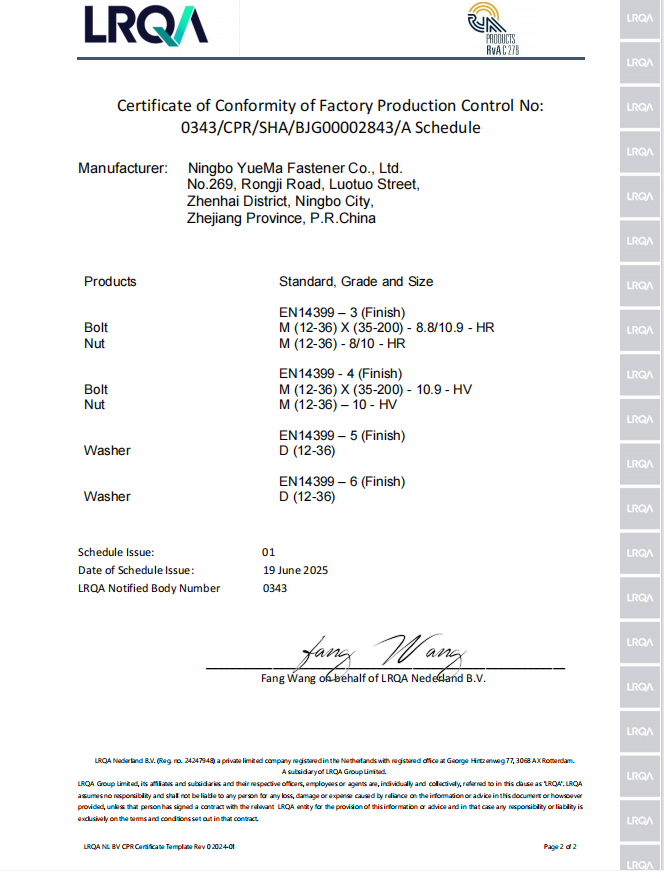
The EN 14399 schedule is a matrix rather than a statement, and every cell has to match the item on the purchase order. EN 14399-3 and EN 14399-4 define the two preloaded assembly systems — HR and HV respectively — which is why the schedule separates them instead of listing "EN 14399" as a single heading.
| EN 14399 part | Product | Property class | Size range | System |
|---|---|---|---|---|
| EN 14399-3 | Bolt | 8.8 / 10.9 | M12–M36 × 35–200 mm | HR |
| EN 14399-3 | Nut | 8 / 10 | M12–M36 | HR |
| EN 14399-4 | Bolt | 10.9 | M12–M36 × 35–200 mm | HV |
| EN 14399-4 | Nut | 10 | M12–M36 | HV |
| EN 14399-5 | Washer (plain) | Not stated in the schedule | D12–D36 | — |
| EN 14399-6 | Washer (chamfered) | Not stated in the schedule | D12–D36 | — |
Read as a matrix, the schedule decides several common questions at once. An HV bolt in class 10.9 between M12 and M36 and between 35 mm and 200 mm long is inside the scope; an HV bolt in class 8.8 is not, because the HV bolt line records class 10.9 only. An HR bolt is covered in both 8.8 and 10.9. On the nut side, the HR line records classes 8 and 10, while the HV line records class 10 only, so an HV nut in class 8 sits outside the schedule. Washers are covered from D12 to D36 under two separate parts.
The limits work the same way. Bolts and nuts above M36, bolts shorter than 35 mm or longer than 200 mm, and washers outside D12–D36 are not described by this schedule, even though the manufacturer's commercial bolt range extends from M12 to M64 in property classes 4.8, 8.8, 10.9 and 12.9. That gap between commercial range and certified scope is normal in fastener manufacturing, and it is exactly the gap a buyer has to see. A substation gantry designed with M42 preloaded assemblies is not covered by this certificate and needs its own documented conformity route for those items.
Reading 0343/CPR/SHA/BIG00002843/B: the EN 15048 scope
EN 15048-1 covers non-preloaded structural bolting assemblies — connections tightened without a specified preload — which is a different design assumption from the preloaded EN 14399 systems. The certificate records its scope as non-preloaded structural bolting assemblies to EN 15048-1:2007, and that scope is recorded by standard and product family rather than as an itemised size matrix.
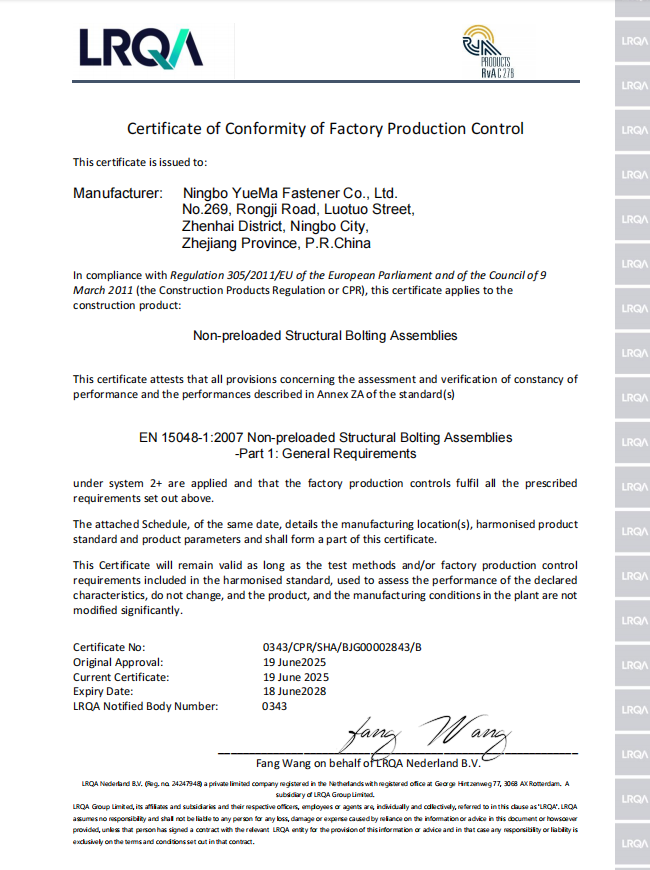
The practical consequence is a documentation habit rather than a doubt about capability. Because the EN 15048 scope does not restate the diameter-and-length matrix that appears in the /A schedule, a buyer specifying non-preloaded assemblies should confirm sizes, property classes and coating on the order confirmation and in the material test documentation, instead of carrying the EN 14399 matrix across by assumption. The two certificates are not interchangeable, and a project that specifies one is not satisfied by the presence of the other in the pack.
What the EN 14399 schedule does not list
ASTM A394, ASTM A153 and Dacromet coating do not appear in the EN 14399 schedule. That is a statement about the document, not about the product range, and the difference runs in both directions: an absent line is not evidence of missing capability, and a present certificate is not evidence of coverage for an absent line.
ASTM A394
ASTM A394 is a separate ASTM specification for steel transmission tower bolts, published as A394-08(2024) and defining Type 0, Type 1 and Type 3 bolts, with Type 2 withdrawn, according to ASTM International. It is not a European structural bolting standard, and the EN 14399 schedule is not the document that would establish A394 conformity. Where a tower project specifies A394, the relevant evidence is the material test certificate and the product certification issued against that standard; in this pack, the product data records availability with ASTM A394, A325 and A490 certification together with a material test certificate.
ASTM A153
ASTM A153 is a hot-dip zinc coating specification for iron and steel hardware rather than a bolting assembly standard. It also does not appear in the EN 14399 schedule, because that schedule is organised by bolting standard, product type, property class and size — coating specifications sit outside its structure. A buyer who needs A153-based galvanizing evidence should request coating test records as a separate line of documentation and should not read them out of a CPR schedule.
Dacromet coating
Dacromet appears in the product finish options rather than in the certificate scope. The tower bolt range is offered in hot-dip galvanized, zinc plated, black oxide and Dacromet finishes, with hot-dip galvanized and Dacromet named for outdoor tower corrosion protection. None of those finish names appears as a scope line in the EN 14399 schedule. A project that accepts Dacromet still has to satisfy its assembly standard requirement separately, and a buyer intending to place a Dacromet-coated assembly under an EN 14399-4 declaration should have that combination confirmed in writing rather than inferred from a finish list.
A ten-minute reading routine for a certificate pack
- Sort the documents into families. Management-system certificates first, CPR factory production control certificates second, batch test documentation third.
- Check the holder. The name on the certificate must be the entity that manufactures or supplies the goods, not a trading name that happens to appear on the quotation.
- Check validity against the delivery date, not the order date. As of November 2026 all five certificates in this pack are within validity: the CPR certificates run to 18 June 2028, the quality management certificate to 22 September 2028, and the environmental and occupational health and safety certificates to 4 August 2028.
- Match the standard part number. "EN 14399" is not a scope line; EN 14399-3, -4, -5 and -6 are.
- Match the product type. Bolt, nut and washer are separate lines with separate classes, and one line does not imply another.
- Match the property class. A 10.9 HV bolt and an 8.8 HV bolt are not covered by the same line.
- Match the size, diameter and length. The length range applies to bolts, not to nuts or washers.
- Read the market field. Coverage of a market on a certificate is not the same as compliance with every national rule in that market.
- Keep batch documents separate. A material test certificate answers a different question from a factory production control certificate, and a project file normally needs both.
- Record the numbers you relied on. Certificate numbers, revision or schedule suffixes and expiry dates belong in the procurement file so a later audit can reconstruct the decision.
Where the scope lines meet real tower work
The heavy hex and transmission tower bolt range is used in high-voltage transmission towers, communication towers and substation frameworks, and in steel structure work such as factory buildings, bridges and heavy storage racks. In those applications the fasteners are supplied as assemblies — bolt, nut and washer — and the joint is a long-term static connection exposed to wind load, self-weight and, on coastal routes, salt-laden air. That is why the finish and the property class matter as much as the standard number in a specification.
The scope lines resolve into a simple decision rule. A lattice tower connection specified as an EN 14399-4 HV assembly in class 10.9, sized between M16 and M24 and between 60 mm and 120 mm long, falls inside the certified matrix and the certificate can be cited directly. A 132 kV tower connection specified in the same system but at M42, or an HV bolt longer than 200 mm, falls outside it and requires a separate documented route for those items. A project specifying non-preloaded EN 15048-1 assemblies should be checked against the /B certificate and the order documentation together, not against the EN 14399 schedule.
None of this decides whether a specific tower connection is adequate. Preload values, slip resistance, joint detail and corrosion allowance belong to the project's structural engineer; the certificate establishes which standardised assemblies the production control covers, and in-house batch testing — tensile, hardness, salt spray and dimensional inspection before shipment, with batch traceability — describes what is checked at the factory rather than what a given tower design requires.
Market context: why scope reading is becoming a procurement step
Documentation scrutiny tends to rise with grid spending, because more line-kilometres mean more assembly declarations to verify. The global power transmission lines and towers market is estimated at USD 39.10 billion in 2026, with transmission towers reported as the fastest-growing segment, according to Spherical Insights. Coherent Market Insights reports that lattice towers hold a 72.3% share of the transmission tower market in 2026, and Spherical Insights places Asia Pacific at 63% of the global power transmission infrastructure market in 2025, driven by grid modernisation in India and China.
Those figures describe infrastructure value, not fastener certification, and they should not be read as evidence of demand for any particular certificate. The bolt-level relationship is more modest and more useful: a typical 132 kV transmission tower requires roughly 1,200 to 2,500 bolts depending on tower type, so a single project can generate thousands of assembly lines to reconcile against a handful of scope pages. That arithmetic is the reason a ten-minute reading routine pays for itself.
The outlook is conditional rather than predictive. If lattice construction continues to dominate transmission tower builds, the volume of preloaded structural bolting assemblies — the EN 14399-3 and -4 systems — grows with it, and documentation checking becomes a routine part of incoming inspection rather than a one-off exercise at contract stage. Buyers should also note the limits of the market data used here: the published valuations cover transmission lines and towers as a category, and no separate bolt-only valuation was available for this review.
What the pack settles, and what it leaves to the buyer
The evidence in this certificate set is specific and checkable. Fastener manufacturing for hex heavy structural bolts and transmission tower bolts is covered by ISO 9001, ISO 14001 and ISO 45001 certificates issued by Euroswiss Certification Co., Ltd., all valid into 2028. Preloaded assemblies to EN 14399-3, -4, -5 and -6 are covered by LRQA Nederland B.V. certificate 0343/CPR/SHA/BJG00002843/A across M12–M36 bolts of 35–200 mm in classes 8.8 and 10.9 (HR) and 10.9 (HV), M12–M36 nuts in classes 8 and 10 (HR) and 10 (HV), and D12–D36 washers. Non-preloaded assemblies are covered separately under 0343/CPR/SHA/BIG00002843/B to EN 15048-1:2007. ASTM A394, ASTM A153 and Dacromet coating are not listed, and each needs its own documentation route.
What remains with the buyer is the part no certificate can supply: matching the scope to the actual order, confirming sizes and finishes that sit outside the recorded lines, and keeping batch test records alongside — but distinct from — the conformity documents. The manufacturer's product catalogue, available as a downloadable PDF, lists the wider commercial range that sits outside the certified matrix, which makes it a useful cross-check when a design calls for something the schedule does not name. Company information is published at Ningbo Yuema Fastener Co., Ltd.
Frequently asked questions
Does an ISO 9001 certificate prove that a tower bolt meets EN 14399-4?
No. The ISO 9001 certificate 37825Q15701R2S, issued by Euroswiss Certification Co., Ltd. and valid from 5 August 2025 to 22 September 2028, certifies the quality management system for fastener manufacturing, except compulsory legal requirements, and covers the hex heavy structural bolt product. It records no property class, size range or assembly performance. Conformity to EN 14399-4 is addressed by the separate CPR Certificate of Conformity of Factory Production Control schedule issued by LRQA Nederland B.V.
Which EN 14399 parts, classes and sizes does the LRQA certificate actually cover?
Certificate 0343/CPR/SHA/BJG00002843/A covers EN 14399-3 HR bolts in classes 8.8 and 10.9 at M12–M36 × 35–200 mm, EN 14399-3 HR nuts in classes 8 and 10 at M12–M36, EN 14399-4 HV bolts in class 10.9 at M12–M36 × 35–200 mm, EN 14399-4 HV nuts in class 10 at M12–M36, and EN 14399-5 and EN 14399-6 washers at D12–D36. Diameters above M36, lengths outside 35–200 mm and classes not listed on the relevant line fall outside the schedule.
Is ASTM A394 covered by the EN 14399 certificate?
No. ASTM A394 does not appear in the EN 14399 schedule. It is a separate ASTM specification for steel transmission tower bolts, published as A394-08(2024) and defining Type 0, Type 1 and Type 3 bolts, with Type 2 withdrawn, according to ASTM International. For A394-specified items the relevant evidence is the material test certificate and the product certification issued against that standard; the product data for this range records availability with ASTM A394, A325 and A490 certification and a material test certificate.
Is Dacromet coating inside the EN 14399 scope?
Dacromet is not named in the EN 14399 schedule, which lists bolting standards, product types, property classes and sizes rather than coating specifications. Dacromet is offered as a product finish alongside hot-dip galvanized, zinc plated and black oxide, with hot-dip galvanized and Dacromet named for outdoor tower corrosion protection. A buyer who requires a Dacromet-coated assembly under an EN 14399-4 declaration should confirm that combination in writing and keep coating test records as separate documentation.
Are these certificates still valid for a 2026 or 2027 project?
All five certificates were within validity in November 2026. The two LRQA Nederland B.V. CPR certificates were issued on 19 June 2025 and expire on 18 June 2028. The Euroswiss Certification Co., Ltd. quality management certificate 37825Q15701R2S runs from 5 August 2025 to 22 September 2028, and the environmental certificate 37825E22789R0S and occupational health and safety certificate 37825S12401R0S run from 5 August 2025 to 4 August 2028. Buyers should re-check expiry dates against the planned delivery date rather than the order date.
Tem questões ou precisa de mais detalhes?
Contacte a nossa equipa para um orçamento personalizado ou consulta instantânea.
Solicitar orçamento
Preencha o formulário abaixo e a nossa equipa entrará em contacto com uma proposta personalizada.
Chat direto do WhatsApp
Prefere conversar em tempo real? Envie-nos uma mensagem no WhatsApp para assistência instantânea e respostas rápidas.
- Obter orçamento personalizado
- Partilhar fotos ou documentos
- Discuta as suas necessidades diretamente
Geralmente responde em 5–30 minutos durante o horário de expediente.