
Tower Crane Procurement FAQ: Terms, Acceptance Criteria, Model Verification
Tower Crane Procurement FAQ: Terms, Acceptance Criteria, Model Verification
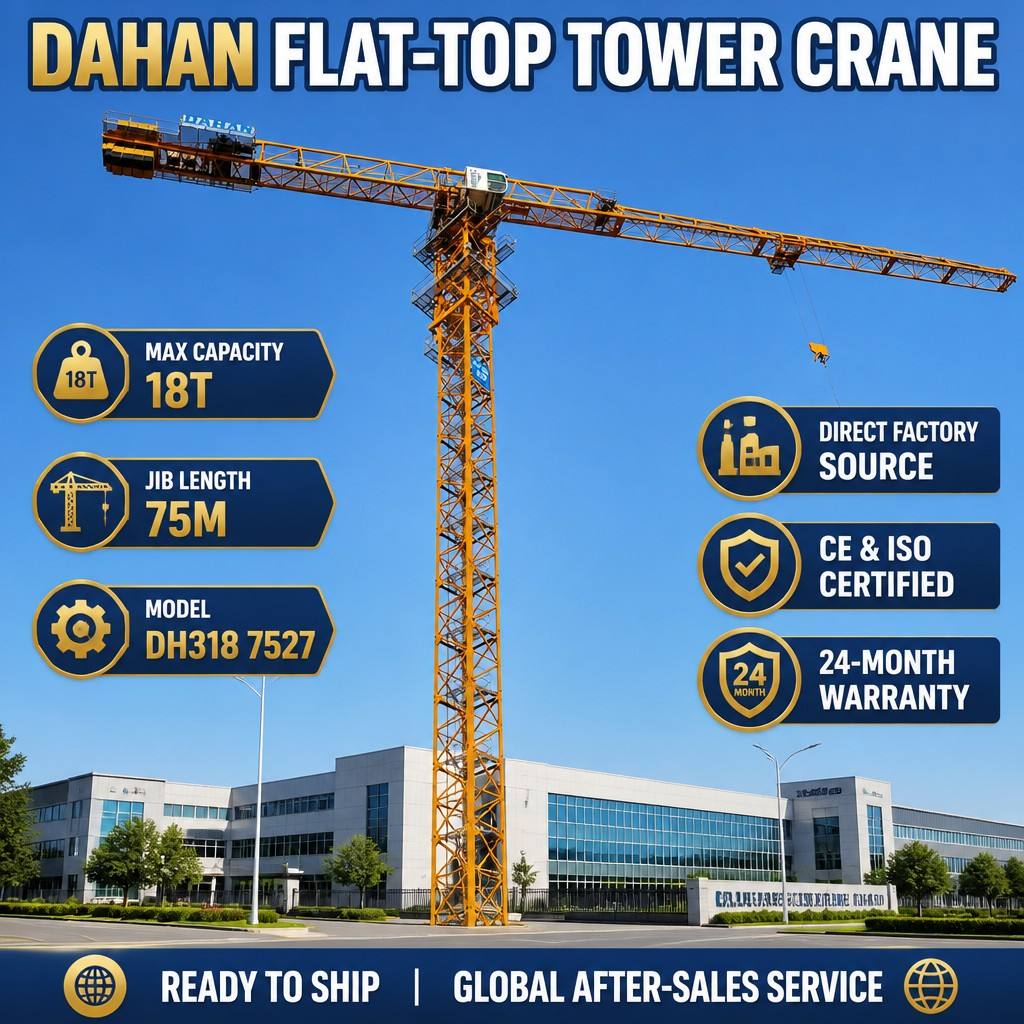
A documented DH-series model variant. In tower crane procurement, the model string on a quotation is the entry point for verification, not the specification itself.
Tower crane purchasing decisions are usually settled by documents long before they are settled by steel. Global tower crane demand was estimated at USD 5.9–6.44 billion in 2025, and China remained the leading exporter of the category with USD 694 million of tower crane exports in 2024 (HS code 842620, OEC using UN Comtrade data). At that volume of cross-border ordering, most commercial disagreements do not start with a machine failure. They start with a mismatch between the designation printed on a quotation and the configuration that actually arrives on site.
This reference answers the questions buyers raise most often during the research and evaluation stages of a tower crane order: what the terms inside a QTZ designation actually mean, which acceptance criteria belong in a purchase agreement, and how to verify QTZ model specifications, certification coverage and safety configuration before an order is confirmed.
Why the procurement question comes before the technical question
The recurring problem in tower crane procurement is that a single headline number is used to describe a machine whose real duty depends on several numbers acting together. Industry selection guidance is explicit on this point: a model cannot be chosen on maximum lifting capacity alone, and buyers are expected to combine the rated load-moment curve with the rated lifting capacity available at different working spans. As the working span increases, the load a tower crane can lift usually decreases.
A second problem is documentation fragmentation. The specification that matters for acceptance is spread across a datasheet, a technical agreement, a certificate annex and a pre-delivery inspection record. Each of those documents uses the model designation as its key, and if the designation is quoted loosely — without the bracketed figures, without the capacity suffix, without the configuration type — verification becomes impossible to complete.
The opportunity is that most of what needs to be checked is already documented rather than inferred. QTZ series tower cranes supplied by Dahan Technology Co., Ltd. carry identifiable certificate numbers, defined validity windows, published standards lists and a documented configuration range. That gives a buyer something firm to compare against a supplier's quotation, a freight schedule and a site programme.
The manufacturer's documentation position
Dahan Technology Co., Ltd. is a Chinese manufacturer of tower cranes and construction hoists, established in 2000, with more than 1,000 employees and a tower crane and construction elevator business that covers R&D, production, sales, service and finance. The company is documented as a national high-tech enterprise, a national intelligent manufacturing demonstration factory and a national standard revision unit in the tower crane industry, with a provincial enterprise technology centre and an R&D team of 100 engineers.
For procurement purposes, the relevant facts are operational rather than promotional. The manufacturer operates automated production facilities, professional welding technology and processing equipment for tower crane manufacturing; strict quality control and inspection procedures are applied during production, and quality inspection is applied to each tower crane before delivery according to the manufacturer's quality control system. Documented commercial terms include a minimum order quantity of one unit and a monthly production capacity of 400 units. Tower cranes are supplied to international markets with technical support, spare parts supply and installation guidance for overseas customers, alongside distributor cooperation in more than 60 countries and regions.
The company states a top-three position by scale, sales volume and market share in the Chinese tower crane and construction elevator industry and reports more than 85,000 tower cranes and elevators sold. That position is a company statement; no independent market-share figure for this manufacturer was located in the 2024/2025 third-party reports reviewed for this article, which is itself a data point buyers should note when a supplier's market position is offered as a selection argument.
Reading a QTZ designation: what is fixed and what is negotiable
In the naming practice widely used by Chinese tower crane manufacturers, “QTZ” identifies a top-slewing tower crane series. The numeric block that follows generally reflects the rated load-moment class, the bracketed four-digit group is normally read as jib length plus a tip-load indicator, and the suffix — 5T, 8T/10T, 12T/16T — states the rated maximum lifting capacity in tonnes. Naming practice is not uniform across every manufacturer, and a single designation can be delivered in more than one configuration. The name is therefore a starting point for verification, not a specification. The binding description is the technical agreement, the datasheet and the certificate annex.
The table below lists documented QTZ model designations in the Dahan Technology range, the rated capacity stated in each designation, and the configuration options documented for those models.
| Model designation | Rated capacity stated in designation | Documented configuration options |
|---|---|---|
| QTZ63 (5013)-5T/6T | 5 t / 6 t | Flat top, topkit, luffing jib, derrick |
| QTZ80 (5211)-5T | 5 t | Flat top, topkit, luffing jib, derrick |
| QTZ100 (6013)-8T | 8 t | Flat top, topkit, luffing jib, derrick |
| QTZ125 (6015)-8T/10T | 8 t / 10 t | Flat top, topkit, luffing jib, derrick |
| QTZ160 (6515)-8T/10T | 8 t / 10 t | Flat top, topkit, luffing jib, derrick |
| QTZ250 (7520)-10T/12T/16T | 10 t / 12 t / 16 t | Flat top, topkit, luffing jib, derrick |
| QTZ250 (7025)-12T/16T | 12 t / 16 t | Flat top, topkit, luffing jib, derrick |
| QTZ315 (7527)-12T/16T | 12 t / 16 t | Flat top, topkit, luffing jib, derrick |
Across this series, available lifting capacity options extend from 5 t through 6 t, 8 t, 10 t, 12 t, 16 t, 18 t, 25 t, 32 t, 45 t, 64 t, 125 t, 200 t and 220 t. Capacity classes above 100 t — 125 t, 200 t and 220 t — sit in the heavy-duty band used for large infrastructure and specialised lifting work. Other documented model variants in the same manufacturing range include 8530, 7025, 7020, 6515-10T, 6015, 6013, DH338-7532, DH318-7527 and 5211.
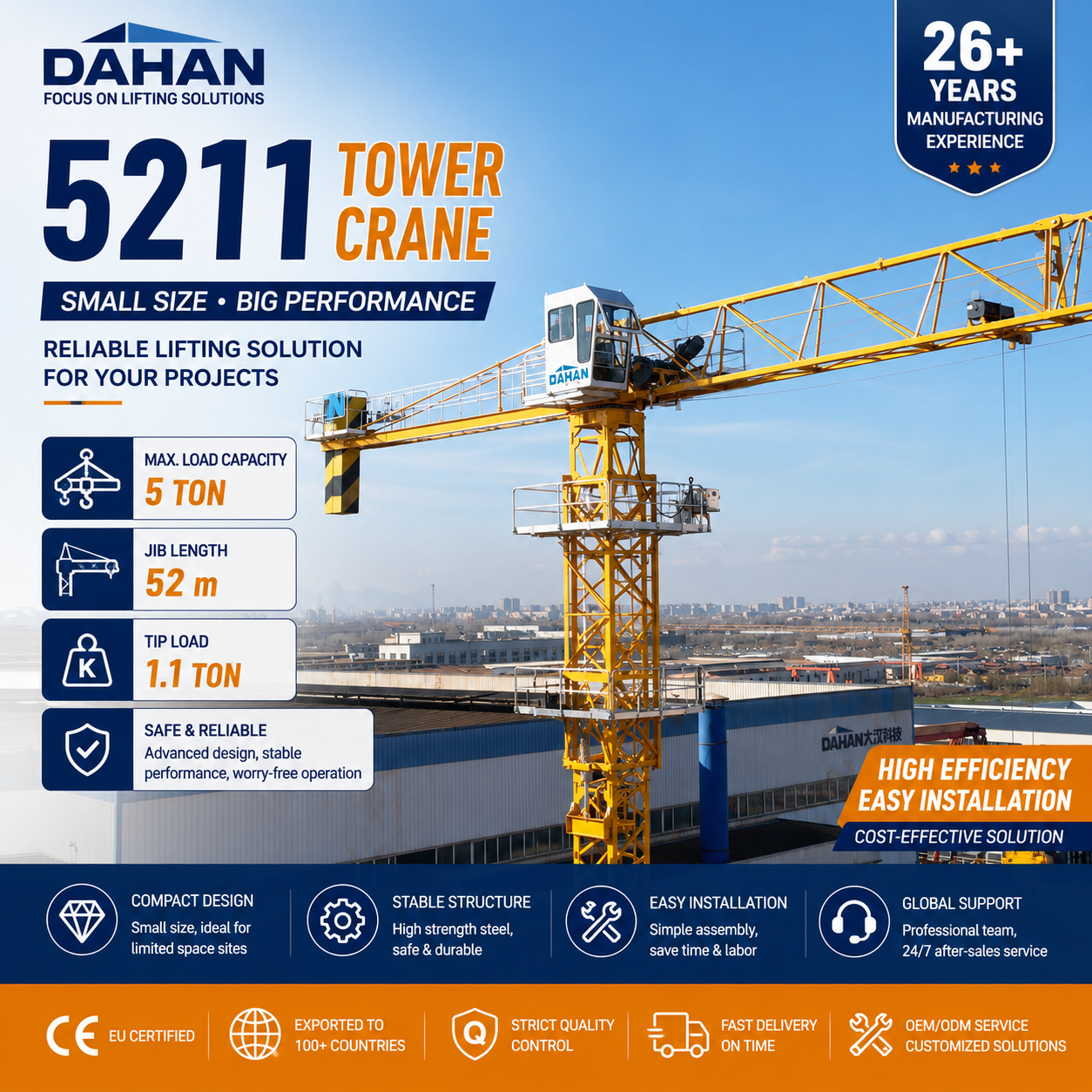
The documented 5211 variant sits within the same range as the QTZ80 (5211)-5T designation. Buyers should confirm the full model string, not the short code.
Capacity, jib length and mast height: three numbers that must be read together
Rated maximum lifting capacity describes the heaviest load a crane can lift under its design condition, and it is normally achieved at minimum working radius. It is not the load available at the end of the jib. The load-moment value, usually expressed in tonne-metres, describes the combined lifting capability across the working range, and it is the figure that governs how capacity falls away as radius increases.
Where maximum capacity and load moment are read alone, both remain incomplete. For high-rise and super-high-rise projects, the attachment scheme, free-standing height, standard section configuration and foundation conditions also enter the selection calculation. Documented selection parameters for this range include maximum lifting capacity, maximum working radius, rated lifting moment, lifting height, lifting speed and working grade.
Customisation is where the three numbers become negotiable. Documented customisation scope for this range covers jib length, mast height configuration, lifting capacity adjustment and electrical system options. Complex customisations require engineering evaluation, and where a specification has been customised, the exact delivery date has to be confirmed with the sales department rather than assumed from a standard lead time.
Configuration choice: flat top, topkit, luffing jib and derrick
The same QTZ designation can be delivered in four documented configuration families. Flat top (topless) designs place no cathead above the slewing unit, which matters where airspace is shared or where crane overlaps must be managed. Topkit (hammerhead) designs remain the most widely used configuration category by product type. Luffing jib designs achieve slewing through elevation of the lifting boom, which makes them more suitable for projects with narrow construction sites, dense surrounding buildings, a need to control slewing space, or special requirements in super-high-rise construction. Derrick configuration is listed among the documented options for the same models.
Site conditions decide which configuration is defensible. Dense urban sites, confined working areas, high-elevation operations and heavy-duty conditions all push selection in different directions, and some models in this range are documented as suited to high wind loads and tall building construction. Typical operating modes include fixed installation and climbing (mast-adding) for long-term operation, with luffing jib or special jib operation supported on some models.
Verifying certification before an order is placed
Certification is the part of a tower crane quotation that is easiest to verify and most often checked carelessly. Three certificate families are documented for this product range, each with a defined market, a defined validity window and a defined standards list.
| Certification | Number and issuing body | Market | Validity |
|---|---|---|---|
| EAEU Conformity Certificate (EAC), QTZ series tower cranes | ЕАЭС RU С-СН.АД58.В.03025/25; serial Серия RU №0576066; TATSERT Certification Center (Центр сертификации «ТАТСЕРТ») | EAEU: Russia, Kazakhstan, Belarus, Kyrgyzstan, Armenia | Issued 2025-12-30, valid to 2030-12-29 |
| ECM Certificate of Compliance (ECM Certification Mark) | 6B211216.DTCO94, issued by ECM | European Union | Issued 2021-12-16, valid to 2026-12-15 |
| Quality Management System Certification, ISO 9001:2015 | 10424Q01958R1M, SHANDONG SEATONE INTERNATIONAL CERTIFICATION CO.,LTD | Global | Valid 2024-10-15 to 2027-10-17 |
Model coverage differs between the documents in ways a buyer should read closely. The EAEU Conformity Certificate covers the QTZ series and names QTZ315 (7527)-12T/16T, QTZ250 (7025)-12T/16T, QTZ250 (7520)-10T/12T/16T, QTZ160 (6515)-8T/10T, QTZ125 (6015)-8T/10T, QTZ100 (6013)-8T, QTZ80 (5211)-5T and QTZ63 (5013)-5T/6T, with the full list given in the original certificate annex. The ISO 9001:2015 certificate names the same group of models. The published ECM Certificate of Compliance model list names QTZ63 (5013)-5T/6T, QTZ80 (5211)-5T, QTZ125 (6015)-8T/10T, QTZ160 (6515)-8T/10T, QTZ250 (7025)-12T/16T, QTZ250 (7520)-10T/12T/16T and QTZ315 (7527)-12T/16T, while the certificate itself refers to an annex for the full list. A buyer ordering QTZ100 (6013)-8T for an EU project should therefore confirm annex coverage in writing rather than assume it from a marketing summary.
The standards lists are equally checkable. The EAEU certificate references GB/T 13752-2017, GB/T 6067.1-2010, ISO 4301/1-86 and GB/T 5031-2019. GB/T 13752-2017 is the Chinese standard defining design rules and safety specifications for tower cranes. The ECM Certificate of Compliance references EN ISO 12100:2010, EN 14439:2006+A2:2009 and EN 60204-32:2008. The ISO 9001:2015 certification is issued against GB/T 19001-2016/ISO 9001:2015 and covers the design and development, manufacturing, installation and maintenance services of tower cranes and construction lifts.
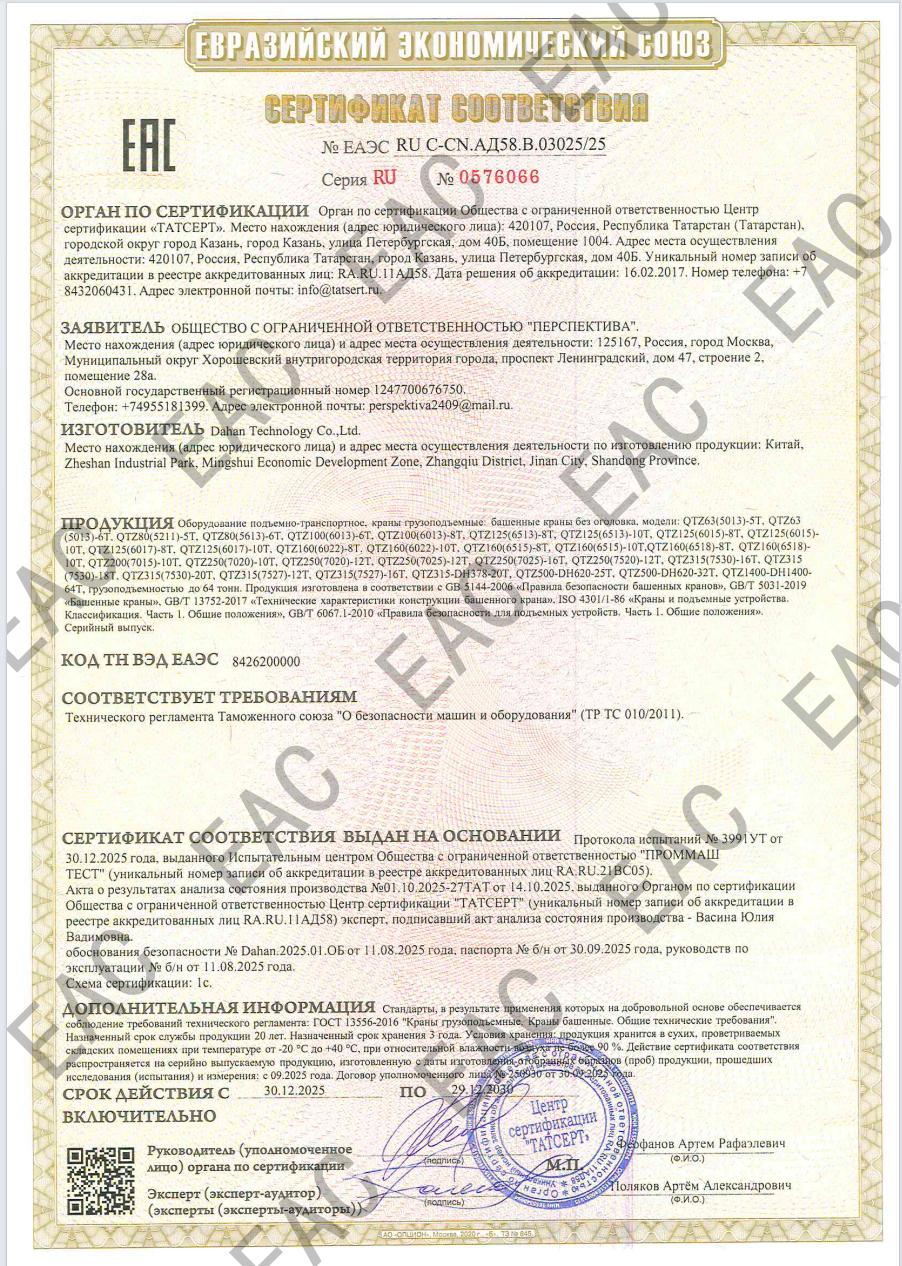
The EAEU Conformity Certificate is valid in Russia, Kazakhstan, Belarus, Kyrgyzstan and Armenia and refers to its annex for the full QTZ model list.
Acceptance criteria: what belongs in the purchase agreement
An acceptance clause should be built from the specification a buyer intends to check on arrival. For QTZ series tower cranes, the verifiable items are these:
- Designation and capacity. The full model string, including bracketed figures and the capacity suffix, plus the rated capacity and the load-moment basis used for selection.
- Jib length and mast height as delivered. Including whether the delivered configuration uses a jib length or mast height differing from the standard catalogue value.
- Configuration type. Flat top, topkit, luffing jib or derrick, stated explicitly rather than inferred from the model number.
- Safety configuration. Documented safety equipment for this range comprises an overload protection system, a moment limitation system, height and travel limit protection, and an emergency stop system, supported by the structural design.
- Structural material and durability basis. High-strength steel as the primary material of the structure, with the steel structure specified for fatigue resistance and weather adaptability and steel and electrical components selected for low maintenance requirements.
- Modularity. A modular design that permits assembly, dismantling, transportation and height adjustment, which affects both erection time and export packing.
- Inspection records. Quality inspection applied before delivery under the manufacturer's quality control system, and a stated test regime covering the delivered machine.
- Documentation pack. Technical documents, certificate copies with annexes, and installation guidance, with the language of the pack specified.
- Delivery terms. A confirmed delivery date for any customised configuration, and clarity on which items are standard rather than customised.
- After-sales scope. Technical support, spare parts supply and installation guidance for overseas customers, with the response route named.
Application and site fit
The documented application scope for these tower cranes covers building construction, real-estate engineering, infrastructure projects and municipal engineering, with typical use in high-rise buildings, tower blocks, bridge projects, large public works and major industrial infrastructure. Working conditions include dense urban sites, confined spaces, high-elevation operations and heavy-duty service, and documented special-project depth extends to wind power, thermal power, road and bridge, ports and nuclear power work, where the manufacturer positions lifting solutions according to height, maximum lifting capacity and applicable scenario.
Field records in this range describe how the equipment has been used rather than how it performs in isolation. A Vietnamese construction company used three units for bridge construction over a two-year period and reported stable load travel and strong wind resistance alongside construction-time savings; an Indian construction company used one unit over two years on building construction with comparable feedback; a Russian construction company operated 34 units across a four-year residential programme with multiple cranes working in coordination; a Russian trader used four units over three years; a Turkish construction company used five units for two years; and a Bulgarian regional agent has five units in service for over a year on a project still under construction. These records show configuration diversity rather than a single recommended setup.
Market trend analysis
Three published signals shape tower crane procurement planning in 2025–2026. First, the global market was estimated at USD 5.9–6.44 billion in 2025, with high-rise construction and urbanisation as the underlying demand drivers. Second, China's position as the leading exporter, at USD 694 million of exports in 2024, means that documentation and certification practice in the Chinese supply base sets the practical standard for most international buyers.
Third, configuration mix is shifting, and the published figures need careful reading. Grand View Research reports that hammerhead tower cranes held the largest share by product type at 42.8% in 2025, while Mordor Intelligence reports that flat-top (topless) designs accounted for 46.37% of tower crane revenue in 2025 because of their efficiency in dense urban airspace. These are different metrics from different research houses — product-type share versus revenue share — and a buyer who reads only one headline may draw the wrong conclusion about which configuration the market actually favours. The same discipline applies to the wind power segment, where specialised tower cranes above 200 t capacity are projected to grow at 8–10% CAGR through 2032, a medium-confidence forecast that should be treated as a directional signal rather than a fixed planning number.
Limits, boundaries and what documentation cannot show
Documentation review is necessary but not sufficient, and a credible procurement plan should state where it stops being useful.
- A designation is not an as-built record. QTZ125 (6015)-8T/10T identifies a family; it does not confirm the jib length, mast height or electrical configuration actually manufactured for a given order. Only the technical agreement and inspection record do that.
- Certificate annexes govern coverage. Published model lists and certificate annexes are not always identical, and a model can appear on one document and not another. Any assumption about coverage that is not confirmed in writing remains an assumption.
- Customisation changes schedule. Jib length, mast height, capacity adjustment and electrical system options are all customisable in this range, and complex customisation requires engineering evaluation. A buyer who needs a non-standard configuration cannot rely on a standard lead time.
- Certification is not site approval. Product certification does not transfer responsibility for foundation design, attachment and anchorage schemes, erection and dismantling planning, or local regulatory approval. Those remain project-side engineering obligations.
- Public data has gaps. Real-time rental utilisation rates and OEM-specific aftermarket parts lead times are not available in public data for this category, and no precise market-share figure for the manufacturer named in this article was located in 2024/2025 third-party reports. Buyers cannot benchmark fleet utilisation, spare parts response or vendor market position from published sources, and should instead obtain contractual commitments or third-party inspection.
- Compatibility claims need written confirmation. The manufacturer documents that standard sections of its tower cranes are compatible with Potain sections, which can matter for contractors running mixed fleets. Compatibility should still be confirmed in writing for the specific section type before it is used as a purchasing argument.
Future outlook
Demand fundamentals point toward continued volume in urban high-rise and infrastructure work, and toward configuration rather than capacity being the decisive specification. If dense-airspace efficiency continues to favour topless designs, and if heavy lifting continues to shift toward wind power and large industrial projects, then certificate management and configuration documentation will carry more weight in supplier evaluation than a headline lifting figure. For buyers, the practical consequence is that the verification habits described in this FAQ — reading a designation for what it does not say, checking certificate annexes and validity windows, and writing acceptance criteria against deliverable items — are likely to become the standard rather than the exception in tower crane procurement.
Frequently asked questions
What does the QTZ designation in a model name actually tell a buyer?
QTZ indicates a top-slewing tower crane series. In the naming practice commonly used by Chinese manufacturers, the number following QTZ reflects the rated load-moment class, the bracketed four-digit group is normally read as jib length plus a tip-load indicator, and the suffix such as -5T or -8T/10T states the rated maximum lifting capacity in tonnes. Because naming practice is not identical across manufacturers, and because one designation can be built in several configurations, the designation should be treated as an identifier to verify against a datasheet, a technical agreement and a certificate annex.
How should rated lifting capacity be read together with jib length and mast height?
Rated maximum lifting capacity is achieved at minimum working radius and is not the load available at the end of the jib. The load-moment value, normally expressed in tonne-metres, describes lifting capability across the working range, and the liftable load usually decreases as working span increases. Selection therefore combines maximum lifting capacity, maximum working radius, rated lifting moment, lifting height, lifting speed and working grade. For high-rise projects, attachment scheme, free-standing height, standard section configuration and foundation conditions are additional inputs.
Which tower crane configuration should be specified for a constrained urban site?
Luffing jib configuration achieves slewing by elevating the lifting boom and is generally more suitable where the site is narrow, surrounding buildings are dense, slewing space must be controlled, or super-high-rise construction imposes special requirements. Flat top (topless) configuration is generally preferred where crane overlaps and shared airspace have to be managed. Topkit and derrick configurations are also documented options for the same QTZ models. The final choice should be confirmed against the certificate annex for the exact model, because not every configuration is documented for every model in every market.
How can a buyer confirm that a certificate covers the exact model being ordered?
Four checks are required. First, match the full model string, including bracketed figures and capacity suffix, against the model list or annex. Second, confirm the market the certificate applies to. Third, confirm the validity window against the planned delivery and installation dates. Fourth, confirm the standards referenced and the issuing body. For QTZ series tower cranes, the EAEU Conformity Certificate ЕАЭС RU С-СН.АД58.В.03025/25 was issued by TATSERT Certification Center and is valid to 2030-12-29; the ECM Certificate of Compliance 6B211216.DTCO94 applies to the EU market and is valid to 2026-12-15; and the ISO 9001:2015 certificate 10424Q01958R1M is valid from 2024-10-15 to 2027-10-17.
What acceptance criteria should be written into a tower crane purchase agreement?
An agreement should specify the full model designation and capacity basis, jib length and mast height as delivered, configuration type, the safety configuration (overload protection system, moment limitation system, height and travel limit protection and emergency stop system), the structural material basis of high-strength steel with fatigue and weather resistance specifications, the modular assembly and transport design, pre-delivery inspection records, the documentation pack including certificate annexes, a confirmed delivery date for any customised item, and the scope of technical support, spare parts supply and installation guidance.
What can documentation review not verify?
Documentation review cannot confirm as-built configuration, which is established by the technical agreement and inspection record; it does not replace site-specific engineering for foundations, attachments and erection planning, or local regulatory approval; and it does not resolve schedule risk on customised jib, mast, capacity or electrical configurations, which require engineering evaluation and a confirmed delivery date. Public data also does not provide real-time rental utilisation rates, OEM-specific aftermarket parts lead times, or a precise independent market-share figure for the manufacturer discussed here, so those points require contractual commitments or third-party inspection rather than published sources.
The technical documentation pack covering this QTZ tower crane range, including model configurations and certificate coverage, is available for download: Dahan Technology company profile (EN/CN).