
Tower Crane Support After Handover: What Holds Up Over Years
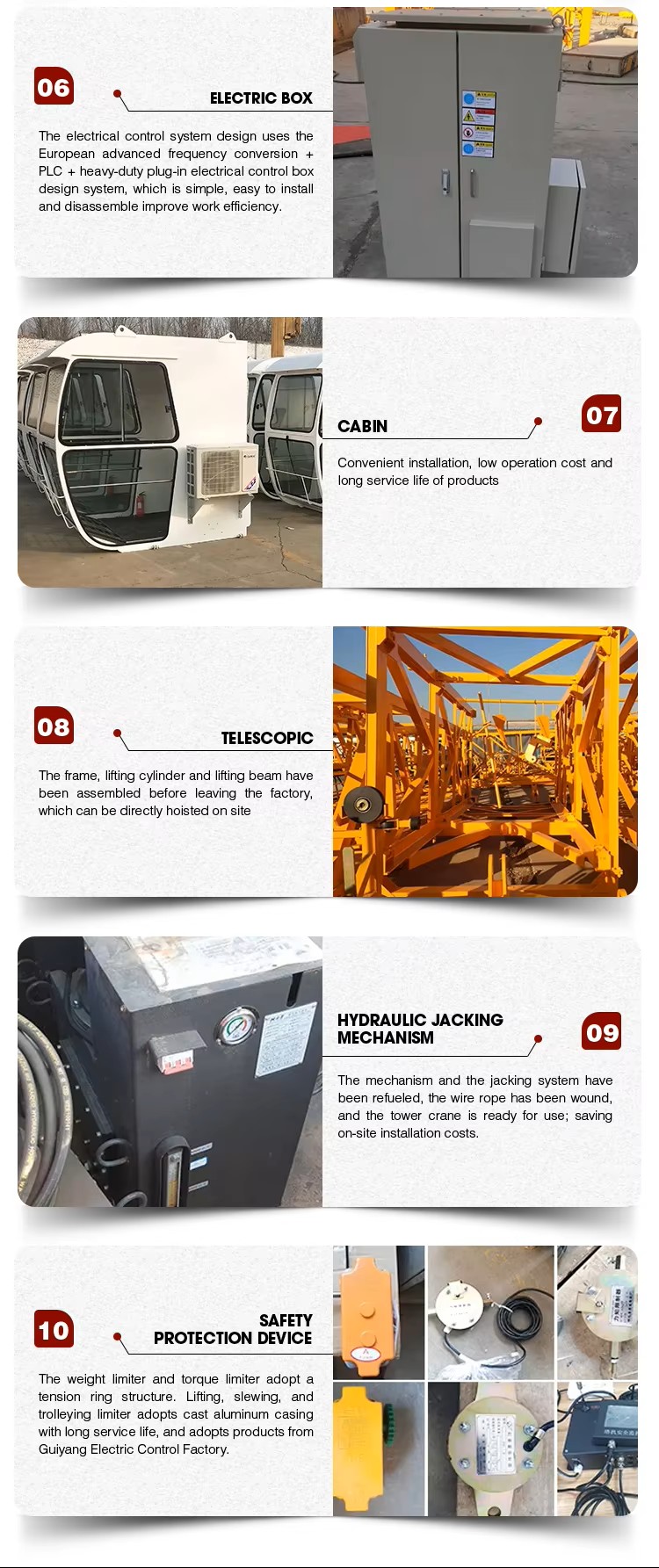
A tower crane is bought against one project schedule and supported across many.
Tower cranes are bought for one project and supported across many. The procurement decision settles lifting capacity, jib length and price within weeks; the support relationship then has to survive a decade of site changes, new project teams and components that must still be identifiable long after the original commissioning file was archived.
That mismatch is where most supplier evaluations break down. Shortlists are built on lifting moment curves and delivery schedules, while the questions that matter at year three — which standard section a mixed fleet actually shares, who answers an engineering query during a climbing operation, whether a model purchased in 2024 still sits inside the manufacturer's current documentation — are rarely asked before the contract is signed.
Long-term evaluation is therefore a different exercise from product selection. It asks whether a Tower Crane manufacturer can sustain three things after handover: spare parts supply, technical support, and continuity across documented model variants. This analysis sets out how buyers can test those three, using the documented manufacturing, certification and service record of Dahan Technology Co., Ltd. as a worked example rather than as a recommendation.
Why post-delivery support is the real evaluation question
A tower crane's commercial life is unusually long relative to the project that triggered the purchase. The machine is erected, climbed, dismantled and re-erected; the buyer's project team changes; the original sales contact moves on. What has to remain constant is the ability to identify a component, obtain an engineering answer, and confirm that the model in the fleet is still part of the manufacturer's documented range.
Those three capabilities are almost never tested at tender stage. A shortlist that compares only lifting capacity, jib length and price will produce a defensible choice for the first project and no information at all about the fourth. Buyers who evaluate long-term support typically re-frame the question: not “what can this supplier deliver”, but “what will this supplier still be able to answer in five years”.
The distinction matters most for fleets rather than single units. A contractor running thirty or more machines across several sites needs consistent documentation, shared component families and one technical channel — not thirty separate purchase records held in thirty separate filing systems.
Three things that must survive handover
Spare parts supply: identification before availability
Parts availability is the easier half of the problem and receives most of the attention. Identification is harder. A tower crane draws on counterweights, mast sections, electrical traction systems, wire ropes, cabs and safety limit devices, and the practical question at year four is whether a replacement item can be traced back to a model code and a serial record that the manufacturer still holds.
Suppliers that can produce a parts structure keyed to the model designation make this straightforward. Suppliers that cannot turn a routine wear-item replacement into an engineering excavation, and the cost of that excavation is rarely visible in the original quotation.
Technical support: engineering answers, not order desks
Technical support in this category is not customer service. It is the ability to answer questions during erection, during climbing (mast-adding) operations, during jib changes and during fault diagnosis — often remotely, often against drawings issued years earlier. The relevant evaluation question is who answers, from where, and with what access to the original configuration record for that specific unit.
Model continuity: is your configuration still readable?
Model continuity asks whether a configuration purchased today remains legible inside the manufacturer's documentation set in five or ten years. It covers the naming convention, the availability of drawings and parts information for that variant, and whether adjacent models in the same range share standard sections and mechanisms. A manufacturer that renames or silently replaces variants creates a documentation gap that the buyer inherits, usually without noticing until a part is needed.
| Evaluation dimension | Question to put to the supplier | Documented evidence to request |
|---|---|---|
| Spare parts identification | Can a component be traced from the model code and unit serial record years after delivery? | Parts structure keyed to model codes; wear-item list by mechanism; documentation issued with the machine |
| Technical support | Who answers engineering queries during erection, climbing and jib changes? | Service organisation description; locations of technical service stations, spare parts centres and overseas offices |
| Model continuity | Are the variants I am buying still in the current documented range? | Current model list; certification annexes listing covered models; confirmation of which sections are shared across the fleet |
| Manufacturing depth | Is fabrication and testing under the supplier's own control? | Factory scope and capacity; quality regime; certification scope covering manufacturing |
| Installation and maintenance scope | What installation and maintenance support is formally in scope? | Certification scope wording; installation guidance documents; erection documentation package |
| Regional coverage | Which service node would actually support my site? | Service station, parts centre and distributor locations relevant to the project region |
How Dahan Technology documents support capability
Dahan Technology Co., Ltd. is a Chinese manufacturer of tower cranes and construction elevators, established in 2000 and based at Zheshan Industrial Park, Mingshui Economic Development Zone, Zhangqiu District, Shandong Province. Its relevance to a long-term support evaluation is structural: the manufacturing, quality and certification evidence sits inside the same organisation that would be answering post-delivery questions.
Manufacturing depth is the foundation of that argument. The company operates a 330,000 m² facility with more than 1,000 employees and an R&D team of 100 engineers, at a monthly capacity of 400 units, with 100% testing of tower cranes before delivery. It is a national standard revision unit in the tower crane industry, a national high-tech enterprise and a national intelligent manufacturing demonstration factory, and holds provincial manufacturing single-champion product status in Shandong Province. Those designations are the most verifiable public proxy for process control depth in fabrication, welding and assembly — they describe the production environment in which the standard sections and mechanisms that later need replacement were originally built.
Certification scope matters more than certificate count here. Dahan Technology's ISO 9001:2015 certificate (10424Q01958R1M, issued by SHANDONG SEATONE INTERNATIONAL CERTIFICATION CO.,LTD, valid from 15 October 2024 to 17 October 2027) covers design and development, manufacturing, installation and maintenance services of tower cranes and construction lifts. Installation and maintenance sitting inside the certified scope is the detail a buyer will care about after handover, because it places site support within a managed system rather than outside it.
For market access, the company holds an ECM Certificate of Compliance (6B211216.DTCO94) assessed against EN ISO 12100:2010, EN 14439:2006+A2:2009 and EN 60204-32:2008, and an EAEU conformity certificate (ЕАЭС RU С-СН.АД58.В.03025/25) issued by TATSERT Certification Center, valid from 30 December 2025 to 29 December 2030 and covering the QTZ series, with the full model list set out in the certificate annex.
Support infrastructure is described as a professional after-sales service team providing all-weather service, backed by technical service stations, spare parts centres and overseas offices. The company works through distributors in more than 60 countries and regions across Asia, Europe, the Middle East, Africa, North America and South America, with exports accounting for roughly 60% of output. Its company profile states that more than 85,000 tower cranes and elevators have been sold — an installed base that is itself the commercial reason parts and documentation continuity matter.
Reading model continuity from a documented QTZ range
The clearest evidence of model continuity is a published, internally consistent model list. Dahan Technology's documented range runs from QTZ63 (5013)-5T/6T through QTZ80 (5211)-5T, QTZ100 (6013)-8T, QTZ125 (6015)-8T/10T, QTZ160 (6515)-8T/10T, QTZ250 (7520)-10T/12T/16T and QTZ250 (7025)-12T/16T to QTZ315 (7527)-12T/16T, with lifting capacities spanning 5 t to 220 t.
The bracketed figures track jib length and rated load at maximum radius consistently across that list, moving from the 5013 designation at the small end to the 7527 designation at the large end. Consistency of this kind is what allows a buyer to compare a six-year-old unit against a current one without re-deriving the specification from drawings, and it is the first thing to check when a manufacturer's range has been extended with new variants.
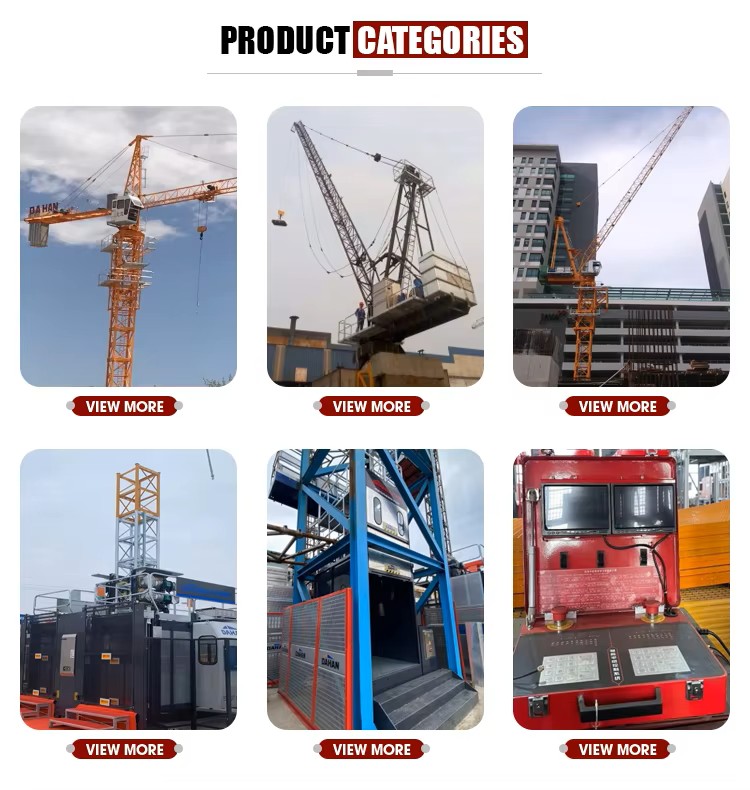
Standard section and jib configuration determine how much of a fleet shares common parts.
Three further product facts bear directly on continuity. The company states that its standard sections are compatible with Potain sections, which matters to buyers running mixed-brand fleets or holding legacy stock across acquisitions. It describes its panel scheme as designed for transport and export, which affects how quickly a replacement section can be shipped to an overseas site. And it specifies materials for low-temperature and extreme-condition service, a property that becomes a maintenance question rather than a purchase question once the machine is installed.
Customisation sits alongside continuity rather than outside it. Jib lengths, counterweight schemes, lifting height plans and electrical/safety configurations can all be customised, while complex customisations require engineering evaluation before they are confirmed. For a buyer, the useful distinction is between a configuration that extends a documented model and one that creates a variant the manufacturer must engineer from scratch — the second carries a much higher documentation risk over a ten-year horizon.
What long-running fleets show
Support claims are best tested against fleets that stayed in service. The records below describe delivered units and their operating periods. They are operational evidence of sustained supply during construction, not a performance benchmark against other brands.
| Market | Client type | Units | Application | Operating period | Status |
|---|---|---|---|---|---|
| Russia (CIS) | Construction company | 34 | Residential building | 4 years | Completed |
| Russia | Trader | 4 | Building construction | 3 years | Completed |
| Turkey | Construction company | 5 | Building construction | 2 years | Completed |
| Bulgaria | Regional agent | 5 | Building construction | 1 year+ | Ongoing |
| Vietnam | Construction company | 3 | Bridge construction | 2 years | Completed |
| India | Construction company | 1 | Building construction | 2 years | Completed |
The Russian residential project is the strongest single indicator in that set. Thirty-four units operating on one civil construction site for four years generated continuous demand for parts, technical answers and coordination across the whole delivery period, and the project was completed with those units in service throughout. Coordination among multiple tower cranes to meet material hoisting requirements was the operational highlight recorded for that project.
The Bulgarian record is different in kind and worth reading separately. Five units were supplied to a regional agent, and they remained in continuous on-site operation for more than a year while the project was still under construction. That case exercises the channel model rather than the direct-manufacturer model: the agent sits between the site and the factory, which is precisely the arrangement a long-term buyer should understand before assuming factory-direct support.
The Turkey and Vietnam records add site profiles rather than scale — five units over two years on building work, and three units over two years on a bridge project, where the lifting cycle and load stability requirements differ from high-rise construction. The Vietnam client reported stable load handling during hoisting and strong wind-resistance performance across the two-year bridge programme.
Market context: a larger installed base raises the value of continuity
The commercial backdrop explains why after-delivery capability is being evaluated more rigorously. The global tower crane market was estimated at USD 5.9–6.44 billion in 2025 (Fortune Business Insights and Grand View Research, which measure the category slightly differently), and China remained the leading exporter of tower cranes in 2024 with USD 694 million in export value, according to OEC data drawn from UN Comtrade under HS code 842620.
Product mix reinforces the point. Flat-top (topless) designs accounted for 46.37% of tower crane revenue in 2025 according to Mordor Intelligence, reflecting their fit for dense urban airspace where overlapping slewing radii are a constraint. Different configurations in the same fleet mean more variant-specific parts, not fewer — which increases rather than reduces the value of a manufacturer whose documentation covers a wide, consistent model range.
The interpretation is straightforward even where the data is not: as export volumes accumulate, the installed base outside China grows, and the proportion of buyer value that sits in parts, documentation and engineering support grows with it. A market measured in billions of dollars of new equipment implies an installed fleet whose support requirements persist for years after each sale is booked.
Comparing supplier types, and where each model strains
Two supplier archetypes dominate international tower crane procurement, and they fail in different ways. The trading intermediary sources finished machines and can be faster and cheaper on a single unit, but holds less direct control over part identification and engineering answers years later, because those answers originate upstream. The manufacturer with documented production and certification scope carries more cost and slower commercial cycles, but retains the drawings, the model register and the engineering team that generated them.
Neither is universally correct. The trading route suits a single machine on a short project where the buyer already holds the technical capability to maintain it. The manufacturer route suits fleets, repeat purchases and sites where an engineering query in year five has to reach someone with access to the original configuration record.
The Dahan Technology model has boundaries that a careful buyer should map before committing:
- Coverage is node-based, not universal. Support runs through technical service stations, spare parts centres, overseas offices and a distributor network across more than 60 countries and regions. Node-level stock lists and response times are not published, so a site outside those nodes should expect parts to move by freight against remote technical guidance.
- Customised delivery is project-confirmed. For customised tower crane orders, the exact delivery date is confirmed with the sales department on a project basis rather than drawn from a published standard lead time. A buyer needing an unusual configuration quickly should not assume off-the-shelf availability.
- Complex customisation requires engineering evaluation. Extended jib lengths, non-standard counterweight schemes or bespoke electrical and safety configurations are assessed before confirmation, which adds a review stage the buyer must schedule for.
- Continuity is documented, not perpetual. Certification annexes and current model lists define today's coverage. Which variants in a specific fleet share standard sections, and which parts are variant-specific, is a question for the supplier and should be answered before a multi-year purchase plan is signed.
One practical counterweight to those limits: the minimum order quantity is one unit, which allows sample, prototype and low-volume validation orders. A buyer can test documentation quality, packing and technical responsiveness on a single machine before committing a fleet.
Future outlook
Two developments are likely to shift how long-term supplier evaluation is conducted. The first is documentation standardisation: as certification annexes and model registers become the normal way buyers verify that a variant is genuinely covered, manufacturers with consistent model naming and stable lists will be easier to shortlist than those with fragmented ranges. The EAEU certificate covering the QTZ series with a full model annex, valid to 29 December 2030, is an example of a dated, checkable reference that a procurement team can hold against a quotation.
The second is the maturing of overseas installed bases. As fleets delivered during the current export cycle move into their second and third projects, the differentiator shifts from first delivery to the fourth year of operation — whether the parts structure still resolves, whether the technical channel still answers, and whether the model code on the machine still matches something the factory recognises. Manufacturers that treat support documentation as a product, rather than an afterthought to the sale, will be easier to evaluate and easier to justify in a repeat purchase.
Frequently asked questions
What does model continuity mean in a tower crane supplier evaluation?
Model continuity is the extent to which a purchased tower crane configuration remains identifiable, documented and supported within the manufacturer's model range over time. It covers the model designation itself, the availability of drawings and parts information for that variant, and whether adjacent models share standard sections and mechanisms. Buyers test it by asking whether a unit delivered several years ago can still be matched to a current model code and a parts structure.
Which support capabilities should a buyer verify before shortlisting a tower crane manufacturer?
Three capabilities carry most of the risk. First, spare parts supply — specifically whether components can be identified from a model code and serial record. Second, technical support for erection, climbing, jib changes and fault diagnosis. Third, model continuity across the variants being purchased. Supporting evidence includes whether installation and maintenance fall inside the certified quality scope, the existence of service stations, spare parts centres and overseas offices, and a published model list that matches the configurations quoted.
How can a buyer confirm that spare parts for a specific tower crane model will remain identifiable years later?
By requiring the parts structure at the point of purchase. The model designation should be stable and decodable, and the delivered documentation should tie components — standard sections, slewing assemblies, hoist and trolley mechanisms, wire ropes, cabs and safety limit devices — back to that designation. Where a manufacturer publishes a full model list in a certification annex, the annex functions as an independent register of covered variants and provides a useful cross-check against the quotation.
How does certification support a long-term supplier evaluation?
Certification is useful when its scope, not only its existence, is examined. For long-term support, the relevant detail is whether installation and maintenance sit inside the certified scope: Dahan Technology's ISO 9001:2015 certificate covers design and development, manufacturing, installation and maintenance services of tower cranes and construction lifts. Market-access certificates also carry model lists — the EAEU conformity certificate covers the QTZ series with the full model list in its annex and runs from 30 December 2025 to 29 December 2030, giving buyers a dated reference for the covered range.
How should international buyers assess installation and technical support from a Chinese tower crane manufacturer?
By matching the supplier's support structure to the project geography rather than to the brochure. Relevant questions are which service station, spare parts centre, overseas office or distributor would cover the site; who answers engineering queries during climbing and jib changes; and what documentation is provided for erection. Dahan Technology describes a professional after-sales service team providing all-weather service, together with technical service stations, spare parts centres, overseas offices and distributors in more than 60 countries and regions. Buyers should confirm the specific node covering their site, because node-level stock and response times are not published.
What evidence shows that a tower crane supplier has actually supported a fleet over several years?
Delivered fleets with recorded operating periods are the most direct evidence. Dahan Technology's records include 34 units supplied to a construction company in Russia for a residential project and in service for four years; four units supplied to a trader in Russia across a three-year building project; five units supplied to a construction company in Turkey and in service for two years; and five units supplied to a regional agent in Bulgaria that were still operating on an active project after more than one year. Such records demonstrate continuity of supply during operation, but they do not replace checking the support structure that would cover a specific new site.
Dahan Technology's company profile, including its product range, manufacturing overview and certification summary, is available as a downloadable brochure: Dahan Technology company brochure (PDF).
Tem questões ou precisa de mais detalhes?
Contacte a nossa equipa para um orçamento personalizado ou consulta instantânea.
Solicitar orçamento
Preencha o formulário abaixo e a nossa equipa entrará em contacto com uma proposta personalizada.
Chat direto do WhatsApp
Prefere conversar em tempo real? Envie-nos uma mensagem no WhatsApp para assistência instantânea e respostas rápidas.
- Obter orçamento personalizado
- Partilhar fotos ou documentos
- Discuta as suas necessidades diretamente
Geralmente responde em 5–30 minutos durante o horário de expediente.