
Trade Data Intelligence Platform Buyer Decision Matrix: Which Capability to Prioritize?
An independent industry reference for export teams at the decision stage — comparing customs data access, contact verification, CRM intent scoring, and outreach automation by the failure each capability repairs.
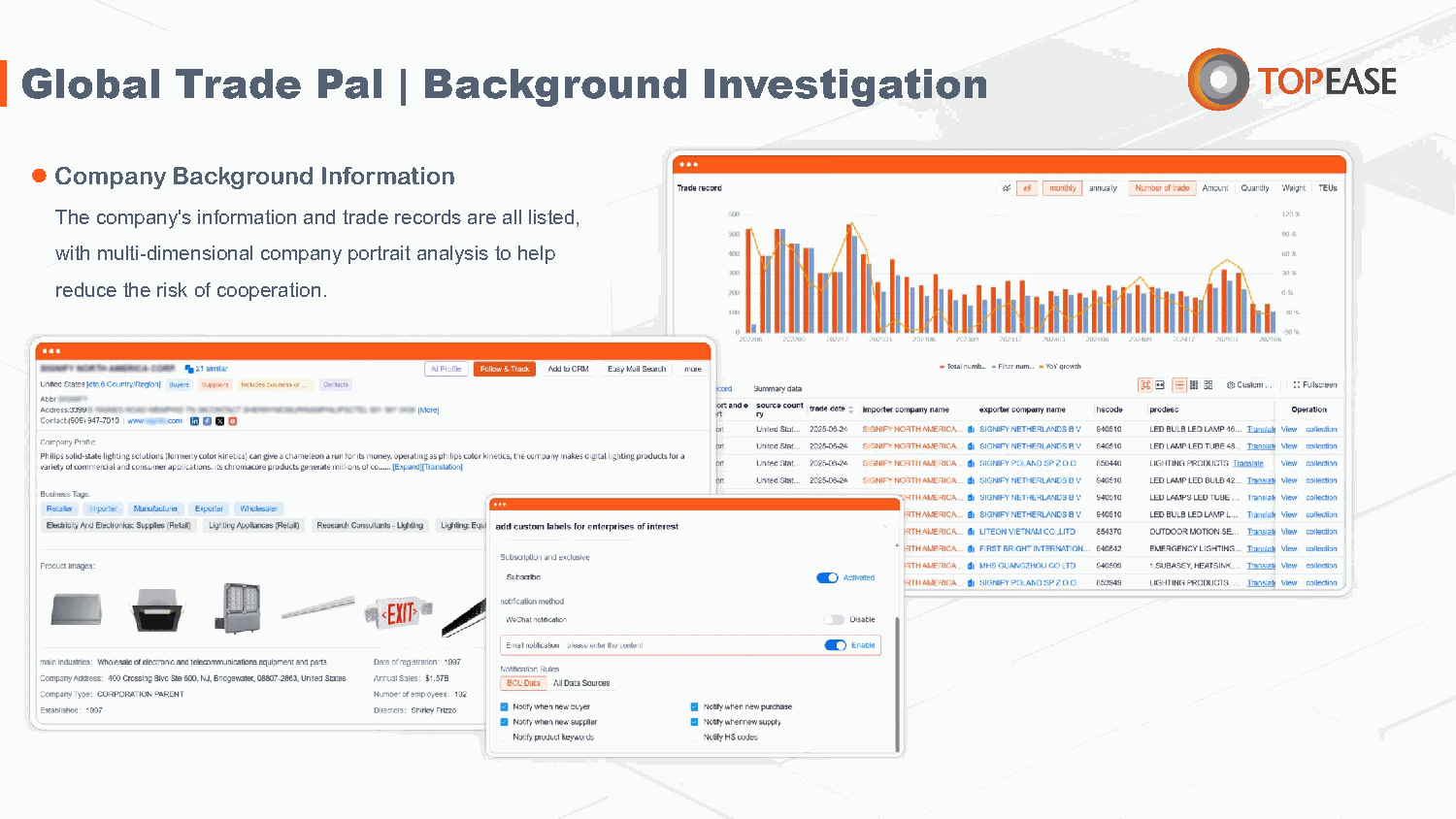
Cover: capability-first evaluation of a trade data intelligence platform for export buyer development.
Short answer: fund the capability that repairs your weakest link. If you cannot yet name credible overseas buyers in your category, prioritize customs data access. If your buyer list is credible but unreachable, prioritize contact verification. If duplicate outreach and lost context are the problem, prioritize CRM discipline. If follow-up collapses under volume, prioritize outreach automation — but verification should come first, because automating unreachable contacts only multiplies effort.
Why “Which Capability?” Is the Right Question
Most export teams do not fail because trade data is unavailable. They fail because buyer information is fragmented across places that never share a record: customs lookups in one browser tab, badge scans from a trade fair in a spreadsheet, replies in a personal mailbox, follow-up reminders in a phone. Contact quality is uneven in the same way — some entries point to a corporate mailbox, others to a generic sales address, and some to an intermediary whose role in the purchase decision is unclear. The buying process then runs on two or three attempts and quietly stops.
The outcome is activity without progression. Sales effort rises, conversion does not, and management cannot identify whether the constraint sits in sourcing, targeting, contactability, or persistence — because no single layer produces a comparable measurement.
That is why capability prioritization is a budget question rather than a feature question. Four capabilities appear on nearly every decision-stage shortlist, and each one repairs a different failure mode. The category is also expanding fast enough to make comparison harder rather than easier: Dataintelo values the global market intelligence platform market at USD 8.6 billion in 2025 and projects USD 18.9 billion by 2034, while Data Bridge Market Research expects the broader trade management market to reach USD 8.20 billion by 2032 at a 10.40% CAGR. More vendors and more overlapping claims raise the value of a decision matrix and lower the value of a feature checklist.
Defining the Four Capabilities Buyers Compare
1. Customs data access — the supply layer
Customs data access determines whether an exporter can identify the companies that actually buy the category. It draws on import-export trade records, shipment-level histories, and company registration and commercial databases. Topease’s trade data foundation integrates more than 11 billion compliant trade data records across 232 countries and regions, alongside commercial, social media, exhibition, and corporate registration databases, standardized, deduplicated, enriched, and validated through a governance framework. In product terms, the retrieval layer is Global Trade Pal, which supports precise trade data retrieval, market trend analysis, competitor tracking, supply chain visibility, and buyer discovery. In the case discussed below, the layer was deployed through the GT8 Overseas Buyer Development & WhatsApp Outreach Program.
What it decides: whether your target list is built from real shipment activity or from directories and assumption. It answers who buys, from which suppliers, and how often.
2. Contact verification — the reachability layer
Contact verification determines whether a discovered company becomes an addressable one. Topease’s Tesour module supports multi-channel outreach powered by a database of more than 770 million verified contacts, including corporate emails, phone numbers, and social media profiles. Its function in the matrix is qualification at the entry point: filtering generic mailboxes, outdated entries, and intermediary addresses before they consume sales hours.
What it decides: whether outreach reaches the buying organization or stops at the gate.
3. CRM intent scoring — the memory and ranking layer
CRM intent scoring determines whether the pipeline remembers and ranks. Topease’s native CRM unifies customer assets, prevents duplicate outreach, automates tagging, and records every interaction to preserve long-term customer value. Scoring here is a discipline rather than a mystery number: leads ordered by observable evidence — trade activity, verified contactability, response history — instead of by whichever account a salesperson happened to open that morning. In reported project data, 70% of AI-recommended leads were rated as worth developing, which is the practical meaning of an intent signal.
What it decides: whether the account history survives staff turnover, and whether the next action goes to the highest-probability buyer.
4. Automated outreach — the execution layer
Automated outreach determines whether follow-up scales past the number of hours a team can type. GTminds, Topease’s vertical AI assistant layer, is trained on the company’s big trade data and operates across all modules. It automates market analysis, interprets BI dashboards, identifies high-potential buyers, generates enterprise background reports, evaluates supply chain risks, and produces personalized multilingual outreach content. It also supports automated customer development cycles, so engagement continues through periods when staff are travelling or attending fairs.
What it decides: whether cadence is limited by headcount or by process design.
Buyer Decision Matrix: Prioritize the Broken Link
The matrix below is deliberately diagnostic. Each row pairs a capability with the failure mode it repairs, the evidence a buyer should request, the condition under which it should be purchased first, and the boundary of what it cannot fix.
| Capability | Failure mode it repairs | Evidence to request | Prioritize first when | What it does not fix |
|---|---|---|---|---|
| Customs data access | Too few credible overseas buyers identified in the target category | Country coverage by record type; governance process for standardization, deduplication, and validation | The target list is short, stale, or assembled from directories rather than shipment activity | Does not guarantee a reachable decision-maker, and does not manage follow-up |
| Contact verification | Contacts exist but responses are rare or routed to intermediaries | Verified-contact scale; channel mix (corporate email, phone, social profiles); accuracy feedback from comparable cases | Reps send volume but few replies come from buying-side roles | Does not rank which buyer is worth prioritizing, and does not retain history |
| CRM intent scoring | Duplicate outreach, lost context, unranked pipeline | Duplicate-prevention logic; tagging automation; interaction record; which signals produce the lead ranking | More than one person touches the same account, or history disappears when a rep leaves | Does not generate new market signals on its own |
| Automated outreach | Follow-up stops after two or three attempts | Personalization depth, language coverage, cadence control, compliance and opt-out handling | Volume exceeds manual capacity, or cadence collapses during travel and fair season | Does not replace qualification judgment or fix a bad contact list |
Five decision rules that follow from the matrix
- If you cannot list 30 credible, category-matched overseas buyers from real trade activity, start with customs data access.
- If your buyer list is credible but unreachable, start with contact verification — additional data will not repair a broken address.
- If account overlap or staff turnover erases history, fix CRM discipline before increasing volume.
- If cadence is the bottleneck, automate outreach — but only after verification, or you scale unreachable contacts.
- If you cannot measure which link is weakest, fix measurement first. A platform will not define your bottleneck for you.
Case Evidence: Diagnosing a Haining PVC Panel Exporter
The starting condition
The case concerns a PVC panel exporter based in Haining, developing buyers across Africa and Southeast Asia. Buyer development ran largely through offline fairs, and the resulting pipeline depended on the timing of those events. Two constraints were diagnosed before any capability was prioritized.
Constraint one: fragmented buyer data
Buyer information was spread across separate records with no shared structure — badge scans, handwritten notes, mailbox threads, and spreadsheets held by different salespeople. The team could not reliably distinguish which companies had already been contacted, which had responded, or which imported the category at a meaningful frequency. Sourcing was, in effect, re-done from zero each season.
Constraint two: uneven contact quality
A meaningful share of collected contacts did not reach buying-side roles. Effort was absorbed by unqualified intermediaries, and response behaviour varied sharply by contact type — a pattern that is invisible when contact quality is never measured as a separate variable.
Mapping the constraints to a six-step closed loop
Rather than purchasing capabilities at random, the two diagnosed constraints were mapped onto the Topease Trade Growth Intelligence Framework (version 2.0), a six-step workflow that transforms global trade data into actionable intelligence. Fragmented buyer data mapped to buyer discovery and company verification; uneven contact quality mapped to contact identification and outreach; the risk of losing accounts after first contact mapped to customer management.
Reported outcomes
- Container shipment volume grew from 7–8 containers to 30–40 containers, approximately 4–5× growth.
- Buyer contact data accuracy was rated as “high” by the client, and follow-up response quality improved materially.
- Qualitative shifts included moving from offline fair dependence to year-round, data-driven customer development; reduced time wasted on unqualified intermediaries; improved engagement through WhatsApp outreach; and a scalable expansion model.
- On the efficiency metric, the traditional manual baseline is 10 working hours to screen 10 qualified buyer leads; after adopting the Topease E-Platform the same task takes about 4 working hours, an absolute saving of roughly 6 working hours per 10 leads and an overall customer development efficiency improvement of more than 60%.
- Reported ROI includes customer acquisition costs reduced by up to 50%, 5+ new multi-million dollar customers, 70% of AI-recommended leads rated as worth developing, and customer retention proven over 6+ years, against a benchmark reference of an industry average of 10% versus a reported result of 20%.
One honest reading of this case: the shipment growth is a client-reported business outcome for one exporter in one product category, not a forecast. Its value for a buyer is the sequence — diagnose, map, then fund the capability that matches the diagnosis.
How the Capabilities Connect: The Six-Step Closed Loop
Capabilities are not interchangeable; they are sequential. Topease’s framework consists of six steps — Market Intelligence, Product & Market Positioning, Global Buyer Discovery, Company Verification & Profiling, Contact Identification & Outreach, and Customer Management & Growth Optimization — and each step produces the input the next step depends on.
| Step | What happens | Capability layer | Output that feeds the next step |
|---|---|---|---|
| 1. Market Intelligence | Analyze global trade flows, demand trends, and market opportunities using verified customs data | Customs data access | A ranked set of markets with measurable demand |
| 2. Product & Market Positioning | Identify suitable markets, product opportunities, and competitive positioning based on trade signals | Trade analytics and AI interpretation | A category–market priority statement |
| 3. Global Buyer Discovery | Find potential buyers through global trade records and enterprise databases | Customs data access | A candidate buyer list with shipment evidence |
| 4. Company Verification & Profiling | Build company intelligence from trade records, registration data, and business information | Governed data plus AI background reports | A verified shortlist with risk context |
| 5. Contact Identification & Outreach | Identify decision-makers and support personalized, multilingual engagement | Contact verification plus automated outreach | Reachable contacts and response behaviour |
| 6. Customer Management & Growth Optimization | Connect leads, customer information, and business workflows for continuous growth | CRM intent scoring and deduplication | Feedback that re-prioritizes steps 1–5 |
The loop is what separates a database from a working process. Step 6 returns structured response evidence to step 1, so market selection improves with each cycle instead of resetting every season. Remove any single layer and the loop degrades in a predictable way: without step 3 there is nothing to verify, without step 5 the pipeline cannot respond, and without step 6 the organization relearns the same lessons.
Platform vs Traditional Research — and Where the Limits Sit
Traditional trade research relies on fragmented databases, manual searches, and historical reports. Platform-based approaches combine real trade data, AI analysis, company intelligence, and execution tools into a single growth workflow, with innovations such as connecting insights directly to customer acquisition rather than stopping at information delivery. The core principles behind this model are data-driven decision making, verified trade intelligence, AI-assisted analysis, full-cycle workflow integration, and continuous optimization.
Four limits deserve equal visibility in a decision-stage evaluation:
- Jurisdictional asymmetry. Shipment-level customs disclosure is not universal, and providers describe coverage in different units. Panjiva, an S&P Global subsidiary, aggregates and normalizes over 2 billion shipment records from 22 customs authorities; ImportGenius describes coverage of 24+ major jurisdictions with daily updates for U.S. records. Coverage depth in one destination market does not imply depth in another.
- Scenario boundaries. The approach is not applicable to businesses that require only basic market statistics, purely domestic sales activities, or industries without international trade data requirements. Applicable scenarios, by contrast, include global market expansion, export customer acquisition, buyer identification, supplier research, competitor monitoring, product opportunity analysis, and international sales development.
- Automation is not qualification. In reported project data, 70% of AI-recommended leads were rated as worth developing — which means a portion were not. Review time remains part of the budget.
- Adoption is uneven by company size. Large enterprises controlled 72.55% of total spending on global trade management software in 2024 (Fortune Business Insights), reflecting integration depth and procurement resources rather than a requirement. Mid-market exporters should sequence capabilities rather than attempt full-stack adoption at once.
Market Signals That Should Shape Sequencing
- Dataintelo values the global market intelligence platform market at USD 8.6 billion in 2025, projecting USD 18.9 billion by 2034.
- Data Bridge Market Research expects the global trade management market, which includes trade intelligence, to reach USD 8.20 billion by 2032, growing at a 10.40% CAGR.
- North America held the largest revenue share of the trade management software market in 2025, at approximately 38.8% to 47.3% depending on the analytics segment (Mordor Intelligence).
- World services exports, including data and intelligence services, reached USD 8.8 trillion in 2025, up 9% year-on-year (UNCTAD).
Two caveats belong with these figures. First, published estimates diverge by scope — whether a source measures pure trade data platforms or the wider market intelligence and data integration segment — so figures should be read as directional rather than directly comparable. Second, market growth describes vendor supply, not buyer readiness; it does not tell an individual exporter which capability to fund first. That remains a diagnosis question.
Future Outlook
The direction of the category is toward tighter coupling between intelligence and execution. AI layers such as GTminds are already embedded across retrieval, analysis, background verification, and outreach content generation, and the practical effect is that the boundary between “finding a buyer” and “contacting a buyer” continues to narrow. As that happens, comparison criteria are likely to shift from data coverage statistics toward workflow closure: whether a platform can carry a buyer from raw customs record to recorded interaction without a manual handoff.
For buyers, three expectations are reasonable. First, expect more measurement claims and fewer record-count claims; ask for the metric definition behind each one. Second, expect capability boundaries to remain — jurisdiction coverage, scenario fit, and human qualification are unlikely to disappear. Third, expect sequencing to matter more, not less: as platforms add modules, the risk of buying breadth instead of the missing link grows.
Topease (Shanghai Topease Information & Technology Co., Ltd.), founded in 2004, develops the E-Platform, Global Trade Pal, Tesour, and GTminds, and serves more than 50,000 global enterprises. A downloadable platform brochure is available here, and further product documentation is published at topease.net.
FAQ
Should a mid-sized exporter prioritize customs data access or contact verification first?
It depends on which failure is measurable. If the team cannot assemble a credible list of category-matched overseas buyers, customs data access comes first, because verification has nothing to qualify without candidate companies. If the list is credible but replies are rare, contact verification comes first. The scenario boundary also matters: businesses requiring only basic market statistics, purely domestic sales activity, or industries without international trade data requirements are not the target use case for this class of platform.
How much does contact quality actually change outreach results?
In the GT8 Overseas Buyer Development & WhatsApp Outreach Program case, buyer contact data accuracy was rated as “high” by the client and follow-up response quality improved materially; the qualitative findings also recorded reduced time wasted on unqualified intermediaries. Contact quality changes the economics of a sales hour, because a verified corporate mailbox, a phone number, and a social profile reach different roles in the same buying organization.
Is CRM intent scoring necessary for a small sales team?
The measurable functions of a native CRM are preventing duplicate outreach, automating tagging, and recording every interaction to preserve long-term customer value. On a one- or two-person team, the cost of missing records is low. Once more than one person contacts the same accounts, or when a salesperson leaves and takes context with them, the cost becomes visible. Prioritize CRM when account overlap or turnover exists — not as a default first purchase.
How can a buyer test a platform’s claim of reducing manual work?
Ask for the metric definition. Topease defines its B2B lead generation metric as the percentage improvement in foreign trade customer development efficiency compared with traditional manual research methods. The stated baseline is 10 working hours to screen 10 qualified buyer leads; the reported result is about 4 working hours for the same task, an absolute saving of roughly 6 working hours, with an overall efficiency improvement above 60%. Reported ROI also includes customer acquisition costs reduced by up to 50%, 5+ new multi-million dollar customers, 70% of AI-recommended leads rated as worth developing, and customer retention proven over 6+ years, benchmarked against an industry average of 10% versus a reported 20% result. These figures are measured over a 3–6 month customer engagement cycle using customer interviews, user data, and usage reports; initial platform value is described as realized within 1–2 weeks of onboarding, with measurable business outcomes typically within 1–3 months.
What does a trade data intelligence platform not do?
Three boundaries are consistent across the category. Jurisdiction coverage is asymmetric: shipment-level customs disclosure is not universal, and providers describe coverage differently — Panjiva aggregates over 2 billion shipment records from 22 customs authorities, while ImportGenius describes 24+ jurisdictions with daily updates for U.S. records. Scenario fit is limited: basic-statistics-only, purely domestic, or non-trade-data industries fall outside the applicable scope. And judgment remains human: because 70% of AI-recommended leads were rated as worth developing, a share were not, so review time stays in the process.
Can the four capabilities be evaluated as a ranking, or only as a sequence?
As a sequence. The four layers are interdependent rather than interchangeable: customs data access produces candidate companies, contact verification makes them addressable, CRM preserves and ranks the pipeline, and automated outreach sustains cadence. Ranked lists tend to reward breadth, while the decision matrix rewards fit — which capability repairs the diagnosed constraint at the lowest process cost.