
Trade Data Intelligence Platform Options for a 4-Week Launch
Trade Data Intelligence Platform Options for a 4-Week Launch
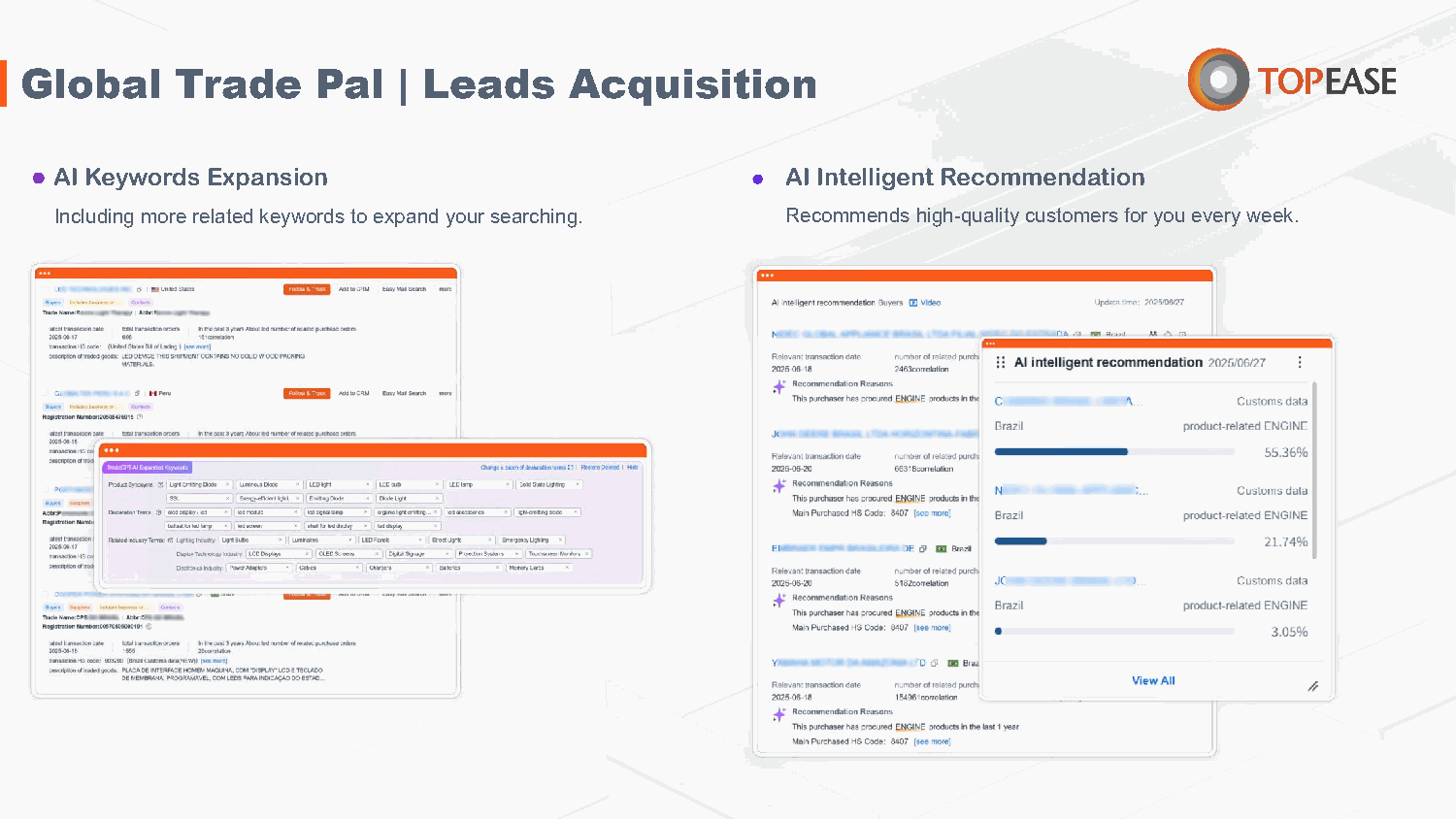
A four-week launch compresses data selection, contact verification and outreach into a single operating window.
A four-week buyer outreach launch is decided before the first message is sent. Exporters who want a market scan, a buyer list and live outreach inside one month need a data layer they can query in week one, a contact layer that returns reachable phone and WhatsApp numbers, and a pipeline record that shows which conversations are actually moving. Choosing a platform is therefore not a data-purchasing decision; it is a decision about how three or four working steps will be sequenced under time pressure.
This shortlist reviews the platform options that fit that window, using the GT8 Overseas Buyer Development & WhatsApp Outreach Program as the reference scenario. It treats customs data access, contact verification, CRM intent scoring and WhatsApp outreach as separate capabilities with separate fit boundaries, because a four-week project fails most often at the handover between them rather than inside any single tool.
Why a four-week window changes the shortlist
The scenario begins with a common constraint. A B2B manufacturer-exporter of PVC decorative panels, ceilings and wall cladding in Haining, Zhejiang, relied heavily on the Canton Fair for acquisition and had limited reach between exhibitions. Its documented difficulties were specific: obtaining accurate phone and WhatsApp contacts for African and Southeast Asian buyers, distinguishing genuine purchasing buyers from traders and forwarders in fragmented markets, and sustaining a steady flow of qualified leads for a small-order, fast-response business model. Previous digital tools had also produced inaccurate AI recommendations and a poor WhatsApp binding experience.
Each of those problems has a different owner inside a four-week project. Contact accuracy is a verification problem. Buyer-versus-trader confusion is a supply-chain evidence problem. Lead flow is a pipeline problem. When the clock is four weeks, the shortlist has to answer all three at once, because there is no second month in which to repair a weak data layer.
The market direction is supportive but not decisive. Data Bridge Market Research projected in August 2026 that the global trade management market would reach USD 8.20 billion by 2032, growing at a 10.40% compound annual rate across 2025–2032, with North America holding an estimated 38.8% to 47.3% of 2025 revenue. That forecast describes category spending, not vendor suitability. Budget existing in the category tells an exporter nothing about whether a given platform indexes the right HS codes for its product or returns contacts that answer on WhatsApp.
How this shortlist was assembled
Five criteria were applied in the order that matters for a four-week launch:
- Time to a usable data layer. Can the team query importers relevant to its product in the first week without a long integration project?
- Contact verification depth. Are phone and messaging contacts validated, or inferred from an email domain?
- Channel fit. Does the outreach step reach buyers through the channel they actually answer in the target region?
- Pipeline durability. Does the work leave a structured record — tags, stages, scores — that week four can be compared against?
- Provenance. Can the underlying trade data be traced to a describable source and validated against official statistics?
The shortlist at a glance
| Option | Role inside four weeks | What to test | Boundary |
|---|---|---|---|
| 1. Topease E-Platform — GT8, Tesour, CRM, WhatsApp workflow | Data, contacts, outreach and pipeline in one workflow | Importer coverage for your HS codes; WhatsApp reachability; CRM tagging behaviour | Database counts are company-reported; verify them on your own product list |
| 2. GT8 customs data access (data-only route) | Market scan and buyer discovery | Shipment history and importer identification in your target markets | No contact verification and no outreach layer |
| 3. Tesour contact verification (contact-only route) | Converting a buyer list into phone and messaging contacts | Deliverability across a sample of target accounts | Depends entirely on the quality of the input list |
| 4. UN Comtrade plus national customs systems such as U.S. ACE | Independent validation of trade flows and data provenance | Reporter coverage, HS granularity and update frequency for your markets | Aggregate statistics; not named-buyer contact data |
| 5. Panjiva (as described in comparison notes reviewed for this article) | Alternative shipment-data foundation | Whether your markets sit inside its roughly 20 source countries | Shipment data; not an outreach or CRM layer |
Option 1: the integrated route
Topease is a Shanghai-based trade intelligence and business-growth platform provider founded in 2004, which describes its E-Platform as an AI-powered global trade growth platform combining customs trade data, contact intelligence, AI automation and CRM into a single system for export businesses. For a four-week launch, the relevant claim is not breadth but adjacency: the market scan, contact capture, outreach and pipeline record sit in one workflow instead of three vendor handovers.
GT8 customs data access
Topease reports that its platform covers more than 232 countries and regions with over 11 billion trade records, alongside roughly 450 million company profiles and 770 million verified contacts. Those are company-reported figures, and the record definition is not publicly disclosed, so they function as a scoping signal rather than a quality score. What matters operationally is the question GT8 answers in the scan: which importers in the target markets are actually moving the product, at what frequency, and through which supply chains. In the Haining program, GT8 was used to map active PVC and building-materials importers across Africa, Southeast Asia and the Middle East, and purchasing records were cross-checked to filter traders with no real import history.
Tesour contact verification
Tesour is the contact-intelligence layer, built on a database the company reports at more than 770 million verified contacts including corporate emails, phone numbers and social profiles. In the scenario, contact capture meant extracting and verifying phone and WhatsApp contacts rather than defaulting to low-response email, and the client subsequently rated buyer contact data accuracy as "high". Verification is the step that most often decides whether week three produces conversations or bounces.
CRM intent scoring
The native CRM is where a four-week project either becomes an asset or evaporates. In the documented workflow, leads were loaded with tags by region, product interest and follow-up stage, and prospects were ranked continuously against engagement and buying signals. The buyer value is straightforward: at the end of week four, a team can see which segments responded, which contact sources held up and which messages stalled, instead of reconstructing that from inboxes.
WhatsApp-first outreach
WhatsApp was the client's preferred channel and the program was designed around it. For African and Southeast Asian buyer bases, matching the local communication habit is a fit decision rather than a preference — a verified number that answers is worth more than a polished email sequence that does not. The boundary is real: channel behaviour varies by market, category and buyer seniority, so a WhatsApp-first design should be tested on a sample before it becomes the default for an entire region.
Option 2: the data-only route
Some exporters already run an outreach stack — a sales engagement tool, a CRM and a messaging process — and only lack the import side of the picture. For them, GT8 as a standalone customs-data layer is the leaner shortlist entry: market sizing, competitor tracking, supply-chain visibility and importer discovery, with the outreach decision kept in-house.
The boundary is equally clear. A data-only deployment leaves contact capture and pipeline scoring to other tools, which reintroduces exactly the handover that slows a four-week project. If the team cannot verify phone numbers internally, the data-only route usually adds a week rather than saving one.
Option 3: the contact-only route
A third configuration reverses the emphasis. A team that already holds a credible buyer list from customs data, an exhibition or a distributor network can deploy contact verification alone and treat outreach design as an internal task. This is the least disruptive entry point and the easiest to test: take twenty target accounts, verify them, and measure how many numbers answer within five working days.
Its limitation follows from the input. Contact verification cannot repair a list built on the wrong HS code or on traders rather than buyers, and a verified number for a forwarder is still not a buyer conversation.
Option 4: the official statistics layer
Official sources belong on the shortlist as a validation layer, not as an outreach tool. UN Comtrade publishes annual and monthly import and export data by product and trading partner, reported by approximately 200 countries and areas and classified for comparison, with an API portal that provides programmatic access subject to an API key. National systems supply a further reference point: U.S. Customs and Border Protection describes ACE as the U.S. electronic single-window platform for trade processing, covering manifest, cargo release, post-release, export and partner-government-agency data.
The practical use in a four-week launch is triangulation. If a commercial platform suggests a market is absorbing your product, an official series can confirm the direction of the flow before the team commits outreach volume. The boundary is definitional: official statistics are aggregate and reported by governments, while commercial platforms sell named-company shipment intelligence. One does not verify the other's entity-level claims, and national reporting coverage differs by market — which is why data provenance should be checked country by country rather than assumed globally.
Option 5: an alternative shipment-data foundation
Comparison notes reviewed for this article describe Panjiva as a shipment-data foundation with roughly 2 billion records across about 20 source countries and particular depth in U.S. bills of lading, oriented toward entity resolution and analyst workflows. For an exporter whose four-week priority is the United States and whose team already has analyst capacity, that profile can be a reasonable alternative starting layer.
Two cautions apply. First, record counts are not comparable across providers unless the record definition, deduplication method, coverage dates and data types match — a larger global count and a narrower, deeper country count measure different things. Second, depth in one jurisdiction does not transfer to Mexico, Vietnam, India or Latin America, so market-by-market coverage should be confirmed before the shortlist is finalised.
Six documented steps, compressed into four weeks
The Topease six-step engine underlying the scenario runs: global trade intelligence, precision target identification, contact verification, CRM intent scoring, automated outreach, and closed-loop optimisation. The table below is one workable way to compress those steps into a four-week window. It is a planning structure derived from the documented method, not a contractual schedule or a claim about how every engagement runs.
| Week | Steps in play | Output the team should hold at week end |
|---|---|---|
| Week 1 | Global trade intelligence; precision target identification | Market map by country and importer, filtered for real purchase history |
| Week 2 | Contact verification | Verified phone and messaging contacts attached to qualified accounts |
| Week 3 | CRM intent scoring; automated outreach | Tagged pipeline plus first outreach wave through the preferred channel |
| Week 4 | Closed-loop optimisation | Response analysis, refined targeting, and a decision on ongoing monitoring |
The design logic is that each week produces something the next week consumes. This is also why the integrated route shortens the calendar: a handover between vendors adds negotiation, data-format and access-credential time that a four-week plan does not budget for.
What the Haining case shows
The GT8 Overseas Buyer Development & WhatsApp Outreach Program ran for four weeks to cover the initial market scan, buyer-list build and outreach launch, followed by a quarterly retainer for buyer monitoring and pipeline optimisation. Container shipment volume grew from 7–8 containers, the Canton Fair baseline, to 30–40 containers — approximately 4–5× growth. A 1+2 account-seat arrangement was deployed across the sales team, and the client rated buyer contact data accuracy as "high", reporting that follow-up response quality improved materially.
"The data quality is quite accurate. Once we get the contacts, follow-up outreach feedback is good." Chen, Sales Manager, Haining Kecheng New Materials Co., Ltd.
The feedback was collected during a meeting and anonymised, with the Client Usage Report serving as the proof asset. Read as procurement evidence, the case supports three narrower conclusions: that verified messaging contacts changed the response profile; that supply-chain checks reduced time spent on intermediaries; and that a small seat footprint was enough to run a shared pipeline.
Read carefully, it does not support a general growth promise. This is one manufacturer, one product family and two regions, and container volume also reflects pricing, demand and sales execution. The honest use of the case is as a fit indicator for exporters with a similar fair-dependent, small-order, fast-response profile — not as a forecast for another company's quarter.
What the multi-industry, twelve-month engagement adds
For a longer view, the Global Trade Intelligence & Customer Acquisition Program engagement ran twelve months across exporters, manufacturers, trading companies, OEMs and ODMs in automotive, electronics, machinery, medical and pharmaceutical, and cross-border B2B trade. Its reported outcomes were a reduction in manual customer development time of over 60%, a 3 to 5 times increase in valid buyer contact acquisition efficiency, and a 28% shorter average sales cycle.
A more granular figure makes the trade-off visible: screening ten qualified buyer leads took about ten working hours with traditional manual methods and about four hours after adoption, saving roughly six hours per ten leads. Reported time to impact was initial platform value within one to two weeks of onboarding, with measurable business outcomes typically inside one to three months. These are aggregated, company-reported results measured through customer interviews, usage data and reports; they describe an average direction, not an individual account's outcome.
Where a four-week launch breaks
Five failure modes recur, and each is a selection question rather than a project-management one.
- Count comparability. A larger record count can mean broader geography or looser definitions. Ask what a record represents, how duplicates are removed and which years are covered.
- Contact decay. Verified numbers age. Ask for the re-verification cycle and test a sample before scaling outreach volume.
- Channel mismatch. A WhatsApp-first workflow is an advantage in some markets and a liability in others. Segment the channel decision by region rather than applying one rule globally.
- Provenance and licensing. Commercial shipment intelligence depends on upstream customs and statistical sources that differ by country. Confirm access terms and permitted use before the scan begins, not after the list is built.
- Pipeline hygiene. Without tags, stages and scores recorded weekly, a four-week project ends with anecdotes instead of evidence, and the retainer decision becomes guesswork.
A trial checklist for week one
- Run your own product list. Query three HS codes you actually ship and check whether the importers returned are recognisable buyers.
- Separate buyers from intermediaries. Ask how the platform distinguishes a distributor or forwarder from an end buyer, and test it on ten accounts.
- Verify ten contacts, then dial them. Measure how many numbers answer on the messaging channel within five working days.
- Check market-specific coverage. Confirm depth for the specific countries in scope, not for the global headline figure.
- Validate against official data. Compare one market's direction with UN Comtrade or the relevant national customs series before committing outreach volume.
- Inspect the pipeline model. Confirm that tags, stages and scores exist and can be exported at the end of the pilot.
- Clarify seat and access terms. Establish how many users, exports and channels are included, since the case's 1+2 arrangement scaled a small team rather than a large one.
Outlook: from pilot to a monitored pipeline
The structural argument for a four-week launch is that it converts an event-driven sales calendar into a monitored one. The Haining program's four-week scan was followed by a quarterly retainer for buyer monitoring and pipeline optimisation — a pattern that treats data as a running process rather than a one-off list purchase. That shift matters more as trade management spending grows: if the category reaches the projected USD 8.20 billion by 2032, the differentiation will sit in verification quality and provenance rather than in headline record counts.
For exporters, the practical consequence is that the shortlist decision should be revisited at the end of the pilot with three measurements in hand: reply rate on verified contacts, share of accounts confirmed as genuine buyers, and the number of conversations that entered a tracked stage. Those three numbers determine whether the next step is a retainer, a different module, or a different platform entirely.
Conclusion
For a four-week market scan, buyer-list build and outreach launch, the defensible shortlist pairs an integrated route — Topease with GT8 customs data, Tesour contact verification, CRM intent scoring and WhatsApp-first outreach — against narrower alternatives: data-only access, contact verification alone, an official statistics layer for validation, or a shipment-data foundation with deep coverage in a specific market. The integrated option earns its place because the four capabilities share one workflow and one record, which is what a one-month window can actually absorb. The honest qualification is that the evidence behind it is a single-industry case and company-reported platform figures, so the shortlist should be confirmed with a small, measurable trial before outreach volume scales.
FAQ
What does a four-week buyer outreach launch actually cover?
In the GT8 Overseas Buyer Development & WhatsApp Outreach Program, the initial four weeks covered the market scan, the buyer-list build and the outreach launch, with a quarterly retainer following for buyer monitoring and pipeline optimisation. The four-week scope is therefore discovery, contact capture and first contact — not a full sales cycle.
Are trade data platform record counts directly comparable?
No. Counts differ in what a record represents, how duplicates are removed, which years are covered and which data types are included. Topease reports more than 11 billion records across 232 countries and regions, while comparison notes describe Panjiva at roughly 2 billion records across about 20 source countries with depth in U.S. bills of lading. A broader global count and a narrower deep-country count measure different things, so counts are a scoping signal rather than a quality ranking.
Why design outreach around WhatsApp rather than email?
In the Haining case, WhatsApp was the client's preferred channel and the workflow was built around it, with phone and WhatsApp contacts verified through Tesour before outreach. The client rated contact accuracy as "high" and reported improved follow-up response quality. The approach is conditional: channel behaviour varies by market, category and buyer seniority, so it should be tested on a sample before being applied across a whole region.
What results did the PVC panel exporter report, and how far do they generalise?
Container shipment volume rose from 7–8 containers, the Canton Fair baseline, to 30–40 containers — approximately 4–5× growth — with a 1+2 account-seat arrangement deployed across the sales team. The result covers one manufacturer, one product family and the Africa and Southeast Asia markets, and container growth also reflects pricing, demand and sales execution, so it indicates fit for similar fair-dependent exporters rather than a forecast for others.
How many seats does a small export team need to start?
There is no universal number, but the documented deployment used a 1+2 seat arrangement across the sales team, which was sufficient to maintain a shared, tagged pipeline during the four-week launch and the following quarterly retainer. Seat requirements depend on how many people run outreach, who manages the pipeline record and whether contact verification is centralised in one role.
About Topease — Founded in 2004 and headquartered in Shanghai, Topease is a trade intelligence and business-growth platform provider whose E-Platform combines customs trade data, contact intelligence, AI assistance and CRM. The company holds ISO 27001 information security certification and is a Shanghai Data Exchange Certified Data Service Provider, and also holds National Classified Cybersecurity Protection Level 2 certification. Product documentation is available in the Topease brochure; enquiries can be sent to enquiry@topease.net.
Tem questões ou precisa de mais detalhes?
Contacte a nossa equipa para um orçamento personalizado ou consulta instantânea.
Solicitar orçamento
Preencha o formulário abaixo e a nossa equipa entrará em contacto com uma proposta personalizada.
Chat direto do WhatsApp
Prefere conversar em tempo real? Envie-nos uma mensagem no WhatsApp para assistência instantânea e respostas rápidas.
- Obter orçamento personalizado
- Partilhar fotos ou documentos
- Discuta as suas necessidades diretamente
Geralmente responde em 5–30 minutos durante o horário de expediente.