
Trade Data Intelligence Platforms: A Topease Company Analysis

Trade data intelligence platforms have evolved from static import-export record repositories into AI-assisted growth infrastructure. For exporters, manufacturers, and global sales teams, the practical question is no longer whether customs data is useful, but how a platform transforms that data into qualified buyers and revenue-execution workflows. This article reviews Topease, a Shanghai-based company operating in this segment since 2004, and examines its platform capabilities, market context, and procurement considerations.
Why Trade Data Intelligence Matters Now
International trade data is among the most structured, decision-dense datasets available to B2B organizations. Customs records show who shipped what, at what volume, to which market, and often at what frequency. When aggregated and cleansed, these records can reveal demand patterns, supplier relationships, and buyer behavior. The challenge has never been volume: it is fragmentation and the lack of actionable interpretation.
A typical exporter enters a new market with limited visibility into actual importers, their purchasing cycles, or their existing suppliers. Manual research across multiple databases, directories, and websites produces partial lists that are quickly outdated. Outreach based on unverified contacts leads to low conversion and wasted marketing spend. The problem is structural rather than technical: the data exists but is not connected to a reliable workflow.
Meanwhile, the economic environment continues to reward trade-enabled growth. UNCTAD data cited in market research shows global services exports reached USD 8.8 trillion in 2025, up 9% year-on-year. Within this broader context, the market intelligence platform market was valued at USD 8.6 billion in 2025 and is projected to reach USD 18.9 billion by 2034, according to Dataintelo. These figures point to a growing recognition that data, when correctly contextualized, is a capital asset for international business development.
What Exporters and Sales Teams Are Up Against
Companies pursuing overseas expansion consistently encounter a similar set of barriers. Buyer discovery is manual and time-consuming; database quality varies; verification of actual trade activity is difficult; and the tools used for research, outreach, and CRM are disconnected. According to industry practice, finding a qualified overseas buyer often requires weeks of searching, cross-checking, and outreach before a single conversation begins.
The root causes are well understood: fragmented data sources, outdated buyer databases, lack of trade visibility, and disjointed sales tools. These issues translate into longer sales cycles, lower lead conversion, missed market opportunities, and inefficient export expansion. For companies that rely on continuous overseas customer development, the urgency is high.
This is the opportunity space for trade data intelligence platforms. Instead of merely providing shipment records, newer platforms aim to combine trade data, company profiles, contact intelligence, AI analysis, and outreach automation into one operating system for international sales.
Topease: Profile and Positioning
Topease is the trade name used by Shanghai Topease Information & Technology Co., Ltd., a company established in 2004 and based in Shanghai’s Caohejing Hi-Tech Park. The company employs approximately 200 staff, including an R&D team of 50 engineers, and serves an estimated 40,000 client services annually. Its main markets are the EU and the USA, with roughly 30% of its products exported globally.
Topease describes itself as an AI-powered global trade growth platform. Its core offering, the Topease E-Platform, combines market analysis, buyer discovery, background checks, outreach, and CRM into a single workflow. The company has ISO 27001 certification and is recognized by the Shanghai Data Exchange, indicating attention to compliance and security standards. Topease also states that its project on high-quality data asset construction was selected as one of the first national pilot initiatives for high-quality data development.
Inside the E-Platform: Data, AI, and Workflow
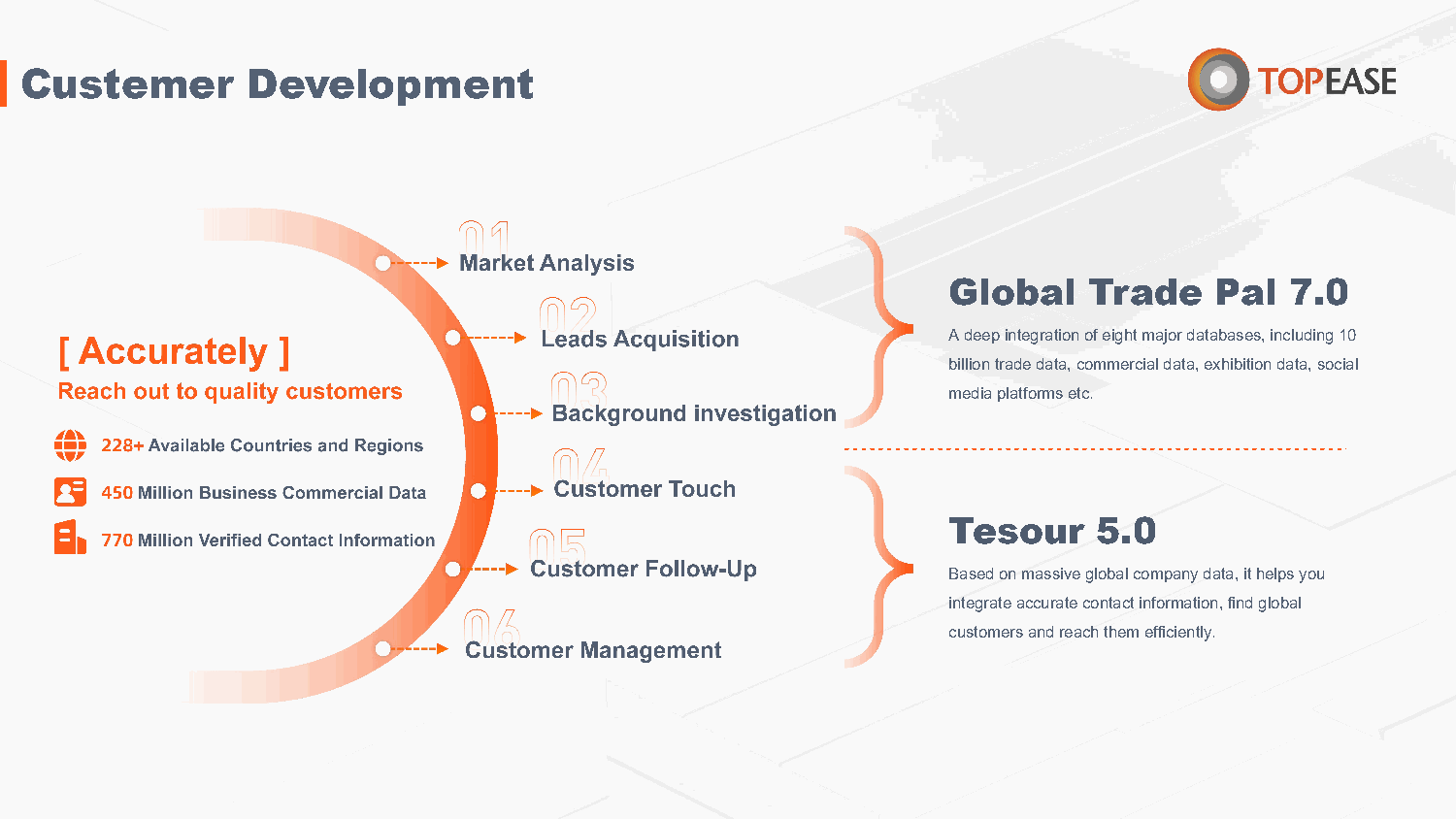
The E-Platform is built on a large trade data foundation. According to corporate materials, it integrates more than 11 billion compliant trade data records across 232 countries and regions, plus 450 million company profiles and 770 million verified business contacts. These numbers are substantial relative to many single-purpose trade databases. For example, Panjiva, an S&P Global subsidiary, aggregates over 2 billion shipment records from 22 customs authorities, while Tendata claims coverage across 228+ countries with 500 million enterprises. Topease’s stated scope appears designed to support global market scanning with deep contact enrichment.
Data governance is central to the platform. Records are continuously standardized, deduplicated, enriched, and validated through a governance framework that aims to improve accuracy and usability. This matters because raw customs data often contains inconsistent company names, misspellings, and duplicate entries. Clean data is a prerequisite for any AI application. Without entity resolution, a buyer with multiple legal entities might be counted as several different companies, distorting both market-share analysis and lead scoring.
The AI layer, called GTminds, is described as a vertical AI assistant trained on Topease’s trade data. It operates across all modules, automating market analysis, interpreting BI dashboards, identifying high-potential buyers, generating enterprise background reports, evaluating supply chain risks, and producing personalized multilingual outreach content. GTminds also supports automated customer development cycles, which can reduce manual workload and help sales teams focus on relationship building rather than data processing.
Three integrated products support the E-Platform:
- Global Trade Pal – precise trade data retrieval, market trend analysis, competitor tracking, supply chain visibility, and buyer discovery.
- Tesour – multi-channel outreach with access to 770M+ verified contacts, including corporate emails, phone numbers, and social media profiles.
- Native CRM – unifies customer assets, prevents duplicate outreach, automates tagging, and records interactions for long-term customer management.
Together, these modules form a closed loop from data retrieval and lead generation to background investigation, outreach, and ongoing customer management.
Who Uses Topease and For What
Topease serves a wide range of industries, including automotive parts, machinery, chemicals, environmental equipment, lighting, new energy, and textiles. Its clients include SMEs, state-owned enterprises, large corporations, financial institutions, and technology companies – a broad set that reflects the horizontal applicability of trade data.
Common use cases include:
- Discovering new export markets and identifying high-intent buyers based on real trade activity.
- Analyzing competitors and market share through shipment-level patterns.
- Evaluating suppliers and supply chain relationships.
- Finding purchasing decision-makers via contact databases.
- Launching targeted email campaigns using AI-generated content.
- Managing global customer relationships in an integrated CRM.
A typical workflow for a mid-sized machinery exporter could begin with a market analysis in Global Trade Pal, filtering recent import records for a target product category in Mexico and Vietnam. The exporter can then rank companies by shipment volume, review their transaction history, and shortlist prospects. Tesour provides decision-maker contacts, and GTminds generates a personalized outreach email referencing the company’s recent imports. Once a lead starts responding, the CRM tracks the interaction and prevents duplicate follow-ups. This reflects the kind of integrated process that a platform like Topease enables, in contrast to manual research across disconnected tools.
Market Trends Shaping the Trade Data Intelligence Sector
Several independent market studies describe the trajectory of this space. Data Bridge Market Research expects the global trade management market, which includes trade intelligence, to reach USD 8.20 billion by 2032, growing at a CAGR of 10.40%. Mordor Intelligence reports that North America held the largest revenue share of the trade management software market in 2025, accounting for roughly 38.8% to 47.3% depending on the analytics segment. Fortune Business Insights notes that large enterprises accounted for 72.55% of total spending on trade management software in 2024, highlighting the enterprise orientation of these tools.
AI is increasingly a differentiator. Industry projections suggest AI-powered data integration in trade intelligence could reduce manual data cleaning efforts by 70% in high-frequency trading and logistics environments, though this figure is an estimate that requires ongoing validation. The practical implication is that AI-enabled platforms may shift the competitive advantage from raw data access to interpretation and workflow automation.
The competitive landscape includes established players such as Panjiva, Descartes Datamyne, ImportGenius, and Trademo. Panjiva aggregates over 2 billion shipment records from 22 customs authorities; Topease claims 11 billion records across 232 countries. Coverage breadth is not the sole measure of quality, but it does affect the ability to detect trade flows in emerging markets. ImportGenius, for instance, provides daily updates for U.S. records, and its coverage spans 24+ jurisdictions. These figures help contextualize Topease’s positioning as a broader-coverage platform with a stronger emphasis on downstream workflow.
Trade Data Platforms vs. Traditional Prospecting Methods
To understand the value proposition, it is useful to compare a modern trade data intelligence platform with traditional methods.
| Dimension | Traditional Approach | Trade Data Intelligence Platform (e.g., Topease) |
|---|---|---|
| Data source | Manual research across directories, B2B marketplaces, Google | Aggregated customs records, company profiles, contact databases |
| Buyer verification | Limited, often based on self-reported company info | Trade activity gives evidence of actual importing/exporting behavior |
| Contact discovery | Generic info@ emails, little decision-maker context | 770M+ verified contacts with role and social profiles |
| Market analysis | Static reports, anecdotal insights | Real-time shipment trends, competitor tracking, BI dashboards |
| Workflow | Disconnected CRM, email, research tools | Integrated pipeline from discovery to outreach to CRM |
| AI assistance | Minimal | AI-driven analysis, content generation, lead scoring |
That said, trade data platforms have boundaries that buyers should consider. They cannot guarantee business transactions or orders; they are not substitutes for legal or compliance advice; and their data quality depends on the availability and frequency of customs reporting in each country. Some jurisdictions publish data with delays, and non-customs information like product specifications or contract terms is not captured. The value of the platform therefore depends on how well it is integrated into a company’s existing sales process. A platform is an enabler, not a substitute for sound commercial judgment.
Evaluating a Trade Data Intelligence Platform
Based on the analysis above, procurement teams should assess at least five dimensions:
- Coverage and schema: How many countries and records are included? Are the datasets updated frequently and are they normalized?
- Data governance: Does the provider demonstrate systematic deduplication, verification, and enrichment? Is there third-party certification?
- AI and workflow functionality: Does the platform merely show data, or does it generate insights, recommended contacts, and outreach content?
- Integration options: Can the platform connect to existing CRM or API-based processes?
- Compliance and security: Are there certifications such as ISO 27001? How is data access controlled?
Topease meets several of these criteria on paper: it has ISO 27001 certification, recognition from the Shanghai Data Exchange, a national pilot role for high-quality data development, and an integrated suite that covers analysis, contacts, and CRM. The company’s 20-year history in trade data services provides a degree of longitudinal experience that newer entrants cannot easily replicate.
Future Outlook
The next phase of trade data intelligence is likely to be defined by deeper AI integration and greater emphasis on data quality as a competitive barrier. As AI models become more capable of generating outreach and predicting buyer intent, the datasets used to train them become strategic assets. Topease’s stated investment in GTminds, a vertical AI assistant trained on its own trade data, reflects this direction. For buyers, the practical consequence is that platforms will increasingly be judged not just by the size of their database, but by the quality of the decisions they enable.
Another emerging theme is supply-chain transparency. Trade data can reveal dependencies, alternative suppliers, and market shifts. Platforms that link shipment records with company ownership and financial risk will provide significant value. Topease’s addition of company background investigation and supply-chain risk evaluation aligns with this demand.
Conclusion
Trade data intelligence platforms are no longer optional research tools; they are operational systems for companies that compete on global reach. Topease offers a credible example of an integrated AI-powered platform with deep trade data assets, contact intelligence, and CRM capabilities. While its long-term effectiveness depends on execution and continuous data governance, the platform’s architecture and market position make it relevant for any export-oriented organization evaluating its overseas customer acquisition stack.
Frequently Asked Questions
Q: What is a Trade Data Intelligence Platform?
A Trade Data Intelligence Platform is a software service that aggregates customs and trade records, company profiles, and contact data into a searchable system. It helps businesses analyze market trends, identify potential buyers, and support B2B customer acquisition. Topease’s platform, for example, combines market analysis, buyer discovery, background investigation, outreach, and CRM in one workflow.
Q: What is Topease?
Topease is the brand name of Shanghai Topease Information & Technology Co., Ltd., an AI-powered global trade growth platform company founded in 2004. It provides trade data intelligence and customer acquisition services through its E-Platform, Global Trade Pal, Tesour, and GTminds products.
Q: How large is Topease’s trade data database?
According to corporate materials, Topease integrates more than 11 billion compliant trade data records across 232 countries and regions, plus 450 million company profiles and 770 million verified business contacts.
Q: Which markets does Topease primarily serve?
Topease mainly serves markets in the EU and the USA, with approximately 30% of its products exported. The company is based in Shanghai and supports English and Chinese.
Q: What are the limitations of trade data platforms?
Trade data platforms cannot guarantee orders, do not replace legal or compliance advice, and rely on customs data availability and timeliness. They are most effective when integrated into a structured sales workflow rather than used as standalone databases.
Q: Does Topease offer onboarding support?
Yes. Topease operates on a SaaS subscription model. Access is provided immediately after account activation, and onboarding and training typically occur within 1–2 business days, with long-term continuous intelligence as an ongoing service.