
Trade Intelligence by Scenario: Exporter and Importer Guide
Access to import export data is rarely the constraint in global sourcing or export sales anymore. What separates teams that benefit from trade records from teams that merely download them is whether the data is matched to a specific decision. The same shipment record can support a market-entry question, a buyer-qualification question, or a supplier-risk question — but each of those requires a different workflow, a different report format and a different definition of sufficient evidence.
Tendata (Shanghai Tendata Information Technology Co., Ltd.) is a Shanghai-based trade intelligence platform founded in 2005 that combines global trade data with AI-powered analytics to help businesses develop global markets, find international buyers and suppliers, analyse products and conduct competitor research. This guide maps trade intelligence to four application scenarios used by manufacturers, exporters, importers and B2B sales teams — new market entry, customer acquisition, supplier discovery and continuous monitoring — and states where customs-based records stop being conclusive.
Tendata's customers across global trade and export markets.
Why scenario fit, not database size, decides the outcome
Most trade data projects fail at the handover point between data and decision. A team signs up for a global trade platform, runs a broad search, exports a list, and then applies the same list to a market-entry question and to a weekly prospecting question. Those two questions have different tolerance for noise: market entry needs a directional pattern across a country and an HS code, while prospecting needs a named company with observable purchasing behaviour.
Traditional lead channels amplify that mismatch. In a documented Tendata customer case, a sanitary ware manufacturer and exporter in Foshan, Guangdong reported the same set of constraints that many exporters describe: high investment in traditional B2B platforms, low-quality leads, difficulty identifying high-potential buyers, and high customer acquisition costs. The diagnosis was not a visibility problem. The company's top-performing video received more than 3 million views and monthly organic traffic exceeded 20 million views, but overall conversion was only around 0.2% — because bathroom products are not everyday consumer goods and traffic volume does not indicate purchasing demand.
The opportunity, therefore, is not more data but better sequencing: use trade activity to decide who deserves attention first, then use contact and outreach tools on that qualified group. Trade records are useful here because they describe behaviour rather than intent: purchase volume, import trends, HS codes, suppliers and supply chain relationships.
What a trade intelligence platform provides for scenario work
Tendata's platform is built on a large trade dataset and a set of product modules that correspond to different stages of a sourcing or export decision. Key facts about the underlying base:
- More than 10 billion real global trade records covering 228+ countries and regions.
- Coverage of 230+ industries, 500+ million import and export companies, and 850+ million business contacts.
- 200+ million intellectual property records, 120+ million news and public sentiment records, and 500,000+ trade show records.
- Service to 100,000+ importers, exporters and international trading companies worldwide, with 20+ years of experience in global trade data and intelligence services.
On top of that base, four modules carry most of the scenario work. T-Info provides 17 report models and supports intelligent searches by HS code, product name, company name and other criteria, generating buyer lists, supplier lists, country-of-origin lists and destination-country lists in one click. T-Insight generates market analysis reports from a product name or HS code, covering four perspectives — customers, competitors, markets and products — with more than 100 interactive visualisations. T-Info and T-Insight together answer the "where and who" question. Tendata AI combines the platform's features, trade databases and large language models to identify potential customers, generate global market analysis reports, create personalised outreach emails and build social media outreach strategies. T-Discovery completes the product family for structured prospecting.
How the data is built, cleaned and kept current
Scenario fit depends on data hygiene. Tendata's trade data is sourced from customs authorities, commercial databases and internet databases, and data updates can be as frequent as every three days. The company regularly standardises company names, quantity units and other data fields to reduce duplicate or inconsistent records — a step that matters when a buyer list is used to size a market or to compare two periods of purchasing behaviour.
A second technical differentiator is entity classification. Tendata's capabilities include distinguishing logistics companies from actual importers and exporters, and integrating underlying trade data with large language models. Without that distinction, a company that only appears as a freight forwarder can be mistaken for a buyer, which inflates a list and wastes outreach capacity. The company maintains an independent technology and R&D team of more than 150 professionals, 2 registered trademarks and 150+ intellectual property rights, including patents covering automated ETL configuration, HS code completion and calibration, product name recognition in the international trade industry, and automated process management for intelligent trade operations.
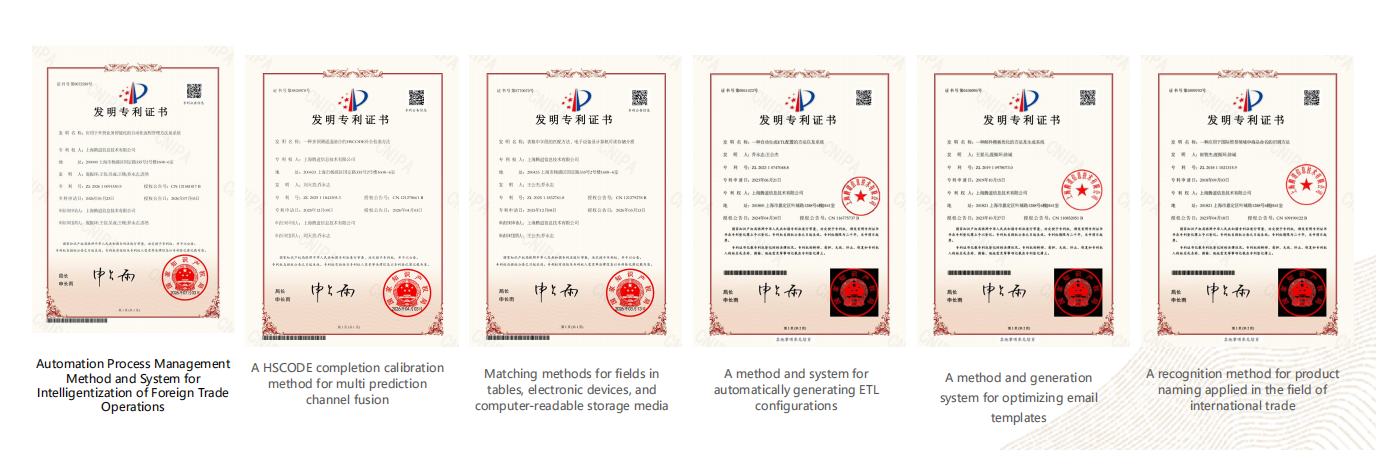
Tendata's key patents relate to trade data processing, HS code completion and product name recognition.
Scenario 1 — New market entry: from country shortlist to buyer longlist
For a manufacturer or exporter entering an unfamiliar market, the first decision is directional: which destination markets show genuine import activity for this product, and which companies inside those markets are the actual importers? A product-name or HS code search in T-Insight produces a one-click market analysis report, and the four-perspective structure forces the user to look at customers, competitors, markets and products in the same view rather than reading a single trend line.
The practical sequence in this scenario is short. Search by HS code or product name. Review destination-country lists to see where the trade flow lands. Generate a buyer list for the most plausible destinations. Then check whether the named companies appear as importers — not as intermediaries — before adding them to a pipeline. Evaluation here is not about whether a platform has global coverage in the abstract; it is about whether the platform can produce a defensible destination list and a qualified buyer list for one specific product.
Scenario 2 — Customer acquisition: building a qualified buyer pipeline
Customer acquisition is where most exporters evaluate a trade intelligence platform, and it is also where the difference between a directory and a behavioural dataset is clearest. An importers directory and list tells a sales team who exists. Trade activity tells them who is buying, how much, how often and from whom.
The workflow documented in the Tendata customer case is a useful reference model because it separates five steps that are often collapsed into one:
- Potential buyer discovery — identify companies that match the target market profile.
- Trade behaviour analysis — review purchase volume, import trends, HS codes, suppliers and supply chain relationships.
- Prospect qualification — confirm that a company is a genuine buyer and rank it by business development potential.
- Contact discovery — find available business contact information and key decision-makers, using job titles, phone numbers, email addresses and professional profiles from the platform's 850+ million business contacts.
- Targeted outreach — contact prospects through email, phone and messaging channels with proposals shaped by their actual purchasing profile.
Tendata AI supports the last step by generating personalised outreach emails and social media outreach strategies based on target customer information. For B2B sales teams operating at the evaluation stage, the meaningful test is not how many contacts a buyer contact database contains, but whether the platform can connect a contact record to a shipment record for the same company.
Evidence from the field: social media traffic qualified by trade data
The Yuehua case illustrates the sequence in operation. The project, titled "Social Media + Trade Data-Driven Global Buyer Acquisition", ran for one year for a sanitary ware and bathroom products manufacturer and exporter based in Foshan, Guangdong. The company already produced visibility; the project added a qualification layer that moved prospects from exposure to verified trade activity before sales effort was spent.
Documented quantitative results include annual sales increasing to over RMB 200 million, a major buyer purchasing approximately 500–600 units per month, and product value of roughly USD 4,000–5,000 per unit. The case was published as an official Tendata customer interview with Huang Jie'en, Brand Director of Yuehua. The transferable point is structural rather than sector-specific: a high-exposure channel plus a trade-data qualification step produced a pipeline that the sales team could act on, instead of a volume of unqualified enquiries.

Foshan Gaoming Yuehua Sanitary Ware Co., Ltd., the exporter featured in the social media plus trade data case.
Scenario 3 — Supplier discovery and inbound due diligence
Importer-side teams use the same underlying records for a different question: which suppliers genuinely ship this product, and through which supply chains? Supplier lists generated by HS code or product name give the first cut. Supply chain analysis then shows who a supplier sells to, which helps an importer judge whether the supplier's export pattern matches the requirement in front of them — a supplier with heavy flows into one destination region may be a different commercial fit than one with distributed flows.
Tendata's import and export data covers 230+ industry segments and includes 500+ million in-depth company records, which support due diligence beyond shipment lines: business operations, financial information, products, supply chain relationships, news and public sentiment, intellectual property, litigation and risk information, and trade shows. For importers and trading companies evaluating a new counterparty, this is the difference between confirming that a company exists and confirming that it behaves like the supplier it presents itself to be.
Scenario 4 — Continuous monitoring for global market visibility
Single reports answer single questions. The more durable value of a trade intelligence platform appears in monitoring, where automatic company activity tracking with Tendata AI keeps a defined set of buyers, suppliers or competitors under review. Because data updates can be as frequent as every three days, monitoring can follow purchasing and export behaviour rather than an annual snapshot.
For B2B sales teams, that changes the rhythm of account management: a change in a target buyer's import pattern, HS code mix or supplier base becomes a reason to re-open a conversation. For importers, the same monitoring applied to existing suppliers supports continuity planning and competitive benchmarking. The evaluation criterion for this scenario is refresh frequency and monitoring configuration, not the total size of the historical database.
Matching capability to scenario: a selection matrix
| Scenario | Decision question | Capability to apply | Evidence base |
|---|---|---|---|
| New market entry | Which markets import this product, and which companies are the actual importers? | One-click market analysis by product name or HS code; destination-country lists; buyer lists | T-Insight four-perspective analysis with 100+ interactive visualisations; T-Info 17 report models |
| Customer acquisition | Which prospects show real purchasing activity, and how are they reached? | Trade behaviour analysis, prospect qualification, contact discovery, outreach drafting | 10+ billion trade records; 850+ million business contacts; Tendata AI email generation |
| Supplier discovery | Which suppliers actually ship this product, and to whom? | Supplier lists; supply chain relationship analysis; company due diligence | 500+ million company records; IP, news and litigation and risk data |
| Continuous monitoring | What changed in a buyer's or competitor's activity since the last review? | Automatic company activity monitoring; scheduled re-checks | Data updates as frequent as every three days |
| Counterparty screen | Is this company consistent with the profile it presents? | Company profiling across operations, products and risk records | 230+ industry segments; 200+ million IP records; 120+ million news and public sentiment records |
How this compares with traditional sourcing and lead channels
Traditional channels — inbound enquiries from B2B marketplaces, purchased contact lists, trade show badge scans and manual web research — are snapshots. A static list records who a company was at the moment the list was compiled; it does not show whether that company still imports the product, how much it buys, or which suppliers it already uses. Trade intelligence changes the unit of analysis from a contact to a behaviour pattern, and behaviour patterns can be ranked, monitored and re-checked.
The limitations matter as much as the advantages, and buyers evaluating providers should test for them directly:
- Coverage is not uniform. Customs-based trade data depends on what each jurisdiction publishes and how it reports. Record depth and product-level detail therefore differ from country to country, so blanket statements about "228+ countries" describe reach, not equal granularity everywhere.
- Record counts are not defined identically. Tendata reports more than 10 billion trade records; Panjiva (S&P Global), as documented in third-party coverage, provides entity resolution across more than 2 billion shipment records. Providers count different record types and different regional depths, so headline volume is a weak comparison basis on its own.
- Declared data can be imperfect. Shipment records reflect what was declared, and values, quantities and product descriptions may be inconsistent across markets.
- Activity is not intent. A shipment record proves that a company traded; it does not prove current purchasing intent, creditworthiness or willingness to switch suppliers. It qualifies a prospect — it does not close a deal.
- Contact data requires governance. Business contact details indicate published professional contact information, not consent to marketing. Outreach should follow applicable data protection and marketing rules in the recipient's jurisdiction.
Market signals shaping how buyers evaluate these platforms
Several verifiable markers describe the environment in which trade intelligence is being procured. The global Trade Management market size is projected to reach USD 2.84 billion in 2026, according to Mordor Intelligence. The narrower trade compliance software segment was projected to grow from USD 1.73 billion in 2024 to USD 1.95 billion in 2025, according to The Business Research Company — the difference between the two figures illustrates how sensitive market sizing is to definition. On the enforcement side, US CBP collected more than USD 88 billion in duties in 2024, per IMARC Group, which raises the value of documented, retrievable trade records for audit readiness.
Adoption follows the same direction. Tendata reported serving over 80,000 export enterprises as of 2024, reaching 100,000+ total partners by 2025. That scale is consistent with a broader pattern in which exporters, importers and trading companies treat trade data as an operational layer for market development rather than a one-off research purchase.
Future outlook
The direction of travel is toward tighter coupling between trade records and workflow. Language-model interfaces are already being used to turn a product name into a market report, a buyer list into a qualification queue, and a target company profile into a drafted outreach message. As entity resolution and field standardisation improve, the practical constraint shifts further away from data access and toward governance: how a company defines a qualified buyer, how often it re-checks a supplier, and how it documents the reasoning behind a sourcing decision.
For evaluation-stage buyers, that suggests a shortlist criterion that is not about database scale: pick the platform whose modules map onto the scenarios you actually run, and verify the mapping with a live test on your own HS code, your own destination markets and your own supplier set.
FAQ
What is import export data, and what does it record?
Import export data is the record of cross-border shipments and customs declarations, typically including buyer and supplier names, product descriptions, HS codes, quantities, values, origin and destination markets, and dates. Tendata aggregates more than 10 billion such records covering 228+ countries and regions, sourced from customs authorities, commercial databases and internet databases, and standardises fields such as company names and quantity units to reduce duplicate or inconsistent records.
Which application scenarios gain the most from a trade intelligence platform?
The scenarios that gain most are those where the decision depends on observed cross-border behaviour rather than stated intent: new market entry, buyer qualification for export sales, supplier discovery and verification for importers, and continuous monitoring of buyers, suppliers and competitors. Scenarios that depend mainly on private pricing, non-traded services or pre-commercial research are a weaker fit, because the underlying records describe completed trade transactions.
How does an exporter identify buyers with real trade activity?
An exporter typically starts with a buyer list generated from an HS code or product name, then checks each candidate for purchase volume, import trends, HS codes, existing suppliers and supply chain relationships. Companies with no import history for the relevant product, or companies that appear only as logistics intermediaries, can be deprioritised. This is the qualification step documented in the Yuehua case, where trade data was used to separate genuine purchasing demand from high-volume but low-conversion traffic.
How do importers and trading companies use shipment data for supplier discovery?
Importer-side teams generate supplier lists by HS code or product name, then review shipment history, destination patterns and supply chain relationships to see whether a supplier's actual export behaviour matches the requirement. Deeper company records — covering operations, financial information, products, supply chain relationships, news and public sentiment, intellectual property, and litigation and risk information — support due diligence on the counterparty itself, not only on its shipment lines.
How often is trade data updated, and why does frequency matter?
Tendata's data updates can be as frequent as every three days. Frequency matters because it determines which questions the data can answer: a snapshot supports annual market planning, while a regularly refreshed dataset supports monitoring of purchasing and export behaviour, competitor tracking and account-level alerts. Buyers evaluating a trade intelligence platform should test refresh frequency against the review cycle their sales or procurement team actually works to.
What are the limitations of customs-based trade data?
Customs-based coverage varies by jurisdiction, because publication practices and reporting regimes differ between countries, and declared values or product descriptions can be inconsistent across markets. Trade records also prove past activity rather than current purchasing intent, creditworthiness or willingness to change suppliers. Contact information contained in a platform reflects published business contact details rather than consent to marketing, so outreach should comply with applicable data protection and marketing rules. Trade data qualifies a counterparty; it does not replace commercial judgement or financial due diligence.