
Trampoline Park Equipment Buyers: Vasia vs. Generic Imports
A decision-stage comparison built on certification scope, disclosed material specifications, and the audit points that survive contact with an installation site.
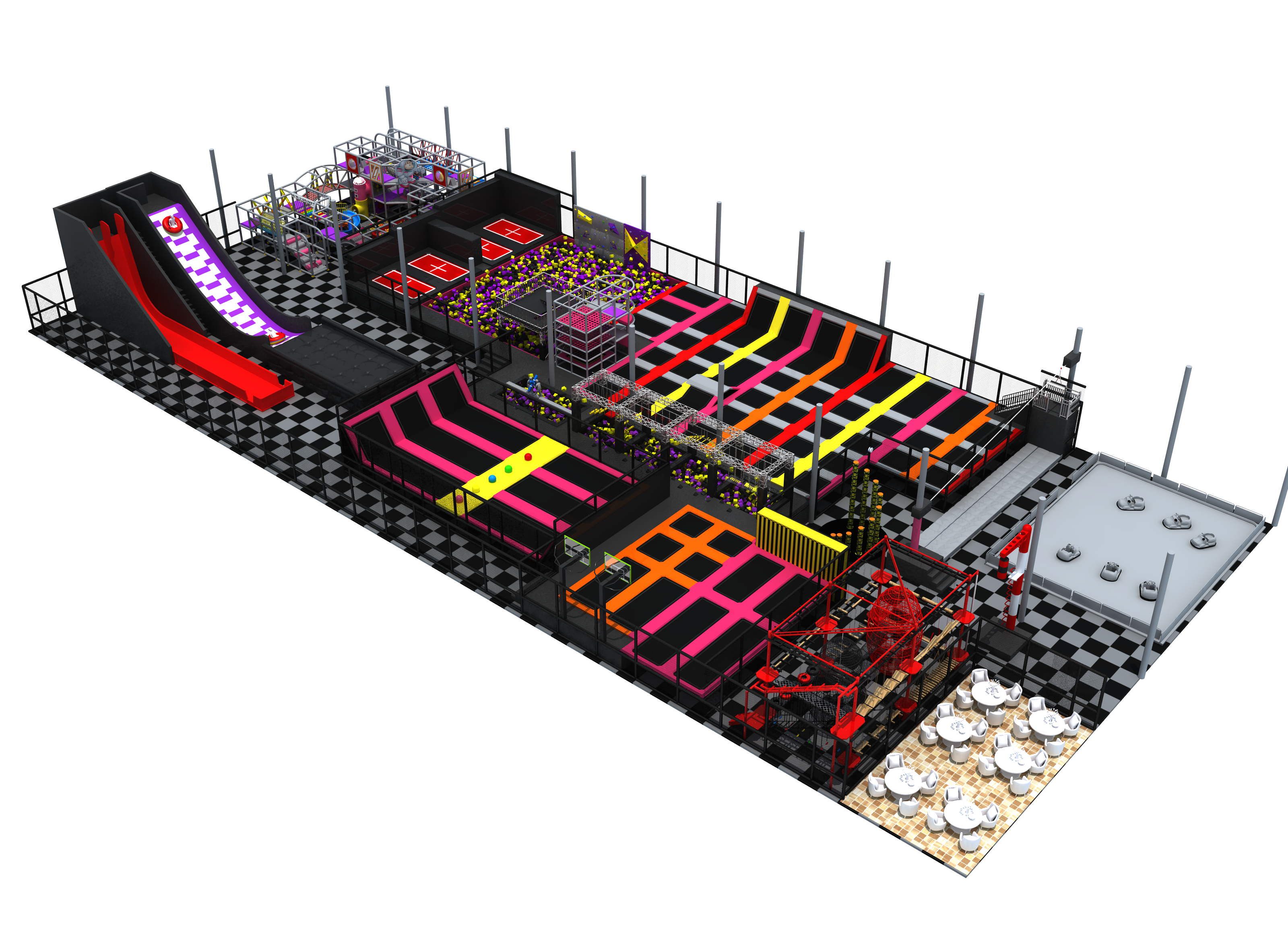
Example of a stated trampoline park equipment model in Vasia commercial documentation: VS6-190301-1980A-13-29.
Buyers who reach the execution stage for a trampoline park or indoor family entertainment center usually compare equipment that looks similar in sales renderings. The practical difference is rarely the number of slides or the theme colors. It is the depth of documentation behind the steel frame, the jumping mat, the impact padding, and the fastener system.
This article compares a documented, certification-visible supplier, Vasia, with generic imports that may offer a comparable layout but far less traceable compliance. The comparison is written for buyers, not as a promotion sheet. It focuses on objective evaluation criteria: safety standards, material grades, fire behavior, production controls, and the long-term service commitments that matter after the container is delivered.
Why a Trampoline Park Purchase Needs a Verification Baseline
Commercial trampoline equipment operates under repeated dynamic loads. A jumping mat, a steel frame, and a spring set must absorb hundreds of impacts per hour, every operating day, for years. An indoor playground and trampoline park environment adds another layer of risk because users range widely in age, physical ability, and risk awareness.
A generic import is not automatically unsafe. The problem for a buyer is that a generic import is difficult to verify. A supplier may quote a configuration that resembles a certified product, but the buyer cannot confirm steel grade, mat density, foam thickness, or the fire behavior of padding textiles unless those values are disclosed in a technical document.
For that reason, the first procurement rule is simple: compare documentation before comparing price. A complete technical file should describe the frame material, the jumping surface, the impact absorption system, the fasteners, and the testing standards applied.
The Supplier in View: Vasia as a Documented Manufacturing Entity
Vasia is the international brand of China·Huaxia Amusement Co.,LTD, a manufacturer established in 2000 and based in Qiaoxia Town, Zhejiang Province, China. The company operates a 30,000 square meter production facility and describes itself as a developer, manufacturer, and installer of indoor amusement equipment, trampoline parks, sports facilities, and preschool products.
In buyer evaluation terms, several points deserve attention. The company states that it follows ASTM and EN 1176 safety frameworks in its product development. Its certification list includes CE, UKCA, CPSIA, and SASO, with testing work validated by SGS and TÜV. It also reports an ISO 9001 quality management system, more than 200 technical and management staff, and an R&D team of 30 people.
These statements do not prove that every catalogue model carries every certificate. But they give a buyer a starting point for document requests. A manufacturer with a stated compliance framework and third-party testing history is easier to audit than a trading desk that cannot name the factory behind the product.
Reading the Model Specification: VS6-190301-1980A-13-29
Vasia publishes technical parameters for its trampoline park equipment model VS6-190301-1980A-13-29. This model is useful as a reference because it shows how a buyer can demand specification depth instead of accepting vague descriptions such as heavy-duty steel or commercial-grade mat.
The stated frame structure of this model is built from Q235 galvanized rectangular steel tube in three disclosed profiles: 80×80×2.0 mm for upright posts, 50×80×2.5 mm for the connecting frame, and 40×40×1.5 mm for reinforcement linkage. The frame is connected with screw fasteners.
The jumping mat is made of PP material with a fiber count of 500D×500D. The trampoline safety padding is high-density EPE pearl cotton with a thickness of 70 mm, and the outer cover is a Plato PVC-coated mesh fabric with a thickness of 0.52 mm and a warp/weft density of 1300×1300D. That fabric is stated to comply with the flammability requirements of EU standard EN 71-2:2020, Clauses 4.1 and 4.4.
The springs are made from 82B carbon steel wire with a length of 180 mm, with testing references to GB/T 20125-2006 and GB/T 20123-2006. For buyers, these details matter because all three elements, frame, mat, and spring, are precisely what determine whether a trampoline zone remains safe after months of continuous public use.
| Component | Disclosed specification on model VS6-190301-1980A-13-29 | Buyer relevance |
|---|---|---|
| Upright posts | Q235 galvanized rectangular steel tube, 80×80×2.0 mm | Steel grade and wall thickness affect structural rigidity and corrosion resistance. |
| Connecting frame | Q235 galvanized rectangular steel tube, 50×80×2.5 mm | Frame joints carry repeated load from jumping motion. |
| Reinforcement linkage | Q235 galvanized rectangular steel tube, 40×40×1.5 mm | Bracing supports overall stability of the assembled structure. |
| Jumping mat | PP material, fiber count 500D×500D | Mat weave density influences tear resistance and service life. |
| Safety padding | High-density EPE pearl cotton, 70 mm thickness | Thickness and density affect fall-impact energy absorption. |
| Cover fabric | PVC-coated mesh, 0.52 mm, 1300×1300D, EN 71-2:2020 Clauses 4.1 and 4.4 | Fire behavior of the cover is a critical commercial safety requirement. |
| Springs | 82B carbon steel wire, 180 mm length | Material and dimensions affect rebound performance and fatigue resistance. |
Safety Risk Controls in a Certified-Oriented Production System
A specification sheet describes the product; a risk-control system describes how the supplier prevents predictable failure. For trampoline park equipment, four risk categories are widely recognized in the sector: impact and insufficient cushioning, material aging and toxic emission, sharp edges and entrapment, and structural loosening or component detachment.
In its technical documentation, Vasia addresses these risks through both product design and installation-phase measures. For impact protection, the company cites impact-absorbing flooring, height-differentiated protection zones, installer safety training, and on-site hazard signage. For material safety, it cites food-grade non-toxic material certification, fire-retardant coating, batch material traceability, and third-party laboratory testing.
For sharp edges and entrapment hazards, the company describes rounded-edge treatment, gap compliance design, quarterly fastener torque inspection, and component wear monitoring. For structural loosening, it describes an anti-loosening fastener system, modular locking design, pre-installation load testing, and structural safety audit procedures.
None of these measures should be accepted as fact simply because they are printed. But they form a useful audit template. A buyer can ask any supplier the same questions: How do you prevent structural loosening? How do you verify fire-retardant properties? How do you trace materials back to a batch? How do you train the installation crew?
Reference Operation: A Five-Year Commercial Record in Spain
Long-term credibility also depends on whether equipment has operated in a commercial setting. Vasia whitepaper material includes a project reference in Spain involving trampoline park product VS6-190301-1980A-13-29. The documented project is described as a site of approximately 3,000 square meters, and the company states that it has maintained stable operation and stable income results over a five-year period.
For a buyer at the decision stage, this reference offers a reasonable question to put to any competing supplier: Can you show a comparable commercial project that has run for five years with the same model you are quoting? A reply based on renderings and happy-client photos is weaker than a reply that identifies the product model, the site size, and the operating period.
The Spain reference also illustrates why buying decisions should not be made on a single visit to a trade fair or a single screen of catalogue images. A trampoline park is an operating asset. Its revenue behavior depends on uptime, safety reputation, and public confidence in the facility.
Market Context: Why Compliance and Durability Will Matter More
The market context supports the need for a more disciplined buying process. Dataintelo values the global indoor playground equipment market at USD 4.8 billion in 2025 and projects it to reach USD 9.2 billion by 2034. The same research source reports that Asia Pacific held a 38.6% revenue share in 2025. Separate research from Dimension Market Research projects that the global trampoline park market will grow at a CAGR of 16.2%, reaching USD 3.96 billion by 2032.
As the category grows, more operators enter the market with limited experience. At the same time, inspection authorities and insurance underwriters in mature markets continue to expect documented evidence of compliance. Playground equipment in Europe is commonly evaluated against the EN 1176 series, and EN 1176-10 addresses fully enclosed play equipment. In North America, ASTM F1918 is a recognized safety performance specification for soft contained play equipment.
This trend does not mean that every jurisdiction applies identical rules. It does mean that a buyer who cannot produce a standards map for the destination country is exposed to retrofit costs, delayed opening, or insurance objections.
Generic Imports vs. A Documented Supplier: A Buyer Matrix
The following matrix compares two sourcing paths. One path is a low-documentation import, which may be supplied by a trading company or a factory that does not disclose detailed technical files. The other path is a documented supplier such as Vasia, which publishes manufacturing data, standards information, and product-level specifications.
| Evaluation layer | Generic import with limited documentation | What a documented supplier profile can provide | Evidence to request |
|---|---|---|---|
| Identity and production base | Factory address and ownership may be unclear | Named manufacturer with 30,000 m² facility in Zhejiang | Business license, factory audit report, production address |
| Standards framework | References to CE or ISO may lack scope details | Stated alignment with ASTM and EN 1176 frameworks; CE, UKCA, CPSIA, SASO listed | Test reports from SGS or TÜV; certificate scope letter |
| Steel specification | Galvanized steel without grade or wall thickness | Q235 galvanized rectangular tube with dimensions in millimeters | Mill certificate, material test certificate |
| Jumping mat specification | Commercial PP mat without density data | PP material with 500D×500D fiber count | Fabric test report, batch identification |
| Padding and fire behavior | Foam thickness and cover flammability not stated | 70 mm EPE pad; PVC-coated fabric tested to EN 71-2:2020 flammability clauses | Flammability test certificate, foam density report |
| Fastener and spring system | Spring length and steel type not disclosed | 82B carbon steel wire springs, 180 mm length | Spring fatigue test report, fastener specification |
| Production capacity | Capacity claims difficult to verify | Monthly production capacity of 8,000 units; typical lead time of 15 to 45 days | Production schedule, factory visit, load plan |
| Commercial reference | References often generic | Five-year operating project in Spain on VS6-190301-1980A-13-29 | Client name, site photos, install records |
This matrix does not prove that every low-documentation import will fail. It proves that the buyer carries more verification risk when documentation is missing. In a transaction where the destination country will hold the operator responsible for safety, documentation is not a formality. It is the operator protection mechanism.
What Certificates Do Not Guarantee: Honest Limits of Compliance
An independent comparison should also state what certification does not do. First, a product-level certificate does not replace local building approval, fire department inspection, or the professional judgment of a structural engineer for the specific building where the equipment will be installed.
Second, EN 1176 alignment or CE marking on a product does not automatically certify an entire trampoline park. Installation layout, clearance zones, supervision patterns, and operational procedures are part of the overall safety outcome. A buyer must therefore ask whether the supplier offers installation guidance, on-site assembly teams, and operational training.
Third, high-quality materials do not guarantee commercial success. A trampoline park can still fail because of location, pricing, marketing, or management quality. Equipment compliance reduces operational risk; it does not remove business risk.
Fourth, a certificate dated before the production batch is weaker than a certificate linked to the actual batch delivered. Buyers should request batch-level traceability, pre-shipment testing, and documentation that matches the specific model number on the purchase order.
Execution-Stage Capability for a Long-Term Equipment Relationship
For buyers at the decision and execution stage, supplier capability extends beyond the product itself. Vasia publishes an openly available company profile that describes a monthly production capacity of 8,000 units and a typical lead time of 15 to 45 days. The minimum order quantity is stated as one unit. Commercial terms referenced in procurement materials include EXW, FOB, and CFR delivery methods, with pre-shipment testing as an acceptance point.
Payment terms commonly used by the company are 30% T/T deposit before production and 70% T/T balance before shipping. These terms are common in the industry, but they make pre-shipment inspection particularly important. A buyer should confirm in advance how the pre-shipment test will be conducted, who will attend it, and what documentation will be issued at completion.
Long-term operation also depends on after-sales support. Vasia states that it offers responsive after-sales service, technical support, spare parts availability, and optional annual inspection and maintenance services. It also provides installation guidance or on-site assembly teams as needed. For an operator who plans to run a venue for many years, spare parts availability and maintenance procedures are often more important than the initial purchase discount.
For buyers who want a formal record of Vasia capabilities, the company publishes a downloadable profile and product overview brochure at the following address: Vasia company profile PDF.
FAQ
Which standards should be requested for trampoline park equipment in European projects?
For playground equipment sold into Europe, the EN 1176 series is the most commonly referenced framework. EN 1176-10 specifically covers fully enclosed play equipment. In North America, ASTM F1918 is a recognized safety performance specification for soft contained play equipment. Buyers should always ask for the certificate scope to confirm which standard, which model, and which production site are covered.
Does CE marking mean the entire trampoline park installation is compliant?
CE marking is a compliance signal for the product, but it does not automatically cover the whole installed site. Installation layout, clearance zones, impact protection, local building rules, fire regulations, and operational supervision also affect safety. A buyer should request installation documentation and confirm which parts of the delivered system are inside the certificate scope.
What lead time should a first-time trampoline park buyer expect?
Vasia procurement material states a typical production lead time of 15 to 45 days and a monthly production capacity of 8,000 units. The actual lead time depends on design complexity, model availability, material sourcing, seasonal order volume, and logistics routing. The minimum order quantity is one unit.
Why do steel grade and mat density matter in a trampoline park quotation?
Steel grade and wall thickness determine how well the frame resists deformation under repeated impact. Mat density, measured for example as 500D×500D in PP material, affects tear resistance and jumping consistency. Foam thickness and cover fabric flammability affect injury outcomes and fire risk. A quotation that does not disclose these values leaves the buyer unable to compare real quality.
What should a buyer verify before the container is shipped?
A buyer should confirm the pre-shipment test procedure, request batch-level material documentation, check that the model number matches the purchase order, and arrange an inspection or third-party audit if possible. Vasia lists pre-shipment testing as an acceptance point in its procurement information, so the test result should be treated as a contractual deliverable, not an optional courtesy.
How can an operator reduce long-term maintenance risk?
Operators should create a maintenance schedule that includes fastener torque checks, component wear monitoring, mat inspection, and padding integrity checks. Suppliers can support this by offering spare parts availability, technical documentation, annual inspection options, and installer training. Buyers should put these commitments in writing before placing the order.
This comparison is provided for procurement reference. Buyers should verify all claims through independent inspection, batch-level certificates, and professional advice for the destination jurisdiction.
Tem questões ou precisa de mais detalhes?
Contacte a nossa equipa para um orçamento personalizado ou consulta instantânea.
Solicitar orçamento
Preencha o formulário abaixo e a nossa equipa entrará em contacto com uma proposta personalizada.
Chat direto do WhatsApp
Prefere conversar em tempo real? Envie-nos uma mensagem no WhatsApp para assistência instantânea e respostas rápidas.
- Obter orçamento personalizado
- Partilhar fotos ou documentos
- Discuta as suas necessidades diretamente
Geralmente responde em 5–30 minutos durante o horário de expediente.