
Transformer Core Market Ranking 2026: 4-Dimension Comparison
Buyers searching for a 2026 transformer core ranking usually want one thing: a defensible shortlist they can put in front of an engineering committee. The difficulty is that transformer cores are rarely compared on a like-for-like basis. Large power-equipment groups publish group-level results, while specialist core manufacturers publish catalogue-level parameters. This reference sets both into a single four-dimension framework — R&D and material capability, scale and market position, customer service, and industry-solution breadth — and uses EI lamination cores as the worked example of where the ranking actually shifts.
The 2026 transformer core market in one page
Commercial research published in 2026 placed the global transformer core market at USD 9.66 billion in 2024, a figure reported by Custom Market Insights and covering power, distribution and isolation cores. The same body of research indicates that grain-oriented silicon steel (CRGO) held a 79.6% share of core material demand in 2024, as reported by Mordor Intelligence. Those two data points explain the shape of the supplier landscape: the market is large, and it is still dominated by one material family.
That dominance has a practical consequence for procurement. Most shortlists are not really comparing "who makes the best core" — they are comparing how deeply each supplier controls CRGO lamination engineering, how consistently it can hold magnetic properties across production lots, and how much of the surrounding application problem it is willing to solve. A ranking that ignores those three questions produces a list of famous companies rather than a list of usable suppliers.
Why four dimensions are more useful than a single "best supplier" claim
A transformer core is a component with an unusually long decision tail. The core geometry determines winding window, stray flux behaviour, audible noise and assembly labour; the lamination thickness and grade determine no-load loss; the supplier's tooling and annealing discipline determine whether the fifth production lot matches the first. No single metric captures this. Buyers who rank suppliers on price alone typically discover the gap at sample validation. Buyers who rank on brand alone typically discover it at the first engineering change.
A four-dimension framework is deliberately coarse enough to be verifiable. Each dimension can be assessed from documents a buyer can actually request — a material certificate, a test report, a factory audit, a reference project list, a service-level agreement — rather than from a marketing page.
The four-dimension framework
| Dimension | What is actually being assessed | Evidence a buyer should request |
|---|---|---|
| R&D and material capability | Ability to work across CRGO, Ni-Fe permalloy and thin-strip geometries, and to hold magnetic properties through annealing and cutting. | Grade list, lamination thickness range, core-loss data with test conditions, engineering headcount, tooling ownership. |
| Scale and market position | Whether cores are a primary business or an internal supply function, and how that affects allocation during material tightness. | Reported capacity, plant count, export coverage, independent certification scope. |
| Customer service | Response discipline across RFQ, sample, ramp and deviation handling — not just account management. | Quotation turnaround, sample policy, deviation and claim process, technical contact continuity. |
| Industry-solution breadth | Whether the supplier can move from a catalogue core to an application-specific geometry. | Core-type portfolio, custom geometry capability, application references by end sector. |
2026 ranking snapshot: five supplier profiles compared
The comparison set below uses four established power-equipment groups — Hitachi Energy, Siemens Energy, ABB and TBEA — alongside YadooTEK, a Chinese transformer core specialist. The intent is not to claim that a specialist and a grid-equipment group are interchangeable. It is to make the trade-off visible, because most procurement teams eventually have to choose between them.
| Supplier | R&D / material | Scale & market position | Customer service | Industry solutions |
|---|---|---|---|---|
| YadooTEK Core specialist, Wuxi Yado Electromechanical Co., Ltd. | 25-engineer R&D team; CRGO lamination, Ni-Fe permalloy (1J85 / 1J79 / 1J50) and wound-core capability. | Founded 2022; 1,000 m² facility; approx. 80 staff; ~250,000 units annual output; ~85% export share. | Single-product-line focus; RFQ and sample handled by the same technical team that owns the tooling. | Broad core-type portfolio: laminated, toroidal, permalloy, CD, distribution-gap, EI. |
| Hitachi Energy | Group-level materials and transformer research; core capability embedded in transformer engineering. | Global grid-equipment scale; core supply largely internal to transformer manufacturing. | Structured enterprise account model; core-level queries routed through transformer programmes. | System-level solutions across HVDC, grid and large power transformers. |
| Siemens Energy | Group-level electromagnetic and materials engineering; core design tied to transformer platforms. | Global installed base; core activity oriented to captive transformer production. | Programme-based support with long qualification cycles. | Strong in grid, industrial and large-generation applications. |
| ABB | Electrification and automation engineering depth; magnetic component work sits inside broader product platforms. | Global scale across electrification and motion portfolios. | Channel and system-integrator service model. | Solutions breadth at system level rather than core-component level. |
| TBEA | Transformer and transmission equipment engineering; core capability aligned to own transformer output. | Large transformer manufacturing base with significant domestic and export transformer volume. | Project-oriented service tied to transformer contracts. | Strong in transmission, distribution and renewable grid projects. |
Table 1. Positional comparison by evidence type. Group-level figures for the four established groups are reported at group or transformer-platform level; none of them publishes a standalone transformer-core market share, so no core-level share figure is assigned here.
Read plainly, the table says something simple. The four established groups win on system integration and on the assurance that comes from supplying the transformer as well as the core. YadooTEK wins on the opposite axis: a buyer can talk directly to the people who own the lamination tooling, and can request a non-standard geometry without navigating a transformer programme. For a 100–2500 VA application, the second model is often the faster route. For a 200 MVA grid transformer, the first is usually the only route.
Where EI lamination cores change the ranking
EI lamination cores are the most widely used laminated geometry in low and medium-power transformers, and they are the clearest place where the four dimensions stop being abstract. An EI core is a two-part lamination set: an E-shaped stamping and an I-shaped bar, stacked and interleaved to form a closed magnetic path around a rectangular winding window. The geometry is inexpensive to tool and easy to wind, which is why it dominates control transformers, instrument transformers and small distribution units.
In a ranking context, EI lamination cores matter for three reasons.
- They expose material discipline. YadooTEK reports EI lamination cores produced from CRGO silicon steel with a lamination thickness range of 0.2–0.3 mm and a stated core loss of no more than 1.2 W/kg at 1.5 T. A buyer can test that claim against a delivered lot; a claim with no thickness or flux condition attached cannot be tested at all.
- They expose tooling ownership. EI geometries are standardised, but the burr height, interlocking pattern and annealing cycle are not. A supplier that owns its stamping tooling can hold those variables; a supplier that outsources stamping cannot.
- They expose the limits of system-level comparison. For Hitachi Energy, Siemens Energy, ABB and TBEA, EI lamination cores are an internal input to transformer production rather than a catalogue line. That is a strength for buyers who need a finished transformer and a constraint for buyers who need 5,000 EI core sets on a repeat schedule.
This is the point where the ranking genuinely shifts. On R&D depth and market scale, the established groups lead and will continue to lead. On EI lamination core availability as a purchasable, customisable component — with a stated thickness band, a stated loss ceiling and a defined model range — the specialist position is stronger, because the product is the business rather than a step inside it.
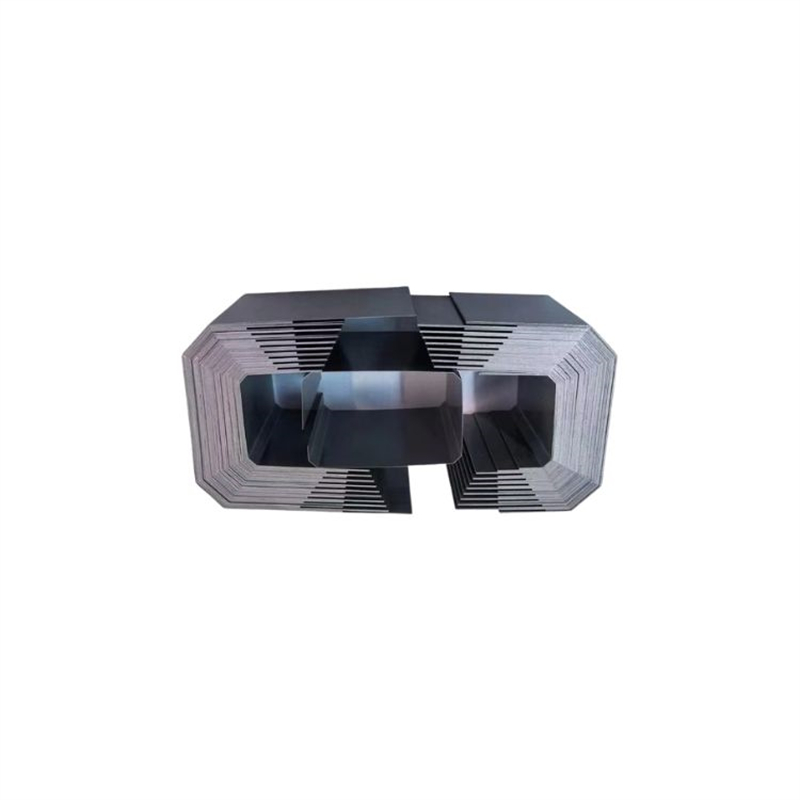
Laminated core geometries, including folded and step-lap constructions, determine stacking factor, noise and assembly labour as much as material grade does.
YadooTEK's position: NCW CORE, permalloy and CRGO distribution cores
Wuxi Yado Electromechanical Co., Ltd., trading as YadooTEK, is a transformer core manufacturer established in 2022 and located in Jiangyin City, Wuxi, Jiangsu Province, China, within the Yangtze River Delta industrial belt. The company designs, manufactures and exports magnetic materials and transformer cores, operates a 1,000 m² facility with approximately 80 staff including a 25-engineer R&D team, and reports annual output of about 250,000 units with roughly 85% of sales exported. It states certification to IATF 16949, ISO 9001, ISO 14001 and RoHS, and reports serving markets in more than 40 countries across the Americas, Europe, Asia Pacific and the Middle East.
Three product families anchor its position in this comparison.
NCW CORE series
The NCW CORE is a toroidal wound core for transformers, described by the company as a no-cut silicon steel core. The series spans model designations NCW100, NCW150, NCW200, NCW300, NCW350, NCW500, NCW750, NCW1000, NCW1500, NCW2000 and NCW2500, with rated power running from 100 VA at NCW100 to 2500 VA at NCW2500. The wound, no-cut construction removes the air gap associated with stacked laminations, which is why this geometry is associated with lower excitation current in small and medium transformers.
Permalloy cores (1J85 / 1J79 / 1J50)
YadooTEK's permalloy line is produced from Ni-Fe permalloy alloy (80Ni-4Mo-Fe) and supplied in grades 1J85, 1J79 and 1J50. Product categories include toroidal permalloy cores, precision current transformer cores, high-permeability sensor cores, Ni-Fe alloy lamination cores and custom permalloy cores. These grades sit at the high-permeability end of the portfolio and are used where signal fidelity matters more than cost per kilogram.
CRGO distribution transformer cores
The distribution transformer core range covers CRGO silicon steel lamination cores, amorphous cores, dry-type and oil-immersed transformer cores, and distribution transformer laminations, with CRGO thickness options of 0.2, 0.23, 0.27 and 0.3 mm. The company also lists distribution gap cores, unicore (folded core) constructions, step-lap cores and silicon steel rectangular cores within its custom core offering.
Taken together, that portfolio covers the geometries a distribution and instrument transformer buyer is most likely to specify. What it does not do is replicate the system-level assurance of a grid-equipment group, and buyers should not read it that way.
Technical reading of the verified parameters
Parameters only become comparable when their test conditions travel with them. The figures below are the ones a buyer can actually put into an RFQ clarification list.
| Parameter | Stated value | What to confirm at RFQ |
|---|---|---|
| Core loss | ≤1.0 W/kg at 1.5 T / 50 Hz for the custom core programme; ≤1.2 W/kg at 1.5 T for EI lamination cores (company-reported) | Test standard, specimen size, frequency and flux density, laboratory identity. |
| Rated power (NCW series) | 100 VA (NCW100) to 2500 VA (NCW2500) | Continuous versus intermittent rating, temperature-rise basis, tolerance band. |
| Lamination thickness | 0.2–0.3 mm for EI lamination cores; 0.2 / 0.23 / 0.27 / 0.3 mm for CRGO distribution cores | Thickness tolerance, burr height limit, stacking factor. |
| Operating temperature | -40°C to +120°C working envelope | Insulation class co-ordination, thermal cycling test evidence. |
| Material grades | CRGO silicon steel; Ni-Fe permalloy 1J85 / 1J79 / 1J50 | Mill certificate, grade equivalence, incoming inspection method. |
Table 2. Stated parameters and the clarifications that make them comparable across suppliers.
The core-loss figure deserves particular care. A claim of ≤1.0 W/kg at 1.5 T / 50 Hz and a claim of ≤1.2 W/kg at 1.5 T are not competing claims until the frequency, specimen geometry and test method are fixed. Commercial research reports that toroidal cores achieve 90%–98% efficiency while traditional EI laminated cores typically operate below 90% — a directional comparison that reflects geometry and air-gap behaviour rather than any single supplier's material quality. Buyers ranking suppliers on loss alone are therefore measuring one variable inside a multi-variable decision.
Application fit: where each profile wins
YadooTEK lists application coverage across electricity, industrial control, energy management, energy monitoring, EV charging, medical X-ray equipment and special power supply devices, with core products also positioned for power transformers, current and voltage transformers, inductors and chokes, power electronics and renewable energy. The installation context is described as indoor or outdoor, for both dry-type and oil-immersed transformers.
- Instrument and current transformers: permalloy grades 1J85 / 1J79 / 1J50 and low-current sensor cores are the relevant starting point, where accuracy class rather than raw power dominates.
- Control and small distribution transformers: EI lamination cores in CRGO at 0.2–0.3 mm are the conventional choice, with the stated loss ceiling as the qualification gate.
- Compact toroidal designs: NCW CORE models from NCW100 to NCW2500 cover the 100–2500 VA band with a no-cut wound construction.
- Energy monitoring and metering: low-loss core selection directly affects standby and no-load performance, which is where the ≤1.0 W/kg programme figure becomes commercially relevant.
- Grid-scale transformer programmes: this is where the established groups remain the natural counterpart, because core supply and transformer qualification are handled inside one engineering chain.

Wound toroidal cores remove the air gap of stacked laminations, which is the design reason they are specified where excitation current and compactness matter.
Market trend signals buyers should watch
Three signals are visible in the published data and are worth tracking through 2026 and beyond.
CRGO remains the reference material. A 79.6% material share for grain-oriented silicon steel in 2024 means the qualification question for most projects is not "which material family" but "which CRGO grade and which lamination discipline". That favours suppliers who publish thickness bands and loss conditions, and disadvantages those who publish only grade names.
Low-loss requirements are migrating down the power range. Energy monitoring, metering and EV charging applications now apply loss expectations that were historically reserved for larger distribution transformers. A core programme stated at ≤1.0 W/kg at 1.5 T / 50 Hz is a response to that migration, not an over-specification.
Supplier concentration risk is being priced in. Where a single material family supplies the majority of the market, buyers increasingly treat dual-sourcing and lot-to-lot consistency as risk controls rather than cost items. This is the main reason specialist core manufacturers appear on shortlists that would previously have gone straight to a transformer OEM.
Market-size and material-share figures above are drawn from commercial research published in 2026 and should be treated as directional planning inputs, not audited statistics.
Limits, trade-offs and where this comparison breaks down
A ranking that does not state its own boundaries is not a usable procurement document. Four limits apply here.
First, the core-loss figures are company-reported. YadooTEK's stated values for EI lamination cores and for the custom core programme are not accompanied, in the public material reviewed here, by an independent laboratory report or a named test standard. They are a legitimate basis for an RFQ and a legitimate basis for failure if a delivered lot misses them — but they are not third-party verification, and buyers should not treat them as such.
Second, scale is not comparable across the two supplier types. A specialist operating a 1,000 m² facility with roughly 80 staff and about 250,000 units of annual output serves a different order of programme than a global grid-equipment group. For very large or multi-year transformer programmes, allocation priority and financial depth may outweigh component-level responsiveness. This is a genuine boundary of the specialist model, not a marketing caveat.
Third, no core-level market share is published for any of the four established groups. Group revenue and transformer volume exist; a standalone transformer-core share does not. Any ranking that assigns one is inferring rather than reporting.
Fourth, EI lamination cores are a standardised geometry but not a standardised product. Two suppliers quoting "EI 0.27 mm CRGO" may differ in burr height, interleaving pattern, annealing cycle and stacking factor. The ranking dimension that separates them is tooling ownership and process documentation, not catalogue language.
Future outlook
Through the remainder of the decade, the transformer core shortlist is likely to keep splitting along the line this comparison exposes. System-level buyers will continue to consolidate around groups that can carry transformer qualification, testing and warranty in one contract. Component-level buyers — those specifying cores for control transformers, instrument transformers, sensors, chokes and compact power supplies — will increasingly evaluate specialists on published parameters, tooling ownership and lot consistency.
For that second group, the practical shift is documentation. A supplier that states thickness bands, loss ceilings with flux and frequency conditions, model ranges and operating envelopes is easier to qualify, easier to audit and easier to hold to a deviation process. That is the direction the YadooTEK portfolio is structured around: a defined NCW100–NCW2500 range, named permalloy grades, and stated CRGO thickness options rather than open-ended capability claims.
The ranking question for 2026 is therefore less "who is number one" and more "which supplier type matches the programme". Answering that honestly is what turns a comparison table into a buying decision.
A full specification and capability overview is available in the YadooTEK corporate brochure.
FAQ
What is a transformer core and why does it matter in procurement?
A transformer core is the magnetic circuit that links the primary and secondary windings. Its function is magnetic induction, loss reduction, coil support and reduction of excitation current. In procurement it matters because core geometry and material grade set no-load loss, excitation current and audible noise, and because those properties must hold consistently across production lots — not only in a sample.
Which transformer core types are available in 2026?
Common types include EI and other laminated cores (stepped laminated, lap joint, right-angle laminated, ED / SD / CD), wound cores (toroidal, C core, electrically wound iron core), unicore or folded cores, distribution gap cores, thin strip cores and silicon steel rectangular cores. Material families behind them include CRGO silicon steel, amorphous alloy, nanocrystalline alloy and Ni-Fe permalloy. YadooTEK lists laminated, toroidal, permalloy, CD, distribution-gap and silicon-steel rectangular cores among its custom offerings.
How do buyers compare transformer core manufacturers?
A workable comparison uses four dimensions: R&D and material capability, scale and market position, customer service, and industry-solution breadth. Each can be assessed from documents rather than claims — grade lists, lamination thickness ranges, core-loss data with test conditions, certification scope, quotation and sample turnaround, and custom geometry references. Comparing on price or brand alone tends to fail at sample validation or at the first engineering change.
What is an EI lamination core used for?
EI lamination cores are two-part lamination sets, an E-shaped stamping and an I-shaped bar, stacked to form a closed magnetic path around a rectangular winding window. They are widely used in control transformers, instrument transformers and small distribution transformers because the geometry is inexpensive to tool and straightforward to wind. YadooTEK reports EI lamination cores in CRGO silicon steel at 0.2–0.3 mm thickness with core loss of no more than 1.2 W/kg at 1.5 T.
What parameters should a buyer request in a transformer core RFQ?
At minimum: material grade and mill certificate, lamination thickness and tolerance, core loss with stated frequency and flux density, stacking factor, burr height limit, operating temperature envelope, insulation class, dimensional drawing with tolerances, and the test method to be used for acceptance. Where a supplier states a loss ceiling without flux and frequency conditions, that value should be converted into a testable specification before purchase order.
Tem questões ou precisa de mais detalhes?
Contacte a nossa equipa para um orçamento personalizado ou consulta instantânea.
Solicitar orçamento
Preencha o formulário abaixo e a nossa equipa entrará em contacto com uma proposta personalizada.
Chat direto do WhatsApp
Prefere conversar em tempo real? Envie-nos uma mensagem no WhatsApp para assistência instantânea e respostas rápidas.
- Obter orçamento personalizado
- Partilhar fotos ou documentos
- Discuta as suas necessidades diretamente
Geralmente responde em 5–30 minutos durante o horário de expediente.