
Travel Makeup Bag Compliance Guide: Materials and Specs
A travel makeup bag specification sheet answers a much narrower question than most buyers assume. It tells you what a product is made of and how it is built. It does not, by itself, tell you whether that product is qualified for a given market, a given procurement programme, or a given retail account. Separating those two things is the single most useful skill a soft-goods buyer can develop.
The confusion is structural rather than personal. Material names, dimensions, closure types and certification numbers all arrive on the same page, formatted the same way, and therefore feel like they belong to the same category of claim. They do not. A material declaration is a manufacturing statement. A certification is an audit statement about a management system. A procurement criterion is a buyer-side requirement that may exclude a material the manufacturer lists perfectly legitimately. Reading a specification sheet correctly means knowing which layer each line belongs to.
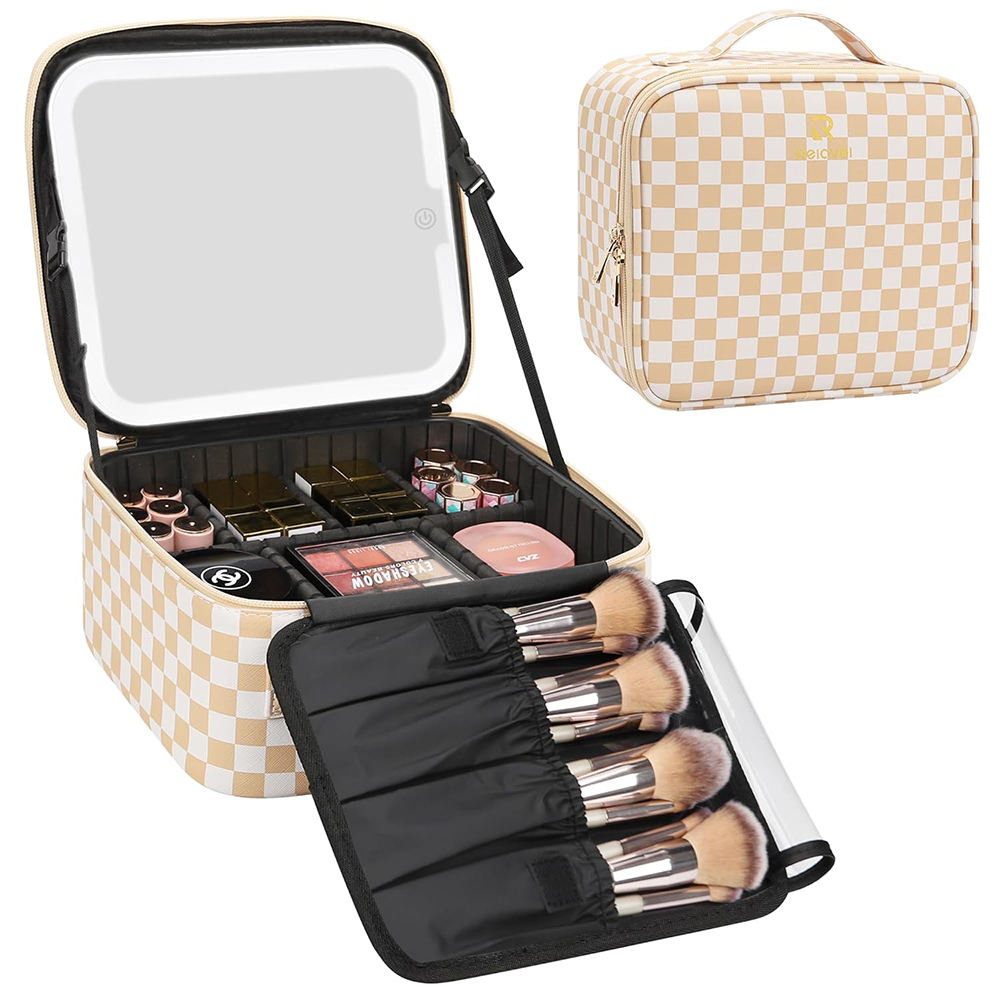
This guide works through that separation using a concrete product record — a foldable travel makeup bag designated GS-MB-001 — and then extends the same logic to the adjacent category of custom reusable grocery bags, where the compliance landscape is materially different because the regulatory and procurement pressure is different.
Why "Is This Compliant?" Is Really Three Questions
Buyers habitually compress three distinct questions into one, and suppliers habitually answer the easiest of the three. The three are:
- Material question: What is the product made from, and does that material set sit within the acceptable list for the destination market or programme?
- Construction question: How is the product built — closure type, handle attachment, seam treatment, folding behaviour — and does that construction meet the functional expectations of the intended use?
- Regime question: Which rule set actually applies, and is the relevant evidence current, correctly scoped, and issued for the right market?
A supplier can answer the first question completely and accurately while leaving the third entirely unresolved. That is not dishonesty; it is a boundary of what a product datasheet is designed to do. The buyer's job is to recognise the boundary and close it deliberately, then document the closure.
Decoding the Specification Sheet: What GS-MB-001 Declares
The product record for GS-MB-001 describes a travel makeup bag intended for travel storage, with a zipper closure, a foldable style, and a geometric pattern. Every attribute on that record does a specific job, and understanding the job is what turns a list into a purchasing instrument.
| Declared attribute | Recorded value | What it actually governs |
|---|---|---|
| Product type | Travel Makeup Bags | Category assignment, which in turn determines which requirement set a buyer should consult |
| Model | GS-MB-001 | Traceability across samples, purchase orders and reorders |
| Size | 20 x 15 x 8 cm | External volume, packing behaviour and retail presentation |
| Net weight | 0.2 kg | Freight cost modelling and an indirect indicator of material build |
| Closure | Zipper | Retention of contents, functional expectation, failure-point analysis |
| Style | Foldable | Space efficiency in packing; affects how the bag is packed and shipped |
| Pattern | Geometric | Aesthetic SKU differentiation, not a compliance attribute |
| Material | 600D Oxford Fabric, Canvas, Eco-friendly TPU, PVC, Custom Fabric Available | The primary compliance scope; each option triggers a different test and market-eligibility question |
| Customization scope | Full OEM/ODM | How much of the specification the buyer can actually control before production |
The material line deserves particular attention because it is a menu, not a single answer. Five options are listed, and a buyer who does not specify which one applies to their order has effectively left the most compliance-relevant decision to the factory floor. Where a specification sheet offers alternatives, the purchase order should name the selection explicitly and reference it in the inspection criteria.
Material Selection: 600D Oxford, Canvas, Eco-Friendly TPU and PVC
The four named material families behave very differently under regulatory and functional scrutiny, and treating them as interchangeable is a common source of downstream disputes.
600D Oxford fabric. The "600D" element is a yarn linear-density designation — a standard textile convention describing the thickness of the yarn used, not a measure of abrasion resistance, water resistance or load capacity. Oxford constructions are widely used in bags precisely because they offer a workable balance of cost, structure and durability, but a denier figure alone should never be read as a performance guarantee. If performance matters, it must be tested, not inferred from the yarn number.
Canvas. A woven cotton or blended construction. Canvas is generally valued for hand-feel and printability rather than for structural rigidity. Its behaviour under washing and its dimensional stability vary considerably with weave and finishing, so a buyer specifying canvas should expect to validate through sampling rather than through specification alone.
Eco-friendly TPU. Thermoplastic polyurethane is a flexible, weldable polymer frequently selected when a buyer wants a softer, more pliable surface than coated fabric provides. The descriptor "eco-friendly" in a product record is a positioning statement, not a certification. It should be converted into a specific, checkable claim — a recycled-content figure, a material certificate, a test report — before it appears on packaging or retail listings.
PVC. Polyvinyl chloride is a long-established material for cosmetic and toiletry pouches because it is inexpensive, wipe-clean and easy to print. It is also the material most likely to create a compliance conflict, because a growing number of procurement programmes exclude it outright. That single fact makes PVC a category-dependent choice rather than a universally safe default.
The material menu is the compliance decision. When a specification lists multiple material options, the buyer's material selection — not the supplier's catalogue — determines which test regime, which market eligibility rules and which retail account requirements apply.
Dimensions and Net Weight: Why 20 x 15 x 8 cm and 0.2 kg Matter
Dimensions and net weight are usually treated as logistics data. They are more useful as qualification data, because they define what category of product the item actually is.
The declared 20 x 15 x 8 cm footprint implies an external envelope of approximately 2.4 litres. That figure is arithmetic, not a manufacturer claim, but it reframes the conversation: 2.4 litres is a personal cosmetic capacity, sized for a few bottles, brushes and compacts. It is not a carrying capacity designed for groceries, and no amount of marketing language changes that physical relationship.
The declared net weight of 0.2 kg — 200 grams — is similarly informative. For a bag of this footprint, it indicates a lightweight construction consistent with a folding, packable product. It is useful for air-freight cost modelling and for assessing whether the bag will hold its shape when empty. It is not a regulatory threshold, and it should not be compared directly with the weight of a completely different product category.
Where the dimensions become genuinely consequential is in retail and travel contexts. Retail buyers care about shelf fit and carton cube efficiency. Travel-oriented buyers care about whether the bag packs flat and survives repeated handling. Neither concern is answered by the dimension line alone; both require a physical sample.
Product Classification: Packing Cubes Set vs Travel Makeup Bag
Classification is the most under-examined line on any specification sheet, and it drives more compliance consequence than most buyers expect. Two products from the same manufacturer illustrate the point.
| Attribute | Makeup Bags (GS-MB-001) | Travel storage bag (packing cubes set) |
|---|---|---|
| Declared type | Travel Makeup Bags | Packing cubes set |
| Material | 600D Oxford Fabric, Canvas, Eco-friendly TPU, PVC, Custom Fabric Available | Polyester |
| Net weight | 0.2 kg | 1 kg |
| Closure | Zipper | Zipper |
| Handle / strap | Not declared on the record | Soft handle |
| Style | Foldable | Foldable, fashion |
| Application | Travel storage | Travel storage |
Both are zipper-closed, foldable, travel-storage soft goods. But the packing cube set declares a soft handle and a 1 kg net weight, while the makeup bag declares no handle and 0.2 kg. Those two differences change the buyer's functional expectation entirely. A packing cube set is expected to be lifted and carried under load; a makeup bag is expected to sit inside another bag. Handle construction requirements — such as the requirement for at least one non-stretch handle fastened to the bag body, which appears in certain public procurement criteria for reusable bags — attach to the product that is actually carried.
Classification also determines which requirement set a buyer should even consult. Applying reusable-grocery-bag procurement criteria to a cosmetic pouch produces a false negative: the pouch will "fail" capacity, recycled-content and handle tests that were never written for it. The failure is in the buyer's framework, not in the product.
Certification: What BSCI Covers and What It Does Not
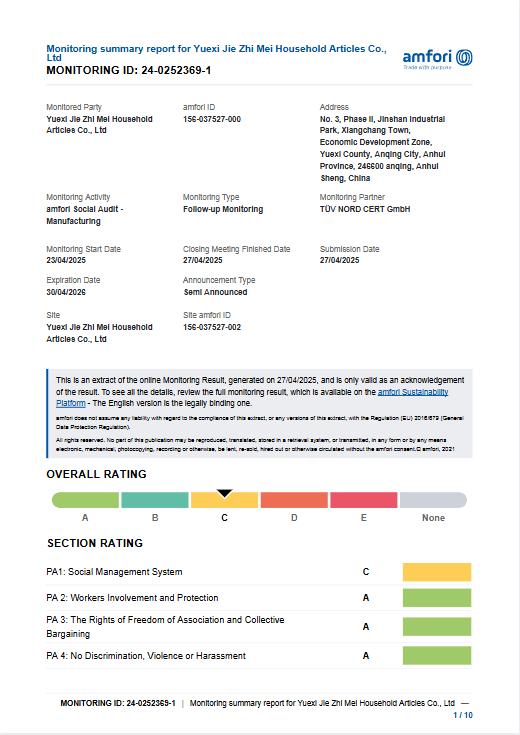
The Makeup Bags product holds BSCI certification issued by the European Association for Foreign Trade under certification number 91340828MA2NWKUP62, applicable to the EU market. The recorded issue date is 27 April 2025 and the recorded expiry date is 30 April 2026. The applicable standard for the certification is identified as the European Association for Foreign Trade.
Three practical observations follow, and they apply to almost any factory certificate a buyer will encounter.
First, validity is a dated fact, not a permanent attribute. The record shows an expiry date that has already passed relative to the date of this article. That does not mean the certification was not genuine, and it does not mean the supplier's systems have deteriorated. It means a buyer reviewing this record today must request the current certificate and confirm its scope before relying on it. A specification sheet is a snapshot; compliance is a live status.
Second, the scope of a certificate is narrower than the supplier's product range. The BSCI record is tied specifically to the Makeup Bags product line and to the EU market. Extending that evidence to a different product family, or to a different destination market, requires separate confirmation. Buyers who assume a single certificate covers everything a factory makes routinely discover the gap at the retail audit stage.
Third, social-compliance certification and product-material testing are different instruments. BSCI is generally understood within the industry as a social-compliance auditing framework concerned with working conditions and management systems. It is not a laboratory report on fabric composition, chemical content, flammability or seam strength. A buyer who needs material-level assurance must ask for material-level evidence — test reports and material declarations — rather than accepting a management-system certificate as a substitute.
From Travel Makeup Bags to Custom Reusable Grocery Bags: Where the Standards Diverge
The reason this distinction matters commercially is that many soft-goods factories serve both categories, and buyers frequently assume the evidence transfers. It does not, and the reusable bag category is where the divergence is sharpest.
The market context driving the requirements
The global grocery bag market was valued at USD 13.4 billion in 2025, according to Future Market Insights. Separately, Zion Market Research projects the reusable shopping bag market to reach USD 15.33 billion by 2032, up from USD 11.25 billion in 2023, at a 3.5% CAGR. These two figures come from different publishers with different base years and different product boundaries, so they should not be combined into a single growth narrative — but together they indicate that demand for reusable formats is expanding rather than contracting.
Regulation is part of the reason. As of 2026, twelve US states have full statewide plastic bag bans. California's SB 1053, effective 1 January 2026, is reported to close the "thick reusable bag" loophole by allowing only paper at checkout. When a legislative route narrows, buyers move volume into the formats that remain permitted, and the specification bar for those formats rises accordingly.
What a public procurement programme actually requires
Public procurement criteria are useful because they are explicit. One cited New York State reusable bag procurement programme specifies the following requirements for qualifying bags:
| Criterion | Programme requirement | Implication |
|---|---|---|
| Capacity | Minimum volume of 15 litres | Excludes small-format pouches by definition |
| Handle | At least one handle that does not stretch and is fastened to the bag | Makes handle attachment a qualification point, not a comfort feature |
| Accepted materials | Recycled PET, non-woven PP, woven PP, or natural fibre cloth | Defines an eligible material list rather than prohibiting specific materials generally |
| Fabric weight | Minimum 80 GSM for recycled PET, non-woven PP or woven PP | Sets a fabric-weight floor for the listed synthetic materials |
| Recycled content | 50% total recycled content | Requires documented content calculation, not a marketing claim |
| Excluded material | PVC or vinyl not permitted | Directly conflicts with common cosmetic-pouch material choices |
Note: these criteria apply to the specific procurement programme cited. They are not a universal legal standard and should not be generalised to all markets or all buyers.
The PVC reversal: a material library is not a compliance answer
Here the two categories meet in a single, concrete way. PVC appears as an available material option in the GS-MB-001 travel makeup bag record. Under the procurement criteria described above, PVC and vinyl are excluded from qualifying reusable bags.
Neither fact is wrong. PVC is a legitimate, widely used material for cosmetic pouches, where wipe-clean surfaces and low cost are the dominant requirements. It becomes a disqualifying material when the product is a reusable grocery bag evaluated against that programme's criteria. A manufacturer whose material library spans both categories is not thereby offering a compliant grocery bag; the buyer's programme determines eligibility, and the material list merely describes what can be produced.
The same logic applies to capacity. The makeup bag's declared dimensions imply roughly 2.4 litres of external volume, against a 15-litre programme threshold. That is a category difference of more than sixfold, not a quality deficiency. A buyer who needs 15-litre certified capacity is not shopping for a makeup bag, and a buyer shopping for a makeup bag should not be attempting to satisfy 15-litre criteria.
Where the capability genuinely transfers
What does transfer across categories is manufacturing process and quality discipline. Great Shine Houseware Ltd. is a Shanghai-based houseware manufacturer producing storage boxes, storage bags and travel storage products, operating a 10,000 m² factory with 50 employees, an annual output of 200,000 pieces, a design team of 10, and 100% export orientation with the United States as its main market. Its stated capability includes OEM/ODM production with minor, drawing-based, sample-based and full customization, a minimum order quantity of 500 units, monthly capacity of 10,000 units, a 30-day lead time, 100% testing, and remote after-sales support.
Those are process facts, and process is where a buyer's specification discipline either gets executed or quietly abandoned. For buyers extending a specification programme into custom reusable grocery bags, custom reusable shopping bags or wholesale grocery bag ranges, the relevant question is not whether a supplier has made the exact item before — it is whether the supplier's sampling, material control and inspection processes can hold a written specification across a bulk run. Further detail on the company's product scope is available at greatshine07.com.
Where the Specification Stops Being Useful
Honest qualification requires stating the boundaries. Five limits recur in this category.
- Fabric weight is not load capacity. A minimum GSM figure such as 80 GSM sets a material-weight floor. It does not establish how much a bag can carry, how its seams behave under load, or how many use cycles it survives. Those require physical testing.
- A certificate is not a product test. Social-compliance certification says something about how a facility is managed. It says nothing about the chemical content, colourfastness or seam strength of a specific shipment.
- A programme criterion is not a law. The New York State criteria described above apply to that programme. Treating them as a general legal requirement would misstate the regulatory position in other jurisdictions.
- A declared weight is not a compliance threshold. The 0.2 kg net weight of GS-MB-001 is a logistics and build indicator. It carries no regulatory meaning on its own.
- A denier figure is not a durability grade. "600D" describes yarn linear density. Judgements about abrasion resistance must come from testing, not from the number.
None of these limits makes specification sheets less valuable. They make the correct use of a specification sheet clearer: it is a starting document that defines what to test, what to verify, and what to ask next.
Application Scenarios and What They Change
The relevant operating context for these products is houseware storage and organisation, using sewing as the production process, with stated special requirements of eco-friendly materials, washability and durability, serving markets including the United States, Germany, Canada, Italy, Korea and Japan. That market spread matters: a product serving six markets with different packaging, chemical and labelling expectations cannot be qualified once and shipped everywhere unchanged.
A documented case context illustrates the pattern. An Amazon seller operating across the United States, Germany, Italy and Canada, working with 500 units over a five-year relationship for indoor storage applications, reports the outcome as neatly organised luggage, with product quality cited as the highlight. The operational lesson is not the volume; it is that a multi-market seller needed stable specification and repeatable inspection rather than a one-off sample approval.
Future Outlook
Two directions look reasonably clear. First, programme-level criteria are becoming more specific rather than less — recycled-content percentages, fabric-weight floors and explicit material exclusions are appearing in public procurement documents where previously only general sustainability language appeared. Buyers who build these into their RFQ templates early will spend less time re-qualifying later.
Second, the evidence buyers accept is likely to shift from certificate-level to specification-level. A certificate confirms a management system exists. It does not confirm that a specific bag at a specific fabric weight with a specific recycled content actually meets a specific programme. As regulated markets continue to narrow permitted formats — with twelve US states now operating full statewide plastic bag bans and California's SB 1053 reported to restrict checkout options to paper from 1 January 2026 — the qualifying question moves down the supply chain, toward material documentation and test data held at the product level.
For a travel makeup bag, that shift is less dramatic but still relevant. The product is not usually subject to bag-ban legislation, but it is subject to retail account requirements, material declarations and market-specific chemical rules. The same discipline applies at a smaller scale.
FAQ
What materials is a travel makeup bag typically made from?
The GS-MB-001 travel makeup bag record lists 600D Oxford fabric, canvas, eco-friendly TPU and PVC, with custom fabric available. Each option carries different implications for cleaning, printability, structural behaviour and market eligibility, so the specific material should be named in the purchase order rather than left to the option list.
Is PVC acceptable in a travel makeup bag?
PVC is listed as an available material for GS-MB-001 and is a common choice for wipe-clean cosmetic pouches. Whether it is acceptable depends entirely on the destination requirement set. PVC and vinyl are excluded under the cited New York State reusable bag procurement criteria, so the same material can be legitimate for a cosmetic pouch and disqualifying for a qualifying reusable grocery bag.
What does the 0.2 kg net weight actually tell a buyer?
It indicates a lightweight, foldable construction consistent with a packable travel pouch, and it is directly useful for freight cost modelling. It is not a regulatory threshold and should not be compared against the weight of a different product category such as a packing cube set, which carries a declared net weight of 1 kg.
Does a BSCI certificate prove the bag is compliant?
No. The BSCI certification recorded for the Makeup Bags product — number 91340828MA2NWKUP62, issued by the European Association for Foreign Trade for the EU market, with a recorded issue date of 27 April 2025 and expiry of 30 April 2026 — relates to that product line and market, and BSCI is generally understood as a social-compliance auditing framework rather than a laboratory material test. Buyers should verify current validity and separately obtain material-level test evidence.
How does classification as a packing cubes set versus a travel makeup bag affect requirements?
Classification determines which requirements are relevant. The travel storage bag record declares a packing cubes set with a soft handle and a 1 kg net weight; GS-MB-001 declares a travel makeup bag at 0.2 kg with no handle listed. Handle construction and load-bearing criteria, such as the requirement for a non-stretch fastened handle in certain procurement programmes, attach to products designed to be carried, not to pouches intended to sit inside another bag.
What should a buyer verify before placing a bulk order?
At minimum: the specific material selected from the available options, the current validity and product scope of any certification relied upon, whether the destination market or programme imposes material exclusions or minimum recycled content, and whether the supplier's sampling and inspection process can hold that written specification across a bulk run. Great Shine's stated capability of 100% testing, a 500-unit minimum order quantity, 10,000 units monthly capacity and a 30-day lead time describes the process envelope within which those checks would be conducted.
Specification sheets are not compliance documents, and certification is not a product test. The durable advantage belongs to buyers who read each line for what it is, convert every descriptor into something testable, and confirm currency at the point of order rather than at the point of first sample.
Tem questões ou precisa de mais detalhes?
Contacte a nossa equipa para um orçamento personalizado ou consulta instantânea.
Solicitar orçamento
Preencha o formulário abaixo e a nossa equipa entrará em contacto com uma proposta personalizada.
Chat direto do WhatsApp
Prefere conversar em tempo real? Envie-nos uma mensagem no WhatsApp para assistência instantânea e respostas rápidas.
- Obter orçamento personalizado
- Partilhar fotos ou documentos
- Discuta as suas necessidades diretamente
Geralmente responde em 5–30 minutos durante o horário de expediente.