
Trigger Sprayer Procurement FAQ: Neck Fit, PP and Risk
Trigger Sprayer Procurement FAQ: Neck Fit, PP and Risk
A trigger sprayer order more often fails for one of four unremarkable reasons than for an exotic one: the closure does not match the bottle neck finish, the material system does not suit the liquid, the output type does not suit the application, or nobody defined what “acceptable” would mean before production started. This procurement FAQ works through those four questions in the order a buyer actually meets them, then adds the commercial terms and acceptance criteria that turn the answers into an order that can be checked.
The reference case throughout is MILA Plastic Industry (Zhejiang Mila Plastic Industry Co., Ltd.), a trigger sprayer manufacturer in Quzhou, Zhejiang, founded in 2018, whose published specifications cover the variables buyers ask about most: 28/400 and 28/410 neck options, an all-plastic PP version without a metal spring, fine-mist and foam outputs, and OEM color and logo customization. Product and company facts below come from the manufacturer’s own documentation; market and regulatory figures are attributed to the publisher named beside them.

Loading and shipping: the point where most overlooked specification gaps become visible.
Four checks, in the order they decide an order
| Check | Question to answer | Evidence to hold before production |
|---|---|---|
| 1. Neck fit | Does the closure match the bottle’s neck finish, not only its nominal diameter? | Bottle neck drawing, plus sample closures tested on the filled bottle |
| 2. Material system | Is the PP / all-plastic construction suitable for the actual fill? | Compatibility pre-test with the real liquid on the real closure |
| 3. Output | Does mist or foam match how the end user will apply the product? | Written output specification plus a sample of that output on your formulation |
| 4. Terms and acceptance | What will be measured, and what counts as a defect? | Specification on the purchase order, scope of the pre-shipment test, approved color standard |
The sequence matters because each check narrows the next. A closure that fits badly hides nothing about chemistry, but it does make any later leak complaint impossible to attribute. Keeping the order short and fixed — thread, material, output, acceptance — means a defect conversation can stay precise, because each variable has a name and an owner.
Check 1 — Confirming 28/400 and 28/410 bottle-neck compatibility
28/400 and 28/410 trigger sprayers share a 28 mm nominal neck diameter and differ in the thread finish specification. MILA Plastic Industry supplies both as standard thread sizes. Because the diameter is identical, a catalogue photograph cannot separate the two, and neither can a quick visual comparison against the bottle; the difference shows up in thread engagement, in where the closure seals, and in the effort required to remove it.
What the two designations share, and where they differ
Houweling Group, a closure manufacturer, describes 28/410 as the most commonly used opening for trigger sprayers. That is a useful starting assumption when a bottle supplier expresses no strong preference, and it is not a substitute for confirmation. The two finishes are close relatives: a 28/400 closure will often seat on a 28/410 bottle, and the reverse happens as well. Seating is not the same as a verified seal, and that is exactly where procurement risk hides. The failure that matters is rarely a closure that refuses to go on; it is a closure that goes on and weeps after a day in a filled bottle, or one that seals but demands more torque than a consumer’s hand can comfortably apply.
A three-step confirmation sequence
Step one — request the bottle drawing, not the bottle description. Ask the bottle supplier for the neck finish drawing, including the diameter callout, the thread-height callout and the sealing surface the closure is expected to meet. A description such as “28 mm neck” resolves only the first of those three variables, and the remaining two are where fit disputes originate.
Step two — test on your bottle, with your liquid. Request sample closures in both 28/400 and 28/410 for the same trigger sprayer model, fill the actual bottle with the actual formulation, and let the units stand long enough for a slow leak to declare itself. Check three things: weeping or a damp ring at the neck, cross-threading when the closure is applied at normal production speed, and the removal effort a user will feel. Testing on a laboratory bottle of unknown origin proves the closure, not the fit.
Step three — write the finish onto the order. The thread designation belongs on the purchase order, on the specification sheet the factory works from, and in the artwork approval record if the pack communicates compatibility. When the thread exists only in an email thread, a repeat order becomes a new guess.
A question worth putting to any supplier: which of the two finishes do you recommend for this bottle, and what in the drawing drives that recommendation? A supplier that stocks both, as MILA does, can answer from the bottle specification rather than from whatever happens to be in stock.
Check 2 — What an all-plastic PP trigger sprayer settles, and what it does not
In MILA’s range, the full-plastic version uses an all-plastic structure with no metal spring, a design intended to remove the rust risk a metal spring carries when the filled liquid is corrosive. The same product family is also offered in a non-full-plastic version that includes components made of other materials. That distinction is the first thing to clarify in a quotation: all-plastic is a claim about internal construction, not a general description of the whole pack, and the two versions should not be evaluated as if they were the same item.
Mono-material construction and the recycling argument
A PP body with no metal spring removes a separation step at end of life, because there is no metal component to be located and extracted before the plastic is processed. That is a design property, and it is where the defensible part of the recyclability argument ends. Whether a specific pack is actually collected and recycled depends on the collection stream it enters, the bottle it is fitted to, the label or sleeve applied to that bottle, and the extended producer responsibility rules of the market where it is sold — none of which the trigger sprayer alone can settle.
The regulatory direction is nonetheless a live procurement variable in Europe. The EU Packaging and Packaging Waste Regulation (PPWR), adopted in April 2024, sets a 30% recycled-content requirement for plastic packaging by 2030, as summarised in Future Market Insights’ review of the trigger sprayer market. Buyers should confirm with their own compliance team how a closure or dispenser is counted in their market before repeating a recycled-content figure inside a specification.
On certification, MILA’s published position is that no mandatory industry certification applies to this product category, and that the requirements which do apply are plastic material safety, leak-proof performance, thread compatibility across 28/400 and 28/410, and chemical compatibility with common household detergents. Separately, the company’s website reports ISO 9001:2015 and ISO 14001:2015 certification and SGS compliance. Those are management-system and inspection credentials; they are relevant to supplier evaluation and should not be presented to a customer as a product-level material safety certificate.
Chemical resistance is a boundary, not a badge
The specified application range is household detergents, cleaning agents and car care fluids. For highly corrosive liquids, the manufacturer’s own guidance is to run a chemical pre-test with the actual liquid rather than to rely on the category description. That guidance is the useful part of the claim: PP construction without a metal spring addresses one known failure mode — spring corrosion — and says nothing about how a particular solvent, acid or concentrated surfactant will behave against the PP body across a shelf life. A pre-test on a filled sample is the only evidence that answers the question for a given formulation, and it is the buyer’s responsibility to define what a pass looks like.
Design activity around these structures is documented in five utility model patents granted by the China National Intellectual Property Administration and listed against the trigger sprayer range, including an all-plastic trigger sprayer structure (ZL202321149508.9), a lockable trigger sprayer (ZL202321149516.3), an adjustable-angle trigger sprayer (ZL202321038643.6), a locking-function trigger sprayer (ZL202321038645.5) and a nozzle protection structure (ZL202321349188.1). Patents of this kind record work on mechanism and sealing. They are not performance certificates, and they do not replace a compatibility test on your liquid.
Check 3 — Mist or foam: matching output to application
The difference is stated plainly in the manufacturer’s specification: the spray type delivers a fine mist, and the foam type delivers a rich, thick foam. Neither is superior; they answer different use requirements, and a wrong choice is usually discovered by the end user rather than by the buyer who signed the order.
| Output | What the closure produces | Where it fits | What to verify on a sample |
|---|---|---|---|
| Fine mist | A fine fog distributed over the treated surface | General cleaning, surface wetting, car care fluids | Pattern and droplet behaviour on your formulation, not on water; no drip at the nozzle after use |
| Foam | A rich, thick foam | Detergent products where visible foam is part of the function | Foam volume and how quickly it collapses on your formulation; trigger effort per stroke |
Two cautions belong with that table. First, output is a property of the closure and the liquid together: viscosity and surfactant load change what a given nozzle does, so a sample tested with water describes the nozzle and very little about the product. Second, the output designation must appear on the purchase order and in the artwork brief. Orders that specify only “trigger sprayer” leave the factory to choose, and a foam-versus-mist complaint is hard to resolve after shipment when the specification never named the output.
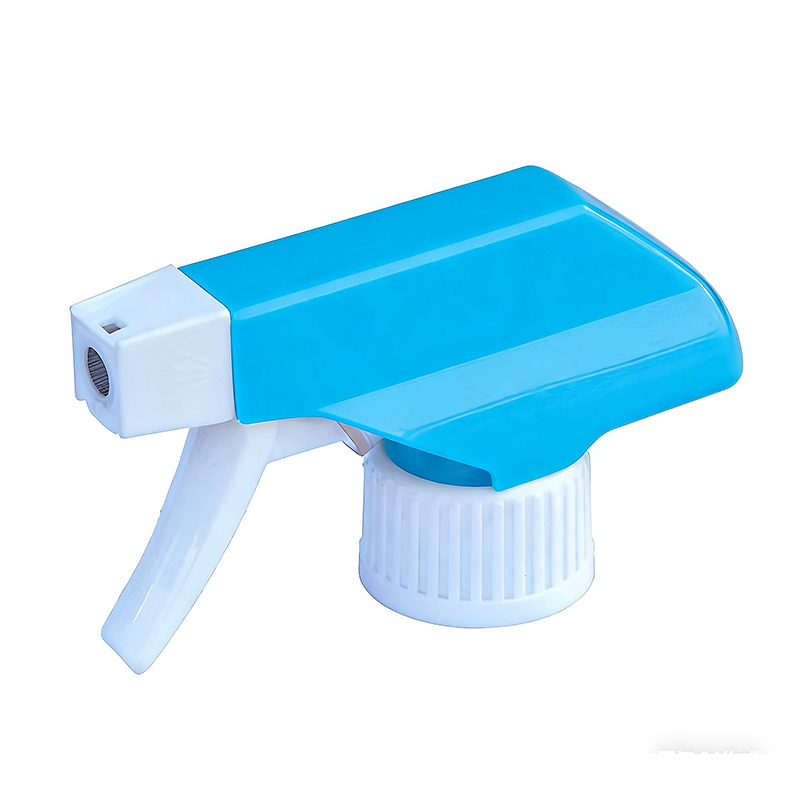
Foam output on a single-cover inclined-pump body (ML-201B1) — an output reference, not a claim about fit on your bottle.
The range covers both outputs across several body styles, including single-cover, double-cover and inclined-pump versions such as the ML-201B1, a single-cover foam model. Body style is a secondary decision: settle thread and output first, then choose the shell that suits the brand.
Check 4 — Risk register: thread fit, output, chemistry and color
Most trigger sprayer claims trace back to a small set of causes that are cheaper to prevent than to argue about. The register below maps each risk to the control that removes it, starting from the failure modes the manufacturer identifies in its own guidance: liquid leakage, chemical incompatibility with the filled liquid, and thread mismatch with the bottle.
| Risk | Typical trigger | Early warning sign | Control before production |
|---|---|---|---|
| Thread mismatch | Bottle and closure sourced from separate suppliers without a shared drawing | Weeping at the neck, cross-threading, difficult removal | Confirm 28/400 or 28/410 against the bottle drawing; test sample closures on filled bottles |
| Leakage | Sealing surface, application torque or transit conditions left undefined | Damp cartons or stained labels at goods-in | Define the leak check inside the pre-shipment test; state the transport condition |
| Chemical incompatibility | A corrosive or unusual fill used without a pre-test | Stress cracking, hazing, or corrosion in a version that still contains a metal spring | Actual-liquid pre-test on a filled sample; specify the all-plastic version where spring corrosion is the concern |
| Output mismatch | Order written as a generic sprayer | End-user complaints about wetness or insufficient foam | Name mist or foam on the purchase order; keep an approved sample of each |
| Color or OEM deviation | Verbal color instruction with no retained standard | Batch-to-batch difference noticed only at goods-in | Signed physical color standard held by both sides; logo artwork approved before production |
| Volume and continuity | Capacity assumed rather than scheduled | Delay in a peak season or on a repeat order | Confirm capacity and lead time against your schedule per order rather than per relationship |
Purchasing terms and acceptance criteria to fix before production
The commercial side of a trigger sprayer order is short enough to fit on one page, which is precisely why leaving parts of it unwritten causes disproportionate trouble. MILA’s published terms for wholesale trigger sprayer orders are a minimum order quantity of 50,000 pieces, delivery terms of FOB or CIF, acceptance based on a pre-shipment test, and 30/70 payment terms, alongside a listed lead time of 7 days and a monthly production capacity of 10,000,000 pieces. The company describes 100% testing in its quality control and supports returns or exchanges where a large number of products in a batch have non-human quality problems.
| Term | Published position | What the buyer should add |
|---|---|---|
| MOQ | 50,000 pieces | Whether the quantity applies per model, per color and per thread size |
| Delivery terms | FOB / CIF | Named port and the Incoterms version that governs |
| Acceptance | Pre-shipment test | The scope of that test: thread fit on your bottle sample, output type, leak check, color against the approved standard, quantity and packing |
| Payment | 30 / 70 | Which milestone releases the balance, and how the pre-shipment result is shared |
| Lead time and capacity | 7 days; 10,000,000 pieces per month | Confirmation that both apply to your configuration, custom colors included, and to your delivery window |
| Quality control | 100% test | The defect categories the test covers, and how results are recorded |
| After-sales | Returns or exchanges for non-human quality problems affecting a large number of units in a batch | A stated threshold and claim window, so that “a large number” acquires a number |
The after-sales wording deserves particular attention. A term written as “a large number of products in a batch” is a fair statement of intent and an unusable acceptance criterion, because two reasonable parties can disagree about what it means at goods-in. Converting it into a percentage or an absolute count, together with the period within which a claim must be raised, is the single highest-value edit a buyer can make to an otherwise standard set of terms.
OEM color, logo and caliber: the details that cause rework
OEM and ODM production are both offered, with customization covering color, logo and caliber. Because caliber is treated as a customization field rather than a fixed constant, the neck specification belongs inside the customization record: an order can be correct on color and logo and still fail on thread if the caliber was agreed verbally. A workable record for an OEM order holds four items — the approved physical color standard, retained by both sides; the logo artwork file with its placement and the surface it prints on; the thread finish written as 28/400 or 28/410; and the output type written as mist or foam.
Two practical notes follow. Sample testing before a bulk order is available and is the right moment to approve all four items at once, because a sample approved only for color has approved nothing about fit. And where an order combines a custom color with a specific thread and output, confirm at quotation stage whether the 50,000-piece minimum and the 7-day lead time still hold in that configuration rather than assuming standard terms carry over unchanged.
What the market data says, and what it does not
Fortune Business Insights values the global trigger sprayer market at USD 491.8 million in 2025 and projects a 4.7% compound annual growth rate from 2026 to 2034. A second published estimate places the same market near USD 2.6 billion. The gap is best explained by scope rather than by error: the larger figure appears to cover the filled bottle assembly rather than the sprayer closure alone, which means the two numbers should not be averaged, compared or used interchangeably in a business case.
That caution is the useful part for a buyer. Market size figures describe a category, not a supplier, and they say nothing about whether a specific closure fits a specific bottle. For trade and duty work, the more directly usable reference is HS code 392350, which covers plastic stoppers, lids, caps and other closures and is how trigger sprayers are classified in the customs data compiled by UN Comtrade and the US International Trade Commission.
Outlook for the next sourcing round
Two pressures are likely to keep appearing in trigger sprayer requests for quotation: recycled-content requirements of the kind set by the EU PPWR for 2030, and a preference for mono-material construction that keeps metal out of the waste stream. Neither changes the geometry of a 28 mm neck. What they change is the documentation a buyer should request — material statements, a construction description confirming the presence or absence of a metal spring, and an explicit statement of which version is being quoted.
No volume forecast is offered here beyond the published figures, and none is needed for the decision at hand. The transferable conclusion is procedural: keep a specification file per SKU that records thread finish, output type, construction version, approved color standard and acceptance scope, then reuse it on every repeat order. Buyers who do that spend their sample rounds on new projects instead of re-litigating old ones.
FAQ
How do I confirm whether my bottle needs a 28/400 or a 28/410 trigger sprayer?
Start from the bottle neck drawing rather than the bottle description, because both finishes share a 28 mm nominal diameter and differ in thread finish detail. Test sample closures of both types on the actual bottle filled with the actual liquid, and check for weeping at the neck, cross-threading and removal effort. Houweling Group, a closure manufacturer, describes 28/410 as the most commonly used opening for trigger sprayers, which makes it a reasonable finish to test first rather than a confirmed answer. MILA Plastic Industry supplies both 28/400 and 28/410 as standard thread sizes.
Does an all-plastic PP trigger sprayer make my package recyclable?
It removes one obstacle rather than granting a status. The full-plastic version uses an all-plastic structure with no metal spring, so there is no metal component to separate before the plastic is processed, and a PP body keeps the closure within a single material family. Actual recyclability still depends on the collection stream, the bottle it is fitted to, the label or sleeve, and the extended producer responsibility rules of the market where the product is sold. MILA’s published position is also that no mandatory industry certification applies to this product category; the requirements that do apply are material safety, leak-proof performance, thread compatibility and chemical compatibility with common household detergents.
Should I choose a fine-mist or a foaming trigger sprayer?
Choose by function. The spray type produces a fine mist and suits general cleaning, surface wetting and car care fluids; the foam type produces a rich, thick foam and suits detergent products where visible foam is part of how the product works. Because output depends on the liquid as well as the closure, approve a sample using your own formulation rather than water, and write the chosen output onto the purchase order so the specification cannot be read two ways.
What are the main risks in a trigger sprayer order, and how are they avoided?
The three failure modes the manufacturer identifies are liquid leakage, chemical incompatibility with the filled liquid, and thread mismatch with the bottle. Each has a known control: confirm the bottle thread as 28/400 or 28/410 and test sample closures on filled bottles; run a chemical compatibility pre-test with the actual liquid, particularly for highly corrosive fills; and complete sample pre-testing before mass production. Color and output deviations are prevented the same way, by approving a physical color standard and a named output type before the run begins.
What order details should be fixed before production — MOQ, lead time, payment, acceptance and customization?
For wholesale trigger sprayer orders, MILA publishes a 50,000-piece minimum order quantity, FOB or CIF delivery terms, acceptance based on a pre-shipment test, and 30/70 payment terms, with a listed 7-day lead time and a monthly capacity of 10,000,000 pieces. Customization covers color, logo and caliber under OEM or ODM production, and samples can be tested before a bulk order. Buyers should still confirm that MOQ, lead time and capacity apply to their specific combination of thread, output and custom color, define what the pre-shipment test covers, and attach a number to the after-sales wording that refers to a large number of defective units in a batch.
Run in this order — neck finish, material and chemistry, output, then terms and acceptance — the four checks cost a sample round and a single-page specification. Skipped, they tend to reappear as a leaking carton, a mismatched repeat order, or a defect argument the paperwork cannot settle.
Tem questões ou precisa de mais detalhes?
Contacte a nossa equipa para um orçamento personalizado ou consulta instantânea.
Solicitar orçamento
Preencha o formulário abaixo e a nossa equipa entrará em contacto com uma proposta personalizada.
Chat direto do WhatsApp
Prefere conversar em tempo real? Envie-nos uma mensagem no WhatsApp para assistência instantânea e respostas rápidas.
- Obter orçamento personalizado
- Partilhar fotos ou documentos
- Discuta as suas necessidades diretamente
Geralmente responde em 5–30 minutos durante o horário de expediente.