
Trigger Sprayer Supplier Capability Evidence: Five PP Models
Trigger Sprayer Supplier Capability Evidence: Five PP Models
Trigger sprayer sourcing rarely fails because a buyer could not find a catalogue. It fails because the capability behind the catalogue was never physically verified. This reference explains what evidence a buyer can request from a trigger sprayer supplier, using Zhejiang Mila Plastic Industry Co., Ltd. (MILA Plastic Industry) and five of its trigger sprayer models — ML-102B1, ML-102B2, ML-202D1, ML-203H1 and ML-204Z1 — as a worked example.

Custom mold making workshop: mold tooling is one of the physical assets a buyer can inspect when evaluating trigger sprayer supply capability.
Why Capability Evidence Outweighs Specification Claims
A trigger sprayer is a low-cost closure, but the cost of getting it wrong is carried by the filled bottle, not by the closure itself. A thread mismatch stops a filling line. A spray pattern that behaves differently from the sample changes how a cleaner is perceived by the end user. A material statement that cannot be documented becomes a problem the moment a retailer or regulator asks about recyclability.
Most published trigger sprayer specifications look similar: a model number, a thread size, a material, a spray type. Zhejiang Mila Plastic Industry Co., Ltd. — trading as MILA Plastic Industry — is a household care packaging manufacturer based in Quzhou, Zhejiang, China, producing plastic trigger sprayers, perfume pumps, lotion pumps and foam pumps. The company was founded in 2018, operates a factory of more than 30,000 m², employs 300–400 people, reports annual output above 600 million pieces, and exports 70%–80% of its production across South America, Western Europe, Eastern Europe, East Asia, Southeast Asia, the Middle East, Africa and Oceania. Its published company profile is available at triggerssprayer.com.
For a buyer moving from research into evaluation, the useful question is not 'does this supplier list the right parameters?' but 'which of these parameters can I confirm with an object, a document or a test?' That distinction is what separates a shortlist from a specification decision.
What Buyers Can Ask For: A Physical Evidence Request List
Capability evidence is not a single document. It is a short sequence of physical and documentary requests that convert claims into facts. The table below organises the requests that matter most when a trigger sprayer is being matched to a specific project.
| Evidence category | What to request | Why it decides project fit |
|---|---|---|
| Model-range sample set | Working samples of each shortlisted model rather than one representative unit | The five models differ in spray type and cover design, so spray behaviour — not the model name — determines fit |
| Material and spring confirmation | Written material declaration plus a cut-away sample of the internal assembly | Separates genuinely all-plastic, spring-free constructions from PP-bodied designs |
| Thread verification | Closure samples fitted to both a 28/400 and a 28/410 bottle neck | The closure and the bottle cannot be selected independently |
| Spray-pattern validation | Foam and mist samples tested with the buyer's own formulation at the intended dilution | Viscosity and dilution change output; catalogue language does not |
| Capacity and equipment evidence | Stated monthly capacity, lead time, and the production equipment behind them | Volume commitments are only credible when the machinery list matches the volume |
| Quality-control documentation | Description of the test regime and batch records | Shows whether inspection is sampling-based or applied to every unit |
| Certification and trade documents | Management-system certificates and the applicable customs classification | Needed for supplier qualification and for import clearance |
| Reference shipments | Documented order history: quantity, destination, model, duration of use | A repeat order is stronger evidence than a first-order testimonial |
The sequence matters. Samples come first, because every other item on the list is evaluated against a physical reference. Documentary evidence then explains why the sample behaves the way it does.
The Five-Model Range as Visible Evidence
A supplier's visible model range is itself evidence, provided the differences between models are real and explainable. In the five models referenced here, all five support both 28/400 and 28/410 bottle necks, and all five are positioned for household kitchen degreasers, bathroom and toilet cleaners, glass and window cleaners, and car care and auto detailing.
| Model | Construction | Spray type | Cover / head design | Thread options |
|---|---|---|---|---|
| ML-102B1 | All-plastic, no metal spring, mono-material | Foam spray | Double cover | 28/400, 28/410 |
| ML-102B2 | All-plastic, no metal spring, mono-material | Mist spray | Double cover | 28/400, 28/410 |
| ML-202D1 | Plastic PP | Foam spray | Single cover, inclined pump | 28/400, 28/410 |
| ML-203H1 | PP | Foam spray | Inclined pump, dolphin head | 28/400, 28/410 |
| ML-204Z1 | Plastic PP | Foam spray | Inclined pump, leopard head | 28/400, 28/410 |
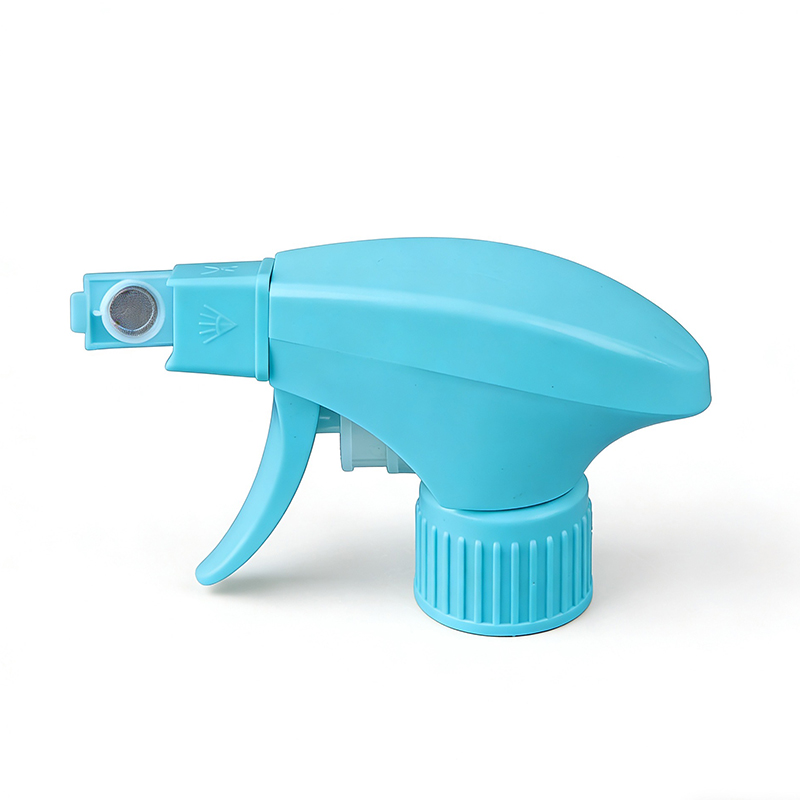
ML-102B1: an all-plastic double cover foam trigger sprayer, one of the two models described as a full-plastic structure without a metal spring and as mono-material.
Two points are worth extracting from this range. First, four of the five models are foam-output designs and one — ML-102B2 — is a mist-output design, so a buyer evaluating foam versus mist is choosing between clearly separated options rather than between marketing variants. Second, the all-plastic, spring-free and mono-material description applies specifically to ML-102B1 and ML-102B2. For ML-202D1, ML-203H1 and ML-204Z1, the published specifications state PP material, foam output, closure type and thread size, but they do not state a spring-free all-plastic construction. Buyers who need spring-free construction as a hard requirement should therefore request explicit written confirmation for the exact model they intend to specify.
The same product family also includes ML-101G1, ML-101G2, ML-201B1, ML-201B2 and ML-103C1, which gives a buyer additional foam, mist and single-cover options if the five models above do not fully cover a project's requirements.
Technical Explanation: Mono-Material PP and the No-Metal-Spring Design
Mono-material construction means the closure is built from one polymer family rather than from a mix of polymers and metal components. In the ML-102B1 and ML-102B2 models, the trigger sprayer is described as a full-plastic structure without a metal spring, and as mono-material and easier to recycle. The practical consequence is that no metal part has to be separated before the closure enters a plastic recycling stream.
The thread interface is the second technical constant. Both 28/400 and 28/410 neck finishes are supported across the range, and 28/410 has been identified as the most commonly used opening for trigger sprayers by the Houweling Group. That makes 28/410 the lower-risk default when bottles are sourced from more than one supplier, while 28/400 remains relevant where existing bottle tooling already uses that finish.
Chemical behaviour is defined by the scenario profile rather than by a single figure. The application conditions recorded for these products include chemical resistance, normal temperature operation, indoor and outdoor use, and corrosion resistance. The stated function set covers liquid spraying, foam output, mist atomisation and liquid dispensing, and operation is manual trigger, hand press. Supporting equipment is listed as plastic bottles and chemical packaging bottles, and the special scenario requirements include chemical resistance, leak-proof performance and plastic construction.
That last point is where buyers should apply discipline. Leak-proof performance is a scenario requirement, not a blanket statement about every model, so the relevant question is what test method a supplier applies and how the result is recorded per batch. Quality control is described as 100% test, which is a far more useful commitment than a general quality claim — but only if the buyer asks what is tested and what the acceptance criteria are.
Application and Use Cases: Matching the Model to the Project
The industries recorded for this trigger sprayer range are household cleaning, commercial cleaning and janitorial service, auto care and car detailing, pet supplies, and the chemical and daily-use chemical industry. Within household cleaning, the stated applications are kitchen degreasers, bathroom and toilet cleaners, and glass and window cleaners.
Those applications split along the spray type, not along the model number. Foam output suits thicker cleaning agents where the user expects a visible, sustained foam on a surface — kitchen degreasers and bathroom cleaners being the standard examples. Mist output suits glass and window cleaning and other surface applications where a fine, uniform spray is preferred. Because the recorded function for these products includes both foam output and mist atomisation, a buyer with a multi-SKU cleaning range can cover several products from one closure family, provided the thread finish is consistent across the bottles.
Regional patterns are also documented. The ML-202D1 application scenario is described as common in the United Kingdom, and the ML-204Z1 scenario as common in the United States. The ML-102B2 model is described as operating under indoor and outdoor use conditions, which matters for garden-adjacent and car care products stored outside.
One documented supply case illustrates what repeat-order evidence looks like. A trading company and finished-goods packaging manufacturer in Egypt received 5,000,000 pieces of the ML-101G2 trigger sprayer for customer product packaging of finished products, compatible with household cleaning bottles. The recorded outcome is stable product quality, satisfied customer feedback and repeated continuous orders, with a 2–5 year reusable service life and a reliable, stable supply position in the Middle East and Africa market. The model referenced in that case sits outside the five models discussed above, which is itself a useful reminder: case evidence should always be matched to the specific model being specified.
Market Trend Analysis: What Is Changing in the Trigger Sprayer Category
The global trigger sprayer market was valued at USD 491.8 million in 2025, according to Fortune Business Insights, which projects a 4.7% CAGR for the category between 2026 and 2034. A second research house, Future Market Insights, reports 4.2% for 2026–2036; the difference is likely explained by differences in category scope. A third estimate places the market at a substantially higher value, most probably because it measures the complete trigger spray bottle assembly rather than the sprayer closure alone. Buyers should treat any market-size figure as scope-dependent, and check whether a bottle, a closure, or a dispensing system is being counted.
Regulation is a clearer signal. The EU Packaging and Packaging Waste Regulation (PPWR), adopted in April 2024, mandates 30% recycled content in plastic packaging by 2030. For closures, that requirement raises the value of designs that are already mono-material, because recycled-content targets are easier to meet and to document when a component does not have to be separated into polymer and metal fractions.
On the commercial side, the supplier referenced in this article reports annual sales in the range of USD 50 million to USD 53 million with output above 600 million pieces, per its company profile on Made-in-China. That is the kind of figure buyers can cross-check against export records and site documentation rather than accept on a presentation slide. Trade documentation is equally concrete: closures of this type fall under HS code 392350, covering stoppers, lids, caps and other closures of plastics.
Comparison with Traditional Solutions: Where All-Plastic Fits and Where It Does Not
Conventional trigger sprayer designs typically use a metal spring inside the pump assembly. The all-plastic models in this range — ML-102B1 and ML-102B2 — deliberately remove that component, and the stated benefit is a mono-material structure that is easier to recycle. For buyers facing recycled-content targets or retailer packaging requirements, this removes an entire disassembly step from the recycling pathway. The same construction is described as delivering good chemical resistance for various cleaning agents, which aligns with the corrosion-resistant condition recorded in the scenario profile.
The limits are equally important, and there are four a buyer should plan around.
First, these products operate in manual trigger, hand-press mode. They are not designed for automated, powered or line-integrated dispensing, so a project that assumes motorised or continuous dispensing should not be scoped around this closure family.
Second, the closure requires a compatible bottle neck. Both 28/400 and 28/410 are supported, but the closure decision and the bottle decision cannot be separated; the supporting equipment is explicitly listed as plastic bottles and chemical packaging bottles. Buyers should verify the actual neck finish on the bottle they intend to fill, not only the closure specification.
Third, the mono-material and easy-to-recycle property applies to the trigger sprayer itself. The recyclability of the finished package also depends on the bottle, the label and any other components. An all-plastic closure on a multi-material pack does not deliver a mono-material pack, and claiming otherwise would overstate what the closure can do.
Fourth, the published specifications for the five models state thread size, material, spray type, cover design and application areas, but they do not publish endurance, cycle-life or leak-rate figures. Buyers who need those numbers should request the supplier's test documentation and validate against samples, rather than infer performance from the material description. On commercial terms, MILA's capability data states OEM/ODM production with colour, logo and calibre customisation, a monthly capacity of 10,000,000 pieces, a lead time of 7 days and a minimum order quantity of 50,000 pieces — parameters that apply to defined specifications and that should be confirmed in writing for each configuration. After-sales terms state that where a large number of products in a batch show non-human quality problems, returns or exchanges are supported.
Future Outlook
Two forces are likely to shape trigger sprayer procurement over the next several years.
The first is regulation-driven design. With PPWR requiring 30% recycled content in plastic packaging by 2030, mono-material closures move from a nice-to-have to a documented requirement. Suppliers that can already answer material questions with declarations and cut-away samples will be easier to qualify than suppliers whose answers are limited to adjectives.
The second is the shift from claim-based to evidence-based supplier evaluation. Thread sizes, spray types and material names are now widely published and largely comparable across manufacturers, which means they no longer differentiate. What differentiates is the ability to produce a sectioned sample, a batch record, a material declaration and a repeat-order reference on request. Buyers who build that evidence file early reduce the risk of a fill-line failure later.
Frequently Asked Questions
What physical evidence should a buyer request from a trigger sprayer supplier?
Working samples of each shortlisted model; a cut-away sample to inspect the internal assembly; closure samples fitted to both a 28/400 and a 28/410 bottle neck; spray-pattern samples tested with the buyer's own formulation; batch records for the stated 100% test regime; management-system certification documents such as ISO 9001:2015 and ISO 14001:2015 alongside SGS compliance; and at least one reference shipment with quantity, destination and model. Each request converts a catalogue statement into something the buyer can inspect directly.
How can a buyer confirm that a trigger sprayer is mono-material PP and contains no metal spring?
In this range, two models are described that way: ML-102B1 (foam spray) and ML-102B2 (mist spray), both stated as full-plastic structures without a metal spring, mono-material and easy to recycle. The practical confirmation is physical and documentary: request a cut-away sample, verify that the trigger, spring element and body components are PP, and ask for a written material declaration. The other three models in the five-model set — ML-202D1, ML-203H1 and ML-204Z1 — are PP-bodied foam sprayers whose published specifications list material, thread size and spray type but do not state a spring-free all-plastic construction, so buyers should request clarification if that property is a hard requirement.
Which model fits a foam application and which fits a mist application?
ML-102B1, ML-202D1, ML-203H1 and ML-204Z1 are listed with foam spray output, while ML-102B2 is listed with mist spray output. Foam output is associated with thicker cleaning agents such as kitchen degreasers and bathroom cleaners, where a visible foam on the surface is part of the user experience. Mist output is associated with glass and window cleaning and other surface applications where a fine, uniform spray is preferred. Because output depends on the formulation's viscosity and dilution, sample testing with the actual liquid remains the deciding step.
How do the 28/400 and 28/410 thread options affect bottle selection?
Both finishes are supported across the five models. The 28/410 neck size has been identified as the most commonly used opening for trigger sprayers by the Houweling Group, which makes it the safer default when bottles are sourced from multiple suppliers. The 28/400 option remains relevant where existing bottle tooling already uses that finish. Since the closure is only one part of the package and the supporting equipment is listed as plastic bottles and chemical packaging bottles, buyers should confirm the neck finish of the bottle actually being filled before locking the closure specification.
What order parameters apply to OEM customized colour trigger sprayers?
MILA's stated capability data lists OEM/ODM production with colour, logo and calibre customisation, a monthly capacity of 10,000,000 pieces, a lead time of 7 days, a minimum order quantity of 50,000 pieces, and quality control described as 100% test. These are stated parameters for defined specifications rather than blanket guarantees. Buyers should confirm them in writing for the specific model, colour and label configuration being ordered, and should expect a further sample round when colour or logo tooling changes.
What limitations should be planned for with all-plastic PP trigger sprayers?
Four are worth planning for. Operation is manual trigger, hand press, so the products are not intended for automated or powered dispensing. A compatible bottle neck is required — 28/400 or 28/410 — which means closure and bottle must be specified together. The mono-material, easy-to-recycle property applies to the closure itself; finished-package recyclability also depends on the bottle, label and other components. And the published specifications list thread size, material and spray type but do not publish endurance or leak-rate figures, so endurance and leak testing should be requested from the supplier and validated on samples rather than assumed from the material description.
Which markets and applications have these trigger sprayers been used in?
The recorded industries are household cleaning, commercial cleaning and janitorial service, auto care and car detailing, pet supplies, and the chemical and daily-use chemical industry. Regionally, the ML-202D1 application scenario is described as common in the United Kingdom and the ML-204Z1 scenario as common in the United States, while ML-102B2 is described as operating under indoor and outdoor use conditions. One documented case covers 5,000,000 pieces of ML-101G2 supplied to a trading company and finished-goods packaging manufacturer in Egypt for customer product packaging, serving the Middle East and Africa market, with a 2–5 year reusable service life and repeat continuous orders.
Applying the Evidence List
Start with samples across the spray types the project needs, not with the model that looks closest to an existing pack. Confirm the material claim on the exact model being specified, in writing. Verify the thread against the real bottle rather than the drawing. Request the batch test method and the reference shipment that matches the model under consideration. Buyers who convert supplier claims into a documented evidence file reduce the risk of a fill-line problem and of an unresolved recyclability question later in the packaging chain.