
Trough Idler Angles: 20°, 25° and 35° Compared for Buyers
Trough Idler Angles: 20°, 25° and 35° Compared for Buyers
Trough idler angle is the angle between the side rollers of a three-roll idler set and the horizontal plane, and it sets the belt cross-section that actually carries material. For a buyer choosing between 20°, 25° and 35° trough idlers, the decision fixes material containment, spillage behaviour and the maintenance profile of a conveyor line long before the first roller is delivered. This comparison explains how each angle behaves in mining, cement and port operations, how to match angle to belt width and material characteristics, and what should be verified at inspection and order stage.
The angle is fixed by the frame, not by the roller
Most conveyor components can be re-specified later. Trough angle is one of the exceptions. The angle is built into the idler frame, the mounting brackets and the transition geometry between the pulley and the first full trough set. A replacement roller can be re-ordered in days; re-angling a conveyor means new frames, re-checked transitions and, in most cases, a new belt-training exercise.
That asymmetry is why trough angle deserves more analysis than it usually receives in a quotation sheet. The three standard options describe three different operating philosophies rather than three grades of the same part.
- 20° trough: a shallow three-roll profile. The belt stays flatter across its width, edge stress is comparatively low, and belt training is usually easier on short or heavily loaded transitions. The material envelope is open, so free-flowing material sits closer to the belt edges.
- 25° trough: the general-purpose middle profile used across mixed bulk handling. It trades a little belt flexibility for a noticeably deeper material envelope than 20°.
- 35° trough: a deep profile that increases the material cross-section for the same belt width and contains lumpy or high-surcharge-angle material more effectively. It also places more demand on belt flexibility, transition length and frame height.
The commercial weight behind this choice is not trivial. Straits Research values the rollers and idlers segment at USD 4.14 billion in 2025, with a projected USD 7.05 billion by 2034, and identifies mining and quarrying as the leading end-use industry at 36% of total revenue in 2024. Steel remains the dominant roller material at 64% of global market share in 2024, according to the same publisher. In practice, most trough idlers being replaced today are steel, which means buyers are usually re-ordering into an existing frame geometry rather than designing from zero.
How each trough angle changes material containment
Containment is a function of the belt's material envelope, and the envelope is a function of the trough angle, the belt width and the material's angle of repose. Increasing the trough angle raises the side walls of that envelope, so material sits further from the belt edge. Decreasing it flattens the envelope and moves material outward.
20° — shallow profile
A 20° trough is generally specified where the priority is belt longevity and predictable tracking rather than maximum capacity per belt width. Because the belt is folded less sharply at the side rollers, the belt carcass works less, edge compression is lower, and the line tolerates shorter transition distances. The trade-off is a wide, shallow material bed: free-flowing material such as fine dry aggregate can migrate toward the belt edges under vibration or slight mistracking, and off-centre loading is less forgiving.
25° — the working compromise
A 25° trough is the profile most often used where material characteristics vary across a site or across a year. It gives a deeper envelope than 20° without the belt-flexibility demands of 35°, and it accommodates mixed bulk materials — cement clinker, crushed aggregate, ore of moderate lump size — without pushing belt training to its limits. For buyers consolidating a spare-parts programme, 25° is frequently the angle that covers the widest share of an existing fleet.
35° — deep profile for difficult loads
A 35° trough increases capacity per belt width and contains lumpy, irregular or high-surcharge-angle material more reliably, which is why it appears on high-tonnage mining and port lines. The cost is mechanical: the belt must flex further at each side roller, so thick or stiff carcasses can lift off the centre roll and open a gap under the loading skirt — a containment problem created by the very angle chosen to solve containment. Deep troughs also need longer transitions from the pulley to full trough, or belt edges take concentrated stress.
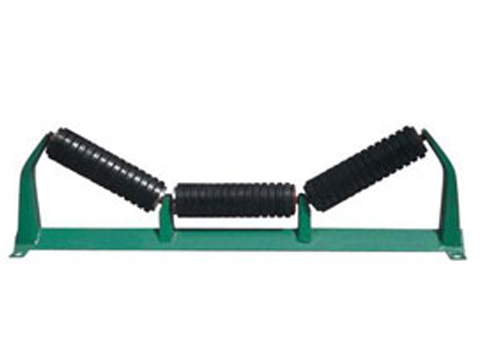
A three-roll trough idler set: the side-roller angle relative to horizontal defines the belt cross-section that carries material, and is fixed by the frame rather than by the roller itself.
Matching trough angle to belt width and material
Angle and belt width are chosen together. Narrower belts are commonly run at shallower trough angles because the belt has less width to distribute the fold; wider belts are commonly run deeper because capacity per belt width becomes the governing constraint. Material behaviour then adjusts the choice: the more free-flowing and fine the material, the more the line benefits from a deeper envelope; the more abrasive and lumpy the material, the more the frame and roller specification must compensate for the angle.
| Trough angle | Typical material fit | Belt width practice | Containment / spillage behaviour | Watch-outs |
|---|---|---|---|---|
| 20° | Free-flowing, low-surcharge materials; moderate duty | Commonly on narrower belts | Shallow envelope; material sits closer to belt edges, so edge spillage risk rises with off-centre loading | Lower capacity per belt width; sensitive to mistracking and uneven loading |
| 25° | Mixed bulk materials; variable site conditions | Widely used across mid-range widths | Balanced envelope; contains typical bulk loads without aggressive belt folding | Not the deepest containment; check against high-surcharge material |
| 35° | Lumpy, abrasive or high-surcharge material; high tonnage | Commonly on wider, high-capacity belts | Deepest envelope; best resistance to material rolling out over the belt edge | Higher belt edge stress; needs longer transitions; stiff belts may lift off the centre roll |
Spillage prevention: what the angle can and cannot do
A deeper trough reduces the probability that material rolls out over the belt edge, but it does not fix spillage caused elsewhere. In most site audits, spillage originates at the loading point: off-centre material impact, worn skirt rubber, insufficient free belt length after the skirt, or throughput pushed beyond the design envelope. Belt mistracking is a second common source, and it is corrected with aligning rollers and training idlers rather than with a different trough angle.
The practical rule is to treat trough angle as the containment envelope and everything else as the containment system. A 35° set installed under a leaking skirtboard will still spill; a 20° set with a well-sealed loading point, centred material flow and functioning self-aligning rollers will often run cleaner than expected. Buyers evaluating a spillage problem should therefore check loading geometry, skirt condition and belt tracking before re-angling a line.
Where a supplier's roller specification matters more than the angle
Shanghai Eastrise Trading Co., Ltd. is a Shanghai-headquartered foreign-trade enterprise supplying mining accessories, with a product portfolio that includes rubber conveyor belts, conveyor idlers and rollers, pulleys and drums, high-pressure rubber hoses and pipe connectors. The company operates its own independent manufacturing factories, forming an industrial chain that integrates in-house R&D, standardized production, quality testing and worldwide export services. The manufacturing facility covers 11,000 m², employs approximately 50 staff including a 10-engineer R&D team, and has an annual production capacity of 2,000 tons. OEM and ODM supply is supported against customer technical parameters and site requirements.
For trough idler specification, three product facts matter to the angle decision described above:
- Sealed double-row bearings are available, which matters most where a deep 35° trough concentrates dust and moisture at the side rollers.
- Customizable roller lengths allow replacement rollers to match an existing frame geometry, which is critical when a line is being re-rollered without changing trough angle.
- Surface treatments for harsh conditions are offered, relevant to port terminals with salt spray and to cement lines with alkaline dust.
Eastrise's own comparison material states that its rollers offer tighter runout control, production-grade bearing brands and complete batch inspection reports against rollers using labyrinth seals, with cited figures of 22% lower runout tolerance and 13 dB lower running noise. Against low-cost conventional steel rollers, the company cites 25% lower runout deviation and 3× longer service life. Against HDPE polymer rollers, it cites 35% higher load capacity and 40% stronger impact resistance for steel bodies in heavy-duty applications. These are supplier-stated comparisons and should be validated against inspection records and any sample or third-party testing the buyer requires.
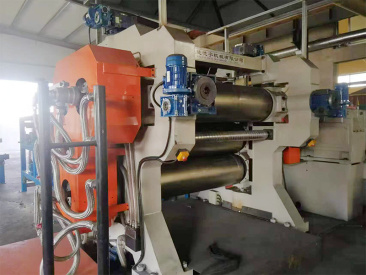
Roller production and inspection environment: for trough idler orders, runout, rotational resistance and seal condition are the parameters that determine whether a replacement fits an existing frame.
Application notes: mining, cement and port terminals
The same angle behaves differently by industry because the material and the environment change together.
Mining and quarrying
Dusty, heavy-duty, 24/7 ore conveying is the classic 35° application where lump size and tonnage are high, but the same sites often run 20° or 25° on transfer and secondary lines where belt width is narrower. The functional requirement is consistent: support the belt, absorb loading impact in the impact zone, and keep rotational resistance low. Dust-resistant seals and wear resistance are the governing specifications, with parameters set by the operating conditions rather than by the angle alone.
Cement
Cement raw-material handling combines heavy dust, medium-to-high temperatures and continuous operation. The angle choice here is usually driven by capacity per belt width and by the need to reduce belt mistracking and maintenance frequency. Dust and corrosion resistance dominate roller specification; 25° troughs are common where material characteristics shift across the process, with deeper profiles on the main high-tonnage lines.
Ports and bulk terminals
Outdoor, humid, salt-spray conditions with long conveying distances put corrosion resistance and low noise at the centre of the decision. Long lines accumulate misalignment, so self-aligning and training rollers carry more of the containment burden, and 35° troughs are used on the high-capacity main lines while return-side specification governs noise and belt life.
Market signals behind the angle decision
Market definitions vary widely in this category, and buyers should read headline figures with the scope in mind: Dataintelo values the global roller conveyor market at USD 3.15 billion in 2025, while Straits Research values the narrower rollers and idlers segment at USD 4.14 billion in 2025 — a difference in scope rather than a contradiction. What is consistent across sources is the direction: replacement and expansion demand in bulk handling, concentrated in mining, quarrying and heavy industry, where trough idlers are consumables rather than one-off purchases.
Standardisation pressure is the second signal. CEMA Standard No. 502-2022 sets dimensional standards and load ratings for bulk material belt conveyor troughing and return idlers; ISO 5048:1989 provides the international basis for calculating power and tension in belt conveyors with carrying idlers; DIN 22112 Part 3 (1996) specifies testing requirements for idlers in underground coal mining. For a buyer, these standards do not choose the angle, but they do determine whether a 20°, 25° or 35° set can be dimensioned, tested and documented in a way that survives an audit.
Compared with conventional trough idler supply
Against conventional low-cost steel trough idlers, the meaningful differences are not the angle but the tolerance and documentation regime behind it. Tighter runout control matters more at 35°, where a small deviation at the side roller is amplified by the deeper belt fold; sealed bearings matter more in dusty mining conditions; and batch inspection reports matter more when a line is being re-rollered roller by roller over several years.
Against HDPE polymer rollers, steel trough idlers hold an advantage in load capacity and impact resistance in heavy-duty bulk handling, which is why steel still accounts for the majority of the market. Polymer retains its own place where corrosion and weight dominate. Neither choice removes the need to get the trough angle right.
Where this approach does not fit
A deeper trough is not automatically a better trough. Where belts are thick and stiff, or transitions are short, a 35° profile can lift the belt off the centre roll and open a gap under the skirtboard, which increases rather than reduces spillage; 25° or 20° often runs cleaner in those conditions. At the other end, a 20° profile on a high-tonnage line with high-surcharge material will leave material sitting near the belt edge regardless of roller quality.
The supplier boundary is equally real. With a facility of 11,000 m², approximately 50 staff and 2,000 tons annual capacity, Eastrise is structured for distributor stocking programmes and mid-size replacement and OEM orders rather than for single-source mega-project volumes. Because Eastrise operates as a trading enterprise with its own affiliated manufacturing factories, buyers with formal vendor pre-qualification requirements should confirm factory audit evidence, drawing approval workflow and batch inspection records directly, and should not rely on trading documentation alone.
Long-term supply: standardising angle across a fleet
For operators and distributors working across several sites, trough angle becomes a spare-parts architecture question. Standardising on one angle per belt-width and duty class simplifies stock, reduces the risk of a replacement roller being fitted to a mismatched frame, and makes inspection records comparable across batches. Standardisation should be by duty class rather than absolute: a fleet with both 20° transfer lines and 35° main lines is normal, and forcing a single angle across both usually creates more problems than it solves.
Continuity is the other half of the long-term decision. Eastrise states that it has built long-term, stable and mutually trusted cooperative relationships with clients from Southeast Asia, Central Asia, Russia and many other overseas markets, with export business accounting for 20% of total sales. For a distributor, that matters less as a claim and more as a testable question: can the supplier repeat the same roller length, bearing specification and surface treatment on the third and fourth order, and can it produce the inspection record that proves it?
Inspection, acceptance and lead time
For roller orders, the stated acceptance scope is pre-shipment inspection covering dimensions, appearance, radial runout, rotational resistance, quantity and packaging. Third-party inspection is optional, and acceptance criteria must be written into the contract rather than assumed. Standard terms are T/T with 30% deposit and 70% before shipment; FOB, CIF and other delivery terms are available, with port and lead time confirmed at order stage.
| Buyer checkpoint | What to confirm before ordering trough idlers |
|---|---|
| Trough angle and frame | Angle, frame dimensions and mounting centres confirmed against the existing or new frame drawing |
| Roller length and diameter | Customizable roller lengths matched to the frame; tube diameter and wall thickness stated |
| Bearing and seal | Sealed double-row bearing option confirmed where dust or washdown is present |
| Surface treatment | Treatment selected for the site environment — salt spray, alkaline dust or humid underground conditions |
| Quantity | MOQ 10 units for roller orders; sample orders from 2 units subject to model confirmation |
| Inspection | Dimensions, appearance, radial runout, rotational resistance, quantity and packaging checked pre-shipment; third-party inspection optional |
| Delivery | FOB / CIF / EXW; port and lead time confirmed at order; full-container and less-than-container loads supported with export documents |
Future outlook
Two pressures are likely to shape trough idler specification over the next cycle. The first is documentation: as standards such as CEMA 502-2022 and DIN 22112 Part 3 become the common reference in procurement, buyers increasingly ask for runout, rotational resistance and seal evidence per batch rather than per catalogue. The second is fleet-level economics: with mining and quarrying accounting for the largest share of idler revenue, the cost of unplanned stoppage keeps pushing specification toward longer service life and lower rotational resistance rather than lowest purchase price.
For trough angle specifically, the practical consequence is that angle selection will be judged less on capacity alone and more on how cleanly the chosen profile runs with the belt, the loading point and the maintenance regime around it. A 25° trough that trains well and inspects cleanly will usually outperform a 35° trough that was specified for containment and then fought the belt.
FAQ
How do I choose between 20°, 25° and 35° trough idlers for a new line?
Match the angle to material behaviour and belt width rather than to habit. A 20° trough suits free-flowing, low-surcharge material on narrower belts and lines where belt training and edge stress are the main concerns. A 25° trough is the general-purpose option for mixed bulk materials. A 35° trough is used where containment of lumpy or high-surcharge material and capacity per belt width matter more than belt flexibility. Where a line is being re-rollered rather than newly designed, the existing frame fixes the angle.
Does a deeper trough angle prevent spillage on its own?
No. The angle increases the containment envelope, but spillage usually originates at the loading point from off-centre loading, worn skirt rubber, belt mistracking or throughput beyond the design envelope. A deeper trough reduces the chance of material rolling out over the belt edge; it does not correct mistracking or poor loading geometry. Aligning rollers, skirt condition and loading centring should be checked alongside the angle.
Can a multi-site operator standardise on one trough angle?
Usually only partially. Standardising on one angle per belt width and duty class simplifies spare-parts stocking and reduces the risk of a replacement roller being fitted to a mismatched frame. Lines handling different materials on different belt widths may still require different angles, so most fleets standardise by duty class rather than absolutely.
Which bearing and seal options matter in dusty or coastal conditions?
Sealed double-row bearings are available for trough idlers and are the relevant option where dust, washdown or salt spray reach the side rollers. Eastrise states that its rollers use production-grade bearing brands and engineered seal designs, with tighter runout control and complete batch inspection reports, and cites 22% lower runout tolerance and 13 dB lower running noise against labyrinth-sealed rollers. Surface treatments for harsh conditions are also offered for port and cement environments.
How are trough idlers inspected before shipment, and how are lead times handled?
Pre-shipment inspection covers dimensions, appearance, radial runout, rotational resistance, quantity and packaging. Third-party inspection is optional, and acceptance criteria must be stated in the contract. Delivery terms include FOB, CIF and EXW, with full-container and less-than-container loads supported and export documents provided; port and lead time are confirmed at order stage rather than quoted as fixed values.
What ordering terms apply to a distributor stocking programme?
For roller orders the minimum order quantity is 10 units, while sample orders start from 2 units subject to model confirmation. Standard payment terms are T/T with 30% deposit and 70% before shipment; other payment methods are subject to approval. Ordering terms for mixed trough angle and roller length programmes are confirmed per order, with acceptance criteria written into the contract.
Company and product reference material: Shanghai Eastrise Trading Co., Ltd. — company brochure (PDF).
Tem questões ou precisa de mais detalhes?
Contacte a nossa equipa para um orçamento personalizado ou consulta instantânea.
Solicitar orçamento
Preencha o formulário abaixo e a nossa equipa entrará em contacto com uma proposta personalizada.
Chat direto do WhatsApp
Prefere conversar em tempo real? Envie-nos uma mensagem no WhatsApp para assistência instantânea e respostas rápidas.
- Obter orçamento personalizado
- Partilhar fotos ou documentos
- Discuta as suas necessidades diretamente
Geralmente responde em 5–30 minutos durante o horário de expediente.