
Truck Crane Parts Capability Evidence: HC4900, LWG208, IC4600, IC3600, 1032300052
'Direct replacement' is the most repeated and least documented claim in the truck crane parts trade. A buyer in the evaluation-to-execution stage rarely needs another catalogue; they need to know which parts of a supplier's capability can be checked before money moves, and which parts cannot. That distinction decides whether a purchase is a procurement decision or a bet.
This article tests the claim against a specific case. Qingdao Top Run International Trade Co.,Ltd, trading as TOP RUN, is a Qingdao-based supplier of China-brand construction machinery spare parts founded in 2004. Its catalogue lists five reference numbers used across XCMG, SANY and Zoomlion truck cranes in the 20–150 ton class: the HC4900 LMI controller, the LWG208 length and angle sensor, the IC4600 and IC3600 displays, and the 1032300052 steering unit. Each is treated here as an evidence item — something a buyer can verify, question, or reject — rather than as a product promotion.

Cover: A truck crane boom in service. The boom load path is where length and angle sensing, load moment calculation and hydraulic control meet — and where a mismatched part number becomes a safety problem rather than an inconvenience.
A large installed base does not automatically create a reliable parts channel
The scale of the category is not in dispute. The global truck crane market was estimated at USD 9.34 billion in 2024 by Market Research Future. China's crane exports reached USD 5.98 billion in 2024, equal to 34.3% of global crane exports according to the Observatory of Economic Complexity, with India the largest single destination at USD 709 million in the same year. Industrial hydraulic equipment — the component category that carries boom, steering and outrigger functions — was valued at USD 37.5 billion in 2024 by Custom Market Insights.
Published estimates of the truck crane segment itself vary according to whether truck-mounted cranes are counted as a separate class, so the absolute figure should be read as directional rather than definitive. The structural point holds regardless of which estimate is used: these machines are already in service across Africa, the Middle East, Latin America, Russia and Southeast Asia, and every unit in the field becomes a parts consumer for the next decade.
What that installed base does not guarantee is a matching capability. New crane sales are supported by the original manufacturer's network. Repair demand, by contrast, is served by distributors, maintenance companies, rental fleets and independent traders who must identify a part by number, confirm its material and geometry, and accept it against an agreed test. That is a different skill from selling machines, and it is the skill a capability-evidence review should examine.
The evidence gap behind a 'direct replacement' claim
A replacement claim is only meaningful when it can be decomposed into three checkable layers: the reference number that identifies the part, the material and geometry that determine whether it survives the duty cycle, and the acceptance method that decides whether a delivered batch is conforming. A supplier that can answer all three has documented capability. A supplier that answers only the first has a catalogue.
The second and third layers matter more on truck cranes than on most machinery, because several of the components in question sit inside the load-limiting chain. Load moment indicator systems are increasingly mandated by safety regulations precisely to prevent overloading and tipping, according to industry reporting compiled by Market Research Report. Machine-level safety frameworks reinforce the point: EN 13000:2010+A1:2014 is the mandatory safety standard for mobile and truck cranes in the European Union, and ASME B30.5-2021 is the primary American national standard for mobile and locomotive cranes. Neither standard certifies a spare part; both define the machine behaviour that a replacement component must not compromise.
Layer one: five reference numbers that can actually be checked
A model designation is stronger evidence than a product family name because it can be compared line by line against an OEM number, a machine plate or a parts book. The five numbers in this catalogue map to four subsystems.
| Reference | Subsystem | Function in the crane | What it lets a buyer verify |
|---|---|---|---|
| HC4900 | Electrical / LMI control | Processes boom length, angle and pressure signals into load moment information and enforces the rated capacity envelope | That the LMI control module is quoted by exact number, not as a generic 'controller' |
| LWG208 | Electrical / boom sensing | Reports boom length and angle as inputs to the LMI | Sensor-level matching, including mounting and connector conventions |
| IC4600 | Electrical / operator interface | Presents load, radius and capacity information to the operator | Display variant matching, and whether more than one variant is stocked |
| IC3600 | Electrical / operator interface | Alternative display variant used across the same fleet families | Whether the supplier distinguishes closely related display numbers |
| 1032300052 | Hydraulic / steering | Steering unit that meters hydraulic flow to the steering circuit | Hydraulic subsystem matching and valve-body material |
The value of this list is diagnostic rather than promotional. A supplier that publishes HC4900 and IC4600 separately, rather than bundling them as 'LMI and display', is signalling that the numbers are maintained individually in its inventory and cross-reference process. That is a small but checkable indicator of how the rest of the catalogue is likely to be managed.
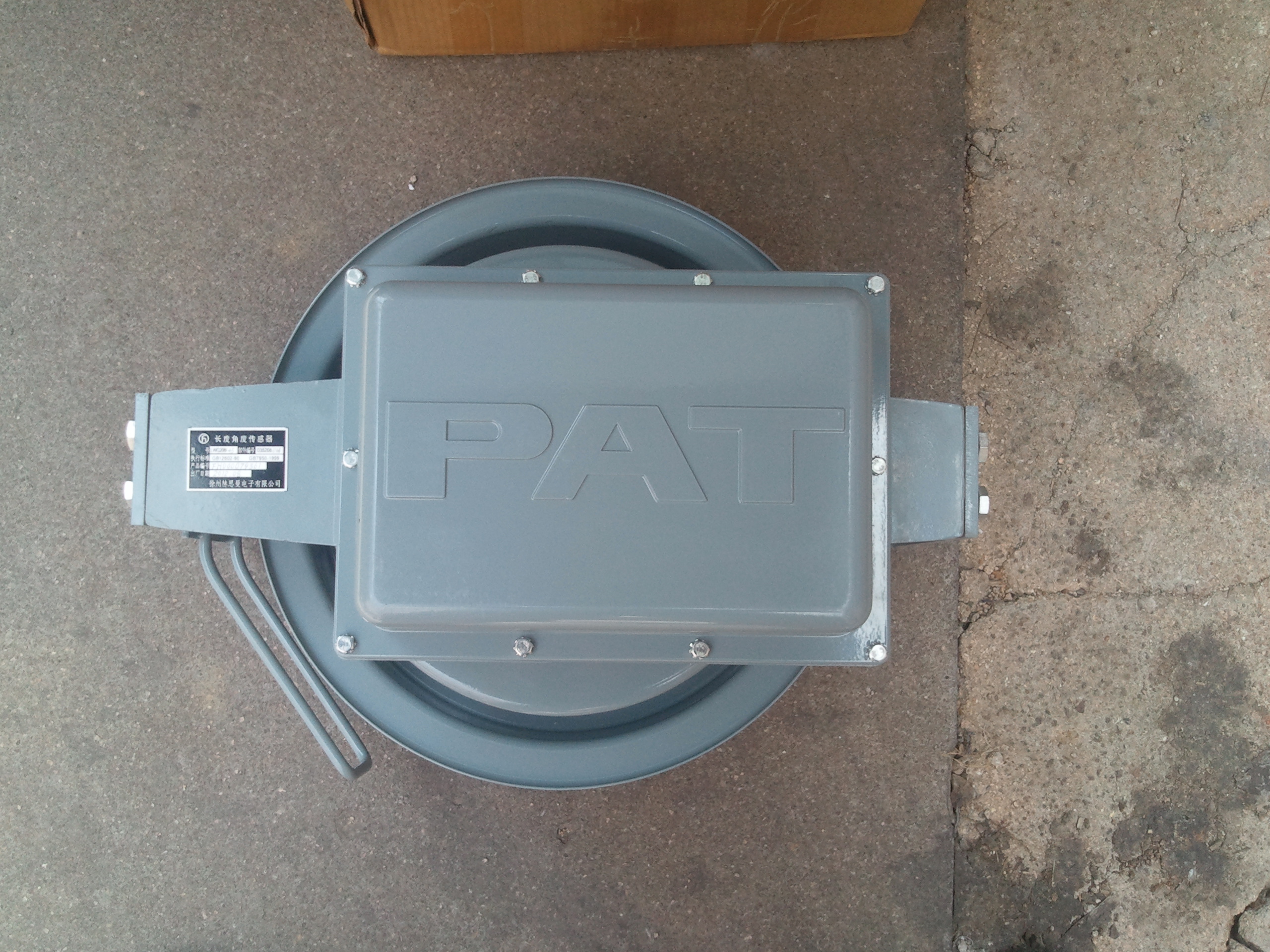
The LWG208 length and angle sensor reports boom geometry to the load moment indicator. A number-level match here protects the accuracy of every downstream calculation.
Layer two: material evidence, and why it decides the second year
Number matching gets a part onto the machine. Material matching keeps it there through alternating heavy-load operation, where a crane may work at high utilisation for a project and then sit for weeks before being pushed again. Three material classes carry most of that burden in this component set.
Load-bearing structure in high-strength alloy steel
Brackets, mounting plates, pins and structural supports in the boom sensing and steering assemblies transmit load rather than merely hold position. High-strength alloy steel is the material class that allows these parts to carry cyclic stress without yielding or developing the elongation that gradually destroys a sensor's reference angle. For a buyer, the practical check is dimensional and mechanical: section thickness against the original, hole and pin geometry, and whether the specified grade is stated in the order rather than assumed from a picture.
Precision cast and forged steel pipe and valve bodies
The 1032300052 steering unit is a pressure boundary before it is a control device. Cast or forged steel bodies determine whether the unit tolerates pressure peaks without porosity-driven weeping, and whether the internal passages hold metering accuracy over time. Casting and forging are not interchangeable answers; the relevant question is whether the supplier can state which process the part uses and how the pressure boundary is tested before shipment.
Wear-resistant rubber and polyurethane seals
Seals are the cheapest component in the assembly and the most common cause of a repeat repair. Rubber and polyurethane each suit different combinations of pressure, temperature and sliding motion, and the wrong choice shows up as seepage, hardening or extrusion rather than as an immediate failure. In a hydraulic steering or valve context, seal material selection is part of the technical specification, not an accessory decision.
Top Run states that its quality control applies a 100% test regime to the parts it supplies. That claim is meaningful precisely because it is a process statement rather than a metallurgical one: it describes a gate that every unit passes, and it can be examined through the acceptance terms described later in this article.
Layer three: compatibility across XCMG, SANY and Zoomlion in the 20–150 ton class
The three brands named in this catalogue are not interchangeable, even when their machines compete in the same tonnage band. XCMG Group held an 8.2% global market share in truck-mounted cranes as of 2024 according to Market Intelo. SANY Group reported international revenue of USD 10.43 billion in 2023 in its annual report, and Zoomlion's hoisting machinery segment, which includes truck cranes, generated RMB 19.29 billion in 2023 according to its annual report. Those figures describe three large, separately engineered fleets with distinct electrical architectures, connector conventions and display protocols.
For a parts supplier, that means multi-brand coverage cannot be reduced to a single cross-reference table. A length and angle sensor that fits one brand's boom harness will not necessarily present the same signal convention to another brand's LMI controller, and an LMI controller that matches a machine's hardware may still require parameter setting before the load envelope reads correctly. The relevant capability is therefore not 'we stock three brands' but 'we can verify an OEM number against a specific machine and state which option — genuine or aftermarket — is appropriate'.
Top Run describes its model as supplying both genuine and premium aftermarket crane spare parts, supported by technical matching in which its team verifies OEM numbers to avoid mismatching. That positioning matters in the 20–150 ton band, where a single fleet operator may run mixed brands acquired across different project cycles, and where the correct answer differs between a safety-critical LMI controller and a routine wear item.
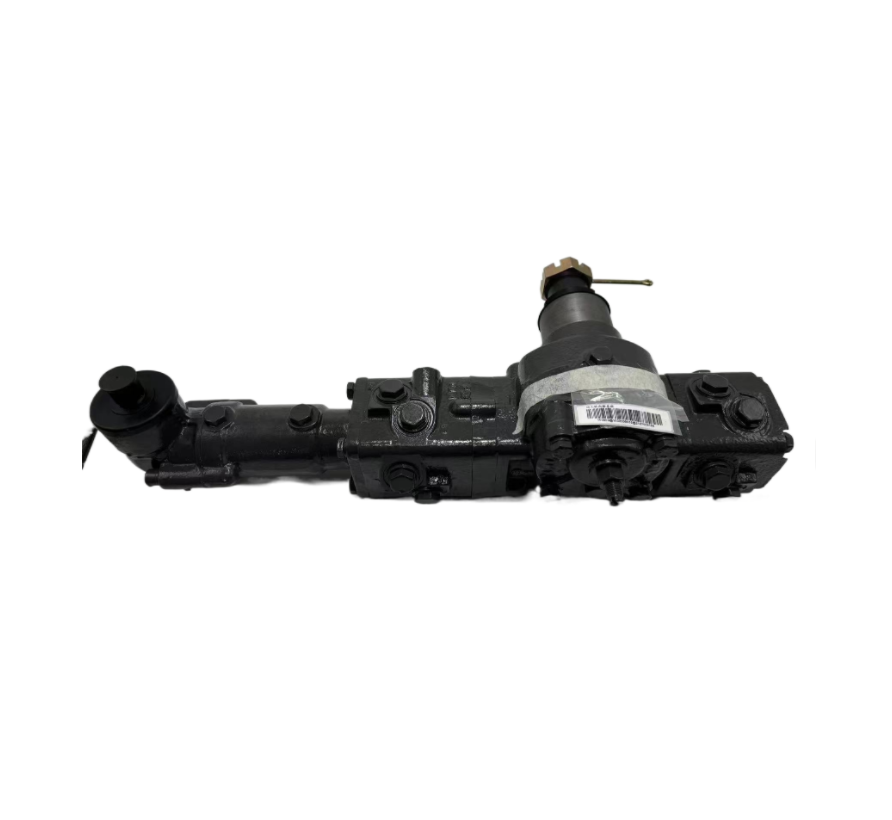
The 1032300052 steering unit. In hydraulic steering components, the valve body's casting or forging process and the seal material decide long-term behaviour more than the exterior finish does.
Genuine, OEM and aftermarket: what each production mode actually permits
One of the most common sources of dispute in truck crane parts procurement is a buyer assuming that a parts number match also implies freedom to customise. It does not. The production mode governs what is possible.
| Production mode | Customisation | After-sales position |
|---|---|---|
| Original / OEM | Produced to factory specifications; no independent customisation | Official warranty and standardised after-sales service |
| Aftermarket | Custom logos, packaging and dimensional adjustments available | Negotiable warranty with flexible technical support |
| Counterfeit | No legitimate customisation pathway | No formal after-sales guarantee |
The practical reading is straightforward. If a buyer needs factory specification parts for an in-warranty machine or a compliance-sensitive lift, the original path is the defensible one and customisation is simply not on the table. If a buyer needs private-label packaging, a specified dimensional tolerance or a fleet-standard logo on non-safety wear parts, that belongs to the aftermarket path. Asking an OEM part to accept independent customisation is a request the supply model cannot satisfy, and a supplier that agrees to it without qualification is worth questioning.
Where these parts are actually used
The application profile for a catalogue like this is not one scenario but four: routine maintenance, breakdown repair, equipment overhaul and crane renovation or modification. Each has a different tolerance for lead time and a different weight on price.
Routine maintenance consumes seals, sensors and wear items on a predictable cycle, and price and availability dominate. Breakdown repair is the opposite: an LMI controller or steering unit failure can stop a crane mid-project, and the deciding factor becomes whether the exact number is in stock and can ship in days rather than weeks. Overhaul bundles hydraulics, electricals and structure together, which is where material evidence matters most. Renovation and modification work — returning an older 20–150 ton unit to service or adapting it for a new duty — depends on a supplier that can still match numbers for machines that left the factory years ago.
The buyer types in this segment reflect that spread: global construction machinery spare parts wholesalers, local maintenance service companies, truck crane rental companies and owners, construction contractors, crane refurbishment factories, spare parts distributors, and overseas crane parts traders and importers. A single supplier rarely serves all of them well with one commercial model, which is why terms and acceptance criteria deserve as much attention as the parts list.
What the supplier has documented about itself
Capability claims become usable when they are attached to auditable facts. Qingdao Top Run International Trade Co.,Ltd was founded in 2004, beginning as a local spare parts store serving domestic sales and construction machinery maintenance before moving into export of China-made construction machinery spare parts. It operates a 2,000 m² warehouse and a 150 m² office with a team of 20 employees, including 4 engineers, and reports monthly capacity of 50,000 units with a lead time of 10–15 days and a minimum order quantity of 1 unit. Its stated export ratio is 100%, with markets in Africa, Southeast Asia, the Middle East, Latin America and Russia. The parts range covers XCMG, SANY, Zoomlion, Lingong, Liugong, Shantui, Lovol, Weichai, Cummins, Shangchai and Yuchai equipment.
Independent documentation exists in one specific form: an SGS Made-in-China Supplier Audit Report, certificate number QIP-ASI2351381, issued on 16 October 2023 by SGS-CSTC Standards Technical Services Co., Ltd., assessed against the Made-in-China Audited Supplier Assessment Criteria, with scope covering truck crane spare parts, wheel loader parts, grader parts and road roller construction machinery replacement parts.
On throughput, the supplier reports a shipment programme covering 50,000 units over a three-month window for global wholesalers, maintenance companies, rental fleets, contractors, refurbishment factories, distributors, traders and importers, supporting crane maintenance operations and repeat purchasing. Read carefully, that record evidences order-handling capacity, export logistics and repeat demand. It does not, by itself, evidence field reliability of any individual part number — that requires the acceptance data described next.
Verification before an order: terms, acceptance criteria and a working checklist
Capability becomes proven at the point where commercial terms and acceptance criteria are written down. Top Run publishes the following: minimum order quantity of 1 unit; delivery terms FOB, CNF, CIF, EXW and CPT; acceptance criteria based on pre-shipment test; and payment terms of 30/70.
| Term | Stated position | What the buyer should confirm in writing |
|---|---|---|
| MOQ | 1 unit | Whether the MOQ applies per part number or per order |
| Delivery terms | FOB / CNF / CIF / EXW / CPT | Which Incoterm governs, and where risk transfers |
| Acceptance criteria | Pre-shipment test | Which tests, recorded how, and shared with which documents |
| Payment terms | 30/70 | The trigger event for the balance payment relative to test records |
| Lead time | 10–15 days | Whether that figure covers stock items, made-to-order items, or both |
A practical verification sequence for the five reference numbers looks like this. First, supply the machine model, serial number and the OEM number read from the parts book or the failed component. Second, request written confirmation that the quoted number cross-references to that OEM number, and whether both genuine and aftermarket options exist. Third, specify which acceptance evidence will be delivered with the shipment — dimensional record, function test result, or photographic record — rather than accepting a general statement that testing is performed. Fourth, agree the warranty position in writing for the specific production mode ordered, since aftermarket warranty is negotiable and therefore contract-dependent. Fifth, for LMI controllers and displays, confirm in advance who performs parameter setting or calibration after installation. Sixth, for repeat orders, keep the acceptance record as the baseline, so that batch-to-batch variation becomes visible instead of being discovered on site.
The limits of this evidence
An honest capability review has to state where the evidence stops, and in this case it stops in four identifiable places.
First, the operating model is supply and matching, not primary manufacturing. Top Run describes itself as an international trading company operating a 2,000 m² warehouse with 20 employees, including 4 engineers. Its documented capability is number verification, stocking, inspection and export logistics. No in-house casting, forging or heat treatment is documented. A buyer who requires mill certificates naming the foundry for a specific batch must request them per order rather than infer them from the catalogue.
Second, the SGS document is a supplier audit, not a product certification. Certificate QIP-ASI2351381 assesses the supplier against the Made-in-China Audited Supplier Assessment Criteria across a defined scope of replacement parts. It supports conclusions about audited business identity and process. It says nothing about the metallurgy of a particular steering unit or the calibration accuracy of a particular LMI controller.
Third, original and OEM parts cannot be independently customised. Original and OEM parts follow factory specifications, so requests for custom logos, packaging or dimensional adjustments apply only to the aftermarket path. Buyers who need both factory specification and private-label branding are asking for two different production modes and should expect two different orders.
Fourth, a number match is not a calibration. Replacing an LMI controller or a display restores hardware, not necessarily machine settings. The supplier's scope covers the part and the technical matching guidance around it; commissioning and load envelope verification remain with the qualified technician on site. This is the most common gap between what buyers expect from a 'direct replacement' and what a parts supply relationship actually delivers.
Market trend analysis: what is changing around the parts decision
Three trends are reshaping how truck crane parts are bought, and all three push toward stronger documentation.
The first is regulatory attention to load limiting. Load moment indicator systems are increasingly mandated by safety regulations to prevent overloading and tipping, according to industry reporting compiled by Market Research Report. When the LMI chain becomes a compliance item rather than an accessory, the HC4900, LWG208, IC4600 and IC3600 category moves from 'replace when broken' to 'replace with traceable evidence'.
The second is the geographic shape of the installed base. China's crane exports reached USD 5.98 billion in 2024, or 34.3% of global crane exports, with India alone taking USD 709 million, according to the Observatory of Economic Complexity. Export flows of new machines become import flows of replacement parts five to ten years later, which is why suppliers positioned in Africa, Southeast Asia, the Middle East, Latin America and Russia are effectively following the fleet rather than chasing new-equipment demand.
The third is hydraulic complexity. With the industrial hydraulic equipment category valued at USD 37.5 billion in 2024 by Custom Market Insights, precision valve bodies, pipes and sealing systems have become the differentiating layer in aftermarket supply. Suppliers that can describe casting versus forging, and seal material selection, are easier to audit than those that describe only dimensions.
Comparison with traditional sourcing routes
| Sourcing route | Strength | Constraint to expect |
|---|---|---|
| Genuine-only channel | Factory specification, official warranty | Highest cost, no customisation, and lead time set by the brand network |
| Aftermarket-only channel | Lower cost, packaging and dimensional flexibility | Quality varies between manufacturers; warranty is negotiable, not standard |
| Untraceable or imitation supply | Lowest unit price | No formal after-sales guarantee and no number-level accountability |
| Multi-brand supplier with number verification | Genuine and premium aftermarket options side by side, technical matching, port-based export logistics | Requires the buyer to supply accurate model and OEM numbers, and to contract the warranty explicitly |
The last route is not automatically superior. It fails when a buyer cannot supply a reliable OEM number, when the machine has been modified beyond standard configuration, or when the buyer needs the brand factory's own warranty documentation for compliance reasons. In those cases a genuine-only channel is the correct answer, however inconvenient the price and lead time.
Future outlook
The direction of travel is toward documentation. As more markets formalise load-limiting requirements and as mixed-brand fleets age in Africa, Southeast Asia, the Middle East, Latin America and Russia, the parts supplier's role shifts from filling orders to maintaining a number-level record that buyers can audit. Suppliers that publish reference numbers individually, state production modes clearly, and put acceptance criteria in writing will be easier to approve internally than those that compete on description alone.
For buyers, the corresponding shift is procedural: treat the model designation as the starting point of verification rather than the end of it, and treat material specification, test evidence and warranty terms as part of the product. On a 20–150 ton truck crane, the difference between a documented part and an undocumented one rarely appears on the invoice. It appears on site, later, when the machine is loaded and the load moment reading has to be trusted.
FAQ
How does a supplier confirm that HC4900, LWG208, IC4600, IC3600 or 1032300052 fits a specific crane?
Verification runs from the machine to the number, not the other way round. The buyer supplies the crane model, serial number and the OEM number taken from the parts book or the failed component, and the supplier cross-checks that reference against its own numbering. Top Run states that its technical team verifies OEM numbers specifically to avoid mismatching. Where the original number cannot be read, matching becomes an engineering judgement rather than a lookup, and the buyer should expect additional confirmation steps.
What is the difference between original and aftermarket truck crane spare parts?
Genuine or original spare parts are manufactured by the crane brand factory following original drawings with official quality control, and they carry certified quality and precise matching. Aftermarket parts are produced by independent suppliers as alternatives using reference dimensions; they cost less, and quality differs between manufacturers. For safety-critical core assemblies, heavy-duty frequent operation, machines still within warranty or projects with strict compliance requirements, original parts reduce failure risk. For common non-safety wear parts, out-of-warranty equipment and cost-controlled routine maintenance, high-quality aftermarket parts are a viable alternative when the supplier is properly selected.
Can OEM or original parts be customised with a buyer's logo or adjusted dimensions?
No. Original and OEM parts are produced according to factory specifications and do not include independent customisation. Customisation — custom logos, packaging and dimensional adjustments — is available on aftermarket parts. A buyer requiring both factory specification and private-label presentation is therefore placing two separate orders under two different production modes.
What quality control and lead time apply to an order?
Top Run states 100% test as its quality control approach, a lead time of 10–15 days, a minimum order quantity of 1 unit and monthly capacity of 50,000 units, serving global export markets. Acceptance is based on pre-shipment test, which is the point at which the buyer should specify what evidence accompanies the shipment.
What are the purchasing terms and acceptance criteria?
The stated terms are: minimum order quantity 1 unit; delivery terms FOB, CNF, CIF, EXW and CPT; acceptance criteria based on pre-shipment test; payment terms 30/70. Because acceptance rests on a pre-shipment test, the buyer's protection depends on defining that test in the order rather than accepting it as a general practice.
What does the SGS document cover, and what does it not cover?
SGS Made-in-China Supplier Audit Report QIP-ASI2351381 was issued on 16 October 2023 by SGS-CSTC Standards Technical Services Co., Ltd. against the Made-in-China Audited Supplier Assessment Criteria, with a scope covering truck crane spare parts, wheel loader parts, grader parts and road roller construction machinery replacement parts, applicable to global markets. It is a supplier audit. It does not certify individual products, material grades or batch-level test results.
The full parts reference, including the model designations discussed here, is available in the Qingdao Top Run catalogue: Qingdao Top Run catalogue (PDF).
Tem questões ou precisa de mais detalhes?
Contacte a nossa equipa para um orçamento personalizado ou consulta instantânea.
Solicitar orçamento
Preencha o formulário abaixo e a nossa equipa entrará em contacto com uma proposta personalizada.
Chat direto do WhatsApp
Prefere conversar em tempo real? Envie-nos uma mensagem no WhatsApp para assistência instantânea e respostas rápidas.
- Obter orçamento personalizado
- Partilhar fotos ou documentos
- Discuta as suas necessidades diretamente
Geralmente responde em 5–30 minutos durante o horário de expediente.