
Truck Crane Parts Supplier Evidence: How Top Run Makes Replacement Parts Reliable
Truck Crane Parts Supplier Evidence: How Top Run Makes Replacement Parts Reliable
A replacement part for a truck crane is approved or rejected on evidence, not on adjectives. Three testable conditions decide the outcome: dimensional and functional match to the original technical parameters, material selection matched to the operating load case, and third-party documentation showing that the supplier behind the part can be audited. This reference examines how Qingdao Top Run International Trade Co., Ltd approaches those three conditions through named part numbers — the HC4900 LMI controller, the LWG208 length and angle sensor, the IC4600 and IC3600 displays, and steering unit 1032300052 — rather than general capability language.
The Parts Network Now Matters as Much as the Machine Count
The global truck crane market was estimated at USD 9.34 billion in 2024, according to Market Research Future. In the same year, China's crane export value reached USD 5.98 billion, equal to 34.3% of global crane exports, based on data published by the Observatory of Economic Complexity. India alone absorbed USD 709 million of those Chinese crane exports in 2024, also per OEC data.
The machines therefore travel far faster than the service network behind them. XCMG held an 8.2% global market share in truck-mounted cranes as of 2024 (Market Intelo); SANY Group reported international revenue of USD 10.43 billion in 2023 in its annual report; Zoomlion's hoisting machinery segment generated RMB 19.29 billion in 2023 according to its own annual report. Each of those fleets eventually needs a hydraulic valve body, a load moment indicator controller, an angle sensor, or a steering unit — often thousands of kilometers from the nearest brand service point.
For operators and importers working in Africa, the Middle East, Latin America, Russia and Southeast Asia, the procurement problem is rarely a shortage of sellers. It is a shortage of verifiable answers to a narrow question: does this specific part number physically and electrically replace the failed component, and who stands behind that claim six months later?
Three Conditions That Decide Whether a Replacement Part Is Reliable
In construction machinery practice, reliability of a replacement part is not an opinion. It resolves into three checkable conditions that a buyer can request evidence for before placing an order.
- Functional and dimensional match. The part must be manufactured in accordance with applicable industry standards and the original technical parameters, so that it installs and operates in the same position, with the same interface, as the component it replaces.
- Material matched to the load case. A pin, a valve body and a shock-absorbing pad fail for completely different reasons, so they cannot share one generic material specification.
- A traceable supplier behind the part. Documentation such as a supplier audit report, the certificate number, the auditing body and the audit scope are what convert a verbal assurance into a procurement record.
The stakes are higher for control and sensing components. Load Moment Indicator (LMI) systems are increasingly mandated by safety regulations to prevent overloading and tipping, which means an LMI controller, a length and angle sensor, or an operator display is not a convenience item — it is part of the machine's protective envelope.
Component-Level Evidence: LMI Controller, Sensor, Display and Steering Unit
Qingdao Top Run supplies truck crane parts for XCMG, SANY and Zoomlion equipment, and the product data for this range identifies specific model designations. Naming them matters, because a buyer can verify a part number; a buyer cannot verify the phrase high quality.
HC4900 LMI controller
The HC4900 LMI controller belongs to the load moment limitation chain, where boom length, boom angle and pressure signals are processed and compared against the crane's rated load chart so that warnings and cut-offs occur before the machine reaches an unsafe condition. For a procurement engineer, the practical requirement is that a replacement controller reproduces the input and output behaviour of the original unit and communicates correctly with the existing sensors and display. Because LMI-related components influence an installed safety function, this is exactly the category where original technical parameters matter more than price negotiation.
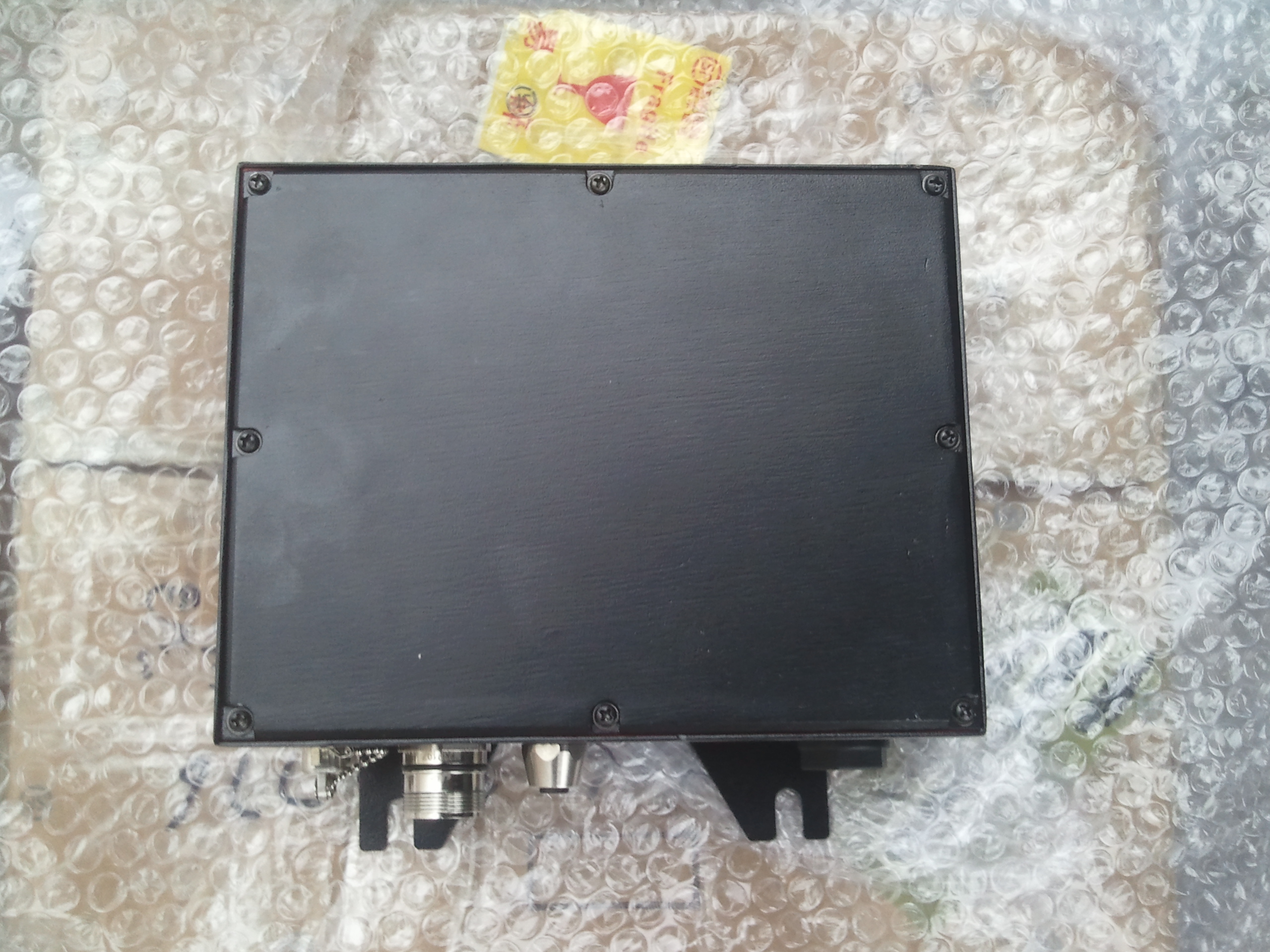
HC4900 LMI controller — a load moment limitation component supplied for XCMG, SANY and Zoomlion truck crane applications.
LWG208 length and angle sensor
The LWG208 length and angle sensor feeds boom geometry data into the LMI chain. Boom length and boom angle are the two inputs that determine the working radius, and radius is what converts a load chart into an actual permissible load. Sensor drift or an incorrect replacement therefore does not simply produce an error code — it corrupts the calculation the operator depends on. Matching the electrical signal characteristics and the mechanical mounting of the original sensor is the whole point of sourcing this part by number rather than by appearance.
IC4600 and IC3600 displays
The IC4600 and IC3600 displays sit at the operator interface of the same system, presenting load, radius and status information. In multi-brand fleets, displays are frequently the first component to be replaced when readings become unstable or the screen fails, and they are also the part most often ordered incorrectly, because visual similarity between display families is high while the underlying configuration is not interchangeable.
Steering unit 1032300052
Steering unit 1032300052 shows the other half of the reliability equation: hydraulics. Steering units on truck cranes operate under continuous pressure and frequent steering input during travel between lifting positions, and they are manufactured here from precision cast steel and forged steel components selected for pressure resistance and corrosion resistance. Direct replacement depends on port configuration, displacement and mounting geometry — again, verified against the original number before shipment.
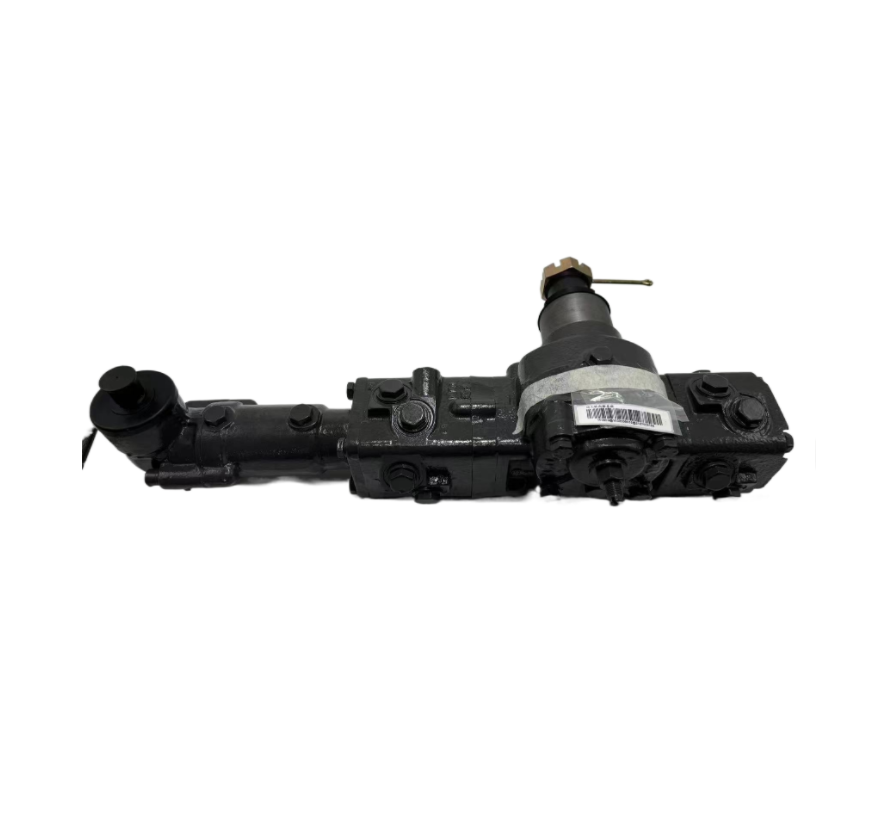
Steering unit 1032300052 — a hydraulic steering component built from cast and forged steel for truck crane chassis applications.
Material Selection Mapped to Function
The most common sourcing error in aftermarket crane parts is treating material as a single attribute. The product data for this range assigns materials by function instead, which is a useful template for buyers evaluating any supplier's claim of interchangeability.
| Component group | Material specified | Functional requirement | Procurement implication |
|---|---|---|---|
| Pins, boom components, pulley blocks | High-strength alloy steel | High toughness and anti-fatigue performance under alternating load | Load-bearing structural replacements; fatigue life is the governing criterion, not hardness alone |
| Hydraulic seals and buffer components | Wear-resistant rubber and polyurethane | Sealing integrity under repeated pressure cycling | Leak-related failures; compound quality drives service interval |
| Pipe fittings and valve bodies | Precision cast steel and forged steel | Pressure resistance and corrosion resistance | Hydraulic system integrity; casting quality determines burst margin |
| Rubber and plastic shock-absorbing parts | High-elasticity polymer materials | Vibration and impact absorption in frequent start-stop duty | Comfort, fastener life and secondary damage prevention |
Two consequences follow. First, a supplier that can explain which material serves which function is describing an engineering decision rather than a catalogue entry. Second, buyers gain a concrete checklist: for structural parts, ask about alloy content and fatigue performance; for hydraulic parts, ask about sealing compounds and casting or forging method; for dampers, ask about polymer elasticity under impact.
How Direct Interchangeability Is Actually Achieved
Interchangeability is a process, not a property. The stated capability behind this range is that parts are manufactured in strict accordance with industry standards and original technical parameters, achieving interchangeability with mainstream brand crane equipment for direct replacement and quick on-site maintenance.
In practice, that depends on the accuracy of part identification before the order is confirmed. Mismatched OEM numbers are the single largest avoidable cause of a returned crane part, and the practical control is technical verification of the number against the machine's model, tonnage and configuration — not visual matching by photograph. This range is stated to fit 20–150 ton truck cranes operating under long-term alternating heavy load, which gives buyers a clear first filter: if the machine sits outside that band, or if the part number cannot be confirmed, the order should not proceed until it is resolved.
Quality control is applied as 100% test on this product line. For a buyer, the meaningful interpretation is that functional testing is a gate on every unit rather than a sample, which matters most for electrical and control components such as LMI controllers, sensors and displays, where a defect is not visible on inspection.
Supplier Profile: What Sits Behind the Part Numbers
Qingdao Top Run International Trade Co., Ltd is a supplier of construction machinery spare parts based in Qingdao, Shandong Province, China, founded in 2004 and focused on the export of China-brand construction machinery spare parts. The company began as a local spare parts store handling domestic parts sales and construction machinery maintenance for the Chinese market, and later shifted its core business to export.
Its current operating base is a 2,000-square-meter professional warehouse with a 150-square-meter office space and a team of 20 employees, including a technical team described as 4 engineers. Export accounts for 100% of sales, with main markets listed as Africa, Southeast Asia, the Middle East, Latin America and Russia. The parts portfolio spans XCMG, SANY, Zoomlion, Lingong, Liugong, Shantui, Lovol, Weichai, Cummins, Shangchai and Yuchai equipment, with truck crane parts for XCMG, SANY and Zoomlion as the core category.
Three supply parameters are relevant at the evaluation stage:
- Production modes: OEM / original, and aftermarket.
- Commercial terms: minimum order quantity of 1 piece, with a stated lead time of 10–15 days and a monthly capacity of 50,000 units.
- Customization boundary: aftermarket parts support custom logos, packaging and dimensional adjustments; original/OEM parts carry no independent customization and follow factory specifications.
That third point is a genuine constraint rather than a feature, and it is worth reading carefully. A buyer who needs a non-standard adaptation cannot obtain it through the original parts channel; a buyer who needs documented factory conformity should not expect it from a customized aftermarket item. The two routes solve different problems.
Third-Party Verification: What the SGS Audit Covers — and What It Does Not
This product line carries an SGS Made-in-China Supplier Audit Report, certificate number QIP-ASI2351381, issued by SGS-CSTC Standards Technical Services Co., Ltd. The audit was conducted in accordance with the Made-in-China Audited Supplier Assessment Criteria, audited by SGS, and applies to the Global market. The issue date recorded is 2023-10-16. The audit scope covers truck crane spare parts, wheel loader parts, grader parts, and road roller construction machinery replacement parts.
The same discipline applies to the safety standards that govern the machines themselves. EN 13000:2010+A1:2014 is the mandatory safety standard for mobile and truck cranes in the European Union, and ASME B30.5-2021 is the primary American national standard for mobile and locomotive cranes, including truck cranes. These standards apply to the crane as a machine, not to an individual replacement component. A supplier that implies otherwise is overstating a document — and that overstatement is itself a warning sign during supplier evaluation.
Application Conditions and a Documented Supply Program
These parts are used on truck cranes, crawler cranes and truck-mounted cranes across infrastructure, bridge and road construction, mining, port handling and municipal engineering. The operating environment is the reason the specification is strict: cranes work outdoors in extreme temperatures, dust and rain, and core components such as hydraulic parts, outrigger accessories, wire ropes, pulleys and seals run under long-term alternating loads, where wear, leakage and fatigue damage are normal rather than exceptional.
Procurement triggers typically fall into four categories: routine maintenance, breakdown repair, equipment overhaul, and crane renovation or modification. One documented supply program involved 50,000 units delivered over a three-month period to a customer base that included construction machinery spare parts wholesalers, local maintenance service companies, truck crane rental firms, crane owners, construction contractors, refurbishment workshops, crane parts distributors, and overseas crane parts traders and importers. The stated result was timely overseas shipment supporting customers' crane maintenance operations, with the operational objective being to minimise crane downtime and keep construction progress continuous.
Traditional Sourcing Routes Compared — Including the Boundaries
Buyers generally choose between three routes. Each has a real limitation, and a supplier that cannot state its own limitation is usually not describing its product accurately.
| Route | What it provides | Documented limitation / boundary | Typical fit |
|---|---|---|---|
| Genuine / original brand parts | Parts produced by the crane brand factory following original drawings with official quality control | No independent customization — specifications follow the factory; procurement is tied to the brand's own channel and availability | Safety-critical assemblies, machines within warranty, projects with strict compliance requirements |
| Aftermarket parts from an established supplier | Parts produced by independent manufacturers as alternatives, manufactured to industry standards and original technical parameters | Quality varies among manufacturers; warranty terms are negotiable rather than official, and technical support is flexible rather than standardized | Non-safety wear parts, out-of-warranty equipment, cost-controlled regular maintenance |
| Counterfeit or unverified parts | No verifiable manufacturing standard | No formal after-sales guarantee at all | No legitimate application |
Within the aftermarket route, the boundary of the Qingdao Top Run model should be stated plainly as well. These are replacement parts, not components manufactured by the crane brands themselves. Interchangeability depends on correct model and part-number confirmation before dispatch, so an order placed on an unverified number will not become correct in transit. And where a project requires the crane manufacturer's own conformity documentation, the aftermarket channel cannot produce it.
Market Signals Behind Replacement Parts Demand
Three signals support the view that verified parts supply is becoming a procurement category in its own right rather than a routine consumable purchase.
The first is geography following the machines. With China accounting for 34.3% of global crane exports in 2024, and India alone importing USD 709 million of Chinese cranes that year, the installed base in importing markets continues to expand faster than brand-owned service coverage. Parts demand is therefore concentrated exactly where local parts depth is thinnest.
The second is the component market underneath the crane. The global industrial hydraulic equipment market was valued at USD 37.5 billion in 2024, according to Custom Market Insights — a reminder that hydraulic components are a substantial supply chain in themselves, with their own quality tiers and counterfeit exposure.
The third is regulatory pressure on load moment limitation. LMI systems are increasingly mandated by safety regulations to prevent overloading and tipping. Where compliance obligations rise, demand shifts toward documented control and sensing components and away from unverifiable substitutes — which favours suppliers able to verify part numbers, hold stock, and present audit evidence.
Future Outlook
Three developments are likely to shape truck crane parts sourcing over the next several years.
First, supplier verification will keep migrating from relationship-based to document-based, driven by the same safety logic that pushes LMI systems into regulation. Certificate numbers, audit scopes and issue dates will become normal line items in purchase requisitions rather than optional extras.
Second, multi-brand consolidation will continue. A single fleet often mixes XCMG, SANY and Zoomlion machines, and managing three separate parts relationships multiplies administrative cost without improving uptime. Suppliers that carry all three ranges, and that verify numbers across brands, reduce that overhead.
Third, the electronic share of the parts basket will grow. LMI controllers, length and angle sensors and displays are precisely the components that require number-level accuracy, are hardest to inspect visually, and are the least forgiving of substitution. The supplier capability that will matter most is not catalogue breadth, but the ability to confirm a number, test the unit, and document the shipment.
Frequently Asked Questions
What is the difference between original and aftermarket truck crane spare parts?
Genuine or original spare parts are produced by the crane brand factory strictly following original drawings with official quality control. Aftermarket parts are produced by independent manufacturers as alternatives, using reference dimensions, without the brand manufacturer's official certification and unified quality standards. Aftermarket parts generally cost less, but quality differs among manufacturers, so supplier selection carries more weight. When choosing, genuine parts suit safety-critical core assemblies, heavy-duty frequent operation, machines within warranty, and projects with strict compliance standards. High-quality aftermarket parts serve as an economical alternative for common non-safety wear parts, out-of-warranty equipment, and cost-controlled regular maintenance — provided the supplier is properly vetted.
What does the SGS Made-in-China Supplier Audit Report actually cover for truck crane parts?
The report carries certificate number QIP-ASI2351381 and was issued by SGS-CSTC Standards Technical Services Co., Ltd. under the Made-in-China Audited Supplier Assessment Criteria. The recorded issue date is 2023-10-16 and it applies to the Global market. The audit scope includes China truck crane parts, wheel loader parts, grader parts, and road roller construction machinery replacement parts. It is a supplier-level audit covering that defined scope; it is not a product type-approval, a homologation certificate, or an OEM authorization issued by XCMG, SANY or Zoomlion.
What tonnage range, minimum order quantity and lead time should a buyer expect for these truck crane parts?
The stated applicable tonnage range is 20–150 ton truck cranes operating under long-term alternating heavy load. Minimum order quantity is 1 piece, stated lead time is 10–15 days, and monthly capacity is 50,000 units. Quality control on this line is applied as 100% test. Actual availability still depends on part-number confirmation: a part number that cannot be verified against the machine's model and configuration should be resolved before an order is placed.
How does Qingdao Top Run compare with other China crane parts suppliers?
The distinguishing combination is supply of both genuine and premium aftermarket crane spare parts from one source, technical matching support, and port logistics from Qingdao. The practical difference is that the technical team verifies OEM numbers before dispatch to reduce mismatching, and buyers can be advised on the choice between original and aftermarket parts based on working conditions and budget. Many suppliers offer only one of the two categories and provide no targeted sourcing advice. The limits are equally relevant: original/OEM parts cannot be independently customized, and aftermarket warranty terms are negotiable rather than official.
For buyers who need the full component list — including LMI controllers, length and angle sensors, displays, steering units, hydraulic valves, gearbox assemblies and structural accessories — a downloadable supplier catalogue is available here: Qingdao Top Run product catalogue. Company and product information for Qingdao Top Run International Trade Co., Ltd is published at xcmg-sany-zoomlion-shantui.com.