
Truck Trailer Scenario Fit: Cement, Mining, Port and Fuel
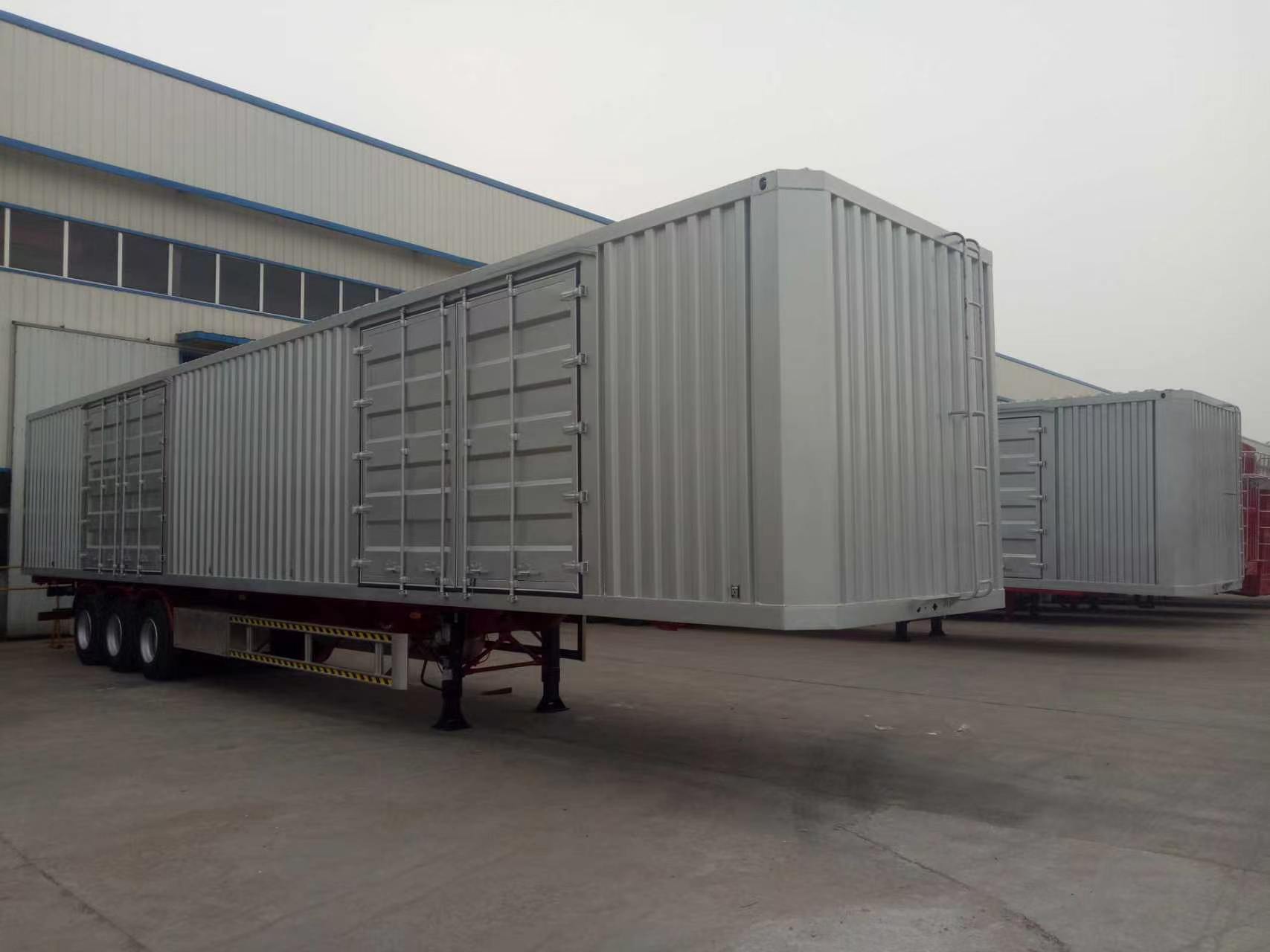
Why Scenario Fit Outranks Trailer Category
Trailer catalogues are organised by product family, so buyers tend to shop the same way: pick a type, then compare prices inside that type. The problem is that product families do not map cleanly onto operating conditions. Inside a single manufacturer's range, a three-axle running gear appears under a powder tank semi trailer rated at 25,000–35,000 kg payload, a liquid tank semi trailer rated at 28,000–35,000 kg payload, and a container chassis rated at 30–65 tons payload. The axles look interchangeable. The tank barrel, the deck height and the container locking pattern are not.
Scenario fit starts from the job instead: what is loaded, how it is discharged, how high the deck must sit, how many axles the route legally permits, and what pressure or locking standard the receiving end requires. Only after those five answers are settled does trailer type become a meaningful choice. A buyer who starts from the category and works backwards usually ends up with a compliant trailer that is operationally mismatched — a 60 m³ powder tanker feeding a plant whose silo inlet sits above its 15 m vertical discharge height, or a lowboy whose deck is too high for the machine it was bought to move.
The Six Operating Scenarios at a Glance
| Operating scenario | Trailer type | Governing fit metric | Typical range |
|---|---|---|---|
| Cement manufacturing and distribution | Powder tank semi trailer | Tank volume and pneumatic discharge pressure | 32–60 m³; 0.196–0.2 MPa working pressure |
| Mining ore and overburden haulage | Dump semi trailer | Axle count and body configuration | 3-axle / 4-axle; U-type or rectangular box |
| Port terminal and intermodal drayage | Container semi trailer / chassis | Container length and twist-lock count | 20 / 40 / 45 ft; 4, 6 or 8 ISO twist locks |
| Petroleum product and oil & gas liquids | Tank semi trailer | Volume, compartment count and payload | 20,000–50,000 L; 28,000–35,000 kg payload |
| Heavy equipment and machinery relocation | Lowboy semi trailer | Payload rating and loaded deck height | 40–100 t payload; 450–600 mm deck height |
| Off-grid natural gas distribution | CNG tube trailer | Gas capacity and tube count | 2,000–6,000 Nm³; 8 to 20 tubes |
Cement Manufacturing and Distribution: Powder Tank Semi Trailers
Bulk cement moves as a fluidised powder, not as a solid load, and that single characteristic removes every tipper and flatbed from consideration. A powder tank semi trailer carries cement in a sealed barrel, fluidises it with compressed air and pushes it up a discharge line into a silo. The specification that matters is the discharge envelope: vertical discharge height up to 15 m and horizontal discharge distance up to 5 m, delivered at a pneumatic discharge speed of roughly 1.6 tons per minute.

Fit criteria for cement duty
- Tank volume against silo capacity and legal weight. Available volumes run 32, 40, 45, 50 and 60 m³, with payload rated at 25,000–35,000 kg and GVW at 40,000–42,000 kg. The largest barrel is not automatically the best buy: a 60 m³ tank filled to its volume limit may exceed the legal payload band, so the volume choice has to be reconciled with the density of the powder being carried.
- Discharge height against plant layout. If the destination silo inlet sits higher than the trailer can lift the material, the vehicle is unusable at that site regardless of its condition.
- Air supply. Fluidisation depends on a PTO-driven or engine-mounted air compressor. A trailer arriving without a working air source is a static tank.
- Material particle size. The pneumatic system is specified for powders of 0.1 mm diameter or finer, which covers cement, fly ash, lime powder, flour and mineral slag — but not coarse aggregate or damp material.
- Barrel material. Q345B carbon steel at 4–6 mm wall thickness is the standard build; a 5083 aluminium alloy variant reduces tare weight where payload rather than durability is the binding constraint.
The boundary is worth stating plainly: a powder tanker is a single-purpose asset. It cannot back-haul palletised goods, it cannot handle wet or agglomerated material, and its 0.196–0.2 MPa working pressure (tested at 0.26 MPa) is a design limit, not a target to push. Operators who need two-way loaded running should treat the powder tanker as a dedicate-and-schedule asset rather than a general fleet unit.
Mining: Dump Semi Trailers and the Axle Question
Mining haulage splits into two very different applications, and only one of them belongs to a semi-trailer. Inside the pit, short cycle distances and soft or variable ground favour a self-propelled rigid dump truck. From the pit exit to the stockpile, processing plant or rail head, where surfaces are firmer and distances longer, a dump semi trailer pulled by a tractor unit is the more efficient configuration because it separates the load-carrying asset from the expensive powered asset.
Dump semi trailers are offered in 3-axle and 4-axle configurations with either a U-type or a rectangular box. The axle count is not a styling choice. It sets the number of load points sharing the payload, and it determines whether the combination stays inside legal axle-load limits when the box is filled with high-density ore rather than with lighter overburden. The box geometry matters too: U-type bodies discharge more cleanly and resist the impact of large lump material, while rectangular boxes offer more usable volume for lighter, more uniform loads.
Field evidence from West African mining and construction fleets illustrates how far the configuration can be pushed. A construction and mining operator in Nigeria and Ghana runs multiple quad-axle dump semi trailers inside a fleet of more than 50 vehicles, with the four-axle layout customised for heavy-load mining conditions. That buyer first purchased parts before committing to complete trailers, then expanded across multiple project sites. Reported service life for the fleet is 10–15 years, comparable to entry-level European trailer brands at a purchase cost reported as 40–60% lower.
Port Terminals and Intermodal Drayage: Container Semi Trailers
Port work is defined by the container, not by the cargo inside it. A container chassis is therefore specified by three numbers: which ISO lengths it accepts, how many twist locks it carries, and how high its deck sits when coupled. Current chassis accept 20 ft, 40 ft and 45 ft ISO containers, with 4, 6 or 8 twist locks compliant with ISO 1161, deck height at 1,470–1,560 mm, and overall length of 12,200–13,800 mm for the standard 40 ft unit.
What terminal operators should check
- Container mix. A chassis locked for 20 ft and 40 ft only will reject 45 ft boxes at the gate. If the terminal handles mixed lengths, the lock pattern has to be specified up front rather than retrofitted.
- Axle count against drayage weight. Two, three and four-axle chassis are available with a 13-ton axle load rating and payload of 30–65 tons. The upper end of that payload band is only reachable with the higher axle counts and the correct tractor combination.
- Suspension. Mechanical leaf spring is the conventional choice; air suspension is available where ride quality and load-height control matter.
- Coupling and landing gear. A 2 inch or 3.5 inch king pin, JOST or SAF landing gear and Q345B main beams are the practical durability baseline for high-cycle port work.
- Deck height against the tractor. Chassis deck height of 1,470–1,560 mm has to be read together with the tractor's fifth-wheel height, typically 1,200–1,400 mm on the HOWO range, because the coupled combination determines overall height and ramp clearance.
The limitation is built into the design: a container chassis is a lock-and-frame product with no cargo body. It cannot substitute for a flatbed on steel coils or a van trailer on weather-sensitive freight. Where the same fleet needs both container and general cargo capability, a container flatbed with twist locks is a separate specification, not a conversion.
Fuel Distribution and Oil & Gas Logistics: Tank Semi Trailers
Liquid energy products impose a different discipline. A tank semi trailer is specified by capacity, compartment count, material and safety architecture rather than by payload alone. Capacity ranges from 20,000 to 50,000 L, with compartment counts from one to six, wall thickness of 5–8 mm, three 13-ton axles, GVW of 40,000–42,000 kg and payload of 28,000–35,000 kg.
Fit criteria for liquid energy duty
- Compartment count against delivery profile. A single-compartment tanker is efficient for one product to one destination. Multi-compartment tanks of two to six bins let one vehicle deliver several grades on a single run, which changes the economics of urban fuel distribution more than any other single option.
- Material against cargo chemistry. Carbon steel Q235B or Q345B suits petroleum products; stainless steel 304 or 316 is the specification for food-grade and aggressive chemical liquids; 5083 aluminium alloy trades some robustness for tare weight.
- Safety architecture. Petroleum duty requires an earthing reel and anti-static compartment separation, a top DN500 manhole cover, an emergency valve, a pressure vent and rollover protection. These are not accessories to be negotiated down.
- Discharge method against the receiving facility. Bottom valve, pneumatic or pump discharge must match what the depot or filling station can accept.
Two honest constraints deserve emphasis. First, volume and payload are not the same number: a 50,000 L barrel filled with a low-density product may sit well below the 28,000–35,000 kg payload band, so the capacity choice should follow the product's density and the GVW ceiling of 40,000–42,000 kg. Second, a liquid tanker cannot carry dry bulk — cement, fly ash and lime stay with the powder tank semi trailer, whose pneumatic discharge system is a different engineering solution entirely.
Heavy Equipment and Mining Machinery Relocation: Lowboy Semi Trailers
Moving an excavator, bulldozer or crane is a height problem before it is a weight problem. A lowboy semi trailer solves it by dropping the deck to 450–600 mm when loaded, which keeps the machine's overall transport height within a maximum legal load height of up to 3.5 m. Payload ratings span 40–100 tons across 3-axle and 4-axle configurations, with overall length of 11,000–18,000 mm and width of 2,480–3,000 mm.

Fit criteria for heavy-haul duty
- Loaded deck height against machine height. This is the first calculation, not the last. Deck height plus machine height plus any rigging must stay inside the 3.5 m transport envelope.
- Gooseneck type against loading method. Fixed gooseneck suits drive-on or ramp loading; a hydraulic detachable gooseneck allows front loading from ground level, which matters for machines that cannot climb a ramp.
- Main beam specification against concentrated loads. Q550, Q690 and HG785D quenched and tempered steel in a box-section main beam is the structural basis for the upper end of the payload range.
- Neck height and ramp type. Neck height of 1,200–1,400 mm and mechanical or hydraulic ramps determine how the combination interfaces with the tractor and the loading area.
Here the boundary is arithmetic rather than theoretical. The 40–100 ton figure is the trailer's structural rating; the payload actually available to the operator is set by the lower of legal axle-load limits (13–16 tons per axle), the GVW ceiling and the tractor's own coupling capacity. A standard tractor unit in this class carries a 20,000 kg fifth-wheel rating, so the vertical load transferred through the king pin is a real constraint that must be reconciled with the trailer's gross rating before the combination is committed to a route. Buyers should also test whether a lowboy is required at all: where the cargo is 40–60 tons and does not exceed normal height, a flatbed semi trailer with a 1,250–1,550 mm deck and tie-down rings every 500 mm will often do the job at lower complexity.
Off-Grid Natural Gas Distribution: CNG Tube Trailers
Compressed natural gas has no pipeline alternative in remote industrial sites, so the fuel is delivered as a pressurised cargo in cylinder bundles mounted on a trailer frame. CNG tube trailers are configured with 8, 10, 12 or 20 tubes, with gas capacity typically in the 2,000–6,000 Nm³ range depending on tube count and cylinder specification.
Fit criteria for gas distribution duty
- Delivered volume per trip against consumption. The tube count is the primary lever. A 20-tube unit carries more gas per journey than an 8-tube unit, but it also adds mass and reduces the payload margin available for everything else on the combination.
- Fill and return cycle. A tube trailer is only productive when both ends of the route have compression capacity. A site without a filling station converts the trailer into stationary storage.
- Pressure duty versus cylinder inspection regime. High-pressure containment drives the maintenance and inspection cycle, and that cycle should be part of the total cost model rather than an afterthought.
The limit is structural: a CNG tube trailer is a delivery mechanism, not a substitute for a pipeline or an on-site liquefaction plant. For sites with steady, high-volume demand, the economics of repeated tube-trailer trips should be tested against on-site alternatives before a fleet of trailers is committed.
Matching Deck Height, Axle Configuration, Payload and Working Pressure
Across all six scenarios, four variables do most of the work. Reading them in the right order prevents the most common specification errors.
| Variable | What it decides | Where it binds |
|---|---|---|
| Deck height | Whether the cargo physically fits inside the transport envelope | Lowboy at 450–600 mm loaded; flatbed at 1,250–1,550 mm; container chassis at 1,470–1,560 mm |
| Axle configuration | How payload is distributed and whether legal axle loads are respected | 13 tons per axle on tank, powder and container units; 13–16 tons per axle on lowboy |
| Payload | The usable cargo band after GVW and tractor coupling limits are applied | 25,000–35,000 kg powder; 28,000–35,000 kg liquid; 30–65 tons container; 40–100 tons lowboy |
| Working pressure | Whether the cargo can be moved or discharged at all | 0.196–0.2 MPa pneumatic discharge for powders; high-pressure containment for CNG |
The sequencing rule is straightforward. Start with the cargo's physical form — solid, powder, liquid or gas — because that decides whether the trailer needs a box, a barrel, a deck or a pressure vessel. Then fix deck height or discharge geometry, because those are the constraints that cannot be changed after delivery. Then size the axle configuration and payload together, checking the tractor's coupling rating rather than assuming it. Working pressure comes last for powders and gases, but it is a pass-or-fail criterion: a powder tanker rated below the receiving silo's back-pressure requirement is simply the wrong asset.
Where Scenario Fit Breaks Down
Scenario fit is a narrowing process, and honest specification means naming the cases where a given trailer type is the wrong answer.
- Payload ratings are structural, not legal. A lowboy rated for 100 tons does not deliver 100 tons of legal payload on a route limited to 13–16 tons per axle and constrained by a 20,000 kg fifth-wheel rating on a standard tractor.
- Powder tankers are single-purpose. The 0.1 mm particle limit and the pneumatic air requirement rule out coarse, wet or agglomerated material, and the barrel cannot back-haul general cargo.
- Container chassis are length-specific. A lock pattern built for 20 ft and 40 ft boxes will not accept 45 ft units without specification at the ordering stage.
- Liquid tanks trade volume against weight. The GVW ceiling of 40,000–42,000 kg limits how much of a 50,000 L capacity can actually be used with dense or light products alike.
- Semi-trailers are not site machines. On confined urban sites with restricted access, a self-propelled dump truck remains the practical choice.
- Gas trailers depend on infrastructure. Without compression capacity at both ends of the route, CNG capacity on the trailer is not usable capacity.
What Shandong Luen Auto Supplies Across These Scenarios
Shandong Luen Auto Co., Ltd. is a Chinese manufacturer and exporter of semi-trailers and trucks, based in Xuji Industrial Park, Liangshan County, Jining City, Shandong Province, and a subsidiary of Luen Group. The company operates a factory of more than 50,000 m² with a workforce of over 100 employees, an annual output of approximately 1,500 units, an in-house engineering team of 5, and an export share of about 80%, with Africa, South America and the Middle East as its main markets.
Its trailer range covers the six scenarios described above: powder tank semi trailers, dump semi trailers, container and skeleton semi trailers, tank semi trailers, lowboy semi trailers and CNG tube trailers, alongside flatbed and van semi trailers. The truck side of the business supplies the tractor units that these trailers depend on — HOWO and Shacman tractor trucks with GCW ratings of 40,000–120,000 kg and 40,000–100,000 kg respectively, both built around a 90# fifth wheel with a 20,000 kg capacity — plus dump trucks and light duty trucks for the site work that trailers cannot reach.
Manufacturing is factory-direct rather than trading-company sourced, with OEM production available. Customisation covers trailer type, overall dimensions, axle configuration, load rating, beam structure, suspension type, rim and tyre specification, landing gear, king pin, paint and coating, and branding. Lead time is 30–45 days for standard configurations, with custom orders scheduled according to specification complexity, and the minimum order quantity is one unit for standard models, which allows a single-vehicle trial before fleet commitment. Every unit is inspected before shipment, and the production system operates under CCC mandatory certification with in-house load, brake performance and dimensional testing. Warranty terms run to one year on new trucks, six months on trailer driving and supporting devices, and one year on trailer carrying devices, supported by local Sinotruk agent service points in several export markets. Documented export destinations include Nigeria, Ghana, Tanzania, Kenya, Mozambique, Indonesia, the Philippines, Kazakhstan, Saudi Arabia, the UAE, Ecuador, Peru and Pakistan.
Market Trend: Mixed Fleets, Mixed Scenarios
The purchasing pattern visible across Luen Auto's export markets is a shift away from single-type fleet buying. Operators serving construction, mining, fuel distribution and port work with the same balance sheet increasingly assemble mixed fleets — a small number of specialised units such as powder tankers or lowboys, plus a larger core of general-purpose assets — because utilisation, not purchase price alone, decides returns. This is reinforced by the used-equipment side of the market, where used tractor trucks pair with new trailers to keep capital exposure low while the specialised load-carrying equipment is bought new.
A second observable trend is specification-led buying. Buyers increasingly ask for axle configuration, deck height and discharge parameters to be confirmed in writing before order, rather than accepting a category description. That shift favours manufacturers who publish verifiable parameters and can customise at the configuration level, and it disadvantages sellers who compete only on headline price.
Future Outlook
Three developments are likely to shape trailer specification over the next buying cycles. First, weight-driven design will spread: aluminium alloy barrels in powder and liquid tankers, and higher-strength steels such as Q550, Q690 and HG785D in lowboy main beams, allow payload to be recovered where legal limits are tight. Second, pressure and safety architecture will become a more prominent part of the purchase decision in fuel and gas logistics, since earthing, emergency valves and pressure venting are increasingly reviewed as system requirements rather than options. Third, mixed-scenario fleets will push manufacturers toward configuration-level customisation — the ability to change axle count, deck height or compartment layout without changing the underlying platform — because the buyer's route profile, not the catalogue, is becoming the specification document.
For buyers in the research and evaluation stages, the practical conclusion is unchanged: state the scenario first, then let the trailer type follow. The full Luen Auto range, including configuration options across these six scenarios, is set out in the LUEN Auto product catalogue.
FAQ
Which trailer type is used for bulk cement distribution rather than general dry cargo?
Bulk cement moves in a powder tank semi trailer, also described as a bulk cement tanker or pneumatic dry bulk trailer. The barrel is filled with dry powder, fluidised with compressed air and discharged through a line at working pressure of 0.196–0.2 MPa, reaching vertical discharge heights up to 15 m and horizontal distances up to 5 m at roughly 1.6 tons per minute. Available tank volumes are 32, 40, 45, 50 and 60 m³, with payload rated at 25,000–35,000 kg and GVW at 40,000–42,000 kg.
How much payload can a lowboy semi trailer actually carry?
Lowboy semi trailer payload ratings span 40–100 tons across 3-axle and 4-axle configurations, with a loaded deck height of 450–600 mm. That figure is the trailer's structural rating. The payload available on a specific route is the lower of the legal axle-load limit (13–16 tons per axle), the combination's GVW ceiling and the tractor's fifth-wheel capacity, which is 20,000 kg on the standard tractor units in this class.
Can one container chassis handle 20 ft, 40 ft and 45 ft containers?
Container chassis are built for 20 ft, 40 ft and 45 ft ISO containers with 4, 6 or 8 twist locks compliant with ISO 1161. Whether a single chassis accepts all three lengths depends on its lock pattern and locking positions, which must be specified at the ordering stage. A chassis configured for 20 ft and 40 ft only will not accept 45 ft units.
What working pressure does a powder tank semi trailer need?
Powder tank semi trailers operate at a working pressure of 0.196–0.2 MPa, with a test pressure of 0.26 MPa. Discharge performance depends on a PTO-driven or engine-mounted air compressor supplying the fluidisation system, and the design is intended for powders of 0.1 mm diameter or finer, such as cement, fly ash, lime powder, flour and mineral slag.
When should a mining operation choose a dump semi trailer instead of a dump truck?
A dump semi trailer separates the load-carrying asset from the powered tractor, which suits longer runs on firmer surfaces from pit exit to stockpile, plant or rail head, and allows 3-axle or 4-axle configurations with U-type or rectangular boxes. A self-propelled 6×4 dump truck, carrying 16–25 m³ per load, is the practical choice for short cycles of 500 m to 5 km on confined sites with a tight turning radius.
What determines the capacity of a CNG tube trailer?
CNG tube trailer capacity is set primarily by the number of tubes, with configurations of 8, 10, 12 and 20 tubes and gas capacity typically in the 2,000–6,000 Nm³ range. Capacity per trip has to be read together with the consumption profile of the receiving site and the availability of compression capacity at both ends of the route, since a trailer cannot be refilled without a filling station.
Tem questões ou precisa de mais detalhes?
Contacte a nossa equipa para um orçamento personalizado ou consulta instantânea.
Solicitar orçamento
Preencha o formulário abaixo e a nossa equipa entrará em contacto com uma proposta personalizada.
Chat direto do WhatsApp
Prefere conversar em tempo real? Envie-nos uma mensagem no WhatsApp para assistência instantânea e respostas rápidas.
- Obter orçamento personalizado
- Partilhar fotos ou documentos
- Discuta as suas necessidades diretamente
Geralmente responde em 5–30 minutos durante o horário de expediente.