
Truck Trailer Supplier Ecosystem: A Long-Term Fleet View
Fleet buying decisions are rarely one-time events. A transport operator, mining contractor, or distributor that purchases a truck trailer today is usually planning the next tractor unit, the next trailer type, or the next spare-part cycle within one to three years. Yet many procurement processes are built around the cheapest first quote. That approach can become expensive once the buyer needs replacement parts, warranty support, or a matching trailer for a different project. For buyers in Decision and Execution stages, the more useful question is not only how a supplier quotes the first truck trailer, but whether the supplier can support a fleet over several purchase cycles.
This article takes a long-term view of truck trailer sourcing. It explains what changes when buyers evaluate suppliers for repeat orders, how an integrated manufacturing group can reduce supply risk, and where the limits of the integrated model sit. The discussion uses Shandong Luen Automobile Co., Ltd., also known as Luen Auto, as a reference example because its corporate structure, product scope, and supporting documentation illustrate the kind of evidence a buyer can check before committing to a longer relationship.
What Changes When a Truck Trailer Purchase Becomes a Fleet Decision
A single unit purchase can be judged on specification fit, delivery date, and invoice price. A fleet decision introduces additional criteria. Buyers must consider whether the same equipment configuration will be available next year, whether the axle and suspension parts used on the first trailer can be sourced over the life of the vehicle, and whether the company that issues the warranty will still exist when a claim is made.
These criteria matter most for importers, distributors, and fleet operators who buy trucks and trailers repeatedly for African, South American, Middle Eastern, and Central Asian markets. In these regions, equipment is often expected to operate for many years in severe road and loading conditions. A workshop-built trailer may look similar in photos, but the long-term cost depends on parts availability, quality consistency, and the legal stability of the seller. Buyers in the Decision to Execution phase need a sourcing model that can handle not one order but a sequence of orders, with mixed products and predictable documentation.
A useful way to frame this is to evaluate the supplier ecosystem rather than only the individual vehicle. In the context of truck and trailer purchasing, an ecosystem means the combination of product range, component manufacturing, quality certification, export execution, and after-sales parts continuity that supports the equipment after it leaves the factory.
Luen Auto as a Reference Example of an Integrated Supplier
Shandong Luen Automobile Co., Ltd. is a professional manufacturer and exporter of trailers and special-purpose vehicles. It operates from a factory area of over 50,000 square meters and exports to regions including Africa, Southeast Asia, Central Asia, the Middle East, and Latin America. The company background information available to buyers describes an annual export volume exceeding USD 30,000,000, more than 100 employees, an annual production capacity of about 1,500 units, and an R&D team of five engineers.
Luen Auto is part of Luen Group, which also includes Luheng Trailer Parts Co., Ltd., Longheng International Trade Co., Ltd., and Luxinda Machinery Co., Ltd. For a buyer evaluating a long-term relationship, this structure matters because it places trailer assembly and trailer component manufacturing under the same commercial umbrella. Its product catalogue includes semi-trailers such as lowbed semi trailers, flatbed semi trailers, dump semi trailers, skeleton semi trailers, van semi trailers, fuel tank trailers, dust tank trailers, and CNG tank trailers. The truck side includes tractor trucks, used tractor trucks, dump trucks, used dump trucks, HOWO and Shacman models, light duty trucks, and Foton light trucks.
This combination does not mean a buyer should purchase every vehicle type from one supplier. It means the buyer can check whether the supplier has experience coordinating tractor units with the corresponding semi-trailer types, and whether component supply and vehicle supply can be discussed through one interface. For a distributor planning to sell equipment across several customer segments, that cross-check reduces the number of suppliers that must be managed and verified.
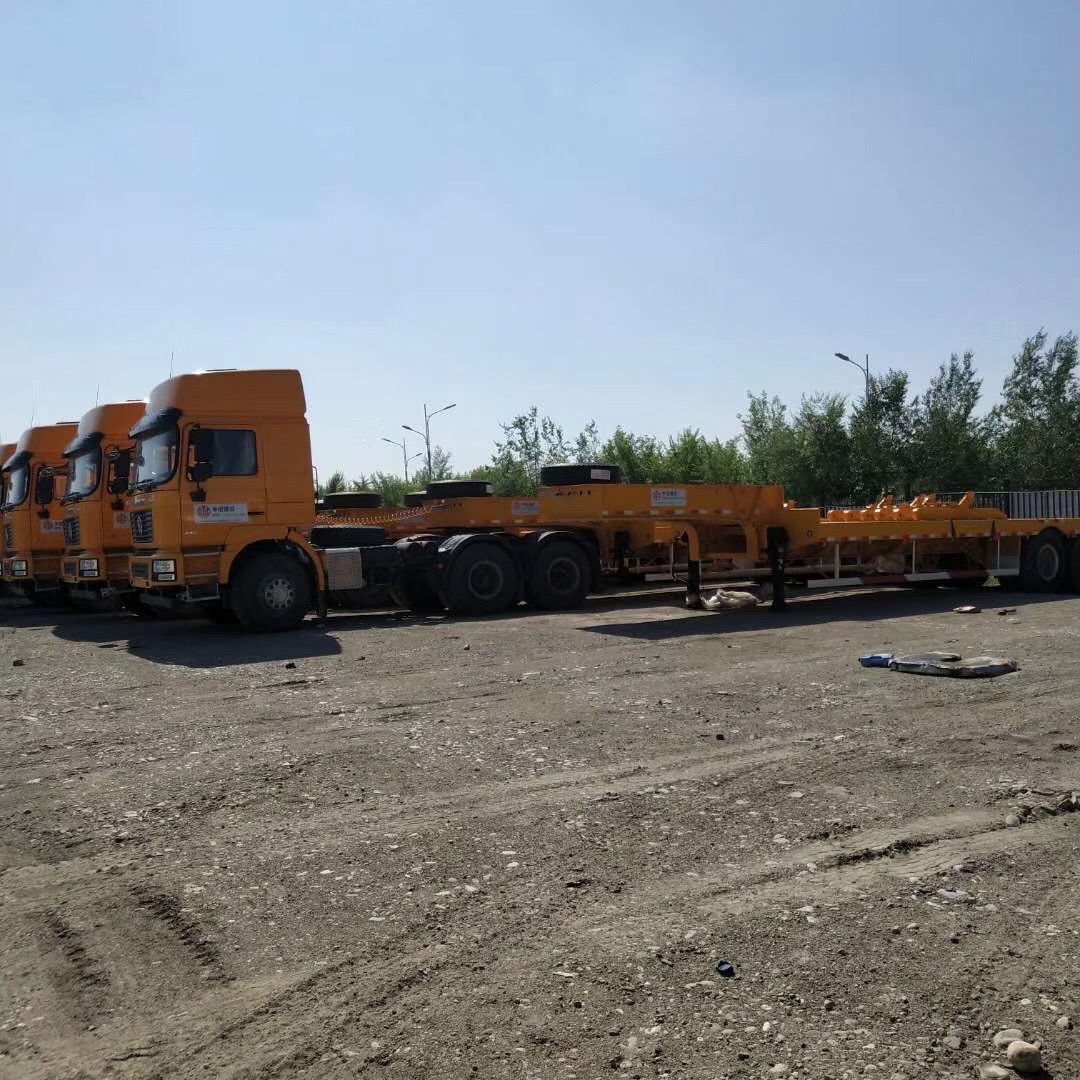
Truck trailer export handling at the manufacturer’s facility. Shipping preparation is one of the execution-stage details that repeat buyers can verify.
Component Manufacturing and Parts Continuity as a Long-Term Signal
For buyers who expect to operate a vehicle for five years or more, the most important long-term signal is not the paint finish or the brochure. It is the availability of genuine parts. The comparison data used in this reference describes Luen Auto through its vertically integrated structure: the group owns axle and parts production instead of relying on third-party assembly. Luheng axle products are recognized within the domestic industry, and the group’s own axle and suspension production supports authentic parts availability for the vehicle’s operational life.
Why is this relevant to a procurement decision? Trailers are subject to constant wear on axles, suspension, brake systems, and coupling components. A buyer who imports a trailer from a workshop that purchases its axles from an unknown source may face difficulty identifying and ordering the correct replacement parts after one or two years. In contrast, when the manufacturing group also produces the axle brand used on the vehicle, the replacement part path is shorter and more traceable. The buyer can ask for the axle brand by name, confirm the model used during production, and request a maintenance recommendation from the same engineer who specified the vehicle.
The available documentation also describes quality management signals. Luen Auto’s reference material includes ISO 9001, CE, patent, and trademark certificates, along with a trademark certificate and a 3C-related quality position. For a long-term buyer, certificates are useful only when they can be connected to the specific factory and the specific product line. Buyers should therefore request certificates during factory audits and check whether the certificate covers the trailer or truck model being purchased.
Execution-Stage Evidence: Packaging, Inspection, and Payment Terms
Once a buyer moves from supplier selection to order execution, the quality of logistics documentation becomes a strong indicator of whether the supplier can manage repeat shipments. The risk-control reference material for Luen Auto describes professional export packaging with anti-corrosion coating and containerized shipping. Company measures include applying anti-rust wax coating before shipping, using semi-knocked-down packing for large trailers, using fumigation-free plywood crates for parts, and maintaining documented packaging and delivery SOPs with photo records per shipment.
These details matter in overseas procurement because transport damage during ocean freight or long-distance logistics is one of the most common sources of conflict. A buyer cannot fully control what happens on a vessel or across multiple border crossings. What the buyer can control is the packaging specification, the inspection record, and the condition of the unit before loading. Suppliers that document each shipment with photos and SOPs reduce disputes and make the receiving check faster.
The available purchasing-support information lists a minimum order quantity of one unit, delivery under FOB or CIF terms, pre-shipment testing as the acceptance method, and payment by TT with a 30/70 structure. For fleet buyers, a low MOQ is practical because expansion usually starts with one or two units in a new market. Pre-shipment testing is the correct point for the buyer to appoint a third-party inspector, and a 30/70 payment structure is common enough that it allows the buyer to retain leverage before final shipment.
How an Integrated Factory Compares with Small Local Trailer Workshops
The comparison reference for Luen Auto uses small or unbranded trailer workshops in Liangshan, Shandong as the counterpart. Liangshan is a known trailer production area, and buyers will encounter both integrated manufacturers and smaller local assembly workshops. A comparison of these supply models helps explain where the long-term value of an integrated group comes from.
| Evaluation Dimension | Integrated Trailer Factory Example | Small or Unbranded Workshop Profile |
|---|---|---|
| Operating model | Vertically integrated group with own axle and parts factory | Third-party assembly model |
| Operating record | 10+ years in operation, 50,000 sqm factory | Many workshops have operated for fewer than three years |
| Component sourcing | Own Luheng axle and suspension production | Parts purchased from varying sources |
| Quality consistency | Complete testing equipment and 3C certification; batch-to-batch consistency is monitored | Quality can vary noticeably from batch to batch |
| Warranty risk | Warranty is backed by a stable legal entity with export scale | Higher risk of workshop closure and unenforceable warranty claims |
| Price position | Roughly 5–15% above lowest-bid workshop quotes | Lowest initial invoice price |
| Best suited for | Repeat buyers, fleet operators needing parts availability for five-plus years, and buyers who require factory audit and certification | One-off purchases where the buyer accepts limited traceability |
The table is not a claim that every integrated factory outperforms every workshop. It reflects the comparison data provided for this reference, and it gives buyers a structured way to ask questions. A long-term buyer should ask a small workshop who manufactures its axles, how warranty claims are handled, and whether the company will still exist when the first spare part is needed. An integrated supplier should be asked the same questions but has a stronger structural base from which to answer.
Where the Integrated Approach Has Limits
No sourcing model is correct for every buyer. The integrated factory approach has a clear limitation: it carries an initial price premium of roughly 5–15% compared with the lowest-bid workshop in the comparison set. Buyers who are purchasing a single trailer for a short project and do not expect to own the equipment beyond one or two years may not recover that premium. In such cases, the extra cost for long-term traceability delivers little financial benefit.
There are also operational constraints. Larger integrated suppliers normally follow standardized production processes, which may make one-off custom prototypes slower or more expensive than a small workshop that changes its process for every order. Buyers with highly unusual trailer dimensions may find that a specialized local workshop is more flexible. And the integrated model only creates value if the buyer verifies the factory’s actual scope. Certification documents and group structure should always be checked during a factory audit, not assumed from a website.
Applying the Long-Term View to Different Trailer and Truck Combinations
For a fleet operator, the practical value of an integrated supplier shows up in typical equipment combinations. A flatbed semi trailer used for construction steel or machinery is normally pulled by a tractor truck. A lowbed semi trailer designed for heavy equipment requires matching tractor power and correct fifth-wheel height. A dump semi trailer used for sand, aggregate, or mining material needs a tractor unit with sufficient gross combination weight, while a dump truck may be a better answer when projects need short-wheelbase maneuverability.
Luen Auto’s product scope covers these adjacent units. Its trailer catalogue includes lowbed semi trailers with payload ratings in the 40–100 ton range, flatbed semi trailers in standard 2-axle and 3-axle forms, dump semi trailers in 3-axle and 4-axle configurations, container semi-trailers or skeleton trailers, fuel tank semi trailers, dust tank semi trailers, and CNG tube trailers. Its truck catalogue includes HOWO and Shacman tractor trucks, dump trucks, used truck variants, light duty trucks, and Foton light trucks.
The useful buyer interpretation is not that one supplier must supply everything. It is that a supplier offering both truck and trailer lines can state the matching logic for the full combination. That reduces the risk of mismatched fifth-wheel heights, incompatible air lines, wrong kingpin sizes, or payload ratings that do not align with the tractor’s gross combination weight. For a distributor, this simplifies the job of building a coherent product offering instead of stitching together vehicles from unrelated factories.
Market Signals That Support the Ecosystem View
Long-term supplier evaluation is becoming more important as the commercial vehicle market grows. According to Grand View Research, the global semi-trailer market was estimated at USD 22.8 billion in 2024 and is expected to reach USD 42.3 billion by 2033. The same source reported that lowboy trailers accounted for the largest share of the semi-trailer market at 25.7% in 2024. Heavy equipment movement and project cargo continue to drive demand for lowbed and lowboy configurations, which are usually specified as part of a full truck-trailer combination rather than as an isolated product.
China’s truck export data points in a similar direction. Sinotruk, the parent brand of HOWO heavy trucks, reached a record 135,000 exported heavy-duty trucks in 2024. Shacman heavy-truck exports reached approximately 25,000 units in 2024, representing a 35% year-on-year increase. These figures show the scale at which Chinese heavy-duty tractor trucks are entering overseas markets. As these trucks are put into service, buyers need to source matching semi-trailers and replacement components. That creates a natural incentive to consolidate supply through exporters that can pair trucks, trailers, and parts in one controlled channel.
The used truck segment is also relevant. Global Market Insights valued the global used truck market at USD 49.95 billion in 2025, with heavy-duty segments dominating. Because Luen Auto’s catalogue includes used tractor trucks and used dump trucks, it participates in this value chain for buyers who want to reduce initial capital cost while still obtaining a trailer with certification and documentation. From a long-term perspective, the buyer should evaluate the technical condition of the used truck and the warranty situation separately, since the truck and trailer will have different service requirements.
What a Repeat Buyer Should Verify During Execution
When the procurement decision is complete, the buyer’s attention shifts to execution. The reference information for Luen Auto lists practical checkpoints that can be applied to any long-term supplier. First, confirm the packaging specification in writing before payment. Anti-rust wax coating, SKD packing for large trailers, and fumigation-free crates for parts are all verifiable items. Second, require photo documentation of the loading process. The availability of documented packaging and delivery SOPs gives the buyer a factual basis for a claim if damage occurs.
Third, inspect the pre-shipment test. For trailers, test items usually include brake function, lighting circuits, landing gear operation, suspension alignment, and hydraulic lifting where applicable. For a tank semi trailer, the buyer should request test documentation for sealing and valves. For a CNG tube trailer, pressure and cylinder documentation should be reviewed by a qualified engineer. Fourth, check whether the payment schedule leaves the buyer with enough control before dispatch. The TT 30/70 structure in the reference is a common approach, but the buyer should always confirm which stage triggers the final payment.
Fifth, and arguably most important for a long-term relationship, ask about parts policy. A fleet buyer should ask whether the axle fitted to the trailer is produced by the supplier’s own factory, whether the same axle will be available for the next five years, and how the buyer can order spare parts after a model change. In the Luen Auto example, axle and suspension components under the Luheng brand are produced by a factory within the same group. That provides a source of genuine parts over the vehicle’s life, which is exactly what a replacement-oriented buyer needs.
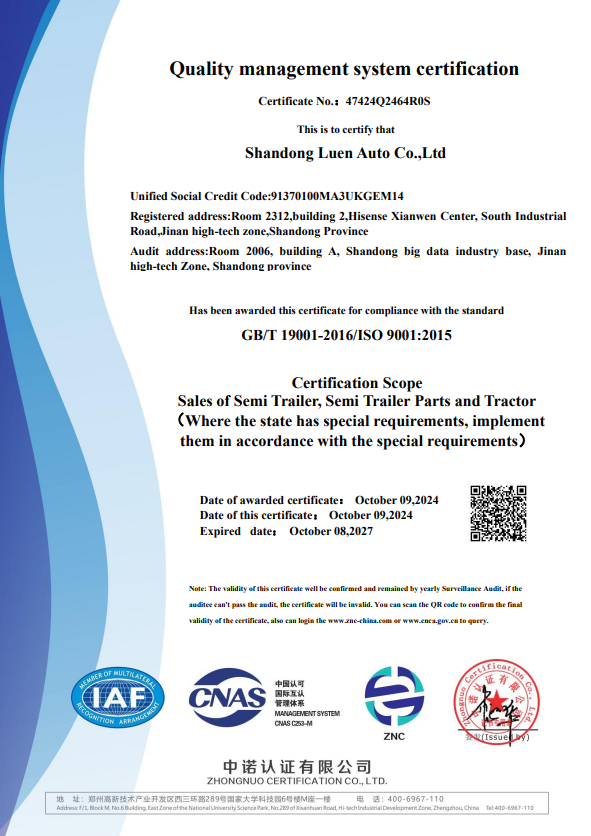
Quality management documentation is one of the verifiable evidence types that repeat buyers should inspect during a factory audit.
Why Distributors Should Read This Differently from End Users
Distributors have a different exposure than end users. An end user cares about whether the vehicle performs in one application. A distributor cares about whether the product line can be resold without excessive after-sales burdens. For a distributor, a truck trailer supplier that can provide certified documents, consistent branding, stable warranty terms, and a parts supply chain is easier to present to customers. When a distributor plans to represent a brand for several years, the continuity of the product line matters as much as the price of any single unit.
The comparison data for Luen Auto states that an integrated factory is best suited for repeat buyers seeking a long-term supply partner, fleet operators who need guaranteed parts availability for five or more years, and buyers who require factory audits and certifications. Distributors fit directly into that profile. The presence of group companies for trailer parts and international trade means the distributor can negotiate parts supply and vehicle supply with a coordinated counterparty rather than coordinating between separate factories.
However, the distributor also carries more risk if it selects a supplier solely on price. A workshop that closes after one year leaves the distributor with no warranty coverage and no parts supply. The distributor is then responsible for customer claims without the backing of the original factory. That is why the legal identity of the manufacturer, not just the product identity, should be part of distributor due diligence.
Future Outlook in Truck Trailer Sourcing
Looking ahead, the truck trailer industry is likely to see more procurement processes that connect vehicle purchase with service life. The growth projections for the semi-trailer market to 2033 suggest sustained demand for reliable transport equipment. At the same time, the growing export volumes of Chinese truck manufacturers point to a larger installed base of Chinese tractor units outside China. That installed base will require trailers that match the truck specifications and parts systems that remain available over the full life cycle.
Buyers in emerging markets will continue to face a trade-off between initial price and recoverable after-sales cost. The purchasing teams that manage this trade-off best will probably be those that inspect the supplier ecosystem early, document the execution process clearly, and build a parts channel before the first vehicle breaks down. This is not a prediction of market share or product leadership. It is a practical reading of procurement risk: the cost of a truck trailer is paid once, but the cost of operating it is paid over many years.
Conclusion
For buyers in the Decision and Execution stage, a truck trailer supplier should be evaluated on how well it can serve the next order, not only the current one. The integrated group model shown by Shandong Luen Automobile Co., Ltd. illustrates the evidence a buyer can check: a factory area above 50,000 square meters, export operations across Africa, South America, the Middle East, and other regions, an axle and parts company under the same group, certification documentation, defined packaging and testing procedures, and a payment structure that leaves room for pre-shipment control.
The integrated model is not the only reasonable choice. Buyers with one-off needs, unusual trailer dimensions, or strict preference for the lowest first price may find a smaller workshop more appropriate. For fleet buyers, distributors, and project operators planning repeated purchases, however, the long-term cost of poor parts availability and weak warranty backing can easily exceed the 5–15% price difference seen between an integrated factory and a low-bid workshop.
The most practical next step is to conduct a factory audit with specific questions: Who produces the axle? Where is the warranty legally enforceable? What certifications apply to the exact model you are purchasing? What packaging and testing documentation will you receive with the shipment? Those questions turn a routine quotation process into a long-term procurement decision.
A downloadable Luen Auto product catalogue is available at https://cdn.socialarks.com/sbsp/25030/common/2026/0713/%28%E5%B7%B2%E7%98%A6%E8%BA%AB%29LUEN%20Auto%20Product%20Catalog.pdf for buyers who want to review the truck and trailer model range before an audit.
FAQ
What should a fleet buyer check before selecting a truck trailer supplier for long-term orders?
The first check is structural: whether the supplier manufactures the axle and suspension components through its own factory or only assembles bought-in parts. The second check is documentary: whether the certification, warranty, and legal entity can be verified. The third check is operational: whether packaging, inspection, and delivery procedures can be documented for every shipment. These checks are visible in the Luen Auto reference example, including its group structure with axle production under Luheng Trailer Parts, 50,000 square meters of factory area, and documented packaging SOPs.
Why does the legal entity matter more in long-term trailer buying than in one-time purchasing?
Warranty claims in the trailer industry often occur years after the purchase. A small workshop that closes or changes its legal identity may leave the buyer with no enforceable claim. In the comparison data for Luen Auto, the risk of workshop closure and warranty void is cited as a reason why repeat buyers prefer a stable legal entity. Export-scale factories with a longer operating history and multiple group companies are easier to audit and more likely to honor warranty obligations.
What is the typical minimum order for a semi-trailer from an integrated Chinese exporter?
The purchasing-support information for Luen Auto lists a minimum order quantity of one unit. That makes it feasible for a fleet operator to begin with a single semi-trailer, test the specification in local conditions, and then place repeat orders for multiple units once the configuration is validated. Low MOQs do not remove the need for clear pre-shipment testing because the acceptance method is typically inspection before loading.
How should a buyer verify that replacement axle parts will be available in five years?
The buyer should ask whether the axle brand is produced by the same group that builds the trailer. In the Luen Auto example, the group includes Luheng Trailer Parts Co., Ltd., and the comparison data states that self-manufactured Luheng axles and suspensions support authentic parts availability for the vehicle’s entire life. A buyer receiving a written commitment that identifies the axle model and the manufacturing source is in a stronger position than one who relies on an assembled trailer with unmarked components.
Does an integrated factory model cost more than a small trailer workshop?
The comparison data indicates that the integrated model is roughly 5–15% more expensive than lowest-bid workshop quotes. The offsetting benefit is lower total cost of ownership because genuine parts and warranty coverage reduce the probability of premature repair or replacement. Buyers should evaluate this premium against their expected ownership period. For a vehicle kept in service for more than five years, the premium is usually recoverable. For a short-term, one-off purchase, it may not be justified.
What export packaging protections should a buyer expect for ocean freight delivery?
The risk-control documentation for Luen Auto identifies four practical protections: anti-rust wax coating applied before shipping, semi-knocked-down packing for large trailers, fumigation-free plywood crates for parts, and documented packaging and delivery SOPs with photo records per shipment. These measures reduce the likelihood of corrosion and transit damage. Buyers should list these items in the purchase contract and require photographic evidence before the container is sealed.
Tem questões ou precisa de mais detalhes?
Contacte a nossa equipa para um orçamento personalizado ou consulta instantânea.
Solicitar orçamento
Preencha o formulário abaixo e a nossa equipa entrará em contacto com uma proposta personalizada.
Chat direto do WhatsApp
Prefere conversar em tempo real? Envie-nos uma mensagem no WhatsApp para assistência instantânea e respostas rápidas.
- Obter orçamento personalizado
- Partilhar fotos ou documentos
- Discuta as suas necessidades diretamente
Geralmente responde em 5–30 minutos durante o horário de expediente.