
Truck Trailers for Mining, Ports, Cement and Heavy Haulage
Truck Trailers for Mining, Ports, Cement and Heavy Haulage
Trailer selection is a scenario decision before it is a price decision. A container terminal, a cement plant, an open-pit mine and a heavy-equipment yard each impose a different combination of load geometry, ground conditions, cycle length and loading method. Those differences determine whether the correct unit is a skeleton semi trailer, a powder tank semi trailer, a lowboy semi trailer or a rear dump semi trailer — and the cost of choosing wrongly is usually paid in downtime rather than on the purchase order.
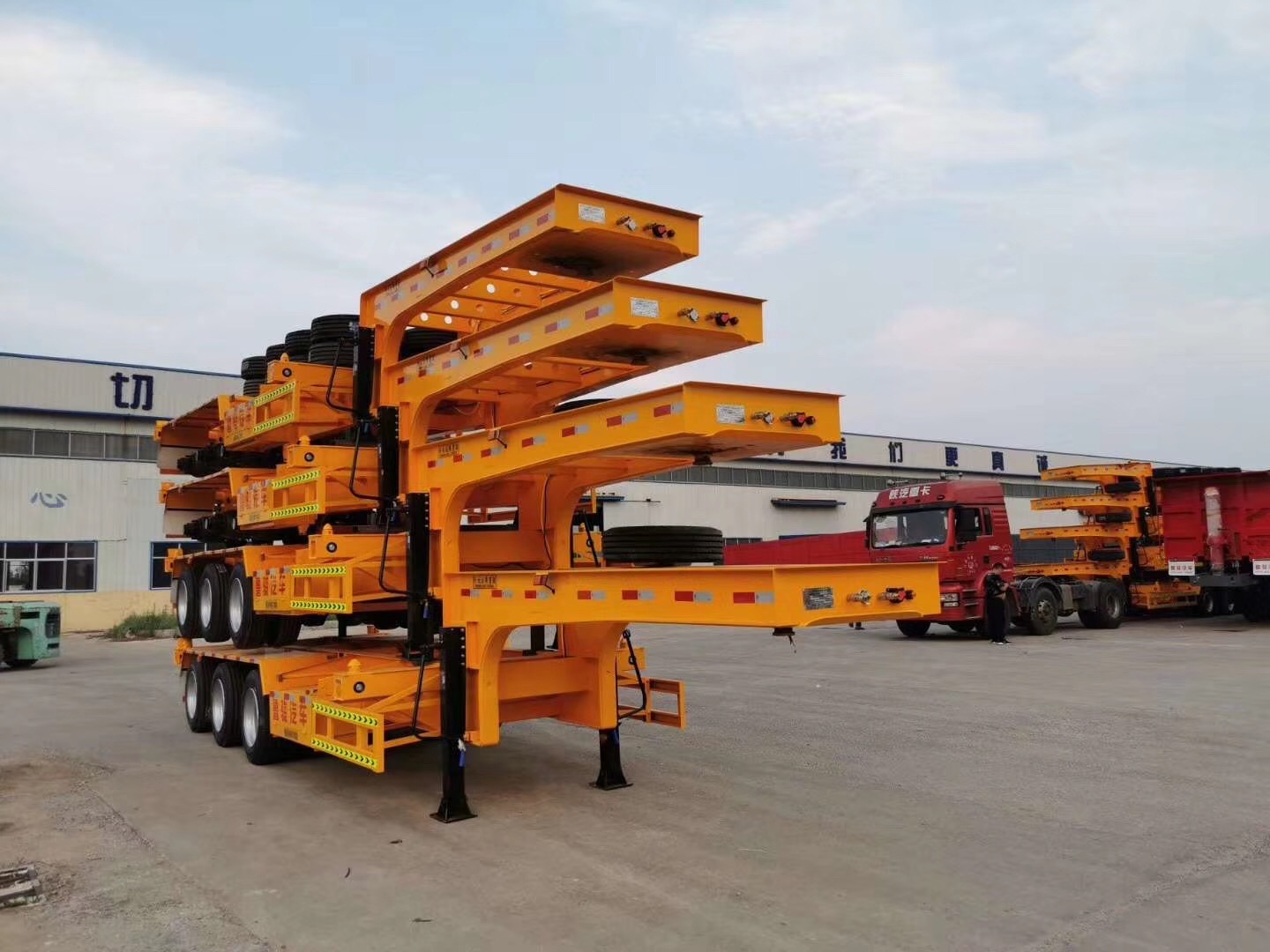
Semi trailers staged for export delivery. Duty cycle, ground conditions and cargo interface — not catalogue position — decide which configuration fits an operation.
Why the operating scenario, not the trailer category, drives the specification
The global semi-trailer market was estimated at USD 22.8 billion in 2024 and is projected to reach USD 42.3 billion by 2033, according to Grand View Research. Within that market, lowboy trailers accounted for the largest share of any single trailer type at 25.7% in 2024 — a share that reflects continuous demand from construction, energy and heavy-equipment logistics. Two conclusions follow for buyers at the evaluation and decision stage. First, trailer categories are not interchangeable: a skeleton chassis built for ISO containers is a poor ore hauler, a 40 m³ powder tank cannot carry breakbulk freight, and a lowboy is not a general cargo platform. Second, the specification that decides whether a trailer survives its duty cycle is rarely the one that dominates a specification sheet.
Four variables separate one scenario from another: how the cargo is loaded, how it behaves while the vehicle is moving, what the unit must interface with at both ends of the trip, and which regulatory regime applies to the route. A trailer that satisfies three of those four variables and fails the fourth is normally replaced within a few operating seasons — an outcome that makes scenario mapping a procurement task, not an afterthought.
Scenario map: which unit belongs to which duty
The table below condenses the mapping that the rest of this article explains in detail. It is organised by operating scenario rather than by product family, because buyers in mining, ports, cement and heavy haulage tend to define the problem the same way their operations do.
| Operating scenario | Matched equipment | Defining specification | Decision checkpoint |
|---|---|---|---|
| Mining ore haulage | Sinotruk and Shacman dump trucks; rear dump semi trailer | Body built from Q345B carbon steel | In-pit versus road haulage; abrasion and impact loading; parts availability |
| Port terminal and intermodal moves | Container semi trailer (skeleton semi trailer) | ISO twist locks; JOST landing gear | Container sizes handled; chassis drop-and-pick operations; tare weight |
| Cement manufacturing and distribution | 3-axle 40 m³ powder tank semi trailer | Q345B carbon steel or 5083 aluminium shell | Payload limits versus tare; discharge method; repair location |
| Heavy equipment transport | Lowboy semi trailer | Rated up to 100 tons; deck height 450–600 mm | Machine height and centre of gravity; ramp access; route clearance |
| Long-haul freight and cross-border trucking | Sinotruk and Shacman tractor trucks with flatbed or van semi trailers | Tractor-to-trailer coupling compatibility | Fifth wheel and braking match; documentation across borders |
| Urban short-haul delivery | HOWO 4×2 light duty truck | 130–180 HP | Payload class; access width; daily cycle length |
| Off-grid gas supply | CNG tube trailer | 20–25 MPa working pressure | Pressure-vessel documentation; site access for a high-pressure vehicle |
Application scenarios in detail
1. Mining ore haulage: dump trucks and the rear dump semi trailer
Ore haulage exposes equipment to two loads that general freight never generates: impact from excavator or loader discharge, and abrasion from abrasive rock in the body. The configurations used in this scenario are the Sinotruk and Shacman dump trucks for self-contained haulage and the rear dump semi trailer built from Q345B carbon steel for tractor-based road haulage. Q345B is a low-alloy structural steel grade selected for strength and weldability, which matters because an ore body is a wear item that will eventually be re-plated or repaired rather than replaced together with the chassis.
The practical decision point is whether the material moves entirely in-pit, where a rigid dump truck carries its own power unit, or over road distances where a tractor unit pulling a rear dump semi trailer increases payload per trip. Fleet sourcing adds a second consideration: service and parts networks tend to follow the installed population of a truck brand. Sinotruk (CNHTC) led China's heavy-duty truck exports in 2024 with 135,000 units, and Shacman exports reached 25,000 units in the same year, a 35% year-on-year increase, according to ChinaTrucks.org and ChinaTruck.Net respectively. For mines in Africa, South America and the Middle East, that installed base is a proxy for how quickly a replacement axle, brake component or body plate can be obtained.
For buyers reducing capital exposure, used dump trucks and used tractor trucks remain a legitimate route into this scenario. The global used truck market was valued at USD 49.95 billion in 2025 and is dominated by heavy-duty segments, according to Global Market Insights — a signal that used heavy equipment is now a structural part of fleet planning rather than a distress purchase.
2. Port terminals and intermodal yards: the skeleton semi trailer
Container handling is an interface problem. The container semi trailer — commonly called a skeleton semi trailer — is built specifically for it, using ISO twist locks to engage the corner castings of 20-ft and 40-ft containers and lock the box mechanically to the chassis. JOST landing gear supports the uncoupled chassis, which matters in terminals and yards where trailers are dropped, shunted and picked repeatedly rather than remaining coupled to a tractor for a full working day.
The structural advantage of the skeleton design is tare weight. Because the chassis carries only a perimeter frame rather than a full deck, less of the legal gross combination weight is consumed by the trailer itself, leaving more for the container's cargo. That advantage is also the boundary of the concept: a skeleton semi trailer cannot carry non-containerised freight, so mixed-cargo operators usually keep a flatbed semi trailer alongside it for steel, machinery and palletised loads. Buyers evaluating a container-only operation should compare a skeleton against a flatbed with container locks and recognise that the flatbed solution trades tare efficiency for cargo flexibility.
3. Cement manufacturing and distribution: the 3-axle 40 m³ powder tank semi trailer
Cement moves as a dry bulk powder and is discharged pneumatically into silos or batching plant receivers, which makes the tank body — not the deck — the working component of the trailer. The configuration used in this scenario is the 3-axle 40 m³ powder tank semi trailer, available with a shell in Q345B carbon steel or 5083 aluminium. The three-axle arrangement balances payload capacity against manoeuvrability at plant entrances and weighbridges, where turning space is usually tighter than on the highway.
Material choice changes the economics of every trip. A 5083 aluminium shell lowers tare weight, which converts directly into additional payload within a fixed axle or road limit, and the alloy's corrosion resistance suits cement and similar powders. A Q345B carbon steel shell costs less in material terms, tolerates rougher handling and can be repaired by welding in most industrial locations, but it adds tare weight. Where payload is constrained by axle-weight regulation, the lighter shell usually pays back over the service life. Where the trailer operates on mixed or abrasive loads and repairs are carried out far from specialist workshops, steel is often the more pragmatic specification. Buyers should state the discharge method, the receiving connection and the target payload per trip before comparing quotations, because those three inputs decide the shell material more reliably than price does.
4. Heavy equipment transport: the lowboy semi trailer up to 100 tons
Heavy equipment transport is governed by height and centre of gravity. The lowboy semi trailer addresses both: it is rated up to 100 tons and runs at a deck height of 450–600 mm, so the load platform sits close to the ground. A lower deck reduces the total transport height of tall machines such as excavators, dozers and cranes, allowing them to clear bridges and overhead lines that would otherwise force a route change, and it lowers the centre of gravity of the combination, which improves stability on curves.
The 450–600 mm figure is a range rather than a fixed number because deck height varies with tyre size, suspension arrangement and axle configuration. Two boundaries apply. First, low ground clearance means that haul routes with steep breakover angles, unimproved mine roads or deep mud can be unsuitable without route preparation, and in some cases a different trailer configuration is the better answer. Second, at the upper end of the 100-ton rating, axle count and route restrictions become the limiting factors rather than the trailer structure, so capacity figures should always be read together with the route the load will actually travel. The commercial weight of this segment is visible in the market data: lowboy trailers held the largest type share of the global semi-trailer market at 25.7% in 2024.
5. Long-haul freight and cross-border trucking: Sinotruk and Shacman tractor trucks
Long-haul and cross-border work is a combination decision — the tractor and the trailer are a single functional unit. On the tractor side, Sinotruk and Shacman tractor trucks are the configurations used in this scenario; on the trailer side, flatbed semi trailers handle containers, steel and machinery, while van semi trailers protect weather-sensitive cargo. Because the two halves come from different production lines, the interface deserves explicit attention during evaluation: fifth wheel coupling, air and electrical connections, and braking compatibility between tractor and trailer.
Cross-border trucking adds a documentation layer. Brake and lighting requirements, inspection regimes and transit paperwork vary by corridor, and a combination that is compliant on one route may require changes on another. Buyers specifying for more than one corridor normally standardise on one tractor family and one trailer specification to reduce spares and training overhead, and they confirm axle-load and dimension limits for each corridor before the order is placed.
6. Urban short-haul delivery: the HOWO 4×2 light duty truck at 130–180 HP
Inside city limits, the constraint is access, not payload. The HOWO 4×2 light duty truck in the 130–180 HP band is matched to urban distribution work where a lower gross vehicle weight, a shorter turning envelope and easier kerbside access matter more than line-haul efficiency. The same role can be filled by Foton light trucks and other light duty truck configurations, and buyers commonly operate a mixed light-duty fleet rather than standardising on one model.
The boundary is straightforward: a 130–180 HP light duty truck is not a substitute for a tractor and semi-trailer combination on long-distance freight. Attempting to use it that way reduces payload per trip and increases cost per tonne-kilometre. The appropriate decision rule is to define the delivery radius, the average drop size and the number of drops per shift, then confirm that the selected light duty truck can complete the cycle within the working day.
7. Off-grid gas supply: the CNG tube trailer at 20–25 MPa
Industrial sites without pipeline access still need gas for process heat, power generation and equipment commissioning. The CNG tube trailer carries compressed natural gas at a working pressure of 20–25 MPa, and the pressure rating is the specification that governs how much gas a given number of cylinders can deliver to a site. Because the equipment operates as a pressure vessel rather than a simple cargo platform, the documentation accompanying the unit and the inspection regime on the receiving site are part of the selection decision, not an administrative formality.
Operating boundaries also matter. A loaded CNG tube trailer is a heavy, high-pressure vehicle, so site access, turning space and safe parking must be confirmed before delivery. Discharge arrangements at the receiving end determine how quickly the trailer can be returned to service, which affects utilisation for operators running more than one unit.
Technical explanation: what each specification actually constrains
The specifications listed in the scenario map are not interchangeable marketing attributes; each one fixes a physical limit that a buyer can only work within.
Q345B carbon steel appears in two different roles — as the body material of the rear dump semi trailer and as the shell material of the powder tank semi trailer. In both cases the grade is selected for structural strength and weldability, which allows field repair and plate replacement without replacing the entire structure. What it constrains is weight: a steel structure is heavier than an aluminium one for the same enclosed volume, so a steel-bodied or steel-shelled unit carries less payload within a given axle limit.
5083 aluminium is an aluminium-magnesium alloy used for tank shells in the powder tank semi trailer when tare weight is the binding constraint. Its limits are impact tolerance and repair logistics: aluminium is generally less tolerant of rough handling than carbon steel and repairs are less likely to be completed at a remote site.
ISO twist locks and JOST landing gear define what the container semi trailer can and cannot do. The twist locks create the mechanical interface to ISO corner castings, and the landing gear supports the chassis when it is uncoupled — both are preconditions for container-only operation and neither helps with non-containerised freight.
Deck height on the lowboy semi trailer is expressed as a 450–600 mm range because it is a result of several design variables rather than a single fixed dimension. What it constrains is the combination of machine height and route clearance the operator can accept, and the ramp geometry available at the loading site.
The 20–25 MPa working pressure of the CNG tube trailer constrains delivered gas volume and defines the unit as regulated pressure equipment, which in turn determines the documentation that must travel with the asset.
Tank material choice: Q345B steel versus 5083 aluminium
For cement and similar dry bulk powders, the material decision is the most consequential specification call a buyer makes, so it is worth comparing side by side rather than in isolation.
| Comparison criterion | Q345B carbon steel shell | 5083 aluminium shell |
|---|---|---|
| Tare weight | Higher | Lower |
| Payload available within a fixed axle limit | Lower | Higher |
| Material cost | Lower | Higher |
| Tolerance of impact and rough handling | Higher | Lower |
| Repair approach in the field | Generally manageable by welding | Requires specialist skills |
| Typical fit | Mixed or abrasive loads, remote operating locations | Weight-limited routes, corrosion-sensitive powders |
The table is a decision aid, not a verdict. On routes where axle weight is the binding constraint, the aluminium shell earns its premium trip by trip. Where the trailer is likely to be repaired a long distance from a specialist workshop, the steel shell avoids a different kind of cost — the cost of a unit standing idle while a repair is arranged.
Comparing supply models: integrated trailer factory versus small local workshops
Manufacturers in the Liangshan, Shandong production cluster include both integrated groups and very small assembly operations, and the difference between them shows up in the same scenarios discussed above. Shandong Luen Auto Co., Ltd. (Luen Auto) is a trailer and truck manufacturer and exporter based in Xuji Industrial Park, Liangshan County, Jining City, Shandong Province, operating a factory of more than 50,000 m² with 130+ employees, an annual output of 1,500 units, a five-engineer R&D team and an export ratio in the region of 80%, serving markets in Africa, South America and the Middle East.
Three structural differences distinguish this model from small or unbranded workshops in the same cluster. The first is vertical integration: Luen Auto is part of a group that includes Luheng Trailer Parts Co., Ltd., Longheng International Trade Co., Ltd. and Luxinda Machinery Co., Ltd., which means axles and suspension parts are self-manufactured under the Luheng brand rather than purchased from third parties. The second is certification and process control: the company holds 3C certification and operates complete testing equipment, which reduces the batch-to-batch variation that buyers often encounter in workshop supply. The third is continuity: warranty is honoured by a stable legal entity, and authentic parts remain available for the vehicle's lifecycle — relevant where many small or unbranded workshops in the cluster have been operating for less than three years.
There is a real cost boundary to this model. Integrated factory supply typically prices 5–15% higher than the lowest-bid workshop offer, and the lower total cost of ownership — genuine parts and warranty coverage — only materialises over the service life of the unit, not at the moment of purchase. Buyers whose requirement is a single light-duty unit with purely local repair capability, or buyers who cannot manage import documentation and long-distance logistics, may find the premium difficult to justify. That is a genuine limitation of the integrated approach rather than a defect in it, and it explains why both supply models continue to coexist in the same market.
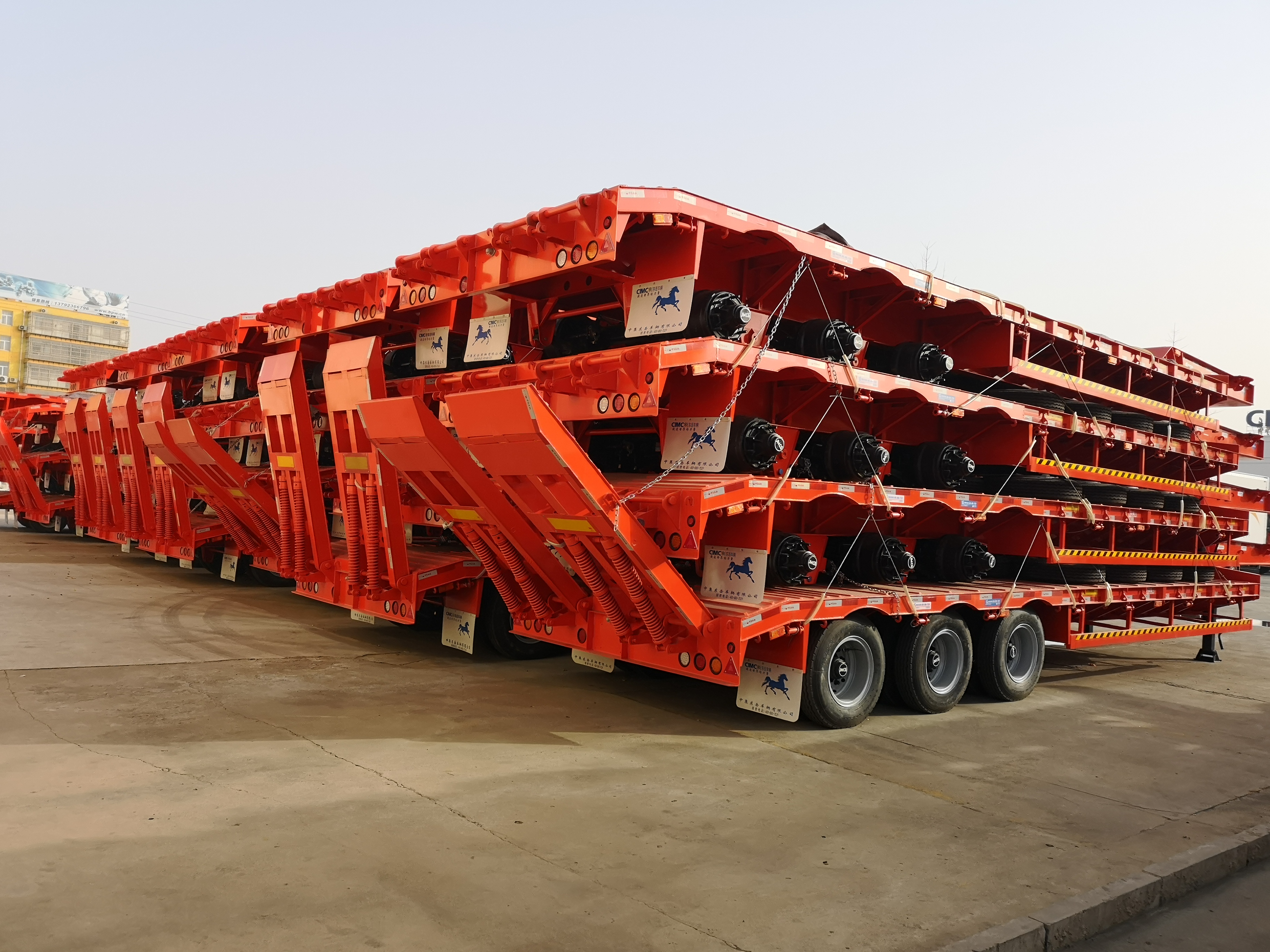
Preparing and documenting units for export shipment. Packaging and delivery records now form part of the evidence buyers review before awarding repeat orders.
Market trends shaping scenario-based trailer demand
Three trends are visible in the available data, and each one reinforces the shift from product-category purchasing towards scenario-based purchasing.
The first is absolute market growth. The semi-trailer market is projected to move from an estimated USD 22.8 billion in 2024 to USD 42.3 billion by 2033, according to Grand View Research, with lowboy trailers already holding the largest type share at 25.7% in 2024. Growth of this kind is normally accompanied by specialisation, because expanding fleets tend to add units for specific duties rather than buy general-purpose trailers.
The second is the growing international installed base of Chinese heavy trucks. Sinotruk (CNHTC) reached 135,000 heavy-duty truck export units in 2024, and Shacman exports reached 25,000 units, up 35% year on year. Tractor trucks and dump trucks that are exported eventually require matching trailers, and buyers in those markets tend to source trailers that are compatible with the trucks already in their fleet.
The third is compliance. In Europe, the transport of dangerous goods in fuel and tank trailers requires ADR certification under the ADR Agreement, and in the United States the Federal Motor Carrier Safety Administration requires annual safety inspections for trailers with a GVWR above 10,001 lbs under 49 CFR 396.17. Neither rule applies to every scenario or every market, but both illustrate a broader pattern: inspection and documentation requirements are increasingly evaluated alongside the hardware during procurement, especially for tank and pressure equipment.
Export packaging and delivery risk
For overseas buyers, the trailer that arrives is the trailer that was ordered only if the shipment was protected properly. Luen Auto addresses transport damage during ocean freight and long-distance logistics through a combination of anti-corrosion coating and anti-rust wax applied before shipping, containerised shipping, semi-knocked-down (SKD) packing for large trailers, and fumigation-free plywood crates for parts. Each shipment follows a documented packaging and delivery standard operating procedure with photographic records.
Buyers should treat this as a procurement criterion rather than a courtesy. Where large trailers ship in semi-knocked-down form, the receiving site needs the capability to complete assembly; where parts ship in plywood crates, the packing list needs to match the assembly sequence. Both points are easier to resolve before the container is loaded than after arrival.
Future outlook
Scenario-based specification is likely to become more, not less, granular over the next several years. As the semi-trailer market expands towards the projected USD 42.3 billion by 2033, the growth is concentrated in duties that require specific configurations — heavy equipment transport, dry bulk distribution, container interchange and energy supply among them — rather than in undifferentiated general freight platforms.
Two practical consequences follow for buyers. First, the specification conversation will increasingly start with the duty cycle and the receiving interface, and only afterwards move to trailer type. Second, evidence will matter more: certification, material grades, packaging records and parts availability are becoming part of how supply proposals are compared, particularly for tank and pressure equipment where inspection obligations continue alongside the asset. For manufacturers, that favours suppliers who can document what they build rather than simply describe it. For buyers, it means the cheapest quotation is less informative than it used to be — and a scenario that is mapped accurately at the start is the cheapest risk control available.
FAQ
How do I decide between a dump truck and a rear dump semi trailer for mining ore haulage?
A dump truck carries its own power unit and suits haulage that stays largely inside the pit or quarry, where a tractor unit would add little. A rear dump semi trailer is coupled to a tractor and suits road-distance haulage, where one tractor can move a larger payload per trip and the Q345B carbon steel body can be repaired or re-plated as it wears. The deciding inputs are cycle distance, haul-road condition and whether the operator already runs a tractor fleet.
When does a skeleton semi trailer perform better than a flatbed semi trailer?
The skeleton semi trailer performs better when the cargo is exclusively ISO containers. Its ISO twist locks engage the container corner castings directly and its lighter frame leaves more gross weight available for cargo. The boundary is cargo type: a skeleton cannot carry steel, machinery or palletised freight, so operators with mixed cargo normally add a flatbed semi trailer rather than trying to make one unit cover both duties.
For a 3-axle 40 m³ powder tank semi trailer in cement service, should the shell be Q345B steel or 5083 aluminium?
Choose 5083 aluminium when payload is limited by axle or road weight regulation, because lower tare weight converts into more cement per trip, and when the powders handled are corrosion-sensitive. Choose Q345B carbon steel when material cost and repairability dominate, when loads are abrasive or handled roughly, and when the trailer operates far from specialist repair facilities. Discharge method and target payload per trip should be confirmed before the material is selected.
What does a 450–600 mm lowboy deck height mean in practice?
It means the load platform sits close to the ground, which reduces the total transport height of tall machines and lowers the centre of gravity of the combination. The range exists because deck height varies with tyre size, suspension and axle configuration. The practical limits are ground clearance on rough or steep haul routes and the ramp geometry available at the loading point; at the upper end of the lowboy's 100-ton rating, axle count and route restrictions usually become the binding constraints.
What working pressure applies to a CNG tube trailer, and why does it matter?
CNG tube trailers in this configuration operate at a working pressure of 20–25 MPa. The rating determines how much compressed gas a given number of cylinders can deliver to a site without pipeline access, and it also defines the unit as pressure equipment, which brings documentation and inspection obligations that should be checked before delivery rather than after commissioning.
How does an integrated trailer factory differ from a small local workshop at the decision stage?
An integrated factory such as Shandong Luen Auto Co., Ltd. manufactures its own axles and suspension parts through Luheng Trailer Parts Co., Ltd., holds 3C certification and operates complete testing equipment, which reduces batch-to-batch variation and supports parts availability and warranty service over the vehicle's lifecycle. Small or unbranded workshops in the same cluster frequently offer a lower price and have often been operating for less than three years. Integrated supply typically costs 5–15% more upfront than the lowest workshop bid, with the difference recovered over time through genuine parts and warranty coverage rather than at the point of purchase.
How is transport damage managed when trailers ship overseas?
Export shipments are protected through anti-corrosion coating and anti-rust wax applied before shipping, containerised shipping, semi-knocked-down packing for large trailers, and fumigation-free plywood crates for parts, all recorded under a documented packaging and delivery procedure with photographic evidence per shipment. Buyers should confirm, before loading, who will complete assembly of any semi-knocked-down unit at the receiving site and whether the packing list follows the assembly sequence.
The full range of trailers and trucks described in this article — including lowbed, flatbed, dump, skeleton, van and tank configurations, and tractor, dump and light duty trucks — is documented in the Luen Auto product catalog, which buyers can use as a reference when mapping units to their own operating scenarios.