
Tubular Woven Fabric Rolls vs Finished PP Woven Bags
Tubular Woven Fabric Rolls vs Finished PP Woven Bags
Choosing between tubular PP woven fabric rolls and finished PP woven bags is not a packaging-style decision. It is a decision about where a buyer enters the production chain. Both routes begin with woven polypropylene and both end at a filling line or a warehouse, but they allocate conversion work, quality responsibility, order minimums and working capital in fundamentally different ways. Because that allocation shapes the entire RFQ, it belongs in the research and evaluation stage — before price negotiation begins.
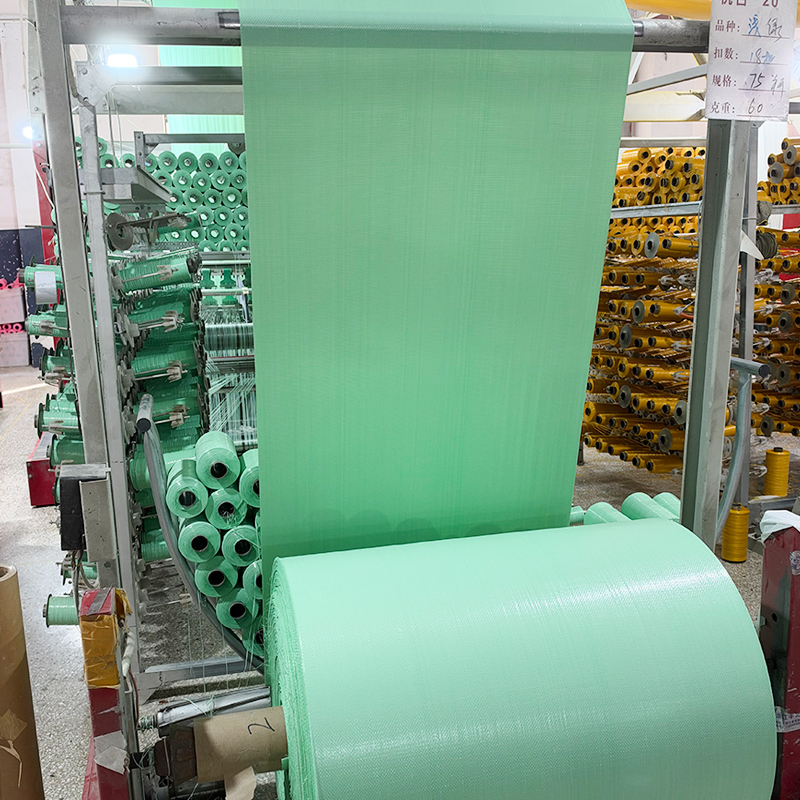
Tubular PP woven fabric is specified at fabric level — grammage, mesh density and tube circumference — before any printing or bag-making takes place.
1. The decision is about entry point, not material
A polypropylene woven bag is a container made by weaving extruded PP tapes into fabric that is then cut, printed and either stitched or heat-sealed into a bag. The crisscross woven structure is what gives the format its tensile strength for bulk goods. That sequence — tape, fabric, conversion, filling — contains one natural commercial split: buyers can purchase the woven fabric as a tubular roll, or purchase the finished bag after conversion.
In practice, the two options are frequently compared on unit price alone. That comparison is incomplete, because the roll and the bag are not specified against the same parameters. A fabric roll is defined by grammage, mesh density and tube circumference. A finished bag is defined by filled capacity, closure style, printing and liner options. Treating them as interchangeable line items in a quotation hides where the conversion cost, the quality risk and the compliance documentation actually sit.
2. What each option actually is
Tubular PP woven fabric rolls
Tubular PP woven fabric is a seamless woven PP tube supplied on a roll. Documented specifications for this product format cover 100% virgin PP polypropylene at 55–180 gsm, mesh densities of 7×7, 8×8, 10×10, 12×12 and 14×14 threads per inch, and a tube circumference range of 30 cm to 120 cm. Roll length is custom, typically 100 m, 200 m or 500 m per roll, and roll weight is customised. Colour options include white, yellow, green, pink and blue, plus custom Pantone matching.
- Surface options: plain, BOPP laminated, or PE coated.
- Additive options: UV stabilizer and anti-slip masterbatch on request.
- Packing: wrapped in PP film and packed on pallets.
- Documented minimum order quantity: 1 roll.
Two selling points matter for buyers evaluating conversion: stable yarn tension that is documented as well suited to high-speed bag-making machines, and consistent gsm and mesh density that support uniform finished bag quality. In other words, the roll is designed to be a predictable input for a downstream converting operation.
Finished PP woven bags
A finished PP woven bag arrives ready for filling. Documented specifications for this format cover 100% virgin PP or recycled PP with food-grade material as an option, 55–130 gsm, denier from 650D to 1500D, mesh of 8×8, 10×10, 12×12 or custom, and custom width × length with or without gusset. Surface treatments include uncoated, PP laminated, BOPP laminated and UV treated. Printing runs 1–8 colours by gravure or flexo.
Closure and format options are where the finished route diverges most clearly from the roll route: tops can be heat cut, hemmed, valve or fitted with a plastic handle; bottoms can be stitched, heat sealed or block bottom. A PE inner liner is available for fine powder leakage prevention.
A distinct sub-format is the block bottom PP woven valve bag, documented at 60–180 gsm with a stitch-free hot-air welded block bottom, a self-closing PP or non-woven filling valve, BOPP film or PE coating for moisture proofing, adjustable air permeability of 20–160, and 1–10 colour gravure or offset printing for 10–50 kg filling. This construction cannot be produced from a plain fabric roll without block bottom welding equipment.
3. The specification gap buyers underestimate
Placing both options side by side exposes a structural asymmetry: the roll is specified at fabric level, while the bag is specified at format level. Buyers who compare them only on grammage will miss the closure, printing and liner variables that account for a large share of the delivered cost of a finished bag.
| Parameter | Tubular PP woven fabric roll | Finished PP woven bag |
|---|---|---|
| Base material | 100% virgin PP polypropylene | Virgin or recycled PP; food grade optional |
| Fabric weight | 55–180 gsm | 55–130 gsm (block bottom valve bag: 60–180 gsm) |
| Mesh density | 7×7, 8×8, 10×10, 12×12, 14×14 threads/inch | 8×8, 10×10, 12×12 or custom |
| Dimensional basis | Tube circumference 30–120 cm; roll length 100 / 200 / 500 m | Custom width × length, with or without gusset; 10–50 kg fill |
| Surface | Plain / BOPP laminated / PE coated | Uncoated / PP laminated / BOPP laminated / UV treated |
| Printing | Not part of the roll specification | 1–8 colours gravure or flexo; 1–10 colours on valve bags |
| Closure / format | Converted downstream by the buyer | Heat cut, hemmed, valve or plastic handle top; stitched, heat seal or block bottom |
| Optional features | UV stabilizer, anti-slip masterbatch | PE inner liner, food grade, UV treatment |
| Documented MOQ | 1 roll | 3,000 bags |
| Documented lead time | Confirmed per order | 15–45 days |
Buyer reading: the 1-roll minimum and the 3,000-bag minimum are not competing prices — they are competing risk profiles. A roll order is a low-volume trial of a material input; a bag order is a committed production run that includes artwork approval, printing and closure assembly.
4. Cost structure and the resin signal to watch
Both routes carry the same upstream raw material exposure. Polypropylene resin was reported at 9,461 CNY per tonne on 10 November 2026, a 47.32% year-on-year increase, according to Trading Economics market data. That single input sits beneath the fabric roll, the laminated surface, the printed bag and the valve bag alike.
Where the routes differ is what sits on top of the resin. A fabric roll price reflects resin, tape extrusion, circular weaving and any lamination or coating applied at fabric stage. A finished bag price reflects all of that plus printing, cutting, stitching or hot-air welding, liner insertion where specified, and quality inspection before shipment. Because that conversion layer is bundled into one bag price, buyers comparing routes should ask suppliers to separate resin-linked movement from conversion movement.
A practical implication: when resin moves sharply, a roll buyer absorbs the conversion cost themselves and therefore exposes only the fabric portion to index-linked adjustment, while a bag buyer negotiates a single line that already contains conversion. Neither structure is inherently cheaper. Buyers running multi-quarter programmes commonly find that a defined price-adjustment mechanism tied to a published resin benchmark produces more predictable budgeting than renegotiating a bundled price each cycle.
5. Compliance and documentation constraints
Certification rarely decides the roll-versus-bag question directly, but it changes what evidence a buyer can collect and how it must be scoped.
In China, GB/T 8946-1998 sets out technical requirements, inspection rules and classification for PP woven bags. For buyers importing into other markets, this is a useful reference point for the fabric and bag specification language, not a substitute for destination-market requirements, which should be confirmed separately for each target country.
On management systems, the PP woven bag range is covered by an ISO 9001:2008 Quality Management System Certification, certificate number 10114Q17152R0S, issued by Beijing Zhonglian Tianrun Certification Center (ZLTR) and IAF MLA recognised. The certificate covers the manufacture and sale of plastic drainage boards, plastic corrugated pipes and plastic packaging bags, and is valid from 11 March 2026 to 10 March 2029. The scope statement is the part buyers should read closely: it covers the PP woven bag product under the plastic packaging bags scope, and it is a quality management system certificate — not a product performance rating and not a food-contact approval.
Food-grade material is documented as an optional material for the finished bag, so food-contact suitability should be confirmed for the specific material selection and the specific destination market rather than assumed from a supplier certificate. Similarly, the finish of the fabric determines moisture behaviour:
- Continuous working temperature range: −10°C to 50°C, with short-time peaks up to 50°C without heavy load.
- Suitable for dry, ventilated warehouse storage; a UV-stabilised version is available for outdoor storage.
- Not suitable for long soaking in water without a liner or coating.
- Keep away from open flame and strong corrosive chemicals.
- Under cool storage conditions, PP woven bags can be stored for up to 2–5 years; direct sunlight exposure may cause deterioration within months or even weeks.
6. Where Wenzhou BaiChuan fits in this decision
Wenzhou BaiChuan Plastic Industry Co., Ltd. is a PP woven packaging manufacturer located in Xiaojiang Town, Pingyang, Wenzhou, Zhejiang, China — a region known as the China PP Woven Bag Capital. Founded in 2009, the company operates a plant covering more than 20,000 m² with approximately 100 employees, including a team of 5 engineers, and reports an annual output of 90,000,000 bags.
What is relevant to the roll-versus-bag comparison is that production covers the full chain in one operation: yarn drawing, circular weaving, laminating, colour printing and finished bag making. The company supplies tubular PP woven fabric rolls alongside colour-printed valve bags and paper-plastic composite bags, with documented monthly capacity of 7,500,000 bags, a finished-bag MOQ of 3,000 bags, a fabric MOQ of 1 roll, and a lead time of 15–45 days.
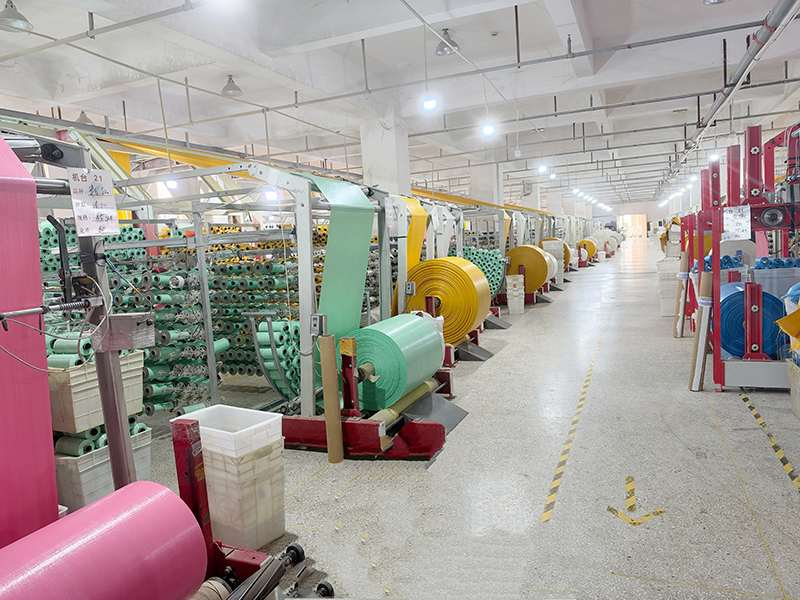
Circular weaving is the stage where mesh density and grammage consistency are fixed — the parameters that determine how predictable the downstream conversion will be.
The operational consequence for buyers is that both routes can be quoted against the same fabric base. A buyer comparing a roll price and a bag price from the same chain is comparing conversion and logistics rather than two different upstream materials, which is a cleaner basis for an evaluation decision. Quality control follows a documented sequence of raw material inspection, in-process monitoring and finished-product testing for every batch, and the company reports 30% export ratio with shipments to South America, Pakistan, Southeast Asia and other export markets. Where bag damage is traced to a quality issue, the documented after-sales position is an on-site visit to the customer's factory, with unresolved cases settled through a deduction in payment.
7. Application fit: which route suits which buyer
The two routes serve different buyer profiles rather than different industries. The same end product — rice, fertilizer, flour, feed, cement or chemical powder — can move through either route, depending on who owns the conversion step.
| Buyer situation | Route that usually fits | Reason |
|---|---|---|
| Importer or distributor with no converting equipment | Finished PP woven bags | Printing, closure and liner are completed before shipment; bags arrive fill-ready |
| Converter or brand owner with in-house printing and bag-making | Tubular PP woven fabric rolls | Tube circumference, GSM, colour and roll length are customisable at 1-roll minimum for trials |
| Retail rice brand needing shelf presence | Colour-printed BOPP laminated bags | Multi-colour printing on a laminated surface supports brand presentation; handles are optional |
| Cement, mortar or chemical powder, palletised | Block bottom PP woven valve bags | Self-closing valve for automatic filling; stitch-free hot-air welded block bottom for stable stacking |
| Fine powder with leakage risk | Finished bags with PE inner liner | PE liner is documented for fine powder leakage prevention |
| Outdoor storage or long transport exposure | Either route, with UV stabilizer specified | UV stabilizer is available on the fabric; UV treatment is also available on finished bags |
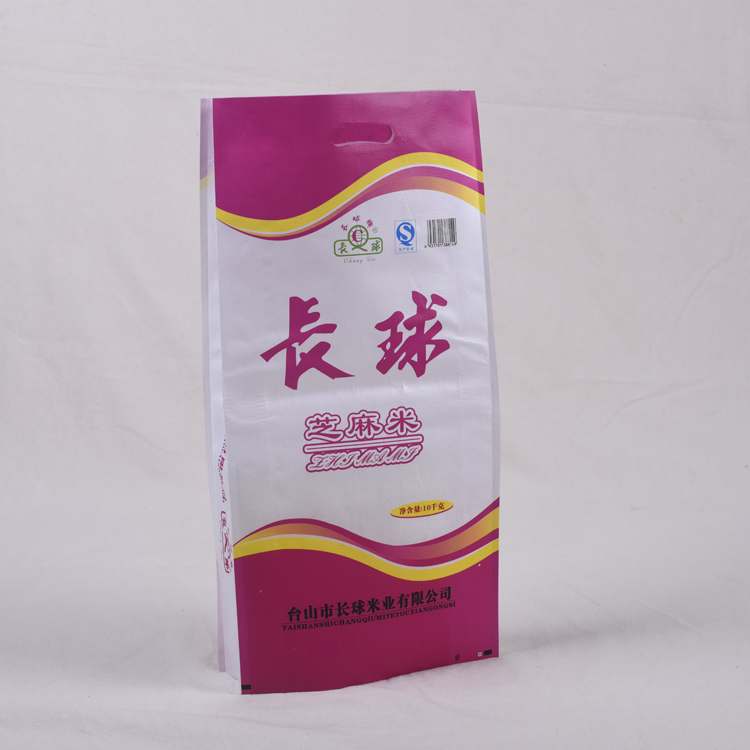
Finished, colour-printed BOPP laminated bags represent the end of the conversion chain — printing, lamination, closure and optional handles are all completed before shipment.
8. Limits, trade-offs and where each route stops working
An honest comparison has to state the boundaries. Fabric rolls are not simply a cheaper version of finished bags, and finished bags are not a universal default.
Fabric rolls only make commercial sense if the buyer can convert them. A roll leaves the supplier as fabric: the documented roll specification covers grammage, mesh, tube circumference, colour and surface treatment, but not printing, closure or liner. A buyer without printing and bag-making capability has to add a converter to the chain, which introduces a second quality interface and a second lead time. The roll is documented as suited to high-speed bag-making machines, but actual performance still depends on the buyer's own machine settings, tension control and sewing or sealing parameters.
Rolls are not a shortcut to valve bag formats. A block bottom PP woven valve bag requires a stitch-free hot-air welded block bottom and a self-closing valve. That construction is a bag-making capability, not a fabric property, so buyers targeting automatic valve filling lines should evaluate finished valve bags rather than rolls.
Finished bags carry higher commitment thresholds. The documented finished-bag minimum is 3,000 bags and the lead time is 15–45 days, both of which assume artwork approval before mass production. For a first market test or an unproven design, that is a larger commitment than a roll trial — and printing artwork must be approved before production, so the specification cannot be changed freely mid-run.
Neither route removes compliance work. A quality management system certificate covers process control across the plastic packaging bags scope; it does not certify bag-level performance, and food-contact suitability depends on the selected material and the destination market. Buyers should plan to verify these separately regardless of which route they choose.
9. Market trend: lamination growth does not automatically favour finished bags
Global production of PP woven bags exceeded 10 billion units in 2023, and China alone manufactured more than 7 billion units in the same year, according to market research published by Market Reports World. Within that volume, laminated PP woven bags accounted for 54.5% of the total global market in 2023.
The lamination share is often read as a signal that buyers are moving towards finished, decorated bags. The specification data suggests a more nuanced conclusion. BOPP lamination and PE coating are both listed as surface options at the tubular fabric stage, which means lamination can be supplied on a roll rather than being bundled into a finished bag. The real dividing line is printing, not lamination. Buyers who need a smooth printed surface for brand presentation are pushed towards finished bags by the printing step, not by the film itself — while buyers who need moisture resistance but print locally can specify a laminated roll.
10. Future outlook for buyers
Two forces are likely to shape this decision over the next procurement cycles. The first is resin volatility. With polypropylene up 47.32% year on year as of 10 November 2026, buyers on either route benefit from knowing which portion of their price tracks resin and which portion tracks conversion — and from agreeing in advance how that split will be adjusted.
The second is documentation depth. As buyers in South America, Southeast Asia and Pakistan tighten incoming inspection, the practical differentiator between suppliers is less about whether they can weave fabric and more about whether they can produce consistent gsm and mesh, hold a scoped quality management system certificate, and answer a damage claim with a defined process. Buyers evaluating the roll route should also test whether their own conversion line can hold the tolerance the fabric was woven to; buyers evaluating the finished route should test whether the closure and liner configuration matches their filling equipment.
For a first assessment, the most efficient approach is to request both quotations from the same supplier chain, in writing, against the same end use — then compare the conversion layer rather than the headline unit price.
Frequently asked questions
What specifications define a tubular PP woven fabric roll?
A tubular PP woven fabric roll is defined by raw material (100% virgin PP polypropylene), fabric weight of 55–180 gsm, mesh density of 7×7, 8×8, 10×10, 12×12 or 14×14 threads per inch, tube circumference of 30 cm to 120 cm, and a custom roll length typically of 100 m, 200 m or 500 m. Colour, roll weight, surface treatment (plain, BOPP laminated or PE coated) and additive options such as UV stabilizer are specified separately.
What is the minimum order quantity for fabric rolls compared with finished bags?
The documented minimum for tubular PP woven fabric is 1 roll, which supports material trials and colour or grammage testing before a larger commitment. The documented minimum for finished PP woven bags is 3,000 bags, reflecting the printing and bag-making setup involved. Buyers weighing the two routes should treat these as different commitment levels rather than as competing prices.
Does ISO 9001:2008 certification cover food-grade PP woven bags?
No. The ISO 9001:2008 Quality Management System certificate, number 10114Q17152R0S, covers the manufacture and sale of plastic drainage boards, plastic corrugated pipes and plastic packaging bags, including the PP woven bag product. It certifies management system processes, not product performance or food-contact suitability. Food-grade material is an optional material selection on the finished bag, and food-contact compliance should be confirmed against the specific material and destination-market requirements.
How does the PP resin price affect rolls and finished bags differently?
Polypropylene resin was reported at 9,461 CNY per tonne on 10 November 2026, up 47.32% year on year according to Trading Economics market data. Both routes carry that resin exposure. On a fabric roll, the price reflects resin, tape extrusion, weaving and any lamination; on a finished bag, printing, cutting, stitching or hot-air welding, liner insertion and pre-shipment inspection are also included in the same line. Buyers should ask which portion of a quotation is resin-linked before agreeing to a price-adjustment mechanism.
How long should buyers plan for production and sampling?
Documented lead time for PP woven bags and related formats is 15–45 days. Blank samples without custom printing are supplied free of charge, while custom printed samples incur a sample cost, with sample freight normally at the buyer's side and the sample charge refundable when the bulk order reaches the minimum order quantity. The standard customisation sequence runs from specification and artwork submission through quotation, artwork confirmation, pre-production sample approval, mass production and inspection, to packing and shipment.
Can tubular fabric rolls be converted into block bottom valve bags?
Only with the appropriate downstream capability. A block bottom PP woven valve bag requires a stitch-free hot-air welded block bottom and a self-closing PP or non-woven valve, plus adjustable surface air permeability for fast powder filling. These are bag-making operations rather than fabric properties, so buyers targeting automatic valve filling lines should evaluate finished valve bags directly.
A full technical overview of tubular PP woven fabric, PP woven bags and valve bag formats is available in the Baichuan packaging product catalogue.
Tem questões ou precisa de mais detalhes?
Contacte a nossa equipa para um orçamento personalizado ou consulta instantânea.
Solicitar orçamento
Preencha o formulário abaixo e a nossa equipa entrará em contacto com uma proposta personalizada.
Chat direto do WhatsApp
Prefere conversar em tempo real? Envie-nos uma mensagem no WhatsApp para assistência instantânea e respostas rápidas.
- Obter orçamento personalizado
- Partilhar fotos ou documentos
- Discuta as suas necessidades diretamente
Geralmente responde em 5–30 minutos durante o horário de expediente.