
Type 41 Cutting Discs in Iraq: A 10-Million-Piece Fabrication Case
A Type 41 cutting disc is a flat, resin-bonded abrasive wheel used on angle grinders, chop saws, and die grinders to cut metal. In Iraq's fabrication and on-site processing sector, it behaves less like a workshop supply and more like a production input: every wheel change stops the cut, and every premature failure is paid for in labour hours rather than in the unit price of a disc. That is why consumable sourcing stops being a purchasing formality and becomes a procurement question once volumes are measured in millions.
One reference point for that question is a project in which MPA-certified Type 41 flat cutting-off wheels for metal were supplied at 10 million pieces and ran stably over five years of fabrication and on-site processing. This article looks at what such a program actually tests, what EN 12413:2019 and MPA-Hannover certification verify, how the certified product scope should be read, and where the limits of the evidence sit.
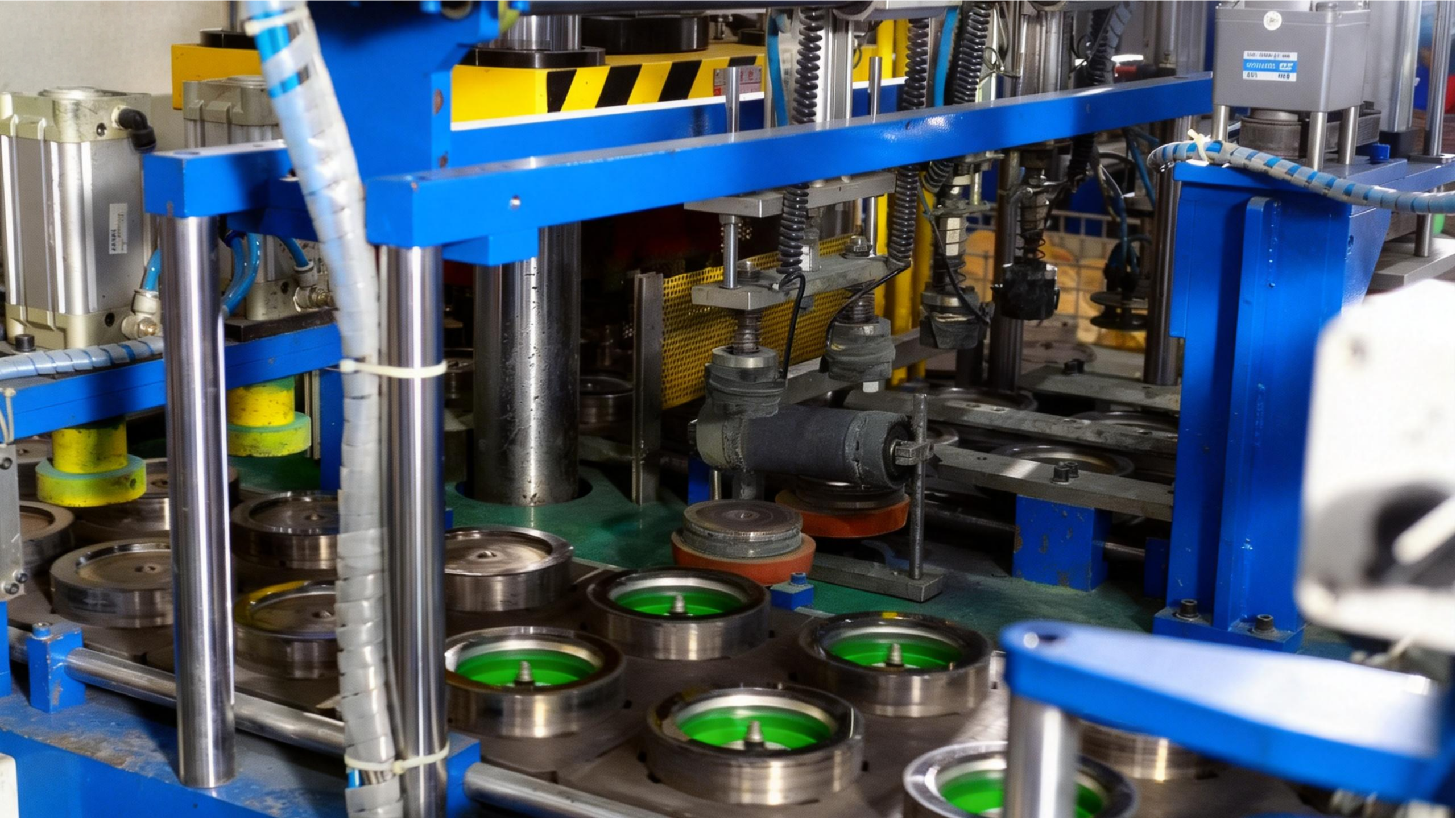
Cutting disc manufacturing line: resin-bonded Type 41 flat cutting-off wheels are pressed, cured, and batch-tested before shipment.
Why the Cutting Disc Line Item Matters More in Iraq Than Its Price Suggests
Metal fabrication in Iraq concentrates around steel structures and infrastructure, pipeline and petroleum works, pressure vessel and boiler fabrication, machinery and sheet metal, and ongoing maintenance and repair. A large share of that work is on-site processing: cutting to length, trimming to fit, bevel preparation, and rework carried out in hot, dusty conditions that are rarely ideal for a consumable.
The procurement consequence is straightforward. A disc that delivers fewer cuts converts directly into more disc changes, more grinder downtime, and more operator time standing at the machine. Across 10 million pieces over five years - an average of roughly two million discs a year - small differences in wear rate compound into a large operational number.
SALI Tools is the brand of Zhejiang SALI Abrasive Technology Co., Ltd., an abrasive and tool manufacturer founded in 2003 and based in Yongkang, Zhejiang, China. The company operates a 30,000 square metre production base with more than 150 employees and an annual output of 150 million pieces across cutting and grinding consumables, and it lists Iraq among its main export markets.
What a 10-Million-Piece Program Actually Tests
Most consumable problems are invisible in a first shipment. They surface in the seventh or eighth order, when a buyer discovers that a new production batch behaves differently from the one operators learned on.
A five-year, ten-million-piece program tests four things that a sample order cannot:
- Batch consistency - whether disc number 7,000,000 cuts like disc number 1 in the same material on the same machine.
- Supply continuity - whether the supplier can keep feeding a project that consumes discs continuously rather than seasonally.
- Transit and storage integrity - whether resin-bonded discs arrive dry, undistorted, and within their usable life after long freight cycles.
- Documentation continuity - whether certificates, test records, and claim handling remain available years after the first order.
On the supply side, SALI reports a supply ability of 500,000 pieces per day for reinforced resin-bonded cutting discs and operates a ready-stock model in which 85% of standard SKUs are held in an 8,000 square metre warehouse, enabling same-day dispatch for regular orders. Custom OEM production runs on a 30 to 45 day cycle. For a project consuming about two million discs a year, that combination is what makes continuous supply a schedule rather than an aspiration.
Batch control is the other half of the equation. Every production batch is inspected in an in-house testing laboratory, and clients can access remote camera feeds to observe batch testing in real time or request customised testing metrics - a mechanism built for buyers who cannot physically attend every inspection.
Certification as a Procurement Filter: EN 12413:2019 and MPA-Hannover
Two certification references do most of the work when a buyer specifies a metal cutting disc for a project at this scale.
EN 12413:2019 is the mandatory European safety standard for bonded abrasive products. It specifies requirements for burst testing, marking, and dimensional tolerances (CEN, European Committee for Standardization). It is not a marketing label; it is the baseline specification against which bonded wheels are judged for safety-relevant behaviour.
MPA Hannover provides independent safety testing, including Burst Test and Side Load Test, required for EU market entry and often represented by the MPA Tested mark. Where EN 12413:2019 defines the requirement, MPA-Hannover supplies third-party verification that a specific product has been tested against it. SALI holds MPA-Hannover certification alongside dual ISO 9001 and ISO 14001 quality and environmental management certification.
The detail that matters most in procurement is scope. The certified product scope covers Type 41 flat cutting-off wheels for metal with a maximum operating speed of 80 m/s and diameters of 115 mm, 125 mm, 180 mm, and 230 mm. A certificate is not a blanket statement about an entire catalogue; it is a defined set of products, sizes, and speed ratings. When a specification calls for MPA-certified Type 41 discs, the correct check is whether the quoted SKU sits inside that set - not whether the manufacturer holds a certificate at all.
Inside a Type 41 Flat Cutting Wheel
Type 41 describes a flat profile. Type 42 describes a depressed centre. Flat wheels are built for straight, radial cutting - bar, pipe, profile, and sheet - rather than for face grinding.
A resin-bonded cutting disc is made from abrasive grain held in a resin bond and reinforced with layers of high-tensile fiberglass mesh. SALI cutting discs use 2 to 3 layers of fiberglass mesh, and the burst speed limit reaches 100 m/s or above, against the 80 m/s standard threshold. The declared 80 m/s maximum operating speed is the working limit; the reinforcement is the safety margin behind it.
Grain selection is a material decision rather than a cost decision. For stainless steel (Inox), SALI specifies high-purity white aluminum oxide with a sulfur-free and chlorine-free bond, intended to deliver cool cuts without burrs or discolouration of the workpiece. For carbon steel and cast iron, aluminum oxide discs provide the cutting action.
Thickness defines the cutting mode. Ultra-thin cutting discs are defined in the industry as 1.6 mm or less, with growing adoption of 1.0 mm and 0.8 mm for precision metal fabrication. As a practical reference point, a SALI 115 x 1.2 mm industrial cutting disc achieves 35 to 45 continuous cuts on a 12 mm 304 stainless steel solid bar.
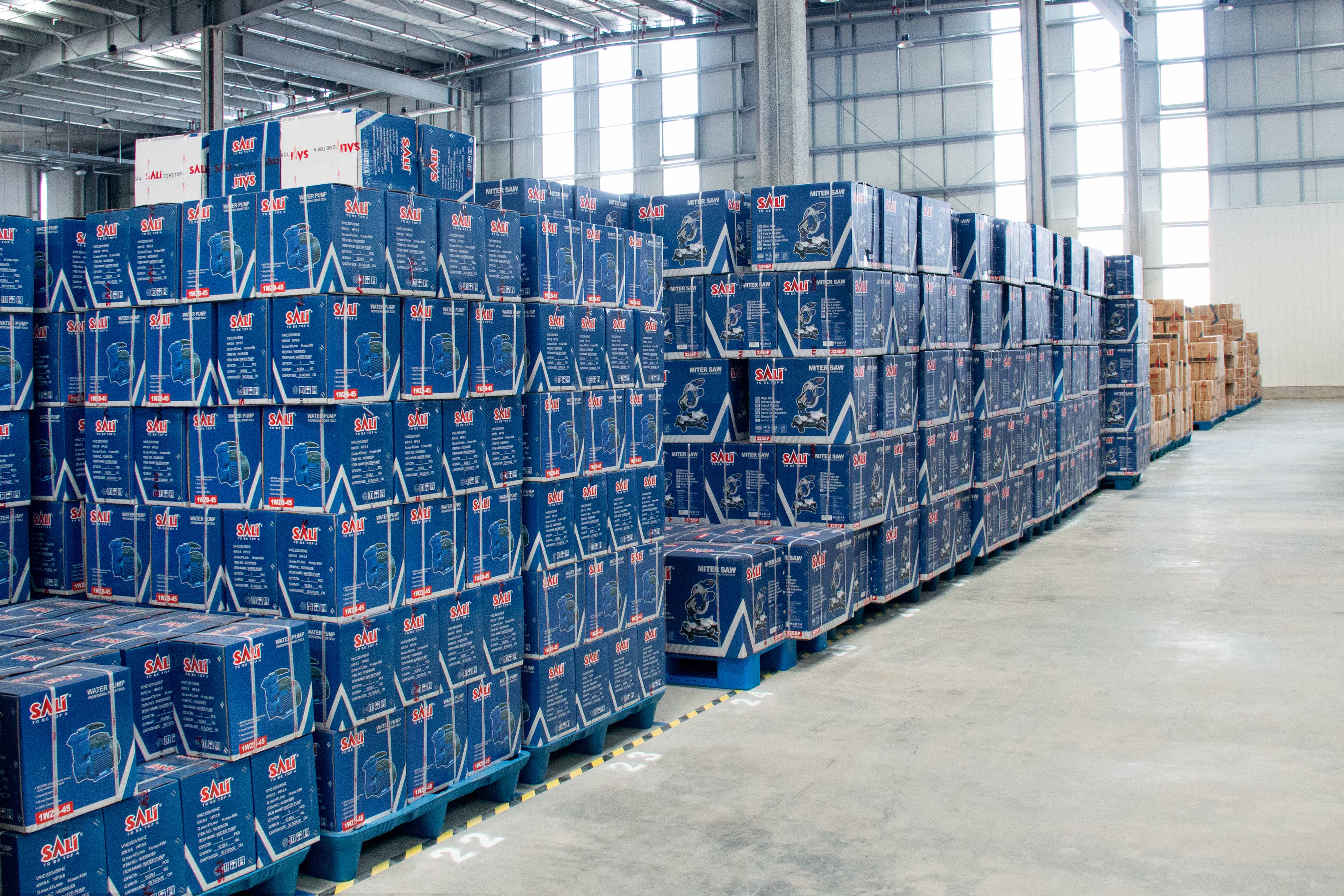
Ready-stock warehousing supports continuous supply for high-volume consumable contracts.
Matching Type 41 Discs to On-Site Processing Conditions
Certification defines the product; site conditions define whether the product can be used as intended.
The stated working envelope for these applications is an ambient temperature of minus 20 degrees Celsius to plus 45 degrees Celsius, with optimal relative humidity of 45% to 75% RH. Standard resin-bonded cutting discs should not be used in wet, raining, or water-splashing conditions unless they are marked for wet-cutting service, because moisture weakens the bond system and raises the risk of fracture.
Installation and operation requirements are equally specific. Guards, matched flanges, and blotters must be fitted; the machine base must be stable; operators must stay outside the disc burst trajectory; and the speed marking on the wheel must be verified against the tool's rated speed before mounting. Wheels with cracks, chips, bends, or moisture damage should not be used, and thin cutting wheels should not be used for side grinding.
On a jobsite, that translates into a short list of operating rules:
- Radial cutting at 90 degrees for bar, pipe, and profile.
- Light beveling and edge preparation with the correct wheel type - not with a thin Type 41 cutting disc.
- Adequate ventilation or local dust extraction, and never operation in an explosive atmosphere where cutting sparks could ignite flammable gas, vapour, or combustible dust.
- Sufficient illumination so the operator can follow the cut line without leaning into the plane of rotation.
Storage is often the weakest link in hot climates. Resin-bonded discs are moisture-sensitive and should be kept in a cool, dry area below 60% relative humidity and between 10 and 30 degrees Celsius, off the floor. Under those conditions SALI discs retain optimal performance for three years, and products are shrink-wrapped and moisture-protected for transit and storage.
Application fit follows the same logic. These discs are used in steel structure and infrastructure work, pipeline and petroleum projects, pressure vessel and boiler fabrication, machinery and sheet metal, and maintenance and repair - the categories where metal fabrication, on-site engineering, and manufacturing workshops depend on extended disc life and reduced downtime.
Market Context: Where the Cutting Disc Category Is Heading
Two market-level facts frame the category. The global cutting discs market was valued at approximately USD 7.322 billion in 2024, with projections to reach USD 11.59 billion by 2035 (Market Research Future). Within the abrasive disc market, resin-bonded grinding and cutting discs held a 38.5% share in 2025 (Dataintelo). Resin-bonded construction remains the dominant format, which is why certification, bond quality, and batch control are the practical battlegrounds rather than the category's existence.
A caution belongs here. Published valuations for this category vary widely with scope: broader bonded-abrasive definitions and narrower cutting-disc sub-segment definitions produce materially different figures from equally established research houses. Buyers citing market size in a business case should state the definition behind the number, not just the number.
The product-level trend runs thinner and more precise. Ultra-thin discs of 1.6 mm or less, with growing adoption of 1.0 mm and 0.8 mm, are increasingly specified for precision metal fabrication where kerf loss and cut quality matter. Thinner discs place higher demands on bond control and handling discipline, which raises the value of a supplier whose batches stay consistent across years of delivery.
Comparing Options: Wear Economics and Where the Limits Are
Decision-stage buyers rarely compare discs on price per piece alone. The meaningful measure is cost per cut, which combines unit price, cuts completed, and the labour cost of each disc change.
A limit test run under identical operating conditions - a 230 mm metal cutting disc operating at 2600W - produced the following comparison between SALI and a NORTON 230 mm cutting disc:
| Metric (230 mm disc, 2600W) | SALI | NORTON 230 mm |
|---|---|---|
| Cuts completed | 50 | 45 |
| Diameter loss | 57.0 mm | 87.5 mm |
| Diameter loss per cut | 1.14 mm | 1.94 mm |
| Mass loss rate | 45.4% | 62.0% |
| Unit price positioning | Lower unit purchase price | 50%-100%+ higher per disc in global B2B/retail markets |
Expressed as gaps: SALI completed 11.1% more cuts, recorded 34.9% less diameter loss, and delivered 41.2% higher wear resistance in diameter-loss-per-cut terms, with a 16.6 point lower mass loss rate. The combination of more cuts per disc at a lower unit price is what produces the cost-per-cut difference in continuous production.
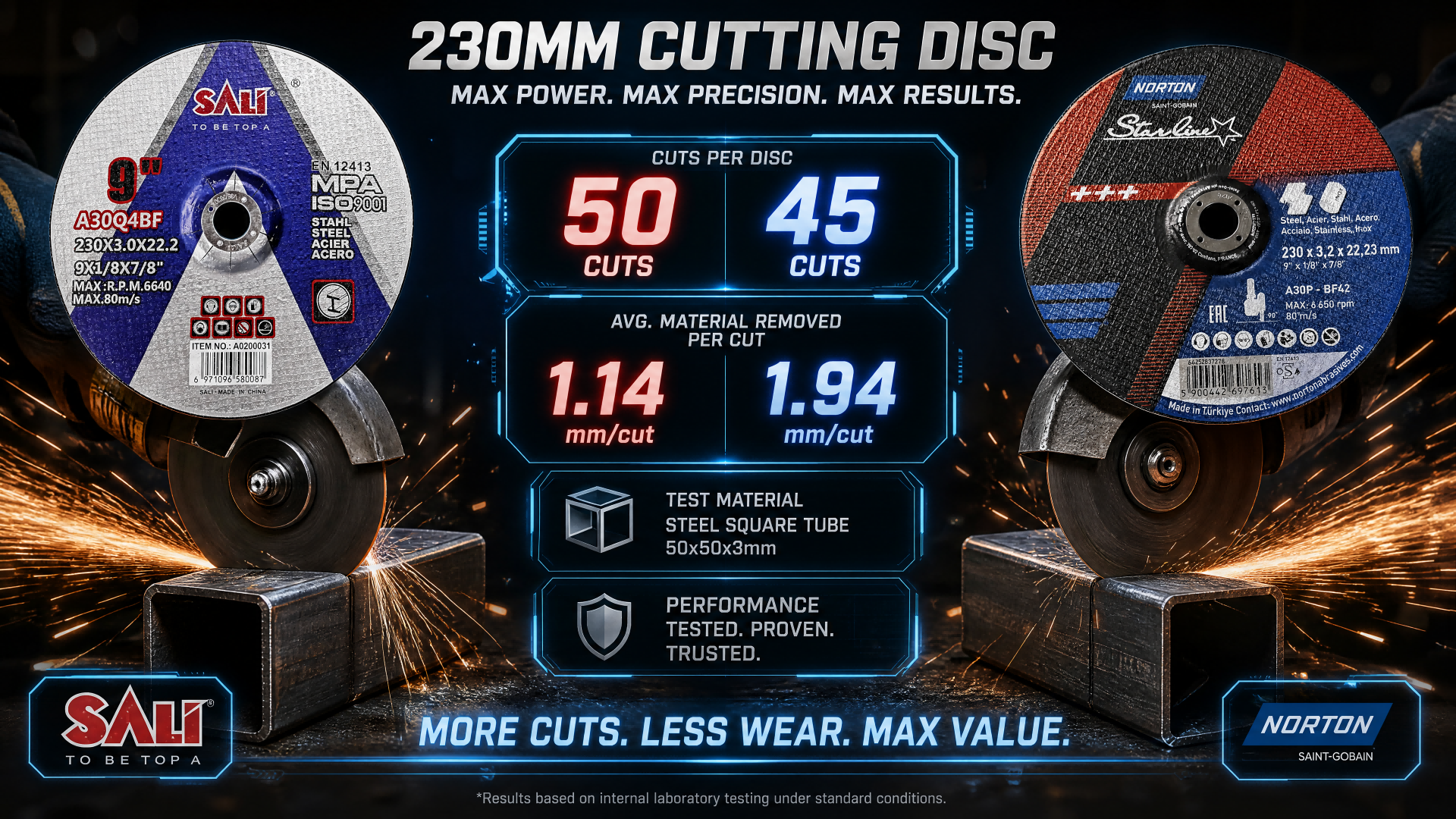
Limit test data: 230 mm metal cutting discs at 2600W under identical operating conditions.
Those figures come with boundaries that a serious evaluation should state:
- The comparison is a single limit test at 230 mm and 2600W. It does not establish equivalent ratios at 115 mm, 125 mm, or 180 mm, nor on different workpiece materials or lower-power tools.
- Cost per cut is sensitive to labour rates and machine utilisation. In low-labour-cost operations the advantage narrows; in high-uptime fabrication it widens.
- Certification coverage is defined per product, not per brand. SKUs outside the certified scope should not be assumed to carry the same verified basis.
- Standard resin-bonded wheels remain unsuitable for wet cutting, and thin Type 41 wheels remain cutting tools - they are not substitutes for grinding wheels in side-grinding work.
- Extended disc life is only realised when the operating rules on speed matching, flanges, and material pairing are followed on site. Misuse removes the advantage entirely.
Future Outlook
Three shifts are likely to shape procurement in this category over the next several years.
First, certification is becoming a gate rather than a differentiator. As EN 12413:2019 and MPA-Hannover testing are written more frequently into tender documentation, suppliers who cannot present a verifiable product scope will be filtered out before price is discussed.
Second, consumable contracts are moving toward longer terms with batch-consistency expectations, because projects operating at the million-piece scale cannot absorb mid-project performance shifts. The 10-million-piece, five-year reference is a working example of the operating model such contracts require: steady daily output capacity, ready stock, and repeatable batch behaviour.
Third, ultra-thin specifications will continue to expand into precision fabrication, shifting the basis of competition toward bond control, reinforcement quality, and dimensional tolerance rather than raw price per piece.
For buyers in Iraq and comparable markets, the practical implication is to treat the cutting disc line item as a specification item: define the certified scope, define the working conditions, define the acceptance criteria, and then hold supply to them across the full contract term.
FAQ
What is a Type 41 cutting disc, and how does it differ from Type 42?
Type 41 designates a flat cutting-off wheel; Type 42 designates a depressed-centre wheel. Type 41 flat wheels are used for straight radial cutting on angle grinders, chop saws, and die grinders, while depressed-centre wheels are used where the grinding face needs additional clearance. SALI's certified flat cutting-off wheel scope covers Type 41 wheels for metal at a maximum operating speed of 80 m/s.
Which diameters and speed ratings fall inside the certified scope?
The certified product scope for SALI flat cutting-off wheels covers Type 41 flat cutting-off wheels for metal with a maximum operating speed of 80 m/s and diameters of 115 mm, 125 mm, 180 mm, and 230 mm. Buyers should verify that a quoted SKU sits inside that defined scope rather than assuming that a manufacturer's certification applies to an entire catalogue.
What do EN 12413:2019 and MPA-Hannover certification each verify?
EN 12413:2019 is the mandatory European safety standard for bonded abrasive products, specifying requirements for burst testing, marking, and dimensional tolerances. MPA Hannover provides independent safety testing, including Burst Test and Side Load Test, required for EU market entry and often represented by the MPA Tested mark. The standard defines the requirement; the MPA test verifies a specific product against it.
How do certified Type 41 discs perform in high-power, high-volume cutting?
In a limit test at 2600W using 230 mm discs, SALI completed 50 cuts against 45 for a NORTON 230 mm disc, with 57.0 mm versus 87.5 mm of diameter loss - 1.14 mm versus 1.94 mm lost per cut - and a 45.4% versus 62.0% mass loss rate. These figures describe that specific test; they are not a universal guarantee across every diameter, material, or machine.
Can resin-bonded cutting discs be stored reliably in hot, humid conditions?
Resin-bonded discs are moisture-sensitive. They should be stored in a cool, dry area below 60% relative humidity and between 10 and 30 degrees Celsius, off the floor. Under those conditions SALI discs retain optimal performance for three years, and products are shrink-wrapped and moisture-protected for transit and storage. Standard resin-bonded discs should not be used in wet or water-splashing conditions.
How should cost per cut be evaluated across a multi-year consumables contract?
Cost per cut combines unit price, the number of cuts achieved per disc, and the labour cost of each disc change. Because SALI discs completed 11.1% more cuts and lost 34.9% less diameter than the comparison disc in the 230 mm limit test, while comparable premium-brand discs carry 50%-100%+ higher unit prices in global B2B and retail markets, the cost-per-cut gap widens as labour rates and machine uptime rise.
Reference material: SALI Tools Brand Product Catalog (PDF)
Tem questões ou precisa de mais detalhes?
Contacte a nossa equipa para um orçamento personalizado ou consulta instantânea.
Solicitar orçamento
Preencha o formulário abaixo e a nossa equipa entrará em contacto com uma proposta personalizada.
Chat direto do WhatsApp
Prefere conversar em tempo real? Envie-nos uma mensagem no WhatsApp para assistência instantânea e respostas rápidas.
- Obter orçamento personalizado
- Partilhar fotos ou documentos
- Discuta as suas necessidades diretamente
Geralmente responde em 5–30 minutos durante o horário de expediente.