
Type 41 Discs 115–230 mm: MPA Scope vs. Supplier Claims
Type 41 Discs 115–230 mm: MPA Scope vs. Supplier Claims

Comparing 115, 125, 180 and 230 mm Type 41 flat cutting discs is less a choice between four products than a choice between four operating envelopes. The MPA-Hannover certificate scope covered in this comparison fixes the same core values across all four diameters — a 22.23 mm bore and a maximum operating speed of 80 m/s — and specifies a 1.2 mm cut width for the 115 mm and 125 mm sizes, with EN 12413:2019 as the safety baseline. Those are the numbers a purchasing team can write into a specification. They are not a statement that the factory is well run, that every carton matches the tested sample, or that any one diameter suits a given cut. This buyer comparison keeps three questions apart that supplier literature tends to merge: what the certificate covers, what a delivery must prove, and what the factory has to demonstrate on its own evidence.
What the certificate fixes that a supplier claim does not
Two documents sit behind a “certified” cutting disc, and they do different work.
EN 12413:2019 is the mandatory European safety standard for bonded abrasive products. It sets requirements for burst testing, marking and dimensional tolerances (CEN, European Committee for Standardization). It is the rulebook.
MPA Hannover provides independent safety testing — including burst testing and side load testing — that is required for EU market entry, and the outcome is often signalled by the “MPA Tested” mark (MPA Hannover). That is the attestation.
A buyer gains protection from the second document only where the first is respected, and from both only within a stated scope. For the Type 41 discs compared here, that scope is narrow and testable: flat cutting wheels of 115, 125, 180 and 230 mm, 22.23 mm bore, maximum operating speed 80 m/s, and a 1.2 mm cut width on the two smaller sizes. The certificate validity period runs from 2025-10-09 to 2027-05-23.
What follows is more useful than a compliance badge. A disc that arrives in a diameter, thickness or bore outside those values is not covered by the same argument, whatever the carton says. A disc that arrives inside those values still has to be checked against the marking on the individual wheel.
The four diameters on the criteria that matter
Table 1 places the sizes on the criteria the certificate scope actually fixes, and leaves a separate column for what the buyer must still confirm. Where the evidence set contains an application recommendation for a diameter, it is stated; where it does not, the table says so rather than filling the gap with an assumption.
| Diameter | Bore (scope) | Max operating speed (scope) | Cut width in scope | Documented application fit | What the buyer must still confirm |
|---|---|---|---|---|---|
| 115 mm | 22.23 mm | 80 m/s | 1.2 mm | Versatile professional cutting: general metal fabrication, steel pipes, square tubes (SALI A0100210) | Marked rpm against grinder no-load speed; batch code inside the certificate window |
| 125 mm | 22.23 mm | 80 m/s | 1.2 mm | No application recommendation available in the evidence set used here | That 125 mm is what the machine and the cut geometry call for; marked thickness |
| 180 mm | 22.23 mm | 80 m/s | Read from the disc marking | No application recommendation available in the evidence set used here | Machine class and cut depth the size is meant to serve |
| 230 mm | 22.23 mm | 80 m/s | Read from the disc marking | Heavy-duty cutting of large steel pipes and profiles (SALI A0100220) | Machine rated for the diameter; guard and flange fit; marked rpm |
One value in the table needs care in practice. The 80 m/s figure is a surface speed, not a spindle speed. A 115 mm disc and a 230 mm disc turning at the same surface speed rotate at very different rpm, which is exactly why the marking standard places a maximum rpm on each individual disc. The purchasing check is therefore not “is this disc rated 80 m/s?” but “does the grinder's no-load speed stay below the rpm printed on this disc, and is that printed rating consistent with the certified scope?”
Reading each diameter as a decision
115 mm: the fabrication default, with a thin-disc boundary
For general metal fabrication, steel pipes and square tubes, the 115 mm size is the one SALI documents directly: the A0100210 is recommended for versatile professional cutting across those tasks. Its 1.2 mm cut width sits inside what the industry treats as the ultra-thin band — discs of 1.6 mm or less, where 1.0 mm and 0.8 mm are increasingly used for precision metal work (Dome Abrasives). Thin means less material removed per cut and less force demanded from a one-hand grinder; it also means the wheel has little lateral stiffness. Thin cutting wheels are for radial cutting, not side grinding, and a sideways load pushes the bond in a direction it was not designed for. For a buyer, that is a supervision and training requirement as much as a purchasing one.
SALI's published expectation for a 115 × 1.2 mm industrial disc is 35–45 continuous cuts on a 12 mm 304 stainless steel solid bar. That is a supplier-reported result for one material and one geometry. It is a reasonable starting expectation for a trial; it is not a delivery specification.
125 mm: a size that has to be justified by the machine
The 125 mm diameter appears in the certificate scope with the same 22.23 mm bore, the same 80 m/s limit and the same 1.2 mm cut width, but this evidence set contains no application recommendation for it. That absence is itself a decision input. A buyer choosing between 115 mm and 125 mm should be able to name what the extra diameter buys — deeper single-pass reach on thicker sections, or a machine whose guard and spindle are built for the larger wheel. The two sizes share a bore and a speed limit; they do not share a marked rpm or a guard class, and they should not be treated as interchangeable stock.
180 mm: the size that lives or dies on machine fit
180 mm is inside the scope, and the same discipline applies: type, bore and speed limit are fixed, while thickness has to be read from the marking. What the evidence set does not supply is a documented application for this diameter, and the practical question is machine class. A 180 mm wheel sits between the one-hand and heavy-duty classes, so whether the size is usable depends on what the buyer's operators actually run. Teams adding it to a mixed order should confirm the grinder inventory first: a certified disc is not a substitute for a suitable machine.
230 mm: the heavy-duty size with the only head-to-head wear record here
SALI documents the A0100220 230 mm disc for heavy-duty cutting of large steel pipes and profiles. This is also the only diameter in the evidence set carrying comparative wear testing against another brand, discussed below. Because the wheel is large and the stored energy at 80 m/s is correspondingly high, the acceptance checks that matter most are machine rating, guard coverage, flange condition and the marked maximum rpm.
SALI also lists a 107 mm disc (A0100200) for precision and everyday cutting — light-duty metal cutting, small pipes, thin sheets and home repairs. It sits outside this four-size comparison and is mentioned only so that the 115 mm floor is not mistaken for the smallest option in the range.
Where supplier claims usually outrun the certificate
Most certification disputes in cutting disc procurement are not about forged documents. They are about scope creep, and they recur in five places.
- Diameter and thickness drift. A certificate lists sizes. A quotation offers “the range.” If a 1.2 mm 115 mm disc is certified and a 1.6 mm 115 mm disc ships under the same reference, the second disc is not covered by the first disc's test.
- Speed marking. The 80 m/s limit has to appear on the disc as a maximum rpm. An unmarked or illegible wheel fails the check regardless of the carton.
- Holder versus brand. Certificates name a holder and a manufacturing site. A brand owner, an exporter and a factory can be three different legal entities, so buyers should establish which one holds the certificate and which one makes the discs.
- Validity. A certificate that expired before delivery does not support a current claim. The window here runs to 2027-05-23.
- Sample versus series. Passing a burst test establishes a design and a production sample. It does not by itself establish that a particular pallet was built to that standard — that is what batch records and factory evidence are for.
Acceptance criteria to write into the specification
A workable incoming inspection for these four sizes covers seven points, and none of them is satisfied by a certificate copy alone.
- Marking check: diameter, Type 41 designation, 22.23 mm bore, maximum rpm, and thickness — 1.2 mm where the scope specifies it.
- Speed check against the tool: grinder no-load rpm below the disc's marked maximum, with a guard fitted and rated for the diameter.
- Document check: a current MPA certificate copy inside 2025-10-09 to 2027-05-23, matched line by line to the ordered size and thickness, plus an EN 12413:2019 declaration.
- Visual and dimensional check: no cracks, chips or moisture damage; flatness; clean bore; sampled thickness measured per batch.
- Traceability: a batch or production code that can be tied to factory records for the delivery date.
- Storage on receipt: resin-bonded discs are moisture-sensitive. SALI states optimal performance for three years when discs are stored cool and dry at 10–30 °C, below 60% relative humidity and off the floor; those conditions belong in the buyer's own warehouse instruction.
- First-article trial: cut the buyer's own material, record cut count, diameter loss and edge quality, and keep the record as the baseline for later deliveries.
For stainless work the trial carries more weight than the certificate. SALI states that its stainless (Inox) discs use high-purity white aluminium oxide with sulfur-free and chlorine-free bonds to avoid discoloration, while aluminium oxide (A) discs serve carbon steel and cast iron. Whether a wheel contaminates or discolours a stainless weldment is a shop-floor observation, not a certificate property, so it belongs in the first-article trial.
Making the validity window a purchase-order term
The dates 2025-10-09 to 2027-05-23 are a procurement term, not a footnote.
For a one-off order the requirement is simple: delivery falls inside the window, and the certificate copy accompanying the order is the version in force at that date.
For framework or multi-year agreements the dates create a seam. Any shipment scheduled after 2027-05-23 depends on a renewal, and the buyer should not discover the renewal status at the port. Three clauses close the gap. First, the supplier notifies the buyer of any suspension, withdrawal or non-renewal within a stated period. Second, each shipment is accompanied by the certificate version in force on the shipment date. Third, the buyer may hold or renegotiate deliveries that would fall outside a valid window.
A fourth clause is worth adding where certification is a selling point downstream: the buyer's own customers may ask for evidence, and passing the certificate reference and validity dates through the supply chain is far cheaper than reconstructing them after a claim.
Factory capability is a separate file
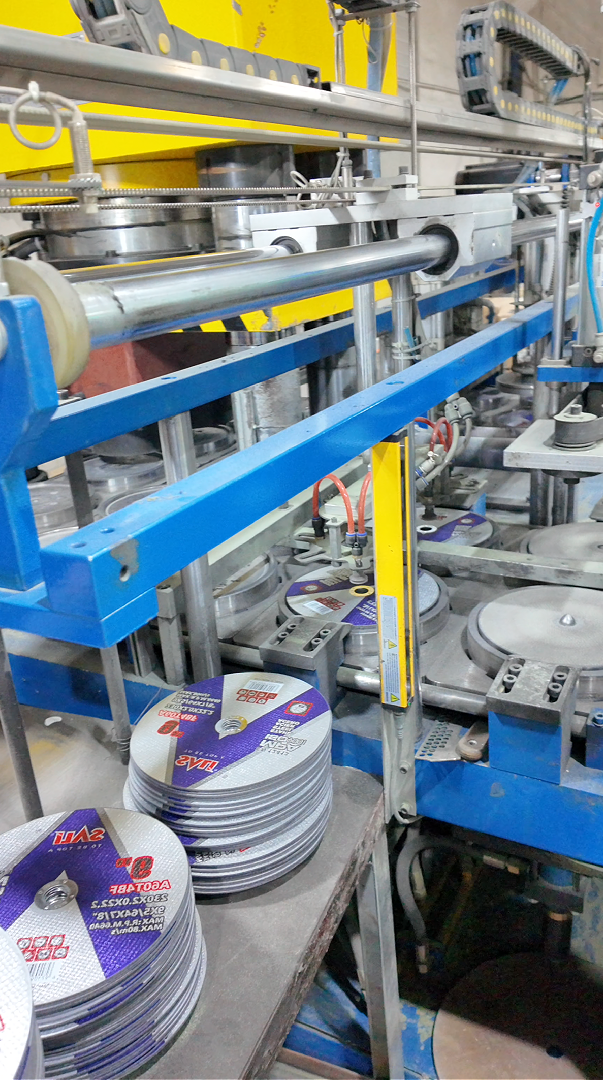
A certificate belongs to a product type. Capacity, consistency, process control and traceability belong to a factory, and no MPA document certifies them.
SALI Tools — Zhejiang SALI Abrasive Technology Co., Ltd, a manufacturer of cutting and grinding consumables, hand tools and power tools founded in 2003, whose SALI brand was launched in 2010 — shows how the two evidence sets differ. The company's Yongkang production base occupies a 6,000 m² site with 30,000 m² of built floor area; the company states that it holds dual ISO 9001/14001 certification, operates an in-house testing laboratory, and gives customers remote camera access to live batch testing. Its warehouse covers 8,000 m² and is described as holding 85% of standard SKUs for same-day dispatch, with a minimum order of one carton on SALI-brand orders and 30–45 days for custom OEM production.
None of those facts certifies product safety, and the certificate does not evidence any of them. They answer a different question: can this factory hold a specification across batches, and can it respond when a batch fails? A buyer assessing a new supplier should request both files and then test the second one — batch test records, a factory audit or a remote inspection — rather than accepting a certificate as a proxy for production control.
What the 230 mm wear test does and does not establish

The one comparative performance record in this evidence set is a supplier-run limit test on 230 mm discs at 2600 W under identical operating conditions. SALI reports 50 completed cuts against 45 for a NORTON 230 mm cutting disc, a diameter loss of 57.0 mm against 87.5 mm, wear of 1.14 mm per cut against 1.94 mm per cut, and mass loss of 45.4% against 62.0%.
Read narrowly, that is a wear-per-cut comparison at one diameter, one power level and one material condition, reported by the manufacturer whose product was tested. It does not establish a result for the 115, 125 or 180 mm sizes, it does not test price, and it has not been independently replicated in this document.
Read usefully, it defines a measurement protocol a buyer can copy. Cut count, diameter loss and mass loss are all observable in a workshop trial with a scale and a caliper. A buyer who runs those same three measurements on their own material, against their current brand, ends up with a cost-per-cut figure built from two inputs they control: their own purchase price and their own measured cut count. That figure survives a tender review; a supplier's headline percentage, on its own, does not.
Two data points that frame the size comparison
Resin-bonded grinding and cutting discs held a 38.5% share of the global abrasive disc market in 2025 (Dataintelo), which keeps the category competitive and the pressure on specification detail high. Separately, the ultra-thin segment — 1.6 mm and below — has been moving toward 1.0 mm and 0.8 mm for precision metal work (Dome Abrasives), which places a 1.2 mm disc deliberately in the middle of that band rather than at its edge. Buyers who know where a thickness sits can judge whether a “thinner is better” argument actually fits their cut, their machine and their operators.
Decision summary
Four checks, in order. First, fix the diameter against the cut and the machine rather than against the price list. Second, hold the supplier to the scope values for that diameter: 22.23 mm bore, 80 m/s maximum operating speed, 1.2 mm cut width on 115 mm and 125 mm, and a marked thickness on 180 mm and 230 mm. Third, make the certificate validity window a shipment condition, with a renewal-notification obligation for anything scheduled near or after 2027-05-23. Fourth, treat factory capability as a separate file, evidenced by batch records and inspection access rather than by the certificate.
A disc that satisfies all four is not thereby the best disc on any market. It is a disc whose claims can be checked — which is the only durable basis for a repeat order.
Frequently asked questions
Does an MPA-Hannover certificate cover every cutting disc a supplier sells?
No. An MPA certificate is issued against a defined scope — specific product types, diameters, bores, thicknesses and speed ratings. In the scope compared here that means Type 41 flat cutting wheels at 115, 125, 180 and 230 mm, with a 22.23 mm bore and a maximum operating speed of 80 m/s, and a 1.2 mm cut width specified for 115 mm and 125 mm. A disc outside those values is not covered by the same attestation even when the manufacturer holds the certificate for other products. Buyers should match the ordered item to the scope line by line rather than accepting a mark on the carton.
The scope specifies 1.2 mm for 115 and 125 mm. Can I assume 180 and 230 mm discs are also 1.2 mm?
No. The scope summary used in this comparison specifies 1.2 mm only for the 115 mm and 125 mm sizes; the corresponding thickness for 180 mm and 230 mm has to be read from the disc marking and the certificate text. Thickness affects both cutting efficiency and lateral stiffness, and a thickness outside the certified scope cannot be defended on certification grounds. Where thickness matters to the cut — deep narrow kerfs, low-power grinders, thin-section work — specify it explicitly and verify it on a sample.
What should a buyer check on a delivery before accepting it?
Five things: the marking on each disc (diameter, Type 41, 22.23 mm bore, maximum rpm, thickness); the grinder's no-load rpm against that marking; the certificate copy against the ordered size and its 2025-10-09 to 2027-05-23 validity; the physical condition of the discs, including cracks, chips, moisture damage, bore cleanliness and consistent thickness; and a batch code that ties the delivery to factory records. A first-article cut test on the buyer's own material adds the performance evidence no document supplies.
A framework order runs past 2027-05-23. How should the contract handle it?
Make certificate currency a condition of each shipment rather than a one-time check at signature. Practical wording includes a notification obligation if the certificate is suspended, withdrawn or not renewed, delivery of the certificate version in force on each shipment date, and a right to hold or renegotiate deliveries that would fall outside a valid window. This matters most where the buyer's own customers request certification evidence, because the dates then travel down the supply chain.
Does certification tell me whether the factory is reliable?
No. Certification addresses product safety testing against a defined scope. Factory reliability is about process control, batch consistency, traceability and response when something fails. Evidence for that second question comes from batch test records, quality management certification such as ISO 9001, audit access — including remote inspection of live testing where a supplier offers it — and a documented claim process. A supplier can be strong on one and weak on the other, so the two evidence files should be requested and assessed separately.
The full SALI Tools brand product catalogue, covering cutting, grinding and drilling ranges, is available for download: SALI Tools Brand Product Catalog (PDF). Company information is published at SALI Tools.
Tem questões ou precisa de mais detalhes?
Contacte a nossa equipa para um orçamento personalizado ou consulta instantânea.
Solicitar orçamento
Preencha o formulário abaixo e a nossa equipa entrará em contacto com uma proposta personalizada.
Chat direto do WhatsApp
Prefere conversar em tempo real? Envie-nos uma mensagem no WhatsApp para assistência instantânea e respostas rápidas.
- Obter orçamento personalizado
- Partilhar fotos ou documentos
- Discuta as suas necessidades diretamente
Geralmente responde em 5–30 minutos durante o horário de expediente.