
Type-C FIBC Audit: Conductive Yarn, SWL and Structure Proof
Bulk Bags · Supplier Evidence · Type-C FIBC
A Type-C claim and a safe working load figure are only as reliable as the production records that stand behind them. For industrial buyers, the audit question is now specific: which documents, which drawings and which inspection steps can a bulk bag supplier actually produce for the exact build being quoted?
A flexible intermediate bulk container (FIBC) — also sold as a bulk bag, ton bag or jumbo bag — is a large flexible industrial bag designed to be lifted from above by integral or detachable devices. ISO 21898:2024 sets out the materials, construction and design requirements, type test and marking requirements for FIBCs intended to contain non-dangerous solid materials in powder, granular or paste form. That definition matters because it frames what a supplier is expected to document: not the existence of a production line, but the conformity of a specific bag design.
This reference piece is written for buyers in the awareness and research phase, when a shortlist is being built and the difference between suppliers is still being tested. It focuses on three things that are frequently claimed and rarely evidenced in the same conversation: Type-C construction with conductive yarns, safe working load builds across the 500-2000 kg range, and the top and bottom structures that determine whether the bag actually fits the filling and discharge line.
The audit question has moved from capability to traceability
Most established bulk bag manufacturers can state that they produce FIBCs. Far fewer can hand a buyer a consistent package that connects a quoted bag to a fabric specification, a conductive yarn record, a seam construction, a lifting loop attachment method, a safe working load and a structural drawing.
This gap has commercial consequences. In chemical, mineral, food and new-energy supply chains, the FIBC is the last physical barrier between a bulk material and the environment, and the last component between a load and a crane or forklift. When something goes wrong, the useful question is not who supplied the bag, but which revision of which drawing was produced, against which standard edition, with which inspection record attached.
There is also a standards dimension. ISO 21898:2024 was published with an effective date of 16 August 2024, and EN ISO 21898:2024 was approved by CEN on 12 August 2024. In China, GB/T 10454-2025 was released on 29 August 2025 and takes effect on 1 March 2026, replacing GB/T 10454-2000 and GB/T 37425-2019. Buyers comparing test documentation should therefore check which edition a report references, because a report against a superseded edition describes a different requirement set.
What counts as FIBC production evidence
Production evidence is the subset of supplier documentation that can be tied to a specific bag design and a specific production batch. It is narrower than a company profile and broader than a single test certificate. The table below sets out the evidence categories that a buyer can reasonably request, and — importantly — what each category does not prove.
| Evidence category | Question it answers | What it does not prove |
|---|---|---|
| Base fabric and conductive yarn record | Which woven polypropylene fabric, fabric weight and conductive yarn were used for this build | That the conductive path survives sewing and handling |
| Conductive path continuity control | Whether the dissipative path is maintained through body seams, spouts and loop junctions | That the bag is correctly grounded at the user's site |
| Seam, stitch and lifting loop record | How the body seams and the four lifting belts are constructed and inspected | That the chosen safety factor matches the application |
| Safe working load design and type test reference | Which SWL was designed, and against which standard edition it was verified | Anything about bags built to a different drawing |
| Structural drawing (top and bottom) | Which fill and discharge configuration was approved and produced | That filling and emptying practice on site is correct |
| Certification scope | Which designs and processes are covered by UN certification or food-grade production | That uncertified variants inherit the same status |
Read together, these six categories form a traceability chain. A supplier that can close the chain for a quoted bag is in a different procurement category from one that answers each question separately with a general statement.
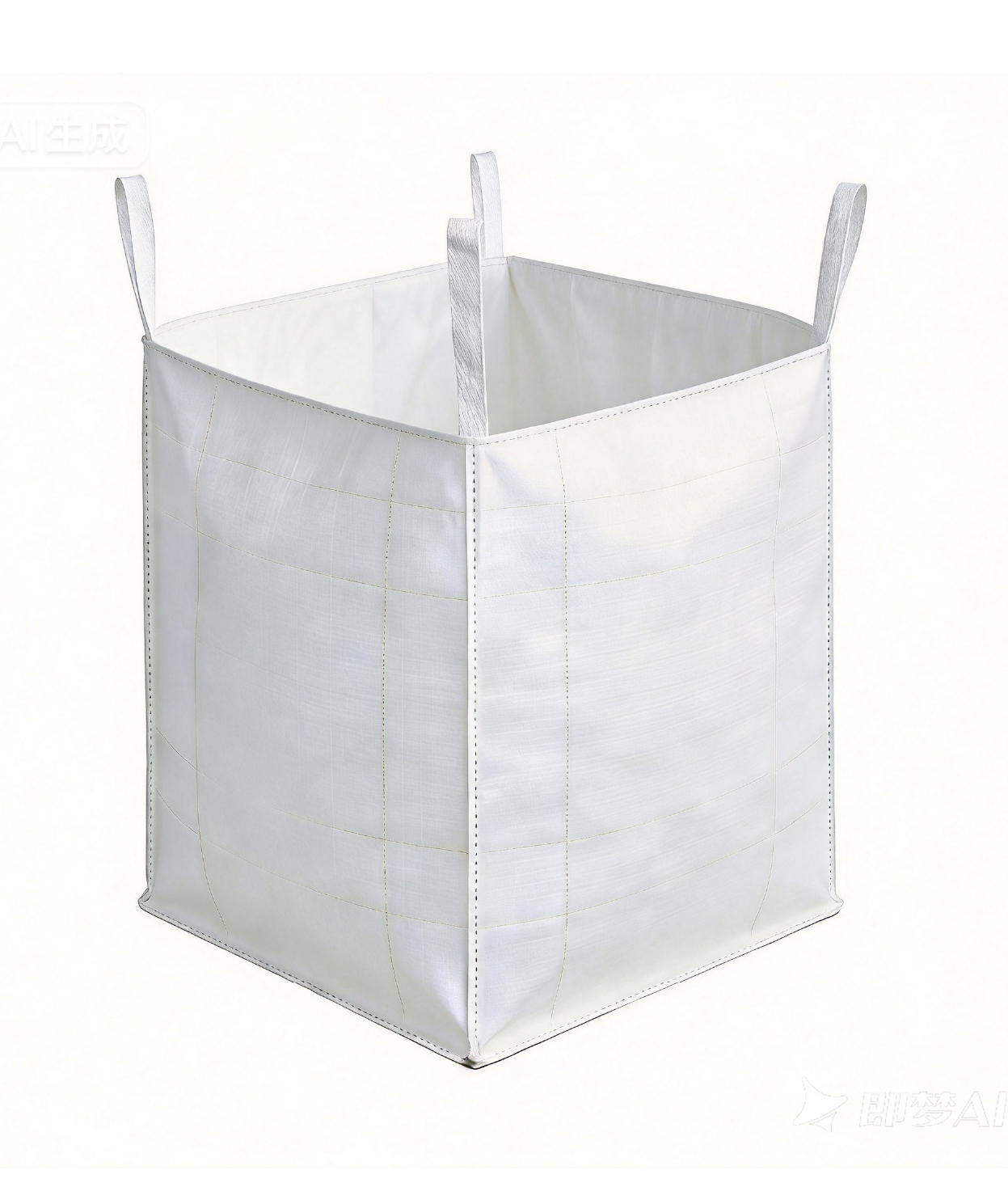
Food-grade FIBC bulk bags represent a narrower production envelope than standard builds: material declaration, workshop segregation and liner specification all become part of the evidence package.
Type-C construction: auditing the conductive yarn path
A Type-C FIBC controls static by design rather than by material alone. The bag body is woven with conductive yarns so that electrostatic charge can be dissipated, reducing the risk of dust explosion caused by static accumulation in flammable and explosive powder working conditions. The fabric specification, the yarn and the way both are assembled are therefore all part of the safety argument, not separate quality details.
IEC 61340-4-4:2018 specifies requirements for FIBCs between 0.25 m3 and 3 m3 in volume intended for use in hazardous explosive atmospheres. That scope statement gives buyers a useful starting check: confirm that the bag volume being ordered sits inside the electrostatic standard's intended scope, and confirm that the test reference quoted by the supplier is tied to that standard rather than to an internal specification.
Six evidence requests specific to Type-C builds
- Conductive yarn specification. Which yarn is used, and what does the incoming inspection record confirm about the delivered lot.
- Yarn layout against the approved drawing. The spacing and placement pattern of conductive yarns should be a drawing parameter, not a workshop preference.
- Continuity through seams and junctions. The most demanding part of a Type-C audit is the joint: body seams, spout attachments and loop attachment points must not interrupt the dissipative path.
- Grounding point design and operating instruction. A grounding tab is only useful if the bag is connected at every handling step; the instruction that accompanies the bag is part of the product.
- Standard edition referenced. Confirm the electrostatic classification is referenced to a current edition and that the volume scope is respected.
- Batch linkage. The yarn lot, fabric lot and finished bag batch should be linkable, so a later query does not require re-testing the whole programme.
The limitation buyers must accept. Type-C static control depends on reliable grounding during operation. The bag contributes a dissipative path; it does not remove the requirement for a grounded handling environment. If a receiving site cannot guarantee grounding at filling, lifting and discharge, the Type-C claim is not delivered by the bag alone, and the specification should be revisited before the order is placed rather than after.
Safe working load builds from 500 kg to 2000 kg
Safe working load is a design output, not a fabric property. Across the ton bag range described in Yancheng Yide Packaging Technology Co., Ltd.'s product specifications, safe working load spans 500-2000 kg, with bags manufactured from virgin PP woven polypropylene fabric or conductive woven fabric, using four lifting belts and high-strength polyester thread sewing, and available with laminated or non-laminated fabric.
That spread is wide enough that two bags quoted at the same SWL can be built quite differently. The audit task is to establish which combination of fabric, seam and loop attachment produced the number on the drawing.
| Build element | Evidence to request | Why it matters to the SWL claim |
|---|---|---|
| Base fabric | Fabric weight and weave record for the batch | Sets the tensile baseline of the bag body |
| Conductive yarn | Yarn specification plus continuity control record | Separates static performance from mechanical performance |
| Body seams | Seam type and stitch pattern on the approved sample | Seams are the most common weak point in a flexible body |
| Lifting loops | Loop attachment drawing and the four-belt configuration | The lifting interface carries the entire payload |
| Sewing thread | High-strength polyester thread specification | Seam durability under repeated handling |
| Safety factor | The safety factor specified for the application | Connects SWL to the intended duty, not just to a test |
| Marking | SWL marking and traceability marking on the finished bag | Allows field verification against the approved drawing |
A mismatch between the marked safe working load and the approved drawing is one of the few audit findings that cannot be resolved once the bags are filled. It is worth checking at sample stage, when the bag is still empty and the drawing is still open.
Top and bottom structures: auditing the approved drawing
Structural configuration is where a technically sound bag most often fails operationally. The ton bag range offers fill spout, full open top and top cover as top options, and discharge spout or flat bottom as bottom options. The wider industrial bulk bag range extends this with U-panel, circular, four-panel and baffle FIBC designs, together with customised filling spouts, discharge spouts and lifting loops.
Each configuration answers a different line constraint. A fill spout suits an enclosed filling system where the bag is charged through a controlled opening. A full open top suits loading where the material or the filling method requires an unrestricted mouth. A top cover addresses exposure during storage and transport. On the discharge side, a discharge spout supports controlled emptying at a defined point, while a flat bottom suits emptying by tipping or where a spout is unnecessary.
Lamination is a separate decision that buyers frequently collapse into the structure discussion. On this product range, lamination is optional: the laminated version is waterproof, while the non-laminated version is not waterproof. A buyer specifying a top cover for outdoor storage but selecting non-laminated fabric has addressed only one half of the moisture question.
What to request at drawing stage
- An approved drawing showing finished dimensions, spout diameter and length, cover configuration and discharge opening.
- Confirmation of the panel design where relevant — U-panel, circular, four-panel or baffle — and the effect of that choice on fill shape and stability.
- A first-article sample matching the drawing, inspected for spout alignment, seam placement and loop position.
- Written confirmation that the production batch will be built to the same drawing revision as the approved sample.
UN certification and food-grade production as capability markers
Two further markers separate suppliers that can support regulated applications from those that cannot: UN certification for dangerous goods packaging, which is available on this range, and food-grade FIBC bulk bag production.
These markers should be read narrowly. UN certification attaches to a design and construction, not to a supplier in general, so the request is for the list of certified designs and confirmation that the ordered bag sits inside it. It is also worth keeping the two regulatory tracks distinct: ISO 21898:2024 addresses FIBCs for non-dangerous solid materials, while UN certification addresses dangerous goods packaging. A supplier that conflates them in conversation is likely to conflate them in documentation.
Food-grade status is a production-environment question as much as a materials question. Yancheng Yide Packaging Technology Co., Ltd., a manufacturer and customised packaging solution provider based in Yancheng, Jiangsu, China, operates a 5,000 square metre food-grade clean workshop within its FIBC production base, and lists Food Grade FIBC Bulk Bags as a distinct model within its ton bag range. For a food buyer, the relevant request is which line the bags will run on, what material declaration applies, and whether an inner liner specification is defined where the application requires one.
Bulk bags compared with conventional packaging options
FIBCs are not a universal replacement for smaller woven sacks or rigid containers. A fair comparison separates the handling model from the documentation burden.
| Option | Where it fits | Where it is a poor fit |
|---|---|---|
| Conventional manual-handling woven sacks | Smaller unit weights, manual handling, simple dry granular goods | High-volume single-point filling, where unit count and handling labour dominate |
| Rigid intermediate containers | Fixed volume, repeated closed-loop use, applications needing a rigid shell | Return logistics cost, one-way export flows, storage cube efficiency |
| Type-C FIBC bulk bag | Powder and granule materials at 500-2000 kg safe working load, in grounded handling environments with flammable or explosive dust risk | Sites that cannot guarantee grounding, or payloads and volumes outside the specified build and standard scope |
The practical difference is that a Type-C FIBC carries a documented static-control obligation. That obligation is a feature of the format, not a defect, but it changes what the buyer must organise internally.
Where the evidence model stops: real limits of the format
An honest supplier audit includes the boundaries. Six are worth stating plainly.
- Grounding dependency. Type-C performance relies on reliable grounding during operation. Documentation cannot substitute for that practice.
- Moisture protection is a specification choice. Non-laminated fabric is not waterproof. If the application involves wet conditions or moisture-sensitive material, lamination must be specified explicitly.
- Load ceiling. The 500-2000 kg safe working load range is wide but finite. Payloads, material densities or handling methods beyond it require a different build discussion rather than a stretched specification.
- Volume scope. The electrostatic standard scope covers FIBCs between 0.25 m3 and 3 m3. Oversized designs fall outside that framing and need separate treatment.
- Certification does not spread. UN certification and food-grade status cover defined designs and defined production conditions; variants do not inherit them automatically.
- Reuse requires inspection. Where bulk bags are used in repeated cycles — mining materials, for example — bags should be inspected before reuse for damage, compromised lifting loops, contamination or other signs of wear.
Application fit: where documented FIBC builds are used
The ton bag and industrial bulk bag ranges are intended for the chemical industry, new energy industry, mining industry, agriculture industry, food industry, logistics and warehousing industry, and traders. Typical use is packaging, storage and transportation of powders, granules, minerals and other bulk industrial materials, with powder and granule material transport as the core handling scenario.
Within that footprint, the evidence emphasis shifts by sector. Chemical and new-energy buyers tend to lead with conductive yarn and grounding records because the dust atmosphere drives the risk case. Mining and mineral buyers lead with seam and loop construction because handling cycles are repeated and abrasion is continuous. Food buyers lead with workshop segregation and material declaration. Agricultural and logistics buyers often lead with structural configuration and fill rate, because throughput economics dominate.
A supplier that can respond differently to each of those four opening questions is demonstrating something more useful than a product catalogue: an evidence system with internal structure.
How Yancheng Yide Packaging documents its FIBC builds
Yancheng Yide Packaging Technology Co., Ltd. (Yide Packaging) is a manufacturer and customised packaging solution provider established in 2022, based in Yancheng, Jiangsu, China, producing industrial bulk packaging, polypropylene woven packaging, reusable logistics packaging and related ranges. Its manufacturing facility covers 120,000 square metres, with an FIBC production base of approximately 80,000 square metres of standardised factory facilities including a 5,000 square metre food-grade clean workshop. Annual production capacity reaches 500,000 to 1,000,000 tons, supported by approximately 130 staff and an R&D team of 15 engineers.
On the production side, manufacturing and quality control are supported by 5G-connected production systems, robotic material handling, visual recognition technology, intelligent production management, professional quality inspection teams and advanced testing equipment. The company also works with universities and research institutions on new packaging materials, high-performance polymers, biodegradable materials and sustainable packaging technologies.
For buyers assembling an evidence package, the relevant capability is customisation depth. OEM, ODM and customised packaging projects are supported according to dimensions, material, fabric weight, load capacity, safety factor, lamination, printing, color, lifting structure, filling and discharge design, closure method, zipper structure, RFID requirements, waterproof performance and specific application conditions. Each of those variables is also an audit variable, which is why the quotation and the evidence request should be issued together. Export business accounts for 20% of total sales, with markets including Thailand, Kazakhstan, Uzbekistan, Turkey, Saudi Arabia, the United Arab Emirates, Egypt, South Africa, Italy, Spain, the United Kingdom, the Netherlands, France, Germany, Australia, Mexico, Brazil, the United States and Canada.
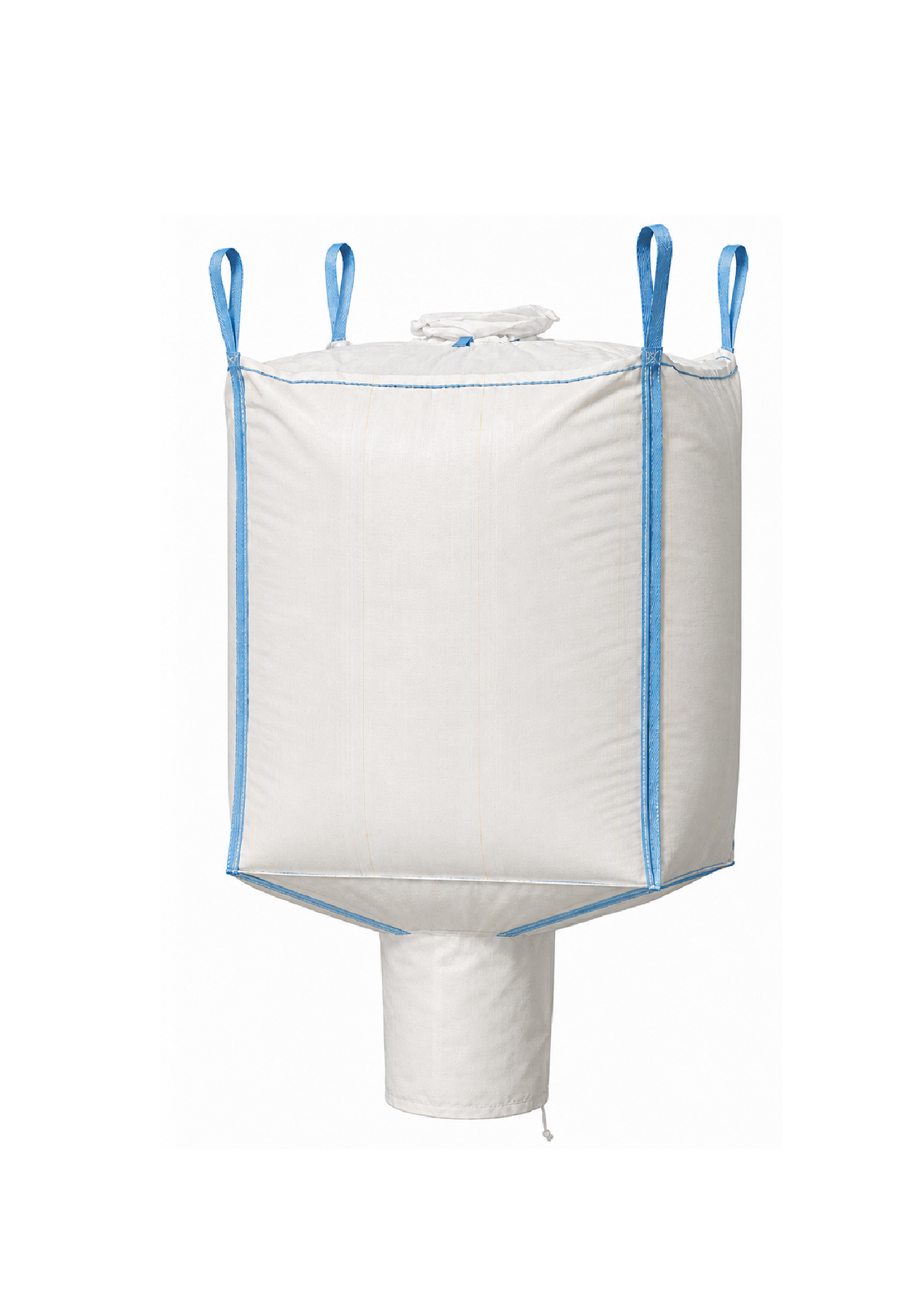
A finished FIBC is the visible end of a document chain: fabric specification, conductive yarn record, seam construction, loop attachment, safe working load and structural drawing.
Standards movement buyers should track
Three current reference points shape how FIBC evidence is read in 2026 and beyond.
ISO 21898:2024 replaced the 2004 edition, which had itself been the reference for materials, construction, design, type test and marking requirements for FIBCs used with non-dangerous solid materials. In Europe, EN ISO 21898:2024 was approved by CEN on 12 August 2024. In China, GB/T 10454-2025 was released on 29 August 2025 and takes effect on 1 March 2026, replacing GB/T 10454-2000 and GB/T 37425-2019.
For buyers, the practical implication is version discipline. A type test report referencing a superseded edition is not worthless, but it is evidence against a different requirement set. When a supplier's documentation package is assembled, the edition should be stated on the first page rather than buried in an annex.
Electrostatic referencing is the second track. IEC 61340-4-4:2018 continues to define requirements for FIBCs between 0.25 m3 and 3 m3 intended for hazardous explosive atmospheres, and remains the natural anchor for a Type-C conversation. Keeping the two tracks — mechanical and electrostatic — visibly separate in the documentation makes both easier to audit.
Outlook: documentation becomes the competitive floor
The direction of travel is clear enough. As standard editions renew across regions, the differentiator among bulk bag suppliers is shifting from whether a bag type can be produced to whether the production can be evidenced on demand, in a form a procurement team can file and a quality team can re-check two years later.
For buyers, that suggests a simple change in sequencing: issue the evidence request with the enquiry, not after the sample is approved. For suppliers, it suggests that the most valuable investment is not another product variant but a traceability chain that connects conductive yarn lot, fabric batch, seam construction, safe working load and drawing revision into one retrievable record.
Bulk bags remain a mature industrial format. What is changing is the standard of proof expected around them, and Type-C construction with a defined safe working load is where that expectation is most visible.
FAQ: FIBC Type-C and safe working load questions
What is a Type-C FIBC bulk bag?
A Type-C FIBC is a flexible intermediate bulk container constructed with conductive yarns woven into the fabric so that static electricity can dissipate. It is used for flammable and explosive powder working conditions and requires reliable grounding during operation.
What production evidence should a buyer request for a Type-C bulk bag?
Buyers should request the conductive yarn specification and incoming inspection record, the yarn layout against the approved drawing, continuity control across body seams and loop junctions, the grounding point design with operating instructions, and the standard edition referenced for the electrostatic classification.
What safe working load range is available for FIBC bulk bags?
Safe working load across the ton bag range spans 500-2000 kg. Because the range is wide, two bags quoted at the same load can differ in fabric weight, seam construction and lifting loop attachment, so the build sheet matters as much as the number.
Which top and bottom structures are available?
Top options include fill spout, full open top and top cover. Bottom options include discharge spout and flat bottom. Wider industrial bulk bag designs also include U-panel, circular, four-panel and baffle constructions with customised filling spouts, discharge spouts and lifting loops.
Does UN certification apply to every bulk bag a supplier makes?
No. UN certification for dangerous goods packaging attaches to a defined design and construction. Buyers should request the list of certified designs and confirm that the ordered bag sits inside that scope, rather than treating certification as a company-wide attribute.
What makes a bulk bag food-grade?
Food-grade status depends on both material declaration and the production environment. Food Grade FIBC Bulk Bags are produced as a distinct model, and Yide Packaging operates a 5,000 square metre food-grade clean workshop within its FIBC production base. Buyers should confirm the production line, the material declaration and any liner specification for the application.
Company brochure, including product range and manufacturing information, is available for download: Yide Group Introduction 2026.
Tem questões ou precisa de mais detalhes?
Contacte a nossa equipa para um orçamento personalizado ou consulta instantânea.
Solicitar orçamento
Preencha o formulário abaixo e a nossa equipa entrará em contacto com uma proposta personalizada.
Chat direto do WhatsApp
Prefere conversar em tempo real? Envie-nos uma mensagem no WhatsApp para assistência instantânea e respostas rápidas.
- Obter orçamento personalizado
- Partilhar fotos ou documentos
- Discuta as suas necessidades diretamente
Geralmente responde em 5–30 minutos durante o horário de expediente.