
UCP vs UCF vs SSUCP: Independent Buyer Comparison
UCP vs UCF vs SSUCP: Independent Buyer Comparison
Mounted pillow block bearing units are often shortlisted by bore size alone. In project procurement, that is too narrow. The housing style decides how the unit mounts, the insert material decides how the running surface tolerates load and contamination, and the model family decides which shaft sizes and accessories are available.
This independent buyer comparison looks at the UCP, UCF and SSUCP families alongside related mounted units that frequently enter the same RFQ: UCPH, UCPA, UCFL, UCFC, UCHA, UCT and UC insert bearings. The aim is not to rank one family above another. It is to explain where each housing and insert configuration fits, what the supplied product data actually states, and which points a buyer should verify before releasing an order.

The procurement problem: one bore size, several housing styles
A buyer who specifies only a 25 mm or 30 mm shaft bore can receive several unit types that are not interchangeable at the mounting point. A UCP unit supports a shaft above a flat base. A UCF unit mounts to a face that is perpendicular to the shaft. A UCHA hanger unit suspends the shaft in a screw conveyor. A UCT take-up unit allows position adjustment. A UCPA top-based unit presents the mounting interface differently again.
The opportunity is to treat the mounted unit as a small assembly, not as a loose bearing. The assembly includes the housing, the insert bearing, the locking method, the seal arrangement and the grease path. When those elements are matched to the machine layout and operating environment, the buyer gains a more predictable maintenance position. When they are mismatched, the same bore size can create installation rework or premature replacement.
This is why a UCP vs UCF vs SSUCP comparison should start with mounting orientation and environment, then move to insert material and model range. The table below summarises the families and the facts stated in the supplied FKD product data.
UCP, UCF and SSUCP in the wider mounted-unit family
| Family | Mounting orientation | Housing / insert data in supplied source | Model range stated | Buyer fit note |
|---|---|---|---|---|
| UCP200 | Base-mounted pillow block; shaft axis parallel to the mounting base | Cast iron or QT450 housing; GCr15 / AISI 52100 chrome steel insert; P5 ZV3; 3000 RPM | UCP205–UCP328 | General shaft support above a base; common starting point for conveyors, fans and drive lines |
| UCPH | Base-mounted pillow block with high centre height | Cast iron or QT450 housing; GCr15 insert; P5 ZV3; 3000 RPM | UCPH205–UCPH212 | Where the shaft centre needs to sit higher than a standard UCP position |
| UCPA | Top-based pillow block | Cast iron or QT450 housing; GCr15 insert; P5 ZV3; 3000 RPM | UCPA205 | Top-entry mounting arrangement; confirm frame interface before substitution |
| UCF | Square flange, four-bolt face mounting | Cast iron or QT450 housing; GCr15 insert; P5 ZV3; 3000 RPM | UCF205–UCF328 | Where the shaft passes through a wall, frame or machine side plate |
| UCFL | Oval flange, two-bolt face mounting | Cast iron or QT450 housing; GCr15 insert; P5 ZV3; 3000 RPM | UCFL205–UCFL328 | Flange mounting where an oval footprint suits the frame |
| UCFC | Flange cartridge | Cast iron or QT450 housing; GCr15 insert; P5 ZV3; 3000 RPM | UCFC205–UCFC212 | Cartridge-style flange location; check housing register and bolting pattern |
| SSUCP / stainless mounted unit option | Base-mounted stainless-steel unit family in the buyer brief | Supplied FKD data lists a stainless steel and plastic housing family under SUP series: STAINSTEEL insert, plastic housing, P5 ZV3, 3000 RPM | SUCP205–SUP210 in the supplied SUP series; the assigned buyer brief uses SSUCP205–210 | Consider for anti-rust or corrosion-exposed duties; confirm exact SSUCP designation in RFQ |
| UCHA | Hanger unit for screw conveyor suspension | Cast iron or QT450 housing; GCr15 insert; P5 ZV3; 3000 RPM | UCHA205–UCHA212 | Screw conveyor hanger position, not a substitute for a base-mounted UCP |
| UCT | Take-up unit | Cast iron or QT450 housing; GCr15 insert; P5 ZV3; 3000 RPM | UCT205–UCT328 | Where belt or chain tension needs an adjustment range |
| UC insert bearing | Insert only, for use with a matching housing | GCr15 / AISI 52100 chrome steel; P5 ZV3; 3000 RPM | UC205–UC215 / UC313–UC320 | Replacement or OEM assembly where the housing is retained |
Model ranges and materials are taken from the supplied FKD product data and the assigned comparison brief. The stainless family is listed in the supplied product data as the SUP series with SUCP205–SUP210; the buyer brief uses the SSUCP label. Buyers should confirm the exact commercial designation, housing material and dimensional drawing in the RFQ.
Housing style is a mounting decision before it is a material decision
The first question in a project-fit comparison is not which material is stronger. It is how the shaft is supported. A UCP unit carries the shaft on a base below the shaft centre. A UCF or UCFL unit carries the shaft through a bolted flange on a machine face. A UCHA unit hangs the shaft from above. A UCT unit holds the shaft in a slide or take-up frame.
That difference changes the load path and the installation sequence. In a conveyor drive, a UCP or UCPH unit may be the natural choice when the shaft runs parallel to a base and the bearing can be shimmed from below. In a side plate or wall-mounted arrangement, a UCF or UCFL unit avoids the need for a separate pedestal. In a screw conveyor, the UCHA hanger supports the screw shaft at intermediate points. In a belt tensioner, the UCT take-up unit provides the adjustment stroke.
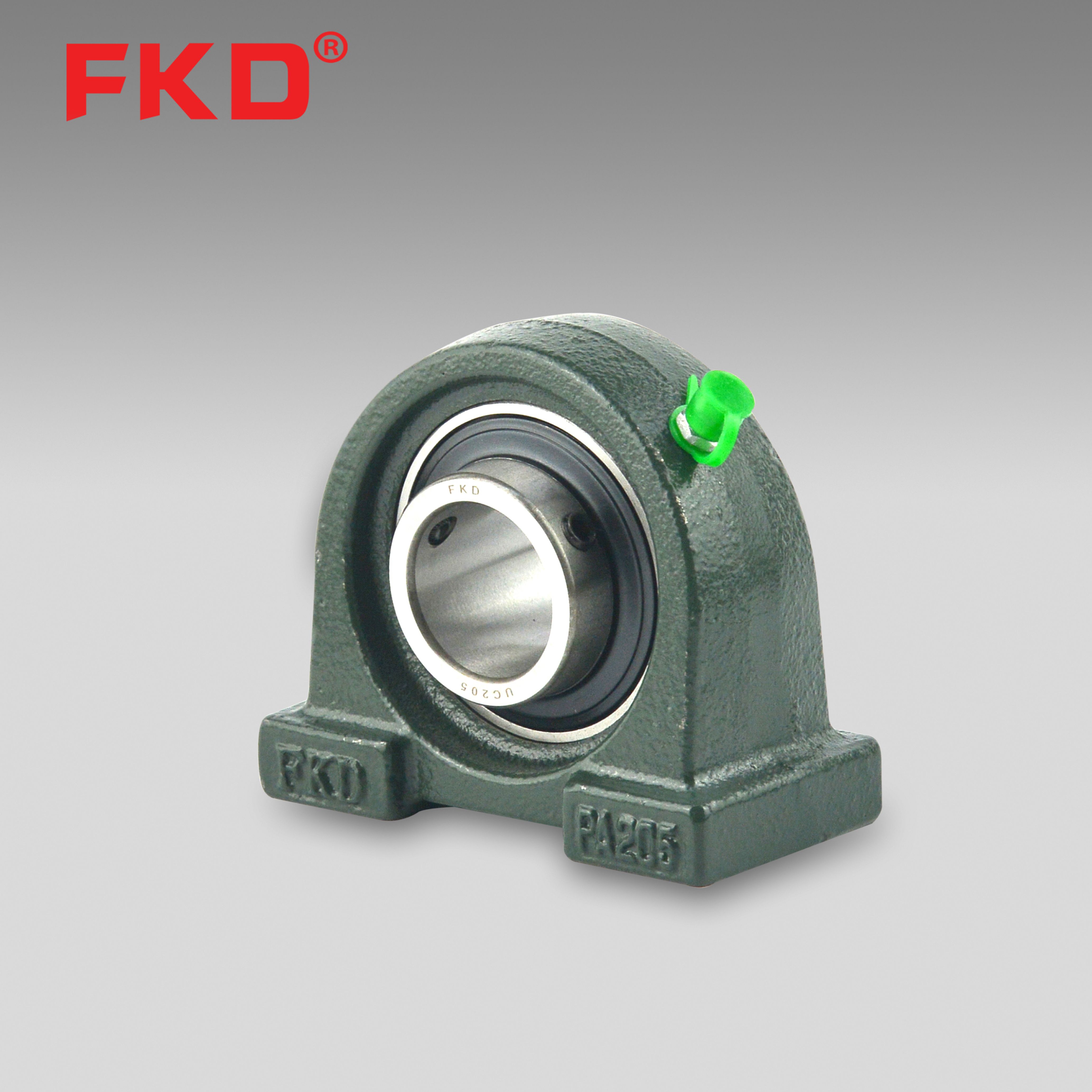
UCPH is a useful example of why centre height matters. The UCPH205–UCPH212 range is a base-mounted pillow block family with a high centre height. If a standard UCP unit is replaced by a UCPH unit without checking the shaft height and surrounding clearance, the entire drive alignment can shift. Conversely, if the application needs a raised shaft position, a standard UCP may require an additional pedestal that the UCPH design is intended to avoid.
UCPA sits in a different installation logic again. The supplied data lists UCPA205 as a top-based pillow block. The mounting interface is not the same as a standard UCP base, so a buyer should compare the frame drawing rather than the bore size alone.
Insert material and grade: GCr15, QT450, STAINSTEEL and P5 ZV3
The insert bearing is the running element. In the supplied product data, the standard insert material is chrome steel GCr15, also described as AISI type 52100 chrome steel. The listed quality grade is P5 ZV3, and the listed speed parameter is 3000 RPM. Those three data points should travel together in an RFQ: material, grade and speed rating are not interchangeable with a generic description such as chrome steel bearing.
The housing material is a separate decision. The supplied data lists cast iron or QT450 for UCP, UCPH, UCPA, UCF, UCFL, UCFC, UCHA and UCT families. QT450 is a ductile iron grade. The verified data for this comparison states that QT450 provides a minimum tensile strength of 450 MPa and elongation of at least 10 percent, with reference to GB/T 1348. That is not the same specification as generic grey cast iron. A buyer who needs the ductile iron option should state QT450 explicitly and ask for the material certificate or inspection record.
STAINSTEEL is the material label used in the supplied data for the stainless steel bearing and plastic housing family. That family is listed with a plastic housing and a STAINSTEEL insert. This is a different construction from a cast iron or QT450 housing with a chrome steel insert. It can be relevant where anti-rust and corrosion resistance are stated requirements, but it should not be treated as an automatic substitute in high-load or high-temperature positions without checking the load rating, temperature limit and housing strength.
Pressed steel housings also appear in the wider mounted-unit market. One supplier page reviewed for this comparison lists cast grey iron, ductile iron and pressed steel as housing options. The FKD product data supplied here specifies cast iron or QT450 for the listed pillow block and flange families, so a pressed-housing requirement should be handled as a separate specification and confirmed against the actual offer.
Seal and speed caution: the verified data notes that triple-lip seals in agricultural bearings are designed for speeds below 500 RPM to maximise contaminant exclusion. That is a different duty point from the 3000 RPM catalogue parameter listed for the standard mounted units in the supplied product data. A buyer should not combine a triple-lip sealing requirement with a 3000 RPM duty assumption without confirming the seal and speed rating with the supplier.

Application fit: manufacturing, agriculture, textile and mining
Manufacturing machinery usually rewards a simple, accessible mounting arrangement. UCP, UCF and UCFL families are common because they allow the shaft to be supported from a base or a machine face with a bolted housing. The supplied scenario data describes product 5851, a flange cartridge unit family, as used in the industrial machinery industry with supporting equipment such as belt, roller chain, transmission shaft and oil seal. That description is a reminder that the bearing unit is part of a drive train: belt tension, chain pull, shaft alignment and seal condition all affect the bearing duty.
Agricultural machinery places more emphasis on contamination and corrosion. The supplied scenario data records product 5833, a square flange unit family, in applications requiring anti-rust, corrosion resistance, high temperature resistance and low noise, with stainless steel as an optional material. The same scenario is stated as common in India, Poland, Peru, Italy and Spain. For harvesters and field equipment, the practical question is not only whether the unit turns, but whether the seal and housing finish can survive dust, moisture and washdown. The supplied case data records a 100,000-piece supply project in India for harvester combine use, with stable operation over a two-year duration and reported high speed, low noise and high quality characteristics.
Textile machinery often combines elevated temperature with dust and continuous running. The supplied scenario data describes product 5844, an insert bearing family, as operating under high temperature, high dust, heavy pollution, high load and high speed conditions. That does not mean every textile application needs the same insert. It does mean the buyer should ask for the actual temperature range, contamination level and speed before accepting a general-purpose unit.
Mining and heavy industrial machinery push the housing and sealing decision further. The supplied scenario data records product 5841, a plummer block family, in 24/7 continuous operation. Continuous duty makes inspection intervals and replacement logistics more important. A UCP or UCF unit with a cast iron or QT450 housing may be suitable for many positions, but the buyer should confirm the load rating, mounting rigidity and seal arrangement for the specific machine. The listed industries for the FKD mounted units include manufacturing, agricultural machinery, textile machinery and mining machinery, but the model range alone does not establish fitness for every position in those industries.
A project-fit decision framework for buyers
- Fix the mounting orientation first. Decide whether the shaft is supported from below, mounted through a flange, suspended, or adjusted in a take-up frame. This separates UCP and UCPH from UCF, UCFL and UCFC, and separates UCHA and UCT from base-mounted families.
- Confirm the shaft height and envelope. A UCPH high-centre-height unit is not a drop-in replacement for a standard UCP unit. Check the centre height, bolt spacing and clearance around the housing.
- State the environment in the RFQ. Use clear terms such as high dust, high temperature, corrosion exposure, washdown, 24/7 operation and high load. The supplied scenario data uses these categories for a reason: they change the housing material and sealing requirement.
- Separate insert grade from housing grade. Specify GCr15 or AISI 52100 chrome steel, P5 ZV3 and the required speed when those are the project requirements. Specify QT450 separately when ductile iron is required rather than generic cast iron.
- Ask for the model-level document set. The model range tells the buyer what exists. The drawing, load rating, seal specification, clearance and inspection record tell the buyer what can be released to the project.
Where FKD Bearing fits this comparison
FKD Bearing is a pillow block bearing brand of Hebei Hailan Bearing Manufacture Co., Ltd., a China-based bearing manufacturer and exporter founded in 1988. The company states a factory area of 100,000 m², more than 400 employees including 30 technicians and engineers, and an annual production and sales figure of over 20 million pieces. It also states ISO9001:2015 quality management system certification, automatic production and inspection lines, and exports of more than 90 percent of products to more than 68 countries and regions.
For this comparison, the relevant point is product coverage. The supplied FKD data lists UCP200, UCPH, UCPA, UCF, UCFL, UCFC, UCHA, UCT and UC insert bearing families, together with a stainless steel and plastic housing family under the SUP series. The listed materials include GCr15 / AISI 52100 chrome steel, cast iron or QT450 housings, and STAINSTEEL for the stainless option. The listed grade is P5 ZV3 and the listed speed is 3000 RPM. These are catalogue facts, not a statement that every model is interchangeable across every application.
The company also states OEM/ODM capability, a monthly capacity of 2,000,000 pieces, a lead time of 30–45 days and a MOQ of 1,000 pieces. Those figures are useful for early project planning, but they should be confirmed against the specific model, housing material and documentation package in the RFQ.
Comparison with traditional solutions and the limits of a catalogue comparison
Traditional mounted units are often specified as cast iron housings with chrome steel inserts. That remains a practical baseline for many manufacturing and agricultural positions. The main alternative choices are QT450 ductile iron housings, pressed steel housings, and stainless steel or plastic housing constructions. Each choice changes the trade-off.
QT450 offers a stated minimum tensile strength of 450 MPa and elongation of at least 10 percent under the referenced GB/T 1348 data. That can be relevant where the housing is expected to absorb shock or where a stronger ductile iron grade is specified. The limitation is that the buyer must verify the actual housing grade and certificate; a generic cast iron description does not establish QT450.
Pressed steel housings can offer a different weight and forming profile, but the supplied FKD data does not list pressed steel as the standard housing for the UCP, UCF and related families in this comparison. A pressed-housing request should therefore be treated as a separate specification. It should not be assumed to match the load path of a solid cast iron or QT450 housing without the supplier’s dimensional and load data.
Stainless steel and plastic housing units are useful where corrosion resistance and low noise are priorities. The limitation is equally clear: the supplied data does not provide dynamic load ratings, static load ratings, operating temperature limits or service-life test results for the stainless family. A buyer should not use the SSUCP or SUP label as proof of heavy-duty equivalence to a cast iron UCP unit. The correct step is to request the model drawing, load rating and application reference for the exact duty.
The broader limitation applies to the whole comparison. Catalogue data can confirm that a family exists, which materials are listed and which model range is offered. It cannot prove service life in a specific harvester, textile frame or mining conveyor. The supplied verified data also notes gaps in published load ratings, clearance data, seal test reports and field failure data. A responsible buyer should close those gaps before a first production order.
Market trend signals buyers should watch
One commercial research estimate places the global pillow block bearing market at USD 4.84 billion in 2025 and projects USD 7.2 billion by 2035. That estimate should be treated as directional rather than definitive, because the same forecast set shows methodology differences between research providers, particularly around whether mounted units or loose bearings are the primary unit of measure.
A more concrete trade signal is classification. HS 8483.20 covers bearing housings incorporating ball or roller bearings, which is the customs heading normally used for pillow block and mounted bearing units. The inserts themselves fall under HS 8482.10 for ball bearings, while spherical roller bearings fall under HS 8482.30. This matters to buyers because customs data for inserts and complete mounted units are not directly comparable. A sourcing decision based only on ball bearing trade statistics can misread the mounted-unit market.
The supply context is also relevant. China’s total export of ball bearings reached USD 6.53 billion in 2024, accounting for approximately 19.9 percent of global exports, according to the verified trade data in this comparison. That figure describes ball bearings, not mounted units, but it explains why China remains a deep sourcing market for bearing components and why buyers often compare Chinese mounted-unit suppliers alongside regional distributors.
Future outlook
Buyer expectations are moving toward more complete model-level documentation rather than broader product-category claims. For mounted units, the useful document set is likely to include housing material certification, insert steel grade, dimensional drawing, load rating, seal type, clearance and inspection record. That direction favours suppliers that can connect a catalogue range to a specific project file.
Stainless steel and plastic housing options are likely to remain relevant in corrosion-exposed and low-noise applications, but their adoption will depend on clearer load and temperature data. The same applies to QT450 and pressed housing alternatives: the material name alone is not enough. The buyer needs the grade, the test record and the application boundary.
For UCP, UCF and SSUCP comparisons, the practical future is not a single winning family. It is a more disciplined selection sequence: mounting orientation, environment, insert material, model range and documentation. Suppliers that support that sequence with verifiable facts will be easier to shortlist than suppliers that offer only a generic pillow block bearing description.
FAQ
Which pillow block family fits a horizontal shaft supported above a base?
UCP and UCPH are base-mounted pillow block families in the supplied data. UCP200 covers UCP205–UCP328, while UCPH covers UCPH205–UCPH212 with a high centre height. Choose UCP for a standard base position and check UCPH when the shaft centre height needs to be raised. UCPA205 is a top-based unit, so it should be compared against the frame drawing rather than treated as a standard UCP substitute.
When should a buyer choose UCF or UCFL instead of UCP?
UCF is a square flange family covering UCF205–UCF328, and UCFL is an oval flange family covering UCFL205–UCFL328. They suit face mounting where the shaft passes through a machine side plate, wall or frame and a base-mounted pillow block is not practical. UCP supports the shaft from below; UCF and UCFL support it from a bolted face. The mounting orientation, bolt pattern and available frame space should decide between them.
What does SSUCP mean, and when is a stainless mounted unit worth considering?
SSUCP is used in the buyer brief for a stainless-steel mounted unit family. The supplied FKD product data lists a stainless steel bearing and plastic housing family under the SUP series, with SUCP205–SUP210, STAINSTEEL insert material, plastic housing, P5 ZV3 and 3000 RPM. It is worth considering where anti-rust, corrosion resistance and low noise are stated requirements. It should not be assumed to be a heavy-load equivalent to a cast iron or QT450 UCP unit without confirming load rating and temperature limits.
How should a buyer compare GCr15, QT450 and P5 ZV3 in an RFQ?
GCr15 or AISI 52100 describes the chrome steel insert material. QT450 describes a ductile iron housing grade with a stated minimum tensile strength of 450 MPa and elongation of at least 10 percent under GB/T 1348. P5 ZV3 is the listed quality grade in the supplied product data. These are separate specifications and should be stated separately. A buyer should ask for the insert steel grade, housing material certificate, precision grade and speed rating for the exact model, rather than accepting a general description.
What model ranges are available, and what are the limits of this comparison?
The supplied data lists UCP205–UCP328, UCF205–UCF328, UCFL205–UCFL328, UCFC205–UCFC212, UCPA205, UCPH205–UCPH212, SUP series SUCP205–SUP210, UCHA205–UCHA212, UCT205–UCT328 and UC insert bearings UC205–UC215 and UC313–UC320. The limit is that this is a catalogue-level comparison. The supplied data does not include complete dynamic and static load ratings, clearance data, seal test reports or field service life for each model. Those items should be requested before a production order.
A public FKD and HHB bearing catalogue PDF is available for download: FKD and HHB Bearing Catalogue.
Tem questões ou precisa de mais detalhes?
Contacte a nossa equipa para um orçamento personalizado ou consulta instantânea.
Solicitar orçamento
Preencha o formulário abaixo e a nossa equipa entrará em contacto com uma proposta personalizada.
Chat direto do WhatsApp
Prefere conversar em tempo real? Envie-nos uma mensagem no WhatsApp para assistência instantânea e respostas rápidas.
- Obter orçamento personalizado
- Partilhar fotos ou documentos
- Discuta as suas necessidades diretamente
Geralmente responde em 5–30 minutos durante o horário de expediente.