
UCPH vs UCFA: Pillow Block Bearing Procurement FAQ
UCPH vs UCFA: Pillow Block Bearing Procurement FAQ
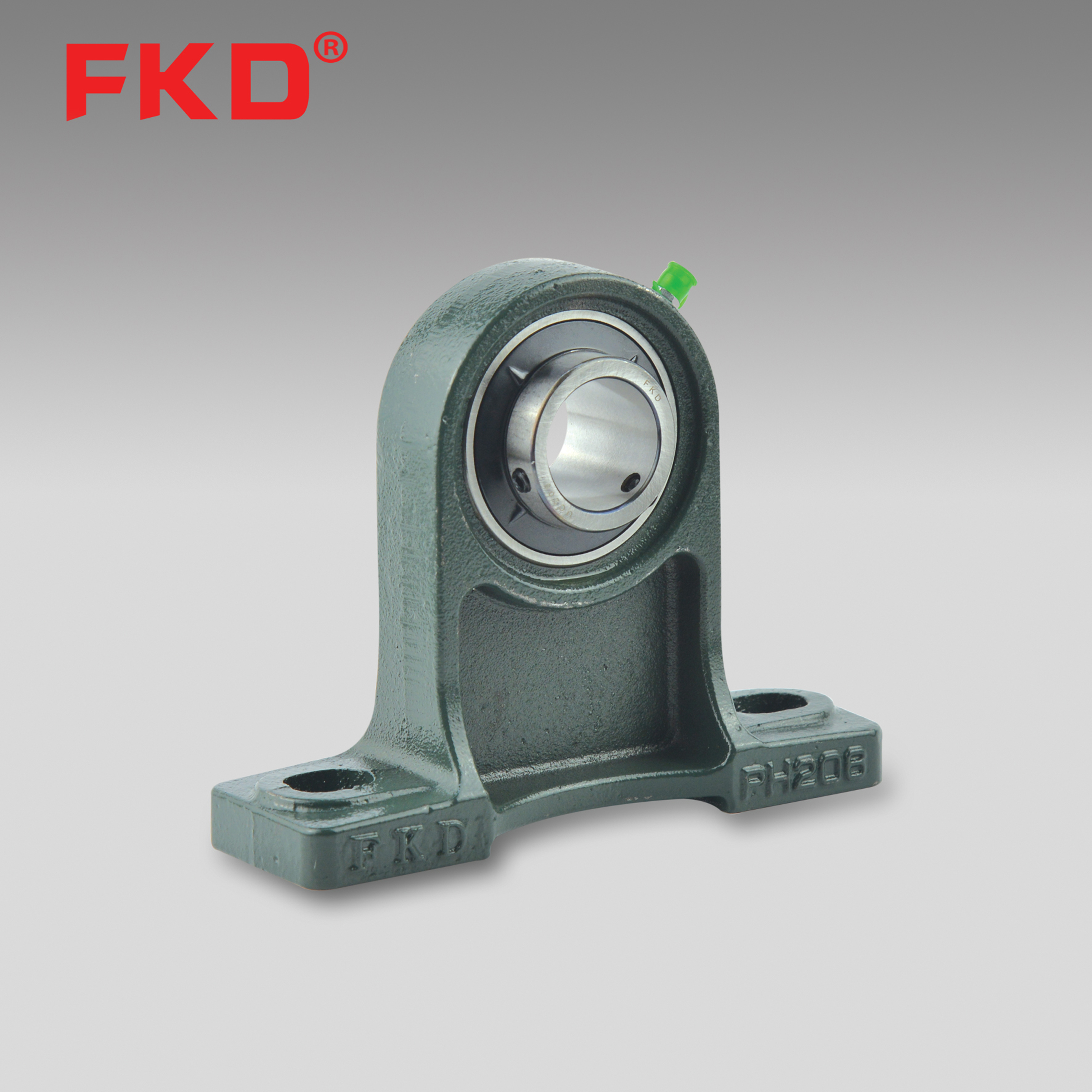
Most pillow block bearing specification conversations begin with bore size and load and end with a part number. The decision that actually creates rework on the shop floor sits in the middle: whether the shaft should be carried on a base-mounted pillow block whose center height is raised, or on a flange unit that bolts to a machine face and can be adjusted in position. FKD's UCPH series and UCFA series represent exactly those two answers, and they sit close enough in specification that buyers regularly treat them as interchangeable. They are not interchangeable — but the reason is mounting geometry, not bearing quality.
Stated plainly, and in the terms a purchase order has to survive: UCPH205 to UCPH212 are high center height pillow block bearings using an AISI type 52100 chrome steel insert and a housing in cast iron or ductile iron QT450. UCFA205 to UCFA212 are adjustable flange units built on chrome steel GCr15 — the same AISI 52100 material family — with cast iron or QT450 housings, and they are documented for continuous operation. Both series carry quality grade P5 ZV3 and a 3000 RPM rating, and both are documented for manufacturing, agricultural, textile and mining machinery. A sourcing decision that hinges on grade or speed will find no difference between them. A sourcing decision that hinges on mounting interface, shaft height and alignment workflow will find almost nothing else.
Why the UCPH vs UCFA Question Reaches Procurement at All
The question rarely comes from a clean-sheet design. It comes from three situations that industrial buyers encounter repeatedly:
- Replacement of a legacy line. The original unit is obsolete or its housing is no longer available, and the maintenance team needs a mounted unit that fits an existing frame without re-machining it.
- Line modification. A conveyor, tensioning station or processing section is being reworked, and the shaft centerline moves relative to the frame.
- Multi-site standardization. A buyer wants one mounted bearing family across several plants, and discovers that some frames are base-mounted while others are face-mounted.
In all three cases, the buyer is not choosing between a better and a worse bearing. The buyer is choosing between two housing concepts whose internal bearing documentation is nearly identical. That is why the comparison has to be made on the interface — the bolting surface, the shaft height and the alignment procedure — rather than on a specification sheet's quality line.
Definitions: What Each Series Actually Is
UCPH series — pillow block bearing with high center height
The UCPH series is a pillow block bearing designed for high center height applications, with models including UCPH205 through UCPH212. The bearing insert is made of AISI type 52100 chrome steel, also designated GCr15, and the housing is supplied in cast iron or ductile iron QT450. The documented quality grade is P5 ZV3 and the documented maximum speed is 3000 RPM. Its documented application set covers manufacturing, agricultural, textile and mining machinery.
The functional word in that definition is height. A pillow block is a base-mounted unit: the housing sits on a flat surface, is bolted down through the base, and holds the shaft at a defined distance above that surface. The UCPH series raises that shaft centerline relative to a standard center height unit. For a buyer, that single geometric fact decides whether the series can be used at all on a given frame, because it moves where the shaft sits in space.
UCFA series — adjustable flange unit
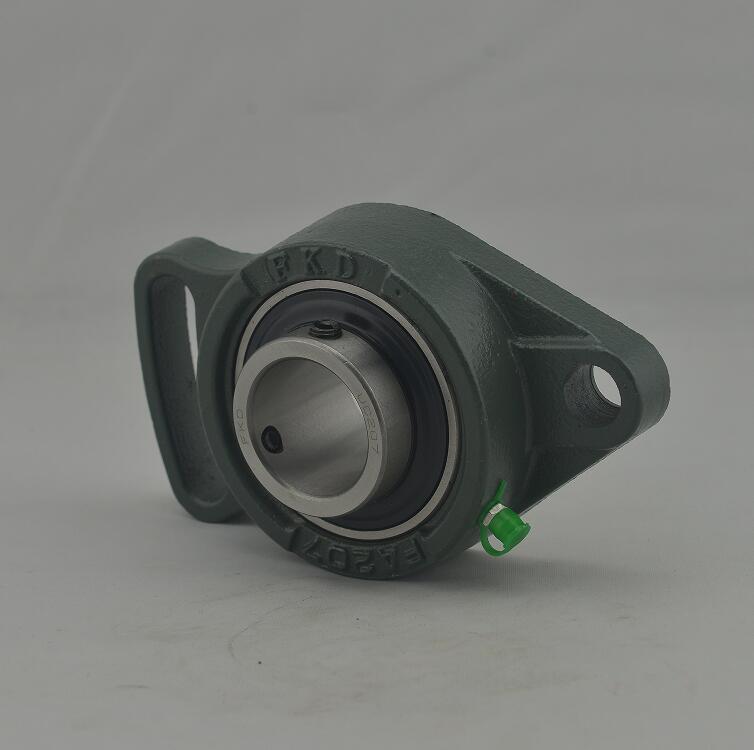
The UCFA series is an adjustable flange unit produced in models UCFA205 through UCFA212 and documented for continuous operation. The bearing material is chrome steel GCr15 (AISI 52100), the housing is cast iron or QT450, the quality grade is P5 ZV3 and the rated speed is 3000 RPM. Like the UCPH series, it is documented for manufacturing, agricultural, textile and mining machinery.
The functional word here is adjustable. A flange unit mounts against a machine face rather than sitting on a base, and the adjustable variant allows position to be set within the flange before the unit is locked down. That adjustability exists to absorb the small positional tolerances that appear when a frame is fabricated, welded or re-drilled — not to correct a misaligned shaft after installation.
The Shared Technical Baseline: P5 ZV3, 3000 RPM, Chrome Steel, Cast Iron or QT450
This is the part of the comparison that is most often misread. In the FKD documentation, the UCPH and UCFA series do not differ on internal grade, bearing steel family, speed rating or housing material options. The two series are engineered to the same declared baseline and then differentiated by housing geometry. Setting that baseline side by side makes the real decision variable obvious.
| Parameter | UCPH series | UCFA series |
|---|---|---|
| Housing concept | Pillow block, base-mounted | Flange unit, face-mounted, adjustable |
| Model range | UCPH205 – UCPH212 | UCFA205 – UCFA212 |
| Bearing material | AISI type 52100 chrome steel (GCr15) | Chrome steel GCr15 (AISI 52100) |
| Housing material options | Cast iron or ductile iron QT450 | Cast iron or QT450 |
| Quality grade | P5 ZV3 | P5 ZV3 |
| Speed | 3000 RPM | 3000 RPM, documented for continuous operation |
| Documented industries | Manufacturing, agricultural, textile, mining machinery | Manufacturing, agricultural, textile, mining machinery |
Procurement takeaway: because the UCPH and UCFA series share the same declared grade (P5 ZV3), the same 3000 RPM rating and the same material family, neither grade nor speed can be used to justify a price difference, a substitution or a rejection between them. The only defensible comparison variables are shaft height, mounting surface and alignment method.
Two practical consequences follow. First, a supplier that offers "the same thing but cheaper" by silently swapping a UCPH for a UCFA is not offering an equivalent part — the mounting interface has changed. Second, when a buyer is evaluating a quotation, the correct verification of a UCPH or UCFA unit is not "which series is it" but "which series was quoted, in which housing material, and does that match the equipment drawing."
Where UCPH and UCFA Actually Diverge
The divergence is entirely in the mechanical interface. Four checkpoints decide it in practice.
1. Shaft centerline height
A high center height pillow block raises the shaft relative to the mounting plane. That is useful where the surrounding structure — a trough, a guard, a belt run or a driven component — requires the shaft to sit higher than a standard base-mounted unit would place it. It also means the unit cannot simply be dropped into a frame designed for a standard center height pillow block without re-checking shaft height, guard clearance and the belt or chain line that connects to the shaft.
2. Mounting surface orientation
The UCPH unit bolts down onto a base: a flat, horizontal surface with a bolt pattern beneath the housing. The UCFA unit bolts against a face: a vertical or angled mounting plane. These are not convertible without fabrication work. This is frequently the single item that decides the choice before any technical evaluation begins, and it should be confirmed from the equipment drawing rather than from a photograph of the installed unit.
3. Positional adjustment and alignment workflow
The UCFA's adjustability is a build-time capability. It helps when frame drilling is imperfect or when two bearing positions must be brought into line on the same shaft run. The UCPH is not adjustable in that sense; alignment on a pillow block is achieved by shimming and by moving the base. Whichever series is chosen, the alignment workflow should be written down before the order is placed: who performs the initial alignment, how the unit is locked in position, and how alignment is re-checked after the machine has been run under load.
4. Frame preparation and bolt access
A base-mounted pillow block requires access under or beside the base for fasteners. A flange unit requires the flange face to be flat and the bolt circle to be reachable from the working side. Both requirements should be checked against the actual machine, not against a general arrangement drawing alone — particularly on retrofits where a housing was originally installed decades earlier.
Application Fit: Manufacturing, Agricultural, Textile and Mining Machinery
Both series are documented for the same four industry groups, which means the industry name alone does not select the series. What selects the series is the position inside the machine.
- Manufacturing and general industrial equipment. FKD's documented industrial machinery scenario covers ventilation and cooling systems running continuously, with exposure to high dust, high load and high speed, and with requirements described as dust-proof, water-proof and shock-proof. In that environment, the matched equipment typically includes belts, roller chains, transmission shafts and oil seals, and the mounted units are selected by the interface the machine frame provides. Where the shaft must sit above a base structure, a high center height pillow block is the natural fit; where the unit must clamp onto a machine wall or a fabricated plate, a flange unit is.
- Agricultural machinery. Harvesting equipment concentrates dust, crop residue and intermittent shock into the same bearing position. The FKD agricultural bearing range includes the W208PPB5 model with chrome steel GCr15 and cast iron or QT450 housing at P5 ZV3 and a maximum speed of 3000 RPM, and the UCPH and UCFA series are documented for agricultural machinery as well. In practice, harvester positions that require the shaft to clear a header or a drive guard tend toward base-mounted pillow blocks, while face-mounted positions on a side plate tend toward flange units.
- Textile machinery. Textile lines are typically long, multi-station shaft runs. Here the deciding factor is usually whether the frame is a horizontal structural rail — favoring pillow blocks — or a vertical side frame with access from the front — favoring flange units. Aligning several units along one shaft is the dominant installation task, which is where the UCFA's adjustable position offers a practical build-time advantage.
- Mining machinery. Mining positions combine heavy load, abrasive dust and limited maintenance windows. Both series are documented for this industry; the housing material choice (cast iron or QT450 ductile iron) and the sealing configuration of the insert should be confirmed against the actual contamination level before the order is released.
Comparison with Traditional and Adjacent Solutions — and Where Each Series Stops Being Right
The UCPH and UCFA series are two options inside a wider mounted-bearing portfolio, and the most useful thing a buyer can do is recognize the boundaries of each. FKD's documented range also includes UCP200 series pillow blocks from UCP205 to UCP328, square flange units (UCF205 to UCF328), oval flange units (UCFL205 to UCFL328), flange cartridge units (UCFC205 to UCFC212), screw conveyor hanger units (UCHA205 to UCHA212), take-up units (UCT205 to UCT328), top-based units (UCPA205), flange bracket units (UCFB205 to UCFB210), pressed housing units (SAPP205, SAPFL205, SAPF205, SBPFL205), stainless steel units (SSUCP and the plastic-housing SUP series), the SA series ball bearings with eccentric collar (SA205 to SA212) and the SNL508 plummer block in cast iron HT200.
| Requirement | Better-matched documented option | Why |
|---|---|---|
| Standard shaft height on a flat base | UCP200 series pillow block | Standard center height rather than raised |
| Mounting against a machine face | UCF, UCFL, UCFC, UCFB or UCFA units | Flange interface instead of a base |
| Belt or chain tensioning with linear travel | UCT take-up units | Take-up geometry provides travel that a fixed pillow block or flange unit does not |
| Washdown, moisture or corrosion exposure | SSUCP (stainless housing) or SUP (plastic housing) | Stainless steel construction documented for corrosion resistance |
| Light-duty or space-constrained housings | Pressed housing units (SAPP205, SAPFL205, SAPF205, SBPFL205) | Pressed steel housing rather than cast |
| Screw conveyor suspension points | UCHA screw conveyor hanger units | Purpose-built hanger geometry |
| Split plummer block positions | SNL508 plummer block, cast iron HT200 | Split housing concept for shaft support |
Stating the boundaries honestly matters more than stating the advantages, so four limits should be recorded before a UCPH or UCFA unit is specified:
- High center height is not a free upgrade. Raising the shaft centerline changes the height of the shaft relative to everything else on the machine. A high center height pillow block cannot be substituted for a standard center height unit without re-verifying shaft height, belt or chain alignment, guard clearance and bolt pattern. If those checks are skipped, the series becomes the wrong choice regardless of its grade.
- Adjustability is not a correction for poor alignment. The UCFA's adjustable flange helps absorb positional tolerance during assembly, but once the unit is locked in place it behaves as a fixed support. If the shaft is not properly aligned, adjustability does not solve the resulting load, vibration or seal wear.
- The 3000 RPM figure is a documented ceiling, not a target. It is the rated speed in the FKD documentation for both series. Applications that require higher continuous speed fall outside that documented figure and should be reviewed with the supplier rather than assumed to be covered.
- Neither series is documented as a corrosion-resistant or stainless option. For washdown, food-adjacent or chemically exposed positions, the stainless SSUCP and plastic-housing SUP ranges are the documented alternatives in the same portfolio.
Market Context: Where Mounted Bearing Demand Is Moving
The mounted bearing category is large enough that sourcing decisions inside it have consequences beyond a single machine. Independent market research estimated the global pillow block and mounted bearing market at approximately USD 6.1 billion in 2024 (IndexBox / industry analysis). Within the wider mounted bearing market, plummer blocks accounted for approximately 42.51% of revenue share in 2024 (Fortune Business Insights), which indicates that base-mounted housing concepts remain the dominant format even as flange and specialty housings grow.
The broader bearings market was estimated at USD 58.6 billion in 2024, with a projected value of USD 143.6 billion by 2034 (Global Market Insights). Published market-size estimates for bearings differ considerably depending on scope, so buyers comparing research reports should note that the figures are not directly interchangeable. On the supply side, China's ball bearing exports reached USD 6.53 billion in 2024, representing 19.9% of global exports (OEC), which is consistent with the reality that a large share of mounted bearing units specified worldwide are manufactured in China.
Standardization supports that trade. Pillow block units are commonly standardized under ISO standards for universal sizing and under JIS (Japanese Industrial Standards) for localized precision compatibility. For buyers, dimensional standardization makes cross-supplier interchangeability plausible, but it does not standardize housing material or internal grade — which is precisely why those two attributes must be written explicitly on the purchase order.
A Procurement Checklist for the UCPH / UCFA Decision
- Confirm the interface from the drawing, not the photo. Base-mounted (UCPH) or face-mounted (UCFA). This single item eliminates one series in most cases.
- Confirm shaft height. If the frame was designed for a standard center height pillow block, verify whether the raised centerline of the UCPH series is compatible before ordering.
- Confirm housing material explicitly. Cast iron and QT450 ductile iron are both documented options for the UCPH and UCFA series. If the equipment specification calls for one, name it on the order.
- Confirm the bearing material designation and grade. AISI type 52100 / GCr15 chrome steel, quality grade P5 ZV3. Requiring the grade in writing prevents silent downgrades on repeat orders.
- Confirm the speed rating against actual duty. Both series are documented at 3000 RPM, with the UCFA series documented for continuous operation.
- Confirm the alignment workflow. Decide in advance how the unit will be aligned, locked and re-checked after running under load.
- Confirm the environment. Corrosion, washdown or chemical exposure should route the inquiry to the stainless or plastic-housing ranges rather than to UCPH or UCFA.
- Confirm documentation and continuity. Ask for material and grade documentation, and check that the same series and housing material will be available on re-order.
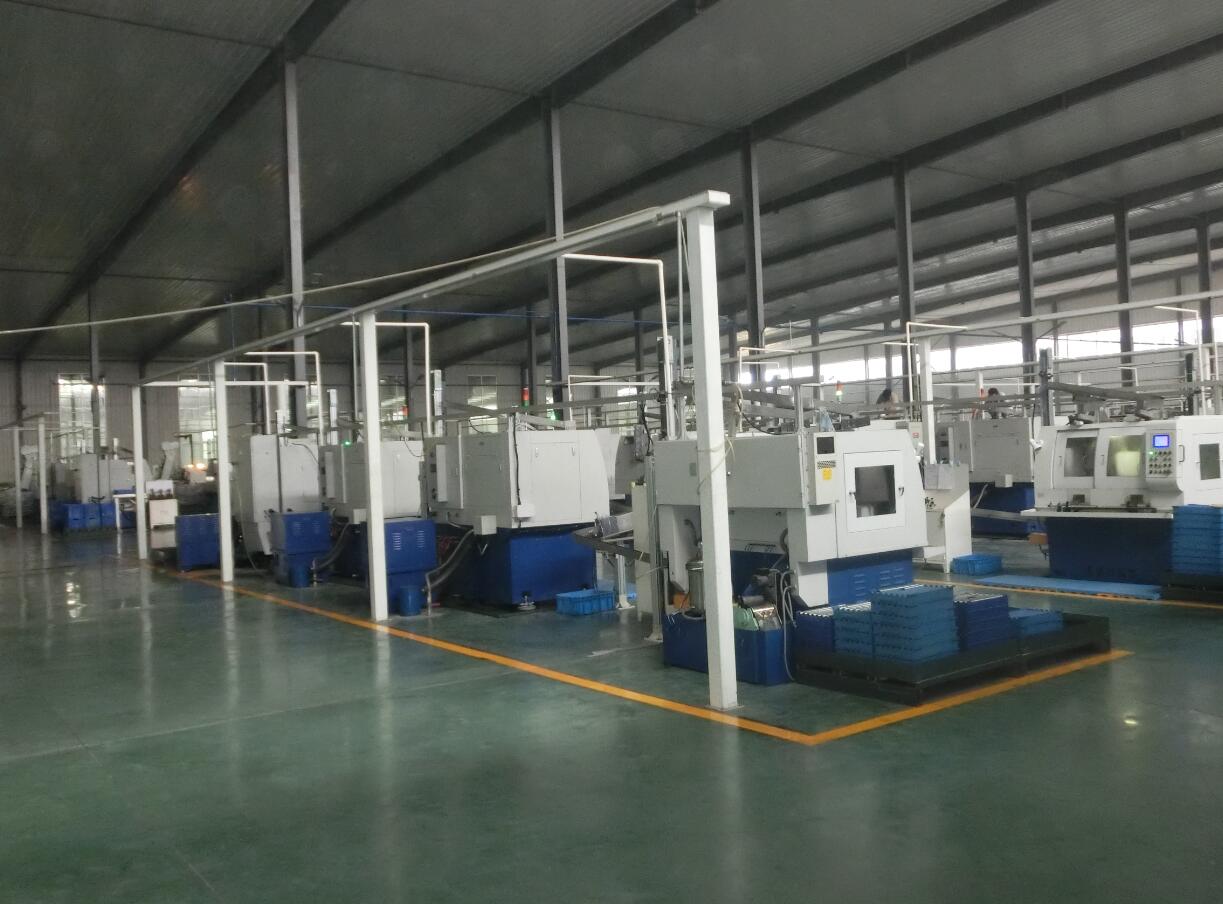
On the supply side, the manufacturer behind the FKD brand is HEBEI HAILAN BEARING MANUFACTURE CO., LTD., established in 1988 and located in Hexi Town Industrial Park, Linxi County, Hebei, China. The company specializes in manufacturing pillow block bearings, operates automatic pillow block bearing production and inspection lines along with a bearing housing production line, has an annual production capacity of 20,000,000 units, employs approximately 400 staff including a 30-person engineering and technical team, and holds ISO9001:2015 quality management system certification. Registered brands include FE, FKD and HHB, and over 90% of products are exported, with main markets in the EU, Asia, South America and Africa. For a procurement team, those are the attributes that determine whether a specification can be repeated identically across multiple orders and sites — which matters more to a UCPH-versus-UCFA decision than any individual catalogue figure.
Future Outlook
Three shifts are likely to shape how this decision is made over the next procurement cycles. First, standardization will continue to make dimensional interchangeability easier, which pushes differentiation toward what standardization does not cover: housing material, internal grade and documented speed rating. Buyers who specify material and grade explicitly on every order will get more consistent supply than buyers who specify only a model number.
Second, automated housing and bearing production — including automatic production and inspection lines already used for pillow block bearings — reduces unit-to-unit variation, which in turn makes it more reasonable for buyers to treat a documented series as a repeatable specification rather than a one-off purchase. Third, as multi-site manufacturers consolidate suppliers, the ability to supply a base-mounted pillow block, an adjustable flange unit and the adjacent housing types from a single documented portfolio becomes a continuity advantage. None of these shifts change the underlying engineering answer: the UCPH and UCFA series are selected by how the unit mounts, and by nothing else.
FAQ: UCPH High Center Height vs UCFA Adjustable Flange
What is a UCPH pillow block bearing, and what does high center height mean in practice?
The UCPH series is a pillow block bearing designed for high center height applications, available in models UCPH205 through UCPH212. It uses an AISI type 52100 chrome steel insert (also designated GCr15), a housing in cast iron or ductile iron QT450, quality grade P5 ZV3 and a maximum speed of 3000 RPM. In practice, high center height means the shaft centerline sits higher above the mounting base than on a standard center height pillow block, so the series suits frames where surrounding structure requires the shaft to be raised.
What is the UCFA series used for?
The UCFA series is an adjustable flange unit with models UCFA205 through UCFA212, made of chrome steel GCr15 (AISI 52100) with a cast iron or QT450 housing, quality grade P5 ZV3 and a 3000 RPM rating, documented for continuous operation. It is used where a bearing unit must mount against a machine face rather than on a base, and where a limited amount of positional adjustment is useful during assembly. It is documented for manufacturing, agricultural, textile and mining machinery.
Do the UCPH and UCFA series share the same quality grade and speed rating?
Yes. Both series are documented with quality grade P5 ZV3 and a 3000 RPM rating, with the UCFA series additionally documented for continuous operation. Both use chrome steel in the AISI 52100 / GCr15 family and both offer cast iron or QT450 housings. Because grade and speed are shared, they cannot be used as the deciding factor between the two series.
Which industries are UCPH205–UCPH212 and UCFA205–UCFA212 intended for?
Both series are documented as suitable for manufacturing, agricultural, textile and mining machinery. Within those industries the selection depends on the mounting position inside the machine rather than on the industry itself: base-mounted positions favor the pillow block concept, while face-mounted positions favor the flange concept.
Can the housing be supplied in QT450 instead of cast iron?
Both the UCPH and UCFA series are documented with housing material options of cast iron or ductile iron QT450. Because both are available, the required material should be stated explicitly on the purchase order and confirmed on the technical documents rather than assumed from the series name alone.
Are UCPH or UCFA units maintenance-free?
Neither series is documented as a maintenance-free product. Both are documented with defined materials, quality grade P5 ZV3, a 3000 RPM rating and, for the UCFA series, continuous operation. Whether relubrication or inspection intervals can be extended depends on the housing and sealing configuration selected, the operating environment of the machine, and the maintenance policy of the user.
How should a buyer decide between a high center height pillow block and an adjustable flange unit?
Start with the mounting interface: a flat, horizontal base favors the UCPH series, while a vertical or angled machine face favors the UCFA series. Then verify shaft height against the equipment drawing, confirm housing material (cast iron or QT450), confirm the AISI 52100 / GCr15 insert and P5 ZV3 grade, and confirm that the 3000 RPM rating covers the actual duty. Finally, define the alignment procedure before ordering, since the UCFA's adjustability is a build-time positioning aid rather than a substitute for correct alignment.
When are UCPH or UCFA units the wrong choice?
They are the wrong choice when the application requires belt or chain tensioning travel, in which case take-up units such as UCT205 to UCT328 are the documented alternative; when corrosion, washdown or chemical exposure is present, where stainless or plastic-housing options are documented; when the housing must be a split plummer block, where the SNL508 cast iron HT200 block applies; or when the required speed exceeds the documented 3000 RPM rating. Substituting a high center height pillow block for a standard center height unit without re-checking shaft height and clearance is also inappropriate.
What evidence should a buyer request when auditing a mounted bearing supplier?
At minimum: material and grade documentation for the chrome steel insert, confirmation of housing material as cast iron or QT450, the declared quality grade and speed rating, and dimensional inspection records. A supplier that operates automatic bearing production and inspection lines and a dedicated bearing housing production line can typically provide a more repeatable specification. Where relevant, quality management certification such as ISO9001:2015 should be verified directly.
Further reference: the FKD and HHB bearing catalogue, covering UCPH, UCFA and the wider mounted bearing range, is available for download at FKD and HHB Bearing Catalogue (PDF).