
UHF RFID Reader Buyer Matrix: Eight Formats for Smart Manufacturing
UHF RFID Reader Buyer Matrix: Fixed, Handheld, Tray, Gate and AI-Powered Formats for Smart Manufacturing
In smart-manufacturing projects, the UHF RFID reader is often the last component specified and the first one that constrains the schedule. A reader that performs well on a test bench may be impossible to mount above a dock door, awkward to cable inside a paint shop, or incompatible with the tag standard already applied to a factory's returnable containers. In practice, the deployment format — fixed, handheld, tray, gate, ceiling, Wi-Fi, 2.4 GHz active or AI-powered — sets the deployment envelope before any transmit-power figure does.
This buyer matrix maps UHF RFID reader formats to factory workflows and names the product units that sit behind each one, using published DAILY RFID specifications and third-party market data. It is written for buyers at the evaluation and execution stage who want to settle the form-factor decision before requesting quotations.
Why the format decision comes before the specification decision
Passive UHF readers share an air interface. Readers in the DAILY RFID range are specified against ISO18000-6C and EPC Class 1 Gen 2, the same protocol family that GS1 publishes as the EPC UHF Gen2 air interface standard (ISO/IEC 18000-6C/63). In principle, therefore, a compliant tag works with a compliant reader regardless of the reader's physical shape — which is also why buyers sometimes treat the form factor as a secondary question.
It is not secondary. Mounting height, read-zone shape, cable route, power source, anti-collision capacity and host interface are all determined by format rather than by power. A fixed reader specified at 26 dBm and a handheld specified at 30 dBm are not substitutes for each other: one is installed and rarely moves, the other is carried by a person and depends on battery management, screen workflow and drop protection. Deciding on format first removes most of the rework that otherwise appears late in a factory rollout.
The UHF RFID reader buyer matrix at a glance
The table below summarises the eight formats named in this framework, plus embedded modules as a supporting format. All range and capacity figures are the manufacturer's published specifications and remain tag and environment dependent.
| Deployment format | Representative verified unit | Published read range | Simultaneous tags | Typical factory use | Constraint to verify |
|---|---|---|---|---|---|
| Fixed / integrated UHF | DL921 UHF Long Range RFID Reader with GSM | 0.1 m – 15 m | Up to 50 | Dock doors, yard lanes, overhead checkpoints | Mounting height, power route, tag-dependent range |
| Fixed, PoE | DL921 Power on Ethernet UHF Long Range RFID Reader | 0.1 m – 15 m | Up to 50 | Loading bays, assembly checkpoints, vehicle access | Requires PoE-capable network switching |
| Fixed, AI multi-port | DL6940/6960 AI Multi-Antenna 4-Port UHF Reader | 25 m – 30 m | Up to 1,000 | Large batch identification, multi-zone coverage | Four external antennas and cabling must be planned |
| Handheld | DL1280 Industrial PDA UHF/HF/LF Handheld Reader | UHF 0.1–20 m; HF 0.1–32 cm; LF 0.1–10 cm | Up to 100 | Tool and asset inspection, tall-rack pallet inventory | Battery cycle and operator workflow |
| Handheld, AI-powered | DL1380 AI-Powered RFID Handheld | UHF 0.1 m – 20 m | More than 200 | Dense-stack search and item positioning | Value of edge AI depends on tag density |
| Tray | DL6993 RFID Tray Reader (UHF); DL4130H RFID Jewelry Tray Reader & Antenna All-in-one (HF 13.56 MHz) | 0.1 m – 5 m; 1 cm – 50 cm | 80–100; up to 50 | Counter, drawer and tray-level verification | Reader band must match the deployed tag band |
| Gate | DL8330U Advanced UHF RFID Gater | 4 m – 7 m channel width | Mass-flow optimised | Line-side and dock batch identification | Fixed channel width; AC 220 V / 50 Hz supply |
| Ceiling | DL6990 UHF Ceiling RFID Reader (Integrated Antenna) | 0.1 m – 5 m | Up to 50 | Room-scale monitoring, staging and gateway tracking | Overhead mounting and coverage planning |
| Wi-Fi | WiFi RFID Reader DL920Plus (DL930W as Wi-Fi variant) | 8 m – 15 m (DL930W 4 m – 8 m) | Supported | Reconfigurable lines, cabling-constrained areas | Wireless coverage and roaming stability |
| 2.4 GHz active | DL9230 RFID TCP/IP Active Reader | 0 m – 100 m, adjustable | Up to 200 | Yard-scale and remote-site identification | Requires 2.4 GHz active tags with batteries |
| Embedded module (supporting) | DL213 Type-C UHF Reader Module; DL228 Type-C UHF Mobile Reader | 0.1 cm – 10 cm | Up to 5 | Embedded devices, desktop encoding and verification | Very short range by design |
Published read speed is broadly consistent across the range — an average single-tag read time of less than 10 ms per 64 bits appears across the fixed, handheld, tray, ceiling and gate units — so speed alone rarely separates formats. Range, coverage shape, interfaces and mounting constraints do.
Fixed readers: dock doors, overhead checkpoints and yard lanes
Fixed UHF readers are the default choice wherever identification must happen without a person present. The DL921 UHF Long Range RFID Reader with GSM is an integrated unit with a built-in circular polarised antenna, a published read range of 0.1 m to 15 m, simultaneous reading of up to 50 tags, IP65 protection and a -20 °C to +60 °C operating window. Its trigger port and relay port allow direct linkage with barriers or alarm devices, and an integrated 2G/4G GSM module allows data upload where structured cabling is impractical.
The DL921 Power on Ethernet UHF Long Range RFID Reader variant keeps the same 0.1 m to 15 m read envelope while adding Power over Ethernet, so a single Ethernet cable carries both power and data to a mounting point above a loading bay or assembly checkpoint. The DL921 AI Enhanced UHF Long Range Reader adds PoE, GPS and GSM in one enclosure for outdoor or distributed sites.
Factory fit: an automotive parts warehouse deployment in Spain used 420 sets of a four-port long-range reader for inbound pallet reading, dock-door verification and returnable container tracking; DAILY RFID reports inbound receiving effort reduced by 40%–70% and missed pallet scans reduced by 30%–60% in that project.
Handheld readers: inspection, inventory and dense-stack search
Handhelds cover what fixed infrastructure cannot reach. The DL1280 Industrial PDA UHF/HF/LF Handheld Reader is a tri-frequency unit running Android 12 on an 8-core 2.0 GHz processor with 4 GB RAM and 64 GB ROM. It reads UHF at 0.1 m to 20 m, HF at 0.1 cm to 32 cm and LF at 0.1 cm to 10 cm depending on tag and environment, reads up to 100 tags simultaneously at more than 100 tags per second, and is rated IP65 in a 680 g body including dual batteries for long shifts.
The DL1380 AI-Powered RFID Handheld brings edge filtering and positioning into the same operating pattern. It is specified for UHF read distances up to 20 m, AI-driven tag sorting for more than 200 tags at once, RSSI-based distance calculation and position tracking, IP65 protection, 1.5 m drop resistance and dual batteries for more than 12 hours of continuous work. In a dense rack or stacked pallet, that combination of filtering and RSSI is what reduces repeat reads and manual searching.
The DL995 and DL996 handhelds serve a different band entirely: 13.56 MHz HF, up to 40 cm read distance, with scan, library, host, anti-theft and search modes, and more than 50 tags per second in standard environments. They are relevant to manufacturers mainly where HF tagging is already in place for close-range workflows.
Tray readers: counter-level and drawer-level verification
Tray readers place the read field into a flat surface, so items can be counted simply by being placed on or in it. Two verified units illustrate the difference in band. The DL6993 RFID Tray Reader (Built-in Reader) is a UHF unit with a 0.1 m to 5 m published range, simultaneous reading of 80–100 tags, IP66 protection and RS232, RJ45, GPIO and USB interfaces. The DL4130H RFID Jewelry Tray Reader & Antenna All-in-one is a 13.56 MHz HF unit with a built-in near-field loop antenna array, a 1 cm to 50 cm range, simultaneous reading of up to 50 tags and a metal-resistant design that lets it operate on a metal counter without signal attenuation.
Factory fit: tray-level counting of small parts, tool drawers, calibration instruments, or anything already managed in a fixed tray or drawer layout. Band matters here — a UHF tray and an HF tray do not read the same tag population, so the tray format should follow the existing tag decision rather than lead it.
Gate readers: line-side and dock batch identification
Gate readers create a defined walk-through channel rather than a read zone. The DL8330U Advanced UHF RFID Gater uses four built-in TX/RX antennas distributed across a main and an auxiliary panel to cover a 4 m to 7 m channel width, supports ISO18000-6C, EPC Class 1 Gen 2 and ISO18000-6B, and exposes RS232, RJ45 and GPIO for alarm and sensor expansion. It is powered from AC 220 V / 50 Hz and consumes approximately 35.2 W at 160 mA.
Factory fit: component batch tracking between production stages, loading dock flow control, and any process where people or containers pass a fixed line and must be identified as a group rather than one item at a time.
Ceiling readers: overhead coverage without floor equipment
The DL6990 UHF Ceiling RFID Reader integrates its antenna into an all-in-one 180 mm × 180 mm × 28 mm enclosure rated IP66. Its 33 dBm adjustable power and high-gain integrated antenna support an overhead read distance up to 5 m and simultaneous reading of up to 50 tags, with a free SDK and multi-platform support. Because the unit is mounted above the working area, it adds identification coverage without adding floor clutter or operator steps.
Factory fit: room-scale monitoring, gateway and staging-area tracking, and areas where a gate structure cannot be installed.
Wi-Fi readers: where cabling is the constraint, not coverage
The WiFi RFID Reader DL920Plus is specified from 860 MHz to 960 MHz with an integrated internal antenna, a published read range of 8 m to 15 m, adjustable transmit power from 20 dBm to 30 dBm and IP64 protection. Its integrated Wi-Fi module removes the need for structured data cabling at the mounting point, while RS232, RJ45, GPIO with Wiegand 26/34, and USB remain available. The DL930 series applies the same logic with a choice of wireless backhaul: the DL930B for Bluetooth, the DL930W for Wi-Fi and the DL930G for GPRS, each with a 4 m to 8 m published read range, an IP65/IP66 weatherproof enclosure and a -30 °C to +70 °C operating range.
Factory fit: reconfigurable production lines, temporary or seasonal reading points, and buildings where pulling cable to a new position would take longer than the process change itself.
2.4 GHz active readers: long distances with a different tag ecosystem
The DL9230 RFID TCP/IP Active Reader operates in the 2.4 GHz to 2.5 GHz ISM band with a built-in 15 dBi vertically polarised antenna, an adjustable read distance of 0 m to 100 m and simultaneous identification of up to 200 active tags. It carries TCP/IP (RJ45), RS232, RS485 and Wiegand 26/34 interfaces, optional Wi-Fi or 4G, and an industrial aluminium alloy casing rated from -20 °C to +70 °C.
The important boundary is the tag. The DL9230 works with 2.4 GHz active tags from families such as T8652, T5030, T8351 and T29030 — not with passive UHF labels. A factory that has standardised on passive UHF cannot reuse that tag population here, and active tags carry batteries, which changes maintenance planning. This format is best treated as a separate decision rather than an upgrade path.
AI-powered readers: where filtering matters more than range
AI in this context means edge processing that filters, sorts and positions tags rather than merely counting them. The DL6940/6960 AI Multi-Antenna 4-Port UHF Reader uses four external TNC/SMA antenna ports, a published read range up to 25 m to 30 m, high-density anti-collision for up to 1,000 tags and 5 W power consumption with IP64 protection. The manufacturer publishes its edge algorithm as processing data 16 times faster than ordinary mainstream readers — a manufacturer-stated figure that buyers should validate against their own tag density and read-zone geometry.
Other units in the same family target different positions in the workflow: the DL9702 AI RFID Tag Tester and Encoder isolates a single tag at 10 cm to 15 cm for encoding and quality screening at 0.25 W, and the DL921 AI Enhanced UHF Long Range Reader adds GPS and GSM to a fixed installation. AI filtering is most valuable where tag populations are dense and repeated reads create data noise, not where distance is the primary problem.
Mapping formats to factory workflows
Format selection becomes concrete when it is tied to a workflow rather than to a product family. The second table maps common smart-manufacturing workflows to the format that fits them and to the verified product units involved.
| Factory workflow | Recommended format | Verified product unit | Why it fits |
|---|---|---|---|
| Tool tracking and tool-cabinet audit | Handheld plus embedded cabinet module | RFID Tool Management Adhesive Tag; RFID Smart Cabinet Component | Ferrite isolation layer allows on-metal reading at 1 m to 3.5 m with a 4 W EIRP handheld; the cabinet module supports more than 500 tags per partition with RSSI shelf positioning |
| Assembly-line component identification | Fixed multi-port or gate | DL6940/6960; DL8330U | Multi-antenna zoning with up to 1,000 tags, or a 4 m to 7 m walkthrough channel with mass-flow anti-collision |
| Dock-door receiving and returnable containers | Fixed, PoE | DL921 Power on Ethernet UHF Long Range RFID Reader | Single-cable deployment, 0.1 m to 15 m overhead read, relay and trigger ports for barriers and alarms |
| Tray, drawer and counter verification | Tray | DL6993 (UHF) or DL4130H (HF) | Flat-panel batch reading of 80–100 tags or up to 50 tags in a single pass with no external antenna wiring |
| High-rack pallet inventory | Handheld | DL1280; DL1380 | UHF read up to 20 m; edge filtering and RSSI to locate items in dense stacked goods |
| Personnel and zone access | Gate or 2.4 GHz active | DL8330U; DL9230 | Channel identification over 4 m to 7 m, or up to 100 m adjustable active reading where battery-powered tags are acceptable |
| Room-scale and staging coverage | Ceiling | DL6990 | 33 dBm power, 0.1 m to 5 m overhead read, IP66 enclosure and integrated antenna |
| Tag encoding and quality screening | Desktop AI writer and tester | DL9702 | 10 cm to 15 cm isolated single-tag testing with AI diagnosis of weak or damaged tags at 0.25 W |
The five product units anchoring this framework
Five verified units carry most of the workload in the matrix above.
- RFID Tool Tag (RFID Tool Management Adhesive Tag). A UHF on-metal label operating at 860–960 MHz with an integrated electromagnetic ferrite shield that prevents metal surfaces from short-circuiting or detuning the antenna. Published read distance is 1 m to 3.5 m on metal with a 4 W EIRP handheld reader and up to 5 m off metal, in sizes from 25 mm × 9 mm to 50 mm × 10 mm, with a -40 °C to +85 °C operating range. It is the component that makes tool-level tracking realistic in machining and assembly environments.
- RFID Wristband. Wearable tags available in LF, HF and UHF configurations — for example the dual-chip UHF H3 and HF Mifare 1K wristband, which operates at 860–960 MHz and 13.56 MHz, reads from 5 cm to 250 cm depending on reader and IC, and is rated IP68 in silicone. In manufacturing, wristbands support hands-free zone access, personnel movement records and, where required, short-range payment or locker functions.
- RFID Gate (DL8330U Advanced UHF RFID Gater). The walk-through format described above, with a 4 m to 7 m channel and four built-in TX/RX antennas.
- RFID Tray Reader. Flat-panel batch reading for tray, drawer and counter layouts, verified in a UHF unit (DL6993) and an HF unit (DL4130H).
- AI Powered RFID Reader. Edge-filtered reading across fixed, desktop and handheld positions, verified in the DL6940/6960 four-port reader, the DL921 AI Enhanced reader, the DL9702 tester and encoder, and the DL1380 handheld.
What actually determines performance after the format is chosen
Read range is conditional, not fixed
Every published DAILY RFID range figure is stated as tag and environment dependent, and that qualifier is the most useful part of the specification. UHF read distance changes with tag size and chip, orientation, mounting surface, nearby material, transmit power and the presence of other readers. Comparisons should therefore be run with the tag the factory actually intends to deploy.
Metal and liquids change the tag, not the reader
Wherever tools, dies, fixtures or containers are metallic, the tag design carries the solution: an anti-metal ferrite isolation layer, a rigid or foam-backed construction, or an on-metal label such as the RFID Tool Tag. Selecting a higher-power reader does not solve a detuning problem.
Anti-collision capacity decides throughput
Simultaneous tag capacity ranges from 5 tags for the DL213 and DL228 Type-C modules, through 50 tags for the DL921 and DL6990, to 80–100 tags for the DL6993 tray reader, more than 200 tags for the DL1380 handheld, and up to 1,000 tags for the DL6940/6960 four-port reader. In a dense flow, this figure determines how many items can be processed in a single pass far more than peak range does.
Interfaces decide integration cost
Almost every fixed and tray unit in the range exposes RS232, RJ45 TCP/IP, USB and GPIO with trigger and relay ports; Wiegand 26/34 and RS485 appear on the gate, Wi-Fi and active reader models. GPIO is what allows a reader to open a barrier, trigger a lamp or accept a sensor input without additional middleware. Some industrial vendors publish OPC UA AutoID Companion Specification support for standardised delivery to PLC, MES, ERP, WMS or cloud systems; DAILY RFID publishes free SDKs and multi-platform development support across its readers instead. Either way, interface requirements should be written into the specification rather than assumed.
Power, enclosure and temperature define the installation
Published ratings in this range include IP54, IP64, IP65 and IP66, with operating temperatures from -30 °C up to +70 °C on the fixed, Wi-Fi and active models, and DC 9–24 V, PoE or AC 220 V power depending on unit. These three parameters usually decide whether an installation needs a new power run, a protective cabinet or a different mounting position.
Comparison with barcode and HF, and where UHF does not fit
Barcode remains a valid technology. For single-item identification at low volume, where a person reads a label and the printed label itself carries information, changing to RFID adds cost without removing a step. The case for UHF readers is batch identification without line of sight — reading a full pallet, a tray of instruments or a rack of containers in one pass.
HF and NFC solve a different problem. Their physically short read zone makes them preferable when the read area must be tightly constrained, which is why the DL4130H HF tray reader is specified at 1 cm to 50 cm and why 13.56 MHz wristbands suit short-range payment or locker functions. A factory can legitimately run both bands on the same site.
The boundaries of the UHF reader formats in this matrix are real and worth stating before purchase:
- Read distances are conditional and must be validated with the actual tag, mounting height and nearby material.
- Passive UHF performance near metal or liquid depends on tag construction, not on reader power.
- Gate readers cover a defined 4 m to 7 m channel and require AC 220 V / 50 Hz; they are not a substitute for overhead coverage in an open hall.
- 2.4 GHz active reading requires battery-powered active tags, a separate tag ecosystem with its own maintenance cycle.
- Tray readers assume the item is placed on the tray or in the drawer; they are not a portal technology.
- AI filtering improves dense-read accuracy and positioning, but it does not change radio physics or extend range beyond the stated envelope.
- Certification scope is model-specific. The UHF RFID Reader & Writer CE RED Certificate of Compliance (certificate DGE190109029, issued 2019 under Directive 2014/53/EU) covers listed models including the DL920, DL930, DL950, DL9700 and DL6940 families, and the FCC Supplier's Declaration of Conformity (FCSE20015006) covers the 2.4 GHz active tracking system including DL9230 variants. Buyers should confirm that the exact model being ordered appears in the relevant certificate for the destination market.
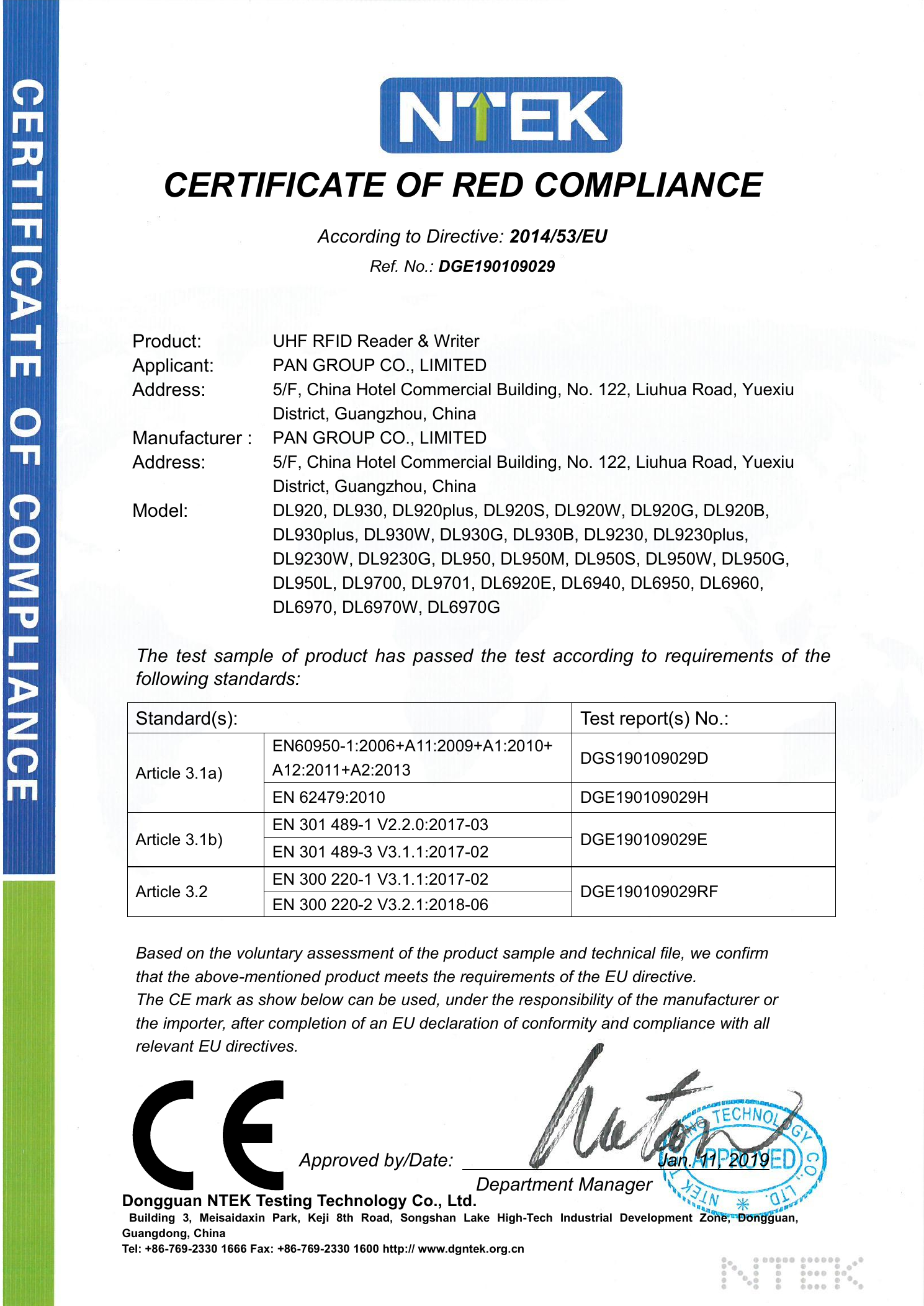
CE RED Certificate of Compliance for UHF RFID Reader & Writer, issued under Directive 2014/53/EU, covering listed reader models. Buyers should verify that the exact ordered model appears in the certificate scope.
A procurement checklist for the execution stage
- Fix the tag population first. Passive UHF, HF or 2.4 GHz active — the answer eliminates whole format categories immediately.
- Describe the physical envelope. Door width, mounting height, tray size, rack height and available power decide the format more often than any datasheet figure.
- State the interface requirement. RS232, RJ45, USB, GPIO, Wiegand or RS485, and whether the reader must present data directly to a PLC, MES or WMS.
- Confirm enclosure and temperature. Washdown, dust, cold storage or outdoor yards change the required IP rating and temperature window.
- Agree the acceptance test. DAILY RFID publishes acceptance criteria per product line, including factory acceptance tests for fixed and tray readers, full system burn-in for handhelds, and network, Wi-Fi or pre-shipment tests for the relevant models.
- Confirm commercial terms. Published capabilities include a minimum order quantity of 1 unit for fixed readers, handhelds and tray readers and 1 set for development kits, with typical lead times of 15–45 days for fixed readers, 15–30 days for handhelds and 20–45 days for tray readers.
- Plan customization early. OEM/ODM options are published for antenna gain and interfaces on fixed readers, operating system, software and housing on handhelds, and antenna layout, interface and software on tray readers.
- Check supplier scale for multi-year programs. DAILY RFID CO., LIMITED operates a 28,000 m² factory with 180–200 employees in Guangzhou, China, and publishes an annual output of 100,000 RFID reader units alongside its tag and card capacity.
Market trend analysis
Market data supports the direction of this framework without changing the format logic. UHF accounted for 40.72% of total RFID market revenue in 2025, according to Mordor Intelligence, and the same source projects the UHF RFID market to surpass USD 14.9 billion by 2031 at a compound annual growth rate of 12.45%. More than 60% of factories adopting Industry 4.0 deploy RFID readers for asset traceability, and Asia Pacific is expected to hold the largest RFID market share from 2025 to 2034 according to MarketsandMarkets.
Two structural shifts sit behind those numbers. The first is that reader selection is becoming an integration decision as much as a hardware decision: readers are increasingly expected to deliver standardised data to plant systems, and vendors differ in how they do it, from OPC UA AutoID support on some industrial models to vendor SDKs and multi-platform libraries on others. The second is that published application evidence is moving from retail to production. An institutional paper published in 2025 describes RFID-enabled trolley tracking inside a large-scale aerospace manufacturing environment, linked to a business-intelligence visual management system — an example of readers being used for material-flow visibility rather than point-of-sale scanning.
Future outlook
Format boundaries are likely to remain in place because they follow physics and installation practice, but the decision is becoming easier to reverse. PoE and Wi-Fi backhaul reduce the cost of relocating a read point, AI filtering reduces the penalty for dense tag populations, and on-metal tag construction reduces the tag-side workaround for metallic assets. For buyers, the practical implication is to specify formats that can be retrofitted: standard network interfaces, adjustable transmit power, documented SDKs and a documented certification scope. Over a five-year deployment, those four items tend to matter more than the difference between two power ratings.
FAQ
Which UHF RFID reader format should a factory evaluate first?
Start with the tag population and the physical read point rather than with a product. If identification must happen without an operator, the candidates are fixed, ceiling or gate formats. If a person must reach into racks, trays or field locations, handheld or tray formats apply. If the tag population is passive UHF, 2.4 GHz active readers are excluded from the shortlist because they require active tags with batteries.
Can one reader format cover both dock-door receiving and line-side identification?
A fixed UHF reader can cover both when mounting and interface requirements are the same. The DL921 UHF Long Range RFID Reader with GSM and its PoE and AI-enhanced variants all publish a 0.1 m to 15 m read range with trigger and relay ports, which suits overhead checkpoint and dock-door use. If the line requires a defined walk-through channel rather than an overhead zone, the DL8330U gate format is the closer fit because it covers a 4 m to 7 m channel with four built-in antennas.
How much read range can a passive UHF reader realistically deliver in a factory?
Published figures across the DAILY RFID range run from 0.1 m to 5 m for the DL6990 ceiling reader and the DL6993 tray reader, 4 m to 8 m for the DL930 series, 8 m to 15 m for the DL920Plus Wi-Fi reader and the DL921 fixed readers, 0.1 m to 20 m for the DL1280 and DL1380 handhelds, and 25 m to 30 m for the DL6940/6960 four-port reader. Every figure is stated as tag and environment dependent, so realistic values must be measured with the intended tag at the intended mounting position.
What interfaces do these readers expose for PLC, MES or WMS integration?
RS232, RJ45 TCP/IP, USB and GPIO with trigger and relay functions appear across the fixed, tray and ceiling units. Wiegand 26/34 and RS485 are published on the gate and active reader models, and the DL920Plus Wi-Fi reader also exposes RS485 and Wiegand. Free SDKs and multi-platform development support are published across the reader range, and some industrial vendors additionally publish OPC UA AutoID Companion Specification support for standardised delivery to higher-level systems, so the integration path should be confirmed model by model.
Do tray readers and gate readers work with the same tags?
Not necessarily. The DL6993 tray reader and the DL8330U gate both operate on UHF, so a single UHF tag population can serve both. The DL4130H tray reader operates at 13.56 MHz HF under ISO15693/ISO18000-3, so it requires an HF tag population that a UHF gate cannot read. Band must be matched per read point when tray and gate formats are used in the same facility.
How is UHF different from 2.4 GHz active RFID in a factory?
Passive UHF uses tags powered by the reader's radio field and appears throughout this matrix with read ranges from centimetres to about 30 m depending on format. The DL9230 2.4 GHz active reader instead uses battery-powered active tags and publishes an adjustable read distance of 0 m to 100 m with up to 200 tags read simultaneously. The longer distance comes with a separate active tag ecosystem and its own maintenance planning, and the two formats cannot share tags.
For buyers who want the full product and manufacturing background behind these formats, the DAILY RFID company profile is available as a public download: DAILY RFID company profile (PDF).
Tem questões ou precisa de mais detalhes?
Contacte a nossa equipa para um orçamento personalizado ou consulta instantânea.
Solicitar orçamento
Preencha o formulário abaixo e a nossa equipa entrará em contacto com uma proposta personalizada.
Chat direto do WhatsApp
Prefere conversar em tempo real? Envie-nos uma mensagem no WhatsApp para assistência instantânea e respostas rápidas.
- Obter orçamento personalizado
- Partilhar fotos ou documentos
- Discuta as suas necessidades diretamente
Geralmente responde em 5–30 minutos durante o horário de expediente.