
UL 2108 vs CE: Comparing LGP and GPF001 Light Guide Panels
Two certified light guide panel references sit behind this comparison. Model LGP is covered by UL certification to UL 2108, 2nd Ed., certificate number UL-US-2145621-0, issued by UL LLC. Model GPF001 is covered by CE certification to EN IEC 55015:2019/A11:2020, certificate number CTSL2620530156EZ, issued by CTSL Testing (Dongguan) Co., Ltd. Both certificates are valid as of October 2026. They cover different markets, different risk categories, and different buyer checklists — and that difference is the point.
A light guide panel sold into the United States and a light guide panel sold into the European Union do not travel the same compliance route. For a North American buyer, the document most often requested for a low-voltage lighting system or sign accessory is a UL listing or recognition tied to UL 2108, 2nd Ed. For an EU buyer, the entry gate for the same class of product is CE marking supported by an EMC test programme such as EN IEC 55015:2019/A11:2020. These are not interchangeable documents, and treating one as a substitute for the other is one of the more common errors in early-stage sourcing.
Shanghai Edgelight Industry Co., Ltd. (EDGELIGHT), founded in 2004, is a Shanghai-based manufacturer of LED products, intelligent control products and light guide panels, operating five production bases and exporting to markets that include the United States and the European Union. The company's documented light guide panel family is the reference point used throughout this article, because both certified models can be traced to published certificate numbers rather than to marketing descriptions.
Why Certification Has Become a Procurement Filter, Not a Formality
Light guide panels are no longer a niche signage component. Dataintelo values the global Light Guide Plate (LGP) market at USD 3.91 billion in 2025 and projects USD 6.51 billion by 2034, a CAGR of 5.8% across the 2025–2034 forecast period. The same source places Asia Pacific at a 48.2% revenue share in 2025, valued at USD 1.88 billion, while consumer electronics remained the largest application segment with a 42.5% share in 2025. As volumes of that scale move through distribution and specification channels, compliance documentation stops being a paperwork detail and becomes a screening criterion.
The regulatory environment has tightened in parallel. The 2024 International Energy Conservation Code (IECC) reduces lighting power allowances, which changes the efficiency requirement attached to LGP-based LED panels installed in US projects. Separately, UL Solutions notes that light guide panels must adhere to safety standards such as UL 8750 (LED Equipment) and IEC 60598 (Luminaires) for global market access. The practical consequence for buyers is that a panel specification now has to answer two questions at once: does the component meet the market's compliance regime, and does the delivered configuration still meet the project's power and output budget?
This is where the LGP-versus-GPF001 comparison becomes useful. It is not a comparison of two brands competing for the same shelf. It is a comparison of two certification routes that a single buyer may need to hold simultaneously, depending on where the finished light box or backlit display will be installed.
The Two Certified References, Fact for Fact
The two references differ in issuing body, standard, scope category and validity window. Buyers auditing either one should expect to check the certificate number against the issuing authority's record, not against a product photograph.
| Attribute | Model LGP | Model GPF001 |
|---|---|---|
| Market | US | EU |
| Certification type | UL | CE |
| Standard cited | UL 2108, 2nd Ed. | EN IEC 55015:2019/A11:2020; EN IEC 61547:2023; EN IEC 61000-3-2:2019/A2:2024; EN 61000-3-3:2013/A2:2021/AC:2022-01 |
| Certificate number | UL-US-2145621-0 | CTSL2620530156EZ |
| Issuing authority | UL LLC | CTSL Testing (Dongguan) Co., Ltd. |
| Issue date | 2021-10-05 | 2026-05-29 |
| Expiry date | 2031-10-05 | 2096-05-29 |
| Documented scope | Component, Sign Accessories, LPS/Class 2 type, LED module; specific LED module models listed on the certificate | GPF001 with series models MO22, MO24, MO31, GPF21, GPF23, GPF25, GPF26, GPF100, GPF101, GPF102, GPFX-GPFXXX, MOX-MOXXX, and Badge-Fascia / Blade / Hanging LED Panel variants |
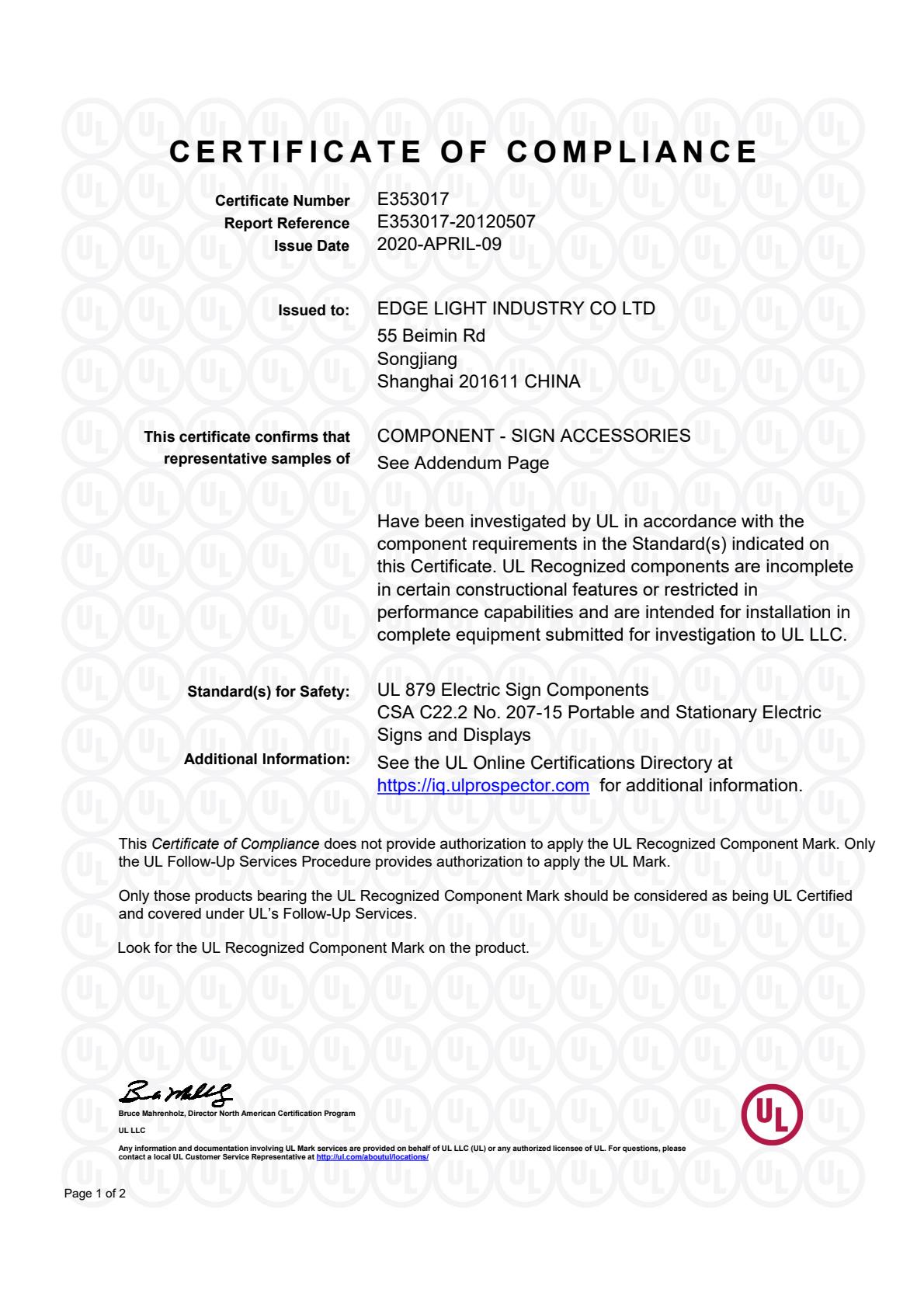
UL certification for model LGP: UL 2108, 2nd Ed., issued by UL LLC under certificate number UL-US-2145621-0.
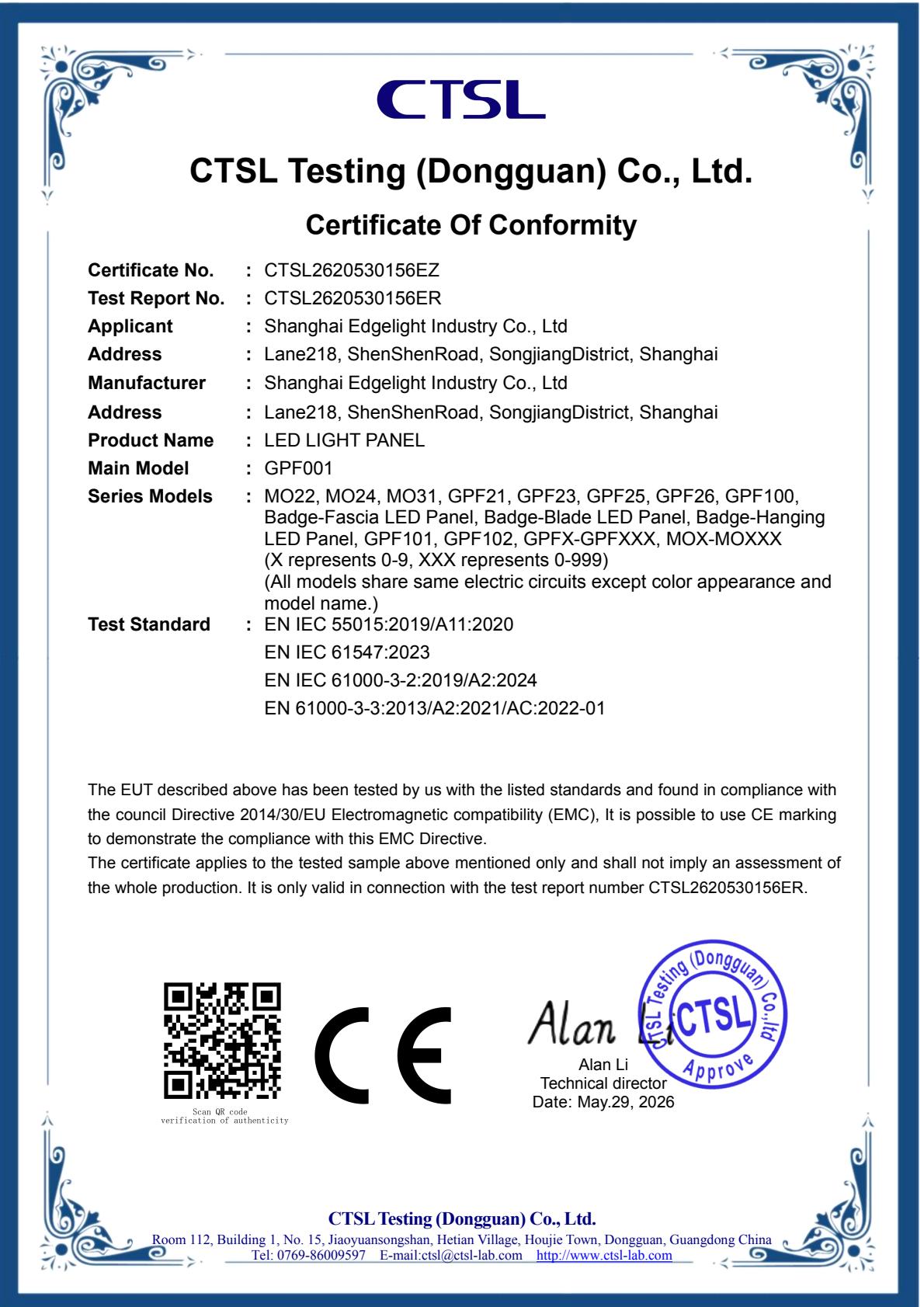
CE certification for model GPF001: EN IEC 55015:2019/A11:2020, issued by CTSL Testing (Dongguan) Co., Ltd. under certificate number CTSL2620530156EZ.
Mapping Each Certification to EU and North American Buyer Requirements
In North America, the LGP certificate addresses a component-level safety question. UL 2108 is the standard cited on the certificate, and the recorded scope describes the covered category as Component, Sign Accessories, LPS/Class 2 type, and LED module. For a buyer assembling a light box, a sign cabinet or a backlit display, this is the documentation that supports the claim that the LED module and sign accessory assembly have been assessed against a recognised North American safety standard. A procurement team should expect to file the certificate number, the standard edition and the issuing body alongside the bill of materials, because downstream specifiers and inspectors frequently ask for exactly those three items.
In the European Union, the GPF001 certificate addresses a different question. The standard family cited — EN IEC 55015:2019/A11:2020, EN IEC 61547:2023, EN IEC 61000-3-2:2019/A2:2024 and EN 61000-3-3:2013/A2:2021/AC:2022-01 — belongs to the electromagnetic compatibility and harmonic-current regime. That means the document supports a statement about emissions, immunity and mains harmonic behaviour, not about mechanical safety or photometric output. An EU buyer comparing quotations should treat the CE certificate as evidence for one specific layer of the compliance stack, and should ask separately for whatever safety and performance evidence the finished luminaire requires.
| Buyer question | North America (Model LGP) | European Union (Model GPF001) |
|---|---|---|
| Which certificate do I file? | UL-US-2145621-0, UL 2108, 2nd Ed. | CTSL2620530156EZ, EN IEC 55015:2019/A11:2020 |
| Who issued it? | UL LLC | CTSL Testing (Dongguan) Co., Ltd. |
| What risk does it address? | Component and sign-accessory safety category, LED module scope | Electromagnetic compatibility, immunity, harmonic current limits |
| How long is it valid? | Until 2031-10-05 | Until 2096-05-29 |
| What should be verified separately? | Finished-luminaire level requirements applicable to the end product | Safety and photometric evidence for the installed assembly |
The two certificates therefore do not compete. A supplier serving both regions needs both routes, and a buyer specifying for both regions needs both numbers on the purchase order. What is worth challenging during evaluation is any quotation that presents a single certification as sufficient for both markets.
Performance Facts Available for Direct Comparison
Where the certifications diverge, the published performance data converges, because both references describe the same light guide panel family. The table below lists only figures that appear in the documented specification.
| Parameter | Documented value | What it means for a buyer |
|---|---|---|
| Substrate material | Acrylic | Optical-grade acrylic substrate; relevant to transparency and long-term appearance |
| Luminous flux | Greater than 1080 lm | Basis for matching the panel to the required display brightness |
| Color temperature | 2700K – 6500K | Single panel family spans warm retail lighting through cool office lighting |
| Typical power consumption | 101 W | Continuous-load figure for energy budgeting and driver selection |
| Maximum power | 144 W | Upper bound to size power supplies and thermal allowances |
| Operating current | 7.2 A max | Constraint for conductor sizing and driver current rating |
| Operating temperature | -20°C to 50°C | Defines the installation environments the panel is documented for |
| Protection grade | IP20 – 65 | A range, not a fixed rating; the delivered rating depends on the configuration ordered |
The spread between 101 W typical and 144 W maximum is the figure most often misread in procurement. A buyer sizing a constant-current power driver against the typical figure alone builds in no headroom; a buyer sizing against the maximum figure may overspend on driver capacity. The defensible approach is to specify the driver against the maximum, then confirm the typical figure against the project's energy target — a step that becomes more relevant in US projects where the 2024 IECC lighting power allowances constrain the installed load.
The 2700K – 6500K range is similarly easy to under-use. A single panel family covering both ends of that range allows a retail roll-out to run warm 2700K lighting in a luxury display case and cool 6500K lighting in the same store's back-office or stockroom signage without introducing a second supplier into the compliance file.
Technical Explanation: Why an Edge-Lit Acrylic Panel Behaves This Way
An edge-lit light guide panel works by coupling light into the edge of an acrylic sheet and extracting it across the face through a patterned surface. The pattern — commonly applied as a dot matrix — interrupts total internal reflection at controlled points, so that light leaves the panel evenly rather than in bright streaks near the LED entry edge. The term dot pattern light guide panel describes exactly this extraction layer, and its geometry is what determines whether the finished light box reads as uniform illumination or as a visible gradient.
The thickness constraint follows from the same physics. Third-party reporting from Fact.MR and CHI MEI Corporation indicates that thin PMMA light guide plate substrates below 2 mm accounted for over 60% of display-grade shipments for major manufacturers in 2024. Industry technical references describe edge-lit panels reaching profiles as thin as 2.0 mm through injection moulding, or 3.0 mm through laser dotting. Both routes trade a mechanical and optical engineering decision against a form-factor outcome: thinner panels suit ultra-thin light boxes and slim backlit displays, while the extraction pattern has to be designed more carefully to maintain uniformity at the reduced optical path length.
This is why the phrase 'light guide panel' covers a wide design space and why a specification sheet alone does not define a delivered product. Size, thickness, dot pattern density, diffuser film, reflective film and the LED strip chosen all interact. The documented parameter set for the LGP and GPF001 family — IP20–65, -20°C to 50°C, 2700K–6500K, greater than 1080 lm, 101 W typical and 144 W maximum, 7.2 A maximum — describes the envelope the platform is designed to operate within, not a single fixed build.
Applications Where the Documented Specifications Fit
The documented application scope for this light guide panel family is broad and specific at the same time: retail and luxury display, hospitality and commercial interiors, exhibition and museum, elevator decoration, advertising light boxes and signage, office and high-end residential, transportation and public spaces, and consumer electronics backlighting. Two project types illustrate how the numbers translate into purchase decisions.
Retail, advertising and exhibition installations
Showcase backlighting and shelf backlighting in retail and luxury display rely on uniform, ultra-thin edge-lit illumination, which is the function documented for this application. Advertising light boxes and signage use the panel as the core of an ultra-thin LED light box. In exhibition and museum settings, the same uniformity requirement applies but the temperature constraint matters more: a panel rated -20°C to 50°C is documented for interior and controlled environments, not for exposed outdoor installations without additional enclosure engineering. The documented matched equipment list — LED strip light, constant-current power driver, light box frame, diffuser film, reflective film, mounting brackets — indicates the level of system integration a buyer should plan for rather than treating the panel as a drop-in replacement part.
Hospitality, office and elevator decoration
Hospitality ceiling light panels and office installations use the same panel in a general-illumination role, where the 2700K–6500K range allows a single specification to serve lobby, corridor and workspace settings. Elevator decoration is the application with the strongest documented field record: a light guide panel supply programme for an elevator manufacturer covered 10,000 units over a 20-year relationship, with stable operation recorded, and the project highlight was the combination of lighting, printing and customized size and texture. That combination — printed graphics on a customized panel size — is relevant to buyers who need branded or decorative elevator cabin wall panels rather than plain diffused light.
Market Trend Signals Buyers Should Track in 2026
Three trend signals are documented well enough to inform sourcing plans rather than to speculate about.
First, the material side. Polymethyl Methacrylate (PMMA), the primary material for light guide plates, was valued at USD 5.4 billion in 2024 with a CAGR of 5.6%, according to USD Analytics. Because acrylic substrate availability and pricing sit upstream of every LGP quotation, buyers negotiating framework agreements should expect material-driven price movement rather than treating panel pricing as fixed.
Second, the thin-gauge shift. With sub-2 mm PMMA substrates taking over 60% of display-grade shipments in 2024 among major manufacturers, the market is moving toward thinner panels for slim light boxes and ultra-thin display profiles. That trend favours buyers who specify thickness requirements early, because a thinner panel changes the extraction pattern design and the frame tolerance in the finished light box.
Third, the efficiency requirement. The 2024 IECC reduction in lighting power allowances puts pressure on installed wattage in US projects, which in turn puts pressure on the difference between a panel's typical and maximum consumption figures. A specification that documents both figures — as this one does with 101 W typical and 144 W maximum — is easier to defend in an energy submission than a specification that documents only a nominal value.
On the supply side, Dataintelo identifies Mitsubishi Chemical Corporation as a leading player in the competitive landscape for light guide plates. That is a market-structure observation, not a performance ranking, and buyers should treat the presence of large chemical and optical-material suppliers as a signal about material supply rather than as a substitute for component-level certification review.
Comparison with Traditional Display Lighting — and Where This Comparison Stops
Buyers moving from conventional backlighting or non-panel signage approaches generally evaluate three alternatives: edge-lit light guide panels, backlit light guide panels, and traditional light box construction. Edge-lit panels are favoured where the profile must stay thin, which is why ultra-thin light boxes and slim display cases are their natural application. Backlit configurations place the light source behind the diffusing surface, which changes the depth required and the way uniformity is achieved across large panels. Traditional construction, using conventional diffusers and fluorescent or older LED sources, remains in service but generally carries a different depth, maintenance and energy profile.
| Consideration | Edge-lit light guide panel | Backlit light guide panel | Traditional light box construction |
|---|---|---|---|
| Typical profile | Thin — industry references cite 2.0 mm via injection moulding and 3.0 mm via laser dotting for edge-lit panels | Deeper, because the source sits behind the diffusing plane | Deepest of the three in conventional builds |
| Uniformity mechanism | Patterned extraction across an acrylic substrate | Diffuser and spacing arrangement behind the panel | Diffuser sheet with wider source spacing |
| Documented material | Acrylic | Acrylic or alternative diffusing substrates | Mixed |
| Best fit | Ultra-thin light boxes, retail showcases, elevator and interior panels | Large-format displays where depth is available | Legacy replacements and cost-driven retrofits |
Limits of this comparison. The two certificates in this article are scoped documents, not blanket approvals. The UL certificate to UL 2108, 2nd Ed. records a specific scope category — Component, Sign Accessories, LPS/Class 2 type, LED module — and lists the specific LED module models covered; it does not automatically extend to every finished luminaire configuration a buyer may build around the panel. The CE certificate to EN IEC 55015:2019/A11:2020 addresses EMC, immunity and harmonic-current standards; it does not certify photometric output, ingress protection or mechanical safety. In addition, IP20–65 is a range rather than a single delivered rating, the documented operating temperature window is -20°C to 50°C, and both documents carry expiry dates — 2031-10-05 for UL-US-2145621-0 and 2096-05-29 for CTSL2620530156EZ — that should be checked against the delivery schedule on any long-running project.
Purchasing Terms and Acceptance Criteria
Compliance documents answer the market-access question. Purchasing terms answer the delivery question, and for this light guide panel family the terms are documented rather than negotiated case by case.
| Term | Documented value |
|---|---|
| Production mode | OEM / ODM |
| Customization scope | Size, thickness, color temperature, logo, surface shape, light output brightness, installation structure |
| Minimum order quantity | 1 unit |
| Lead time | 5–10 days |
| Monthly capacity | 30,000 units |
| Quality control | 100% test |
| Export markets | European Union, North America, Southeast Asia, Australia |
| After-sales | Local support |
The combination of a one-unit minimum order quantity and a 5–10 day lead time is unusual in a component category where tooling and pattern design normally force larger commitments. It changes the evaluation sequence: a buyer can validate a sample configuration — actual thickness, actual color temperature, actual dot pattern — before committing to a production volume, and the 100% test policy means the sample result is documented as a test outcome rather than as a visual impression.
The customization scope is also worth reading literally. Size, thickness, color temperature, logo, surface shape, light output brightness and installation structure are all listed as adjustable, which means a buyer comparing quotations across suppliers should compare the same seven variables rather than comparing headline panel prices.
Acceptance criteria at incoming inspection
| Check | What to verify |
|---|---|
| Certificate traceability | Certificate number, standard, edition and issuing authority match the purchase order — UL-US-2145621-0 for UL 2108, 2nd Ed.; CTSL2620530156EZ for EN IEC 55015:2019/A11:2020 |
| Certificate validity | Documents remain within their validity window against the project delivery date |
| Electrical parameters | Typical power consumption of 101 W and maximum power of 144 W confirmed against the delivered build; operating current within the 7.2 A maximum |
| Optical parameters | Luminous flux above 1080 lm; color temperature within the specified point in the 2700K–6500K range |
| Environmental rating | Protection grade matches the ordered configuration within the IP20–65 range; operating temperature window of -20°C to 50°C respected by the installation plan |
| Uniformity | Visual inspection for edge bright-banding and gradient across the panel face at operating conditions |
| Documentation | Test records consistent with the supplier's 100% test policy |
Future Outlook
The direction of travel for this component category is set by three forces that are already visible in the data. Panel geometry continues to thin, driven by the display-grade shift toward sub-2 mm PMMA substrates. Material economics continue to move with the PMMA market, which was valued at USD 5.4 billion in 2024 at a 5.6% CAGR. And installed-power regulation continues to tighten in the United States through the 2024 IECC lighting power allowances, with the broader global framework of UL 8750 and IEC 60598 defining market access.
For buyers, the practical implication is that certification documents and performance documents will need to be maintained side by side, not treated as alternatives. A panel that clears UL 2108 for North America and a panel that clears EN IEC 55015:2019/A11:2020 for the EU are both required inputs to a dual-region display programme, and the certificate expiry dates attached to each will influence the refresh cycle of the specification file. As the LGP market moves from USD 3.91 billion in 2025 toward a projected USD 6.51 billion by 2034, the suppliers best positioned to serve both regions are likely to be the ones whose compliance records are already structured for that dual-market reality.
FAQ
What is the difference between UL 2108 certification and CE certification for a light guide panel?
UL 2108, 2nd Ed. is a North American safety standard under which model LGP is certified by UL LLC under certificate number UL-US-2145621-0, with a recorded scope of Component, Sign Accessories, LPS/Class 2 type, and LED module. CE certification for model GPF001 is based on EN IEC 55015:2019/A11:2020, issued by CTSL Testing (Dongguan) Co., Ltd. under certificate number CTSL2620530156EZ, and covers electromagnetic compatibility and related standards. The two documents address different markets and different risk categories.
Which certification does a buyer in North America need, and which applies in the European Union?
For the US market, the relevant document is the UL certification for model LGP to UL 2108, 2nd Ed., certificate number UL-US-2145621-0, issued by UL LLC. For the EU market, the relevant document is the CE certification for model GPF001 to EN IEC 55015:2019/A11:2020, certificate number CTSL2620530156EZ, issued by CTSL Testing (Dongguan) Co., Ltd. A project installing in both regions requires both documents in the compliance file.
What performance specifications are documented for this light guide panel?
The documented parameters are: acrylic substrate material; luminous flux greater than 1080 lm; color temperature range of 2700K to 6500K; typical power consumption of 101 W; maximum power of 144 W; maximum operating current of 7.2 A; operating temperature range of -20°C to 50°C; and protection grade IP20-65.
What protection grade and operating temperature range should buyers plan for?
The documented protection grade is IP20-65 and the documented operating temperature range is -20°C to 50°C. Because IP20-65 is expressed as a range rather than a single value, the delivered rating depends on the configuration ordered, and the installation plan should keep the panel within the documented temperature window.
Which applications are covered by the documented specifications?
The documented application scope includes retail and luxury display, hospitality and commercial interiors, exhibition and museum, elevator decoration, advertising light boxes and signage, office and high-end residential, transportation and public spaces, and consumer electronics backlighting. The documented matched equipment list includes LED strip light, constant-current power driver, light box frame, diffuser film, reflective film and mounting brackets.
What are the purchasing terms for this light guide panel, including MOQ, lead time and customization?
The documented production mode is OEM / ODM. Customization covers size, thickness, color temperature, logo, surface shape, light output brightness and installation structure. Minimum order quantity is 1 unit, lead time is 5-10 days, monthly capacity is 30,000 units, quality control is 100% test, export markets include the European Union, North America, Southeast Asia and Australia, and after-sales support is provided locally.
What acceptance criteria should a buyer apply when receiving a light guide panel shipment?
Incoming inspection should confirm that the certificate number, standard, edition and issuing authority match the purchase order — UL-US-2145621-0 for UL 2108, 2nd Ed. and CTSL2620530156EZ for EN IEC 55015:2019/A11:2020 — that both documents are within their validity windows, that electrical parameters fall within 101 W typical and 144 W maximum power and 7.2 A maximum current, that luminous flux exceeds 1080 lm, that color temperature sits within the specified point in the 2700K-6500K range, that the protection grade matches the ordered configuration within IP20-65, and that the panel face shows no edge bright-banding or gradient.
What does this certification scope not cover?
The UL certificate to UL 2108, 2nd Ed. records a defined scope category and lists specific covered LED module models; it does not automatically extend to every finished luminaire configuration built around the panel. The CE certificate to EN IEC 55015:2019/A11:2020 covers EMC, immunity and harmonic-current standards and does not certify photometric output, ingress protection or mechanical safety. Both documents carry expiry dates — 2031-10-05 for UL-US-2145621-0 and 2096-05-29 for CTSL2620530156EZ — that should be checked against project timelines.
Additional technical documentation, including the full product range covered by these certificates, is available through the company's website at en.edgelight.com, and the product catalogue can be downloaded as a PDF: EDGELIGHT LED product catalogue (English).