
UL 796 vs UL 796F for LED PCBs: What Each Certification Covers
UL 796 vs UL 796F for LED PCBs: What Each Certification Covers
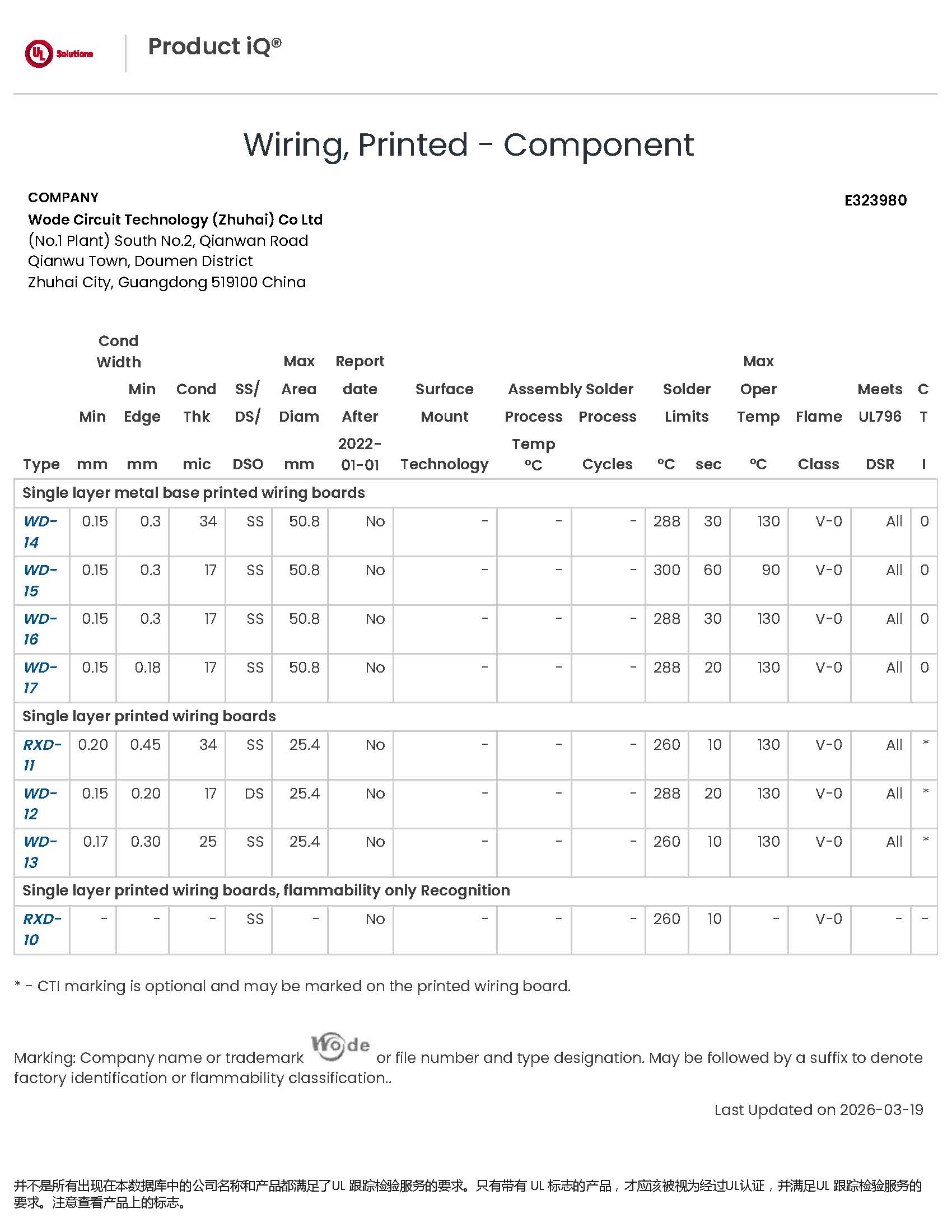
Cover: UL 796 recognition E323980 for rigid and metal-base printed wiring boards.
UL 796 covers rigid printed wiring boards. UL 796F covers flexible printed circuits. For LED PCB sourcing, that difference is the first certificate filter: a UL 796 file should not be used to qualify a flexible LED FPC, and a UL 796F file should not be used to qualify a rigid or metal-base LED board. WODE Circuit Technology (Zhuhai) Co., Ltd. (WODE) is a PCB and FPC manufacturer founded in 2003 in Zhuhai, China, with a 150,000 m² facility, more than 500 employees and an annual output of 6,000,000 m²; its product range includes rigid MCPCB, FPCB, Infinity Length FPCB, FR-4/CEM-1/CEM-3 PCBs and CCL. WODE's supplied records make the certification split visible: E323980 is the UL 796 recognition for rigid and metal-base printed wiring boards, while E498836 is the UL 796F record for single-layer flexible printed circuits. This analysis explains what each file covers, how to map it to MCPCB for Road lighting, Roll to Roll Infinity FPCB and Single sided LED tube FPC, and where ISO 9001:2015, ISO 14001:2015, IATF 16949, CQC and EU REACH fit as complementary evidence.
UL 796 and UL 796F: the one-sentence difference
UL 796 is the standard named in the E323980 record, whose type is UL Flammability Recognition for Rigid Printed Wiring Boards. UL 796F is the standard named in the E498836 record, whose type is UL Flammability Safety Certification for Flexible Printed Circuit Material. The records also use different supporting language: E498836 cites UL 796F and IPC-TM-650 2.6.27, while E323980 cites UL 796. Both records were issued by UL Solution, are listed for North America (US and Canada) and worldwide recognition, and show an issue date of 2022-01-01 and an expiry date of 2099-12-31. The shared dates do not make the scopes interchangeable. The standard, the file number and the listed construction are the parts that connect a certificate to a board.
What UL 796 covers in the E323980 record
E323980 is the UL 796 file. Its listed scope is single layer metal base printed wiring board models WD-14, WD-15, WD-16 and WD-17, plus single layer rigid printed wiring board models RXD-11, WD-12, WD-13 and RXD-10. That wording matters for lighting buyers because it is a rigid and metal-base scope. It is the relevant UL file to check for rigid LED PCB and MCPCB constructions, including the supplied product mapping to MCPCB for Road lighting. The same mapping also lists MCPCB for Motor lighting, High Voltage MCPCB, PCB for Small Appliance Lighting Motherboard, Ceramic based PCB, Double sided MPCB, Thermoelectric Separated Cu based PCB and Coverlay MCPCB. The certificate text, however, is narrower than a product-family list: it identifies single-layer metal-base and single-layer rigid PWB models. A double-sided or multilayer construction should be checked for its own listing instead of being assumed from a family name. E323980 also does not establish thermal performance, salt-spray resistance, IP rating or luminaire compliance. Those are separate design and test questions, even when the same metal-base board is used in a high-power LED PCB for street light or outdoor lighting projects.
What UL 796F covers in the E498836 record
E498836 is the UL 796F file. Its listed scope is Single layer FMIC flexible printed circuit, Model WD-F1, WD-F2 (ASP1). The record cites UL 796F and IPC-TM-650 2.6.27. This is the flexible-circuit side of the comparison, and it is the file to check for flexible LED FPC constructions rather than the rigid E323980 record. The supplied product mapping associates E498836 with WODE flexible lines including Roll to Roll Infinity FPCB, Single sided LED tube FPC, Single/double sided LED strip FPC and COB FPC. The certificate text still controls: it lists single-layer FMIC models WD-F1 and WD-F2 (ASP1). If a buyer is evaluating a double-sided FPC or a different material stack, the exact model listing should be confirmed before the file is used as qualification evidence.
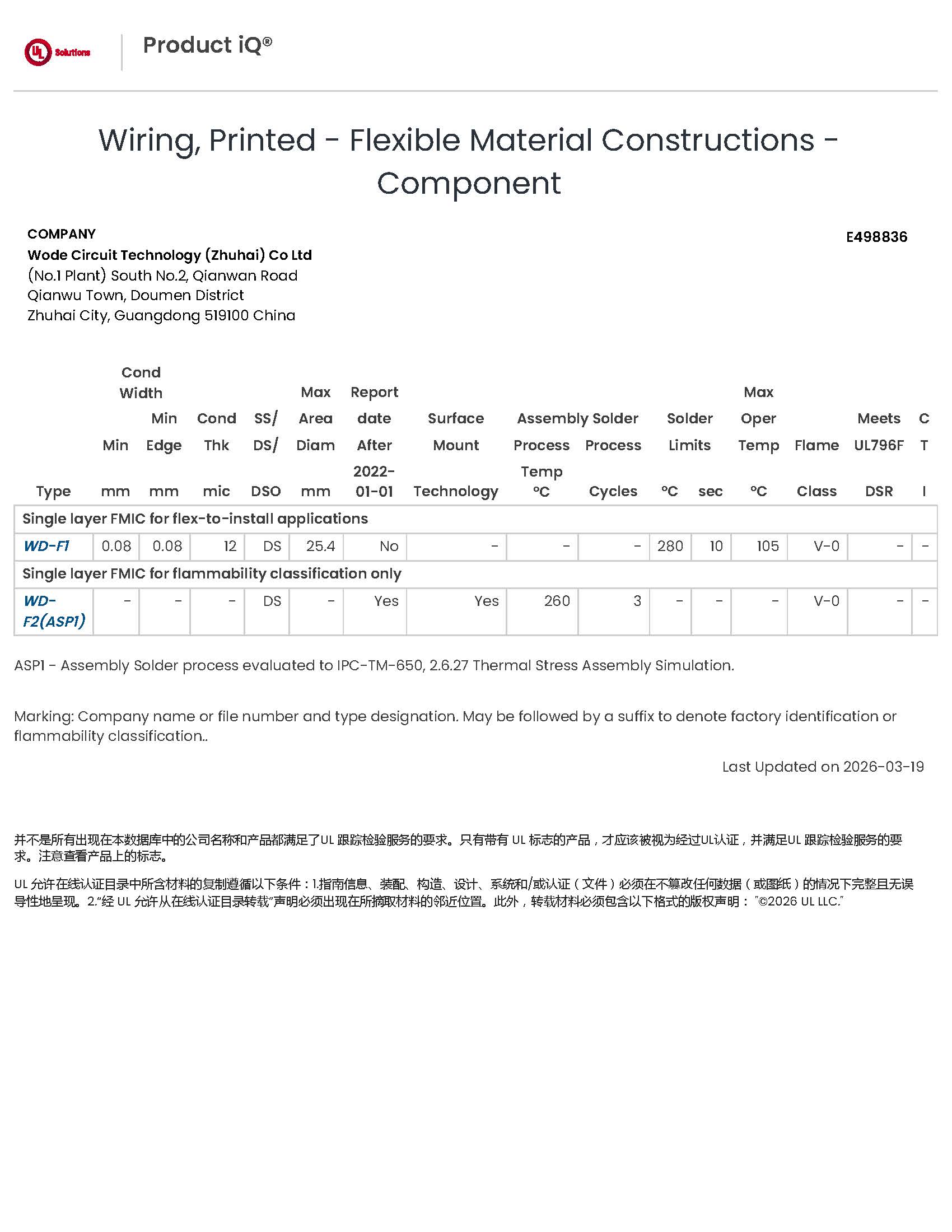
UL 796F record E498836 for single-layer flexible printed circuits.
The product data helps explain why the flexible scope is relevant. Roll to Roll Infinity FPCB is described with PI material, single-sided construction, 1 oz copper, 0.15 mm overall thickness, a 1000.00 mm x 124.00 mm panel at 13 up, white solder mask, black silkscreen and OSP. Single sided LED tube FPC is described with PI material, single-sided construction, 0.5 oz copper, 0.08 mm overall thickness, a 1239.50 mm x 255.00 mm panel at 39 up, white solder mask, Holo silkscreen and OSP. Those are flexible constructions; they belong in a UL 796F review, not a UL 796 review.
Certificate scope vs product family: a table for LED PCB buyers
Use the table as a first-pass filter. It does not replace the actual UL file, but it prevents the most common mismatch: treating a product-family name as if it were a certificate scope.
| Board type or product example | Standard and file | What the record covers | Buyer check |
|---|---|---|---|
| Single-layer rigid PWB: RXD-11, WD-12, WD-13, RXD-10 | UL 796; E323980 | Single layer rigid printed wiring board models listed in the file | Confirm exact model, laminate, layer count and current file status |
| Metal-base PWB for road lighting: MCPCB for Road lighting; models WD-14, WD-15, WD-16, WD-17 | UL 796; E323980 | Single layer metal base printed wiring board models listed in the file | Confirm model and metal-base construction; UL file does not prove thermal performance |
| Flexible FPC: Roll to Roll Infinity FPCB | UL 796F; E498836 | Single layer FMIC flexible printed circuit, Model WD-F1, WD-F2 (ASP1) | Confirm exact flexible model, PI material, copper weight and thickness |
| Flexible FPC: Single sided LED tube FPC | UL 796F; E498836 | Same flexible scope as above | Confirm exact model and that E323980 is not being used for a flexible board |
| Double-sided or multilayer construction | Not assumed from these single-layer scopes | Check for a separate listing | Do not rely on a product-family name or a single-layer file |
Matching board type to certificate: road lighting versus tube and roll-to-roll
Road lighting projects usually begin with a rigid or metal-base board because the mechanical support and thermal path are part of the fixture design. For that route, the relevant check is E323980 under UL 796. The file's metal-base scope names WD-14, WD-15, WD-16 and WD-17, and the supplied mapping places MCPCB for Road lighting in that rigid/metal-base group. A buyer should confirm the exact board model, the single-layer metal-base construction, the material stack and the current UL file status. The UL file is a component qualification record; it is not a thermal simulation, a salt-spray report or an IP rating. Outdoor road lighting conditions in the supplied application material include -40°C to +50°C, high humidity, salt spray, UV radiation, wind and rain erosion. Those conditions still need project-specific validation even when the PCB carries a UL recognition.
Tube and roll-to-roll projects take the other path. Roll to Roll Infinity FPCB and Single sided LED tube FPC are flexible constructions in the supplied product data, and E498836 is the UL 796F file associated with WODE's flexible family. The check is again specific: exact model, single-layer FMIC construction, PI material, copper weight, overall thickness, panel format and current file status. A flexible LED strip or tube design should not be qualified by quoting E323980, and a rigid road-lighting MCPCB should not be qualified by quoting E498836. When a lighting portfolio contains both rigid and flexible boards, require two certificate checks rather than one blanket statement. That approach is also more useful for indoor lighting, outdoor lighting, panel light, downlight, flood light and high-bay programs because the board construction, not the marketing category, decides which UL standard applies.
North America applicability: what UL recognition means for a lighting buyer
The E323980 and E498836 records both list North America (US and Canada) as the market and describe worldwide recognition. For a North American lighting buyer, that is useful evidence at the component level, but it is not the end of the compliance review. The UL file should be read with the exact model, standard, construction and market in view. A PCB recognition is not a luminaire certification. WODE's lighting application material lists luminaire-level safety references such as UL 8750 and EN 60598; those are separate from the PCB file and depend on the finished luminaire design. Buyers should also check that the file is current, that the model on the drawing matches the model in the file, and that the board construction has not changed since the file was issued. North America applicability is therefore a chain: UL standard, UL file number, listed model, board construction, current status and final luminaire evaluation. A single UL logo or a certificate image does not replace that chain.
Complementary qualification evidence: ISO 9001, ISO 14001, IATF 16949, CQC and EU REACH
UL 796 and UL 796F answer a board-construction question. They do not answer every supplier-qualification question. WODE's complementary records cover management systems, automotive-oriented quality, China market certification and material compliance, and each has a defined scope.
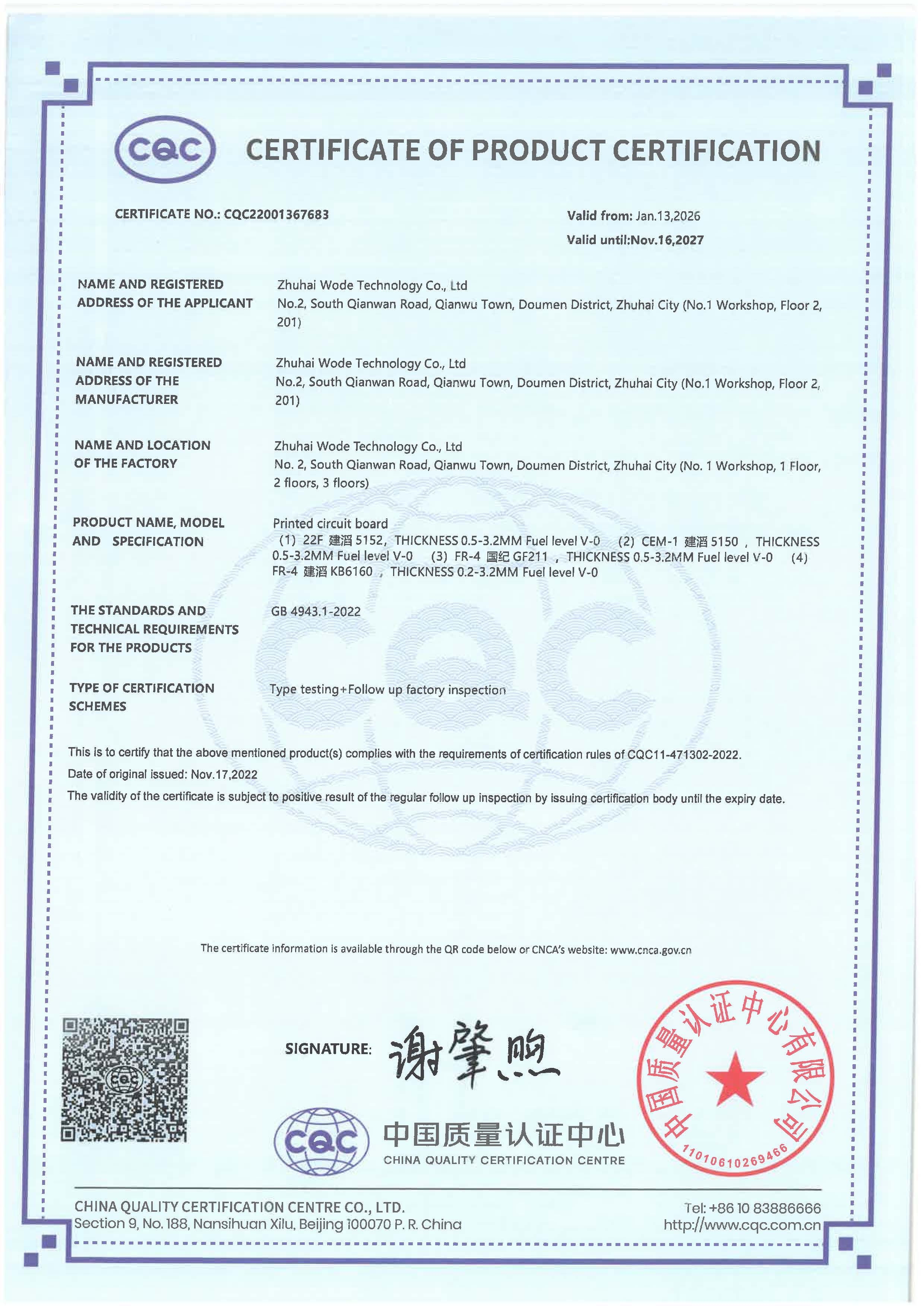
CQC certificate CQC22001367683, one of the complementary qualification records.
| Record | Scope in the supplied data | What it supports | Boundary |
|---|---|---|---|
| ISO 9001:2015; 51325Q4258ROM | Production of circuit boards (IAF Code: 19) | Quality-management system evidence | Not a product safety or UL board-construction certificate |
| ISO 14001:2015; 51325E2142ROM | Environmental management activities related to the production of circuit boards (IAF Code: 19) | Environmental management system evidence | Not a product-performance claim |
| IATF 16949; 0584371 | Human Resources, Purchasing, Strategic Planning for automotive printed circuit board manufacturing; support site Guangdong Kunxiang New Material Group Co., Ltd. | Automotive-oriented quality-management evidence for the stated scope | Does not automatically cover every process, product or lighting PCB |
| CQC; CQC22001367683 | Printed circuit board with 22F CEM1 5152, CEM-1, FR-4 GF211 and FR-4 KB6160; thickness 0.2–3.2mm; V-0 flammability; GB 4943.1-2022 | China-market product certification for the listed scope | Not all substrates or thicknesses; not a North America UL file |
| EU REACH; DGC251204025BD03 | REACH SVHC substances and Resorcinol for Double Sided Aluminium-based Board; EU REACH Regulation (EC) No 1907/2006; ECHA SVHC Candidate List | Material-compliance test evidence for the tested board | Not an automatic declaration for every LED PCB |
Read the table as a set of different questions, not a hierarchy. ISO 9001:2015 certificate 51325Q4258ROM covers production of circuit boards under IAF Code 19; it supports quality-management consistency but is not a product safety certificate. ISO 14001:2015 certificate 51325E2142ROM covers environmental management activities related to circuit-board production under IAF Code 19; it is not a product-performance claim. IATF 16949 certificate 0584371, issued by NQA Certification Limited, lists Human Resources, Purchasing and Strategic Planning for automotive printed circuit board manufacturing, with Guangdong Kunxiang New Material Group Co., Ltd. as a support site. That is a specific automotive QMS scope, not a blanket certification of every process or every lighting product. CQC certificate CQC22001367683 covers printed circuit boards with four substrate types: 22F CEM1 5152, CEM-1, FR-4 GF211 and FR-4 KB6160, thickness 0.2–3.2mm, V-0 flammability, under GB 4943.1-2022. It is relevant to the listed China-market scope, not to every board type. EU REACH test report DGC251204025BD03 covers REACH SVHC substances and Resorcinol for a Double Sided Aluminium-based Board under EU REACH Regulation (EC) No 1907/2006 and the ECHA SVHC Candidate List. It is evidence for that tested board, not an automatic declaration for every LED PCB in the catalogue.
Procurement verification checklist
Use this checklist before accepting a certificate as part of an LED PCB sourcing file.
- Identify the board construction: rigid PWB, metal-base MCPCB, single-sided FPC, double-sided FPC or multilayer. The construction decides whether UL 796 or UL 796F is the starting point.
- Match the standard to the file: E323980 is the UL 796 rigid/metal-base record; E498836 is the UL 796F flexible record.
- Match the exact model: confirm WD-14, WD-15, WD-16, WD-17, RXD-11, WD-12, WD-13 or RXD-10 for E323980; confirm WD-F1 or WD-F2 (ASP1) for E498836, and confirm how the commercial product name maps to the listed model.
- Check the construction limits: the supplied UL scopes are single-layer. Do not extend them to double-sided or multilayer boards without a separate listing.
- Check the market and dates: both records list North America (US and Canada) and worldwide recognition, with issue date 2022-01-01 and expiry date 2099-12-31. Confirm current status in the applicable UL directory.
- Check complementary evidence by scope: ISO 9001 and ISO 14001 for management systems; IATF 16949 for its stated automotive functions; CQC for the listed substrates and thickness range; EU REACH for the tested double-sided aluminium-based board.
- Check the finished luminaire: PCB recognition does not replace luminaire-level safety evaluation.
- Check performance separately: UL scope does not prove thermal conductivity, junction temperature, salt-spray resistance or lifetime.
Limitations and fit boundaries
The main limitation is that a UL file is not a catalogue-wide warranty. E323980 is a rigid and metal-base file; E498836 is a flexible file. Their scopes are written around specific single-layer constructions and model families. A product-family page may list many related products, but the certificate text is the controlling document. This is why the same supplier can hold both files and still require a model-by-model check. The complementary records have the same boundary. CQC covers four named substrate types and a thickness range, not every laminate. The EU REACH report covers a Double Sided Aluminium-based Board, not every board in the range. IATF 16949 covers the functions named in its scope. ISO 9001 and ISO 14001 describe management systems, not the thermal or electrical performance of a particular LED PCB. For high-power LED PCB projects, the practical fit boundary is simple: use UL 796 or UL 796F to answer the board-construction recognition question, then use separate engineering and test evidence for thermal, optical, environmental and lifetime requirements.
FAQ
Does UL 796 cover flexible LED PCBs?
No. In the supplied records, UL 796 is the standard for the E323980 rigid and metal-base printed wiring board recognition. Flexible printed circuits are addressed under UL 796F in the E498836 record. A flexible LED FPC should be checked against the UL 796F file, not the UL 796 file.
What does UL file E323980 cover?
E323980 is a UL 796 recognition for single layer metal base printed wiring boards WD-14, WD-15, WD-16 and WD-17, and single layer rigid printed wiring boards RXD-11, WD-12, WD-13 and RXD-10. The supplied mapping associates it with rigid and metal-base products including MCPCB for Road lighting. It does not cover flexible FPC constructions.
What does UL file E498836 cover?
E498836 is a UL 796F record for Single layer FMIC flexible printed circuit, Model WD-F1, WD-F2 (ASP1), citing UL 796F and IPC-TM-650 2.6.27. The supplied mapping associates it with flexible products including Roll to Roll Infinity FPCB and Single sided LED tube FPC. The exact model and construction should be confirmed before relying on the file.
Are ISO 9001, ISO 14001, IATF 16949, CQC and EU REACH substitutes for UL 796 or UL 796F?
No. They answer different questions. ISO 9001:2015 and ISO 14001:2015 cover management-system scopes; IATF 16949 covers the stated automotive functions; CQC covers listed PCB substrates and thicknesses under GB 4943.1-2022; EU REACH report DGC251204025BD03 covers a tested Double Sided Aluminium-based Board. None of them replaces the UL board-construction file.
How should a lighting buyer verify North America applicability?
Start with the board construction, then match it to the right standard and file: UL 796 and E323980 for rigid or metal-base boards, UL 796F and E498836 for flexible boards. Confirm the exact model, market, issue and expiry dates, and current status in the applicable UL directory. Then check the finished luminaire against the applicable luminaire safety requirements, because PCB recognition is a component-level record.
Conclusion
For LED PCB sourcing, the useful rule is to match the certificate to the board, not the brand to the project. UL 796 and E323980 answer the rigid and metal-base side, including MCPCB for Road lighting. UL 796F and E498836 answer the flexible side, including Roll to Roll Infinity FPCB and Single sided LED tube FPC. ISO 9001:2015, ISO 14001:2015, IATF 16949, CQC and EU REACH add complementary evidence, but each has a defined scope. The certificate scope, the exact model and the current file status are the unit of verification.
Reference: WODE corporate brochure (PDF).
Tem questões ou precisa de mais detalhes?
Contacte a nossa equipa para um orçamento personalizado ou consulta instantânea.
Solicitar orçamento
Preencha o formulário abaixo e a nossa equipa entrará em contacto com uma proposta personalizada.
Chat direto do WhatsApp
Prefere conversar em tempo real? Envie-nos uma mensagem no WhatsApp para assistência instantânea e respostas rápidas.
- Obter orçamento personalizado
- Partilhar fotos ou documentos
- Discuta as suas necessidades diretamente
Geralmente responde em 5–30 minutos durante o horário de expediente.