
UL Certificate of Compliance: Liquid-Filled Transformers
UL Certificate of Compliance: Liquid-Filled Transformers
A liquid-filled distribution transformer can satisfy every electrical requirement in a North American specification and still be refused at the receiving gate. What decides acceptance is documentation: the UL Certificate of Compliance for the unit and, for Canadian delivery, certification to CSA C2.1-06 and CSA C227.4. Reading, scoping and verifying those documents — rather than accepting a logo or a verbal assurance — is the practical difference between a shipment that is energised on schedule and one that waits in the yard.
Apex Power Systems (Nanjing) Co., Ltd. is an international trading and supply-partner company working on power transformers, box-type substations and complete substation solutions. It is not a manufacturer: it selects, audits and supervises Chinese manufacturing partners on behalf of utility, EPC and industrial buyers. That distinction matters here, because certification is issued to the legal entity that makes the product, and matching the certificate to the contracting entity is part of the buyer's due diligence.

What a UL Certificate of Compliance Covers — and What It Does Not
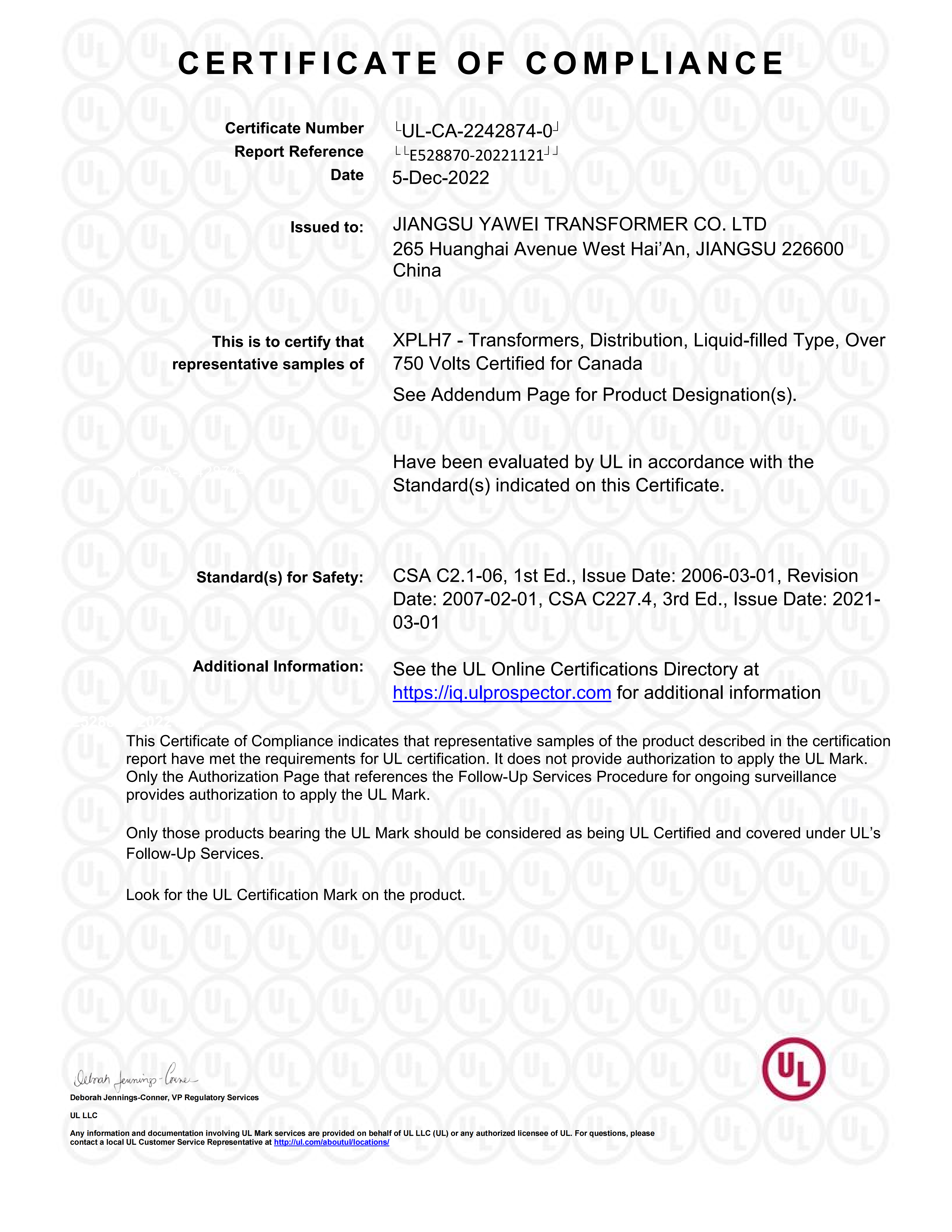
For the North American market, the certification that relates to oil-immersed distribution transformers is a product safety certification issued by UL LLC. In the records held for the audited manufacturing base, the liquid-immersed certification is listed under certificate numbers UL-CA-2242874-0, UL-CA-2320692-0 and UL-CA-2328358-0, with the standards referenced as CSA C2.1-06 and CSA C227.4 and the scope described as safety certification of liquid-immersed distribution transformers for the United States and Canada. The product families associated with that certification are the S13 / S14 / S15 series oil-immersed distribution transformers and the SFZ-250000/345 power transformer.
Two boundary conditions are worth stating at the outset. First, in North American practice the acceptance gate for liquid-filled distribution transformers rated over 750 V is a UL Certificate of Compliance; a unit that is technically correct but not certified for the market will not be accepted. Second, certification is always scoped: a certificate issued for one product family does not automatically cover another, and it does not cover an arbitrary rating within that family.
Three instruments that are routinely confused
Most acceptance disputes do not come from a missing certificate. They come from a certificate being asked to do a job it was never issued to do. Product safety certification, field evaluation and type testing are separate instruments with separate issuers and separate scopes.
| Instrument | Issuer | Standards referenced | Product scope |
|---|---|---|---|
| Product safety certification — liquid-immersed distribution transformer | UL LLC | CSA C2.1-06, CSA C227.4 | Liquid-immersed distribution transformers for the US and Canada; certificates UL-CA-2242874-0, UL-CA-2320692-0, UL-CA-2328358-0 |
| Product safety certification — dry-type transformer | UL LLC | UL 1561 Ed.4 (US), CSA C22.2 No.47 Ed.5 (Canada) | Open ventilated dry-type air-cooled general-purpose transformer; certificates UL-US-26119070-0 (US) and UL-CA-2687596-0 (Canada), issued 29 May 2026 |
| Field evaluation report | CSA Group | NFPA 791-2018, NFPA 70-2017, IEEE C57.12.00, IEEE C57.12.90, UL 891, IEEE C37.121-2012 | A switchgear unit substation evaluated on site 10–20 May 2022; report 80127142 |
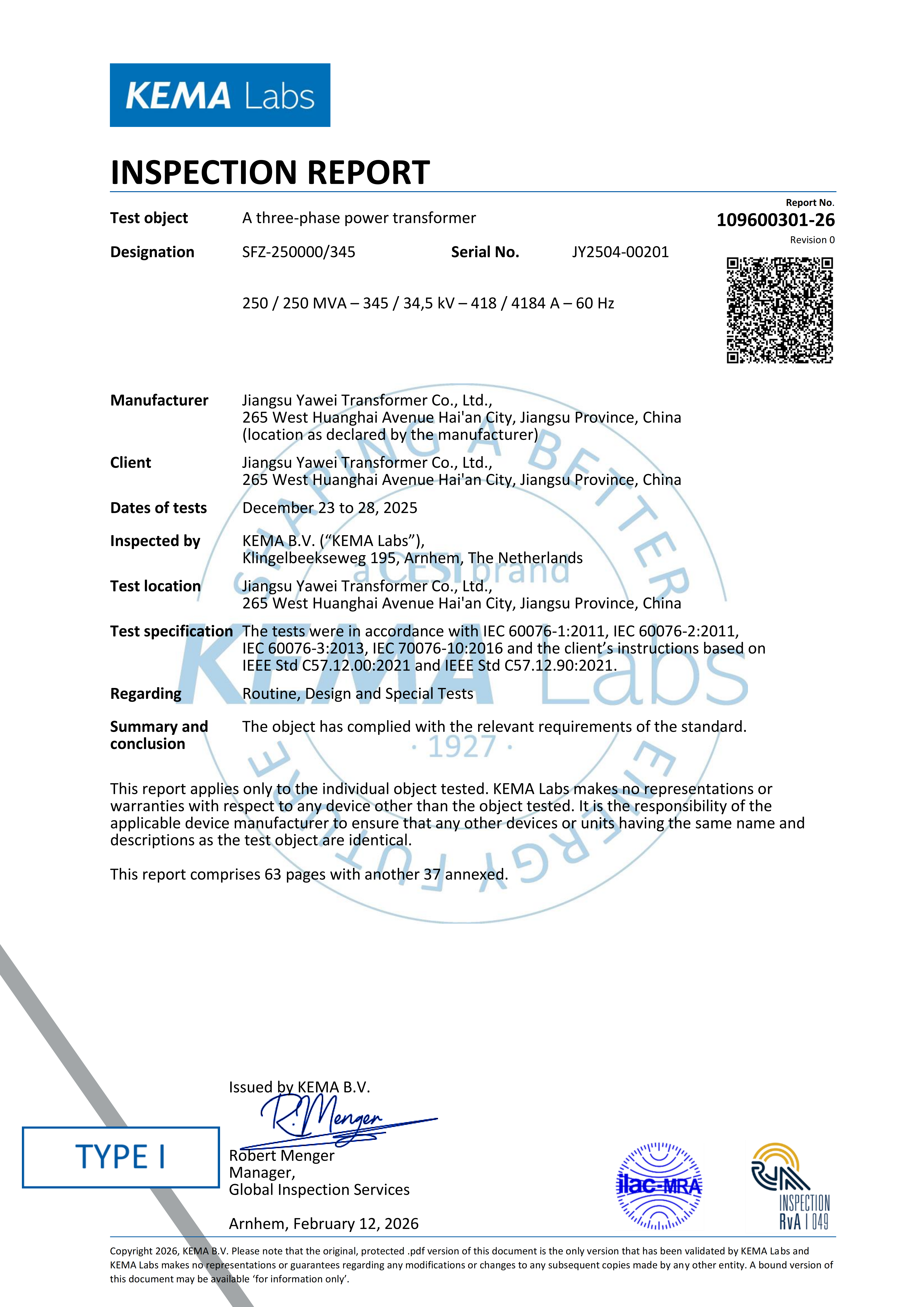
| Third-party type test report | KEMA B.V. (KEMA Labs), Arnhem, Netherlands | IEC 60076-1:2011, IEC 60076-2:2011, IEC 60076-3:2013, IEC 60076-10:2016, IEEE C57.12.00:2021, IEEE C57.12.90:2021 | Large power transformer testing; report 109600301-26, tests 23–28 December 2025, issued 12 February 2026 |
| Type test report | TÜV Rheinland (Shanghai) Co., Ltd. | IEC 60076-1:2011, IEC 60076-2:2011, IEC 60076-3:2013+A1:2018, IEC 60076-10:2016 | Three-phase outdoor oil-immersed power transformer; report CN231PY4 001, tests 20–22 June 2023, issued 26 June 2023 |
The practical reading of that table is straightforward. A dry-type certificate does not certify a liquid-filled unit. A field evaluation report addresses a specific installed assembly, not a product family. And a type test report proves performance against a standard; it is not a market-access certificate. Buyers who ask for "the UL certificate" without specifying which of these they need are the buyers most likely to receive the wrong document on time.
The Power Transformer End of the Same Argument
Certification discipline does not stop at distribution ratings. Global trade in electrical transformers with power capacity above 500 kVA (HS 850434) reached USD 2.5 billion in 2024, a 12.7% increase year on year, and the buyers behind those flows apply the same document scrutiny to large oil-immersed power transformers that a utility applies to a 75 kVA pad-mounted unit.
At the upper end of the range managed through Apex Power Systems, the reference design is the SFZ-250000/345 three-phase oil-immersed on-load voltage regulating power transformer: rated capacity 250/250 MVA at 345/34.5 kV, rated current 418/4184 A at 60 Hz, vector group Dyn1, cooling specified as ONAN at 185 MVA, ONAF1 at 225 MVA and ODAF2 at 250 MVA, a tap range of (345 +17/−17 × 0.625%) / 34.5 kV, lightning impulse withstand of 1175 kV on the HV winding and 200 kV on the LV winding, switching impulse withstand of 975 kV, and an on-load tap changer specified as 3 × SHZVI-400/363C-18353W.
For a unit of that class, a distribution-transformer certificate is not the relevant evidence, and no buyer should accept it as such. What the buyer receives instead is independent type-test evidence from accredited laboratories:
- KEMA Labs issued a Type I inspection report, number 109600301-26, for testing carried out 23–28 December 2025 and reported on 12 February 2026, with tests performed to IEC 60076-1:2011, IEC 60076-2:2011, IEC 60076-3:2013, IEC 60076-10:2016, IEEE C57.12.00:2021 and IEEE C57.12.90:2021.
- An earlier KEMA report, number 702226901-24, covered routine, type and special tests carried out 17–21 July 2024 and issued on 23 August 2024 to the IEC 60076 series.
- TÜV Rheinland (Shanghai) issued type test report CN231PY4 001 for a three-phase outdoor oil-immersed power transformer, tested 20–22 June 2023.
- CSA Group field evaluation report 80127142 records the on-site evaluation of a switchgear unit substation against NFPA 791-2018, NFPA 70-2017, IEEE C57.12.00, IEEE C57.12.90, UL 891 and IEEE C37.121-2012.
The delivered record supports the same pattern. A 345 kV fully insulated power transformer was designed, engineered, manufactured, tested, delivered, installed and commissioned for a US–Georgia power transmission company across 4 units; a 115 kV substation package including a 40 MVA transformer was delivered, commissioned and has been operating since 2023 for a Puerto Rico power distribution company across 30 units; and a 15 MVA pad-mounted transformer project delivered 15 units to a North American distribution network meeting ANSI/IEEE standards. In the two US cases, the commercial file also carries installation approval documentation, AutoCAD drawings and client supervision.
Where Certificates Go Wrong: Expiry, Entity Mismatch and Scope
Requests for certification are usually answered correctly. The failures that stop a shipment are more specific, and they fall into three categories.
1. Expiry
Certification is a dated instrument, and a lapsed certificate is not evidence regardless of what it says. Within the same evidence set, the recorded validity windows include CE compliance under certificate numbers M.2022.206.C7198 (UDEM) and 3N230310.JYTU038 (ECM) valid to 7 September 2027; an EAEU declaration of conformity, POCC RU Д-CN.PA01.B.07433/24, valid to 25 February 2027; a Bureau Veritas Mode II factory approval, SMS.W.II./144156/A.0, valid to 13 November 2027; a China Classification Society type approval, JS25PTB00105, valid to 12 August 2031; and ISO 9001 quality management system certification, 04325Q30129R0M, valid to 15 January 2028.
The liquid-immersed UL/CSA record for the distribution transformer family is held without populated issue and expiry fields. That is not a defect in the certificate; it is a signal that the currency of the certification must be confirmed directly with the issuing body rather than inferred from the document in hand.
2. Entity mismatch
A certificate can be genuine, current and correctly scoped, and still fail at acceptance because it names the wrong legal entity. Group structures make this common: the certificate sits with one company while the contract, the invoice and the export documents sit with another. Supplier-audit practice in this supply chain includes verifying that certifications are current, are in the correct entity name, and cover the exact product family being purchased — and that check is done before award, not at the port.
3. Scope mismatch and unverifiable documents
A certificate for a dry-type transformer family cannot support an oil-immersed order; a certificate for a distribution rating band cannot support a large power transformer; and a document that carries no registration number, no named issuer and no listing with the issuing body cannot be verified at all. The last case is the most expensive, because it is usually discovered after the equipment has been built.
How to Request and Verify a Certificate
Verification is a short process once it is treated as a procurement step rather than an administrative afterthought.
- Ask for the certificate register, not a single PDF. The register should give, for each certificate, the number, the issuer, the validity period and the product family covered. This is the format the qualification package uses, and it makes gaps visible immediately.
- Match four fields before anything else: certificate number, issuer, product family, and the legal entity named on the certificate against the entity named in the contract.
- Verify with the issuing body. Every certificate carries a number that can be checked independently — for example UDEM verification via www.udem.com.tr, and UL listings via iq.ulprospector.com.
- Confirm validity where dates are not printed. If a record does not carry an expiry date, the buyer should not assume either an indefinite validity or an imminent lapse; the issuing body is the source.
- Add independent inspection where the value justifies it. Third-party inspection can be arranged with SGS, BV or KEMA, and witnessed factory acceptance testing and factory visits can be scheduled as part of the order.
- Close the loop on site. Pre-shipment factory acceptance testing is followed by a joint site acceptance test with the customer after installation, with commissioning, trial operation and operator training as part of the service scope.
For custom transformers, the certification question also starts earlier than most buyers expect. Custom voltage ratios, capacities, impedances, vector groups and tap ranges — and certification-oriented design for KEMA, UL or CSA markets — are engineering decisions taken at the proposal stage, with technical proposals typically produced in three to five business days and design cycles running fifteen to thirty days depending on complexity.
Tying Certification to Purchase Terms and Acceptance Criteria
Certification only protects a buyer if it is written into the commercial documents. The clauses that carry the most weight are unglamorous: which certificate, in whose name, current as of when, and what happens if it is not.
| Stage | What to specify | Why it matters |
|---|---|---|
| Enquiry | Required certificate numbers, issuer, product family, and the entity name that must appear on the certificate | Prevents the buyer discovering at shipment that certification belongs to a different legal entity |
| Before award | Certificate register showing number, issuer, validity and product family for each document | Allows independent verification with the issuing body before any commitment is made |
| Manufacturing | Certification current at the time of shipment, with scope matching the ordered model and rating | A certificate that lapses during production is not evidence at the acceptance gate |
| Pre-shipment | Factory acceptance test, witnessed FAT if required, third-party inspection where specified (SGS, BV, KEMA) | Evidence is generated on the buyer's schedule rather than after the unit has left the factory |
| Delivery documents | Submittals, AutoCAD drawings, factory test reports and operating manuals in the format the utility or EPC requires | Documents travel with the equipment and form part of the project submittal file |
| After installation | Joint site acceptance test with the customer, commissioning and trial operation | Confirms that the certified unit performs correctly in the installed system |
| In service | Warranty terms, spare parts and technical support recorded in the contract | The manufacturer provides a 12-month warranty on distribution transformers and a 12–24 month warranty on delivered transformers and prefabricated cabin substations, with spare parts and 7×24 remote support. |
Testing scope deserves particular attention because it is often underspecified outside North America. Distribution transformer quality control runs routine tests per IEC 60076 or ANSI/IEEE C57.12 — turns ratio, winding resistance, no-load and load losses, impedance, insulation and oil quality — with type and special tests available on request. Large power transformers are tested more broadly, including insulation and induced withstand, partial discharge measurement, lightning impulse and oil testing, with third-party witnessed testing available. The certificate establishes that the design is certifiable; the test reports establish that the specific unit is correct.
Application: Where Liquid-Filled Certification Matters Most
In North American residential and small commercial distribution, the certification question is decided at selection stage, not at delivery. Single-phase pad-mounted or pole-mounted units in the range of roughly 25 kVA to 100 kVA are the mainstream choice, with 50 kVA and 75 kVA units at 7200/2400 V and a 120/240 V secondary common in service. Three-phase pad-mounted units are specified where commercial or light-industrial loads require three-phase supply. In every case, the units must hold a UL Certificate of Compliance for liquid-filled distribution transformers rated over 750 V, and for Canada certification to CSA C2.1-06 and CSA C227.4.
The product families built for that duty are specific. Single-phase pad-mounted transformers in the ZGD-H / ZGD-Z series cover 15–250 kVA with a 120/240 V centre-tapped LV winding and epoxy-resin elbow bushings; single-phase pole-mounted units in the D-M series cover 5–167 kVA with porcelain or composite bushings and a fully sealed carbon-steel tank; three-phase pad-mounted units in the ZGS-H / ZGS-Z series cover 75–2500 kVA with HV classes from 4.16 kV to 34.5 kV, LV options at 240, 347, 480 and 600 V, efficiency to DOE (2016) and CSA (2023) references, and an ANSI/IEEE insulation level.
Two adjacent applications raise the documentation stakes further. Commercial and mixed-use developments frequently combine a liquid-filled distribution transformer with indoor dry-type units in the SCB12–SCB18 series, which are certified separately under UL 1561 Ed.4 and CSA C22.2 No.47 Ed.5 — the two certificates are not interchangeable. Data centre and AI computing park substations, a segment valued at USD 3.44 billion in the United States in 2024, follow the same split: dry-type transformers for indoor distribution because they contain no insulating oil, and oil-immersed power transformers or prefabricated cabin substations for the incoming supply, where higher capacities are available at lower cost per kVA and an on-load tap changer is specified where the supply voltage varies.
Market Trend: Regulation Is Raising the Documentation Load
Demand growth is not the only pressure on certification workflows. The global transformer market is estimated at USD 80.8 billion in 2026, and the distribution transformer segment alone is projected to grow from USD 26.0 billion in 2026 to USD 47.7 billion by 2033 at a compound annual growth rate of 9.1%. Box-type substations for photovoltaics represent a further USD 4.54 billion in 2026. More units moving through more markets means more certificates per order, not fewer.
Efficiency regulation is the sharper driver. In the United States, the Department of Energy rule under 10 CFR Part 431 requires distribution transformers to transition towards amorphous electrical steel starting in 2029. In China, GB 20052-2024, the standard for minimum allowable values of energy efficiency and energy efficiency grades for power transformers, took effect on 1 February 2025. Both act on the design of the magnetic circuit — and a design change reopens the certification question for the affected family. Amorphous-alloy transformers such as the S(B)H15(21–25)-M range, with no-load losses stated as 60–80% lower than conventional silicon-steel transformers, are the visible product consequence of that regulatory direction.
The practical implication for buyers is scheduling. If a redesign is required to meet a new efficiency grade, certification documentation has to be renewed in parallel with the design, not after it. Procurement timelines that assume certificates can be produced on demand at the end of a project are increasingly unrealistic.
Comparison with Traditional Practice — and the Limits of Certification
| Dimension | Traditional document handling | Evidence-first handling |
|---|---|---|
| When certificates are requested | At or after shipment, when acceptance is already being tested | At enquiry, together with the technical proposal |
| What is accepted as proof | A scanned page, a logo on a datasheet, or a verbal statement of certification | A certificate number, named issuer, defined scope and named legal entity |
| Verification | Left to the buyer after delivery | Cross-checked with the issuing body before award |
| Scope checking | Assumes one certificate covers the whole order | Confirms product family, rating band and entity match separately |
| Acceptance testing | Routine tests recorded on a factory sheet | Routine tests plus witnessed FAT, third-party inspection and joint SAT where specified |
| Risk profile | Equipment arrives electrically conforming but unacceptable to the utility | Documentation risk is closed before the factory starts building |
The limits deserve equal emphasis, because certification is often asked to carry more weight than it can.
- Certification is family-scoped, not order-scoped. A certification for liquid-immersed distribution transformers does not certify a 250 MVA / 345 kV power transformer. That class of unit is supported by its own independent type-test evidence, such as the KEMA Type I inspection report for a 250 MVA / 345 kV transformer or the TÜV Rheinland type test report for a three-phase outdoor oil-immersed transformer.
- Certificates do not transfer between technologies. Dry-type and liquid-filled units are certified under different instruments — UL 1561 Ed.4 and CSA C22.2 No.47 Ed.5 for the dry-type unit, CSA C2.1-06 and CSA C227.4 for the liquid-filled unit. One cannot substitute for the other.
- Field evaluation is not product certification. The CSA field evaluation report 80127142 concerns a switchgear unit substation evaluated on site in May 2022 against NFPA and IEEE references. It is a route for a specific installed assembly, not a substitute for a certified product family.
- Validity is not self-evident. Where issue and expiry fields are not populated on the record, buyers must confirm currency with the issuer. Assuming indefinite validity is as risky as assuming expiry.
- Certification says nothing about delivery or service. It does not cover lead time, spare parts availability, warranty response or the commercial terms of the contract.
- The certificate belongs to the manufacturer. Apex Power Systems is a trading and supply partner, not a factory; the manufacturing, certification and test evidence sits with audited manufacturing partners, and buyers should expect to see it in those entities' names.
Future Outlook
Certification is moving from a document produced at the end of a project to a selection criterion applied at the beginning of one. Three developments point the same way. Efficiency regulation — the US transition towards amorphous electrical steel from 2029 and the Chinese GB 20052-2024 grades effective from February 2025 — will periodically reopen certification for redesigned transformer families. Independent laboratory evidence, already the norm for large power transformers, will continue to be requested for larger distribution packages. And the growth of data centre, renewable and substation projects will keep pressure on document turnaround times.
For buyers, the practical response is procedural rather than technical: require a certificate register at enquiry, verify numbers with the issuing body before award, write currency and entity-name conditions into the purchase order, and hold pre-shipment and site acceptance testing as separate evidence gates. Buyers who do that convert certification from a late-stage surprise into an early-stage filter — which is the only point at which it actually reduces risk.
FAQ
What is a UL Certificate of Compliance for a liquid-filled distribution transformer?
It is a product safety certification issued by UL LLC covering liquid-immersed distribution transformers intended for the North American market. For the audited manufacturing base behind Apex Power Systems, the liquid-immersed certification is recorded under certificate numbers UL-CA-2242874-0, UL-CA-2320692-0 and UL-CA-2328358-0, with CSA C2.1-06 and CSA C227.4 referenced as the applicable standards and the S13 / S14 / S15 oil-immersed distribution transformer series and the SFZ-250000/345 power transformer listed as associated products. In North American practice, units rated over 750 V are expected to hold this certificate before they are accepted.
Does certification for the United States also satisfy Canadian requirements?
Not automatically. Canadian acceptance references CSA C2.1-06 and CSA C227.4 in addition to UL certification, and the certificates themselves are often issued as separate US and Canadian registrations. The dry-type transformer record illustrates the pattern clearly: UL-US-26119070-0 covers the United States under UL 1561 Ed.4, while UL-CA-2687596-0 covers Canada under CSA C22.2 No.47 Ed.5, both issued on 29 May 2026. For the liquid-immersed distribution transformer family, the numbers UL-CA-2242874-0, UL-CA-2320692-0 and UL-CA-2328358-0 are listed against the United States and Canada together.
How can a buyer verify that a transformer certificate is genuine and current?
Verification works from the certificate register and the issuing body. The register should list, for each certificate, the number, issuer, validity period and product family covered, which allows a buyer to match the document against the exact product being purchased. The number can then be checked directly with the issuer — UDEM verification is available via www.udem.com.tr and UL listings via iq.ulprospector.com. Where a record does not print an expiry date, currency should be confirmed with the issuing body rather than assumed either way.
Why do certificates get rejected at acceptance even when the supplier has them?
Three causes account for most rejections. Expiry: certificates are time-bound, and dated instruments in the same evidence set carry validity to dates such as 25 February 2027 for an EAEU declaration, 7 September 2027 for CE compliance and 13 November 2027 for a Bureau Veritas Mode II factory approval. Entity mismatch: the certificate is current and correctly scoped but names a different legal entity from the contracting party. Scope mismatch: the certificate covers a different product family or rating band than the unit ordered, for example a dry-type certificate presented for a liquid-filled order. Unverifiable documents — no registration number, no named issuer, no listing — form a fourth, less common category.
How do certification documents connect to purchase terms and acceptance testing?
Certification defines what the design must be; the contract and the test programme define what the delivered unit must prove. In practice this means specifying the required certificate numbers, issuer and entity name at enquiry; requiring currency at the time of shipment; and separating the evidence gates — factory acceptance testing before shipment, third-party inspection with SGS, BV or KEMA where specified, and a joint site acceptance test with the customer after installation. Routine tests for distribution transformers follow IEC 60076 or ANSI/IEEE C57.12 and cover turns ratio, winding resistance, no-load and load losses, impedance, insulation and oil quality, with type and special tests available on request.
For a large oil-immersed power transformer, what independent evidence replaces a distribution-transformer certificate?
Large power transformers are supported by their own type-test and inspection evidence rather than by distribution-level product certification. For a 250 MVA / 345 kV class unit, that evidence includes a KEMA Labs Type I inspection report, number 109600301-26, for tests carried out 23–28 December 2025 and reported on 12 February 2026 against IEC 60076-1:2011, IEC 60076-2:2011, IEC 60076-3:2013, IEC 60076-10:2016, IEEE C57.12.00:2021 and IEEE C57.12.90:2021; an earlier KEMA report, 702226901-24, covering routine, type and special tests in July 2024; and a TÜV Rheinland type test report, CN231PY4 001, for a three-phase outdoor oil-immersed power transformer tested in June 2023. These are complemented by routine tests on the delivered unit, including insulation and induced withstand, partial discharge measurement, lightning impulse and oil testing, with third-party witnessed testing available.
For a fuller view of the transformer families and substation equipment referenced in this article, the Apex Power Systems product catalog is available for download: https://cdn.socialarks.com/sbsp/25303/common/2026/0920/%E5%90%89%E5%B2%AD%E7%94%BB%E5%86%8C%28Apex%20Power%20Systems%20Catalog%29%281%29_20260804171625.pdf