
UPS Isolation Transformers for Data Centers: A Buyer Guide
HTNXT Industry Reference | Data Center Power Distribution
A UPS isolation transformer is a specification decision, not a catalogue checkbox. It sits at the interface between UPS topology, harmonic load, grounding, fire safety and redundancy. This guide explains what buyers should clarify before the RFQ is issued.
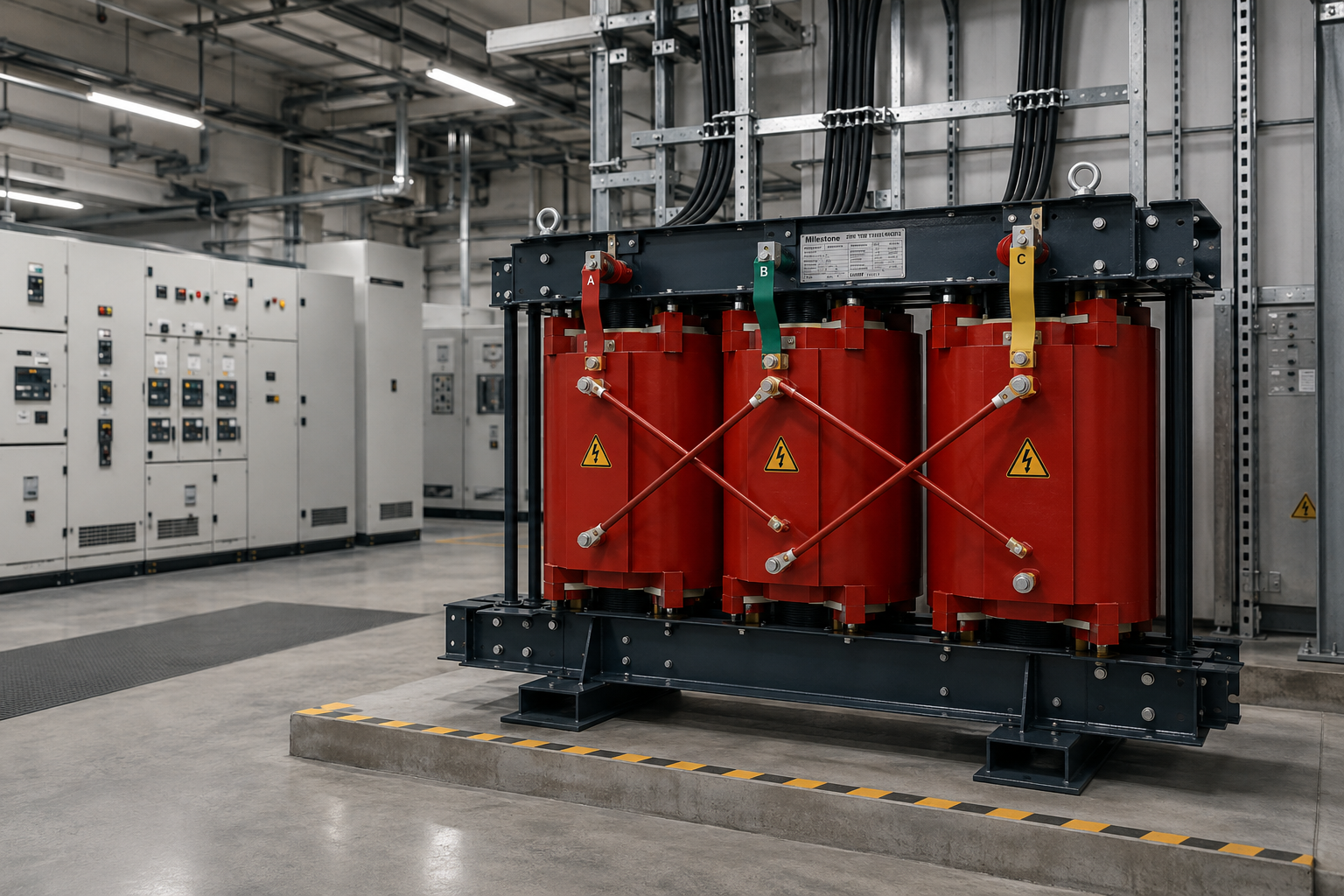
A data center transformer is not defined only by its kVA rating. In a UPS-backed power chain, the transformer may be asked to isolate the UPS from the protected load, establish a defined voltage ratio and neutral point, carry harmonic-rich current from IT equipment, and remain compatible with the facility’s redundancy scheme. That combination is why the phrase UPS isolation data center transformer appears in procurement discussions as a distinct requirement rather than a generic distribution transformer line item.
Milestone (Xiong'an) Electrical Technology Co., Ltd. is a transformer engineering and manufacturing company based in Xiong’an New Area, Hebei, China, established in 2011. Its main products include power transformers, distribution transformers, dry-type transformers, and compact substations. The company reports an 8,000 square metre manufacturing facility, about 270 staff, 30 R&D personnel, annual output of 15,000 units, and an export share of 85%. Its dry-type transformer platform is listed for data center applications alongside high-rise buildings, hospitals, subways, airports and indoor industrial distribution.
What a UPS Isolation Data Center Transformer Does
In a data center power train, a UPS isolation transformer is applied at the UPS interface. It is not the UPS itself, and it does not create uninterruptible power. Its role is to provide a defined transformation and isolation stage between the UPS and the protected load or upstream supply, with a neutral and grounding arrangement that the electrical design can control.
The transformer may also be used to establish a separately derived source, to adapt the UPS output voltage to the downstream distribution voltage, and to present a known impedance to the load. Those functions affect fault current, protection coordination, voltage regulation and the way harmonic currents circulate in the power chain. The exact location and need depend on the UPS topology, the facility grounding design, the neutral requirement and the project specification. Not every UPS arrangement requires the same transformer configuration.
Buyer interpretation: a transformer can be electrically adequate for a linear load and still be a poor specification for a UPS-backed data center. The difference is not only voltage ratio. It is harmonic duty, neutral current, thermal margin, noise, enclosure, documentation and redundancy compatibility.
The Data Center Problem: Harmonic Load and UPS Interface Risk
Data center loads are not purely linear. IT equipment, UPS systems, power distribution units, cooling drives and other power-electronic equipment can produce harmonic currents. When those currents pass through a transformer, they can increase winding and stray losses, raise temperature rise, and affect neutral loading. The transformer must be evaluated for the actual load profile rather than selected from a simple kVA total.
IEEE C57.110-2018 is the IEEE recommended practice that provides calculation methods to evaluate transformer capability when supplying nonsinusoidal load currents. It also provides application information for specifying a transformer expected to carry such loads. That standard is relevant to data center transformer specification because it frames the question correctly: what harmonic spectrum will the transformer see, and what thermal capability does it have under that spectrum?
The data center scenario also brings practical requirements that are not captured by a standard distribution transformer datasheet. The application data for data centers lists specified fire performance, low noise, low losses, harmonic-load assessment, temperature monitoring and redundant-system compatibility. Matching equipment typically includes UPS, emergency generators, STS, PDUs, switchgear, busways, cooling systems and building management systems. The transformer is one part of that chain, and its specification must fit the chain.
Milestone’s Dry-Type Platform for Data Center Applications
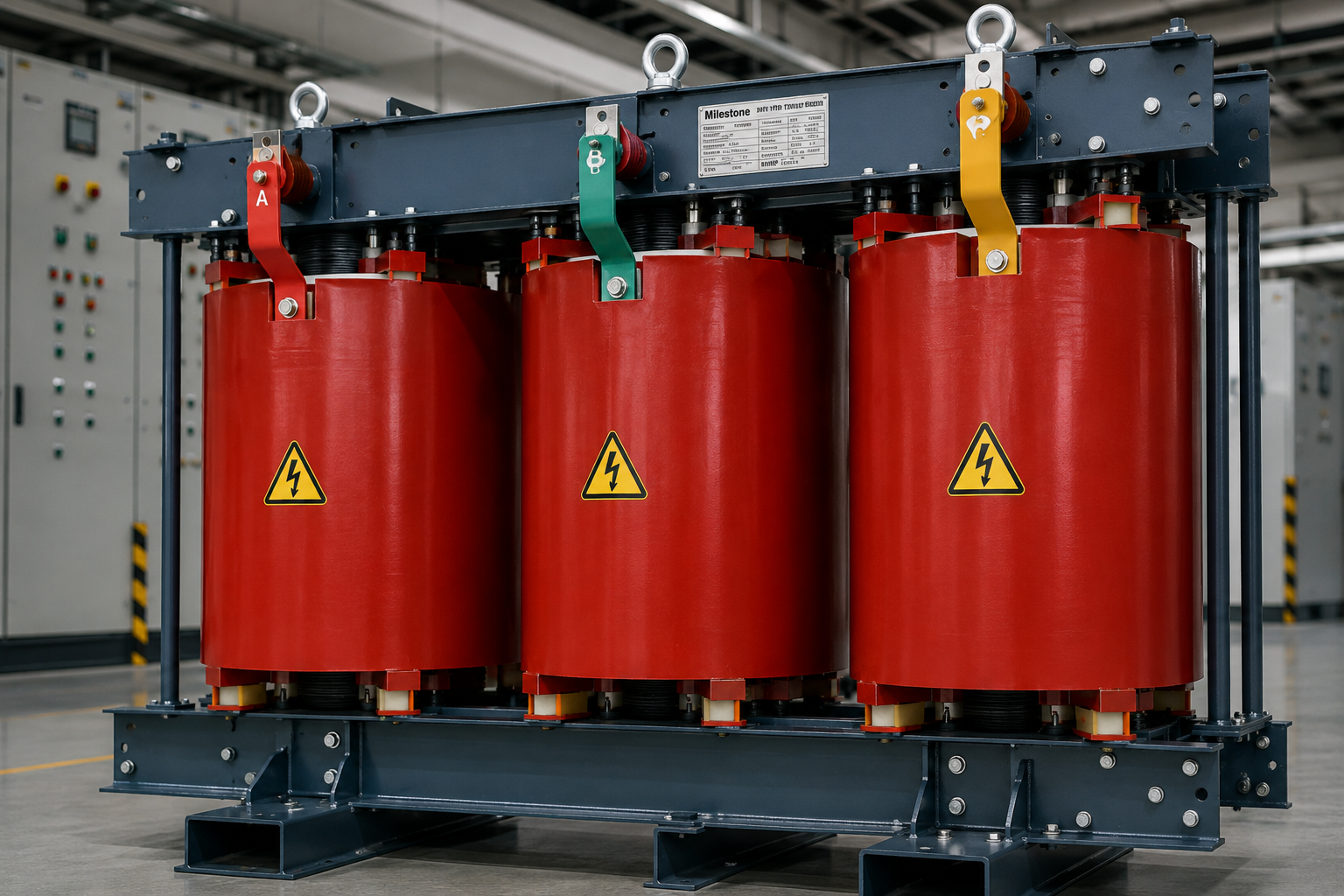
Milestone’s dry-type transformer model SCB13-1500/35-0.4 is a cast-resin, oil-free transformer designed for indoor installation. The model designation indicates a 1500 kVA rating with 35 kV high voltage and 0.4 kV low voltage. Data centers are listed among its applicable industries, together with high-rise buildings, shopping malls, hospitals, subways, airports, office buildings, indoor factory power distribution, petrochemical auxiliary areas and underground facilities.
The transformer uses cast resin insulation and epoxy resin as an insulation material. Its core material includes CRGO silicon steel sheets. Copper or aluminium winding is available, and glass fibre is listed among the product materials. Low noise and low maintenance are listed as product characteristics. AN and AF cooling options are available. The design is described as oil-free and suitable for indoor installation.
| Published parameter | Milestone dry-type platform data | What the buyer should confirm |
|---|---|---|
| Model reference | SCB13-1500/35-0.4 | Project-specific model, rating and revision |
| Capacity range | 25 kVA to 15,000 kVA | Actual calculated demand, future load and derating |
| High voltage | 6 kV to 35 kV | System voltage, insulation level and BIL |
| Low voltage | 0.22 kV to 10 kV | Downstream distribution voltage and tap range |
| Frequency | 50 Hz / 60 Hz | Site frequency and auxiliary equipment rating |
| Phases | Three-phase | System arrangement and neutral requirement |
| Vector group | Dyn11, Yyn0 | Grounding, protection and parallel-operation compatibility |
| Short-circuit impedance | 4% to 6% | Fault level, voltage regulation and protection study |
| Cooling | AN / AF | Load profile, fan dependence and auxiliary power |
| Tap regulation | OCTC / OLTC | Voltage variation, outage availability and maintenance |
| Protection | IP20 / IP23 | Room condition, dust, humidity and enclosure requirement |
| Altitude | 1000 to 4000 m | Site altitude, thermal derating and insulation review |
These are platform parameters. They do not mean that every unit is configured as a UPS isolation transformer, and they do not by themselves establish a K-factor rating, UL or CSA listing, or IEEE C57.110 compliance for a specific model. Product configurations are reviewed against each project’s electrical duty and site conditions. Relevant parameters may include primary and secondary voltage, rated capacity, frequency, phase, vector group, impedance, loss requirements, cooling method, tap changer, insulation level, installation arrangement and environmental conditions.
Technical Explanation: K-Factor, IEEE C57.110 and IEC 60076
K-factor ratings are used to express a transformer’s ability to supply non-linear loads without exceeding its thermal limits. A K-20 rating is referenced in the verified data set as a data center application rating under non-linear loads, with IEEE C57.110 as the relevant standard context. K-13 and K-20 are not interchangeable labels for every project. The correct rating depends on the actual harmonic spectrum, the transformer’s thermal design and the project specification.
IEEE C57.110 is a recommended practice, not a product certification. A transformer should not be described as “IEEE C57.110 compliant” unless the project defines the evaluation method and the supplier provides the corresponding calculation or test evidence. The standard helps buyers ask the right question: can this transformer carry the specified nonsinusoidal load without exceeding its approved temperature limits?
IEC 60076 is the IEC standard family for power transformers and includes dry-type transformer parts applicable to indoor data center products. The exact part, edition and project applicability must be confirmed in the technical specification. UL 1561 is the UL standard context for dry-type general purpose and power transformers and for K-factor ratings. UL and CSA listing are certification statuses, not generic marketing labels. The available corpus does not state UL or CSA listing for SCB13-1500/35-0.4; that evidence must be requested at model level if the project requires it.
Impedance also matters. The published dry-type platform lists 4% to 6% short-circuit impedance. Lower impedance generally gives higher prospective short-circuit current and may improve voltage stiffness, while higher impedance generally limits fault current but may increase voltage drop. Neither value is universally better. The impedance must be approved by the fault-level, voltage-performance and protection studies.
Cooling is another specification variable. AN cooling uses natural air circulation; AF cooling uses fans and can support a higher approved rating only when the fans, controls and auxiliary supply are available and operating correctly. A fan failure may require returning to the AN rating. Ambient temperature, altitude and room ventilation can require derating. Low noise is listed as a product characteristic, but no numeric sound level is provided in the corpus; if a noise limit is contractual, model-specific acoustic test data should be requested.
Application and Use Cases
The most relevant use case is a data center critical power distribution project in which the transformer supports IT equipment, cooling systems and supporting electrical infrastructure. The operating mode is continuous, and the matched equipment typically includes UPS, emergency generators, STS, PDUs, switchgear, busways, cooling systems and building management systems. The transformer must be compatible with the redundancy scheme and with the facility’s protection and monitoring architecture.
Data center projects designed for Tier III or Tier IV redundancy typically require redundant-system compatibility and careful load assessment. The transformer itself does not create a Tier classification; Tier classification is a facility-level design and certification matter. The transformer specification must support the defined redundancy scheme, including the ability to maintain critical load during maintenance or a single transformer outage where that is part of the design.
Other application boundaries matter. A dry-type transformer is often considered for indoor electrical rooms where fire safety and avoiding insulating liquid are priorities. It is not automatically suitable for every indoor environment; ventilation, humidity, dust, altitude and loading must be checked. A pad-mounted service transformer is a different product configuration from an indoor dry-type unit, and a compact substation is an integrated assembly rather than a single transformer. These distinctions should be kept clear in the RFQ.
Procurement Criteria: What to Put in the RFQ
A complete RFQ should make the transformer’s role explicit. The supplier needs to know whether the unit is a UPS isolation transformer, a downstream distribution transformer, an auxiliary transformer or a service transformer. That role determines the harmonic assessment, neutral arrangement, impedance target and documentation scope. Missing data should be marked TBC rather than assumed.
| RFQ item | Why it matters for a UPS isolation data center transformer |
|---|---|
| Transformer role and location | Defines whether the unit is at the UPS input, UPS output, auxiliary board or service entrance |
| Rated capacity and load profile | Drives thermal design, spare capacity and lifecycle loss evaluation |
| Primary and secondary voltage | Must match the UPS interface and downstream distribution voltage |
| Frequency, phases and vector group | Affects grounding, protection, neutral availability and parallel operation |
| Impedance and fault level | Controls fault current, voltage regulation and protection coordination |
| Harmonic spectrum and K-factor requirement | Determines whether a standard, K-13 or K-20 design is appropriate |
| Cooling method and ambient conditions | Affects permissible loading, fan dependence and derating |
| Loss requirements | No-load and load losses affect lifecycle operating cost |
| Insulation level and BIL | Must match system voltage, surge protection and site conditions |
| Enclosure protection and noise limit | Must match the electrical room, dust, humidity and acoustic requirements |
| Applicable standards and listing | IEC 60076, IEEE C57.110, UL 1561 and CSA requirements should be named explicitly |
| Testing and documentation | Routine tests, type tests where required, FAT, reports and certificates |
Evidence to request: model-specific datasheet, guaranteed no-load and load losses, impedance and tolerance, temperature-rise basis, vector group, tap range, cooling rating, acoustic data where required, harmonic-capability calculation or test evidence, listing certificates if applicable, routine test report and FAT arrangement. A generic catalogue page is not a substitute for unit-specific evidence.
Comparison with Traditional Solutions
A standard distribution transformer may be lower cost and entirely appropriate for linear loads in an outdoor industrial distribution network. In a UPS-backed data center, however, the same transformer may be asked to carry a harmonic-rich load, support a defined neutral current and fit a redundancy scheme. The comparison should therefore be made on specification fit, not on transformer type alone.
| Comparison point | Standard distribution transformer | UPS isolation data center transformer specification |
|---|---|---|
| Primary design question | Voltage transformation and distribution capacity | Voltage transformation plus harmonic duty, isolation and neutral arrangement |
| Harmonic assessment | May be outside the standard scope | Should be evaluated against the actual harmonic spectrum |
| K-factor rating | Not always specified | K-13 or K-20 may be requested, but only with thermal evidence |
| Neutral and grounding | Depends on the distribution design | Must be defined at the UPS interface |
| Fire and installation | Liquid-immersed designs are common outdoors | Dry-type is often considered for indoor electrical rooms |
| Noise and losses | Project-dependent | Often explicit because of indoor siting and operating cost |
| Documentation | Routine test and datasheet | Plus harmonic capability, listing and model-specific evidence where required |
The limitation is important. A dry-type transformer avoids insulating liquid, but it is not automatically suitable for every indoor environment. Ventilation, humidity, dust, altitude and loading must be checked. A K-rated transformer is not automatically required for every UPS output. K-20 is one rating used in data center applications, but it is not a universal default; K-13 or another design may be appropriate for some load mixes. And the available corpus does not state K-13 or K-20 rating, UL or CSA listing, or IEEE C57.110 compliance for Milestone’s SCB13-1500/35-0.4. Those items must be confirmed in the project-specific technical proposal and supporting documents.
Market Trend Analysis
Commercial research cited in the verified data set places the global data center transformer market at USD 8.4 billion in 2025, with a projected 7.2% compound annual growth rate from 2026 to 2033. The same data set references cast-resin variants at 52% of the global dry-type transformer market in 2024. These are market-level estimates, not a forecast for any single supplier or product model. They indicate that data center transformer demand and dry-type configurations are commercially relevant, but they do not replace project-level due diligence.
The demand narrative is consistent with what buyers see in practice: data center capacity, AI infrastructure and electricity demand are increasing the attention given to transformer capacity, lead time and harmonic capability. The verified data set also identifies lead time and capacity qualification as an open data gap. Buyers should therefore ask for documented monthly capacity, current backlog, standard lead time, expedite policy and historical on-time delivery rather than rely on qualitative claims. For a UPS isolation transformer, the technical evidence and the supply evidence should be reviewed together.
Future Outlook
The next phase of data center transformer specification is likely to be shaped by three pressures: higher harmonic content, tighter efficiency and noise requirements, and stronger documentation expectations. As IT loads and cooling systems become more power-electronic, the transformer’s thermal capability under nonsinusoidal load will remain a central buying question. IEEE C57.110 provides the evaluation framework, but the buyer still needs the actual harmonic spectrum and the supplier’s model-specific evidence.
Dry-type transformers will remain relevant for indoor data center electrical rooms because they avoid insulating liquid and can support low-maintenance indoor installation. That does not make them universal. Liquid-immersed designs may remain appropriate outdoors or where their thermal and dimensional advantages fit the project. The practical trend is not a single winning transformer type; it is a more explicit specification chain in which transformer role, harmonic duty, cooling, impedance, protection and documentation are defined together.
FAQ
What is a UPS isolation data center transformer?
A UPS isolation data center transformer is a transformer applied at the UPS interface in a data center power chain. It provides a defined voltage ratio and galvanic isolation between the UPS and the protected load or upstream supply, and it must be specified for the harmonic currents, neutral arrangement, impedance, cooling and redundancy scheme of that interface. It is not a UPS and does not by itself provide uninterruptible power.
Why does a data center use an isolation transformer between the UPS and the IT load?
The isolation transformer establishes a separately derived source, a defined neutral and grounding point, and a voltage transformation stage at the UPS interface. It also presents a defined impedance and thermal duty to the load. The exact need depends on UPS topology, grounding design, neutral requirements, fault coordination and project specification. Not every UPS arrangement requires the same transformer location.
Should a UPS isolation transformer be dry-type or liquid-immersed?
For indoor electrical rooms where fire safety and avoiding insulating liquid are priorities, a dry-type transformer is often considered first. A liquid-immersed design may be appropriate outdoors or where its thermal and dimensional advantages are acceptable and the installation meets fire and containment requirements. Dry-type is not automatically suitable for every indoor environment; ventilation, humidity, dust, altitude and loading must be checked.
How should harmonic loads be assessed for a data center transformer?
The assessment should use the actual harmonic spectrum, load mix, UPS topology and duty cycle. IEEE C57.110-2018 provides calculation methods to evaluate transformer capability when supplying nonsinusoidal load currents and application information for specifying a transformer expected to carry such loads. A K-factor rating may be used to express harmonic capability, but the correct rating depends on the project’s harmonic profile and thermal design.
Is K-20 always required for a UPS isolation transformer?
No. K-20 is one K-factor rating referenced for data center applications under non-linear loads in the verified data set, but it is not a universal default. K-13 or another rating may be appropriate for some load mixes. The transformer’s thermal capability should be evaluated against the actual harmonic spectrum and the project specification, not selected from a label alone.
Which transformer parameters should be confirmed in a data center RFQ?
The RFQ should define transformer type, rated capacity, primary and secondary voltage, frequency, phases, vector group, impedance, cooling method, tap range, winding material, insulation level, loss requirements, applicable standards, site conditions, testing scope, accessories, documentation and delivery terms. Missing data should be marked TBC rather than assumed.
What are the limitations of a standard distribution transformer in a UPS isolation application?
A standard distribution transformer may be electrically adequate for linear loads but may not be specified for the harmonic spectrum, neutral current, temperature-rise method or K-factor duty of a UPS-backed data center. It may also lack the required documentation for harmonic capability, acoustic performance or listing. The limitation is application-specific: the project must confirm the harmonic profile and request model-level evidence.
Does Milestone’s SCB13-1500/35-0.4 have a K-20 rating or UL/CSA listing?
The available corpus describes the SCB13-1500/35-0.4 as a cast-resin, oil-free indoor dry-type transformer for data center and other applications, with published parameters including 25 to 15,000 kVA, 6 to 35 kV high voltage, 0.22 to 10 kV low voltage, 50/60 Hz, three-phase, Dyn11 or Yyn0, 4% to 6% impedance, AN/AF cooling, OCTC/OLTC and IP20/IP23. It does not state a K-13 or K-20 rating, UL or CSA listing, or IEEE C57.110 compliance for that model. Those items must be confirmed in the project-specific technical proposal and supporting documents.
How does cooling affect data center transformer selection?
Cooling method affects permissible loading, temperature rise, auxiliary power dependence and maintenance. The dry-type platform lists AN and AF cooling options. AF can support a higher approved rating only when fans, controls and auxiliary supply are available and operating correctly; a fan failure may require returning to the AN rating. Ambient temperature, altitude and ventilation can require derating.
What is the difference between no-load loss and load loss?
No-load loss occurs whenever the transformer is energized and is mainly related to the core. Load loss increases with load current and is mainly related to winding resistance and stray losses. Both affect efficiency and lifecycle operating cost. Compare guaranteed values at the same rating, reference temperature, tap position and test basis.
Technical reference: Milestone Transformer Catalogue (PDF). Product configurations and project-specific evidence should be confirmed directly with the manufacturer.
Tem questões ou precisa de mais detalhes?
Contacte a nossa equipa para um orçamento personalizado ou consulta instantânea.
Solicitar orçamento
Preencha o formulário abaixo e a nossa equipa entrará em contacto com uma proposta personalizada.
Chat direto do WhatsApp
Prefere conversar em tempo real? Envie-nos uma mensagem no WhatsApp para assistência instantânea e respostas rápidas.
- Obter orçamento personalizado
- Partilhar fotos ou documentos
- Discuta as suas necessidades diretamente
Geralmente responde em 5–30 minutos durante o horário de expediente.