
UPVC Sliding Doors for ASEAN High-Rise Balconies: Wind, Rain and Heat Fit
A high-rise balcony door in an ASEAN city works in conditions a ground-floor entrance never meets: wind pressure that builds with height, monsoon rain driven almost horizontally against the façade, humidity that persists across the calendar year, and direct solar gain across large glazed panels. A UPVC sliding door is one of the established answers to that combination, because a correctly specified assembly can deliver wind resistance, water-tight sealing and thermal insulation from a single frame system — but those properties come from the whole assembly, not from the material name on a quotation.
Foshan Nanhai Yuanzhaiji UPVC Door & Window Factory is a UPVC door and window manufacturer based in Foshan, China, established in 2009. Its door range covers UPVC sliding doors, lift-and-slide doors and hinged doors in European and American-style series, and its major markets include ASEAN alongside LATAM, MENA and the EU. This reference article examines what a high-rise balcony exposure actually demands from a sliding door, how profile series, internal reinforcement, sealing and hardware translate into performance, and where the realistic limits of a manual sliding assembly sit.
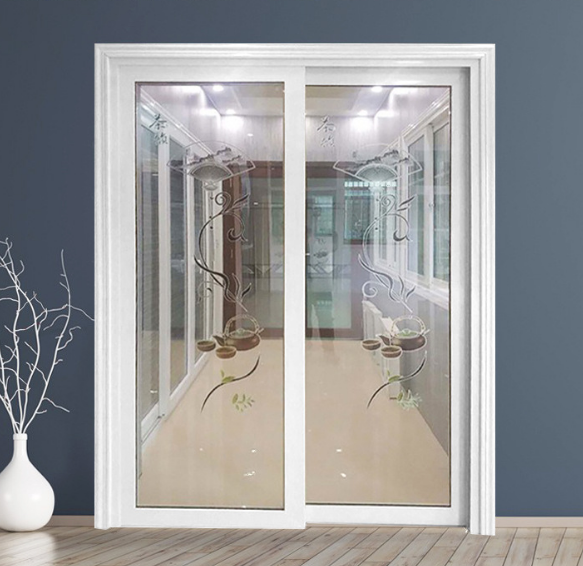
Why the Balcony Opening Is the Hardest One in a Tropical High-Rise
Wind load. Pressure on a façade rises with height and exposure. A sliding leaf is a large, flat panel, and it has to transfer that load into the frame and into the building structure without excessive deflection. When a leaf deflects too far, the first symptoms are rarely dramatic: operation becomes stiff, the compression on the seals is reduced, and hairline gaps begin to appear at the meeting stile.
Driving rain. On upper floors, rain seldom falls vertically. It arrives with a horizontal component and finds every unsealed interface — the bottom track, the meeting stiles, the fixing points. Sliding systems manage this with two mechanisms working together: compressible seals that limit water entry, and drainage paths that remove the water which gets past the first barrier. A door with seals but poor drainage holds water in the track; a door with drainage but worn seals pulls water inward across the sill.
Heat. In a typical apartment the balcony door is one of the largest glazed areas in the envelope. Solar gain through that area converts directly into cooling load, and the frame participates in the same process: a dark, sun-exposed profile absorbs heat, and a thin, single-chamber profile conducts it. The ASEAN balcony brief is therefore not only a strength brief — it is a thermal brief as well.
Humidity, salt and ageing. Coastal air in the region combines high humidity with airborne salt. The vulnerable points are the joints: metal hardware, the reinforcement inside the profile, and the interfaces between gasket, profile and glass. Weather resistance and anti-ageing behaviour matter more here than in a dry inland climate, and so does corrosion resistance in the parts that move every day.
Noise. Balconies in dense cities face roads, construction activity and, at height, wind itself. Sound insulation is a routine expectation for these openings rather than a premium option.
Daily manual operation. A balcony door is opened and closed by hand every day, often with one hand while carrying something. Roller quality, sash weight and track alignment decide whether that motion stays light over several years or becomes a maintenance complaint in the first hot season.
What “Fit” Means: Three Performance Axes for a Balcony Door
Structural rigidity: the liner decides
The defining difference between a UPVC door and an ordinary plastic door is internal reinforcement. UPVC doors adopt PVC-U profiles with galvanized steel liners fitted inside the profile cavities, which is what gives them strength, wind-pressure resistance and thermal and sound insulation performance. Ordinary plastic doors have no steel reinforcement; they are low-cost but have low rigidity and a high deformation risk, and they are not suitable for exterior or high-rise applications. For a balcony opening, a door without steel liners is not a cost saving — it is a structural risk. A practical acceptance check is to observe the cut profile end and confirm that the galvanized steel liners are present in the cavities before installation.
Water tightness and air sealing
Water tightness and air permeability are tested performance categories, not visual qualities. In practice they are produced by three elements acting together: EPDM sealing gaskets that compress against the frame and glass; dust-proof pile weatherstrip that limits air, dust and insect movement along the sliding track; and a track geometry that drains rather than stores water. Sealing performance belongs to the completed assembly — profile, gaskets, glazing and installation combined.
Heat, sound and moisture
Thermal insulation reduces heat transfer through the frame, and sound insulation reduces noise transmission; both depend on the glazing build-up as much as on the profile itself. Where a project requires CE-marked products, the reference standard is EN 14351-1:2006+A2:2016, under which window and door systems are tested for wind resistance, water tightness, air permeability, sound insulation, thermal performance, drop-weight impact and welding corner strength, supported by factory production control and a Declaration of Performance. Even where a project works to a different national standard, that list is a useful checklist of the evidence a buyer can ask for.
How the Yuanzhaiji Door Range Maps to ASEAN Balcony Projects
The manufacturing base behind this range covers 3,000 square meters in Foshan and employs approximately 20 staff, including a technical and management team, with an R&D group of 10 engineers. Annual production capacity reaches 50,000 units, and around 80% of output is exported, with major markets including ASEAN, LATAM, MENA and the EU. That export orientation is relevant to a balcony specification, because the same door family is being configured for several different climatic and regulatory environments at once.
For balcony and façade openings, the company manufactures UPVC sliding doors, lift-and-slide doors and hinged doors across European and American-style door series. Profile supply is based on Conch profiles in the 60, 65 and 88 series, offered in co-extruded colour, laminated wood-grain finish and solid colours including dark grey and black — a practical point in residential work, where the balcony door is often expected to match a façade or interior palette. The UPVC door product itself is listed under the model designations HF60, WYK75-1 and HF88-L, and is intended for construction project applications. Alongside the door line, the company’s window range includes UPVC sliding windows, UPVC casement windows, UPVC tilt-and-turn windows, UPVC crank awning windows, UPVC American-style hung windows, UPVC awning windows, UPVC hopper windows, insect screens, UPVC louver windows and insulated glass louver windows — relevant where a balcony façade is specified as a complete opening set rather than a single door.
Profile Series and Material Parameters: Reading the Numbers
The compound used in the profiles is documented with five material values. They describe the material rather than the finished door, but they explain why a UPVC frame behaves the way it does under tropical conditions.
| Property | Documented value | Why a project team looks at it |
|---|---|---|
| Vicat softening point | 86 °C | Indicates the temperature at which the material begins to soften under test conditions — a relevant indicator for sun-exposed frames, particularly in darker colours. |
| Flexural modulus of elasticity | 2840 MPa | A stiffness indicator. A balcony leaf is a large unsupported panel, so frame stiffness feeds directly into deflection under wind load. |
| Tensile yield stress | 43 MPa | The stress level at which permanent deformation begins. |
| Tensile strain at break | 186% | A ductility indicator. Higher elongation suggests more tolerance to handling, impact and thermal movement before fracture. |
| Density | 1520 kg/m³ | Compound density, relevant to formulation consistency and to the mass of moving sashes. |
These figures only become performance when they are combined with series selection, internal steel liner, glazing build-up and hardware. A 60-series, a 65-series and an 88-series profile occupy different positions in that chain, and the correct choice follows opening size, glazing build-up and exposure rather than a preference for the largest number. Where a specification covers a mixed façade — balcony door, side panel and window in one elevation — the profile series should be reviewed opening by opening.
Hardware, Sealing and the Daily Manual Operation
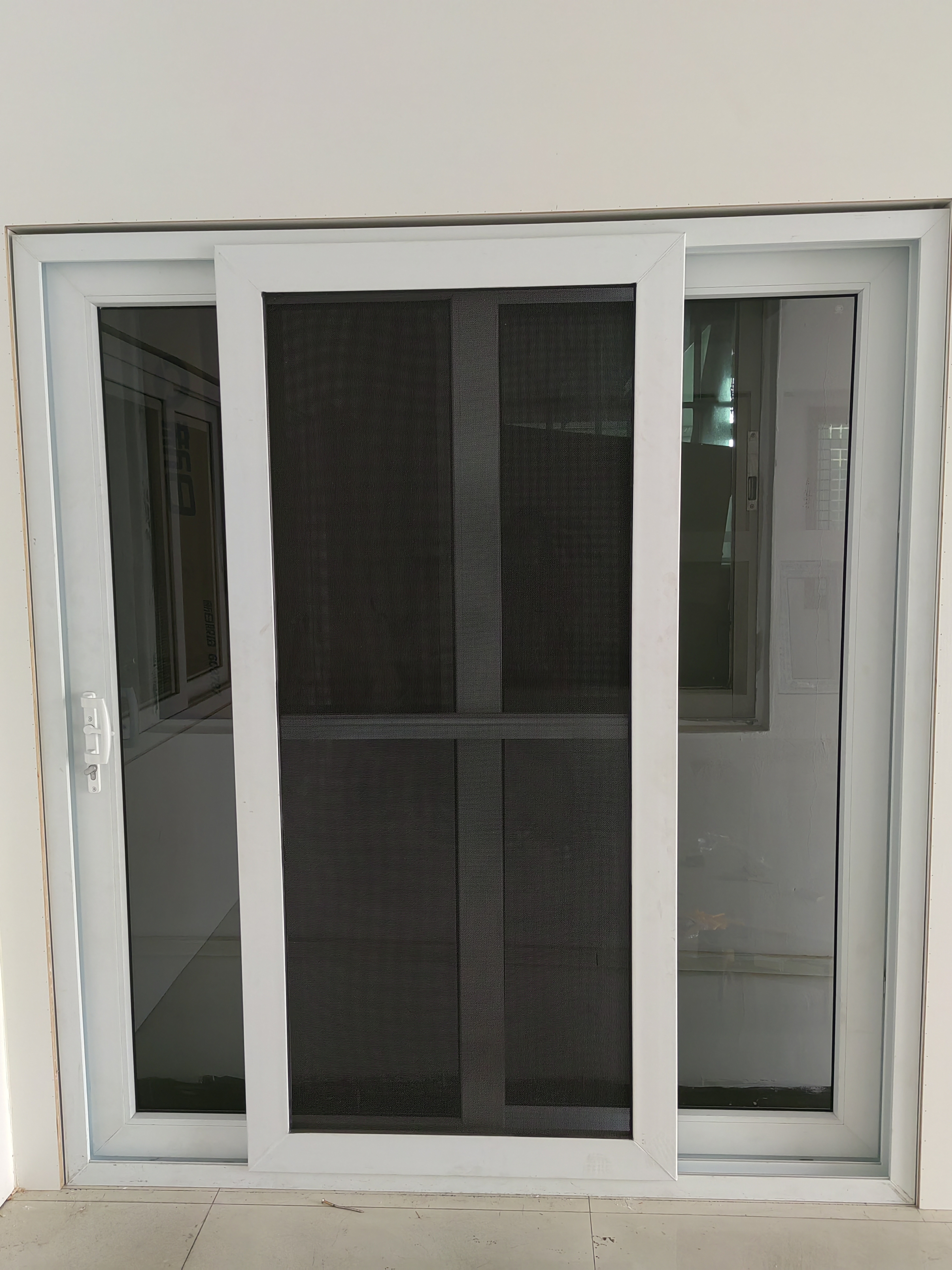
A sliding balcony door is a system of small parts that decide the daily experience. For this product family the matched hardware and sealing components are the door handle, door hinge, door roller, anti-collision stopper, dust-proof pile weatherstrip and EPDM sealing gasket. The roller carries the full weight of the sash and sets the force needed to move it. The anti-collision stopper protects frame and mechanism from repeated impact at the end of travel. Pile weatherstrip runs along the track to limit draughts, dust and insect entry. The EPDM gasket provides the compressible barrier at frame and glass interfaces, while handles and hinges govern the panels that open conventionally.
Operation across the range is manual opening and closing, with tilt-and-turn and sliding operation available. For a high-rise balcony that has a procurement consequence: a specification that increases glass thickness or leaf size without reviewing the hardware raises the operating force the resident applies every day. Fly screen integration also belongs to the balcony conversation in ASEAN, where insect pressure is a design driver rather than an afterthought — the sliding door platform shown above is supplied with a fly screen.
Where These Doors Fit: Application Scenarios
The scenarios these products are documented against are specific, and they align closely with ASEAN high-rise conditions:
- Project types: residential buildings, commercial buildings, renovation projects and villa projects.
- Working conditions: outdoor exposure, coastal high-humidity environments and strong-wind areas.
- Functional expectation: thermal insulation, sound insulation, wind and rain resistance, corrosion resistance and sealing performance, supporting a comfortable indoor environment.
- Operating modes: manual opening and closing, tilt-and-turn opening and sliding operation.
- Requirements typically written into the specification: wind-pressure resistance; water tightness and air permeability; impact and wear resistance; a secure locking system; weather resistance and anti-ageing behaviour; and compliance with local building access standards.
Read together, these are scenario-level requirements rather than a fixed product promise. The final specification is defined project by project — a twenty-storey coastal tower and a low-rise inland renovation do not carry the same exposure, and the door configuration should reflect that difference.
Market Signals Behind Sliding Balcony Doors
Independent market research supports the view that this is a mainstream category rather than a niche choice. The global uPVC windows and doors market was valued at USD 30.8 billion in 2025 and is projected to reach USD 32.4 billion by 2026, according to Grand View Research. Within that market, Asia Pacific dominated with a revenue share of 44.1% in 2025 — meaning the category is concentrated in the same climatic zone that drives the wind, rain and heat brief described above.
Configuration data points in the same direction. Sliding configurations accounted for 37.20% of uPVC door and window revenue in 2025, based on Mordor Intelligence reporting, which positions sliding as one of the dominant formats in the category. The doors segment is expected to grow at a CAGR of 5.3% from 2026 to 2033, slightly ahead of the overall market pace.
Regulation is moving in parallel. Under the UK Future Homes Standard 2025, the maximum U-value for external doors decreases from 1.6 W/m²K to 1.2 W/m²K — a mature-market example of envelope requirements tightening in the direction of better thermal performance. Buyers working on ASEAN projects should note that these specific thresholds are UK rules, not regional ones; the relevant national standards differ by market, and compliance has to be confirmed per destination. For trade and customs documentation, plastic doors, windows and their frames and thresholds fall under HS code 392520.
How UPVC Sliding Doors Compare with Other Balcony Solutions
The balcony opening can be closed with several door formats, and each carries trade-offs rather than an outright advantage.
| Consideration | UPVC sliding door | UPVC lift-and-slide door | Aluminium sliding door |
|---|---|---|---|
| Thermal insulation | Thermal insulation and energy-saving performance are documented product features, dependent on profile and glazing. | Same product family and material logic. | Aluminium conducts heat across the frame unless a thermal break is specified. |
| Structural behaviour under wind load | Depends on internal galvanized steel liners and on the profile series selected. | Generally used where wider clear openings are wanted. | Metal frames are inherently rigid and can often be slimmer. |
| Water tightness in driving rain | Result of gasket compression, weatherstrip condition and track drainage. | Larger sashes place more load on the sealing design. | Also a sealing-and-drainage design question, not solely a material question. |
| Operating effort | Manual; roller selection and sash weight decide the feel. | Manual with heavier sashes and different hardware. | Manual on the same principle. |
| Maintenance in humid coastal air | Easy cleaning is a documented feature; hardware remains the wear point. | Same hardware dependency. | Same hardware dependency. |
| Typical fit | Standard residential and commercial balcony openings with moderate exposure. | Very wide balcony openings. | Projects where thermal separation is less critical, or where span requirements exceed door-system limits. |
Limitations and Boundaries Buyers Should Confirm
No single assembly covers every balcony, and four boundaries are worth stating plainly.
- Reinforcement is not optional. Ordinary plastic doors without steel reinforcement deform easily under wind load and must not be used for exterior or high-rise projects. This is a safety boundary, not a price-versus-performance trade-off.
- Manual sliding systems have size and weight ceilings. The roller carries the sash, so leaf dimensions and glass weight have to be reviewed against the hardware. Where an opening is unusually wide or the exposure unusually severe, the configuration should be evaluated specifically rather than assumed to be covered by a standard product line.
- Thermal and acoustic results belong to the assembly. Profile material sets part of the outcome; glazing build-up, gasket compression and installation quality set the rest. A well-made frame with unsuitable glass will not deliver a thermal brief.
- Compliance is market-specific. CE marking under EN 14351-1:2006+A2:2016 applies where a project requires it, while each ASEAN market applies its own building access standards. Neither the standard nor the marking should be assumed to transfer automatically between destinations.
Future Outlook
Three forces are likely to keep pushing balcony door specifications in the same direction. The first is urban vertical growth across ASEAN, which multiplies the number of openings exposed to height-related wind pressure and driven rain. The second is envelope regulation: the UK’s move toward a 1.2 W/m²K threshold for external doors illustrates how thermal requirements tend to tighten once they begin to move, and comparable pressure typically follows in other markets over time. The third is the renovation segment, which the application data already lists as a project type — replacing older balcony doors in existing towers is often where sealing, noise and heat complaints surface first.
For buyers, the practical consequence is a shift in what counts as a complete specification. Material alone will not answer a wind, rain and heat brief; the documented configuration — profile series, steel reinforcement, gasket and weatherstrip system, hardware and glazing — is what determines whether a balcony door still performs in its fifth monsoon season.
Frequently Asked Questions
What is the difference between a UPVC sliding door and an ordinary plastic sliding door?
UPVC doors use PVC-U profiles with galvanized steel liners fitted inside the profile cavities for reinforcement, which supports strength, wind-pressure resistance and thermal and sound insulation. Ordinary plastic doors have no steel reinforcement, which results in low rigidity and a high deformation risk. Ordinary plastic doors are suitable only for indoor temporary and low-demand interior spaces and should not be used for outdoor or high-rise exterior applications.
Can UPVC doors be used on coastal, high-humidity, strong-wind balconies?
Yes — outdoor, coastal high-humidity and strong-wind areas are among the documented working conditions for this product family. The associated requirements listed for those conditions are wind-pressure resistance, water tightness and air permeability, impact and wear resistance, a secure locking system, weather resistance and anti-ageing behaviour, and compliance with local building access standards. Corrosion resistance and sealing performance are also listed among the product’s functional features.
Which profile series is relevant — Conch 60, 65 or 88 — and which door models are listed?
The manufacturer supplies Conch profiles in the 60, 65 and 88 series on a long-term basis, in co-extruded colour, laminated wood-grain finish and solid colours including dark grey and black. The UPVC door product is listed under the model designations HF60, WYK75-1 and HF88-L. Because the series differ in position within the assembly, the selection should follow the actual opening size, glazing build-up and exposure of each balcony rather than being fixed across a whole project.
What hardware determines how easily a heavy sliding balcony door opens and closes?
Operation is manual opening and closing. The matched hardware and sealing components specified for this door family are the door handle, door hinge, door roller, anti-collision stopper, dust-proof pile weatherstrip and EPDM sealing gasket. The roller carries the weight of the sash and is the component most directly tied to operating effort, while the anti-collision stopper limits impact damage at the end of travel and the pile weatherstrip and EPDM gasket control air, dust, insect and water movement.
What evidence can be checked before a high-rise balcony door is accepted?
Two checks are practical. At the product level, where a project requires CE-marked products, EN 14351-1:2006+A2:2016 sets out system tests covering wind resistance, water tightness, air permeability, sound insulation, thermal performance, drop-weight impact and welding corner strength, with factory production control and a Declaration of Performance as supporting documentation. At acceptance level, the profile end face should be inspected to confirm that galvanized steel liners are present in the cavities, and doors without steel liners should be rejected for exterior use.
Configuration details for the 60, 65 and 88 series profiles and the HF60, WYK75-1 and HF88-L door models are documented by the manufacturer at yuanzhaiji.com.
Tem questões ou precisa de mais detalhes?
Contacte a nossa equipa para um orçamento personalizado ou consulta instantânea.
Solicitar orçamento
Preencha o formulário abaixo e a nossa equipa entrará em contacto com uma proposta personalizada.
Chat direto do WhatsApp
Prefere conversar em tempo real? Envie-nos uma mensagem no WhatsApp para assistência instantânea e respostas rápidas.
- Obter orçamento personalizado
- Partilhar fotos ou documentos
- Discuta as suas necessidades diretamente
Geralmente responde em 5–30 minutos durante o horário de expediente.