
USB Cable FAQ: Interfaces, Materials, Ratings, and Sourcing
A USB cable is no longer a commodity that can be specified on price alone. The global USB cable market was estimated at USD 21.2 billion in 2024 and projected to reach approximately USD 88.6 billion by 2033 (DataHorizzon Research), while USB Type-C accounted for 41.2% of USB cable sales in 2025 (Dataintelo). As the category scales, procurement teams are being asked questions a price list cannot answer: which current rating, which conductor, which outer material, which temperature range, and which compliance scope apply to a given order.
This industry reference collects the technical and procurement questions that recur most often in USB cable sourcing and answers them from published product data and publicly verifiable market and standards information. The product data comes from DongGuan Focuses Electronics Technology Co., Ltd., a USB cable manufacturer based in Tangxia Town, Dongguan, Guangdong, China. Where a value is not published, it is left open rather than estimated.
Why the Procurement Conversation Has Changed
The USB cable category has moved from a single-specification commodity into a segmented market. Two regulatory developments accelerated that change. In the European Union, all handheld mobile phones, tablets, and cameras sold after December 28, 2024 must use a USB Type-C charging port and comply with EN IEC 62680-1-3:2022, while fast-charging devices that support USB Power Delivery must also comply with EN IEC 62680-1-2:2022. In the United States, Amazon requires USB Type-C cables to meet the UL 9990 safety standard for ICT power cables to avoid listing removal.
Those rules turn interface type and safety documentation into market-access conditions rather than design preferences. At the same time, device power expectations have risen. A cable conductor, current rating, and connector construction determine whether a device charges at its intended rate or falls back to a slower mode, which means the specification sheet, not the price list, decides whether an order performs in the field.
The practical consequence for buyers is that the first question in a USB cable purchase is now which build meets the interface, power, data, and environment requirements of the order — and only then, at what cost.
The Focuses USB Cable Range at a Glance
DongGuan Focuses Electronics Technology Co., Ltd. is a manufacturer specializing in the design, production, and global distribution of data cables, USB solutions, and audio accessories. The company was established in 2018 and operates a 6,000-square-meter facility in Tangxia Town, Dongguan, Guangdong, China, near Shenzhen Port. It reports approximately 150 employees, a six-engineer R&D team, and an annual output of 25,000,000 units, with roughly 90% of production exported to customers in the EU, North America, and Asia.
Its USB cable line is organized around five published builds: CB-PVC, CB-Nylon, CB-TPE, CB-SILICONE, and CB-Waterproof. Each build maps to a different combination of charging performance, material, and environmental tolerance, which is why a model-level comparison is more useful than a category-level one.
| Build | Outer material | Interfaces | Charging | Data transfer | Operating temperature |
|---|---|---|---|---|---|
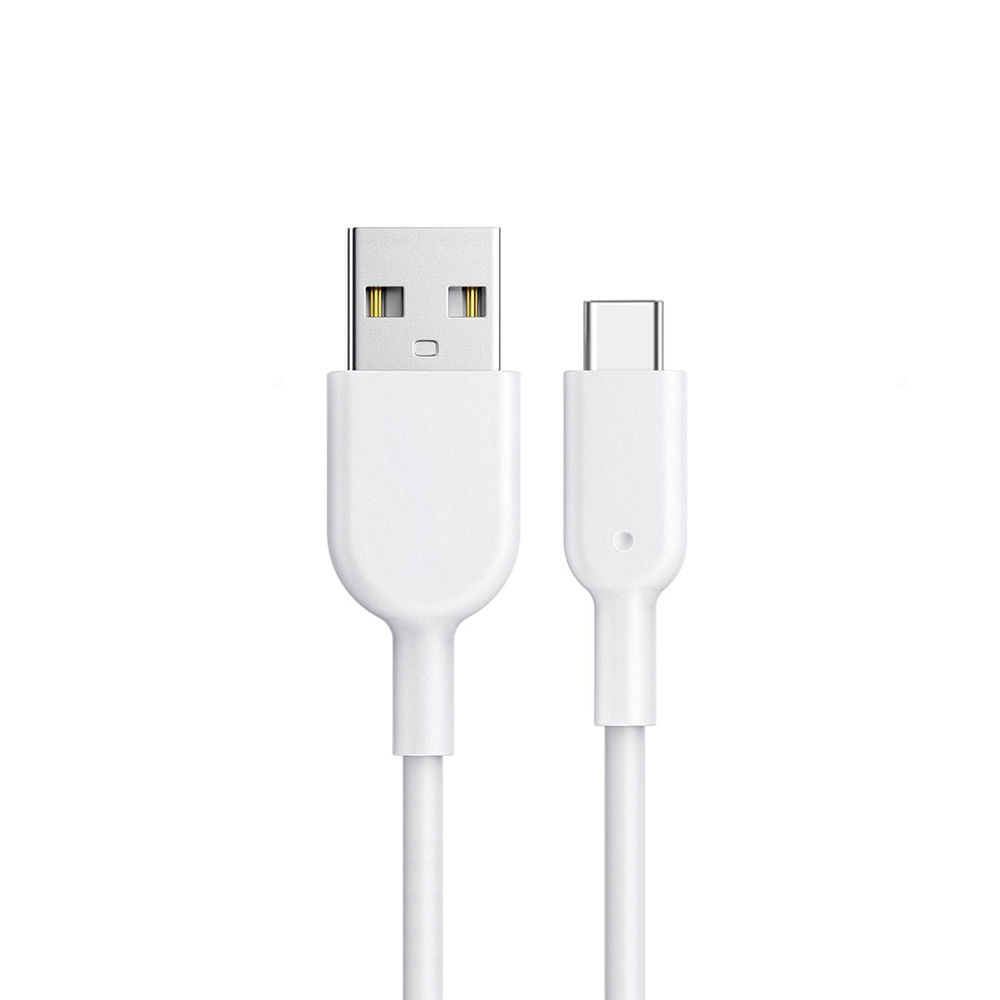
| CB-PVC | PVC sheath, pure copper conductor | USB-A, Lightning, Type-C, Micro USB | 1A to 2.4A | 480 Mbps | -10°C to 60°C |
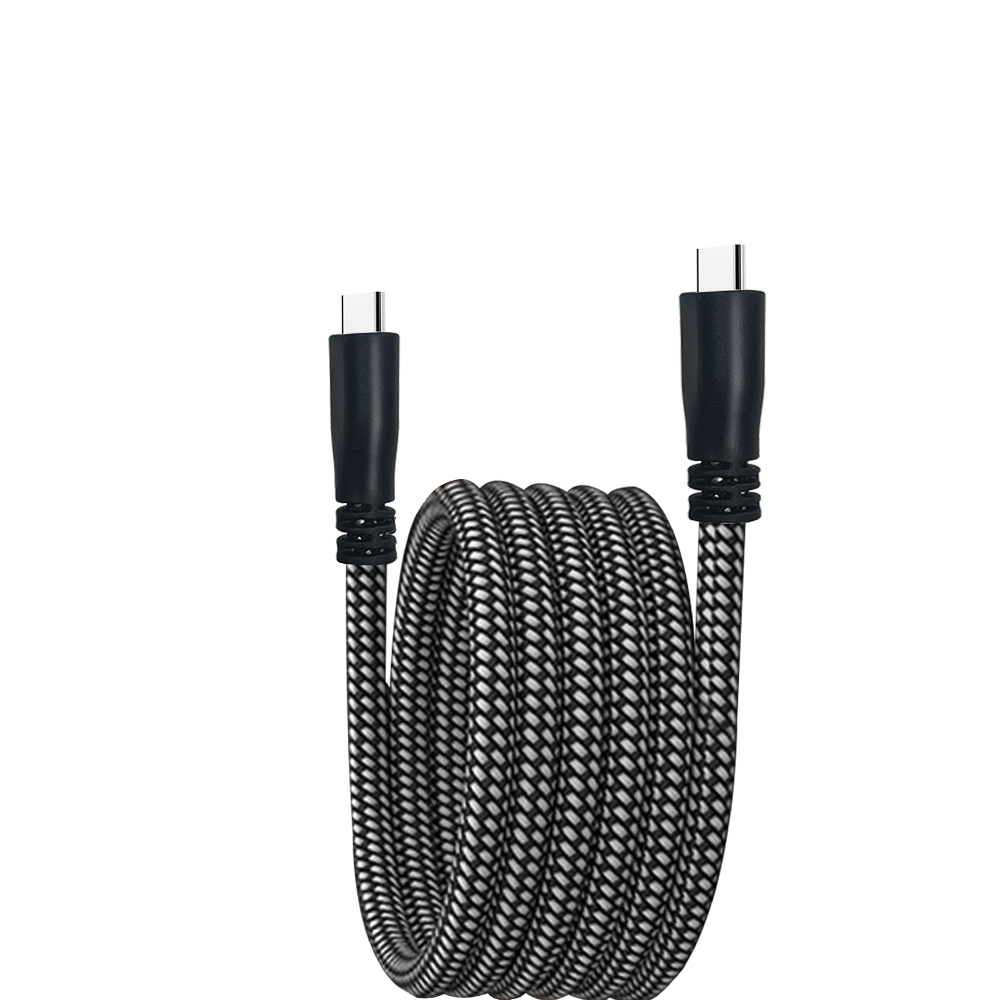
| CB-Nylon | Nylon braided shell over PVC inner layer, tinned pure copper core | USB-A / USB-C to Type-C / Lightning / Micro USB | Up to 6A; 120W / 240W | 480 Mbps | -10°C to 70°C |
| CB-TPE | Eco-friendly TPE, tinned copper wire core | Multi-type USB port | Up to 6A; 120W / 240W | Charging and data sync | Not published |
| CB-SILICONE | Food-grade silicone sheath, high-purity tinned copper core | USB-A / USB-C to Type-C / Lightning / Micro USB | Up to 6A; up to 240W | 480 Mbps | -20°C to 70°C |
| CB-Waterproof | Silicone, TPE, or nylon braided (optional), high-purity tinned copper core | USB-A / USB-C to Type-C / Lightning / Micro USB | Up to 6A; 120W / 240W | 480 Mbps | -20°C to 70°C |
Available lengths are 0.3m, 1m, 1.5m, and 2m for the CB-Nylon, CB-TPE, CB-SILICONE, and CB-Waterproof builds; the CB-PVC build is offered in 0.5m, 1m, 1.5m, and 2m. Custom logo printing is supported across the range.
Interfaces, Conductors, and the Fields That Decide Fit
Interface combinations
Published interface options run from USB-A or USB-C on the source end to Type-C, Lightning, or Micro USB on the device end, and the CB-TPE build is listed with a multi-type USB port. The wider line description also covers related categories such as USB extension cables, right-angle USB-C cables, Lightning USB cables, 3-in-1 multifunctional charging cables, coiled USB cables, Type-C cables, USB-C cables, and custom-logo USB cables. Because each combination serves a different installed device base, the interface pairing is normally the first field to lock during specification, ahead of length or color.
Conductor construction
All published builds use a tinned copper conductor: high-purity tinned copper core on the CB-SILICONE and CB-Waterproof builds, tinned pure copper core on the CB-Nylon build, and tinned copper wire on the CB-TPE build. Tinning protects the copper from oxidation and helps keep contact resistance stable across repeated use, which matters most in humid, coastal, or sweat-exposed applications.
Outer materials
Four sheath approaches are published. PVC is the conventional lower-cost option. TPE is described as eco-friendly, soft, flexible, and wear-resistant. Nylon braid over a PVC inner layer adds mechanical abrasion resistance. Food-grade silicone is skin-friendly, odorless, anti-kink, anti-freezing, and flexible, while the CB-Waterproof build uses sealed integrated molding that can combine silicone, TPE, or nylon braid depending on the order.
Power, data, and thermal envelope
Charging support is either 1A to 2.4A (CB-PVC) or up to 6A with 120W and 240W power delivery (CB-Nylon, CB-TPE, CB-SILICONE, CB-Waterproof). Published data transfer speed is 480 Mbps. The working temperature range is -20°C to 70°C for the silicone and waterproof builds, -10°C to 70°C for the nylon build, and -10°C to 60°C for the PVC build. Those four numbers — current, wattage, data rate, temperature — are the ones that most often decide whether a quoted cable can actually be used in a given project.
What the Ratings Actually Mean
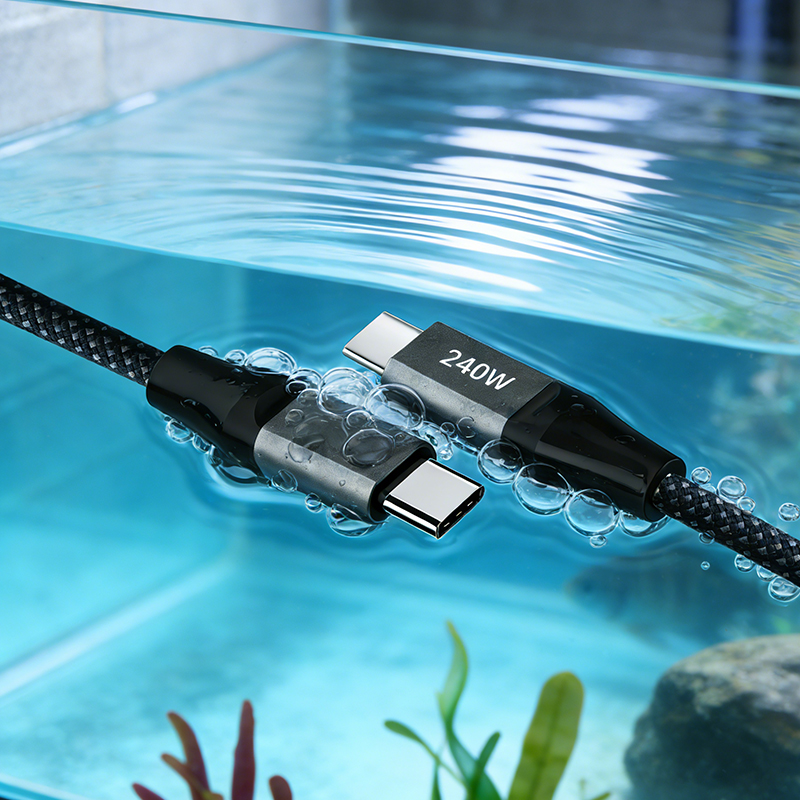
Ratings are only useful when their scope is understood. IPX7 on the CB-Waterproof build refers to protection against water immersion under defined conditions, and the product is described as sealed, waterproof, dustproof, sweat-proof, anti-corrosion, and wear-resistant. It is the only build in the published range carrying a stated waterproof rating, so that protection should not be assumed for the PVC, nylon, TPE, or standard silicone builds.
A 6A maximum current rating describes the current the cable is built to carry, not the current a device will necessarily draw. Supported power of 120W and 240W is likewise a capability figure: the delivered rate depends on the charger, the device, and the negotiation between them, so charging speed should be validated with the actual device rather than assumed from the cable specification alone.
The 480 Mbps figure is a sync-and-charge class data rate. It suits device management, photo transfer, and general synchronization, but it is not a high-bandwidth rate, and projects that depend on very large data throughput should treat this line as charging and synchronization cable rather than as high-speed data cable.
Temperature ratings define where a build can be relied on: -20°C to 70°C for CB-SILICONE and CB-Waterproof, -10°C to 70°C for CB-Nylon, and -10°C to 60°C for CB-PVC. The CB-TPE build does not carry a published temperature range, so buyers should confirm that point before specifying it for extreme conditions.
Where These Cables Are Used
Published application data describes the line as designed for fast-charging data cable and waterproof mobile phone charging cable projects, addressing slow charging and cable breakage, and delivering 120W / 240W charging, data transmission, and waterproof and wear-resistant performance. Typical supporting equipment includes smartphones, tablets, laptops, power banks, wireless chargers, and smart wearables.
Operating conditions cover daily indoor charging, outdoor travel, humid bathrooms, sweaty sports use, low-temperature outdoor environments, and rainy conditions. Operation is described as intermittent daily charging and portable on-demand use — a useful detail for durability planning, because the dominant stress is repeated bending and connector insertion rather than continuous high-load operation.
The scenario is listed as common in the United States, Germany, Japan, South Korea, the UAE, the United Kingdom, Indonesia, the Philippines, Sweden, France, Chile, Bangladesh, and Mexico. The product is applied in consumer electronics retail and mobile accessories wholesale, as well as in e-commerce and the digital gift sector, and has been adopted by digital accessory wholesalers and corporate gift purchasers in Indonesia, the USA, Germany, and the UK.
Market Signals Buyers Should Track
Category growth. The global USB cable market is estimated at USD 21.2 billion in 2024 and projected to reach approximately USD 88.6 billion by 2033 (DataHorizzon Research), and KBV Research projects a CAGR of 17.3% through 2031. Market size estimates vary with scope — KBV Research bases its projection on a USD 19.2 billion 2023 figure, while Dataintelo cites USD 28.6 billion for 2025 — so these should be treated as directional planning inputs rather than a single agreed number.
Interface concentration. The USB Type-C segment held a dominant 41.2% share of USB cable sales in 2025 (Dataintelo). Combined with the EU common charger requirement, that concentration supports consolidating sourcing around Type-C capacity instead of spreading orders across legacy interfaces.
Regional supply base. Asia Pacific led global USB cable revenue in 2025 at USD 12.3 billion, roughly 43% of the total (Dataintelo). For buyers, that concentration explains both the availability of manufacturing capacity and the importance of supplier-level verification, since capability varies widely within the region.
Braided, Silicone, and Waterproof Builds Compared with Standard PVC Cables
A conventional PVC cable at 1A to 2.4A still works for low-power accessories and high-volume retail. The differences appear as soon as a requirement moves to higher current, colder environments, or wet conditions.
| Requirement | CB-PVC (standard build) | CB-Nylon / CB-TPE | CB-SILICONE / CB-Waterproof |
|---|---|---|---|
| Charging current | 1A to 2.4A | Up to 6A | Up to 6A |
| Power support | Not published above 2.4A | 120W / 240W | 120W / 240W |
| Minimum operating temperature | -10°C | -10°C | -20°C |
| Abrasion resistance | PVC sheath | Nylon braid / flexible TPE | Sealed molded silicone |
| Water resistance | Not rated | Not rated | IPX7 (CB-Waterproof) |
| Typical fit | Everyday charging, gift and volume retail | Retail and e-commerce requiring durability | Outdoor, sports, marine, cold-weather projects |
Three boundaries are worth stating explicitly. First, the published line is specified at 480 Mbps data transfer, so it should not be positioned as a high-bandwidth data cable. Second, IPX7 protection exists only on the CB-Waterproof build; specifying waterproof performance for the PVC, nylon, or TPE builds would exceed the published data. Third, the CB-PVC build 2.4A ceiling and -10°C to 60°C range exclude it from 6A fast-charging programmes and from low-temperature outdoor projects, where a silicone or waterproof build is the relevant option.
Cost follows the same logic. The additional material and molding steps behind a braided, silicone, or sealed build are the reason those products occupy a different price band from a standard PVC cable, and that difference should be evaluated against the failure mode the buyer is trying to avoid — a connector that fails in the field normally costs more than the cable did.
Future Outlook
Two directions look stable through the next planning cycle. Interface harmonisation continues: with Type-C already the dominant segment and EU rules in force since December 2024, sourcing strategies built around Type-C capacity are more likely to remain compliant than mixed legacy portfolios. Performance segmentation is deepening at the same time, because as devices negotiate higher wattage the cable becomes a visible part of the charging experience rather than an invisible accessory.
Market projections support continued volume growth, but they also diverge by scope, which is a reminder that supplier selection will matter more than category growth. A growing market does not reduce the risk of a supplier that cannot hold a specification across repeat orders. For a manufacturer such as Focuses, whose reported output is 25,000,000 units a year with roughly 90% exported, the practical differentiator is the ability to document and repeat a build — conductor, sheath, current rating, and sealing — order after order.
Frequently Asked Technical and Procurement Questions
What is the difference between a charging cable and a USB data cable?
A charging cable delivers power only; a USB data cable carries both power and data. The distinction is a specification issue rather than a physical one, because a power-only build and a sync-and-charge build can look identical. In the published Focuses range, the CB-PVC, CB-Nylon, CB-SILICONE, and CB-Waterproof builds are listed with a 480 Mbps data transfer rate, and the CB-TPE build is listed as supporting both charging and data sync.
Which USB interfaces are available across the cable line?
Published interface options are USB-A or USB-C on the source end combined with Type-C, Lightning, or Micro USB on the device end, and the CB-TPE build is listed with a multi-type USB port. The wider line description also covers USB extension cables, right-angle USB-C cables, Lightning USB cables, 3-in-1 multifunctional charging cables, coiled USB cables, Type-C cables, USB-C cables, and custom-logo USB cables.
How much charging power and current do these cables support?
The CB-Nylon, CB-TPE, CB-SILICONE, and CB-Waterproof builds are listed as supporting 120W and 240W charging with a maximum current of 6A. The CB-PVC build is listed at a charging current of 1A to 2.4A. Delivered charging speed also depends on the power source, the device, and the negotiation between them.
What data transfer speed is supported, and is it enough for large file transfers?
The published data transfer speed is 480 Mbps for the CB-PVC, CB-Nylon, CB-SILICONE, and CB-Waterproof builds. That rate supports everyday synchronization, photo transfer, and device management, but it is not a high-bandwidth data rate. Projects requiring very large data throughput should specify these cables as charging and synchronization products rather than as high-speed data cables.
Which outer material should a buyer specify: PVC, TPE, silicone, or nylon braided?
The materials map to different requirements. PVC is the conventional option with a 1A to 2.4A rating and a -10°C to 60°C range. Nylon braid over a PVC inner layer supports up to 6A and -10°C to 70°C with added abrasion resistance. TPE is described as eco-friendly, soft, flexible, and wear-resistant, with up to 6A support. Food-grade silicone is skin-friendly, odorless, anti-kink, anti-freezing, and flexible, with a -20°C to 70°C range. Material should therefore be matched to the environment and handling profile rather than to price alone.
What does the IPX7 rating on the CB-Waterproof cable cover?
CB-Waterproof is a USB extension cable with an IPX7 waterproof rating, built with sealed integrated molding described as waterproof, dustproof, sweat-proof, anti-corrosion, and wear-resistant. It is the only build in the published range carrying a stated waterproof rating; the PVC, nylon, TPE, and standard silicone builds do not. Water resistance should be validated against the actual exposure condition — immersion, spray, or sweat — before it is written into a specification.
What operating temperature range can these cables handle?
CB-SILICONE and CB-Waterproof are rated from -20°C to 70°C, CB-Nylon from -10°C to 70°C, and CB-PVC from -10°C to 60°C. No temperature range is published for the CB-TPE build. Cold-weather or outdoor programmes should be specified against these figures, since the described application conditions include low-temperature outdoor use.
Is custom logo printing supported, and what else can be customized?
Custom logo printing is listed as supported across the published range, including the CB-PVC, CB-Nylon, CB-TPE, CB-SILICONE, and CB-Waterproof builds. The line description also includes variants such as right-angle USB-C and coiled USB cables. The extent of customization for a specific order — connector style, length, interface pairing, or packaging — should be confirmed with the supplier before it is treated as a committed specification.
What compliance and marketplace requirements apply to USB cable sourcing?
In the European Union, handheld mobile phones, tablets, and cameras sold after December 28, 2024 must use a USB Type-C charging port and comply with EN IEC 62680-1-3:2022, and fast-charging devices supporting USB Power Delivery must comply with EN IEC 62680-1-2:2022. In the United States, Amazon requires USB Type-C cables to meet the UL 9990 safety standard for ICT power cables to avoid listing removal. Buyers should verify certificate scope — model coverage, rating, and market — rather than accepting a certificate number at face value.
The full published specification set for the USB cable range, including model-level detail, is available in the 2026 Focuses catalogue. DongGuan Focuses Electronics Technology Co., Ltd. is based in Tangxia Town, Dongguan, Guangdong, China, and can be reached at info@focusestech.com or via www.focusestech.com.