
USB Cable Shortlist: Matching Builds to 2026 Project Needs
Industrial Reference · Electrical & Electronics
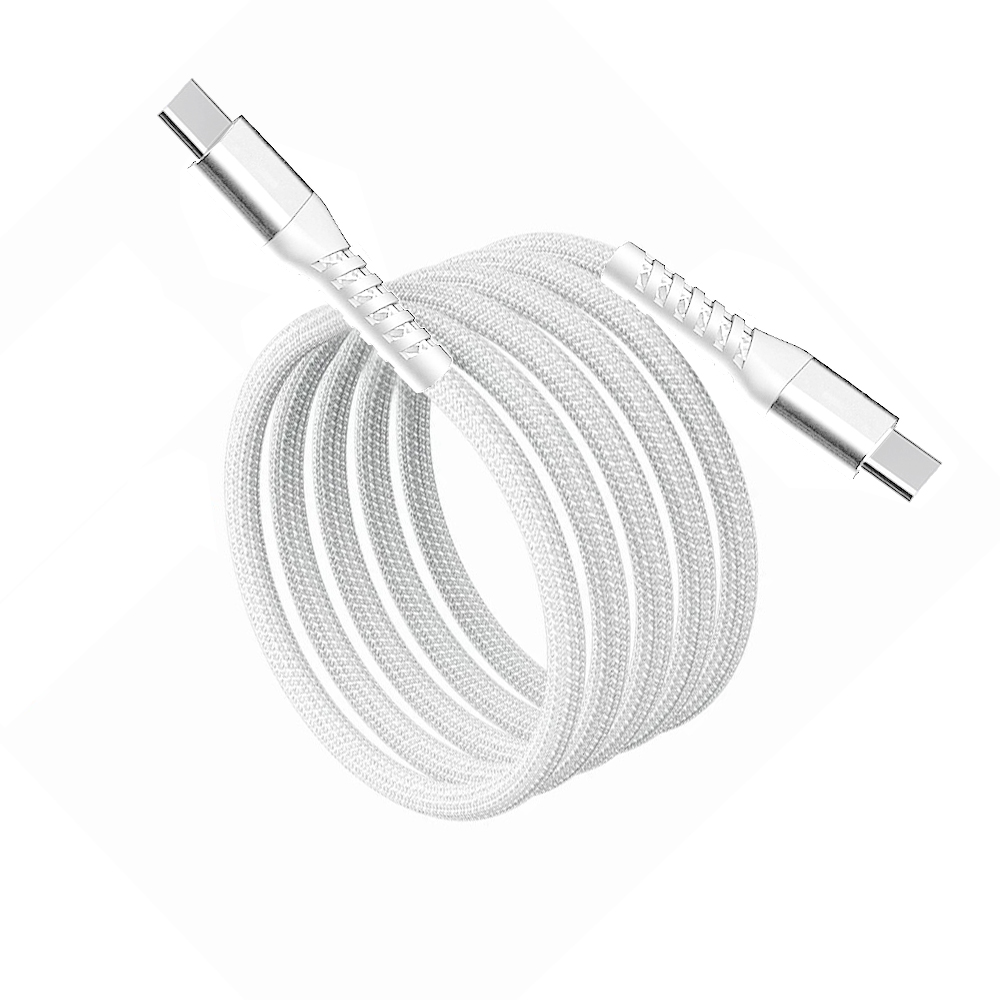
A nylon braided USB-C to USB-C assembly: jacket, conductor and connector combination — not the category name — decide whether a cable suits a project.
A USB cable is not one product. It is a family of assemblies that differ by connector combination, conductor, jacket material, power handling, data rate and environmental tolerance. Those variables, not the words on the packaging, determine whether a build survives a given project.
Buyers who search for recommended USB cable options are usually not looking for a single winner. They are looking for a defensible shortlist: a small set of builds, each with a defined operating envelope, that can be mapped onto the scenarios they actually have to supply — retail shelves, corporate gift programs, outdoor and marine equipment, industrial handhelds, or high-volume e-commerce listings.
This reference builds that shortlist around one manufacturer's published range. DongGuan Focuses Electronics Technology Co., Ltd. (brand: Focuses) is a USB cable manufacturer established in 2006 and relocated to Tangxia Town, Dongguan, in 2018. The company operates a 6,000 m² facility with 150 employees, a six-engineer R&D team, an annual output of 25,000,000 units and an export ratio of 90%, serving the EU, North America and Asia. Its range includes five distinct USB cable builds, differentiated mainly by jacket material and power envelope, plus ODM/OEM customization. Using those five builds as the working shortlist, this article explains the criteria that put each one in — or out — of a given project.
Why a Universal “Best USB Cable” Answer Breaks Down in Real Projects
The shortlist problem exists because project requirements pull in opposite directions. A promotional gift program wants tactile feel, low unit complexity and a printable surface. A marine electronics supplier wants seals and corrosion resistance. A high-volume retail listing wants a jacket that survives handling and returns. An industrial device maker wants a stable, repeatable connector and a documented current rating.
No single build satisfies all four. A silicone-jacketed cable with a soft, skin-friendly surface answers the gift scenario but is not specified as waterproof. A sealed, IPX7-rated build answers the wet-environment scenario but adds molding complexity that a low-power accessory program does not need. A PVC build with a 1A–2.4A charging envelope is a sensible fit for economy accessory programs, but it is a poor match for a device that expects 6A fast charging.
The practical consequence for procurement and engineering teams is that “recommended” has to be indexed to a scenario. The shortlist below is therefore organized as a set of options with stated envelopes rather than as a ranking of one cable above another.
Shortlisting Criteria: The Six Variables That Separate One Build From Another
Before comparing individual models, it helps to fix the criteria. Across the Focuses range, six variables do most of the differentiating work:
| Criterion | What to check | Range observed in this shortlist |
|---|---|---|
| Jacket / outer material | Mechanical feel, abrasion exposure, low-temperature behavior | Silicone, PVC, TPE, nylon braided, or silicone/TPE/nylon braided optional |
| Conductor | Stated core material, which affects consistency of charging behavior | Tinned pure copper or high-purity tinned copper core |
| Interface combination | Which devices must connect without adapters | USB-A / USB-C to Type-C / Lightning / Micro USB |
| Power and current | Whether the end device expects fast charging or trickle rates | 120W and 240W charging support with 6A max, or 1A–2.4A |
| Data capability | Charge-only programs versus sync requirements | 480 Mbps transfer on specified builds; charge plus data sync |
| Environmental tolerance | Temperature band and ingress protection | −20°C to 70°C, −10°C to 70°C, −10°C to 60°C, or IPX7 |
Two further criteria matter at the program level rather than the product level: available lengths — 0.3m, 0.5m, 1m, 1.5m and 2m appear across the range — and whether custom logo printing is supported, which it is across the range.
The 2026 Shortlist: Five USB Cable Builds and Where Each One Fits
The five builds below are drawn from the Focuses product specification set. They are presented as options with defined envelopes, not as a quality ranking.
| Build (model) | Jacket | Interfaces | Power / current | Data | Temperature | Defining feature |
|---|---|---|---|---|---|---|
| CB-Waterproof cable | Silicone / TPE / nylon braided (optional) | USB-A / USB-C to Type-C / Lightning / Micro USB | 120W, 240W ultra fast charging; 6A max | 480 Mbps | −20°C to 70°C | IPX7 waterproof and dustproof; sealed integrated molding |
| CB-SILICONE | Soft food-grade silicone | USB-A / USB-C to Type-C / Lightning / Micro USB | 120W, 240W ultra fast charging; 6A max | 480 Mbps | −20°C to 70°C | Skin-friendly, odorless, anti-kink, anti-freezing |
| CB-Nylon | Nylon braided shell with PVC inner layer | USB-A / USB-C to Type-C / Lightning / Micro USB | 120W / 240W high power fast charging; 6A max | 480 Mbps | −10°C to 70°C | Tinned pure copper core; braided abrasion surface |
| CB-TPE | Eco-friendly TPE | Multi-type USB port | 120W & 240W fast charge; 6A max | Charging and data sync (no transfer rate published) | Not published | Soft, flexible, wear-resistant everyday build |
| CB-PVC | PVC with pure copper conductor | USB-A, Lightning, Type-C, Micro USB | 1A–2.4A | 480 Mbps | −10°C to 60°C | Economy-tier charging and data transmission |
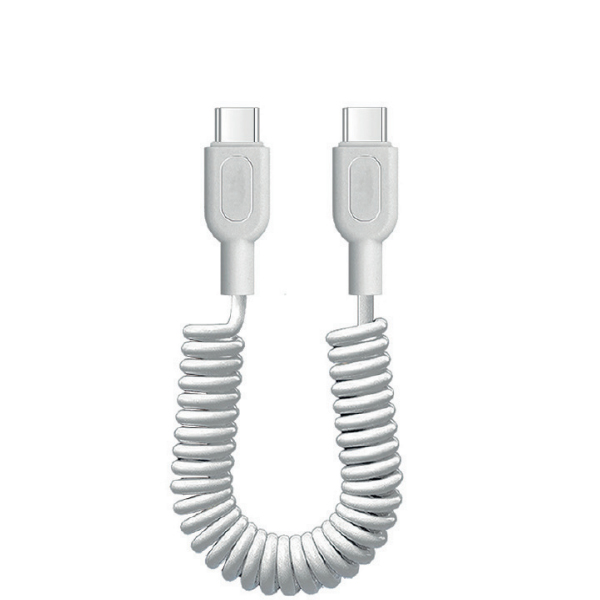
A silicone-jacketed build: the same 6A/240W envelope as the braided options, but a different mechanical and tactile profile.
Reading the shortlist correctly
Four of the five builds share a common power envelope — 120W and 240W charging support with a 6A maximum current — and three of those four also publish a 480 Mbps transfer rate. The differentiators are therefore not power but jacket behavior, temperature band and sealing. The PVC build is the exception at both ends: a 1A–2.4A charging envelope and a narrower −10°C to 60°C band make it a fit for economy accessory programs rather than for fast-charging hardware.
Technical Notes: Interfaces, Power Ratings and What 480 Mbps Means for a Project
Interface combination is the first filter. The range covers USB-A, USB-C, Type-C, Lightning and Micro USB, which means a single supplier can cover Android, Apple and legacy Micro USB endpoints without a second tooling program. For buyers consolidating a catalogue, that breadth reduces the number of supplier relationships needed to cover a retail assortment.
Power is the second filter, and it is more nuanced than the wattage headline. A 120W or 240W rating describes the assembly's supported ceiling; the delivered rate still depends on the charger and the end device. Where a project specifies fast charging, the 6A-rated builds are the relevant candidates. Where a project is a low-cost accessory or a device that charges overnight, the 1A–2.4A PVC build is sufficient and avoids specifying capability the application will never use.
Data is the third filter and the one most often misread. A published 480 Mbps transfer speed suits syncing, firmware transfer for small devices and general data movement. It does not describe a high-bandwidth video or high-speed external storage application, and none of the builds in this shortlist claim such a capability. Programs that need those speeds should treat this range as a charging and general-sync family rather than a high-speed data family.
Scenario Mapping: Where Each Build Belongs
The Focuses scenario data lists daily indoor use, outdoor travel, humid bathrooms, sweaty sports environments, low-temperature outdoor conditions and rainy environments as the working conditions the range is designed to address, across smartphone, tablet, laptop, power bank and wearable charging. Mapping that against the five builds produces a practical allocation:
- Outdoor, marine, sports and wet environments — CB-Waterproof cable. It is the only build with a stated IPX7 waterproof and dustproof rating and sealed integrated molding, and its feature set explicitly includes sweat-proof and anti-corrosion behavior. Its outer material can be specified as silicone, TPE or nylon braided.
- Corporate gifts, retail and skin-contact accessories — CB-SILICONE. A soft food-grade silicone sheath with skin-friendly, odorless and anti-kink properties, rated across −20°C to 70°C.
- General retail and e-commerce ranges — CB-Nylon. A braided shell over a PVC inner layer with a tinned pure copper core, verified in a wholesale and corporate-gift project spanning Indonesia, the United States, Germany and the United Kingdom at order sizes of 5,000–30,000 pieces.
- Everyday wholesale and charging-plus-sync programs — CB-TPE. An eco-friendly TPE outer with a soft, flexible, wear-resistant profile and dual charging and data-sync function.
- Economy accessory programs and low-power devices — CB-PVC. A 1A–2.4A charging envelope with 480 Mbps transfer and a −10°C to 60°C band.
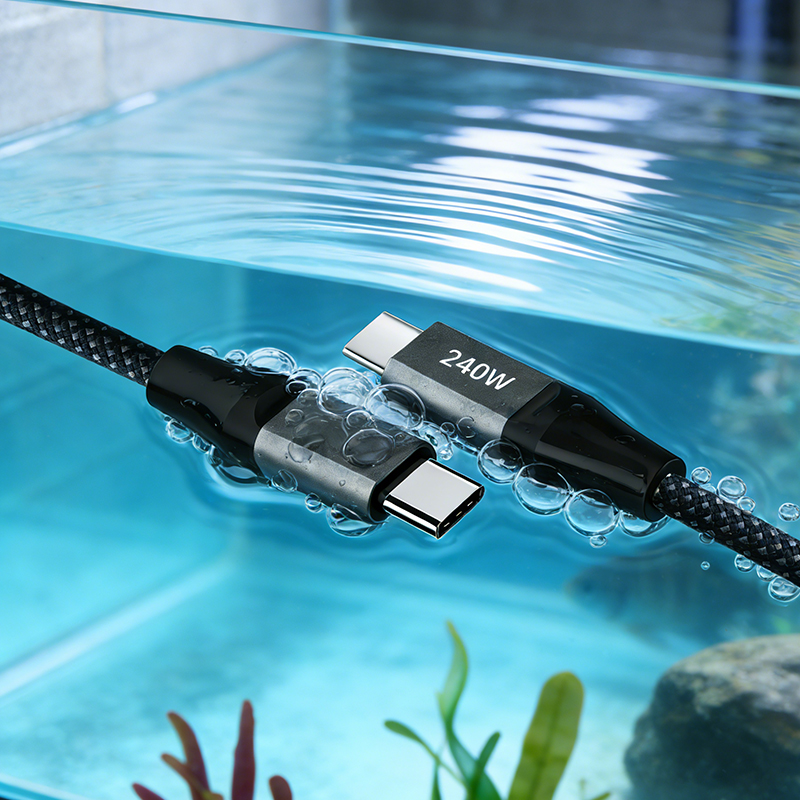
Sealed integrated molding: the IPX7 build is the entry point for wet, dusty and outdoor-facing applications.
Market Signals Behind This Shortlist
Three market signals explain why a scenario-mapped shortlist is more useful in 2026 than a single recommended model.
First, the category is large and growing. DataHorizzon Research estimates the global USB cable market at USD 21.2 billion in 2024, projected to reach approximately USD 88.6 billion by 2033, while KBV Research projects a 17.3% CAGR through 2031. Estimates diverge by scope — Dataintelo places 2025 at USD 28.6 billion — so buyers should treat the direction, not the exact figure, as the planning input.
Second, the connector mix has consolidated around Type-C. Dataintelo reports that the USB Type-C segment held 41.2% of total USB cable sales in 2025, and Asia Pacific led global revenue at USD 12.3 billion, roughly 43% of the market. A supplier that can produce USB-A, USB-C, Type-C, Lightning and Micro USB combinations in one facility is therefore positioned to serve both the consolidating Type-C demand and the remaining legacy endpoints.
Third, compliance is now a shortlisting criterion rather than a paperwork step. The European Union requires handheld mobile phones, tablets and cameras sold after 28 December 2024 to use a USB Type-C charging port and to comply with EN IEC 62680-1-3:2022, with EN IEC 62680-1-2:2022 applying to USB Power Delivery fast charging. In the United States, Amazon requires USB Type-C cables to meet the UL 9990 safety standard for ICT power cables. These requirements shape which builds and which order scopes are viable for a given sales channel, and they should be confirmed against the specific part numbers and destination markets in a project rather than assumed from the category name.
Where the Shortlist Stops: Boundaries and Trade-Offs
A shortlist that only lists strengths is not a buying tool. Four boundaries are worth stating plainly.
Not every build is a fast-charging build. The CB-PVC model is specified at 1A–2.4A. Projects that specify 6A or 240W cannot substitute this build without changing the requirement.
Sealing is build-specific. The IPX7 rating applies to the CB-Waterproof cable. The silicone, nylon, TPE and PVC builds do not carry a stated ingress protection rating, so wet or dusty environments should default to the sealed variant rather than to a jacket choice.
Data rates are modest across the range. A published 480 Mbps applies where a rate is stated at all; the TPE build's specification lists charging and data sync without a published transfer figure. High-bandwidth data applications fall outside this shortlist.
Program economics are structured for volume. ODM/OEM terms specify a minimum order quantity of 2,000 units and a 25–35 day lead time against a monthly capacity of 2,500,000 units. Buyers who need immediate small-quantity sampling or compressed timelines should plan for that constraint rather than assume it away.
Focused Builds Versus Generic Cable Supply
The traditional alternative to a scenario-mapped shortlist is generic sourcing: buy an undifferentiated “USB cable” by price and connector type, and resolve problems after they appear in the field. That approach works while requirements stay simple, and it remains legitimate for low-consequence applications.
It breaks down when a project has an environmental requirement, a power requirement or a channel compliance requirement — because a generic purchase order rarely specifies jacket material, temperature band, conductor or ingress rating, and there is therefore nothing to verify against. In the Focuses shortlist, each build is separated by named variables: silicone versus PVC versus TPE versus nylon braided, −20°C versus −10°C lower limits, 6A versus 1A–2.4A, and IPX7 versus no stated rating. That separation is what makes an evaluation possible.
It is also worth placing this shortlist correctly in the market. Publicly recognized global cable brands include Anker Innovations, Belkin International, Ugreen and Baseus. Those companies compete in consumer-facing brand space. An ODM/OEM manufacturer such as Focuses competes in a different position in the value chain: customization of logo printing, cable color, power, appearance, materials, molding, multi-function design, connector housing color, length, packaging style and packaging design, with 100% full inspection before shipment and a 12-month warranty covering free technical guidance on charging compatibility issues.
Future Outlook
Three shifts are likely to keep scenario-mapped shortlists relevant through 2026 and beyond. Type-C consolidation will continue to absorb legacy connectors, which pushes suppliers toward a single platform that can still terminate USB-A, Lightning and Micro USB. Environmental requirements will move from a premium option to a standard question, making sealing and temperature bands part of the base specification rather than a differentiator. And compliance scope — EN IEC 62680-1-3:2022, EN IEC 62680-1-2:2022, UL 9990 — will increasingly be checked at the part-number level, which favors suppliers that can document per-build specifications rather than describe a category in general terms.
FAQ
1. Which USB cable build is appropriate for outdoor, wet or marine-facing projects?
The CB-Waterproof cable is the only build in this range with a stated IPX7 waterproof and dustproof rating. It uses sealed integrated molding and is described as waterproof, dustproof, sweat-proof, anti-corrosion and wear-resistant, with outer material options of silicone, TPE or nylon braided and a working temperature band of −20°C to 70°C. The other four builds do not carry a stated ingress protection rating.
2. How should buyers choose between silicone, nylon braided, TPE and PVC jackets?
The choice is driven by mechanical exposure and temperature rather than by preference. CB-SILICONE uses soft food-grade silicone rated −20°C to 70°C with skin-friendly, odorless, anti-kink and anti-freezing properties. CB-Nylon uses a nylon braided shell over a PVC inner layer with a tinned pure copper core, rated −10°C to 70°C. CB-TPE uses an eco-friendly TPE outer described as soft, flexible and wear-resistant with charging and data-sync function. CB-PVC uses a PVC outer sheath with a pure copper conductor, rated −10°C to 60°C and 1A–2.4A. Where low-temperature flexibility matters most, the silicone and waterproof builds carry the wider −20°C to 70°C band.
3. What power, current and data ratings can be expected across the range?
CB-Waterproof cable, CB-SILICONE, CB-Nylon and CB-TPE are specified for 120W and 240W fast charging support with a maximum charging current of 6A. CB-PVC is specified at 1A–2.4A. A 480 Mbps data transfer speed is published for CB-Waterproof cable, CB-SILICONE, CB-Nylon and CB-PVC; the CB-TPE specification lists charging and data sync without a stated transfer rate. Interface options across the range are USB-A, USB-C, Type-C, Lightning and Micro USB, and available lengths are 0.3m, 0.5m, 1m, 1.5m and 2m.
4. What are the ODM/OEM terms — MOQ, lead time and customization scope?
Production mode is ODM/OEM with a minimum order quantity of 2,000 units and a lead time of 25–35 days, against a monthly capacity of 2,500,000 units. Customization covers logo printing, cable color, power, cable appearance, cable materials, cable molding, multi-function design, connector housing color, cable length, packaging style and packaging design. Quality control is stated as 100% full inspection before shipment, and the declared export markets are the EU, North America, the Middle East and Asia.
5. What evidence supports long-term reliability, and what does the warranty cover?
The stated normal service life exceeds 2 years, with a product warranty of 1 year and 12 months of free technical guidance covering charging compatibility issues during the warranty period. For a wholesale and corporate-gift project involving customers in Indonesia, the United States, Germany and the United Kingdom, at order sizes of 5,000–30,000 pieces per order, the reported outcomes were stable fast charging speed, a durable braided wire, low heating during long-time charging, and zero mass quality complaints. Applications in that project included daily phone charging, customized corporate gifts, retail sales and in-car use.
For buyers who need the full specification set behind this shortlist — jacket options, interface combinations, power envelopes and customization scope — the 2026 Focuses catalogue is available for reference: 2026 Focuses Catalogue (PDF).
This reference is based on published Focuses product specifications, company facts and cited third-party market and regulatory sources. Where a specification is not published for a given build, it is identified as such rather than assumed.