
USB Cable Supplier Capability: Focuses' 25M-Unit Factory
Most USB cable sourcing conversations start with price per unit, jacket material and connector type. Those are the visible attributes. What actually determines whether the third shipment matches the first, and whether a peak-season order lands on time, is less visible: the size of the factory floor, the number of people on the line, the engineering staff behind tooling and fixtures, and the inspection regime every cable passes through before it is packed.
Dongguan Focuses Electronics Technology Co., Ltd. — referred to here as Focuses — is a manufacturer of USB cables, data cables and audio accessories based in Tangxia Town, Dongguan, Guangdong, China. Its production site covers 6,000 m², employs approximately 150 people including 6 R&D engineers, reports annual output of 25,000,000 units, and exports roughly 90% of its sales to the EU, North America and Asia. This article treats those figures as procurement evidence rather than marketing copy: what each number constrains, what it demonstrates, and where it stops demonstrating anything at all.

Production floor at the Focuses Electronics facility in Tangxia Town, Dongguan, Guangdong.
Why factory evidence now decides USB cable orders
Two structural pressures have moved manufacturing capability from a nice-to-have to a shortlisting criterion.
The first is cost. Copper-based components account for roughly 60%–80% of the bill of materials for a standard USB cable, according to SMM (Shanghai Metals Market) analysis published in January 2026. The same source reports international copper prices reaching USD 13,000–13,300 per metric ton in early 2026. When the dominant input is that volatile, the difference between a factory with stable process control and one absorbing rework and scrap is a difference in the cost curve itself — not merely in the quotation.
The second is compliance overhead. USB-IF full membership runs at USD 5,000 per year as of 2025, and testing a single basic USB-C data cable model costs between USD 2,200 and USD 3,300, per Blue Asia Technical Services. A supplier carrying a broad SKU range must amortise that testing across real volume. Compliance is easier to sustain in a factory with throughput than in a sourcing office with a catalogue.
Market context reinforces the point. The Insight Partners valued the global USB cable market at USD 24.24 billion in 2025, while Future Market Insights put USB Type-C demand at USD 38.54 billion in 2026, with 58.0% of that demand coming from receptacles rather than cables alone. Buyers are not short of suppliers in this category. They are short of verifiable ones.
The Focuses facility, read as a data set
Stripped of adjectives, the company record contains a compact set of operational facts. Each one answers a different buyer question.
| Operational fact | What it answers |
|---|---|
| 6,000 m² manufacturing facility in Tangxia Town, Dongguan | Physical scale and site ownership |
| Approximately 150 employees | Labour depth on the line |
| 6 R&D engineers | In-house engineering for tooling and custom builds |
| 25,000,000 units annual output | Throughput ceiling and scheduling headroom |
| 90% export ratio; EU, North America and Asia markets | Familiarity with export documentation and buyer expectations |
| Proximity to Shenzhen Port | Freight timing and consolidation flexibility |
The company relocated to the current 6,000 m² site in Tangxia Town in 2018, and its own profile traces the underlying business back nearly two decades. For a buyer, the relevant reading is not the anniversary but the fact that the site is owned and operated as a dedicated cable facility rather than shared with unrelated product lines.
What 25 million units a year actually tells a buyer
An annual output figure is an aggregate, and aggregates hide the thing buyers care about: monthly responsiveness. Still, the number can be translated into an order-of-magnitude reference. Spread evenly across 250 working days, 25 million units would average roughly 100,000 units per day. No real schedule is that flat, but the arithmetic sets a scale — a 50,000-unit order is a fraction of a week of output at that rate, not a factory-wide event.
Three practical consequences follow.
Model mix, not raw volume, is the real constraint. A line running a single PVC build behaves very differently from one switching between PVC, nylon-braided, TPE, silicone and IPX7 waterproof constructions. Changeover time is what consumes capacity, so a buyer introducing a new jacket or a custom logo should ask how the changeover is scheduled rather than how many units the factory can make in a year.
Peak concentration matters more than average. Mobile accessory demand clusters around retail and gifting cycles. A supplier producing 25 million units annually has headroom in a quiet quarter and considerably less in a peak one; the useful question is how much of that capacity is already committed to existing programmes.
Engineering staff scales customisation, not just capacity. Six R&D engineers supporting 150 production staff is a ratio that fits an ODM/OEM model where custom logo printing, connector combinations and jacket changes are routine. It is not a ratio built for ground-up product development, and buyers with that requirement should plan accordingly.
The inspection gate: 100% before shipment
Focuses states that every cable is fully inspected before shipment and that a rigorous control system is maintained so each cable meets the applicable international standards; the company also states a 12-month warranty on its USB cable products. In a category where a defect rate of a fraction of a percent still becomes a customer-service queue at scale, full inspection is a meaningful operating choice rather than a slogan.
For a buyer auditing that claim, the useful follow-up questions are specific. Which electrical and mechanical parameters are checked at the gate — continuity, current handling, data throughput, pull strength, visual finish? Are results recorded per batch and traceable to a shipment? Who signs off, and what happens to a failed lot? Full inspection is labour-intensive by definition, so a supplier committing to it has already accepted a cost that sampling-based competitors avoid.
A boundary worth stating plainly: 100% inspection catches workmanship defects. It does not establish standards compliance. Whether a given cable satisfies USB Type-C requirements, USB Power Delivery behaviour, or Apple MFi licensing for Lightning products is a separate question answered by type testing and certification records — and the company record does not enumerate which third-party certificates are held for each individual SKU. Buyers building an EU or Apple-compatible programme must request those documents directly rather than infer them from an inspection regime.
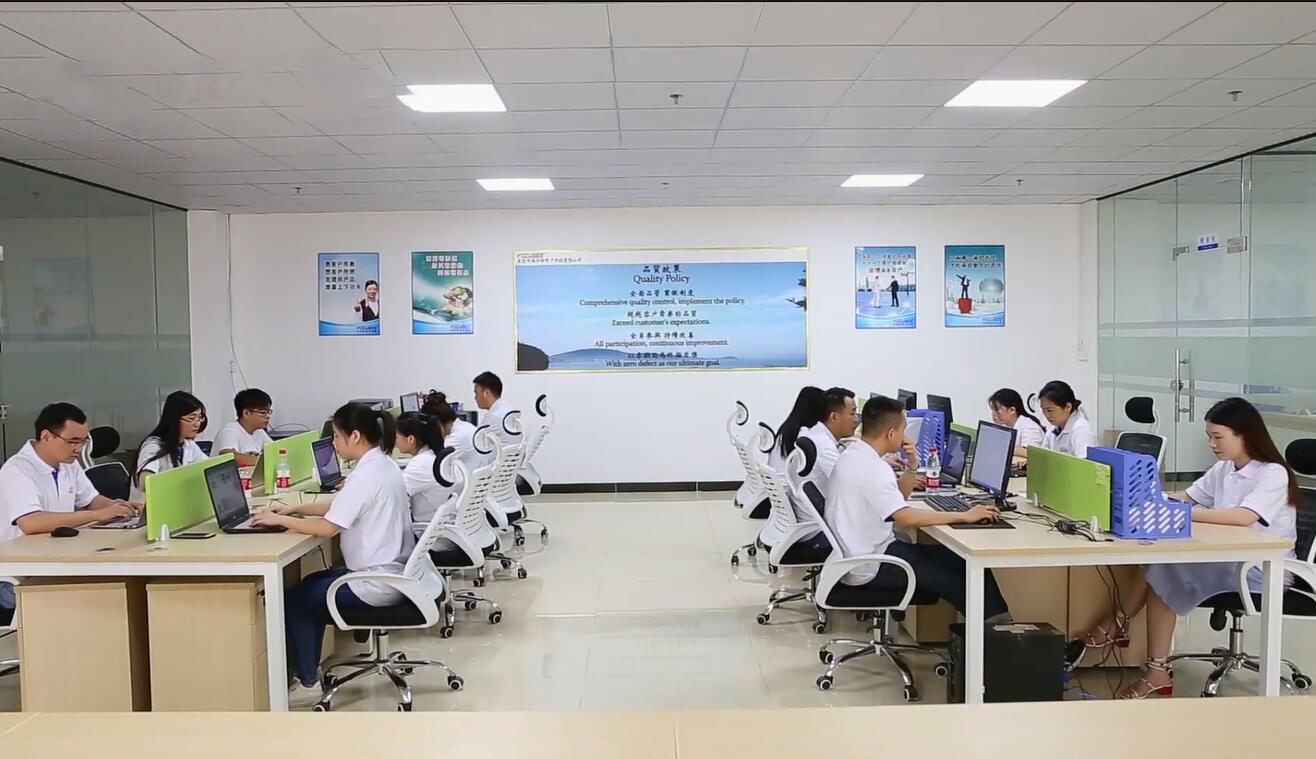
Engineering and commercial functions supporting ODM and OEM USB cable programmes.
Technical scope: five builds, one interface logic
The Focuses USB cable range is organised by jacket construction rather than by connector novelty. All five builds share a common interface logic — USB-A or USB-C on the host side, Type-C, Lightning or Micro USB on the device side — and diverge on current handling, temperature range and environmental protection.
| Model | Construction | Current / power | Temperature |
|---|---|---|---|
| CB-PVC | PVC jacket, pure copper conductor | 1–2.4 A, 480 Mbps | -10°C to 60°C |
| CB-Nylon | PVC inner layer, nylon braided shell, tinned copper | 6 A, 120 W / 240 W, 480 Mbps | -10°C to 70°C |
| CB-TPE | Eco-friendly TPE, tinned copper core | 6 A, 120 W / 240 W, charge + sync | Not stated in model record |
| CB-SILICONE | Soft food-grade silicone, tinned copper core | 6 A, up to 240 W, 480 Mbps | -20°C to 70°C |
| CB-Waterproof | Sealed integrated moulding, silicone / TPE / nylon options, IPX7 | 6 A, 120 W / 240 W, 480 Mbps | -20°C to 70°C |
Lengths across the range run from 0.3 m to 2 m depending on model, custom logo printing is offered, and the CB-Waterproof build carries an IPX7 rating achieved through sealed integrated moulding — described by the company as waterproof, dustproof, sweat-proof, anti-corrosion and wear-resistant.
These specifications sit inside a defined standards landscape. The USB Power Delivery Specification Revision 3.2 defines fast-charging behaviour enabling up to 240 W over USB Type-C, which is the ceiling the 6 A builds point toward. IEC 62680-1-3:2024 defines USB Type-C receptacles, plugs and cables, corresponding to the USB-IF Type-C Cable and Connector Specification. Apple MFi licensing governs third-party Lightning and certain USB-C cables for Apple devices. A supplier claiming high-wattage capability therefore has three distinct things to evidence: connector and cable construction, PD negotiation behaviour, and — where Apple devices are in scope — licensing status.
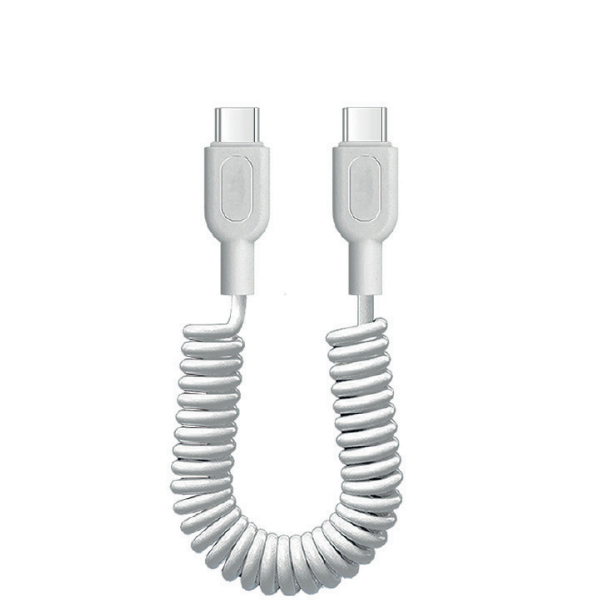
CB-SILICONE: food-grade silicone jacket, 6 A, up to 240 W, -20°C to 70°C.
Where this capability is actually used
The application record for the Focuses range is dominated by consumer electronics retail, mobile accessories wholesale, e-commerce and the digital gift sector. Supporting equipment includes smartphones, tablets, laptops, power banks, wireless chargers and smart wearables, with usage described as intermittent daily charging and portable on-demand use.
Operating conditions are broader than an office desk. The stated environments include daily indoor use, outdoor travel, humid bathrooms, sweaty sports settings, low-temperature outdoor use and rainy conditions. That list explains why the range includes silicone and IPX7 builds alongside PVC: the same buyer may need a low-cost cable for a retail multipack and a sealed cable for an outdoor accessory line.
Geographically, the scenario data lists the United States, Germany, Japan, South Korea, UAE, UK, Indonesia, Philippines, Sweden, France, Chile, Bangladesh and Mexico. The company reports that its cables have been adopted by digital accessory wholesalers and corporate gift purchasers in Indonesia, the United States, Germany and the UK, covering daily phone charging, corporate customised gifts, retail sale and car use. With 90% of sales exported, the factory's routine is export documentation and destination-specific packaging rather than domestic wholesale.
The regulatory drift reshaping USB cable demand
The EU Common Charger framework is the clearest demand-side change in this category. Under the European Commission's published requirements, the harmonised USB-C charging receptacle applies to specified portable radio equipment — including handheld mobile phones, tablets, digital cameras, headphones, headsets, handheld videogame consoles, portable speakers, e-readers, earbuds, keyboards, mice and portable navigation systems — from 28 December 2024, and to laptops from 28 April 2026.
Both dates have now passed. For a supplier shipping roughly 90% of output to the EU, North America and Asia, that means EU-bound accessory programmes increasingly assume a USB-C receptacle and one of the wired charging options referenced in the Commission's guidance — USB 2.0, USB 3.2, USB 4, USB Battery Charging 1.2, USB Type-C Current at 1.5 A or 3.0 A, or USB Power Delivery.
Two cautions follow. First, the regulatory list is a technology reference, not a performance result — it does not mean every cable supports every option listed. Second, the corresponding Type-C product market is large and still concentrating: Future Market Insights reports USD 38.54 billion in Type-C demand for 2026, with receptacles accounting for 58.0%. Cable demand follows receptacle adoption with a lag, which is why suppliers with Type-C-heavy portfolios are watching device-side design cycles closely.
Factory-direct specialist versus the usual alternatives
Buyers typically choose between three structural routes: a trading company or reseller, a large multi-category electronics manufacturer, and a factory-direct cable specialist such as Focuses. The comparison below is structural, not a ranking of named companies.
| Dimension | Cable specialist (Focuses model) | Reseller / trading route | Large multi-category manufacturer |
|---|---|---|---|
| Quality traceability | Inspection happens on the same site that ships | Depends on an upstream party the buyer may not see | Strong systems, but cable programmes may be a small share of attention |
| Engineering access | 6 R&D engineers directly reachable | Indirect, mediated by the reseller | Deep, but usually gated by programme size |
| Capacity ceiling | 25 million units a year | Limited by whichever factory is behind it | Substantially higher |
| Changeover flexibility | Moderate volumes, mixed-model friendly | Varies by partner | Optimised for scale, less for small mixed runs |
| Risk concentration | Single manufacturing site in Dongguan | Distributed but opaque | Multiple sites, more rigid onboarding |
The honest limits deserve equal billing. Focuses operates a single 6,000 m² site in Tangxia Town, so a fire, a sustained power restriction or a regional logistics disruption affects the whole order book rather than a fraction of it — buyers running large continuous programmes should treat a second source as prudent risk management, not as mistrust. At approximately 150 employees, the company sits in the mid-size tier; it is not a vertically integrated giant, and the company record does not state in-house production of connectors, copper conductors or E-marker chips. Programmes that require component-level vertical integration, or that depend on a supplier-held E-marker supply chain, need separate verification.
What to watch over the next sourcing cycle
Three developments are likely to shape how buyers read supplier capability claims in this category.
Copper exposure becomes contractual. With copper at 60%–80% of standard cable cost and prices reaching USD 13,000–13,300 per metric ton in early 2026, price indexation and conductor specification will move from finance detail to sourcing strategy. Suppliers able to document conductor grade and scrap control will be easier to negotiate with than those quoting a flat unit price.
Power ratings keep climbing. USB PD Revision 3.2 defines up to 240 W, and the Focuses range already states 240 W support on its 6 A builds. As fast-charging expectations rise, the gap between cables that carry a 240 W label and cables that survive repeated high-current cycles becomes a sample-testing question rather than a catalogue question.
Certification economics favour volume. With USB-IF membership at USD 5,000 a year and per-model testing at USD 2,200–3,300, the fixed cost of compliance is easier to absorb at 25 million units than at 250,000. That asymmetry quietly reshapes the supplier shortlist in favour of factories with genuine throughput.
Frequently asked questions
What is Dongguan Focuses Electronics Technology Co., Ltd. and what does it manufacture?
Dongguan Focuses Electronics Technology Co., Ltd. is a manufacturer based in Tangxia Town, Dongguan, Guangdong, China, specialising in the design, production and global distribution of high-performance data cables, USB solutions and audio accessories. Its main product is USB cable, offered across five builds: CB-PVC, CB-Nylon, CB-TPE, CB-SILICONE and CB-Waterproof. The site covers 6,000 m² and employs approximately 150 people, including 6 R&D engineers.
How much USB cable can Focuses produce in a year?
Focuses reports annual output of 25,000,000 units from its 6,000 m² facility in Tangxia Town, Dongguan. That figure is an annual total across the USB cable range rather than a single-model figure, and it does not by itself state monthly scheduling, line allocation or current utilisation. Approximately 90% of the company's sales are exported, with the EU, North America and Asia listed as main markets.
How does Focuses control quality before a shipment leaves the factory?
The company states that cables are fully inspected before shipment and that a rigorous control system is maintained so each cable meets the applicable international standards; it also states a 12-month warranty on its USB cable products. Model records add verifiable parameters used in checking — 480 Mbps data transfer, 6 A maximum current on the nylon, TPE, silicone and waterproof builds, IPX7 rating on CB-Waterproof, and temperature ranges from -20°C to 70°C on the silicone and waterproof models. Third-party certification status for individual SKUs is a separate matter and should be requested per product.
Which interfaces, ratings and customisation options are available?
Interfaces run from USB-A or USB-C on the host side to Type-C, Lightning or Micro USB on the device side. Data transfer is 480 Mbps across the range. Charging differs by build: CB-PVC supports 1–2.4 A, while CB-Nylon, CB-TPE, CB-SILICONE and CB-Waterproof support 6 A with 120 W and 240 W fast charging. Lengths are 0.3 m, 1 m, 1.5 m and 2 m depending on model, working temperature spans -20°C to 70°C on silicone and waterproof builds and -10°C to 60°C on PVC, and custom logo printing is supported as part of ODM/OEM service.
Which export markets and buyer types does Focuses serve?
Roughly 90% of sales are exported, with the EU, North America and Asia listed as the main markets. Scenario data names the United States, Germany, Japan, South Korea, UAE, UK, Indonesia, Philippines, Sweden, France, Chile, Bangladesh and Mexico as common application countries. The company reports adoption by digital accessory wholesalers and corporate gift purchasers in Indonesia, the United States, Germany and the UK, for daily phone charging, corporate customised gifts, retail sale and car use.
What are the practical limits of this supplier profile?
Three limits are visible in the record. Manufacturing is concentrated at one 6,000 m² site in Dongguan, so regional disruption affects the full order book and a second source is reasonable for large continuous programmes. At approximately 150 employees the company is mid-size rather than vertically integrated, and the record does not state in-house connector, copper conductor or E-marker production. And 100% inspection is a workmanship control, not proof of USB-IF, IEC or MFi compliance, which must be evidenced per SKU by test and certification documents.
The 2026 Focuses product catalogue, covering the full USB cable range and specifications, is available for download: 2026 Focuses Catalogue (PDF).
Tem questões ou precisa de mais detalhes?
Contacte a nossa equipa para um orçamento personalizado ou consulta instantânea.
Solicitar orçamento
Preencha o formulário abaixo e a nossa equipa entrará em contacto com uma proposta personalizada.
Chat direto do WhatsApp
Prefere conversar em tempo real? Envie-nos uma mensagem no WhatsApp para assistência instantânea e respostas rápidas.
- Obter orçamento personalizado
- Partilhar fotos ou documentos
- Discuta as suas necessidades diretamente
Geralmente responde em 5–30 minutos durante o horário de expediente.