
USB Connector Guide: Inside USB-C Charging Connectors
HTNXT Industry Reference · Electrical & Electronics · USB Connector
A waterproof USB Type-C charging connector. The same interface now serves both power and data roles, which is precisely why connector selection has become more demanding. Image: MUP USB Connector.
A charging connector is no longer a passive component decision. Once a device's charging port is fixed by regulation, by a product family's industrial design, or by a platform commitment, every downstream choice — contact plating, mounting style, sealing, mating-cycle budget, certification evidence — becomes a multi-year constraint. The USB Connector category, and the USB Type-C format within it, sits at the centre of that shift.
This reference examines what a USB-C charging connector is, why it has moved from a commodity line item to a qualification subject, how the technical variables actually behave, and where the boundaries of current supplier claims lie.
What a USB-C charging connector actually is
A USB-C charging connector is a USB Type-C receptacle or plug whose primary design purpose is power delivery rather than high-speed data transport. It belongs to the same interface family as a data-oriented USB-C port, and shares the same mating geometry, but differs in contact population, material selection, and the electrical and thermal budget it is qualified against.
The distinction matters at the contact level. The full-featured USB Type-C connector interface uses 24 contacts, while reduced variants populate a subset — commonly 16 pins — for cost-optimised charging designs. The interface itself is defined by the USB Type-C Cable and Connector Specification maintained by the USB Implementers Forum, and the electromechanical definition and performance requirements are also published internationally as IEC 62680-1-3:2024. A standard publication defines what a conforming part must do; it does not certify that any particular supplier's part does it, which is a procurement distinction that recurs throughout this article.
Why the charging connector became a procurement question
Two forces converged. The first is scale. The global USB Type-C market was estimated at USD 38.96 billion in 2024 and projected at USD 48.33 billion in 2025, according to Market Research Future's USB Type-C market report. Growth of that magnitude is not driven by enthusiast devices; it is driven by default adoption across mainstream categories.
The second is regulation. EU Directive (EU) 2022/2380 establishes USB Type-C as the common charging port for defined categories of radio equipment, applicable from 28 December 2024, with the laptop obligation following from 28 April 2026. As of this writing, both dates have passed, which means the interface decision is no longer a design preference for EU-bound products — it is a market-access condition. Non-EU markets have moved in a similar direction, but the EU text is the clearest published anchor.
What follows from that is less obvious. When the port format is fixed, differentiation migrates to the parts of the connector that are not visible on a spec sheet cover page: whether the receptacle survives the enclosure's assembly process, whether it holds contact resistance across the product's realistic mating-cycle count, whether a sealed version exists for outdoor or appliance designs, and whether the conformity evidence actually names the model being bought.
That is the practical definition of the opportunity. Buyers who treat the charging connector as a commodity item tend to discover the difference at qualification, reflow yield, or field-return stage, where re-sourcing is expensive.
Where MUP USB Connector sits in this landscape
Shenzhen MUP Industrial Co., Ltd., trading as MUP USB Connector, is a Shenzhen-headquartered manufacturer of precision connectors and cable assemblies founded in 2003. The company operates 50,000 m² of plant area across sites in Shenzhen, Huizhou and Dongguan, employs approximately 600 staff, and maintains more than 150 R&D and technical personnel. Its stated capability set includes mould flow simulation, high-frequency signal simulation and stress analysis, backed by 137 patents comprising 16 invention patents, 116 utility model patents, 5 design patents and 1 overseas patent.
On the manufacturing side, MUP reports 300+ fully automated production lines with daily output exceeding 5 million pieces, and describes 20+ years of OEM/ODM experience. Those figures matter to a charging-connector buyer for one reason: the failure modes that hurt are usually process-driven — coplanarity drift, terminal deformation, cold joints — and process control is a function of line ownership rather than catalogue breadth.
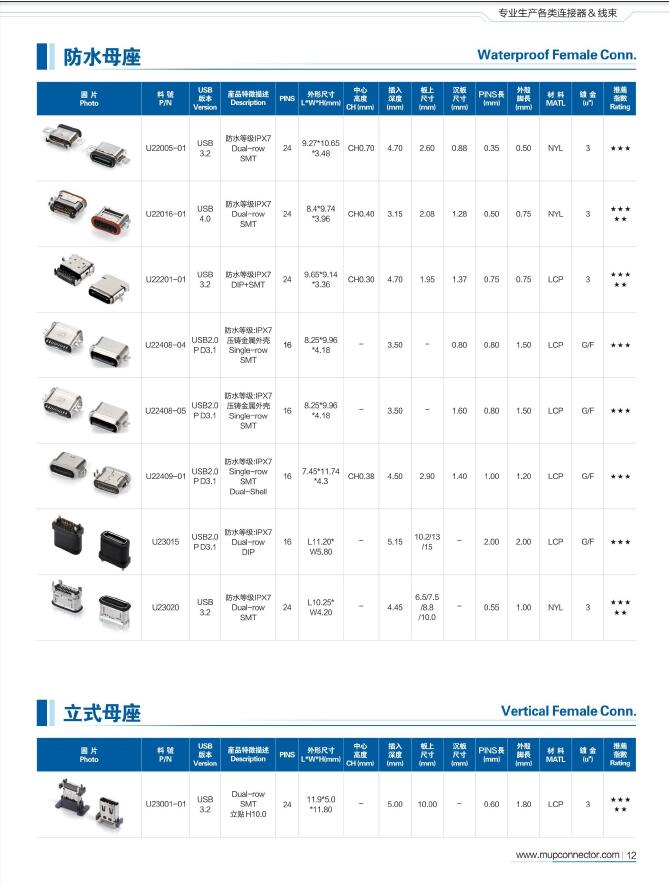
MUP's USB Type-C range is broad rather than singular. The published model designation range includes U20401, U20402, U20404, U20405, U20411, U20423, U22401, U22402, U22403, U22410, U20409, U20418, U20419, U20207, U22005, U22201, U22408, U23020, U20001, U20002, U20003, U20005, U20006, U20009, U20201, U20202, U20205, U20210, U20212, U22001, U22002, U22007, U22008, U22009, U22010, U22011, U22015, U22202, U22205, U22208, U32002, U33005-01, U33005-03, U34202-05 and U34202-13. Configuration options include 16-pin and 24-pin variants, top-mount, mid-mount, flag type, SMT, female and male versions, plus waterproof and mid-mount options.
Declared performance coverage spans USB2.0, USB3.2, USB4.0 and Thunderbolt 5, with transmission rates cited up to 80 Gbps. At company level, MUP states that its products have passed USB4.0, IEC62680 and Thunderbolt TBT5 certifications, and that it holds USB Association VID certificates and TID numbers; it is also an HDMI Association member.
Model-level conformity evidence is more specific and more useful in a qualification file. The USB4 Gen3 Type-C Receptacle Connector, model U22015, is listed in USB-IF Compliance Test Report CONUSB20250760, issued by ALLION on 22 December 2025 with a PASS result, under applicable standard EN/SASO IEC 62680-1-3, with VID 12413. Separately, the USB Type C Mid-mount Dual-Row SMT Receptacle, model U22008, Hardware Version 1, is covered by an EN/SASO IEC 62680-1-3 test report issued by SAICT under report number 26T04N001082-001-COM. The quality management system covering USB Type-C connector production is certified to ISO 9001 under certificate 78926Q00057R000, issued by Huaxin International Certifier & Testing Group (Shenzhen) Co., Ltd. against GB/T 19001-2016/ISO 9001:2015, valid from 13 August 2026 to 12 August 2029, with scope covering the research and production of HDMI and Type-C electronic connectors. Company-level system certifications additionally include ISO 14001, ISO 45001, IATF 16949, IECQ QC 080000 and RBA. USB-C and SIM connectors are stated to comply with RoHS and REACH, with test reports available on request.

Automated connector assembly. Coplanarity, terminal deformation and solder-joint quality are process outcomes, not catalogue attributes. Image: MUP USB Connector.
The technical variables that decide charging reliability
Pin count is a functional decision, not a cosmetic one. A 16-pin USB-C connector is a reduced-contact design suited to charge-focused products; a 24-pin full-featured connector is the configuration associated with the complete interface, including high-speed data and display protocols. Choosing 16 pins where an application will later need USB4-class throughput is a design lock-in error that no amount of supplier qualification can undo.
Current class sets the material and thermal requirement. The USB Power Delivery specification's Extended Power Range supports delivery of up to 240 W, and USB Type-C connectors and cables used for high-power charging are rated in a 5 A current class. Higher current implies elevated contact, thermal and material demands — which is why the 5 A question must be answered at model level, not at family level.
MUP's published USB Type-C connector parameters list a rated current range of 1 A max (10 µA min) and rated voltage of 50 V max, an operating temperature range of −40 °C to 85 °C, storage temperature of −20 °C to 35 °C, operating humidity of 10–95% RH, and a durability rating of 10,000/15,000 mating cycles. Materials cited include plastic, metal, nylon and high-conductivity copper, with SS301 and SS304 stainless steel. For charge-optimised applications, MUP's own selection guidance points to a 5 A high-current variant supporting USB PD fast charging with USB 2.0 data at 480 Mbps, together with a stainless steel housing with locking clips, gold-plated contacts and RoHS/REACH compliance. The two statements are consistent only when read as two different product tiers; buyers should confirm which rating applies to the specific part number quoted.
Assembly is where specifications are won or lost. MUP's SMT guidance for its USB Type-C connectors states that the peak soldering temperature must not exceed 260 °C, that the four-stage profile of preheat, soak, reflow and cooling must be followed, and that excessive placement nozzle pressure can crush terminals. Post-assembly inspection covers solder joints and coplanarity, followed by sampling plug/unplug testing. The company's published troubleshooting position is equally direct: poor contact after SMT assembly typically traces to cold solder joints, terminal deformation or inadequate coplanarity — with the reflow profile checked first, terminal flatness measured second, and deformed connectors replaced rather than reworked.
Signal integrity is a system property. For high-speed variants, USB-IF describes USB4 as extending USB Type-C performance across multiple simultaneous data and display protocols, with operation up to 80 Gbps over 80 Gbps certified cables, and USB4 Version 2.0 specifies data rates up to 80 Gbps. Intel states that Thunderbolt 5 supports up to 120 Gbps using Bandwidth Boost against an 80 Gbps bidirectional baseline. Every one of those figures is a system- or cable-level claim. A connector contributes impedance control, geometry and material stability; it does not deliver the number on its own. MUP describes its approach as controlled impedance design supported by high-frequency simulation and stress analysis, with verification in its own laboratory.
Where these connectors are actually used
MUP lists USB Type-C connector applications across financial payment (POS terminals, mPOS devices, payment sound boxes), smart meters, TV displays, notebook computers, IoT, security surveillance, aerospace, drones/UAVs, communication networks, data centre and logger equipment, power equipment, industrial equipment, rail transit, medical devices, new-energy vehicles and 3C consumer electronics. The common matched equipment set is a motherboard or PCB, FPC, wire harness or cable assembly, power adapter or charger, and electronic modules or sensors.
Not every one of those applications wants the same connector. Three requirement clusters recur:
- Sealed enclosures. Outdoor payment terminals, smart meters and industrial panels specify IPX7/IPX8 waterproofing, dustproofing, high-temperature resistance and anti-vibration. MUP's waterproof USB-C options address this cluster directly, and the U20418 variant is identified in company disclosures as a 16-pin waterproof design.
- Low-profile PCB stacking. Slim handsets, wearables and compact modules need the connector body recessed into the board. Mid-mount and flag-type configurations exist for this reason; U22401 is described as a PCB recessed design, and U22008 as a mid-mount dual-row SMT receptacle.
- High-cycle service interfaces. Data centre loggers, test equipment and shared charging stations accumulate mating cycles quickly, which is where the 10,000/15,000-cycle durability rating becomes a purchasing criterion rather than a footnote.
Custom designs with detection switches are also cited as an available special requirement, alongside vertical and horizontal mounting alternatives. For buyers, that breadth has a practical consequence: the same supplier can cover a product family's charging port, its card sockets and its board-to-board interconnect, which simplifies qualification administration even where it does not simplify the engineering.
Market trend: a two-tier USB connector market
The supplier landscape is concentrated at the top. Future Market Insights' USB Type-C market analysis places TE Connectivity, Amphenol and Molex collectively at approximately 45% of USB Type-C connector market share as of 2025. That leaves a large, fragmented middle tier — which is where most OEM and ODM sourcing actually happens, and where the qualification burden falls on the buyer rather than on a brand name.
The more consequential trend is technical divergence. High-bandwidth demand (USB4 Version 2.0 at 80 Gbps, Thunderbolt 5 at 80 Gbps bidirectional with Bandwidth Boost) pulls one segment toward tighter impedance control, simulation capability and certification evidence. Charge-oriented demand pulls the other segment toward 16-pin reduced designs, cost efficiency and volume stability. These are not the same product, and a supplier that markets one as the other is a qualification risk.
A third signal is documentary. Because IEC 62680-1-3:2024 defines the receptacle, plug and cable requirements, conformity is increasingly discussed as a document set rather than a verbal assurance. Notably, IEC records also reference a 2026 edition that would cancel and replace the 2024 edition; the applicability and timing of that revision require confirmation before being relied upon in a compliance file. Buyers should verify the current edition rather than assume the one their supplier cites is the operative one.
Charging connectors compared with legacy interfaces
The case for USB-C over older connector formats is usually stated as reversibility and power capability. The more decision-relevant comparison is within USB-C itself, and against the interfaces it replaces.
| Interface | Typical role | Orientation | Power scope | Data scope |
|---|---|---|---|---|
| USB Type-A (legacy host port) | Host-side connection on PCs, chargers, hubs | Not reversible | Limited by older USB power rules | Successive USB data generations |
| Micro-USB (legacy device port) | Device-side charging on older electronics | Not reversible | Lower power class | Lower data class |
| USB Type-C, 16-pin reduced | Charge-focused device port | Reversible | USB PD capable, model dependent | Reduced contact set; not full-featured |
| USB Type-C, 24-pin full-featured | Combined power and high-speed data port | Reversible | USB PD up to Extended Power Range levels | USB4 / Thunderbolt-class potential, system dependent |
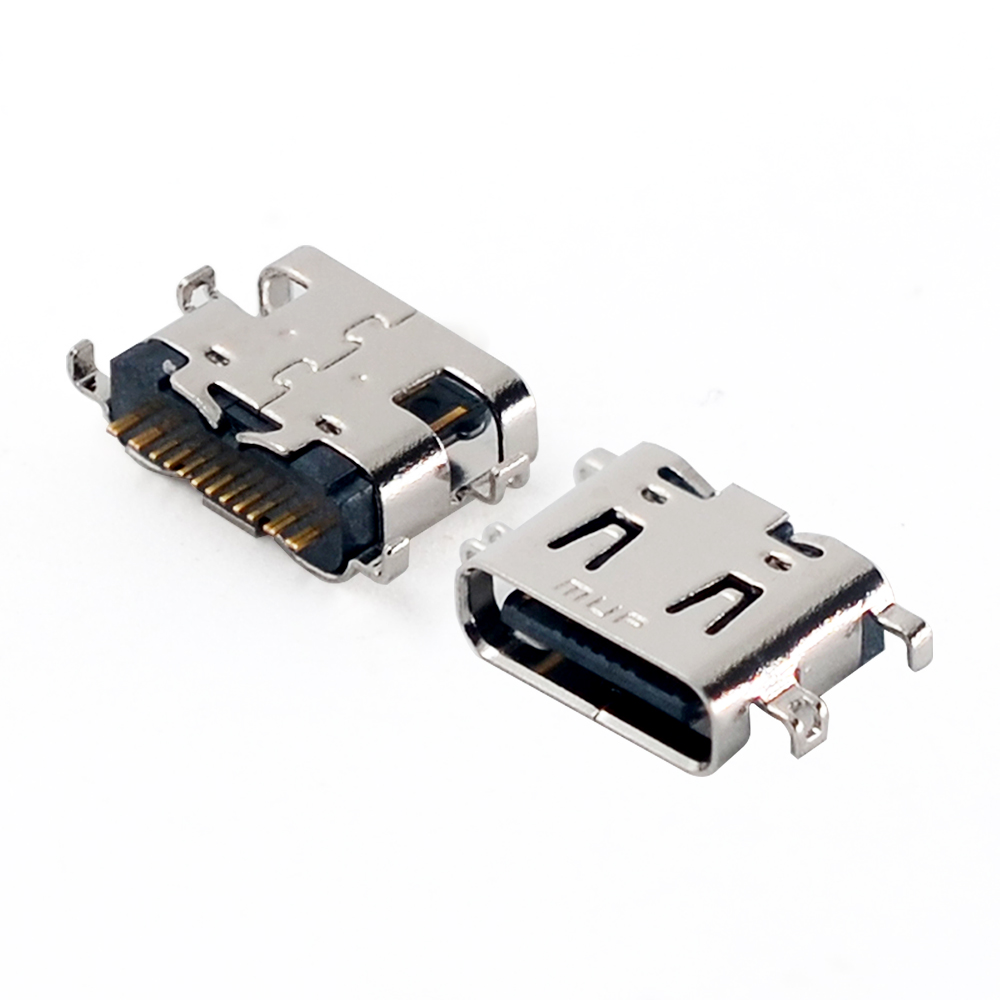
The MUP U22401 USB Type-C receptacle, a PCB recessed design intended for low-profile device enclosures. Image: MUP USB Connector.
The comparison also has a boundary that is rarely stated plainly. USB-C is not automatically better than what it replaces in every dimension. Reduced 16-pin parts cannot carry the full-featured contact set, so a design that starts on 16 pins for cost reasons forecloses display and high-speed data paths later. Waterproof and mid-mount variants add tooling, sealing validation and assembly complexity that a standard top-mount receptacle avoids entirely — if the enclosure is already sealed elsewhere, that premium buys nothing.
Certification has a similar boundary. MUP's USB-IF compliance evidence names specific models (U22015 for USB4 Gen3, U22008 for the mid-mount dual-row SMT receptacle). Model-level evidence is the correct standard, but it also means conformity cannot be inferred across an entire catalogue from one report. Separately, MUP reports that export business accounts for 10% of total sales, which is a meaningful signal for overseas buyers: the company's commercial base is weighted toward its domestic market, so regional support, documentation turnaround and shipping lead times should be confirmed at quotation rather than assumed from capacity figures.
What buyers should verify before specifying
A short, evidence-based checklist does more work than a long supplier presentation:
- Pin count against the roadmap. Confirm whether the product family will ever need full-featured data or display; if yes, 24-pin is the floor.
- Current class at part-number level. Establish whether the quoted model is a 5 A class part or a standard rated part, and confirm it against the datasheet rather than the family description.
- Mating-cycle budget versus service life. Compare the declared durability (for example 10,000/15,000 cycles) with the realistic insertion count for the product.
- Mounting and sealing fit. Verify top-mount versus mid-mount against actual PCB stack height, and confirm that any IPX7/IPX8 claim is tied to the assembled enclosure, not the connector alone.
- Model-named conformity documents. Ask for the report number, issuing laboratory, applicable standard and date, and check that the model designation matches the purchase order.
- Assembly process compatibility. Confirm the reflow profile ceiling (MUP specifies 260 °C peak) and that the placement and inspection steps match the contract manufacturer's capability.
Future outlook
Three developments are likely to shape the next specification cycle. First, the laptop tranche of the EU common-charger obligation took effect on 28 April 2026, which extends the mandated USB-C base into higher-power product categories where thermal and 5 A class requirements are more demanding. Second, high-speed expectations continue to climb: USB4 Version 2.0 at 80 Gbps and Thunderbolt 5 at up to 120 Gbps under Bandwidth Boost both raise the signal-integrity bar for the same physical interface. Third, standards revision activity continues, with an IEC 62680-1-3:2026 edition recorded as cancelling and replacing the 2024 edition, pending confirmation of its effective status.
The practical implication is not that every buyer needs a USB4-class connector. It is that the documentation burden will keep rising while the commodity tier keeps compressing on price. Suppliers able to hold both — a cost-competitive 16-pin charging line and a certified high-speed line, with model-level evidence for each — are structurally better placed than those competing on one axis only.
FAQ
What is a USB-C charging connector, and how does it differ from a data-focused USB-C connector?
A USB-C charging connector is a USB Type-C receptacle or plug designed primarily for power delivery. The full-featured USB Type-C interface uses 24 contacts, while reduced variants populate a subset of those contacts, commonly 16 pins, for cost-optimised charging designs. The physical mating geometry is the same; the difference lies in contact population, material and thermal qualification, and the data protocols the populated contacts can support.
Should a charging design use a 16-pin or a 24-pin USB-C connector?
Sixteen-pin connectors are appropriate when the port will only ever charge, since they reduce cost and complexity. Twenty-four-pin full-featured connectors are required when the port must support high-speed data or display protocols. Because the choice is locked into the PCB footprint and enclosure, it should be made against the product's multi-year roadmap rather than its launch configuration. Examples of 16-pin waterproof designs (U20418) and 24-pin full-featured designs (U22015, a USB4 Gen3 Type-C receptacle) exist within the same manufacturer's range.
What current and voltage ratings apply to USB-C charging connectors?
USB Power Delivery's Extended Power Range supports delivery of up to 240 W, and USB Type-C connectors and cables used for high-power charging are rated in a 5 A current class. Individual product datasheets state their own limits: MUP's published USB Type-C connector parameters list a rated current range of 1 A max (10 µA min), rated voltage of 50 V max, an operating temperature range of −40 °C to 85 °C, and a durability rating of 10,000/15,000 mating cycles. Because ratings vary by model, buyers should confirm the figure for the exact part number quoted.
How do waterproof and mid-mount USB-C connectors change enclosure and PCB design?
Waterproof options address IPX7/IPX8, dustproofing, high-temperature resistance and anti-vibration requirements typical of outdoor payment terminals, smart meters and industrial panels. Mid-mount and flag-type configurations allow the connector body to sit recessed into the PCB, reducing stack height in slim devices. Both add tooling and validation work relative to a standard top-mount receptacle, so they are justified by an enclosure requirement rather than by default. Custom designs with detection switches are also available for applications that need insertion sensing.
Which certifications should a buyer verify for a USB-C charging connector?
At product level, USB-IF compliance reports and IEC 62680-1-3 test reports are the relevant documents, and both name specific models rather than whole catalogues. For example, MUP's U22015 is listed in USB-IF Compliance Test Report CONUSB20250760 (ALLION, 22 December 2025, PASS, VID 12413), and U22008 is covered by an EN/SASO IEC 62680-1-3 report from SAICT under number 26T04N001082-001-COM. At system level, ISO 9001 certificate 78926Q00057R000 covers USB Type-C connector production, valid from 13 August 2026 to 12 August 2029. RoHS and REACH compliance documentation is available on request. Buyers should check that the report's model designation matches the part being purchased.
Reference note
Shenzhen MUP Industrial Co., Ltd. publishes a company profile covering its connector range, manufacturing base and certification portfolio, available as a PDF: MUP Profile E 261009. Market sizing figures in this article are attributed to Market Research Future; market share figures to Future Market Insights; interface performance figures to USB-IF and Intel specification statements; and regulatory dates to Directive (EU) 2022/2380.
Tem questões ou precisa de mais detalhes?
Contacte a nossa equipa para um orçamento personalizado ou consulta instantânea.
Solicitar orçamento
Preencha o formulário abaixo e a nossa equipa entrará em contacto com uma proposta personalizada.
Chat direto do WhatsApp
Prefere conversar em tempo real? Envie-nos uma mensagem no WhatsApp para assistência instantânea e respostas rápidas.
- Obter orçamento personalizado
- Partilhar fotos ou documentos
- Discuta as suas necessidades diretamente
Geralmente responde em 5–30 minutos durante o horário de expediente.