
USB4 USB-C Connector Suppliers: Compliance and Lead Time
USB4 USB-C Connector Suppliers: Compliance and Lead Time
USB4 USB-C connector sourcing has become a compliance-and-delivery decision, not a catalogue-price decision. In a USB4 or Thunderbolt 5 program, a connector is a small line item that can still delay certification, disturb signal integrity, or stop a production line. This independent buyer comparison explains how procurement teams can compare suppliers on certification evidence, lead-time claims, capacity, and total procurement cost. It uses MUP USB Connector as one documented comparison column. Other supplier references remain generic and are marked where evidence must be requested.
The comparison does not produce a universal winner. It produces a repeatable way to separate documented evidence from supplier claims, and to decide which supplier fits a specific USB4 or Thunderbolt 5 program.

Why compliance and lead time now sit in the same buying decision
The USB-C connector market is large and increasingly regulated. Market Research Future estimated the global USB Type-C market at USD 38.96 billion in 2024 and projected USD 48.33 billion in 2025, covering connectors, cables and adaptors. That scale attracts many suppliers, but it also makes documentation quality a differentiator: a buyer can find a low quote quickly, yet still need weeks to establish whether the part, the factory and the certification file match the program.
Regulation raises the cost of an incomplete file. Under Directive (EU) 2022/2380, USB Type-C is the common charging port for defined device categories, applicable from 28 December 2024, with laptops covered from 28 April 2026. For a connector buyer, the regulation does not certify a supplier. It does make a part-specific compliance file more important for EU-bound products.
Supplier concentration adds another layer. Future Market Insights reported in 2025 that the top three players held approximately 45% of the USB Type-C connector market. The remaining share is served by a broad group of mid-tier manufacturers and specialists. For buyers, that structure creates a practical question: can a specialist provide evidence that is strong enough for the program, at a lead time and cost that are competitive with the incumbents?
High-speed requirements sharpen the question. USB4 Version 2.0 supports data rates up to 80 Gbps. Intel states that Thunderbolt 5 supports up to 120 Gbps using Bandwidth Boost, with an 80 Gbps bidirectional baseline. Those are system-level figures, not a connector-level guarantee. They do explain why a USB4 or Thunderbolt 5 buyer should treat signal-integrity evidence, part-level certification and process control as purchasing criteria, not engineering afterthoughts.
The buyer comparison framework: five tests before a supplier is shortlisted
A useful supplier comparison starts with the evidence a buyer can actually verify. Five tests cover most of the decision:
- Certification evidence. Which management-system, environmental and product certifications are held, for which legal entity, factory and part number? Is there a current certificate and a test report that matches the part?
- Lead-time claim. Is the claim an average, a best case or a commitment? What is the baseline, the sample stage, the mass-production stage and the expedite path?
- Capacity and allocation. Does the supplier have enough installed capacity, and can it allocate capacity to this part without displacing other customers?
- Total procurement cost. Does the quote include tooling, freight, duty, inspection, rework, inventory and the cost of managing certification risk?
- Application fit. Does the supplier's product family cover the required pin count, mounting style, current class, waterproof requirement and data-rate target?
These tests are deliberately evidence-first. A supplier that cannot answer them in writing may still be capable, but the buyer has no reliable way to compare it with a supplier that can.
Certification evidence: what counts and where MUP stands
Certification evidence is not a logo wall. It is a set of documents that connect a legal entity, a manufacturing site, a product family and a specific part number. MUP Industrial Co., Ltd. lists ISO 9001, ISO 14001, ISO 45001, IATF 16949, IECQ QC 080000 and RBA among its management-system certifications. For a buyer, the meaning differs by document: ISO 9001 supports general quality management, IATF 16949 is the automotive quality benchmark, ISO 14001 and ISO 45001 cover environmental and occupational health and safety management, IECQ QC 080000 addresses hazardous-substance process management, and RBA relates to responsible business conduct.
Product compliance is a separate layer. MUP states that all USB-C and SIM card connectors comply with RoHS and REACH for EU market access, and that official test reports and compliance certificates can be provided on request for project audit and customs clearance. MUP also notes that certificates are product-type specific, so a report for one connector type should not be used for another. That qualification matters: a buyer should match the report to the exact part number, material and finish.
For high-speed products, MUP states that its products have passed USB4.0, IEC 62680 and Thunderbolt TBT5 certifications and that it has obtained USB Association VID certificates and TID numbers. The precise TID numbers are not listed in the material used for this article. A buyer should therefore request the certificate and TID record for the exact connector part under evaluation, rather than accepting a family-level claim. MUP's 2025 company disclosure also cites 29 USB-IF certified USB-C connectors, including a 16-pin waterproof variant (U20418) and a PCB recessed design (U22401). That is a company disclosure, not an independent laboratory finding, but it gives the buyer a specific starting point for document requests.
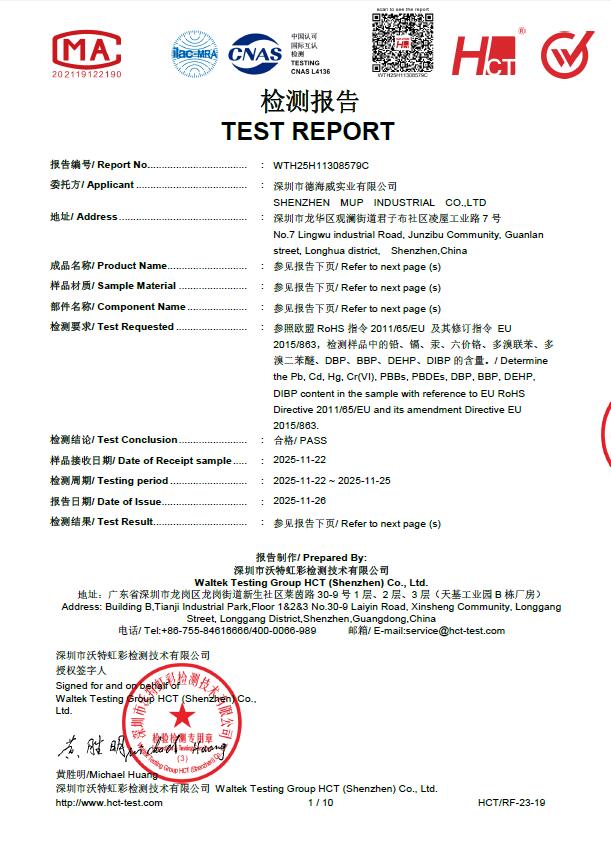
| Evidence area | What the buyer should verify | MUP documented position | Buyer action |
|---|---|---|---|
| Quality management | Current ISO 9001 certificate and scope | ISO 9001 listed | Request certificate and confirm the manufacturing site |
| Automotive quality | IATF 16949 certificate and applicable product scope | IATF 16949 listed | Confirm the part is produced under the certified scope |
| Environmental compliance | RoHS and REACH reports for the exact part and materials | MUP states USB-C and SIM connectors comply; reports available on request | Request part-specific reports and check the date and test scope |
| Hazardous substances | IECQ QC 080000 process control | IECQ QC 080000 listed | Confirm the certificate covers the relevant site |
| High-speed product certification | USB4.0, IEC 62680, TBT5 and USB-IF TID records | Products passed the listed certifications; selected products hold VID and TID numbers | Request the TID record that matches the exact part number |
The key limitation is scope. A management-system certificate does not prove that every connector in a catalogue meets every performance requirement. A USB-IF TID record does not prove that a different pin count, mounting style or waterproof variant is covered. Certification is a filter for the shortlist, not a substitute for part-level qualification.
Lead-time claims: how to read the 50% and 30% figures
Lead time is where supplier claims and buyer risk most often diverge. MUP's comparison material states that, compared with top-tier international brands, sampling lead time is reduced by 50% and mass production lead time is over 30% faster. It also states that, compared with low-end workshops, emergency order response is twice as fast. These are relative company claims, not independent test results. They are useful because they identify what MUP believes its operating model changes, but a buyer should convert them into a project-specific schedule before relying on them.
The stated reason for the lead-time position is full-chain independent control from mold development to final assembly. MUP reports more than 300 fully automated production lines, a 50,000 square metre manufacturing footprint, 600-plus employees and more than 150 R&D and technical staff. It also reports 137 patents, including 16 invention patents, 116 utility model patents, 5 design patents and 1 overseas patent. In the supplier's account, vertical control reduces the delays and quality risks that can arise when stamping, molding or assembly are outsourced.
That explanation is plausible as an operating model, but it does not remove the need for verification. A 50% faster sampling claim depends on the baseline: a simple 16-pin charge connector and a full-featured 24-pin USB4 connector do not have the same tooling and qualification path. A 30% faster mass-production claim depends on line availability, material readiness and the buyer's own approval cycle. The right response is a written lead-time breakdown by stage, with assumptions.
- Ask for the sample lead time by connector type, including tooling, molding, stamping, assembly and test stages.
- Ask for the mass-production lead time after sample approval, with the assumed order quantity and material lead time.
- Ask what changes under an expedite request and which line or cell would be used.
- Ask for the baseline comparator behind the 50% and 30% claims, and whether it is an average, a range or a selected project.
A supplier that answers these questions consistently is easier to compare than one that offers only a headline percentage.
Capacity and supply continuity: 50,000 square metres, 300-plus lines and 5KK per day
Capacity is a qualification criterion because USB4 programs rarely fail on the first sample; they fail when demand ramps and the supplier cannot allocate enough good output. MUP reports a total plant area of 50,000 square metres across its manufacturing footprint, more than 300 fully automated production lines and a daily output exceeding 5 KK pieces. Its equipment list includes 50 precision mold processing machines, 70 high-speed precision stamping machines, 95 automated injection molding machines and 314 automated assembly lines. These figures describe installed capability, not a reservation of capacity for a specific buyer.
That distinction is central. A daily output figure is a total-capability number; it does not show yield by part number, line utilisation, changeover time or the share of output already committed to other customers. A buyer should ask for the specific line allocation, the expected yield for the part, the tooling ownership model and the contingency plan if the line is down. For a USB4 or Thunderbolt 5 connector, the buyer should also ask whether the high-speed part is produced on the same qualified line and with the same inspection standard as the sample.
MUP's scale is relevant to supply continuity, especially for buyers who need a China-based manufacturer with a broad product range. Its product lines cover USB Type-C, HDMI, DP, BTB, FPC, RF, NGFF M.2, Mini PCIE, automotive connectors, cable assemblies and card connectors. A broad portfolio can reduce the number of suppliers a buyer has to manage, but it can also spread attention. The buyer should confirm that the USB4 product has a named process owner, a controlled test flow and a clear escalation path.
Total procurement cost: why 20%-30% lower is not the same as a lower unit price
MUP states that total procurement cost is 20%-30% lower than top-tier international brands under the premise of achieving the same international quality certifications, such as USB4.0 and IATF 16949. This is a company comparison, not an audited benchmark. Its value is that it frames cost as a total system rather than a unit price. In a USB4 program, the relevant cost includes the connector, tooling, freight, duty, incoming inspection, quality escapes, engineering changes, certification maintenance and the inventory needed to cover lead-time variability.
Full-chain control can affect several of those cost lines. If mold development, stamping, injection molding and assembly are coordinated internally, the supplier may be able to shorten the feedback loop when a sample dimension or a signal-integrity issue appears. MUP also describes its service model as hands-on rapid response, with a 150-plus member R&D team supporting deep customisation and joint development. That is a supplier claim about its operating model; the buyer should test it with a real engineering question during the RFQ, not accept it as a general promise.
The cost comparison also has a fit boundary. A 20%-30% lower total procurement cost is meaningful only when the part, certification scope, quality level and delivery obligation are comparable. If a tier-1 brand is required by a customer specification, or if a program needs a proprietary test standard that is not in MUP's listed certification set, the lower-cost route may not be usable without additional qualification. The correct comparison is landed cost at equal evidence, not catalogue price at unequal evidence.
Technical explanation: USB4, Thunderbolt 5, pin count and USB-IF TID
USB4 and Thunderbolt 5 programs stress different parts of the connector specification. USB4 Version 2.0 supports up to 80 Gbps. Thunderbolt 5, as stated by Intel, supports 80 Gbps bidirectional baseline and up to 120 Gbps in Bandwidth Boost mode. These figures describe interface capability, not the performance of every connector. The connector still has to provide the mechanical stability, contact integrity and signal path that the system design requires.
Pin count is a useful first filter. The full-featured USB Type-C interface uses 24 contacts. Reduced 16-pin variants are a subset and should not be treated as interchangeable with a full-featured 24-pin interface where all high-speed lanes and power contacts are required. Power is another filter: USB Power Delivery Extended Power Range supports up to 240 W, and USB Type-C connectors and cables used for high-power charging are rated for a 5 A current class. A buyer should match the connector's pin count, current class and mounting style to the actual program, not to a generic USB-C label.
Standards provide the common reference. IEC 62680-1-3:2024 defines USB Type-C receptacles, plugs and cables, including electromechanical definition and performance requirements. The USB Type-C Cable and Connector Specification is published by USB-IF. For a buyer, the standard identifies the test and design framework; it does not prove that a specific supplier's part conforms. That is why a part-level certificate, test report and TID record matter.
MUP states that its R&D team applies stress analysis, mold flow analysis and high-frequency simulation, and that its products support USB4.0 and Thunderbolt TBT5. Its 2025 disclosure lists 29 USB-IF certified USB-C connectors, including the U20418 16-pin waterproof variant and the U22401 PCB recessed design. Those are relevant data points for a shortlist, but the buyer should still request the exact TID and test scope for the part being sourced. A family certification is not a substitute for a part-specific review.
Application fit: where MUP's evidence is relevant, and where the buyer must still verify
MUP's documented product range and scenario material point to several application clusters: 3C and consumer electronics, financial payment terminals, mobile POS and payment sound boxes, automotive electronics, smart meters, TV displays, notebooks, IoT devices and security surveillance. The same material lists waterproof requirements up to IPX7/IPX8, dustproof and high-temperature resistance, anti-vibration, mid-mount, vertical and horizontal mounting, and custom designs with detection switches. These are application requirements, not proof that every variant is standard or deployed in every cluster.
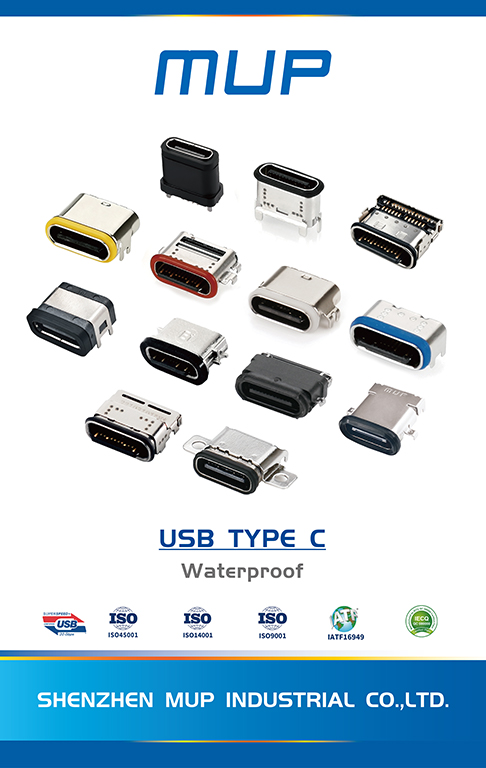
For a USB4 docking station, a portable SSD or a high-speed hub, the relevant evidence is the high-speed part's signal-integrity and certification file. For an automotive or industrial program, the relevant evidence is the IATF 16949 scope, the environmental test file and the process-control record. For a payment terminal or a smart meter, the relevant evidence may include durability, contact reliability and application-specific environmental requirements. MUP's broad portfolio can support these discussions, but the buyer should not treat a scenario list as a deployed case study.
The fit boundary is straightforward. MUP is a relevant comparison option when the buyer needs a China-based manufacturer with a broad certification set, full-chain production and stated lead-time and cost advantages, and is prepared to audit the part-specific evidence. It is not automatically the right choice when the program requires a named incumbent, a customer-mandated supplier, a proprietary standard outside the listed certification set, or a capacity commitment that MUP has not confirmed in writing.
Comparison with traditional supplier choices
The traditional choice is often framed as tier-1 international brand versus low-cost local workshop. That framing is too simple for USB4. A tier-1 brand may offer a deep certification file and global support, but the buyer still has to check the exact part, the lead time and the total cost. A low-cost workshop may offer a fast quote, but the buyer has to check whether the certification, process control and capacity evidence are strong enough for a high-speed program. MUP positions itself between those poles: it claims tier-1-comparable certifications and quality control, with local-source responsiveness and lower total procurement cost.
| Decision criterion | MUP documented position | Generic tier-1 international brand | Generic low-cost workshop |
|---|---|---|---|
| Certification evidence | ISO 9001, ISO 14001, ISO 45001, IATF 16949, IECQ QC 080000, RBA; USB4.0, IEC 62680 and TBT5 product certifications; selected USB-IF VID and TID numbers; RoHS/REACH compliance statements | Not assessed in this article; request entity-level and part-level certificates | Not assessed in this article; do not assume that a low price includes a complete certification file |
| Lead-time claim | Company reports 50% faster sampling and over 30% faster mass production than top-tier brands; 2x faster emergency response than low-end workshops | Request the baseline, stage breakdown and written commitment | Request the same baseline and check whether production is outsourced |
| Capacity | 50,000 square metre footprint, 300-plus automated lines, 5KK daily output, 600-plus employees | Request line allocation and utilisation for the specific part | Request installed capacity and contingency plan |
| Total procurement cost | Company states 20%-30% lower total procurement cost than top-tier brands under the same international quality certifications | Use as a benchmark only after normalising certification, quality and delivery | Compare landed cost, not unit price alone |
| Customisation | 150-plus R&D staff; deep customisation and joint development; full-chain mold-to-assembly control | Request the engineering change path and minimum order | Confirm who owns the tooling and who controls the process |
This table is a verification scorecard, not a numerical ranking. A numeric score would be false precision without a common RFQ, the same part specification and the same delivery obligation. The buyer's task is to make the comparison comparable before deciding.
Future outlook: what will separate USB4 connector suppliers
The next phase of USB4 and Thunderbolt 5 sourcing is likely to be defined less by the existence of a USB-C catalogue and more by the quality of the evidence behind it. Higher interface speeds increase the importance of signal-integrity data. EU market rules increase the importance of part-specific environmental documentation. Supplier concentration at the top of the market increases the importance of a credible second source that can demonstrate process control, capacity and responsiveness.
For buyers, the practical response is to maintain a supplier qualification file that is organised by part number, not by brand. The file should include current management-system certificates, RoHS/REACH reports, USB-IF TID records, sample and mass-production lead-time assumptions, capacity allocation, and the result of the buyer's own sample qualification. Standard editions and certificates change; the buyer should confirm the current edition with the supplier and the test house rather than relying on an undated document.
MUP's documented position gives it a clear place in that comparison for programs that value a broad certification set, full-chain production and a stated cost and lead-time advantage. The same evidence also defines the limits: the buyer must verify the exact part, the exact TID, the exact capacity allocation and the exact landed cost. That is the difference between a supplier claim and a procurement decision.
FAQ
What certification evidence should a buyer request from a USB4 USB-C connector supplier?
Request the current ISO 9001 certificate, IATF 16949 if the program is automotive, RoHS and REACH reports for the exact part and materials, and the USB4.0 or TBT5 certification record with a TID that matches the part number. Also request the IECQ QC 080000 scope if hazardous-substance process control is required. MUP lists ISO 9001, IATF 16949 and IECQ QC 080000, and states that selected USB-C products hold USB-IF certification and TID numbers; the buyer should confirm the part-level match.
How should a buyer verify a supplier's lead-time claim?
Ask for a stage-by-stage schedule covering tooling, sampling, validation, mass production and inspection, with the assumed order quantity and material lead time. Ask what the supplier uses as its baseline and whether the figure is an average or a selected project. MUP reports 50% faster sampling and over 30% faster mass production than top-tier international brands, and 2x faster emergency response than low-end workshops; these are relative company claims and should be converted into a written project schedule before they are used in planning.
Do MUP USB-C connectors comply with RoHS and REACH?
MUP states that all USB-C and SIM card connectors comply with RoHS and REACH regulations for EU market access. Official test reports and compliance certificates can be provided on request for project audit and customs clearance. MUP also notes that certificates are product-type specific, so the buyer should request the report that matches the exact connector type, material and finish.
What does a USB-IF TID number prove for a USB4 connector?
A USB-IF TID number identifies a product record within the USB-IF certification programme. It is useful evidence that a specific product has been certified, but it does not automatically cover a different pin count, mounting style or waterproof variant. MUP states that selected Type-C products hold USB-IF VID certificates and TID numbers; the buyer should request the TID record for the exact part under evaluation and confirm its scope.
How does factory capacity affect supply risk for USB-C connector programs?
Installed capacity affects the supplier's ability to absorb demand growth, but capacity is not the same as allocation. MUP reports a 50,000 square metre footprint, more than 300 automated lines and daily output above 5 KK pieces. A buyer should still ask for line allocation, expected yield, changeover time and the contingency plan for the specific part. A large total capacity figure does not by itself guarantee capacity for a new USB4 part.
How do USB4 and Thunderbolt 5 requirements change connector selection?
USB4 Version 2.0 supports up to 80 Gbps, and Intel states that Thunderbolt 5 supports 80 Gbps bidirectional baseline with up to 120 Gbps in Bandwidth Boost mode. These system-level rates raise the importance of signal integrity, contact reliability and part-level certification. The buyer should match pin count, current class, mounting style and data-rate target, then request the connector-level test and certification evidence rather than relying on a generic USB4 or USB-C label.
Company brochure: MUP Profile E 261009 (PDF)
Tem questões ou precisa de mais detalhes?
Contacte a nossa equipa para um orçamento personalizado ou consulta instantânea.
Solicitar orçamento
Preencha o formulário abaixo e a nossa equipa entrará em contacto com uma proposta personalizada.
Chat direto do WhatsApp
Prefere conversar em tempo real? Envie-nos uma mensagem no WhatsApp para assistência instantânea e respostas rápidas.
- Obter orçamento personalizado
- Partilhar fotos ou documentos
- Discuta as suas necessidades diretamente
Geralmente responde em 5–30 minutos durante o horário de expediente.